वोकैबुलरीज

इंग्लिश वोकैबुलरी डिस्कवर, लर्न और मास्टर करें

aesthetics definition card — visual illustration of the meaning
noun
esˈθet.ɪks
सौंदर्यशास्त्र (soundaryashastra)

A set of principles concerned with the nature and appreciation of beauty, especially in art and design.

"Interior design focuses on aesthetics and functionality."

"इंटीरियर डिज़ाइन सौंदर्यशास्त्र और कार्यक्षमता पर ध्यान केंद्रित करता है।" (Interior design soundaryashastra aur karyakshamata par dhyan kendrit karta hai.)
adjective
/ˈæfəbəl/
मिलनसार (milansaar)

friendly, easy to talk to, and pleasant in manner

"He is such an affable host that everyone feels comfortable at his parties."

"वह एक मिलनसार मेज़बान है कि हर कोई उसके पार्टियों में आराम महसूस करता है।" (Wah ek milansaar mezbaan hai ki har koi uske partiyon mein aaraam mehsoos karta hai.)
noun
/əˈfɛər/
मामला / संबंध (maamla / sambandh)

an event, situation, or relationship, often one that is private or romantic

"The scandal became the most talked-about affair of the year."

"उस कांड ने साल का सबसे ज्यादा चर्चित मामला बना दिया।" (Us kaand ne saal ka sabse zyada charchit maamla bana diya.)
verb
/əˈfɛkt/
प्रभावित करना (prabhavit karna)

to influence or make a difference to something

"The weather can greatly affect our mood."

"मौसम हमारे मूड को बहुत प्रभावित कर सकता है।" (Mausam hamare mood ko bahut prabhavit kar sakta hai.)
noun
/ˌæfɛkˈteɪʃən/
आडम्बर (afektayshan)

an unnatural behavior or speech intended to impress others

"Her British accent was just an affectation to sound sophisticated."

"उसका ब्रितिश उच्चारण सिर्फ दूसरों को प्रभावित करने के लिए एक आडंबर था।" (Uska british uchcharan sirf dusron ko prabhavit karne ke liye ek aadambar tha.)
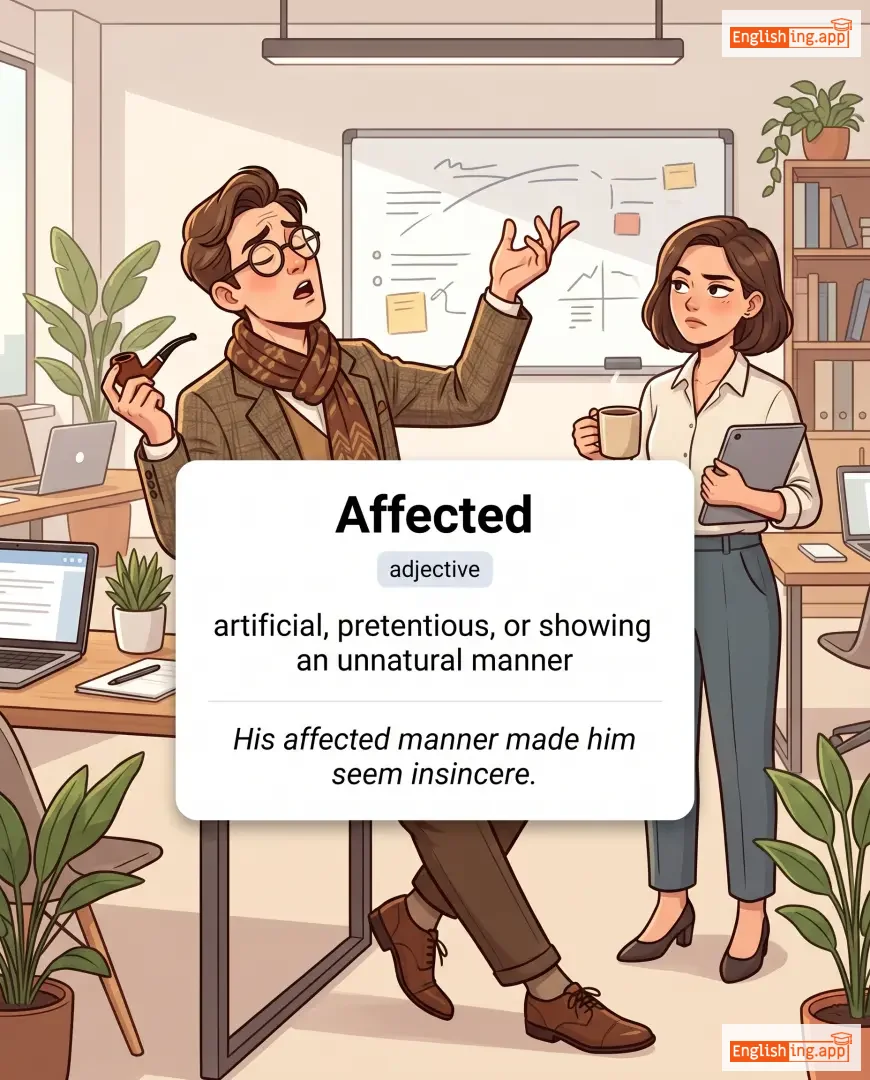
Affected definition card — visual illustration of the meaning
adjective
/əˈfɛktɪd/
प्रभावित (prabhavit)

artificial, pretentious, or showing an unnatural manner

"His affected manner made him seem insincere."

"उसका प्रभावी तरीका उसे दिखावा करने वाला लग रहा था।" (Uska prabhavit tareeka use dikhawa karne wala lag raha tha.)
noun
/əˈfɛkʃən/
स्नेह (afekshan)

a gentle feeling of fondness or liking

"She showed great affection for her younger brother."

"उसने अपने छोटे भाई के प्रति बहुत स्नेह दिखाया।" (Usne apne chhote bhai ke prati bahut sneh dikhaya.)
adjective
/əˈfekʃənət/
स्नेही; देखभाल करने वाला; कोमल; स्नेह दिखाने वाला (snehi; dekhbhal karne wala; komal; sneha dikhane wala)

loving; caring; tender; showing affection

"She is very affectionate towards her children."

"वह अपने बच्चों के प्रति बहुत स्नेही है।" (vah apne bachchon ke prati bahut snehi hai.)
adverb
/əˈfek.ʃən.ət.li/
स्नेहपूर्वक; स्नेह से (snehpurvak; sneh se)

in a way that shows feelings of liking or love; with fondness and care

"She hugged her grandmother affectionately."

"उसने अपनी दादी को स्नेहपूर्वक गले लगाया।" (usne apni dadi ko snehpurvak gale lagaya)
adjective
/ˈæfərənt/
आगामी (aagaami)

carrying impulses toward a central organ or part, especially toward the brain or spinal cord

"Afferent nerves carry signals from the body to the brain."

"आगामी तंत्रिका शरीर से मस्तिष्क तक संकेत लाती हैं।" (Aagaami tantrika sharir se mastishk tak sanket laati hain.)
verb
/əˈfaɪəns/
सगाई करना (sagai karna)

to promise or pledge marriage; to formally engage

"They decided to affiance after years of friendship."

"सालों की दोस्ती के बाद उन्होंने सगाई करने का निर्णय लिया।" (saalon ki dosti ke baad unhonne sagai karne ka nirnay liya)
noun
/ˌæfəˈdeɪvɪt/
शपथ पत्र (shapath patra)

a written statement confirmed by oath or affirmation, used as evidence in court

"The witness submitted an affidavit to the court."

"गवाह ने अदालत में एक शपथ पत्र प्रस्तुत किया।" (Gawah ne adalat mein ek shapath patra prastut kiya.)
verb
/əˈfɪliˌeɪt/
जोड़ना (jodna)

to officially attach or connect (a group or organization) to a larger body

"The school is affiliated with the local university."

"स्कूल स्थानीय विश्वविद्यालय से जुड़ा हुआ है।" (School sthaaneey vishwavidyalay se juda hua hai.)
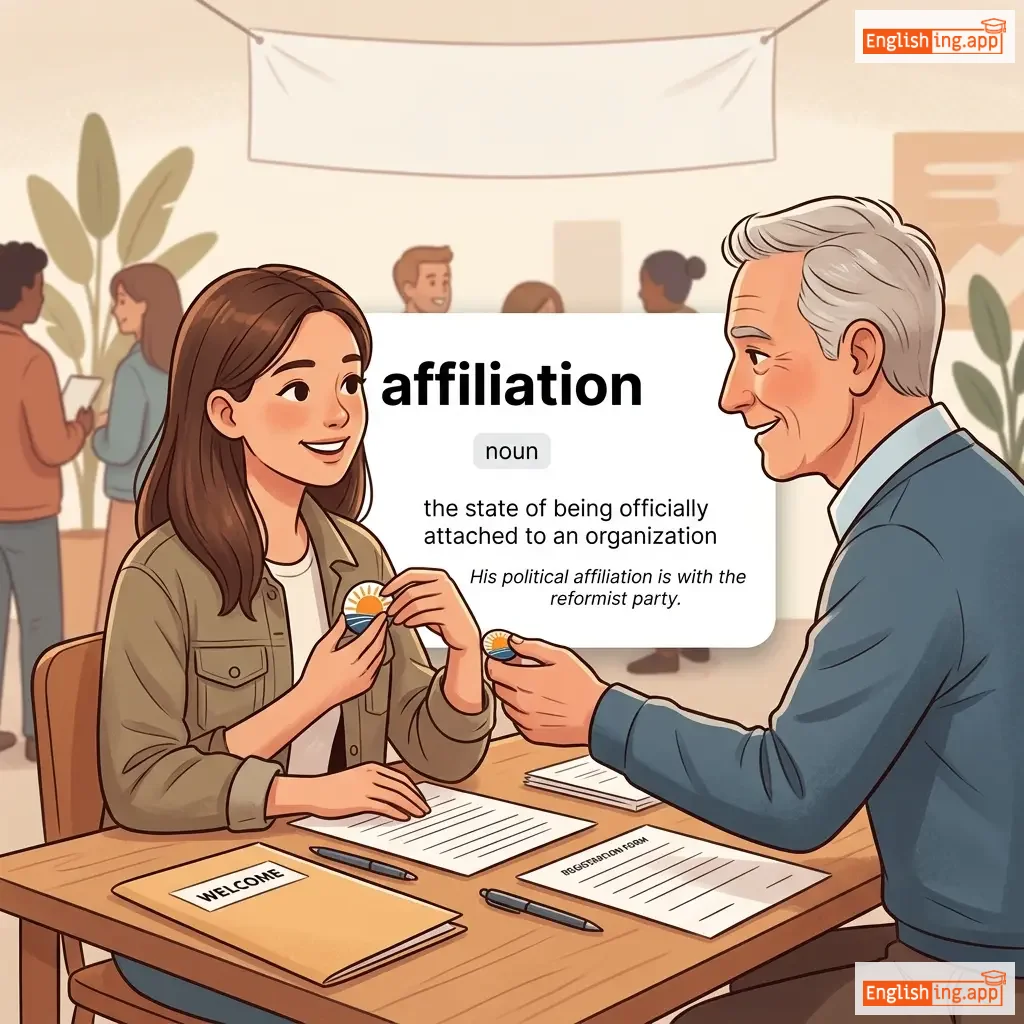
affiliation definition card — visual illustration of the meaning
noun
/əˌfɪliˈeɪʃən/
संगठन से जुड़ाव (sangathan se judav)

the state of being officially attached to an organization

"His political affiliation is with the reformist party."

"उनकी राजनीतिक संबद्धता सुधारवादी पार्टी से है।" (Unki raajneetik sambandhata sudharvaadi party se hai.)
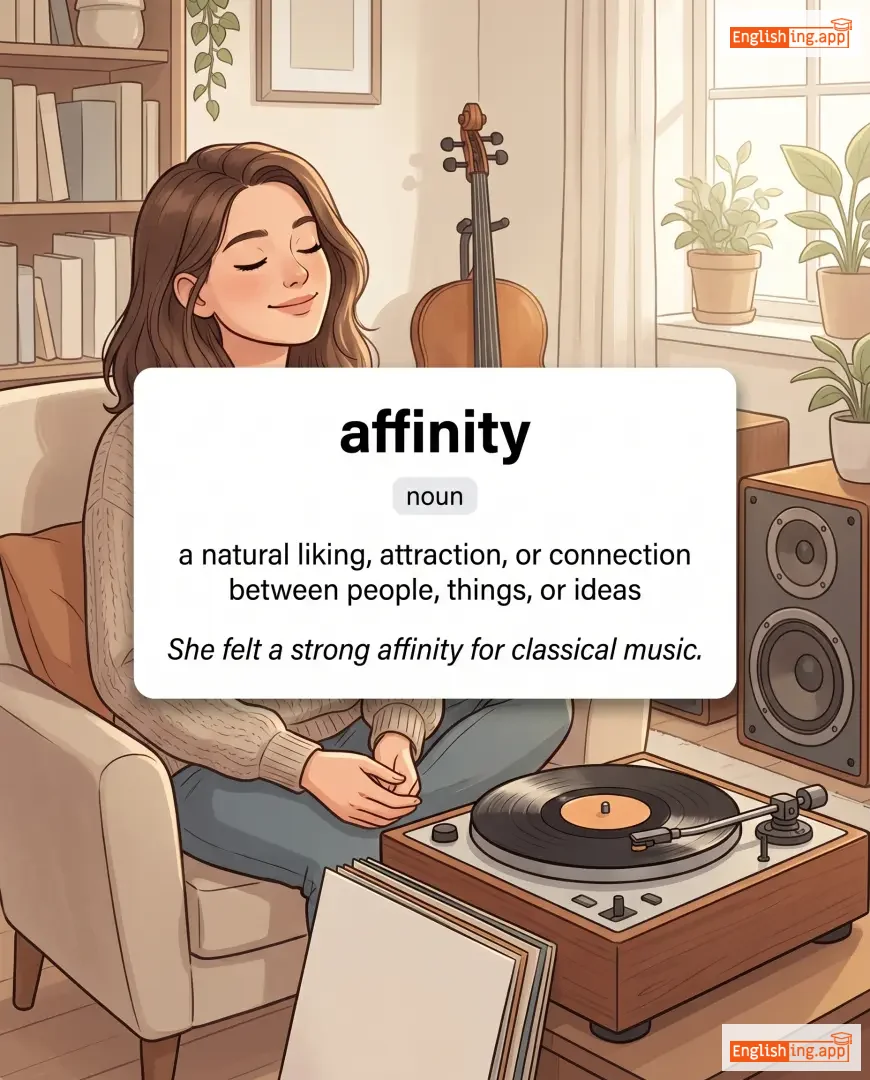
affinity definition card — visual illustration of the meaning
noun
/əˈfɪnɪti/
संबंध (sambandh)

a natural liking, attraction, or connection between people, things, or ideas

"She felt a strong affinity for classical music."

"उसे शास्त्रीय संगीत के प्रति एक मजबूत संबंध महसूस हुआ।" (Use shastriya sangeet ke prati ek majboot sambandh mehsoos hua.)
affirmation definition card — visual illustration of the meaning
noun
/ˌæfərˈmeɪʃən/
पुष्टि (pushti)

the act of confirming or stating something positively; a declaration of support or belief

"Daily affirmation helps to build confidence and positivity."

"प्रतिदिन की पुष्टि आत्मविश्वास और सकारात्मकता बढ़ाने में मदद करती है." (pratidin ki pushti aatmavishvas aur sakaratmakta badhaane mein madad karti hai)
adjective
/əˈfɜːrmətɪv/
सकारात्मक (sakaratmak)

expressing agreement, approval, or a positive response

"She gave an affirmative answer to the proposal."

"उसने प्रस्ताव पर सकारात्मक उत्तर दिया।" (Usne prastāv par sakāratmak uttar diyā.)
verb
/əˈfɪks/
जोड़ना / चिपकाना (jodna / chipkana)

to attach or stick something firmly to another thing

"Please affix the stamp to the envelope."

"कृपया स्टाम्प को लिफ़ाफ़े पर चिपकाएँ।" (Kripya stamp ko lifaafe par chipkaayein.)
noun
/əˈfleɪtəs/
दिव्य प्रेरणा (divya prerna)

a sudden divine inspiration or creative impulse

"The poet wrote the verses under a sudden afflatus of inspiration."

"कवि ने अचानक एक दिव्य प्रेरणा के तहत कविताएँ लिखी।" (Kavi ne achanak ek divya prerna ke tahat kavitaayein likhi.)
verb
/əˈflɪkt/
पीड़ा देना (peeda dena)

to cause pain, suffering, or distress to someone or something

"Many people are afflicted by seasonal allergies."

"Kai log mausami allergy se peedit hain." (Kai log mausami allergy se peedit hain.)
noun
/əˈflɪkʃən/
दुःख (dukh)

a state of pain, suffering, or distress

"Poverty is a common affliction in many parts of the world."

"गरीबी दुनिया के कई हिस्सों में एक सामान्य दुःख है।" (gareebi duniya ke kai hisson mein ek saamaanya dukh hai.)
affluence definition card — visual illustration of the meaning
noun
/ˈæfluəns/
धन संपत्ति (dhan sampatti)

the state of having a great deal of money or wealth

"His lifestyle shows signs of great affluence."

"उसकी जीवनशैली बड़ी धन संपत्ति के संकेत दिखाती है।" (Uski jeevanshailee badi dhan sampatti ke sanket dikhati hai.)
adjective
/ˈæfluənt/
धनी (dhani)

having a great deal of money; wealthy

"She grew up in an affluent neighborhood."

"वह एक धनी मोहल्ले में पली-बढ़ी।" (Vah ek dhani mohalle mein pali-badhi.)
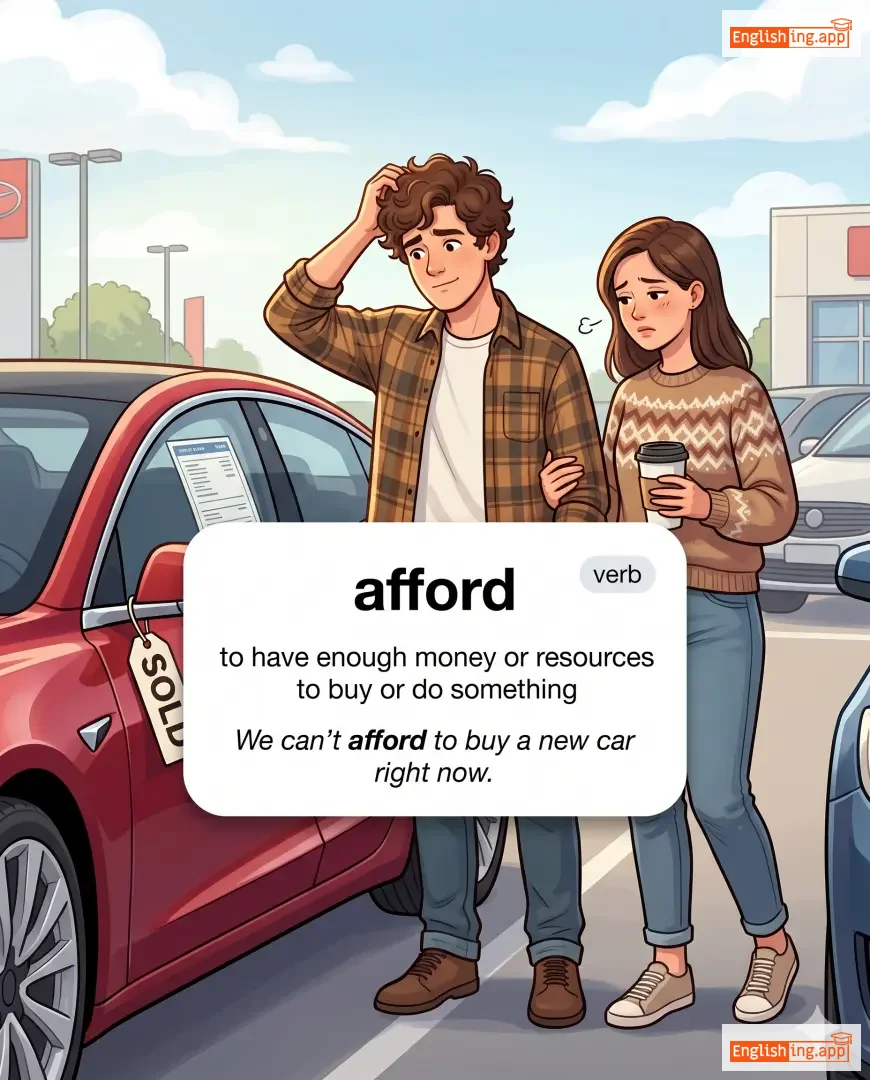
afford definition card — visual illustration of the meaning
verb
/əˈfɔːrd/
सक्षम होना (saksham hona)

to have enough money or resources to buy or do something

"We can’t afford to buy a new car right now."

"हम अभी एक नई कार खरीदने का खर्च नहीं उठा सकते।" (Ham abhi ek nai car kharidne ka kharch nahi utha sakte.)
adjective
/əˈfɔːdəbl/
सस्ती (sasti)

inexpensive and within one's financial means

"This restaurant offers affordable meals for families."

"यह रेस्तरां परिवारों के लिए सस्ते भोजन प्रदान करता है।" (Yeh restaurant parivaron ke liye saste bhojan pradan karta hai.)
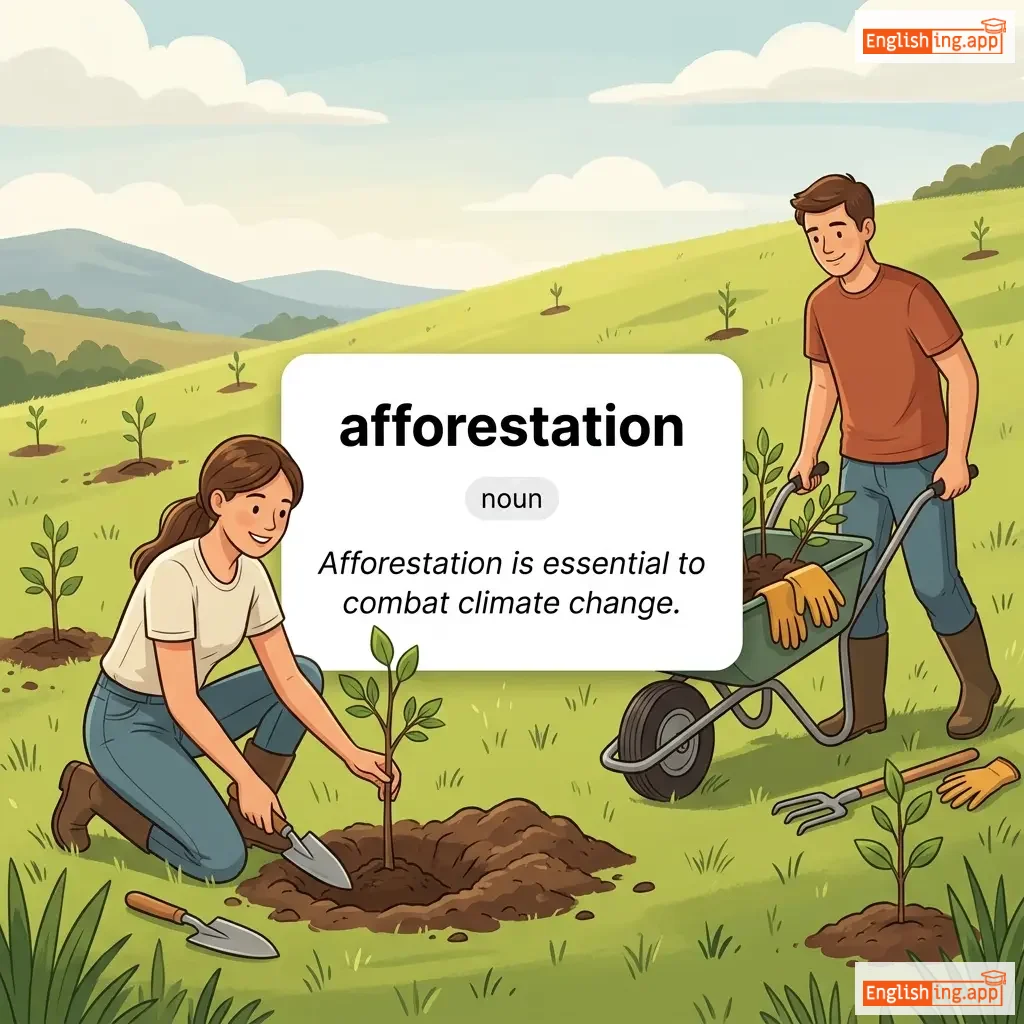
afforestation definition card — visual illustration of the meaning
noun
ˌæfɔːˈreɪʃən
वनरोपण (vanropan)

The process of establishing a forest, especially on land that was not recently forested.

"Afforestation is essential to combat climate change."

"वनरोपण जलवायु परिवर्तन से निपटने के लिए महत्वपूर्ण है।" (Vanropan jalvayu parivartan se nipatne ke liye mahatvapurn hai.)
noun
/əˈfreɪ/
झगड़ा (jhagda)

A public fight or noisy disturbance that causes alarm.

"The police were called to break up an affray outside the stadium."

"पुलिस को स्टेडियम के बाहर एक अफ़्रे को तोड़ने के लिए बुलाया गया था।" (Police ko stadium ke baahar ek affray ko todne ke liye bulaaya gaya tha.)
noun, verb
/əˈfrʌnt/
अपमान (apmaan)

An action or remark that causes outrage or offense.

"He took her criticism as a personal affront."

"उसने उसकी आलोचना को व्यक्तिगत अपमान के रूप में लिया।" (Usne uski aalochana ko vyaktigat apmaan ke roop mein liya.)
adjective, adverb
/əˈfʊt/
प्रगति में (pragati mein)

In progress; happening or being prepared.

"There are several new projects afoot in the company."

"कंपनी में कई नए प्रोजेक्ट्स प्रगति में हैं।" (Company mein kai naye projects pragati mein hain.)
adjective
/əˈfɔːrˌsɛd/
पूर्व उल्लिखित (purv ullikhit)

Mentioned earlier; previously stated.

"The aforesaid conditions must be met before the contract is signed."

"चु्क्ति साइन करने से पहले पूर्व उल्लिखित शर्तों को पूरा करना होगा।" (Chukti sign karne se pehle purv ullikhit sharton ko poora karna hoga.)
adjective
/əˈfreɪd/
डर (dar)

feeling fear or anxiety; worried that something undesirable will happen

"She was afraid of the dark."

"वह अंधेरे से डरती थी।" (vah andhere se darati thi.)
adverb
/əˈfrɛʃ/
नए तरीके से (nae tareeke se)

From the beginning, in a new way.

"After the failure, they started the project afresh."

"विफलता के बाद, उन्होंने परियोजना को नए तरीके से शुरू किया।" (Vifalta ke baad, unhone pariyojna ko nae tareeke se shuru kiya.)
adjective
/ˈæfrɪkən/
अफ़्रीकी (afrikī)

relating to Africa or its people

"She studied African culture in university."

"उसने विश्वविद्यालय में अफ़्रीकी संस्कृति का अध्ययन किया।" (Usne vishwavidyalay mein afrīkī sanskr̥ti kā adhyayan kiyā.)
noun/adjective
/ˌæfrɪkən əˈmɛrɪkən/
अफ़्रीकी-अमेरिकन (afriki-amerikan)

A person of African descent living in or originating from the United States; relating to such people.

"She is proud of her African-American heritage."

"वह अपनी अफ्रीकी-अमेरिकन धरोहर पर गर्व करती है।" (Vah apni afriki-amerikan dharohar par garv karti hai.)
preposition, conjunction, adverb
/ˈæftər/
बाद (baad)

in the time following an event or another action

"We went for ice cream after the movie."

"हम मूवी के बाद आइस क्रीम खाने गए।" (Hum movie ke baad ice cream khane gaye.)
noun
/ˈæftərˌlaɪf/
परलोक (aftrlaif)

Life or existence that some believe continues after physical death.

"Many cultures have different beliefs about the afterlife."

"कई संस्कृतियों के पास परलोक के बारे में विभिन्न मान्यताएं हैं।" (kai sanskritiyon ke paas parlok ke baare mein vibhinn vishwas hain)
noun
/ˈɑːftərmɑːθ/
परिणाम (parinaam)

the consequences or aftereffects of an event or situation, especially a disastrous one

"The aftermath of the earthquake was devastating."

"भूकंप के परिणाम विनाशकारी थे।" (Bhookamp ke parinaam vinaashkari the.)
noun
/ˌæftərˈnuːn/
दोपहर बाद का समय (dopahar baad ka samay)

The part of the day between noon and evening.

"We met in the afternoon for coffee."

"हमने दोपहर में कॉफी के लिए मुलाकात की।" (Humne dopahar mein coffee ke liye mulaqat ki.)
noun
/ˈæftərˌθɔːt/
बाद की सोच (aftarthot)

Something added or considered later than originally planned.

"The gift seemed like an afterthought rather than a genuine gesture."

"उपहार ऐसा लग रहा था कि वह एक बाद की सोच है, एक वास्तविक इशारा के बजाय." (Uphaar aisa lag raha tha ki vah ek baad ka vichaar hai, ek vaastvik ishaara ke bajay.)
adverb
/ˈɑːftərwərd/
बाद में (baad mein)

at a later or subsequent time

"She went home afterward."

"वह बाद में घर चली गई।" (Vah baad mein ghar chali gayi.)
adverb
/ˈɑːf.tə.wərdz/
बाद में; उसके बाद; फिर; (baad mein; uske baad; phir;)

at a later time; after an event or time that has already been mentioned

"We had dinner and afterwards we watched a movie."

"हमने डिनर किया और बाद में हमने एक मूवी देखी।" (hamne dinner kiya aur baad mein hamne ek movie dekhi.)
adverb
/əˈɡɛn/ or /əˈɡeɪn/
फिर (phir)

Once more; another time.

"She read the book again to understand it better."

"उसने किताब को फिर से पढ़ा ताकि उसे बेहतर समझ सके।" (Usne kitaab ko phir se padha taaki use behtar samajh sake.)
preposition
/əˈɡɛnst/ or /əˈɡeɪnst/
के विरुद्ध (ke viruddh)

In opposition to; contrary to; touching or resting on.

"They voted against the proposal."

"उनहोंने प्रस्ताव के विरुद्ध मतदान किया।" (unhone prastav ke viruddh matdaan kiya)
adjective
/əˈɡeɪp/ or /əˈɡɑːp/
आश्चर्यचकित (aashcharyachakit)

With the mouth wide open in surprise or wonder.

"She stood agape at the breathtaking view."

"वह आश्चर्यचकित होकर दृश्य देख रही थी।" (vah aashcharyachakit hokar drishya dekh rahi thi.)
noun/verb
/eɪdʒ/
उम्र (umr)

The length of time that a person has lived; to grow older.

"She asked his age politely."

"उसने विनम्रता से उसकी उम्र पूछी।" (Usne vinamrata se uski umr poochi.)
adjective
/eɪdʒd/
वृद्ध (vruddh)

having lived for a specified number of years; old

"The aged man sat in the park, watching the children play."

"वृद्ध व्यक्ति पार्क में बैठा था, बच्चों को खेलते हुए देख रहा था।" (Vruddh vyakti park mein baitha tha, bachchon ko khelte hue dekh raha tha.)
noun
/ˈeɪ.dʒən.si/
एजेंसी (agency)

An organization or business that provides a particular service.

"She works at a travel agency."

"वह एक यात्रा एजेंसी में काम करती है।" (Wah ek yatra agency mein kaam karti hai.)
noun
/əˈdʒɛndə/
कार्यसूची (kaaryasoochi)

A list of items to be discussed or acted upon in a meeting or plan.

"The manager reviewed the agenda before the meeting began."

"बैठक शुरू होने से पहले प्रबंधक ने एजेंडा की समीक्षा की।" (Baithak shuru hone se pehle prabandhak ne ejenda ki samiksha ki.)
noun
/ˈeɪ.dʒənt/
एजेंट (agent)

A person who acts on behalf of another person or organization.

"The real estate agent showed us several houses."

"रियल एस्टेट एजेंट ने हमें कई घर दिखाए।" (Real estate agent ne humein kai ghar dikhaye.)
verb
/əˈɡlɒməˌreɪt/
संगठित करना (sangathit karna)

To collect or form into a mass or group.

"The dust particles began to agglomerate into larger clusters."

"धूल कण बड़े गुच्छों में इकट्ठा होने लगे।" (dhool kan bade guchchon mein ikattha hone lage.)