वोकैबुलरीज

इंग्लिश वोकैबुलरी डिस्कवर, लर्न और मास्टर करें

noun
/ˈɑːrmi/
सेना (sena)

a large organized military force trained for war

"The army protected the border from attack."

"सेना ने सीमा को हमले से बचाया।" (sena ne seema ko hamle se bachaya.)
noun
/əˈroʊmə/
खुशबू (khushboo)

A pleasant, distinctive smell.

"The aroma of freshly baked bread filled the kitchen."

"ताजा बेक किया हुआ रोटी की खुशबू रसोई में भर गई।" (Taza bek kiya hua roti ki khushboo rasoi mein bhar gayi.)
adjective
/ˌærəˈmætɪk/
सुगंधित (sugandhit)

Having a pleasant and distinctive smell.

"The chef used aromatic herbs to flavor the dish."

"शेफ ने व्यंजन को स्वादिष्ट बनाने के लिए सुगंधित हर्ब्स का उपयोग किया।" (Shef ne vyanjan ko swadisht banane ke liye sugandhit herbs ka upyog kiya.)
adverb, preposition
/əˈraʊnd/
चारों ओर (charon or)

situated on every side; in a circular way; approximately

"There are many restaurants around the park."

"पार्क के चारों ओर कई रेस्तरां हैं।" (Park ke charon or kai restoran hain.)
verb
/əˈreɪn/
आदालत में आरोपित करना (adalat mein aaropit karna)

to formally accuse someone in a court of law and ask them to respond to the charges

"The suspect was arraigned before the judge this morning."

"आज सुबह आरोपी को न्यायधीश के सामने आरोपित किया गया।" (Aaj subah aaropi ko nyayadhish ke samne aaropit kiya gaya.)
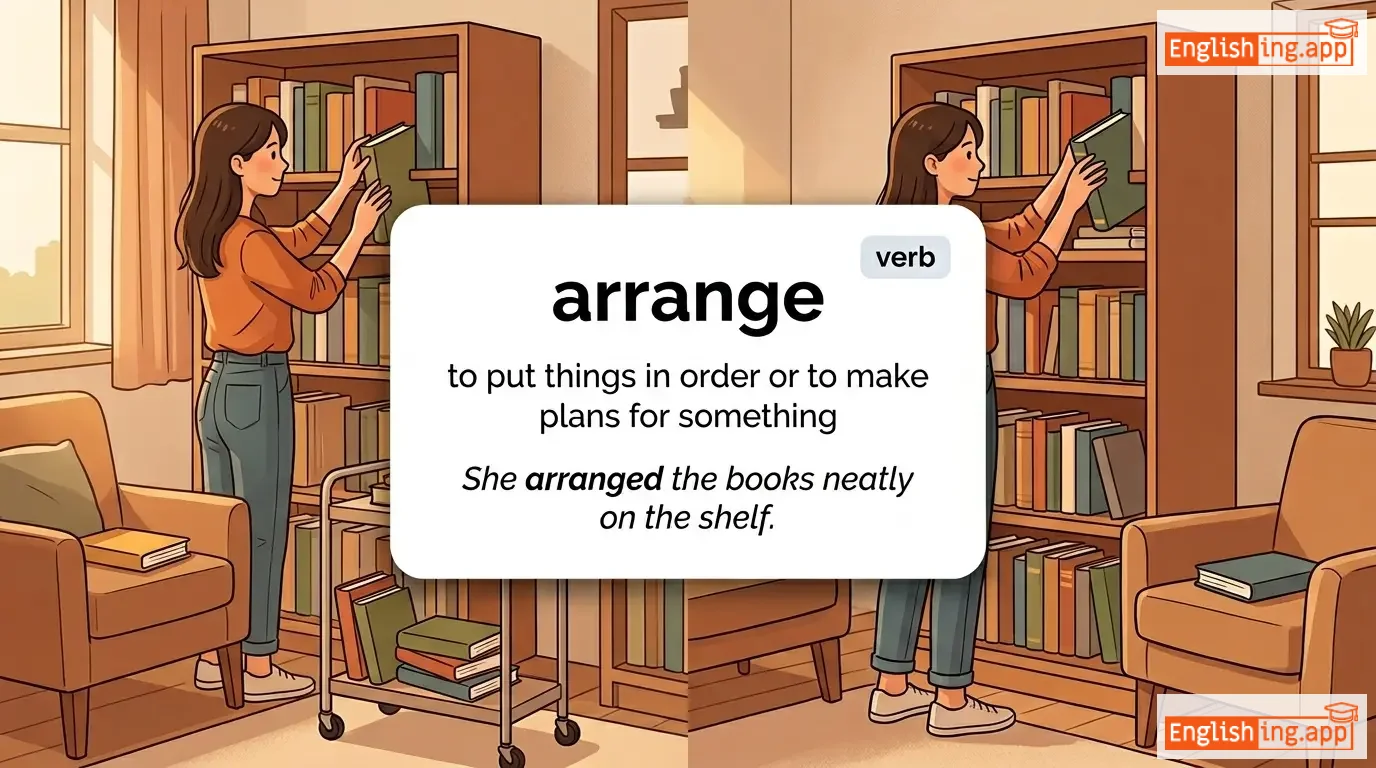
arrange definition card — visual illustration of the meaning
verb
/əˈreɪndʒ/
सज्जित करना, व्यवस्थित करना (sajit karna, vyavasthit karna)

to put things in order or to make plans for something

"She arranged the books neatly on the shelf."

"उसने किताबों को शेल्फ पर सलीके से रखा।" (Usne kitabon ko shelf par saleeke se rakha.)
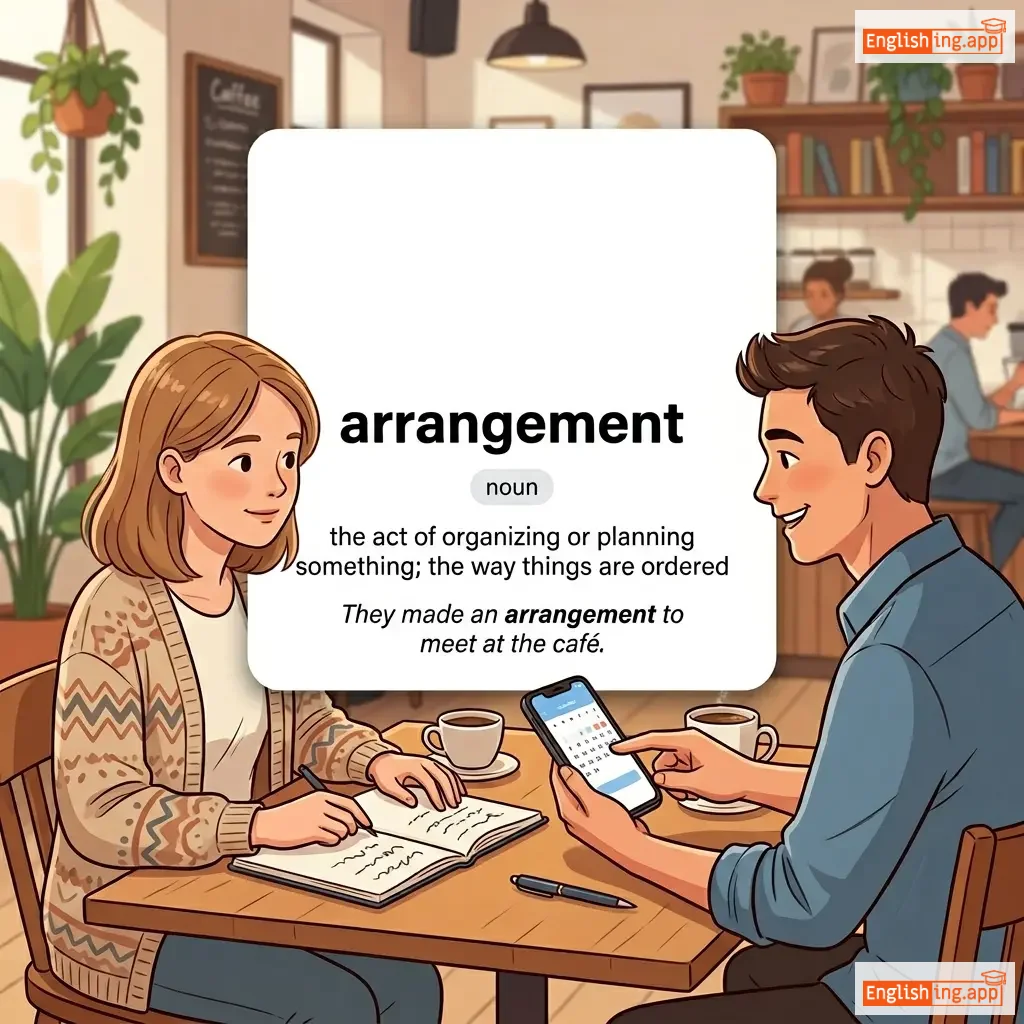
arrangement definition card — visual illustration of the meaning
noun
/əˈreɪndʒmənt/
व्यवस्था, आयोजन (vyavastha, aayojan)

the act of organizing or planning something; the way things are ordered

"They made an arrangement to meet at the café."

"उन्होंने कैफे में मिलने के लिए एक व्यवस्था बनाई।" (Unhone cafe mein milne ke liye ek vyavastha banai.)
adjective
/ˈærənt/
पूर्ण, निरर्थक (poorn, nirarthak)

complete or utter (used negatively, e.g., 'arrant nonsense')

"His excuse was arrant nonsense."

"उसका बहाना था पूर्ण बकवास।" (Uska bahana tha poorn bakwaas.)
noun
/əˈreɪ/
व्यवस्थित श्रेणी, प्रदर्शन (vyavasthit shreni, pradarshan)

an impressive display or arrangement of things

"The shop displayed an array of colorful dresses."

"दुकान में रंगीन कपड़ों की एक प्रभावशाली प्रदर्शनी थी।" (Dukaan mein rangeen kapdon ki ek prabhavshaali pradarshani thi.)
noun
/əˈrɪə/
बकाया (bakaya)

A debt or payment that is overdue and unpaid.

"He was sued for an arrear of rent."

"उसे किराए के बकाया के लिए मुकदमा दायर किया गया था।" (Use kiraye ke bakaya ke liye mukadma daayar kiya gaya tha.)
noun
/əˈrɪəz/
बकाया (bakaya)

Money that is owed and should have been paid earlier.

"She was months in arrears with her electricity bill."

"वह अपनी बिजली बिल के बकाए में कई महीनों से पीछे थी।" (Vah apni bijli bil ke bakaye mein kai mahino se peeche thi.)
arrest definition card — visual illustration of the meaning
verb
/əˈrɛst/
गिरफ्तार करना (giriftar karna)

To seize and hold someone by legal authority.

"The police arrested the suspect last night."

"पुलिस ने पिछले रात संदिग्ध को गिरफ्तार किया।" (Police ne pichle raat sandigdh ko giriftar kiya.)
adjective
/əˈrɛstɪŋ/
आकर्षक (aakarshak)

Attracting attention in a striking or impressive way.

"The actress gave an arresting performance."

"अभिनेत्री ने एक आकर्षक प्रदर्शन दिया।" (Abhinetri ne ek aakarshak pradarshan diya.)
adjective
/eɪˈrɪðmɪk/
अनियमित (aniyamit)

Lacking a regular rhythm or beat.

"The patient had an arrhythmic heartbeat."

"मरीज का हृदय अनियमित था।" (Mareez ka hriday aniyamit tha.)
noun
/əˈraɪvəl/
आगमन (aagaman)

The act of coming to a place, especially at the end of a journey.

"The train's arrival was delayed by two hours."

"ट्रेन का आगमन दो घंटे देरी से हुआ।" (Train ka aagaman do ghante deri se hua.)
arrive definition card — visual illustration of the meaning
verb
/əˈraɪv/
पहुंचना (pahuchna)

to reach a place, especially at the end of a journey

"She will arrive at the airport in the evening."

"वह शाम को एयरपोर्ट पर पहुंचेगी।" (Wah shaam ko airport par pahuchengi.)
noun
/ˌæriˈviːst/
आलसी धनिक (aalsi dhanik)

A person who has recently gained wealth or status but is considered arrogant or socially unsophisticated.

"The business world is full of ambitious arrivistes."

"व्यवसायिक दुनिया में कई महत्वाकांक्षी आलसी धनिक होते हैं।" (Vyavsayik duniya mein kai mahatvakankshi aalsi dhanik hote hain.)
noun
/ˈærəɡəns/
अहंकार (ahankar)

The quality of being overly proud and having a sense of superiority.

"His arrogance made him unpopular among his colleagues."

"उसका अहंकार उसे अपने सहकर्मियों में अप्रिय बना देता था।" (Uska ahankar use apne sahkarmiyon mein apriya bana deta tha.)
adjective
/ˈærəɡənt/
अहंकारी (ahankari)

Having an exaggerated sense of one's own importance or abilities.

"The arrogant manager dismissed the workers' complaints."

"अहंकारी प्रबंधक ने कर्मचारियों की शिकायतें खारिज कर दीं।" (ahankari prabandhak ne karmachariyon ki shikayaten kharij kar deen)
verb
/ˈærəˌɡeɪt/
अन्यायपूर्वक दावा करना (anyaaypoork daava karna)

To claim or take something without justification.

"The dictator arrogated all powers to himself."

"तानाशाह ने सभी शक्तियाँ अपने लिए अन्यायपूर्वक दावा कर ली।" (Taanashaah ne sabhi shaktiyan apne liye anyaaypoork daava kar li.)
noun
/ˈæroʊ/
तीर (teer)

a thin, straight weapon with a pointed tip, shot from a bow

"The hunter shot an arrow at the target."

"शिकारी ने लक्ष्य पर तीर छोड़ा।" (Shikari ne lakshya par teer chhoda.)
noun
/əˈrɔɪ.oʊ/
सूखा नाला (sookha naala)

A dry creek or stream bed that temporarily fills with water after heavy rain.

"After the storm, the arroyo quickly filled with rushing water."

"तूफान के बाद, अरोयो जल्दी से पानी से भर गया।" (Toofan ke baad, arroyo jaldi se paani se bhar gaya.)
noun
/ˈɑːr.sən.əl/
हथियारों का डिपो (hathiyaron ka depo)

A collection or storage place for weapons and military equipment.

"The army kept its weapons in a secure arsenal."

"सेना ने अपने हथियार एक सुरक्षित हथियार डिपो में रखे।" (Sena ne apne hathiyar ek surakshit hathiyar depo mein rakhe.)
noun
/ɑːrt/
कला (kala)

the expression or application of human creative skill and imagination

"She studied art at the university."

"उसने विश्वविद्यालय में कला का अध्ययन किया।" (Usne vishwavidyalay mein kala ka adhyayan kiya.)
noun
/ˈɑːr.tər.i/
धमनी (dhamani)

A blood vessel that carries blood away from the heart; also a main route or channel of communication or transport.

"The doctor explained how arteries supply blood to the body."

"डॉक्टर ने समझाया कि कैसे धमनियां शरीर में रक्त की आपूर्ति करती हैं।" (Doktar ne samjhaya ki kaise dhamaniyan sharir mein rakt ki aapurti karti hain.)
adjective
/ˈɑːrt.fəl/
चतुर (chatur)

Skillful, clever, or crafty, often in a cunning way.

"She gave an artful reply that avoided the real issue."

"उसने एक चतुर जवाब दिया जो असली मुद्दे से बच गया।" (Usne ek chatur jawab diya jo asli mudde se bach gaya.)
adjective
/ɑːrˈθʊr.i.ən/
आर्थर से संबंधित (arthar se sambandhit)

Relating to the legendary King Arthur and the stories surrounding him.

"The novel is set in an Arthurian world of knights and castles."

"यह उपन्यास एक आर्थुरियन दुनिया में नाइट्स और किलों के बीच सेट है।" (Yeh upanyas ek Arthurian duniya mein knights aur kilon ke beech set hai.)
noun
/ˈɑːrtɪkl/
लेख (lekh)

a piece of writing included in a newspaper, magazine, or journal

"He wrote an article about climate change."

"उसने जलवायु परिवर्तन पर एक लेख लिखा।" (Usne jalvayu parivartan par ek lekh likha.)
verb/adjective
/ɑːrˈtɪkjʊlət/
स्पष्ट रूप से व्यक्त करना (spasht roop se vyakt karna)

to express thoughts or ideas clearly; having the ability to speak fluently and clearly

"She was able to articulate her ideas during the meeting."

"वह मीटिंग के दौरान अपने विचार स्पष्ट रूप से व्यक्त करने में सक्षम थी।" (Vah meeting ke dauran apne vichar spasht roop se vyakt karne mein saksham thi.)
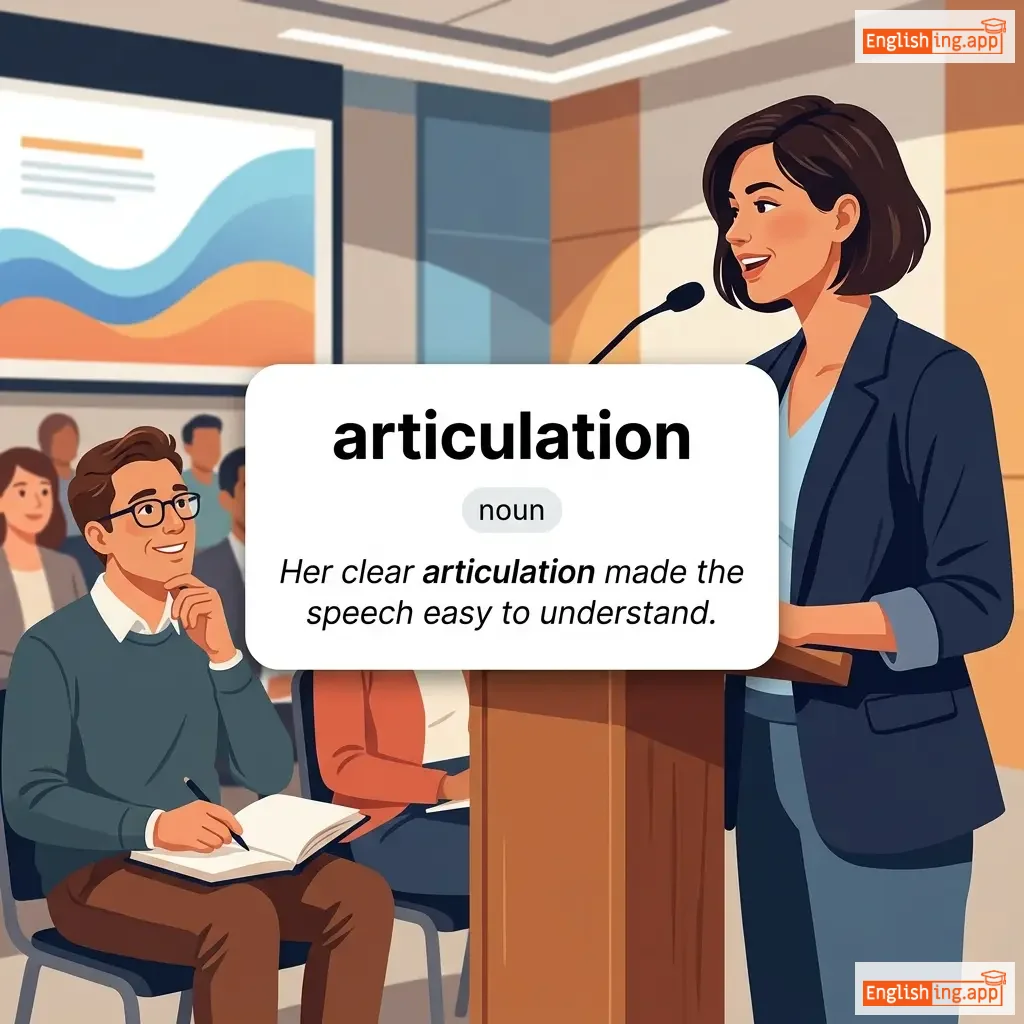
articulation definition card — visual illustration of the meaning
noun
/ɑːrˌtɪkjʊˈleɪʃən/
स्पष्ट उच्चारण (spasht uccharan)

the act of expressing something clearly in speech or the way in which words are pronounced

"Her clear articulation made the speech easy to understand."

"उसकी स्पष्ट आर्टिकुलेशन ने भाषण को समझने में आसान बना दिया।" (Uski spasht articulation ne bhashan ko samajhne mein aasan bana diya.)
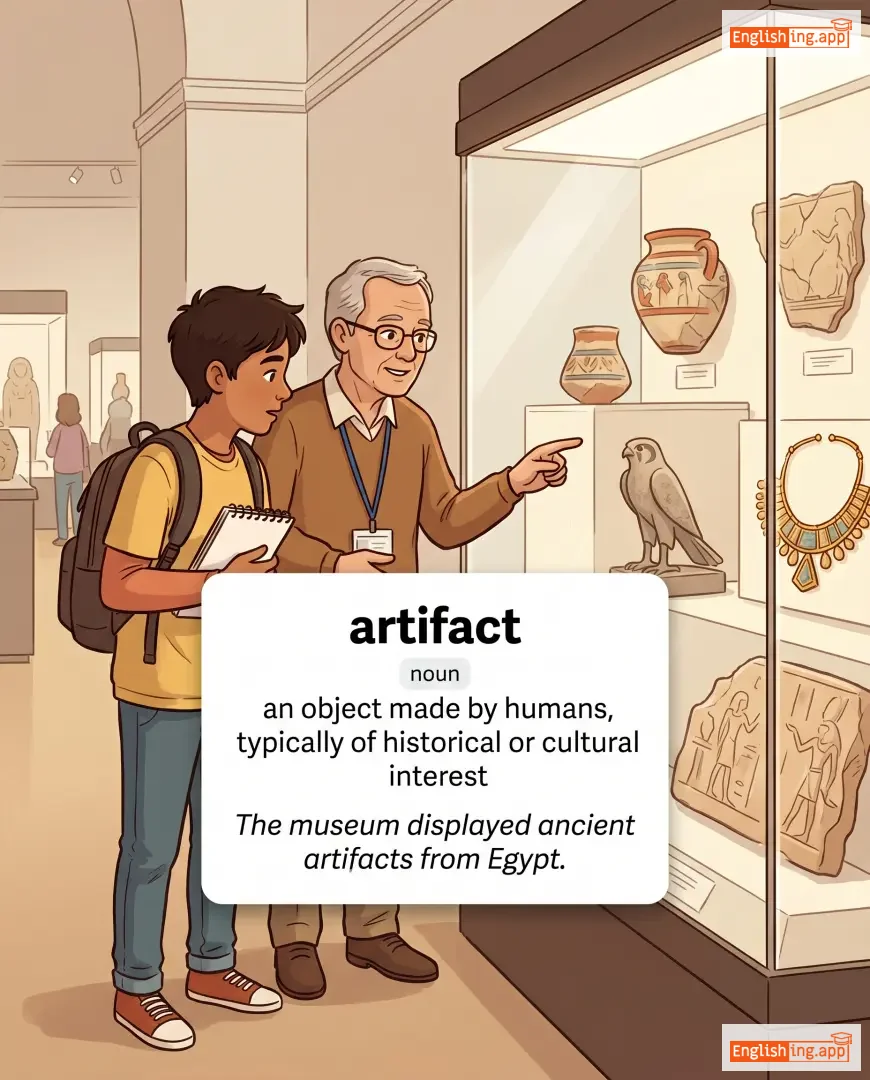
artifact definition card — visual illustration of the meaning
noun
/ˈɑːrtɪˌfækt/
कलाकृति (kalakruti)

an object made by humans, typically of historical or cultural interest

"The museum displayed ancient artifacts from Egypt."

"संग्रहालय ने मिस्र के प्राचीन कलाकृतियों का प्रदर्शन किया।" (Sangrahalay ne Misr ke prachin kalakritiyon ka pradarshan kiya.)
noun (plural)
/ˈɑːrtɪˌfæks/
कला वस्‍तुएं (kala vastuyein)

objects made by humans, often of historical or cultural importance

"Archaeologists discovered valuable artifacts in the ruins."

"पुरातत्‍ववेत्ताओं ने खंडहरों में क़ीमती कला वस्‍तुएं खोजी।" (Puratatvavettaon ne khandharon mein keemti kala vastuyein khoji.)
noun
/ˈɑːrtɪfɪs/
चातुरी (chaturi)

clever or cunning devices or tricks used to deceive others

"The politician's charm was nothing but artifice."

"राजनेता का आकर्षण केवल चातुरी था।" (Rajneta ka aakarshan keval chaturi tha.)
artificial definition card — visual illustration of the meaning
adjective
/ˌɑːrtɪˈfɪʃəl/
कृत्रिम (kritrim)

made or produced by humans rather than occurring naturally

"The flowers on the table were artificial, not real."

"टेबल पर फूल कृत्रिम थे, असली नहीं।" (Table par phool kritrim the, asli nahin.)
artificial intelligence definition card — visual illustration of the meaning
noun
ˌɑː.tɪˈfɪʃ.əl ɪnˈtɛl.ɪ.dʒəns
कृत्रिम बुद्धिमत्ता (kritrim buddhimatta)

The simulation of human intelligence in machines that are programmed to think and learn.

"Artificial intelligence is reshaping modern industries."

"आर्टिफिशियल इंटेलिजेंस आधुनिक उद्योगों को नया रूप दे रहा है।" (Artificial intelligence aadhunik udyogon ko naya roop de raha hai.)
adverb
/ˌɑːrtɪˈfɪʃəli/
कृत्रिम रूप से; (kritrim roop se)

by artificial means; not naturally; in a fake manner

"The lake was artificially created for irrigation purposes."

"झील को सिंचाई के उद्देश्य से कृत्रिम रूप से बनाया गया था।" (jheel ko sinchai ke uddeshya se kritrim roop se banaya gaya tha)
noun
/ˈɑːrtɪzən/
शिल्पकार (shilpkār)

a skilled craftsperson who makes things by hand

"The artisan crafted a beautiful wooden chair."

"शिल्पकार ने एक सुंदर लकड़ी की कुर्सी बनाई।" (Shilpkār ne ek sundar lakdi ki kursi banayi.)
noun
/ˈɑːr.tɪ.zən/
कारीगर (karigar)

a skilled craftsperson who makes things by hand

"The artisan created a beautiful wooden sculpture."

"कारीगर ने एक सुंदर लकड़ी की मूर्तिकला बनाई।" (karigar ne ek sundar lakdi ki moortikala banai)
noun
/ˈɑːrtɪst/
कलाकार (kalakar)

a person who creates art, especially paintings or drawings

"The artist painted a beautiful landscape."

"कलाकार ने एक सुंदर परिदृश्य चित्रित किया।" (Kalakar ne ek sundar paridrishya chitrit kiya.)
adjective
/ɑːrˈtɪstɪk/
कलात्मक (kalatmak)

having or revealing natural creative skill

"She has an artistic sense of design."

"वह डिज़ाइन का एक कलात्मक अहसास रखती है।" (Vah design ka ek kalatmak ahsas rakhti hai.)
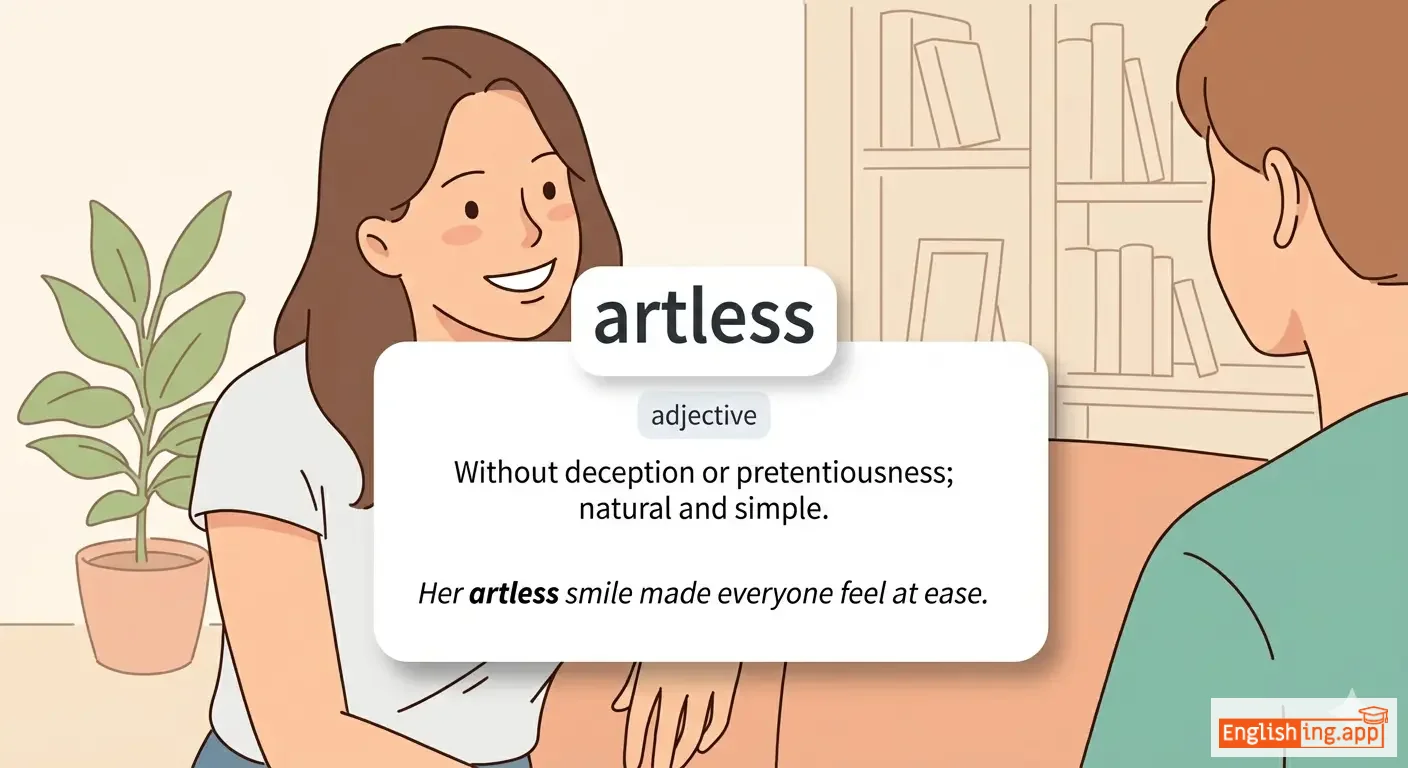
artless definition card — visual illustration of the meaning
adjective
/ˈɑːrtləs/
निष्कलंक, सरल (nishkalank, saral)

Without deception or pretentiousness; natural and simple.

"Her artless smile made everyone feel at ease."

"उसकी निष्कलंक मुस्कान ने सबको सहज महसूस कराया।" (uski nishkalank muskaan ne sabko sahaj mehsoos karaya.)
noun
/ˈɑːrtləsnəs/
सरलता, बिना बनावट (sarlata, bina banavat)

The quality of being natural and simple without deceit or pretension.

"Her artlessness made her beloved by all."

"उसकी आर्टलेसनेस ने उसे सभी का प्रिय बना दिया।" (Uski artlessness ne use sabhi ka priya bana diya.)
noun
/ˈɑːrtwɜːrk/
कलाकृति (kalakriti)

a piece of art, such as a painting, sculpture, or drawing

"The gallery displayed an impressive artwork by a local artist."

"गैलरी ने एक स्थानीय कलाकार द्वारा बनाई गई प्रभावशाली कलाकृति प्रदर्शित की।" (Gallery ne ek sthaniye kalakar dvara banayi gayi prabhavshali kalakriti pradarshit ki.)
noun
/ˈeə.rəm/
अरम (arum)

a plant with large arrow-shaped leaves and a white spathe, also known as taro

"Arum leaves are commonly used in Bengali cuisine for cooking."

"अरम पत्तियाँ आमतौर पर भारतीय व्यंजनों में पकाने के लिए उपयोग की जाती हैं।" (arum pattiyan aamtaur par bhartiya vyajnon mein pakaane ke liye upyog ki jaati hain.)
conjunction, adverb, preposition
/æz/
के रूप में (ke roop mein)

used to compare, to indicate the role or function of something, or to introduce clauses of time or reason

"She works as a teacher."

"वह एक शिक्षक के रूप में काम करती है।" (Wah ek shikshak ke roop mein kaam karti hai.)
adverb
/æz ˈjuː.ʒu.əl/
सामान्य रूप से (samaanay roop se)

in the way that is normal or typical; customarily

"As usual, he arrived late to the meeting."

"सामान्य रूप से, वह बैठक में देर से पहुंचा।" (samaanay roop se, vah baithak mein der se pahunchaa.)
noun
/ˌæs.əˈfet.ɪ.də/
हींग (hing)

a pungent spice derived from the resin of a plant, commonly used in Indian cooking

"A pinch of asafoetida adds a distinctive flavor to the lentil curry."

"एक चुटकी हींग दाल के करी में एक विशिष्ट स्वाद जोड़ता है।" (ek chutki hing daal ke kari mein ek vishisht swad jodta hai.)
ascend definition card — visual illustration of the meaning
verb
/əˈsɛnd/
ऊपर चढ़ना (upar chadhna)

to move upward or rise to a higher position or level

"The hikers began to ascend the steep mountain trail."

"पर्वतारोही खड़ी पहाड़ी रास्ते पर चढ़ने लगे।" (Parvatarohi khadi pahadi raste par chadhne lage.)
noun
/əˈsɛndənsi/
प्रभुत्व, आधिपत्य (prabhutva, aadhipatya)

A position of power, influence, or control over others.

"The company gained ascendancy in the market through innovation."

"कंपनी ने नवाचार के माध्यम से बाजार में प्रभुत्व हासिल किया।" (company ne navaachar ke madhyam se bazaar mein prabhutva haasil kiya.)
adjective
/əˈsɛndənt/
उत्थानशील, प्रभावशाली (utthan-sheel, prabhavshali)

Rising in power or influence; dominant.

"She is an ascendant leader in the political party."

"वह राजनीतिक पार्टी में एक उभरता हुआ नेता है।" (vah rajneetik party mein ek ubharta hua neta hai.)