वोकैबुलरीज

इंग्लिश वोकैबुलरी डिस्कवर, लर्न और मास्टर करें

adjective
/ˌænθrəpəˈmɔːrfəs/
मानवात्मक (manavaatmak)

having the form or attributes of a human

"The statue had an anthropomorphous shape resembling a human."

"प्रतिमा का मानवात्मक आकार मानव जैसा था।" (Pratima ka manavaatmak aakaar manav jaisa tha.)
noun
/ˈænti ˈeəkræft ɡʌn/
एंटी-एयरक्राफ्ट गन (anti-aircraft gun)

a weapon designed to attack aircraft from the ground

"The anti-aircraft gun was positioned to defend the military base."

"एंटी-एयरक्राफ्ट गन को सैन्य अड्डे की रक्षा करने के लिए स्थित किया गया था।" (anti-aircraft gun ko sainik adde ki raksha karne ke liye sthit kiya gaya tha)
anti-discrimination definition card — visual illustration of the meaning
adjective
ˌæn.tiˌdɪs.krɪˈmɪn.eɪ.ʃən
भेदभाव विरोधी (bhedbhaav virodhi)

Opposed to or working against discrimination; promoting equal treatment regardless of differences.

"The anti-discrimination movement was groundbreaking."

"एंटी-डिस्क्रिमिनेशन आंदोलन परिवर्तनकारी था।" (Anti-discrimination aandolan parivartankari tha.)
noun
/ˈæntɪk/
मज़ेदार हरकत (mazedaar harkat)

a playful, funny, or silly act or gesture

"The children laughed at the clown’s antics."

"बच्चे जोकर के मजेदार हरकतों पर हंसी से झूम उठे।" (Bachche joker ke mazedaar harkaton par hansi se jhoom uthhe.)
noun
/ˈæntiˌkraɪst/
एंटीक्राइस्ट (antichrist)

A person regarded as the supreme opponent of Christ, often seen as a figure of ultimate evil.

"Some people fear the rise of an Antichrist in the future."

"कुछ लोग भविष्य में एंटीक्राइस्ट के उभरने से डरते हैं।" (Kuch log bhavishya mein antichrist ke ubharne se darte hain.)
verb
/ænˈtɪsɪˌpeɪt/
पूर्वानुमान करना (purvanuman karna)

to expect or look forward to something; to realize or foresee in advance

"We anticipate a large crowd at the event."

"हम कार्यक्रम में बड़ी भीड़ की उम्मीद करते हैं।" (Hum karyakram mein badi bheed ki ummid karte hain.)
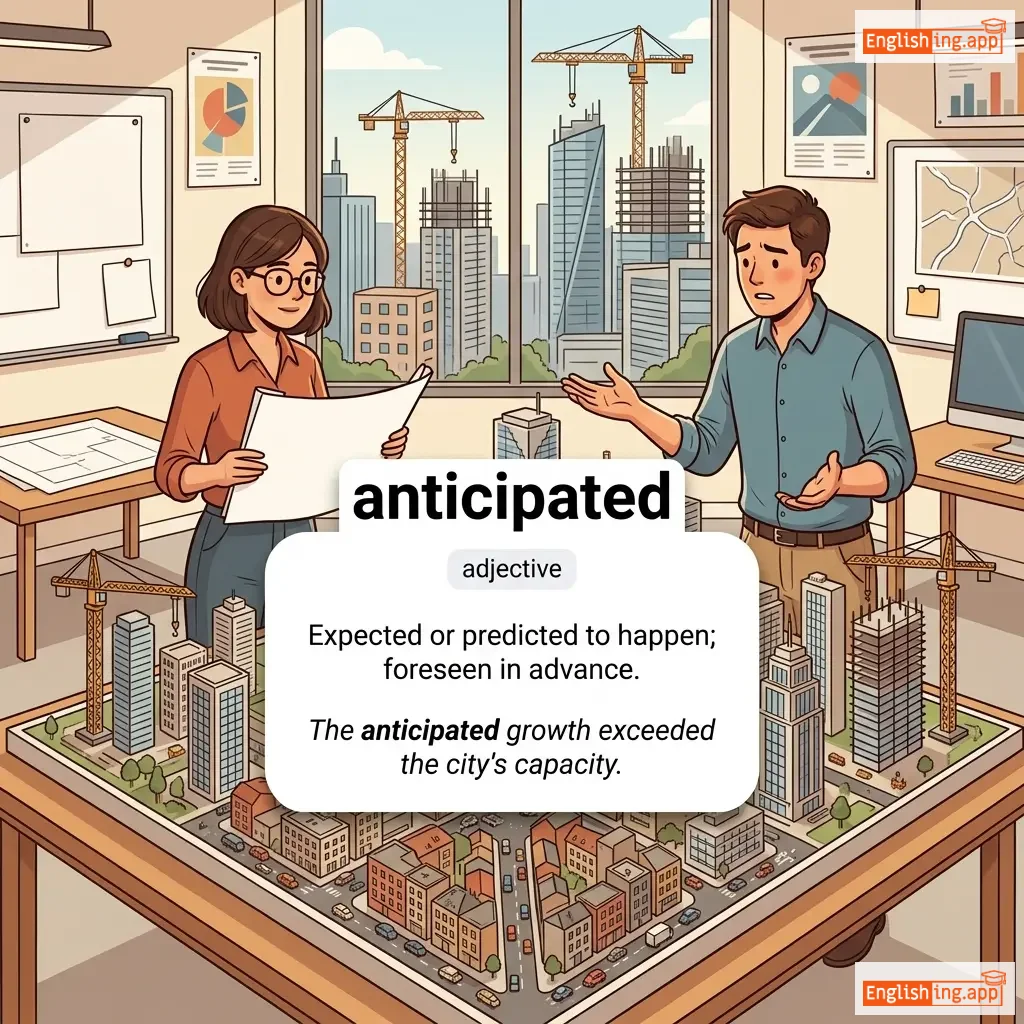
anticipated definition card — visual illustration of the meaning
adjective
ænˈtɪsɪpeɪtɪd
अपेक्षित (apekshit)

Expected or predicted to happen; foreseen in advance.

"The anticipated growth exceeded the city's capacity."

"अपेक्षित वृद्धि शहर की क्षमता से अधिक हो गई।" (Apekshit vruddhi shahar ki kshamata se adhik ho gayi.)
noun
/ˌæntiˈklaɪmæks/
निराशाजनक अंत (niraashajanak ant)

A disappointing end after a big build-up of excitement or expectation.

"The movie's ending was an anticlimax after such a thrilling story."

"फिल्म का अंत एक निराशाजनक अंत था, इतनी रोमांचक कहानी के बाद।" (Film ka ant ek niraashajanak ant tha, itni romanchak kahani ke baad.)
noun
/ˌæntiˈsaɪkloʊn/
वायुचक्र (vaayuchakra)

A weather system with high atmospheric pressure at its center, usually bringing calm and clear conditions.

"An anticyclone brought sunny weather across the region."

"एक एंटीसायक्लोन ने क्षेत्र भर में धूप वाला मौसम लाया।" (Ek anticyclone ne kshetra bhar mein dhoop wala mausam laaya.)
noun
/ˈæntɪˌdoʊt/
एंटीडेट (antidote)

A substance that neutralizes the effects of a poison; something that relieves or counteracts.

"The doctor quickly administered an antidote to the snake venom."

"डॉक्टर ने जल्दी से सांप के जहर के लिए एक एंटीडेट दिया।" (Doktar ne jaldi se saanp ke zahar ke liye ek antidote diya.)
noun
/ænˈtɪlədʒi/
विरोधाभास (virodhabhas)

A contradiction in terms or ideas; inconsistency in speech or writing.

"The politician's statement was criticized for its antilogy."

"राजनेता के बयान को उसके विरोधाभास के लिए आलोचना की गई थी।" (Rajneeta ke bayan ko uske virodhavas ke liye alochana ki gayi thi.)
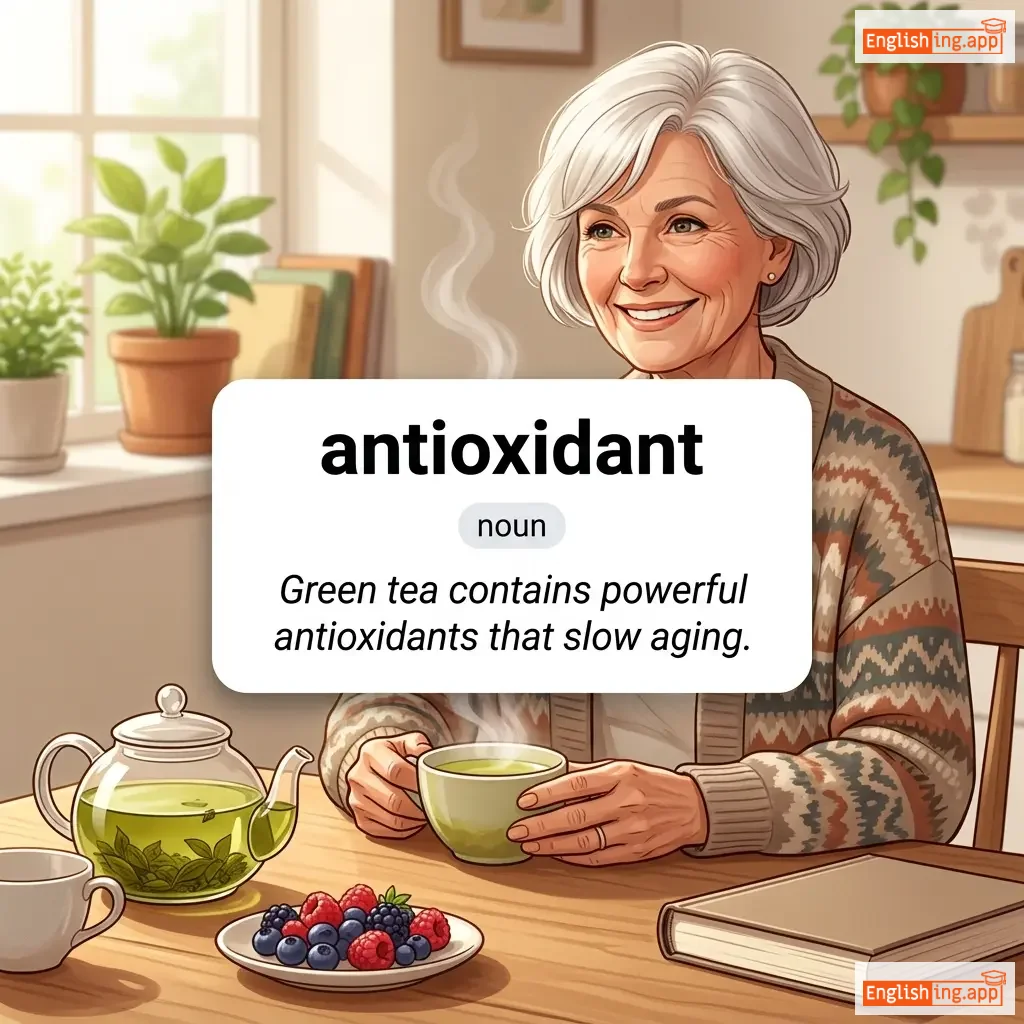
antioxidant definition card — visual illustration of the meaning
noun
ˌæn.tiˈɒk.sɪ.dənt
एंटीऑक्सीडेंट (antioxidant)

A substance that may prevent or delay some types of cell damage by neutralizing free radicals.

"Green tea contains powerful antioxidants that slow aging."

"ग्रीन टी में शक्तिशाली एंटीऑक्सीडेंट होते हैं जो बुढ़ापे को धीमा करते हैं।" (Green tea mein shakti-shali antioxidant hote hain jo budhape ko dheema karte hain.)
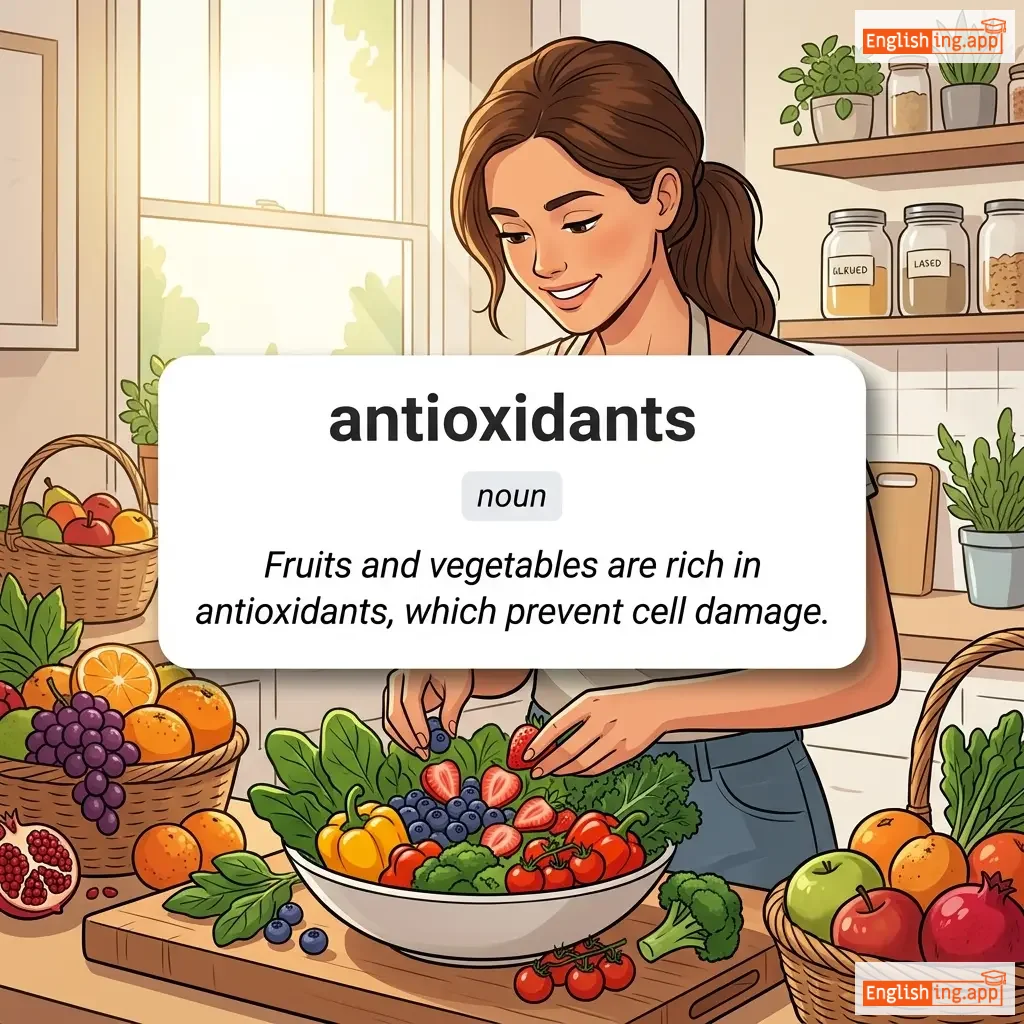
antioxidants definition card — visual illustration of the meaning
noun
/ˌæn.tiˈɒk.sɪ.dənts/
एंटीऑक्सिडेंट्स (antioksidants)

Substances that may prevent or delay cell damage caused by free radicals, potentially reducing the risk of certain diseases.

"Fruits and vegetables are rich in antioxidants, which prevent cell damage."

"फल और सब्ज़ियाँ एंटीऑक्सिडेंट्स से भरपूर होती हैं, जो कोशिका क्षति को रोकती हैं।" (phal aur sabziyaan antioksidants se bharpoor hoti hain, jo koshika kshati ko rokate hain.)
verb
/ænˈtɪpəθaɪz/
विद्वेष करना (vidvesh karna)

to feel or express a strong dislike or aversion toward something or someone

"He seemed to antipathize with the new management's approach."

"वह नए प्रबंधन के दृष्टिकोण के साथ एंटिपैथाइज करता हुआ दिखाई दिया।" (Wah naye prabandhan ke drishtikon ke saath antipathize karta hua dikhai diya.)
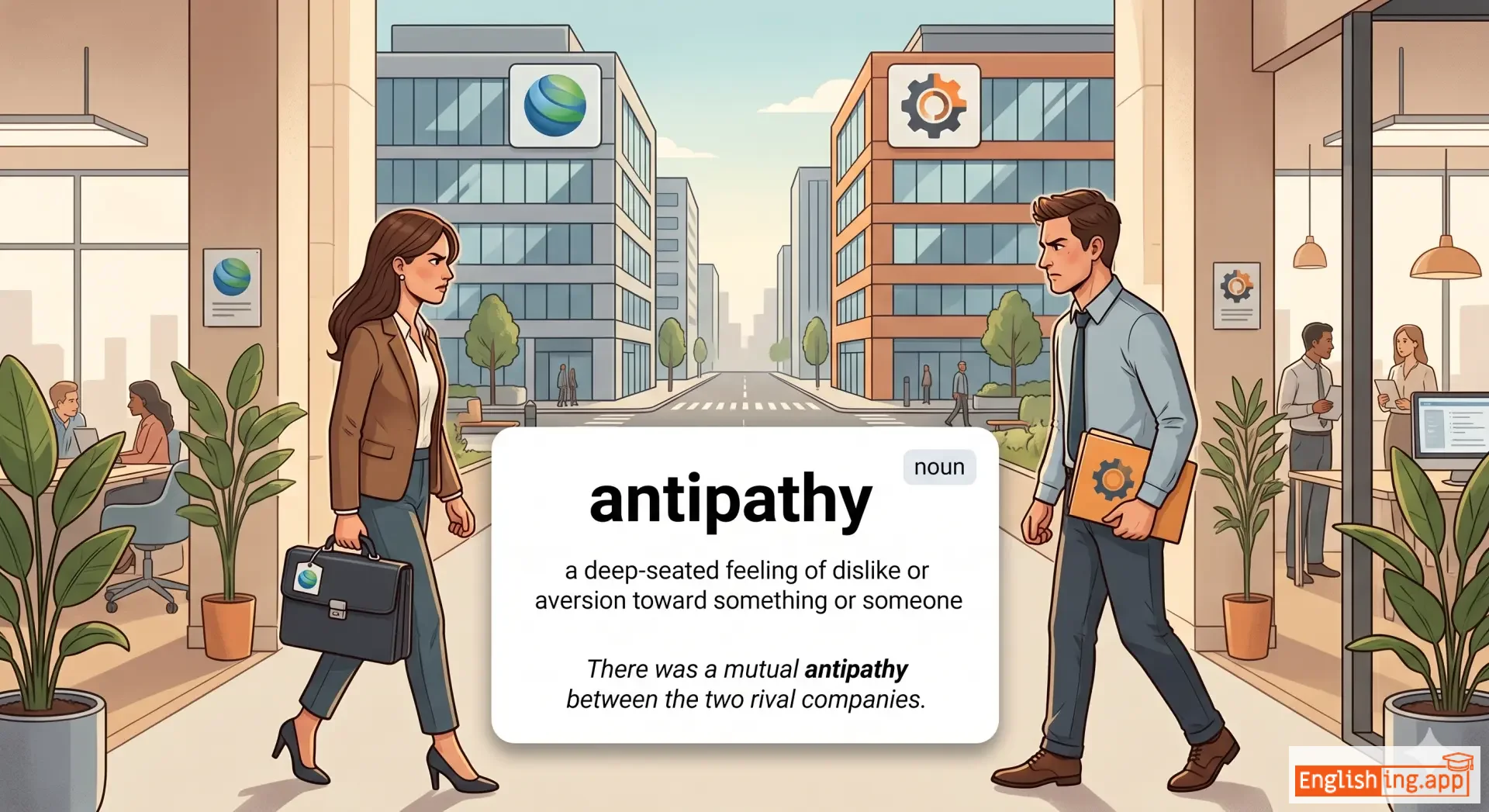
antipathy definition card — visual illustration of the meaning
noun
/ænˈtɪpəθi/
अप्रियता (apriyata)

a deep-seated feeling of dislike or aversion toward something or someone

"There was a mutual antipathy between the two rival companies."

"दो प्रतिद्वंद्वी कंपनियों के बीच एक आपसी अप्रियता थी।" (Do pratidwandi kampaniyon ke beech ek aapsi apriyata thi.)
noun
/ˈæntɪfɒn/
प्रतिस्वर (pratiswar)

a short chant or verse sung responsively in Christian worship, typically sung before or after a psalm or canticle

"The choir sang the antiphon before beginning the main hymn."

"गायक मंडली ने मुख्य भजन शुरू करने से पहले प्रतिस्वर गाया।" (Gaayak mandali ne mukhya bhajan shuru karne se pehle pratiswar gaya.)
noun
/ænˈtɪfəni/
प्रतिक्रिया (pratikriya)

a form of music in which two or more groups or choirs sing alternately in response to each other

"The cathedral's architecture was designed to enhance the effect of antiphony."

"कैथेड्रल की वास्तुकला को प्रतिकिया के प्रभाव को बढ़ाने के लिए डिज़ाइन किया गया था।" (Cathedral ki vastukala ko pratikriya ke prabhaav ko badhane ke liye design kiya gaya tha.)
noun
/ænˈtɪpədiːz/
पृथ्वी के विपरीत स्थान (antipohdz)

places on opposite sides of the Earth; also refers to things that are direct opposites

"Australia and Britain are often considered antipodes of each other."

"ऑस्ट्रेलिया और ब्रिटेन को अक्सर एक दूसरे के विपरीत स्थल के रूप में माना जाता है।" (australia aur britain ko aksar ek dusre ke vipreet sthal ke roop mein mana jata hai.)
noun
/ˈæntɪkwɛri/
प्राचीन वस्तु विशेषज्ञ (prachin vastu visheshagya)

A person who studies, collects, or deals in antiques or ancient objects.

"The antiquary spent years collecting rare manuscripts from the medieval period."

"एंटीक्वेरी ने दुर्लभ पांडुलिपियाँ एकत्रित करने में कई साल बिताए।" (Antiquary ne durlabh pandulipiyan ekatrit karne mein kai saal bitaye.)
verb
/ˈæntɪkweɪt/
पुराना करना (purana karna)

To make something old-fashioned or obsolete.

"The rise of digital cameras antiquated traditional film photography."

"डिजिटल कैमरों का उदय पारंपरिक फिल्म फोटोग्राफी को पुराना बना दिया।" (Digital cameron ka uday paramparik film photography ko purana bana diya.)
adjective
/ˈæntɪkweɪtɪd/
पुराना (purana)

Old-fashioned or outdated.

"The office still uses an antiquated filing system."

"दफ्तर अब भी एक पुराने फाइलिंग सिस्टम का इस्तेमाल करता है।" (Daftar ab bhi ek purane filing system ka istemal karta hai.)
noun
/ænˈtiːk/
प्राचीन वस्तु (prachin vastu)

An old collectible item that has high value because of its age and rarity.

"She bought an antique vase from the market."

"उसने बाजार से एक प्राचीन फूलदान खरीदी।" (Usne bajar se ek prachin phuldani kharidi.)
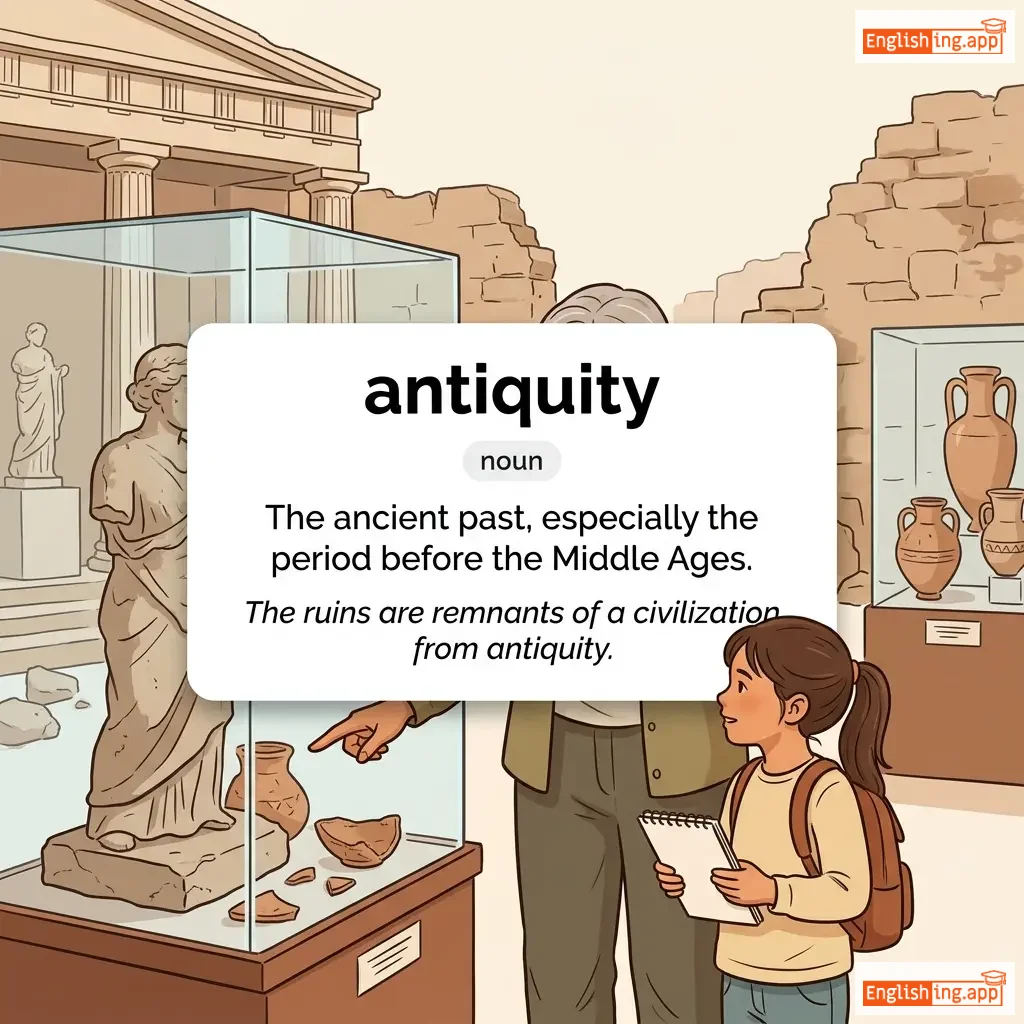
antiquity definition card — visual illustration of the meaning
noun
/ænˈtɪkwɪti/
प्राचीनता (prachintā)

The ancient past, especially the period before the Middle Ages.

"The ruins are remnants of a civilization from antiquity."

"खंडहर प्राचीनता से एक सभ्यता के अवशेष हैं।" (Khandhar prāchīntā se ek sabhyatā ke avasheṣ hain.)
noun, adjective
/ˌæntiˈsɛptɪk/
एंटीसेप्टिक (antiseptik)

A substance that prevents the growth of disease-causing microorganisms; clean and free from germs.

"The nurse applied an antiseptic to the wound."

"नर्स ने घाव पर एंटीसेप्टिक लगाया." (nars ne ghaav par antiseptik lagaya)
adjective
/ˌæntiˈsleɪvəri/
दासता विरोधी (daasta virodhi)

Opposed to the practice or system of slavery.

"The antislavery movement gained momentum in the 19th century."

"दासता विरोधी आंदोलन 19वीं सदी में गति पकड़ने लगा था।" (daasta virodhi aandolan 19vi sadi mein gati pakadne laga tha.)
adjective
/ˌæn.tiˈsoʊ.ʃəl/
एंटीसोशल; समाजविरोधी (antisocial; samajvirodhi)

avoiding social interaction; hostile to social order

"His antisocial behavior made it difficult for him to make friends."

"उसका एंटीसोशल व्यवहार उसे दोस्तों से मिलने में मुश्किल बना रहा था।" (Uska antisocial vyavhaar use doston se milne mein mushkil bana raha tha.)
noun, adjective
/ˌæntiˌspæzˈmɒdɪk/
एंटीस्पाजमोडिक (antispasmodic)

A drug or agent that relieves or prevents muscle spasms.

"The doctor prescribed an antispasmodic to ease the pain."

"डॉक्टर ने दर्द को कम करने के लिए एंटीस्पाजमोडिक दवा दी।" (Doktor ne dard ko kam karne ke liye antispasmodic dava di.)
noun
/ænˈtɪstrəfi/
एंटिस्ट्रोफी (एक भाषाशास्त्र उपकरण) (antistrofi)

A rhetorical device in which a word or phrase is repeated at the end of successive clauses; in Greek choral poetry, the part of the ode sung by the chorus in return movement.

"The poet used antistrophe to emphasize the repeated phrase."

"कवि ने दोहराए गए वाक्यांश को ज़ोर देने के लिए एंटिस्ट्रोफी का उपयोग किया।" (Kavi ne dohraye gaye vakyansh ko zor dene ke liye antistrofi ka upyog kiya.)
noun
/ænˈtɪθəsɪs/
विपरीत (vipreet)

A person, thing, or idea that is the direct opposite of another; a rhetorical device contrasting opposing ideas in parallel structure.

"Love is the antithesis of hate."

"प्रेम नफ़रत का विपरीत है।" (Prem nafrat ka vipreet hai.)
adjective
/ˌæntɪˈθɛtɪkəl/
विरोधी (virodhi)

Directly opposed or contrasted; mutually incompatible.

"His views were antithetical to the values of the organization."

"उसके विचार संगठन के मूल्यों के खिलाफ थे।" (uske vichar sangathan ke mulyon ke khilaf the.)
noun
/ˌæntɪˈtɒksɪn/
एंटीटॉक्सिन (antitoxin)

A substance that neutralizes a specific toxin in the body.

"The doctor administered an antitoxin to counter the snake venom."

"डॉक्टर ने सांप के विष को नष्ट करने के लिए एंटीटॉक्सिन दिया।" (doktar ne saap ke vish ko nasht karne ke liye antitoxin diya.)
noun
/ˈæntlɚ/
हिरण के सींग (hiran ke seeng)

The branched horns on the head of a deer or similar animal, usually shed and regrown annually.

"The deer’s antlers grew larger each year."

"हिरण के सींग हर साल बड़े होते हैं।" (hiran ke seeng har saal bade hote hain.)
noun
/ˈæntənɪm/
विपरीतार्थक शब्द (vipreetarthak shabd)

A word opposite in meaning to another.

"‘Hot’ is the antonym of ‘cold’."

"‘हॉट’ का विपरीतार्थक शब्द ‘कोल्ड’ है।" ('Hot' ka vipreetarthak shabd 'cold' hai.)
noun
/ˈeɪ.nəs/
गुदा (guda)

the opening at the end of the digestive tract through which waste leaves the body

"The doctor examined the patient's anus during the medical checkup."

"डॉक्टर ने मेडिकल चेकअप के दौरान मरीज के गुदा की जांच की।" (daktar ne medical checkup ke dauran mareez ke guda ki jaanch ki.)
noun
/ˈænvɪl/
लोहा ब्लॉक (loha block)

A heavy iron block used by blacksmiths for hammering and shaping metal.

"The blacksmith placed the hot iron on the anvil."

"लोहार ने गर्म लोहे को ऐनविल पर रखा।" (lohaar ne garm lohe ko anvill par rakha.)
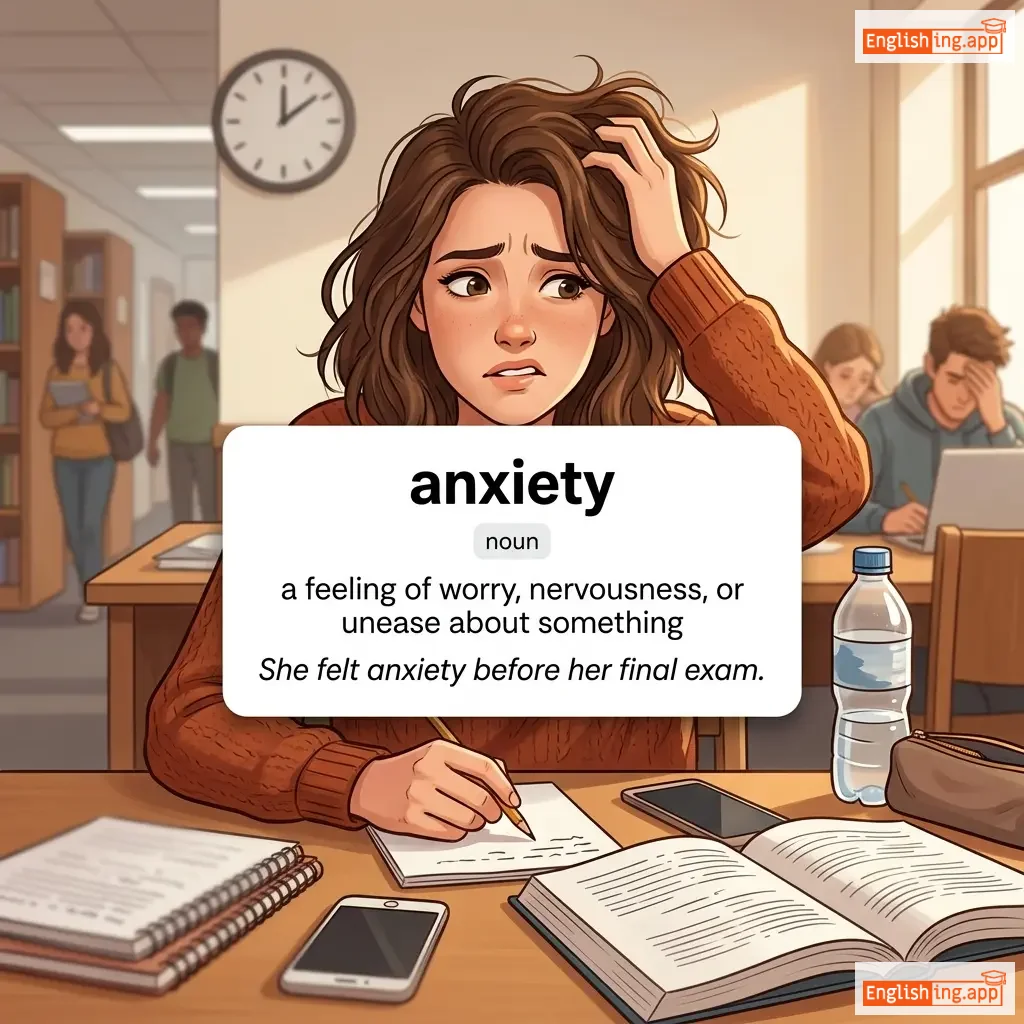
anxiety definition card — visual illustration of the meaning
noun
/æŋˈzaɪəti/
चिंता (chinta)

a feeling of worry, nervousness, or unease about something

"She felt anxiety before her final exam."

"उसे अपनी अंतिम परीक्षा से पहले चिंता महसूस हो रही थी।" (Use apni antim pariksha se pehle chinta mehsoos ho rahi thi.)
adjective
/ˈæŋkʃəs/
चिंतित (chintit)

feeling worried, nervous, or uneasy about something

"She felt anxious before her job interview."

"वह अपने नौकरी के साक्षात्कार से पहले चिंतित महसूस कर रही थी।" (Vah apne naukari ke sakshatkaar se pehle chintit mehsoos kar rahi thi.)
adverb
/ˈæŋkʃəsli/
घबराकर (ghabarakar)

in a worried, nervous, or uneasy manner; with anxious anticipation

"She waited anxiously for the exam results."

"वह परीक्षा के परिणाम का घबराकर इंतज़ार कर रही थी।" (vah pariksha ke parinam ka ghabarakar intazar kar rahi thi)
determiner/pronoun
/ˈɛni/
कोई भी (koi bhi)

one, some, or all, without specifying which

"Do you have any questions?"

"क्या आपके पास कोई सवाल है?" (Kya aapke paas koi sawaal hai?)
pronoun
/ˈɛniˌbɒdi/
कोई भी (koi bhi)

any person; anyone

"Anybody can join the club."

"कोई भी क्लब में शामिल हो सकता है।" (Koi bhi klub mein shamil ho sakta hai.)
adverb
/ˌɛniˈmɔr/
अब नहीं (ab nahin)

used to refer to the present time, typically to mean no longer

"He doesn’t live here anymore."

"वह अब यहाँ नहीं रहता।" (vah ab yahaan nahin rehta.)
pronoun
/ˈɛniwʌn/
कोई (koi)

any person at all; used to refer to an unspecified person

"Does anyone know the answer to this question?"

"क्या कोई इस सवाल का जवाब जानता है?" (kya koi is sawal ka jawab janta hai?)
pronoun
/ˈɛnɪθɪŋ/
कुछ भी (kuch bhi)

any object, event, or matter; whatever thing

"You can ask me anything about the project."

"आप मुझसे प्रोजेक्ट के बारे में कुछ भी पूछ सकते हैं।" (Aap mujhse project ke baare mein kuch bhi pooch sakte hain.)
adverb
/ˈɛniweɪ/
वैसे भी (waise bhi)

used to emphasize a statement or to return to a previous subject; regardless of what happened

"I was tired, but I went to the meeting anyway."

"मैं थका हुआ था, लेकिन मैं मीटिंग में वैसे भी गया।" (Main thaka hua tha, lekin main meeting mein waise bhi gaya.)
adverb
/ˈɛnɪwɛər/
कहीं भी (eniwear)

in, at, or to any place

"You can find good food anywhere in this city."

"आप इस शहर में कहीं भी अच्छा खाना पा सकते हैं।" (aap is shahar mein kahin bhi accha khana paa sakte hain)
adverb
/əˈpɑːrt/
अलग (apart)

separated by distance or time; into pieces

"They live miles apart from each other."

"वे एक दूसरे से कई मील दूर रहते हैं।" (Ve ek doosre se kai mil door rahte hain.)
noun
/əˈpɑːrtmənt/
अपार्टमेंट (apartment)

a set of rooms forming a residence within a building

"She rented an apartment in the city center."

"उसने शहर के केंद्र में एक अपार्टमेंट किराए पर लिया।" (Usne shahar ke kendra mein ek apartment kiraaye par liya.)
adjective
/ˌæpəˈθɛtɪk/
उदासीन (epathetik)

showing or feeling little or no interest, enthusiasm, or concern

"He was apathetic about the outcome of the match."

"वह मैच के परिणाम के बारे में उदासीन था।" (vah maich ke parinaam ke baare mein udaaseen tha)
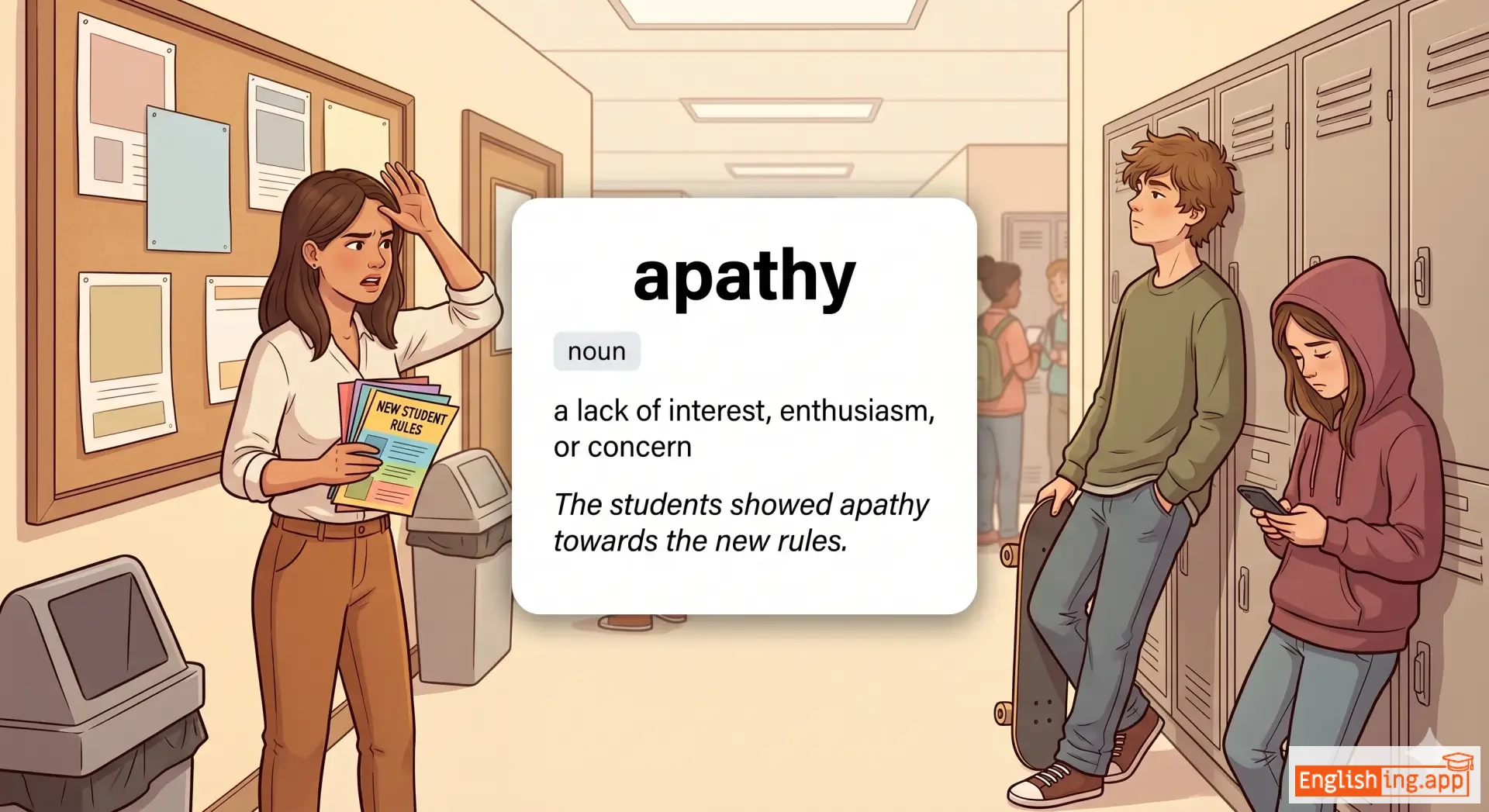
apathy definition card — visual illustration of the meaning
noun
/ˈæpəθi/
उदासीनता (udasinata)

a lack of interest, enthusiasm, or concern

"The students showed apathy towards the new rules."

"छात्रों ने नए नियमों के प्रति उदासीनता दिखाई।" (Chhatron ne naye niyamon ke prati udasinata dikhai.)
noun/verb
/eɪp/
बड़े बंदर की तरह जानवर / नकल करना (bade bandar ki tarah janwar / nakal karna)

a large primate similar to a monkey but without a tail; as a verb, to imitate or mimic

"Children often ape the behavior of adults."

"बच्चे अक्सर बड़ों के व्यवहार की नकल करते हैं।" (Bacche aksar bado ke vyavhaar ki nakal karte hain.)