वोकैबुलरीज

इंग्लिश वोकैबुलरी डिस्कवर, लर्न और मास्टर करें

noun
/əˈmɛrɪkəˌnɪzəm/
अमेरिकीपन (amerikanizm)

A word, phrase, or practice characteristic of American English or culture.

"The term 'sidewalk' is an Americanism, while 'pavement' is used in British English."

"शब्द 'sidewalk' एक अमेरिकी शब्द-प्रचलन है, जबकि 'pavement' ब्रिटिश अंग्रेजी में प्रयोग किया जाता है." (shabd 'sidewalk' ek ameriki shabd-prachlan hai, jabki 'pavement' british angrezi mein prayog kiya jata hai.)
adjective
/ˈeɪmiəbəl/
मिलनसार (milansar)

Having a friendly and pleasant manner.

"She has an amiable personality that makes her well-liked by everyone."

"उसका मिलनसार स्वभाव उसे सभी द्वारा पसंद किया जाता है।" (uska milansar svabhaav use sabhi dwara pasand kiya jata hai.)
adverb
/ˈeɪ.mi.ə.bli/
दोस्ताना ढंग से, स्नेहपूर्वक (dostana dhang se, snehpurvak)

in a friendly and pleasant manner

"They discussed the issue amiably without any arguments."

"उन्होंने बिना किसी तर्क के दोस्ताना तरीके से मुद्दे पर चर्चा की।" (unhone bina kisi tark ke dostana tareeke se mudde par charcha ki)
amicable definition card — visual illustration of the meaning
adjective
/ˈæmɪkəbəl/
मैत्रीपूर्ण (maitripurn)

Friendly and peaceful, especially in resolving conflicts.

"The two companies reached an amicable agreement after months of negotiation."

"दो कंपनियाँ महीनों की बातचीत के बाद एक मैत्रीपूर्ण समझौते पर पहुंची।" (do kompaniyan mahino ki baatchit ke baad ek maitripurn samjhote par pahunche.)
adverb
/ˈæm.ɪ.kə.bli/
मित्रवत तरीके से (mitravat tareeke se)

in a friendly way without anger or resentment

"The divorce was settled amicably between both parties."

"दिवोर्स को दोनों पक्षों के बीच मित्रवत तरीके से सुलझा लिया गया।" (divors ko dono pakshon ke beech mitravat tareeke se suljha liya gaya.)
preposition
/əˈmɪd/
बीच में (beech mein)

in the middle of or surrounded by something

"The team stayed calm amid the chaos."

"टीम ने अराजकता के बीच में शांति बनाए रखी।" (Team ne arajakta ke beech mein shaanti banaaye rakhi.)
adjective/adverb
/əˈmɪs/
ग़लत (galat)

Not quite right; inappropriate or out of place.

"Something seems amiss with the car's engine."

"कार के इंजन में कुछ ग़लत लगता है।" (kaar ke engine mein kuch galat lagta hai.)
noun
/ˈæmɪti/
मित्रता (mitrata)

A friendly relationship between people or countries.

"The treaty helped maintain amity between the neighboring nations."

"संधि ने पड़ोसी देशों के बीच मित्रता बनाए रखने में मदद की।" (sandhi ne padosi deshon ke beech mitrata banaye rakhne mein madad ki.)
noun
/æmˈniːʒə/
स्मृतिलोप (smritilop)

A partial or total loss of memory, usually caused by injury, illness, or psychological trauma.

"After the accident, she suffered from amnesia and could not remember her own name."

"दुर्घटना के बाद, वह स्मृतिलोप से पीड़ित हो गई और अपना नाम याद नहीं कर पा रही थी।" (Durghatna ke baad, vah smritilop se peedit ho gayi aur apna naam yaad nahi kar pa rahi thi.)
noun
/ˈæmnəsti/
अम्नेस्टि (amnesty)

An official pardon granted to people who have been convicted of political offenses.

"The government announced an amnesty for all political prisoners."

"सरकार ने सभी राजनीतिक कैदियों के लिए एक आम माफी की घोषणा की।" (sarkaar ne sabhee raajneetik kaidiyon ke liye ek aam maafi kee ghoshna kee.)
adverb
/əˈmʌk/
अविकसित तरीके से (aviksit tareeke se)

Behaving uncontrollably and disruptively.

"The angry mob ran amok after the verdict was announced."

"निर्णय की घोषणा के बाद गुस्साई भीड़ अविकसित तरीके से व्यवहार करने लगी।" (Nirnaya ki ghoshna ke baad gussaee bheed aviksit tareeke se vyavhaar karne lagi.)
preposition
/əˈmʌŋ/
के बीच में (ke beech mein)

surrounded by; in the middle of a group

"He was sitting among his friends."

"वह अपने दोस्तों के बीच बैठा था।" (Vah apne doston ke beech baitha tha.)
adjective
/ˌeɪˈmɔːrəl/
नैतिकताहीन (naitikatahin)

Lacking a moral sense; unconcerned with rightness or wrongness of something.

"The character in the novel was portrayed as completely amoral."

"उपन्यास में पात्र को पूरी तरह से नैतिकताहीन के रूप में चित्रित किया गया था।" (Upanyaas mein paatr ko puri tarah se naitikatahin ke roop mein chitrit kiya gaya tha.)
adverb
/ˌeɪˈmɔːrəli/
नैतिकताहीन रूप से (naitikatahin roop se)

In a way that shows no concern about whether behavior is morally right or wrong.

"He acted amorally, ignoring the consequences of his actions."

"वह नैतिकताहीन रूप से व्यवहार करता था, अपने कार्यों के परिणामों की उपेक्षा करते हुए।" (vah naitikatahin roop se vyavhaar karta tha, apne karyon ke parinaamon ki upeksha karte hue.)
adjective
/ˈæmərəs/
प्रेमासक्त (premasakt)

Showing, feeling, or relating to romantic love or desire.

"He sent her an amorous letter filled with declarations of love."

"उसने उसे एक प्रेमपूर्ण पत्र भेजा जिसमें प्रेम की घोषणाएँ भरी हुई थीं।" (Usne use ek prempoorN patra bheja jismein prem ki ghoshnayein bhari hui thi.)
adjective
/əˈmɔːrfəs/
आकृतिहीन (akrithin)

Lacking a clear shape or form; without a defined structure.

"The plan remained amorphous and lacked concrete details."

"योजना आकृतिहीन रही और ठोस विवरण की कमी थी।" (Yojana akrithin rahi aur thos vivaran ki kami thi.)
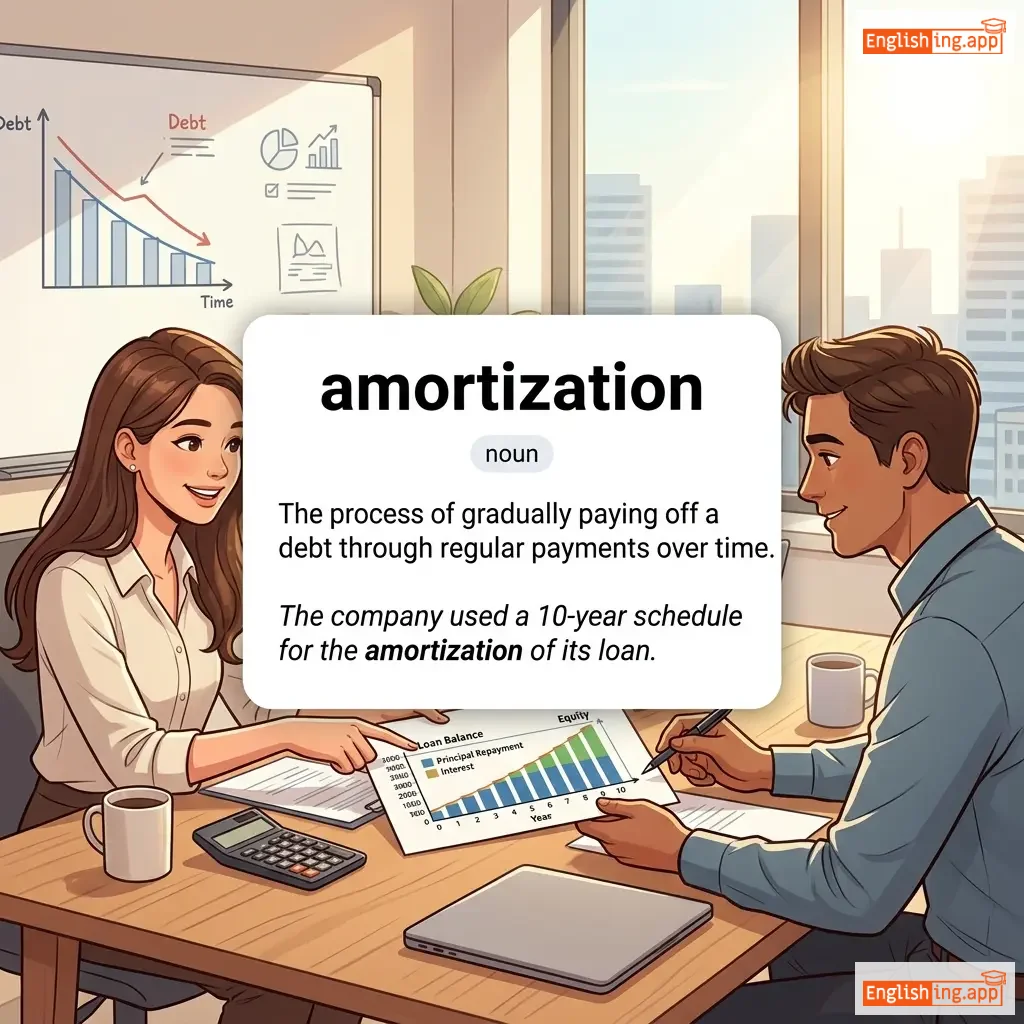
amortization definition card — visual illustration of the meaning
noun
/əˌmɔːrtəˈzeɪʃən/
ऋण अदायगी (rin adayagi)

The process of gradually paying off a debt through regular payments over time.

"The company used a 10-year schedule for the amortization of its loan."

"कंपनी ने अपने ऋण के अमॉर्टाइजेशन के लिए 10 साल का शेड्यूल इस्तेमाल किया।" (Company ne apne rin ke amortization ke liye 10 saal ka schedule istemal kiya.)
verb
/ˈæmərˌtaɪz/
ऋण क़िस्तों में चुकाना (rin kistoon mein chukana)

To gradually reduce or pay off a debt with regular payments.

"They plan to amortize the mortgage over 20 years."

"वे 20 वर्षों में मॉर्टगेज को क़िस्तों में चुका करने की योजना बनाते हैं।" (Ve 20 varshon mein mortgage ko kiston mein chuka karne ki yojana banate hain.)
noun/verb
/əˈmaʊnt/
राशि (rashi)

a quantity of something, typically the total of a thing or things in number, size, value, or extent

"The total amount of money is not enough."

"पैसों की कुल राशि पर्याप्त नहीं है।" (Paiso ki kul rashi paryapt nahi hai.)
noun
/əˈmʊr/
गोपनीय प्रेम (gopniya prem)

A secret or illicit love affair.

"The novel tells the story of a forbidden amour between two characters."

"उपन्यास दो पात्रों के बीच एक निषिद्ध प्रेम संबंध की कहानी बताता है।" (Upanyas do patron ke beech ek nishiddh prem sambandh ki kahani batata hai.)
noun
/ˈæmpɛər/
ऐम्पीयर (ampiyar)

A unit of electric current in the International System of Units (SI), symbolized as A.

"The current flowing through the wire is measured in amperes."

"तार के माध्यम से प्रवाहित हो रही धारा को ऐम्पीयर में मापा जाता है।" (tar ke madhyam se pravahit ho rahi dhara ko ampiyar mein mapa jata hai.)
noun
/ˈæmpərˌsænd/
ऐम्परसैंड (ampersand)

The symbol '&' used to represent the word 'and'.

"Use an ampersand instead of writing the word 'and' in the company name."

"कंपनी के नाम में 'and' शब्द के बजाय ऐम्परसैंड का उपयोग करें।" (company ke naam mein 'and' shabd ke bajaye ampersand ka upyog karein.)
noun
/æmˈfɪbiən/
उभयचर (amphibian)

A cold-blooded vertebrate animal that can live both on land and in water.

"A frog is a common amphibian that lives both in water and on land."

"मेंढ़क एक सामान्य उभयचर है जो पानी और जमीन दोनों में रहता है." (Mendhak ek samanya ubhayachar hai jo paani aur zameen dono mein rehta hai.)
adjective
/æmˈfɪbiəs/
उभयचर (ubhaychar)

Able to live or operate both on land and in water.

"The army used amphibious vehicles to cross the river."

"सेना ने नदी पार करने के लिए उभयचर वाहन का इस्तेमाल किया।" (sena ne nadi paar karne ke liye ubhaychar vahan ka istemal kiya.)
noun
/ˈæmfɪˌθiətər/
एंफीथिएटर (amphitheater)

A large open circular or oval building with rising tiers of seats, used for public events.

"The concert was held in an ancient amphitheater."

"संगीत कार्यक्रम एक प्राचीन एंफीथिएटर में हुआ था।" (sangeet karyakram ek prachin amphitheater mein hua tha.)
adjective
/ˈæmpəl/
पर्याप्त (paryapt)

more than enough; plentiful; abundant

"There was ample food for everyone at the party."

"पार्टी में सभी के लिए पर्याप्त भोजन था।" (Parti mein sabhi ke liye paryapt bhojan tha.)
noun
/ˌæmplɪfɪˈkeɪʃən/
प्रवर्धन (pravardhan)

the act or process of making something stronger, louder, or more intense; an expansion or elaboration of details

"The microphone provides amplification of the speaker’s voice."

"माइक्रोफोन वक्ता की आवाज़ का प्रवर्धन करता है।" (maikrofon vakta ki awaaz ka pravardhan karta hai)
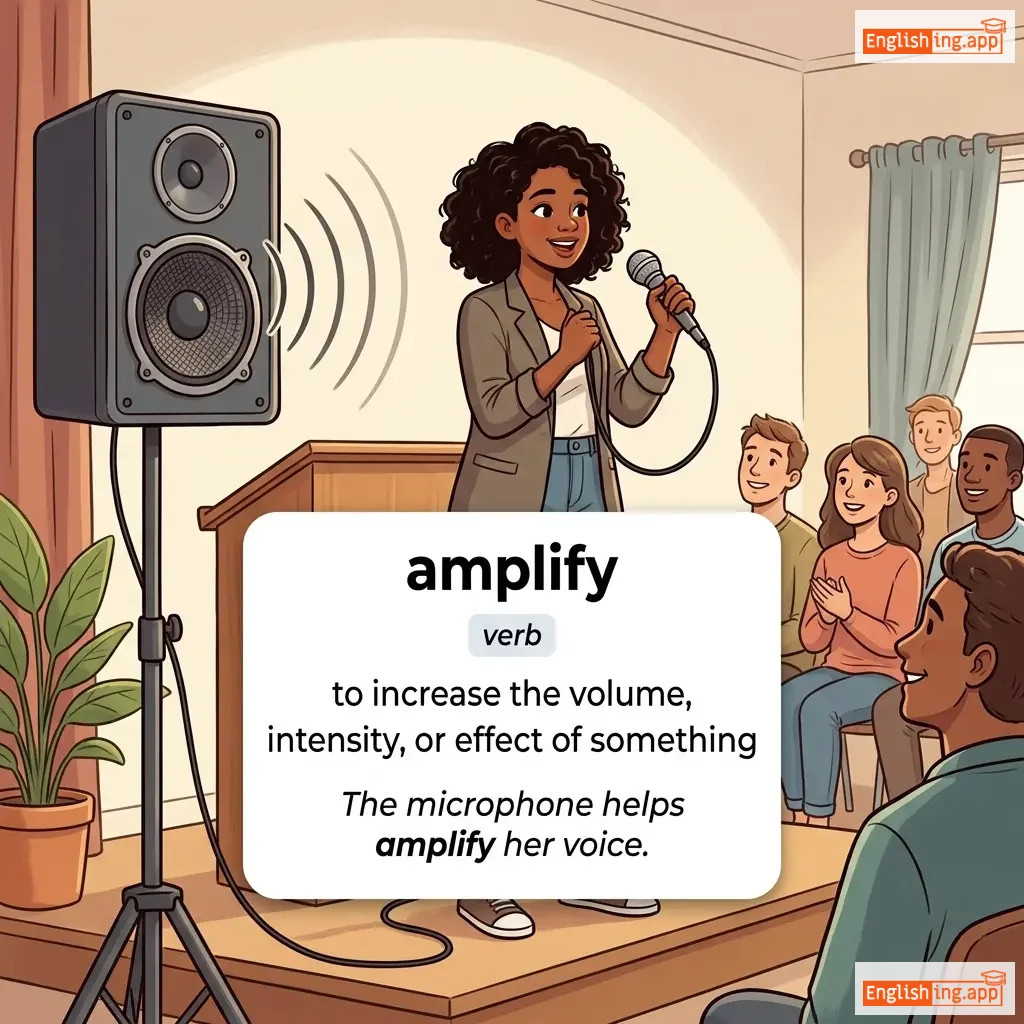
amplify definition card — visual illustration of the meaning
verb
/ˈæmplɪfaɪ/
बढ़ाना (badhana)

to increase the volume, intensity, or effect of something

"The microphone helps amplify her voice."

"माइक्रोफोन उसकी आवाज को बढ़ाने में मदद करता है।" (Microphone uski aawaz ko badhane mein madad karta hai.)
noun
/ˈæmplɪtjuːd/
परिमाण (parimaan)

the maximum extent of a vibration or oscillation, or the size of something

"The amplitude of the earthquake was measured on the Richter scale."

"भूकंप की परिमाण रिख्टर पैमाने पर मापी गई।" (Bhookamp ki parimaan Richter paimane par maapi gayi.)
adverb
/ˈæmpli/
पर्याप्त से अधिक; उदारता से (paryapt se adhik; udarta se)

more than sufficiently; generously

"She was amply rewarded for her hard work."

"वह अपनी मेहनत के लिए अत्यधिक पुरस्कार प्राप्त हुई।" (Vah apni mehnat ke liye atyadhik puraskar prapt hui.)
verb
/ˈæmpjʊteɪt/
अंग काटना (ang kaatna)

to cut off a limb from the body by surgery

"The doctors had to amputate his leg after the accident."

"द डॉक्टरों को दुर्घटना के बाद उसका पैर अंग काटना पड़ा।" (Da doktoron ko durghatna ke baad uska pair ang kaatna pada.)
adverb
/əˈmʌk/
उन्मत्त तरीके से (unmatt tareeke se)

in a frenzied, uncontrolled, or chaotic manner

"The bull ran amuck through the village."

"सांड़ गाँव में उन्मत्त तरीके से दौड़ा।" (Sand gaon mein unmatt tareeke se dauda.)
Amulet definition card — visual illustration of the meaning
noun
/ˈæmjʊlət/
ताबीज (taabej)

an ornament or small object believed to protect against evil, danger, or disease

"She wore an amulet to protect herself from harm."

"वह खुद को नुकसान से बचाने के लिए एक ताबीज पहने हुए थी।" (Wah khud ko nuksan se bachane ke liye ek taabej pehne hui thi.)
verb
/əˈmjuːz/
मनोरंजन करना (manoranjan karna)

to entertain or make someone laugh or smile; to occupy pleasantly

"The clown amused the children at the party."

"जोकर ने पार्टी में बच्चों का मनोरंजन किया।" (joker ne party mein bachchon ka manoranjan kiya)
noun
/əˈmjuːzmənt/
मनोरंजन (amyuuzment)

the state of being entertained or finding something funny

"The children watched the clown with great amusement."

"बच्चों ने जोकर को बहुत आनंद के साथ देखा।" (bachchon ne joker ko bahut anand ke saath dekha.)
adjective
/əˈmjuːzɪŋ/
मनोरंजक (manoranjak)

causing laughter or amusement

"The movie was very amusing, and I laughed a lot."

"फिल्म बहुत मनोरंजक थी, और मैंने खूब हंसी मजाक की।" (film bahut manoranjak thi, aur maine khub hansi mazak ki.)
article
/æn/
एक (स्वर से पहले) (ek (svar se pehle))

used before a noun to refer to a non-specific item that begins with a vowel sound

"She ate an apple for breakfast."

"उसने नाश्ते में एक सेब खाया।" (usne nashte mein ek seb khaya)
anabolism definition card — visual illustration of the meaning
noun
/əˈnæb.ə.lɪ.zəm/
एनेबोलिज़्म (anabolizm)

The set of metabolic pathways that construct molecules from smaller units, involving tissue repair and growth.

"Anabolism is essential for muscle growth and tissue repair."

"एनेबोलिज़्म मांसपेशियों के विकास और ऊतक मरम्मत के लिए आवश्यक है।" (Anabolism maanspeshiyon ke vikas aur utak marammat ke liye avashyak hai.)
anachronism definition card — visual illustration of the meaning
noun
/əˈnækrəˌnɪzəm/
काल विसंगति (enecronizm)

something that is out of its proper time period, especially something old-fashioned in a modern context

"Using a typewriter today feels like an anachronism."

"आज टाइपराइटर का इस्तेमाल करना एक काल विसंगति की तरह महसूस होता है." (aaj typewriter ka istemal karna ek kaal visangati ki tarah mehsoos hota hai)
adjective
/əˌnækrəˈnɪstɪk/
कालातीत (kalateet)

belonging to a period other than that being portrayed; old-fashioned or outdated

"His views on gender roles are considered anachronistic."

"उसके लिंग भूमिकाओं पर विचार ऐनाक्रोनिस्टिक माने जाते हैं।" (Uske ling bhoomikaon par vichar ainakronistik maane jaate hain.)
noun
/ˈænəɡræm/
एक शब्द या वाक्यांश जो किसी अन्य शब्द या वाक्यांश के अक्षरों को फिर से व्यवस्थित करके बनाया गया हो। (ek shabd ya vakyansh jo kisi anya shabd ya vakyansh ke aksharon ko phir se vyavasthit karke banaya gaya ho)

A word or phrase formed by rearranging the letters of another word or phrase.

"The word 'listen' is an anagram of 'silent'."

"'listen' शब्द का 'silent' के अक्षरों को फिर से व्यवस्थित करके बनता है।" ('listen' shabd ka 'silent' ke aksharon ko phir se vyavasthit karke banta hai)
noun
/ˌænəlˈdʒiːziə/
दर्दनाशकता (dardnashakta)

The inability to feel pain while still conscious.

"The doctor induced analgesia before performing the procedure."

"डॉक्टर ने प्रक्रिया करने से पहले दर्दनाशकता प्रेरित की।" (Doktar ne prakriya karne se pehle dardnashakta prerith ki.)
analgesic definition card — visual illustration of the meaning
noun
/ˌænəlˈdʒiːzɪk/
दर्द निवारक (dard nivarak)

A drug or substance that relieves pain.

"She took an analgesic to ease her headache."

"उसने सिरदर्द को कम करने के लिए एक दर्द निवारक लिया।" (Usne sir dard ko kam karne ke liye ek dard nivarak liya.)
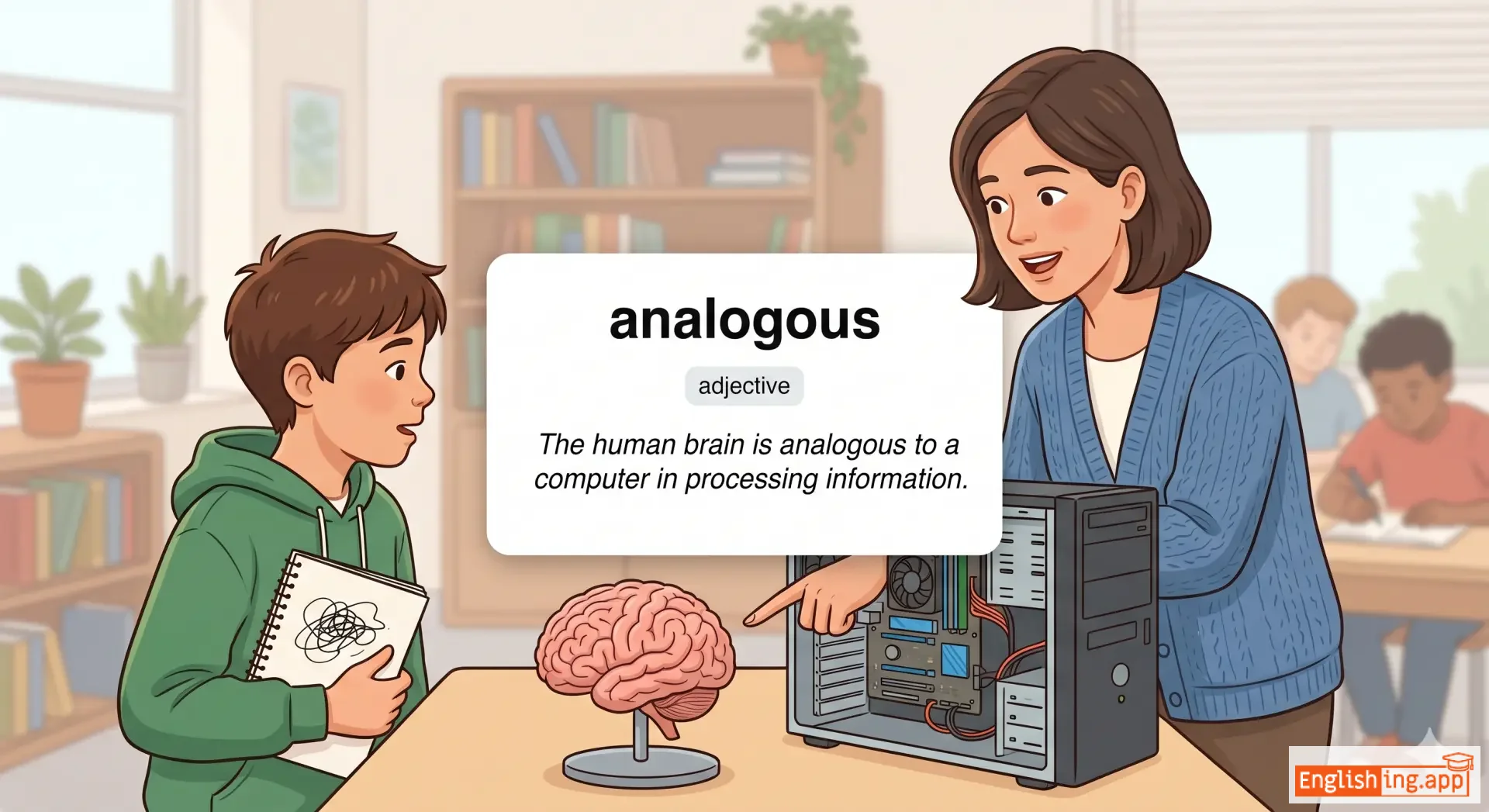
analogous definition card — visual illustration of the meaning
adjective
/əˈnæləɡəs/
तुलनात्मक (uhnaluguhs)

Comparable in certain respects, typically in a way that makes clearer the nature of the things compared.

"The human brain is analogous to a computer in processing information."

"मानव मस्तिष्क सूचना के प्रसंस्करण में एक कंप्यूटर के समान है।" (manav mastishk soochna ke prasanskaran meN ek kampyutar ke samaan hai)
noun
/əˈnælədʒi/
उपमा (upma)

A comparison between two things for the purpose of explanation or clarification.

"The teacher used the analogy of a tree to explain the structure of an essay."

"शिक्षक ने एक पेड़ के उपमा का उपयोग करके निबंध की संरचना को समझाया।" (Shikshak ne ek ped ke upma ka upyog karke nibandh ki sanrachna ko samjhaya.)
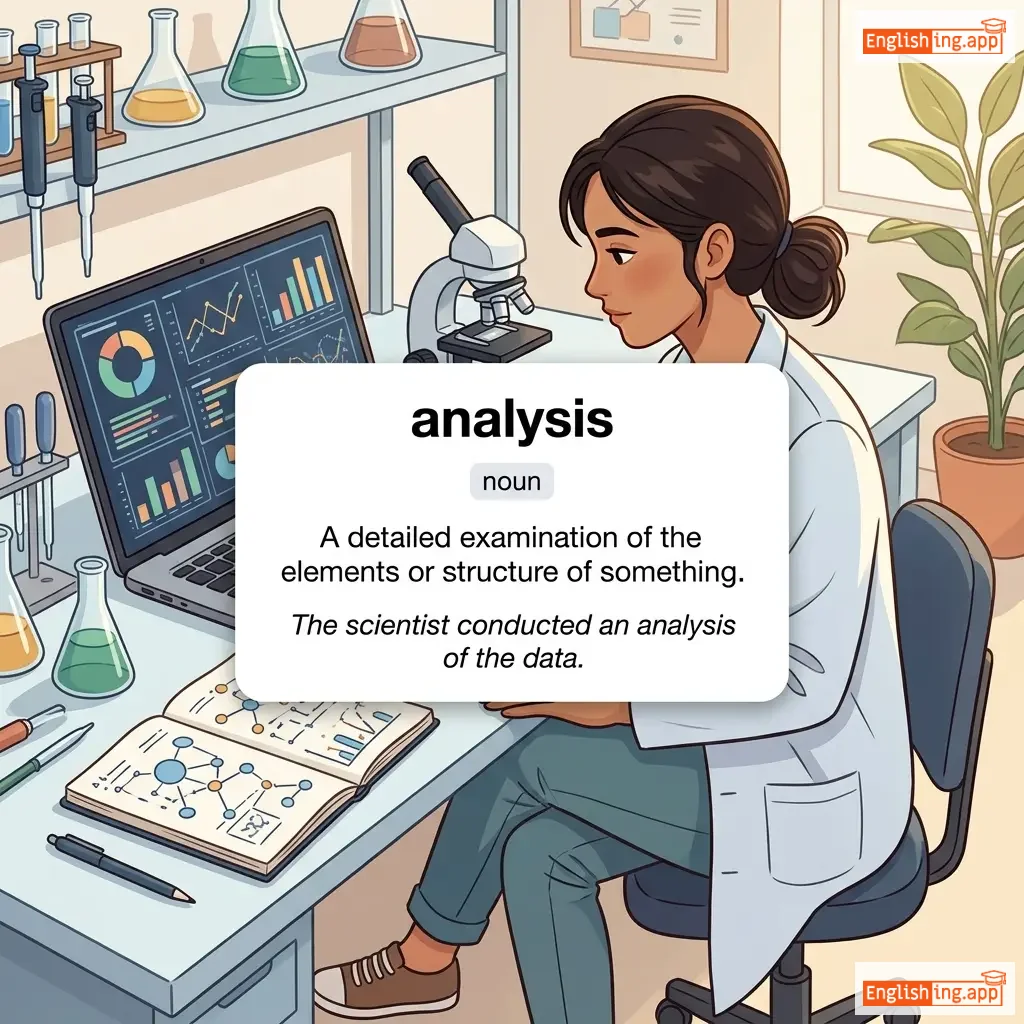
analysis definition card — visual illustration of the meaning
noun
/əˈnæləsɪs/
विश्लेषण (vishleshan)

A detailed examination of the elements or structure of something.

"The scientist conducted an analysis of the data."

"वैज्ञानिक ने डेटा का विश्लेषण किया।" (Vaigyanik ne data ka vishleshan kiya.)
noun
/ˈænəlɪst/
विश्लेषक (vishleshak)

a person who studies or examines something carefully to understand it or make decisions

"The financial analyst predicted a rise in the stock market."

"वित्तीय विश्लेषक ने स्टॉक मार्केट में वृद्धि का अनुमान लगाया।" (Vittiya vishleshak ne stock market mein vruddhi ka anumaan lagaya.)
analytical definition card — visual illustration of the meaning
adjective
ˌæn.əˈlɪt.ɪ.kəl
विश्लेषणात्मक (vishleshanatmak)

Using analysis or logical reasoning; characterized by the use of analysis.

"His analytical approach helped solve the problem."

"उसकी विश्लेषणात्मक दृष्टिकोण ने समस्या को हल करने में मदद की।" (Uski vishleshanatmak drishtikon ne samasya ko hal karne mein madad ki.)
verb
/ˈænəlaɪz/
विश्लेषण करना (vishleshan karna)

to examine something in detail to understand it better or draw conclusions

"Scientists analyze data to discover new patterns."

"वैज्ञानिक डेटा का विश्लेषण करते हैं ताकि नए पैटर्न ढूंढ सकें।" (Vaigyanik data ka vishleshan karte hain taaki naye pattern dhoondh sakein.)
noun
/ˈænərkɪst/
अराजकतावादी (arajkatavadi)

a person who believes in or promotes the absence of government or authority

"The anarchist group protested against state control."

"अराजकतावादी समूह ने राज्य नियंत्रण के खिलाफ विरोध प्रदर्शन किया" (Arajkatavadi samuh ne rajya niyantran ke khilaf virodh pradarshan kiya)