Vocabulaires

Découvrez, apprenez et maîtrisez le vocabulaire anglais

verb
/diːˈmoʊbəlaɪz/
démobiliser (démobiliser)

To release from military service or to disband troops.

"The government decided to demobilize the army after the war."

"Le gouvernement a décidé de démobiliser l'armée après la guerre." (Le gouvernement a décidé de démobiliser l'armée après la guerre.)
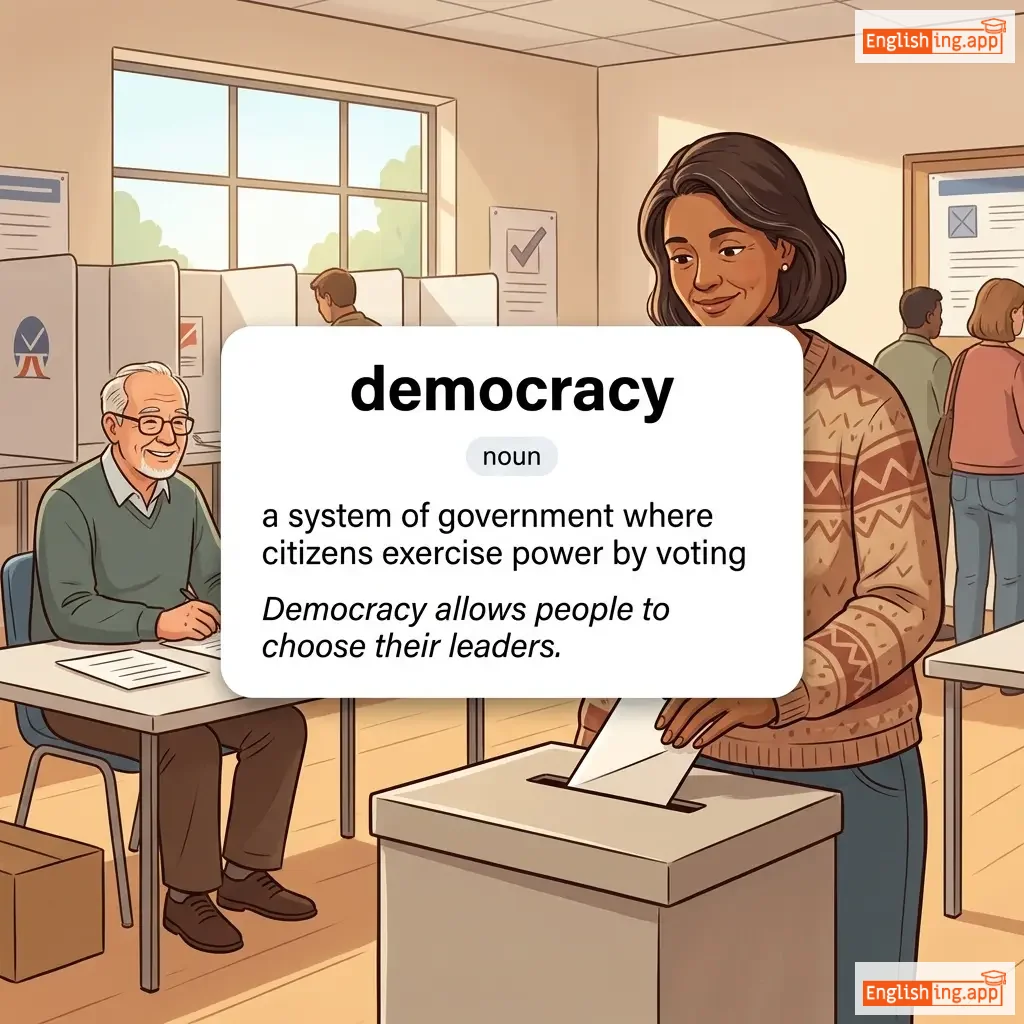
democracy definition card — visual illustration of the meaning
noun
/dɪˈmɑːkrəsi/
démocratie (demokrasi)

a system of government where citizens exercise power by voting

"Democracy allows people to choose their leaders."

"La démocratie permet aux gens de choisir leurs dirigeants." (La démocratie permet aux gens de choisir leurs dirigeants.)
noun
/ˈdɛməˌkræt/
démocrate (democrate)

a supporter of democracy or a member of the Democratic Party in the US

"He is a strong democrat who believes in equal rights."

"Il est un démocrate fort qui croit en l'égalité des droits." (Il est un démocrate fort qui croit en l'égalité des droits.)
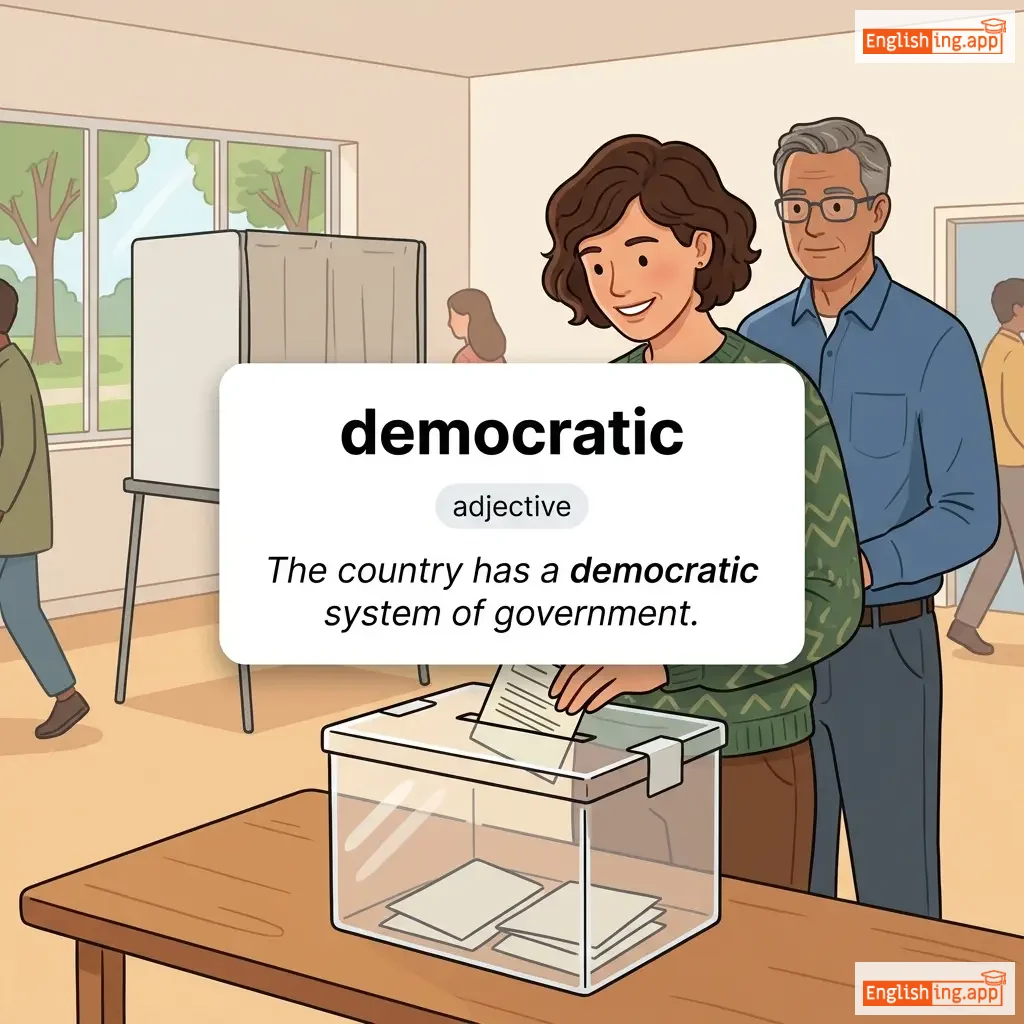
democratic definition card — visual illustration of the meaning
adjective
/ˌdɛməˈkrætɪk/
démocratique (demokratik)

relating to or supporting democracy or its principles; characterized by equality and freedom

"The country has a democratic system of government."

"Le pays a un système démocratique de gouvernement." (Le pays a un systeme demokratik de gouvernement.)
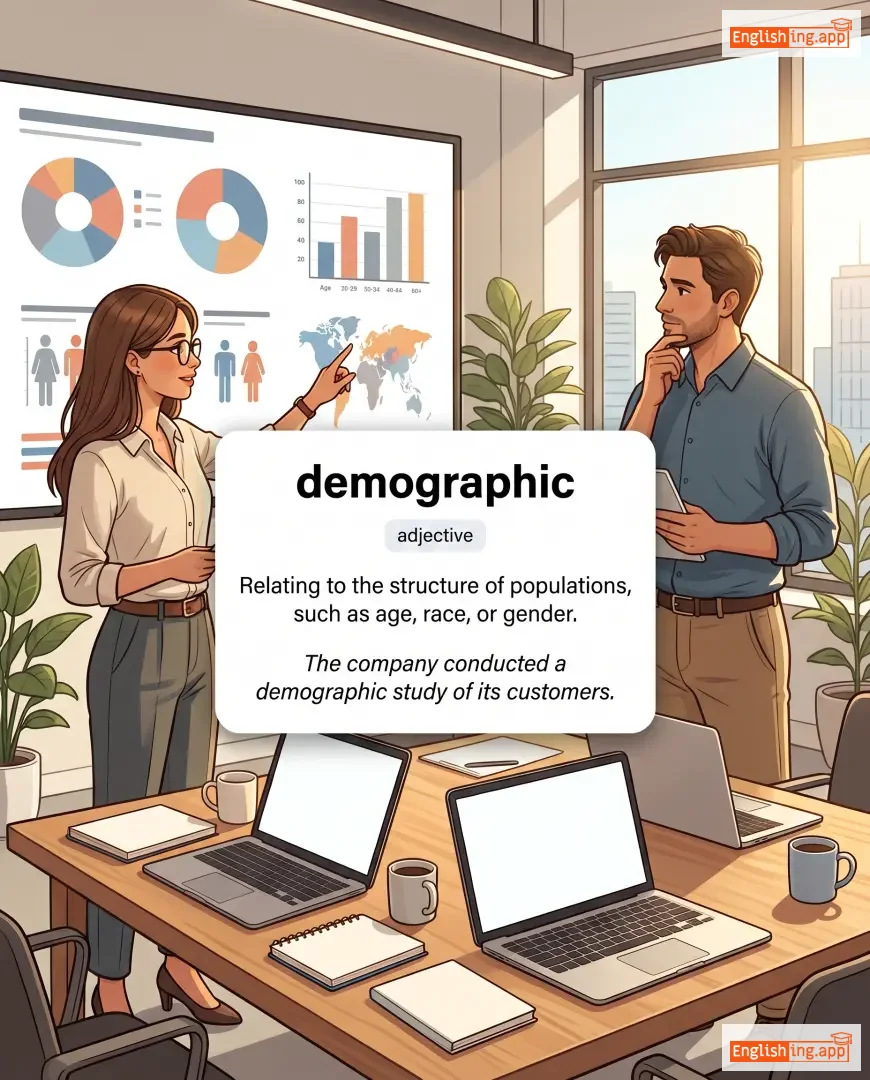
demographic definition card — visual illustration of the meaning
adjective
/ˌdɛməˈɡræfɪk/
démographique (demographique)

Relating to the structure of populations, such as age, race, or gender.

"The company conducted a demographic study of its customers."

"L'entreprise a mené une étude démographique de ses clients." (L'entreprise a mené une étude démographique de ses clients.)
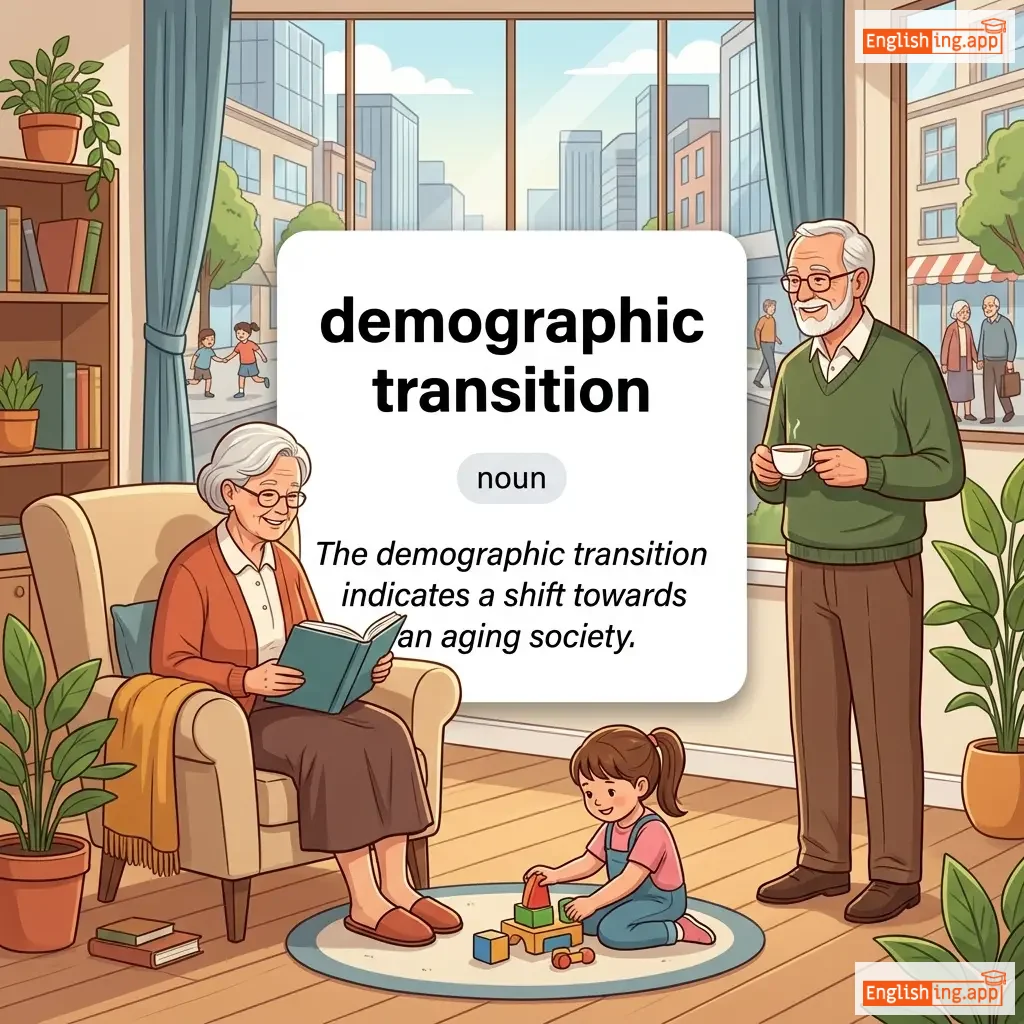
demographic transition definition card — visual illustration of the meaning
noun
ˌdɛməˈɡræfɪk trænˈzɪʃən
transition démographique (transition demographique)

A shift in population patterns from high birth and death rates to low birth and death rates as a country develops economically

"The demographic transition indicates a shift towards an aging society."

"La transition démographique indique un changement vers une société vieillissante." (La transition demographique indique un changement vers une societe vieillissante.)
Demographics definition card — visual illustration of the meaning
noun
/ˌdɛm.əˈɡræf.ɪks/
Démographie (Demographie)

Statistical data relating to the population and particular groups within it.

"Demographics help in targeted advertising."

"La démographie aide à la publicité ciblée." (La demographie aide a la publicite ciblee.)
verb
/dɪˈmɒlɪʃ/
démolir (demolir)

to destroy completely, especially a building or structure

"The city decided to demolish the old stadium to build a new one."

"La ville a décidé de démolir l'ancien stade pour en construire un nouveau." (La ville a décidé de démolir l'ancien stade pour en construire un nouveau.)
noun
/ˌdɛməˈlɪʃən/
démolition (demolition)

the act or process of destroying a building or structure

"The demolition of the old factory took several weeks."

"La démolition de l'ancienne usine a pris plusieurs semaines." (La démolition de l'ancienne usine a pris plusieurs semaines.)
noun
/ˈdiːmən/
démon (demon)

an evil spirit or devil

"The story was about a demon who haunted the village."

"L'histoire parlait d'un démon qui hantait le village." (L'histoire parlait d'un démon qui hantait le village.)
adjective
/dɪˈmoʊniˌæk/
démoniaque (demoniaque)

possessed, produced, or influenced by a demon; frenzied or violent

"The soldiers fought with demoniac fury."

"Les soldats ont combattu avec une furie démoniaque." (Les soldats ont combattu avec une furie démoniaque.)
adjective
/ˌdɛməˈnaɪəkəl/
démoniaque (demoniaque)

characteristic of or resembling a demon; wildly evil

"He gave a demoniacal laugh that terrified everyone."

"Il a donné un rire démoniaque qui a terrifié tout le monde." (Il a donne un rire demoniaque qui a terrifie tout le monde.)
adjective
/dɪˈmɒnstrəbl/
démontrable (demonstrable)

clearly able to be shown or proven

"There was demonstrable evidence that he was innocent."

"Il y avait des preuves démontrables qu'il était innocent." (Il y avait des preuves démontrables qu'il était innocent.)
verb
/ˈdɛmənˌstreɪt/
démontrer (demonstrer)

to clearly show or prove something through evidence, explanation, or action

"The teacher demonstrated the experiment to the class."

"Le professeur a démontré l'expérience à la classe." (Le professeur a démontré l'expérience à la classe.)
noun
/ˌdɛmənˈstreɪʃən/
manifestation, démonstration (manifestation, demonstration)

the act of showing something clearly, or a public protest

"The workers organized a demonstration for better wages."

"Les travailleurs ont organisé une manifestation pour de meilleurs salaires." (Les travailleurs ont organisé une manifestation pour de meilleurs salaires.)
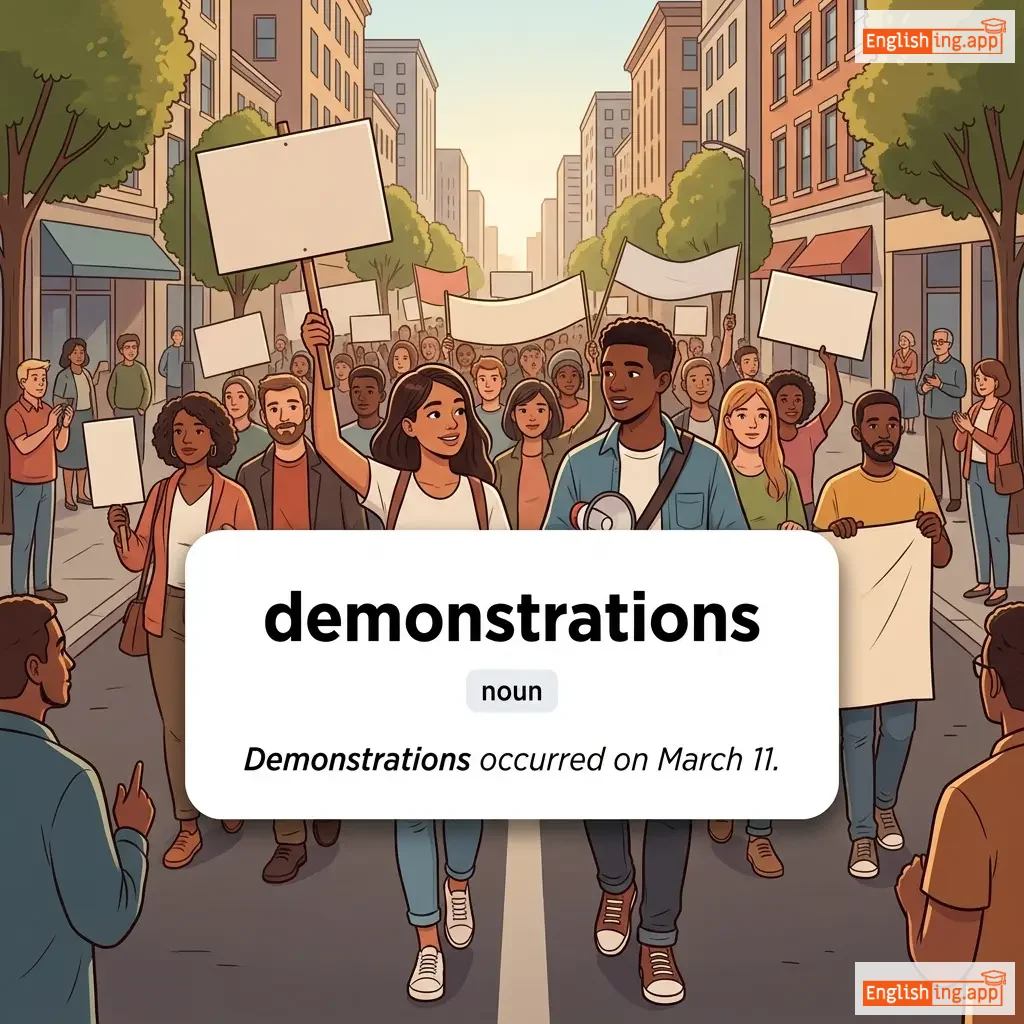
demonstrations definition card — visual illustration of the meaning
noun
ˌdemənˈstreɪʃənz
manifestations (manifestations)

The action or process of showing the existence or truth of something by giving proof or evidence.

"Demonstrations occurred on March 11."

"Des manifestations ont eu lieu le 11 mars." (Des manifestations ont eu lieu le 11 mars.)
adjective
/dɪˈmɒnstrətɪv/
expressif (expressif)

openly showing feelings, especially affection or emotion

"She was very demonstrative with her affection towards her friends."

"Elle était très expressive avec son affection envers ses amis." (Elle etait tres expressive avec son affection envers ses amis.)
noun
/ˈdɛmənˌstreɪtər/
démonstrateur, manifestant (demonstrateur, manifestant)

a person who shows how something works or takes part in a public protest

"The demonstrators marched peacefully through the city streets."

"Les manifestants ont défilé pacifiquement dans les rues de la ville." (Les manifestants ont défilé pacifiquement dans les rues de la ville.)
verb
/dɪˈmɔrəˌlaɪz/
démoraliser (démoraliser)

to cause someone to lose confidence or hope

"The constant criticism demoralized the young athlete."

"La critique constante a démoralisé le jeune athlète." (La critique constante a démoralisé le jeune athlète.)
verb
/dɪˈmoʊt/
rétrograder (retrograder)

to reduce to a lower rank or position

"The manager decided to demote the employee for poor performance."

"Le gestionnaire a décidé de rétrograder l'employé pour mauvaise performance." (Le gestionnaire a décidé de rétrograder l'employé pour mauvaise performance.)
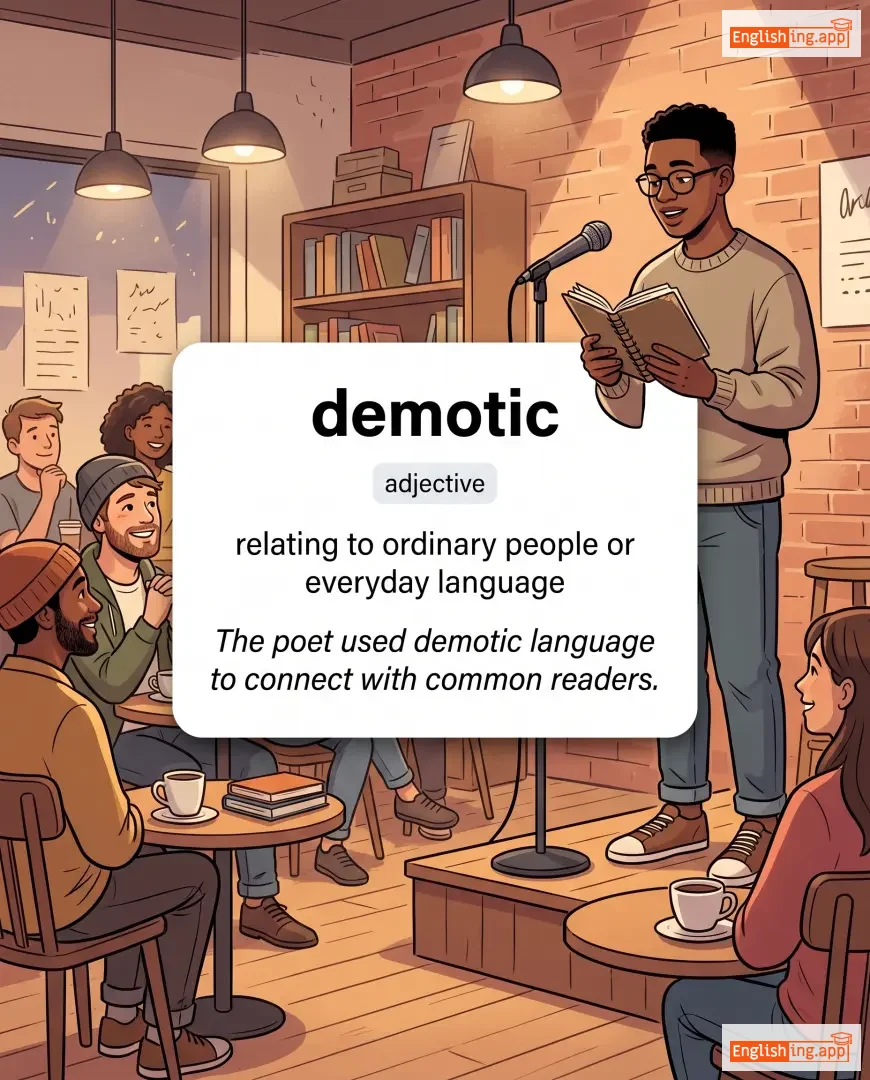
demotic definition card — visual illustration of the meaning
adjective
/dɪˈmɒtɪk/
relatif au langage populaire (relatif au langage populaire)

relating to ordinary people or everyday language

"The poet used demotic language to connect with common readers."

"Le poète a utilisé un langage relatif au langage populaire pour se connecter avec les lecteurs ordinaires." (Le poète a utilisé un langage relatif au langage populaire pour se connecter avec les lecteurs ordinaires.)
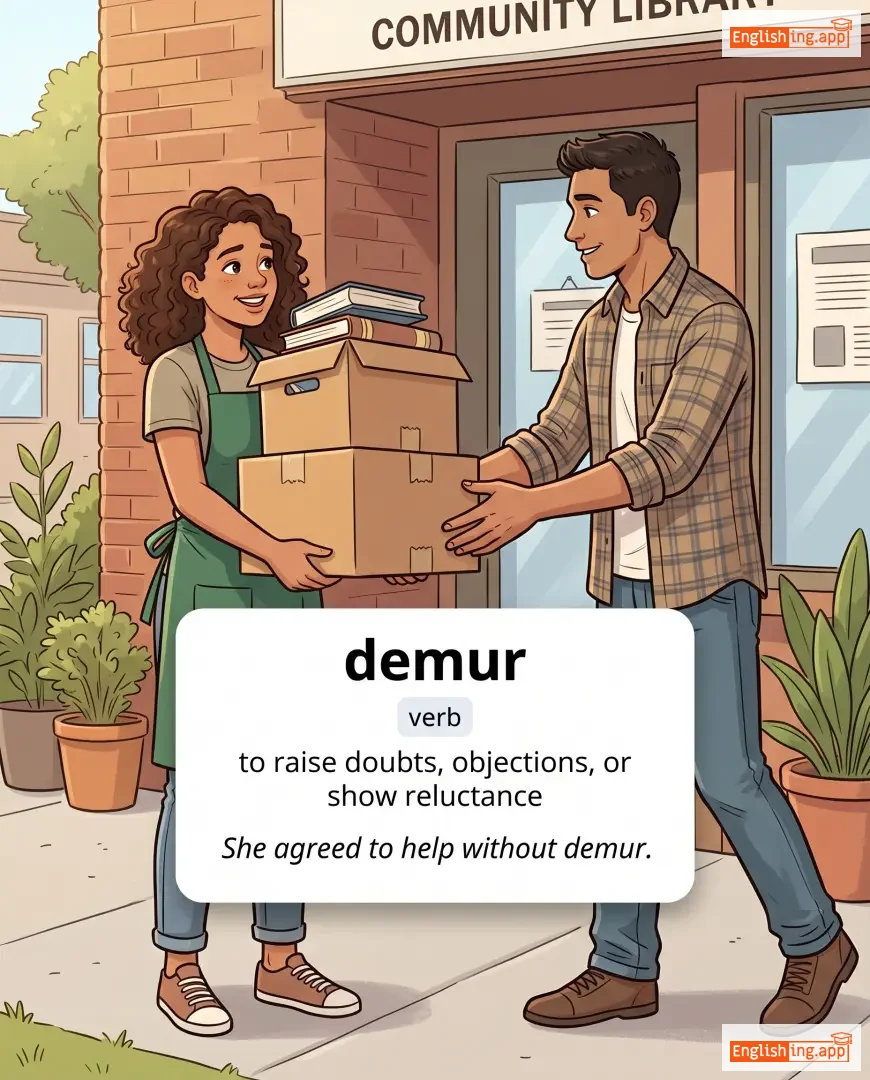
demur definition card — visual illustration of the meaning
verb
/dɪˈmɜːr/
objecter (objecter)

to raise doubts, objections, or show reluctance

"She agreed to help without demur."

"Elle accepta d'aider sans objection." (Elle accepta d'aider sans objection.)
adjective
/dɪˈmjʊər/
réservé (reserve)

reserved, modest, and shy

"She gave him a demure smile."

"Elle lui donna un sourire réservé." (Elle lui donna un sourire réservé.)
noun
/dɪˈmʌrɪdʒ/
démurrage (demurrage)

a charge payable to the owner of a ship or vehicle for not loading or unloading on time

"The company had to pay demurrage for delaying the unloading of goods."

"L'entreprise a dû payer des frais de démurrage pour avoir retardé le déchargement des marchandises." (L'entreprise a dû payer des frais de démurrage pour avoir retardé le déchargement des marchandises.)
noun
/den/
caverne, tanière (caverne, tanière)

a wild animal's lair or home; a small room used for relaxation

"The bear returned to its den for winter hibernation."

"L'ours est retourné dans sa tanière pour l'hibernation d'hiver." (L'ours est retourne dans sa taniere pour l'hibernation d'hiver.)
verb
/diːˈnæʃənəlaɪz/
dénationaliser (dénationaliser)

to transfer ownership from the government to private individuals or companies

"The government decided to denationalize the bank to encourage private investment."

"Le gouvernement a décidé de dénationaliser la banque pour encourager les investissements privés." (Le gouvernement a décidé de dénationaliser la banque pour encourager les investissements privés.)
adjective
/ˈdɛndrɔɪd/
en forme d'arbre (en forme d'arbre)

tree-shaped or branching like a tree

"The coral has a dendroid structure."

"Le corail a une structure dendroïde." (Le corail a une structure dendroïde.)
noun
/dɛnˈdrɒlədʒi/
dendrologie (dendrology)

the scientific study of trees and woody plants

"He is studying dendrology at the university."

"Il étudie la dendrologie à l'université." (Il etudie la dendrologie a l universite)
🙅‍♂️

Denial (di-na-yal)

noun
/dɪˈnaɪəl/
dénégation (denegation)

a statement that something is not true; the refusal to accept or believe something

"His denial of the accusations surprised everyone."

"Sa dénégation des accusations a surpris tout le monde." (sa denegation des accusations a surpris tout le monde.)
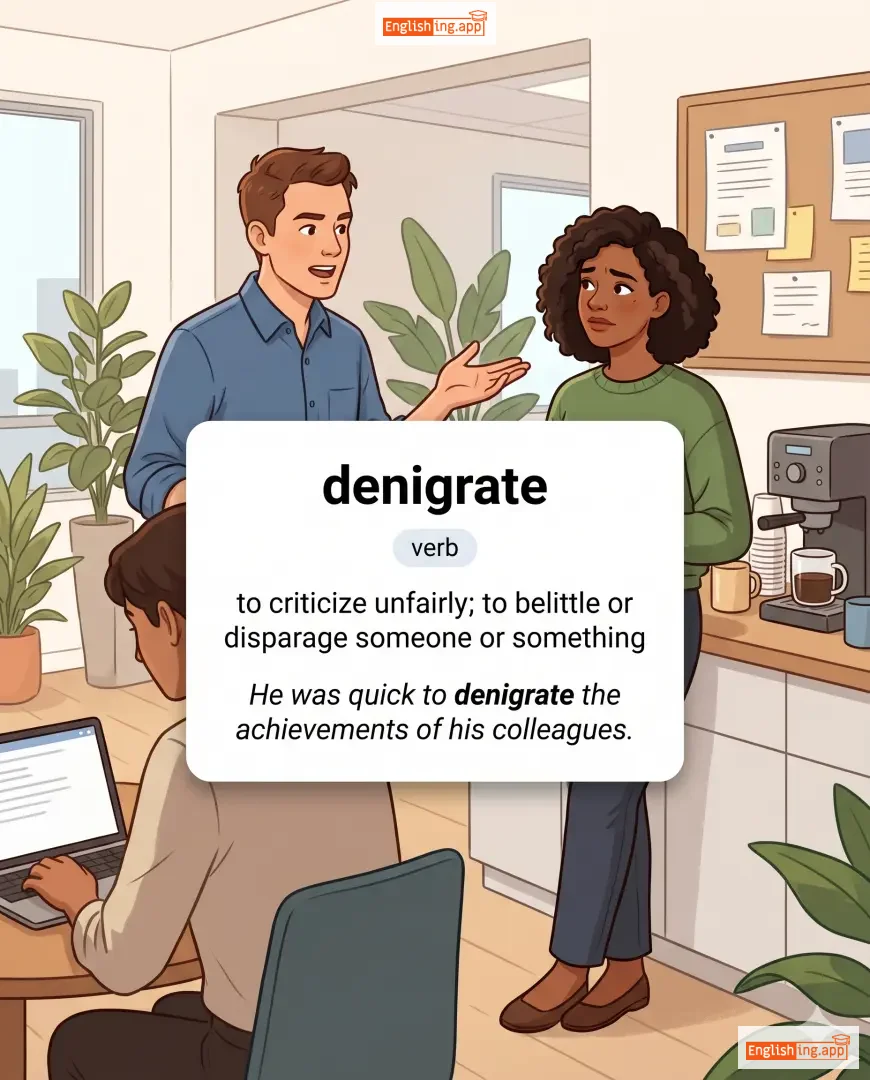
denigrate definition card — visual illustration of the meaning
verb
/ˈdɛnɪˌɡreɪt/
dénigrer (denigrer)

to criticize unfairly; to belittle or disparage someone or something

"He was quick to denigrate the achievements of his colleagues."

"Il était rapide à dénigrer les réalisations de ses collègues." (Il etait rapide a denigrer les realisations de ses collegues.)
noun
/ˈdɛnɪmz/
pantalons en denim (pantalon an denim)

pants or clothes made from denim fabric, usually jeans

"He wore blue denims with a white shirt."

"Il portait des pantalons en denim bleus avec une chemise blanche." (Il portait des pantalons en denim bleus avec une chemise blanche.)
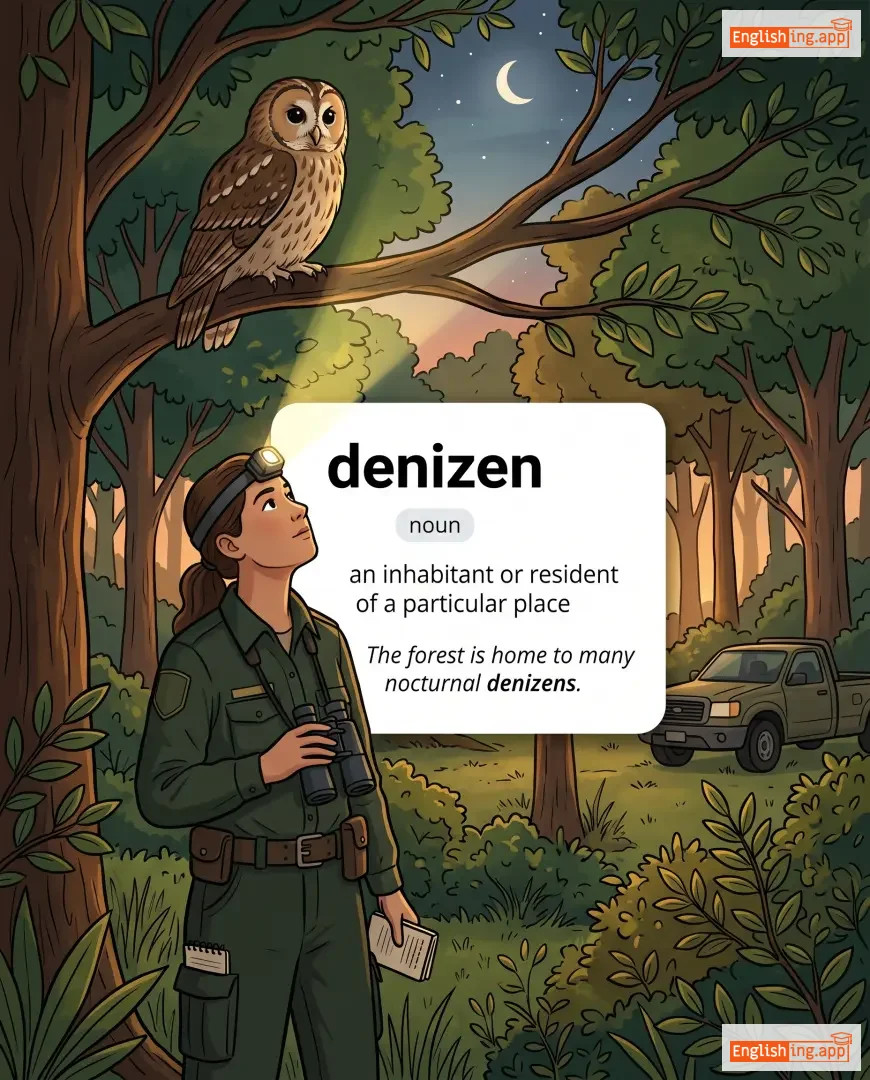
denizen definition card — visual illustration of the meaning
noun
/ˈdɛnɪzən/
habitant (habitant)

an inhabitant or resident of a particular place

"The forest is home to many nocturnal denizens."

"La forêt abrite de nombreux habitants nocturnes." (La forêt abrite de nombreux habitants nocturnes.)
verb
/dɪˈnɒmɪˌneɪt/
dénommer (denommer)

to give a name or designation to something

"The currency was denominated in dollars."

"La monnaie a été dénommée en dollars." (La monnaie a ete denommee en dollars.)
noun
/dɪˌnɒmɪˈneɪʃən/
dénomination, valeur (denomination, valeur)

a recognized autonomous branch of the Christian Church; a unit of value or currency

"The church belongs to a Protestant denomination."

"L'église appartient à une dénomination protestante." (L'eglise appartient a une denomination protestante.)
noun
/dɪˈnɒmɪˌneɪtər/
dénominateur (denominateur)

the number below the line in a fraction; a common factor in a situation

"In the fraction 3/4, the number 4 is the denominator."

"Dans la fraction 3/4, le nombre 4 est le dénominateur." (Dans la fraction 3/4, le nombre 4 est le denominateur.)
noun
/ˌdiːnəʊˈteɪʃən/
dénotation (denotation)

The literal or primary meaning of a word, in contrast to the feelings or ideas that the word suggests.

"The denotation of the word 'rose' is a type of flower."

"La dénotation du mot 'rose' est un type de fleur." (La denotation du mot 'rose' est un type de fleur.)
verb
/dɪˈnəʊt/
dénoter (denoter)

To be a sign of; to indicate or mean something.

"A red flag denotes danger."

"Un drapeau rouge dénote un danger." (Un drapeau rouge dénote un danger.)
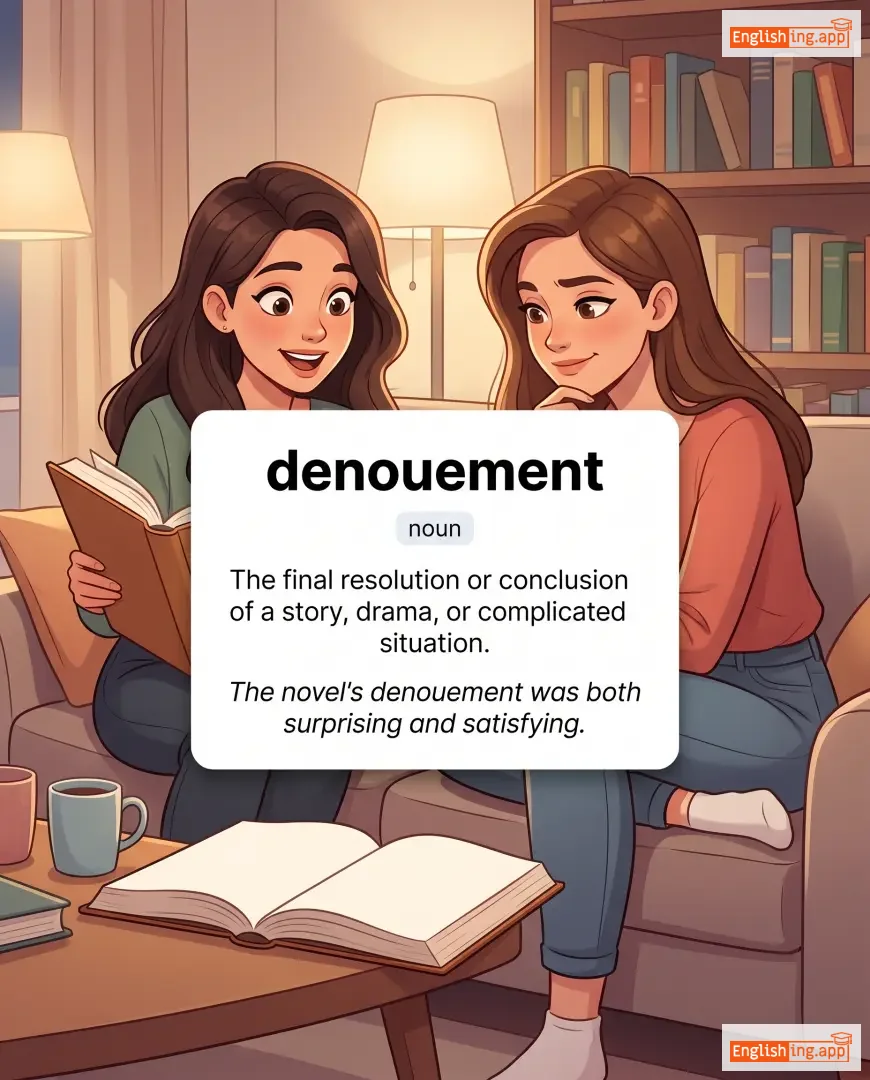
denouement definition card — visual illustration of the meaning
noun
/ˌdeɪnuːˈmɒ̃/
dénouement (denouement)

The final resolution or conclusion of a story, drama, or complicated situation.

"The novel's denouement was both surprising and satisfying."

"Le dénouement du roman était à la fois surprenant et satisfaisant." (Le denouement du roman etait a la fois surprenant et satisfaisant.)
verb
/dɪˈnaʊns/
dénoncer (dénoncer)

To publicly declare something to be wrong, evil, or condemn strongly.

"The leader denounced corruption in his speech."

"Le leader a dénoncé la corruption dans son discours." (Le leader a dénoncé la corruption dans son discours.)
adjective
/dɛns/
dense (dense)

Closely compacted in substance; having parts crowded together.

"The forest was so dense that little sunlight reached the ground."

"La forêt était tellement dense que la lumière du soleil atteignait à peine le sol." (La forêt était tellement dense que la lumière du soleil atteignait à peine le sol.)
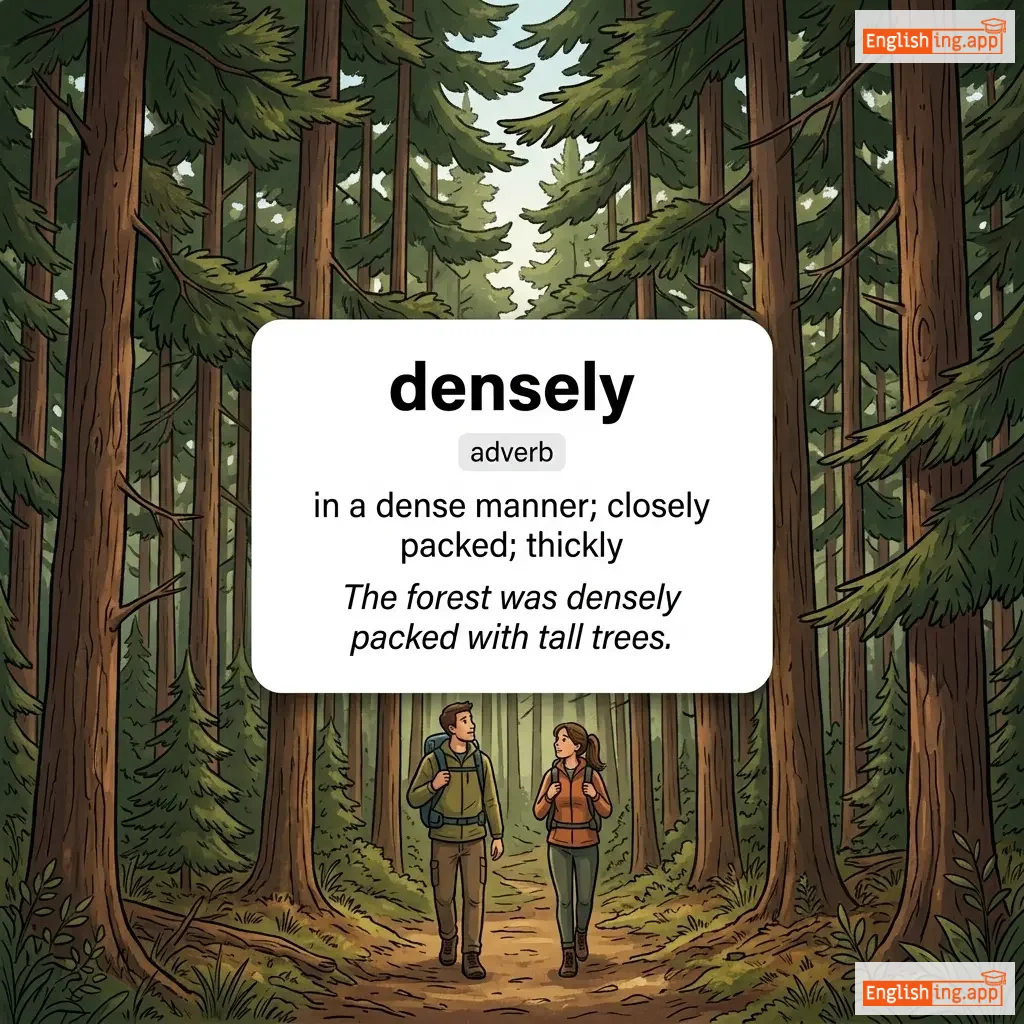
densely definition card — visual illustration of the meaning
adverb
/ˈdens.li/
densément; de manière dense; fortement packé (densement; de manière dense; fortement packé)

in a dense manner; closely packed; thickly

"The forest was densely packed with tall trees."

"La forêt était densément remplie d'arbres hauts." (La foret etait densment remplie d'arbres hauts)
noun
/ˈdɛnsɪti/
densité (densite)

the degree of compactness or thickness of a substance or object

"The density of water is higher than that of air."

"La densité de l'eau est plus élevée que celle de l'air." (La densite de l'eau est plus elevee que celle de l'air.)
noun/verb
/dɛnt/
bosse (bosse)

a small hollow mark on the surface of something; to make a small hollow mark

"The accident left a dent in the car door."

"L'accident a laissé une bosse dans la porte de la voiture." (L'accident a laissé une bosse dans la porte de la voiture.)
adjective
/ˈdɛntəl/
dentaire (dentaire)

relating to teeth or dentistry

"She goes for a dental checkup every six months."

"Elle fait un contrôle dentaire tous les six mois." (elle fait un controle dentaire tous les six mois)
noun
/ˈdɛntɪfrɪs/
dentifrice (dentifris)

a substance such as powder, paste, or liquid used to clean teeth

"He bought a new herbal dentifrice from the pharmacy."

"Il a acheté un nouveau dentifrice à base de plantes à la pharmacie." (Il a acheté un nouveau dentifrice à base de plantes à la pharmacie.)
noun
/ˈden.tɪst/
dentiste (dentiste)

a medical professional who treats teeth and oral health

"I need to visit the dentist for a regular checkup."

"Je dois rendre visite au dentiste pour un contrôle régulier." (Je dois rendre visite au dentiste pour un controle regulier)
verb
/dɪˈnjuːd/
dénuder (denuder)

to strip something of its covering, possessions, or assets

"The forest was denuded of trees by illegal logging."

"La forêt a été dénudée d'arbres par l'abattage illégal." (La foret a ete denudee d'arbres par l'abattage illegal.)
noun
/dɪˌnʌnsiˈeɪʃən/
dénonciation / accusation publique (denonciation / accusation publique)

the public condemnation or accusation of someone or something

"The journalist's article was a strong denunciation of corruption."

"L'article du journaliste était une forte dénonciation de la corruption." (L'article du journaliste etait une forte denonciation de la corruption.)
verb
/dɪˈnaɪ/
nier (nier)

to refuse to accept or admit something; to declare something untrue

"He denied stealing the money."

"Il a nié avoir volé l'argent." (Il a nié avoir volé l'argent.)
noun
/diˈoʊ.dər.ənt/
déodorant (deodorant)

a substance that removes or conceals unpleasant smells, especially bodily odors

"She applied deodorant before going to the gym to stay fresh during workout."

"Elle a appliqué du déodorant avant d'aller à la salle de sport pour rester fraîche pendant l'entraînement." (Elle a appliqué du déodorant avant d'aller à la salle de sport pour rester fraîche pendant l'entraînement.)