Vocabulaires

Découvrez, apprenez et maîtrisez le vocabulaire anglais

noun
/hɪp/
hanche (hanche)

The part of the body on either side of the pelvis, or informal: trendy and fashionable.

"She put her hands on her hips."

"Elle a mis ses mains sur ses hanches." (Elle a mis ses mains sur ses hanches.)
noun
/ˌhɪp.əˈpɒt.ə.məs/
hippopotame (hippopotam)

a large, mostly herbivorous mammal that lives in and around water in Africa

"The hippopotamus spends most of its day in the water."

"L'hippopotame passe la plupart de sa journée dans l'eau." (L'hippopotame passe la plupart de sa journee dans l'eau)
hire definition card — visual illustration of the meaning
verb
/ˈhaɪə(r)/
embaucher (embaucher)

to employ someone for a job or task

"The company decided to hire more staff this year."

"L'entreprise a décidé d'embaucher plus de personnel cette année." (L'entreprise a décidé d'embaucher plus de personnel cette année.)
noun
/ˈhaɪərlɪŋ/
mercenaire (mercenaire)

A person who works for payment only, often with little loyalty or principle.

"The mercenary was dismissed as just a hireling with no real loyalty."

"Le mercenaire a été renvoyé en tant que simple hireling sans véritable loyauté." (Le mercenaire a été renvoyé en tant que simple hireling sans véritable loyauté.)
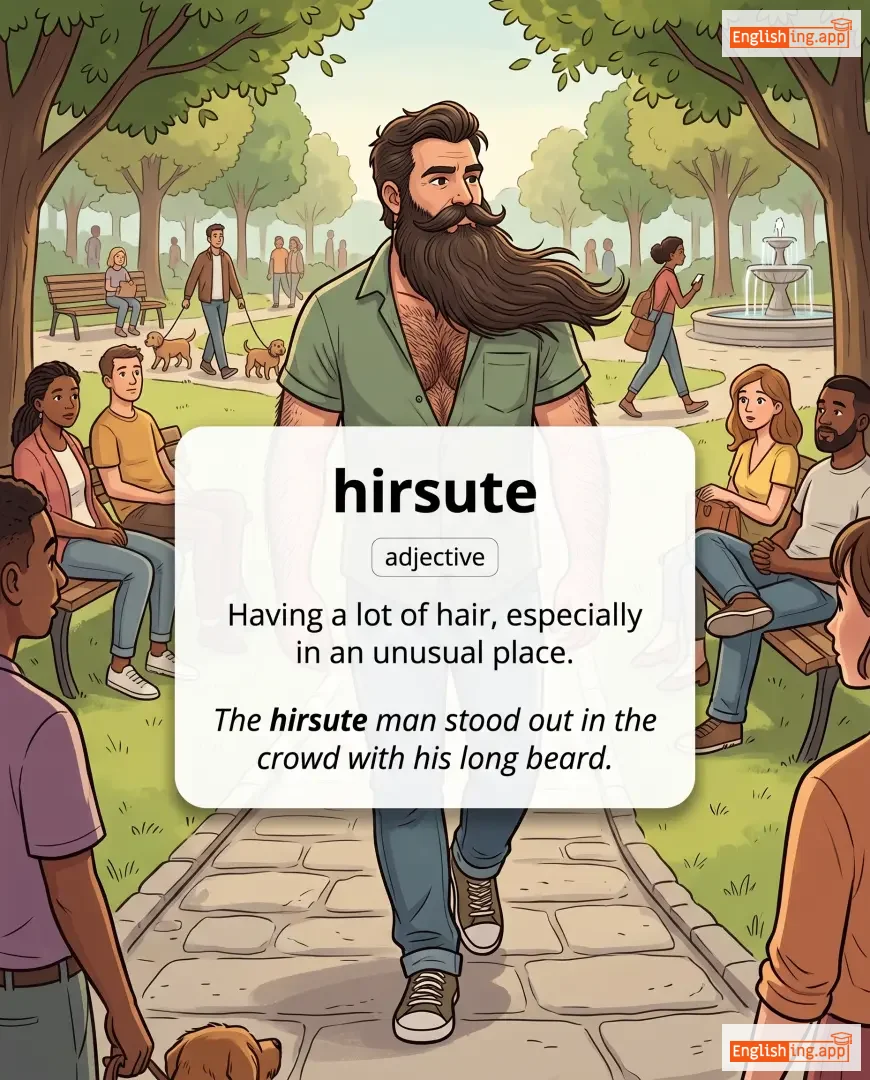
hirsute definition card — visual illustration of the meaning
adjective
/ˈhɜːrsuːt/
hirsute (hursyoot)

Having a lot of hair, especially in an unusual place.

"The hirsute man stood out in the crowd with his long beard."

"L'homme hirsute se démarquait de la foule avec sa longue barbe." (L homme hirsute se demarquait de la foule avec sa longue barbe)
pronoun
/hɪz/
son (son)

belonging to or associated with a male person previously mentioned

"This is his book on the table."

"C'est son livre sur la table." (C'est son livre sur la table.)
adjective
/hɪˈspænɪk/
hispanique / parlant espagnol (hispanique / parlant espagnol)

relating to Spain or Spanish-speaking countries, especially Latin America.

"She studies Hispanic culture and language."

"Elle étudie la culture et la langue hispanique." (Elle etudie la culture et la langue hispanique.)
noun
/hɪˈstɔːriən/
historien (historien)

a person who studies or writes about history

"The historian gave a lecture on ancient civilizations."

"L'historien a donné une conférence sur les civilisations anciennes." (L'historien a donné une conférence sur les civilisations anciennes.)
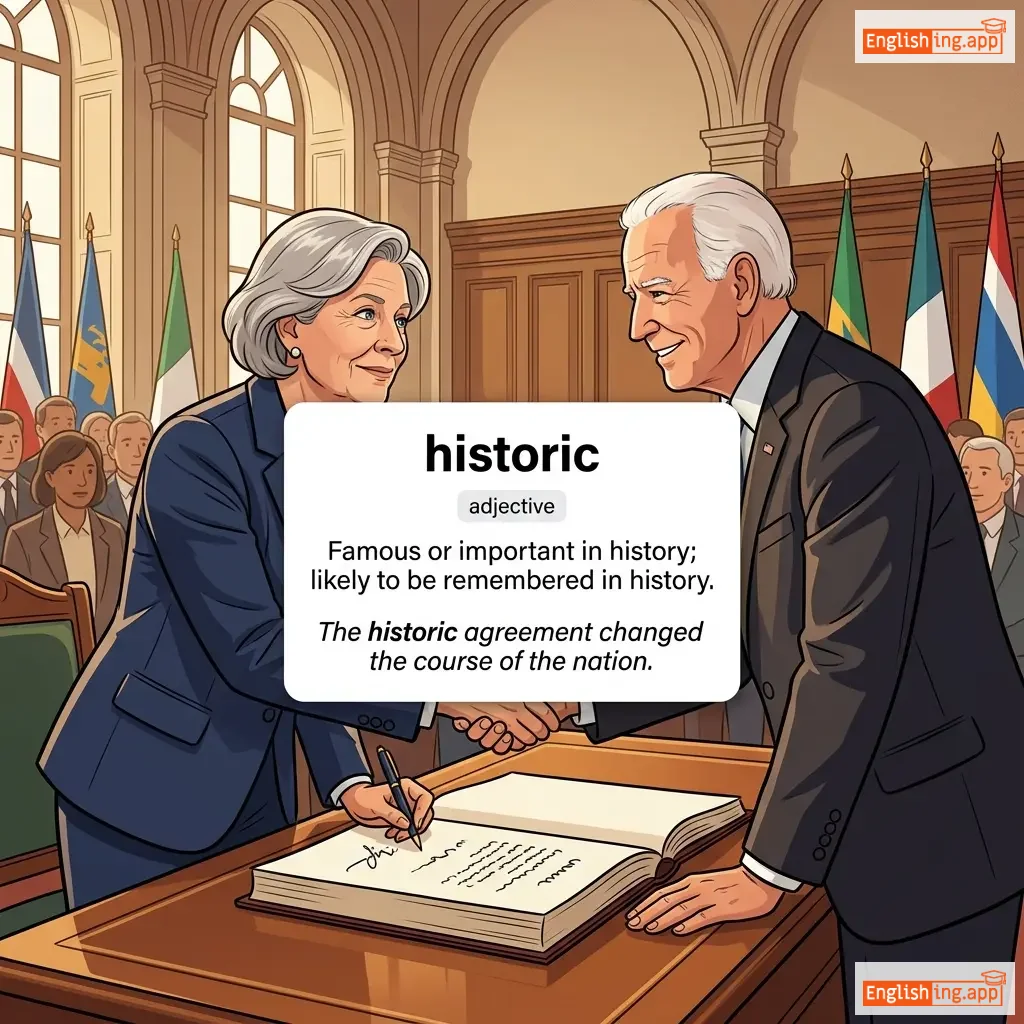
historic definition card — visual illustration of the meaning
adjective
/hɪˈstɔːrɪk/
historique (historique)

Famous or important in history; likely to be remembered in history.

"The historic agreement changed the course of the nation."

"L'accord historique a changé le cours de la nation." (L'accord historique a change le cours de la nation.)
adjective
/hɪˈstɔːrɪkəl/
historique (historique)

Related to history or past events.

"The museum has a large collection of historical documents."

"Le musée possède une grande collection de documents historiques." (Le musee possede une grande collection de documents historiques.)
adverb
/hɪˈstɒrɪkli/
historiquement (historiquement)

in a way that relates to history or past events

"Historically, this city was a major trade center."

"Historiquement, cette ville était un centre commercial majeur." (Historiquement, cette ville etait un centre commercial majeur.)
History definition card — visual illustration of the meaning
noun
/ˈhɪstəri/
histoire (histoire)

the study of past events

"She is studying the history of medieval Europe."

"Elle étudie l'histoire de l'Europe médiévale." (Elle etudie l'histoire de l'Europe medievale.)
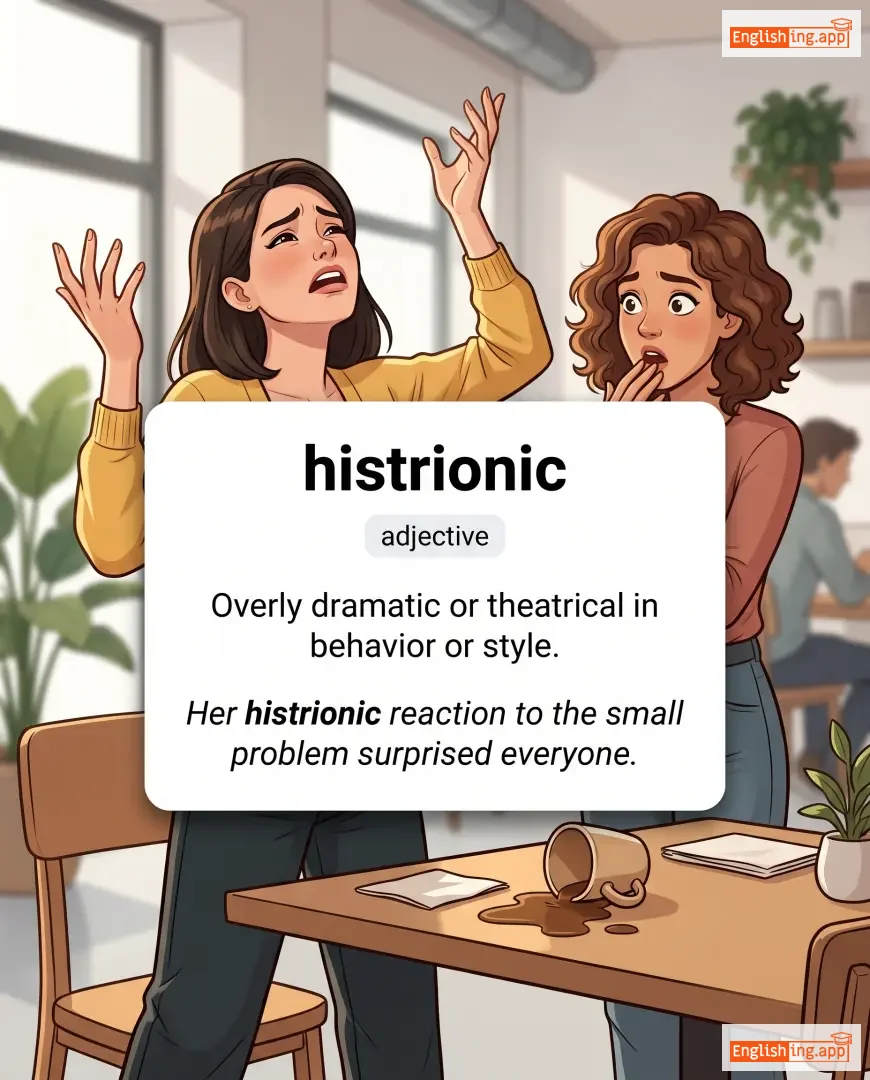
histrionic definition card — visual illustration of the meaning
adjective
/ˌhɪstriˈɒnɪk/
excessivement dramatique (excesiveman dramatik)

Overly dramatic or theatrical in behavior or style.

"Her histrionic reaction to the small problem surprised everyone."

"Sa réaction histrionique au petit problème a surpris tout le monde." (sa reaksyon histrionik o pe petit problam a supri tou le mond.)
verb
/hɪt/
frapper (frapper)

to strike someone or something with force

"He accidentally hit the ball into the window."

"il a accidentellement frappé la balle contre la fenêtre." (Il a accidentellement frappé la balle contre la fenêtre.)
noun
/haɪv/
ruche (ruche)

A structure where bees live and produce honey; also a place full of busy activity.

"The office was a hive of activity before the deadline."

"Le bureau était une ruche d'activité avant la date limite." (Le bureau était une ruche d'activité avant la date limite.)
verb
/hɔːrd/
amasser (amasser)

to accumulate and hide away a large supply of something, often secretly

"During the crisis, many people began to hoard food and water."

"Pendant la crise, de nombreuses personnes ont commencé à stocker de la nourriture et de l'eau." (Pendant la crise, de nombreuses personnes ont commencé à stocker de la nourriture et de l'eau.)
adjective
/hɔːrs/
rauque (rauke)

having a rough, harsh, or weak voice, often due to illness or shouting

"After shouting all day at the rally, his voice was hoarse."

"Après avoir crié toute la journée lors du rassemblement, sa voix était rauque." (Aprés avoir crié toute la journée lors du rassemblement, sa voix était rauque.)
adjective
/ˈhɔːri/
gris, ancien (gris, ancien)

gray or white with age; very old and respected

"The hoary oak tree stood as a witness to centuries of history."

"Le vieux chêne se tenait comme témoin de siècles d'histoire." (Le vieux chêne se tenait comme témoin de siècles d'histoire.)
noun
/hoʊks/
canular, tromperie (canular, tromperie)

a trick or false story meant to deceive people

"The news about aliens landing turned out to be a hoax."

"Les nouvelles sur les extraterrestres qui atterrissent se sont révélées être un canular." (Les nouvelles sur les extraterrestres qui atterrissent se sont revelees etre un canular.)
verb
/ˈhɑːbəl/
boiter (boiter)

to walk awkwardly with difficulty, usually due to injury

"He hobbled across the room after twisting his ankle."

"Il boitait à travers la pièce après s'être tordu la cheville." (Il boitait à travers la pièce après s'être tordu la cheville.)
noun
/ˈhɑː.bi/
loisir; activité récréative; passe-temps (loisir, activite recreative, passe-temps)

an activity done regularly in one's leisure time for pleasure; a pastime or recreation

"Photography became her favorite hobby after she received a camera for her birthday."

"La photographie est devenue son hobby préféré après avoir reçu un appareil photo pour son anniversaire." (La photographie est devenue son hobby prefere apres avoir recu un appareil photo pour son anniversaire.)
noun
/ˈhɒki/
hockey (hockey)

a sport played with sticks and a ball or puck on ice or a field

"He plays hockey for the national team."

"Il joue au hockey pour l'équipe nationale." (Il joue au hockey pour l'equipe nationale.)
noun
/ˈhɒdʒ.pɒdʒ/
mélange confus (melange confus)

A confusing mixture of different things; a jumble.

"The essay was a hodgepodge of unrelated ideas."

"L'essai était un mélange confus d'idées non liées." (L'essai était un mélange confus d'idées non liées.)
noun
/hoʊ/
binette (binette)

a gardening tool with a thin metal blade used for breaking up soil and removing weeds

"The farmer used a hoe to remove weeds from his vegetable garden."

"Le fermier a utilisé une binette pour enlever les mauvaises herbes de son jardin de légumes." (Le fermier a utilisé une binette pour enlever les mauvaises herbes de son jardin de légumes.)
noun
/hɔːɡ plʌm/
prune de hog (prune de hog)

tropical fruit with yellow skin and sour taste

"Hog plums are often used to make pickles and chutneys."

"Les prunes de hog sont souvent utilisées pour faire des cornichons et des chutneys." (Les prunes de hog sont souvent utilisees pour faire des cornichons et des chutneys.)
noun
/ˈhɒɡz.hɛd/
grand fût (grand fut)

A large cask or barrel, traditionally used for storing liquids like wine or beer.

"The cellar was filled with hogsheads of ale."

"La cave était remplie de grands fûts de bière." (La cave était remplie de grands futs de bière.)
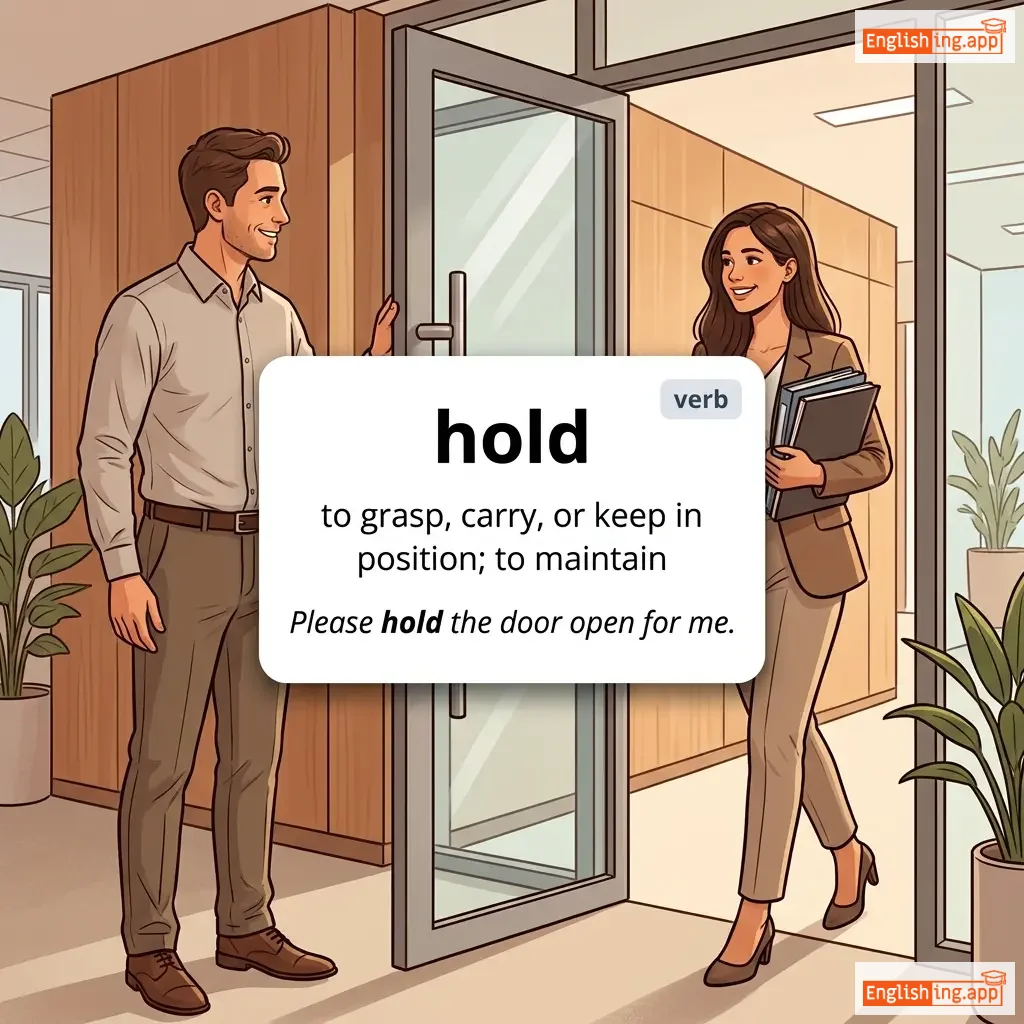
hold definition card — visual illustration of the meaning
verb
/hoʊld/
tenir (tenir)

to grasp, carry, or keep in position; to maintain

"Please hold the door open for me."

"Veuillez tenir la porte ouverte pour moi." (Veuillez tenir la porte ouverte pour moi.)
🕳️

Hole (hol)

noun
/hoʊl/
trou (trou)

an opening, gap, or hollow place in a solid surface

"There is a hole in my shirt."

"Il y a un trou dans ma chemise." (Il y a un trou dans ma chemise.)
noun
/ˈhɒlɪdeɪ/
vacances (vacances)

A day of celebration or rest when most people do not work.

"We are planning a trip during the summer holiday."

"Nous prévoyons un voyage pendant les vacances d'été." (nous prevoyons un voyage pendant les vacances d'ete.)
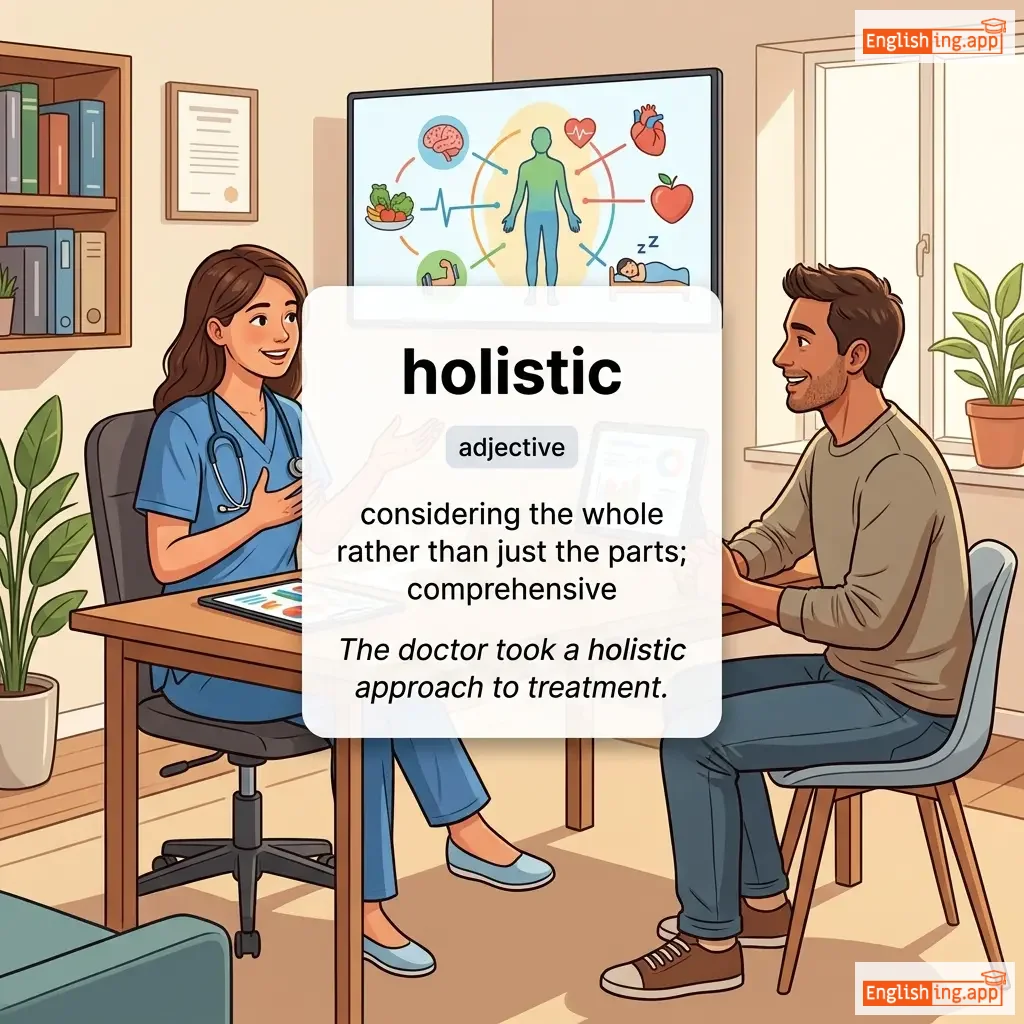
holistic definition card — visual illustration of the meaning
adjective
/hoʊˈlɪstɪk/
holistique (holistique)

considering the whole rather than just the parts; comprehensive

"The doctor took a holistic approach to treatment."

"Le médecin a adopté une approche holistique du traitement." (Le medecin a adopte une approche holistique du traitement.)
adjective
/ˈhɑlːoʊ/
creux; vide; (krö; veed;)

having an empty space inside; lacking substance or meaning; insincere

"The hollow tree trunk provided shelter for small animals."

"L'arbre creux a fourni un abri pour les petits animaux." (L'arbre creux a fourni un abri pour les petits animaux.)
noun
/ˈhɒl.ə.kɔːst/
holocauste (holocauste)

A large-scale destruction, especially by fire; historically, the genocide of Jews during World War II.

"Millions of people perished during the Holocaust."

"Des millions de personnes ont péri pendant l'Holocauste." (Des millions de personnes ont péri pendant l'Holocauste.)
noun
/ˈhoʊl.stər/
étui (etui)

A holder or case for carrying a gun, typically worn on a belt or shoulder.

"The sheriff kept his revolver in a leather holster."

"Le shérif gardait son revolver dans un étui en cuir." (Le sherif gardait son revolver dans un etui en cuir.)
adjective
/ˈhoʊli/
sacré (sacre)

Dedicated to God or a religious purpose; sacred.

"This temple is considered a holy place."

"Ce temple est considéré comme un lieu sacré." (Ce temple est considéré comme un lieu sacré.)
noun
/ˈhɒm.ɪdʒ/ or /ˈɑː.mɑːʒ/
hommage (hommage)

Special honor, respect, or tribute shown publicly.

"The statue was built as an homage to the national hero."

"La statue a été construite comme un hommage au héros national." (La statue a ete construite comme un hommage au heros national.)
noun
/hoʊm/
maison (maison)

the place where one lives, especially with family; a residence

"She finally returned home after a long journey."

"Elle est enfin rentrée chez elle après un long voyage." (Elle est enfin rentrée chez elle après un long voyage.)
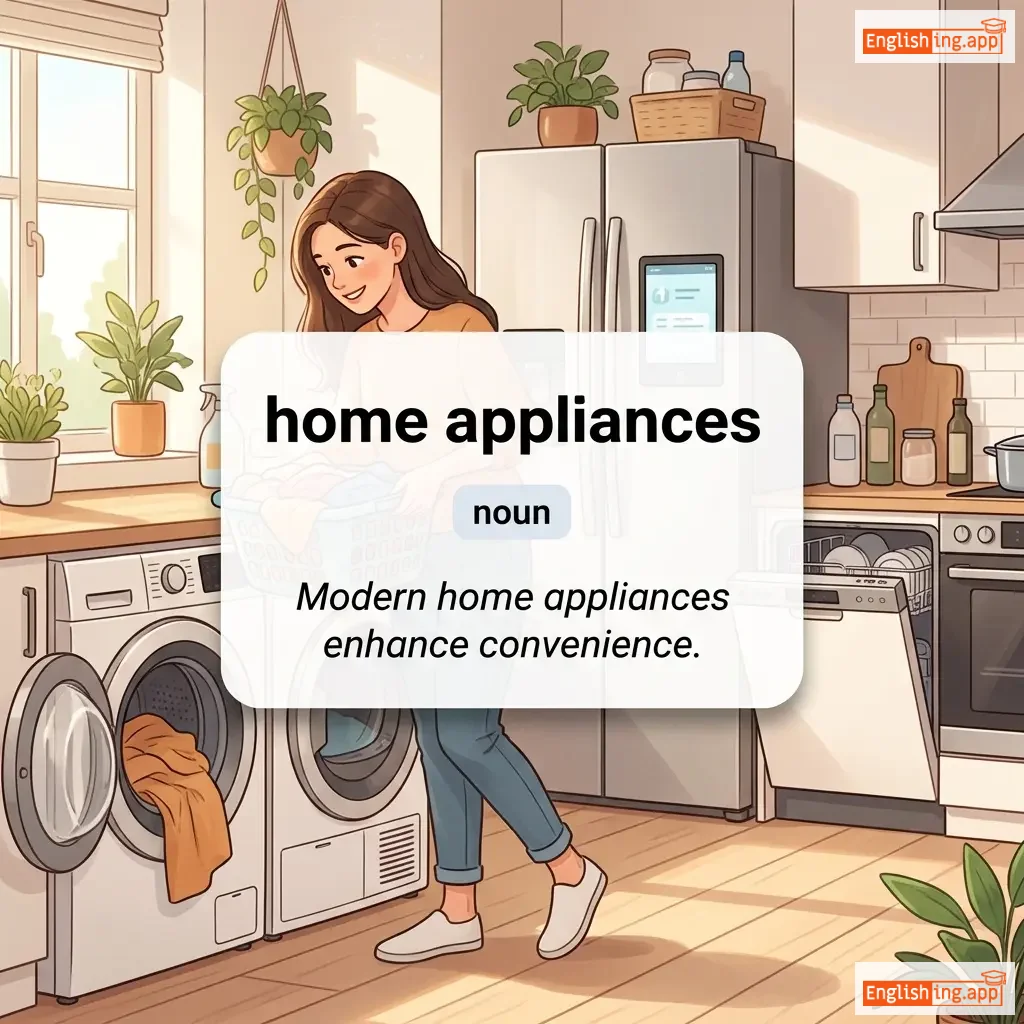
home appliances definition card — visual illustration of the meaning
noun
hoʊm əˈplaɪ.ənsɪz
appareils électroménagers (appareils électroménagers)

Electrical devices and machines used in households for daily tasks and convenience.

"Modern home appliances enhance convenience."

"Les appareils électroménagers modernes améliorent la commodité." (Les appareils électroménagers modernes améliorent la commodité.)
noun
/hoʊm ˈdɪstrɪkt/
district d’origine (district d'origine)

the district where a person was born or originally comes from

"He returned to his home district after many years abroad."

"Il est retourné dans son district d’origine après de nombreuses années à l’étranger." (Il est retourne dans son district d'origine apres de nombreuses annees a l'etranger)
noun
/ˈhoʊmlænd/
pays natal (pays natal)

a person's native country or region

"She returned to her homeland after ten years abroad."

"Elle est retournée dans son pays natal après dix ans à l'étranger." (Elle est retourne dans son pays natal apres dix ans a l'etranger.)
adjective
/ˈhoʊmləs/
sans-abri (sans-abri)

Without a home, and therefore typically living on the streets.

"The organization helps homeless people find shelter."

"L'organisation aide les sans-abri à trouver un abri." (L'organisation aide les sans-abri à trouver un abri.)
adjective
/ˈhoʊmli/
simple (simple)

Plain or unattractive in appearance; simple and comfortable in style or character.

"Despite being homely, the cottage felt warm and welcoming."

"Malgré son aspect simple, le chalet était chaleureux et accueillant." (Malgré son aspect simple, le chalet était chaleureux et accueillant.)
noun
/ˌhoʊmiˈɑːpəθi/
homéopathie (homeopathy)

a system of alternative medicine based on treating diseases with highly diluted substances

"He believes in homeopathy for treating common colds."

"Il croit en l'homéopathie pour traiter les rhumes." (Il croit en l'homéopathie pour traiter les rhumes.)
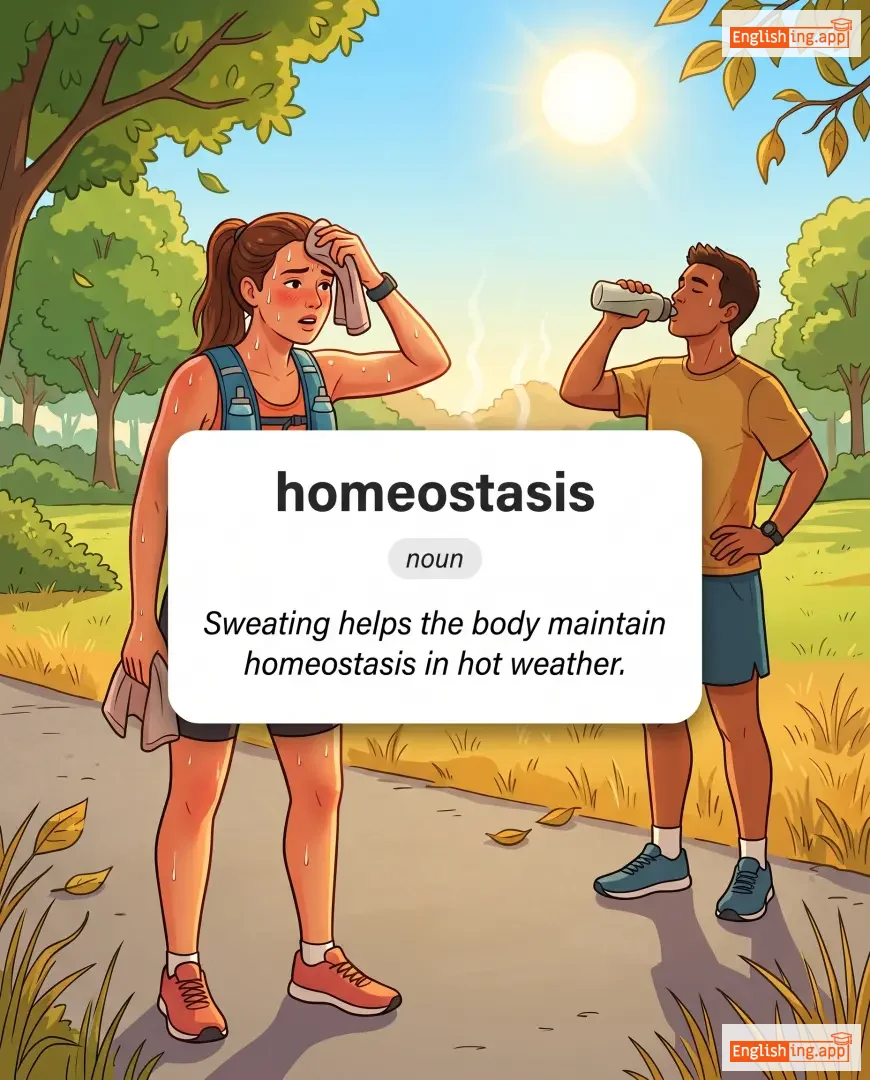
homeostasis definition card — visual illustration of the meaning
noun
/ˌhoʊmi.oʊˈsteɪsɪs/
homéostasie (homeostasie)

The ability of a living system or organism to maintain internal stability despite changes in external conditions.

"Sweating helps the body maintain homeostasis in hot weather."

"La sueur aide le corps à maintenir l'homéostasie par temps chaud." (La sueur aide le corps a maintenir l'homéostasie par temps chaud.)
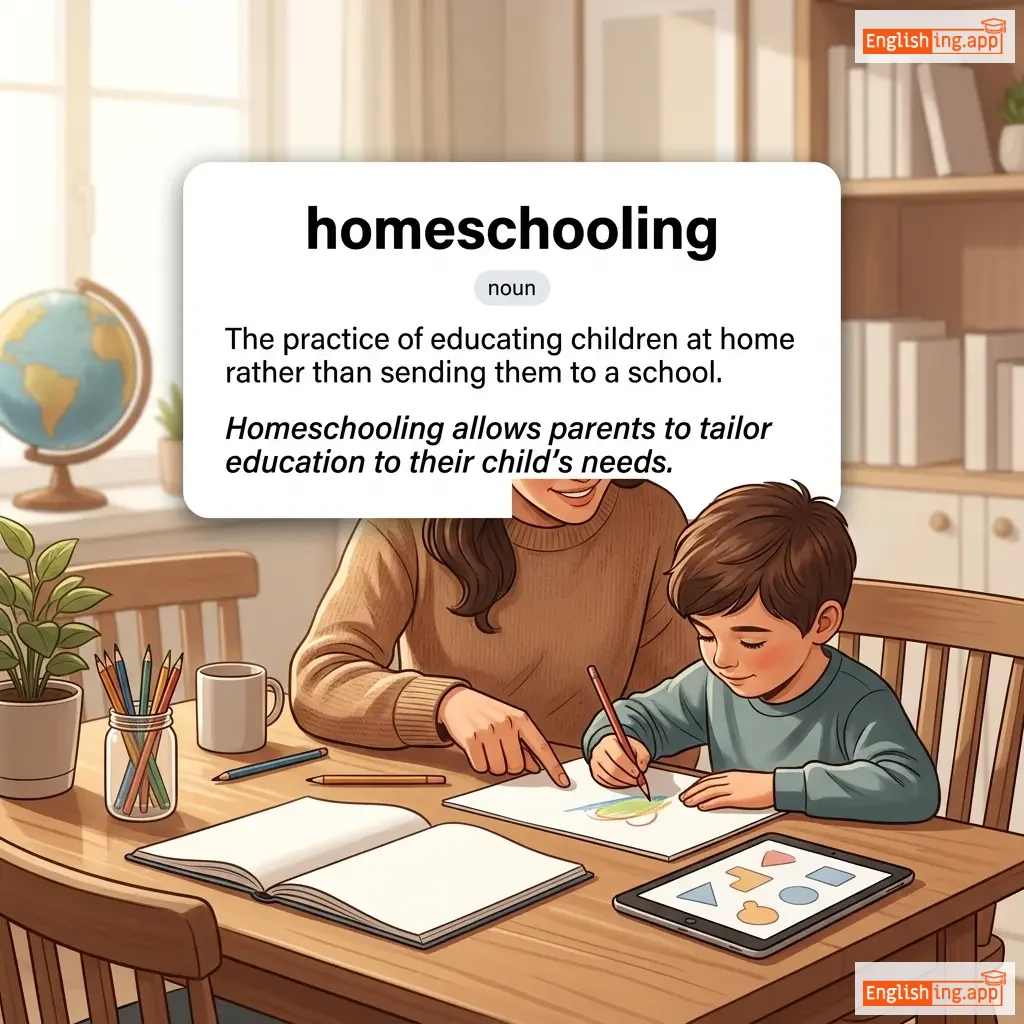
homeschooling definition card — visual illustration of the meaning
noun
ˈhoʊmˌskuː.lɪŋ
école à domicile (ecole a domicile)

The practice of educating children at home rather than sending them to a school.

"Homeschooling allows parents to tailor education to their child's needs."

"L'école à domicile permet aux parents d'adapter l'éducation aux besoins de leur enfant." (L'ecole a domicile permet aux parents d'adapter l'education aux besoins de leur enfant.)
adjective
/ˈhoʊmˌsɪk/
nostalgique; manquer de chez soi, de la famille (nostalgique; manquer de chez soi, de la famille)

feeling sad because you are away from home; longing for one's home and family

"She felt homesick during her first week at college."

"Elle s'est sentie nostalgique pendant sa première semaine à l'université." (Elle s'est sentie nostalgique pendant sa première semaine à l'université.)
adjective
/ˈhoʊm.spʌn/
fait maison (fait maison)

Simple and unsophisticated; made at home rather than in a factory.

"She wore a homespun dress to the village festival."

"Elle portait une robe faite maison au festival du village." (Elle portait une robe faite maison au festival du village.)
noun
/ˈhoʊmwɜːrk/
devoir (devoir)

schoolwork that a student does at home

"I need to finish my math homework before dinner."

"Je dois terminer mes devoirs de mathématiques avant le dîner." (Je dois terminer mes devoirs de mathématiques avant le dîner.)
noun
/ˈhɑːmɪsaɪd/
meurtre (meurtre)

the killing of one human being by another

"The police are investigating a case of homicide."

"La police enquête sur un cas de meurtre." (La police enquete sur un cas de meurtre.)
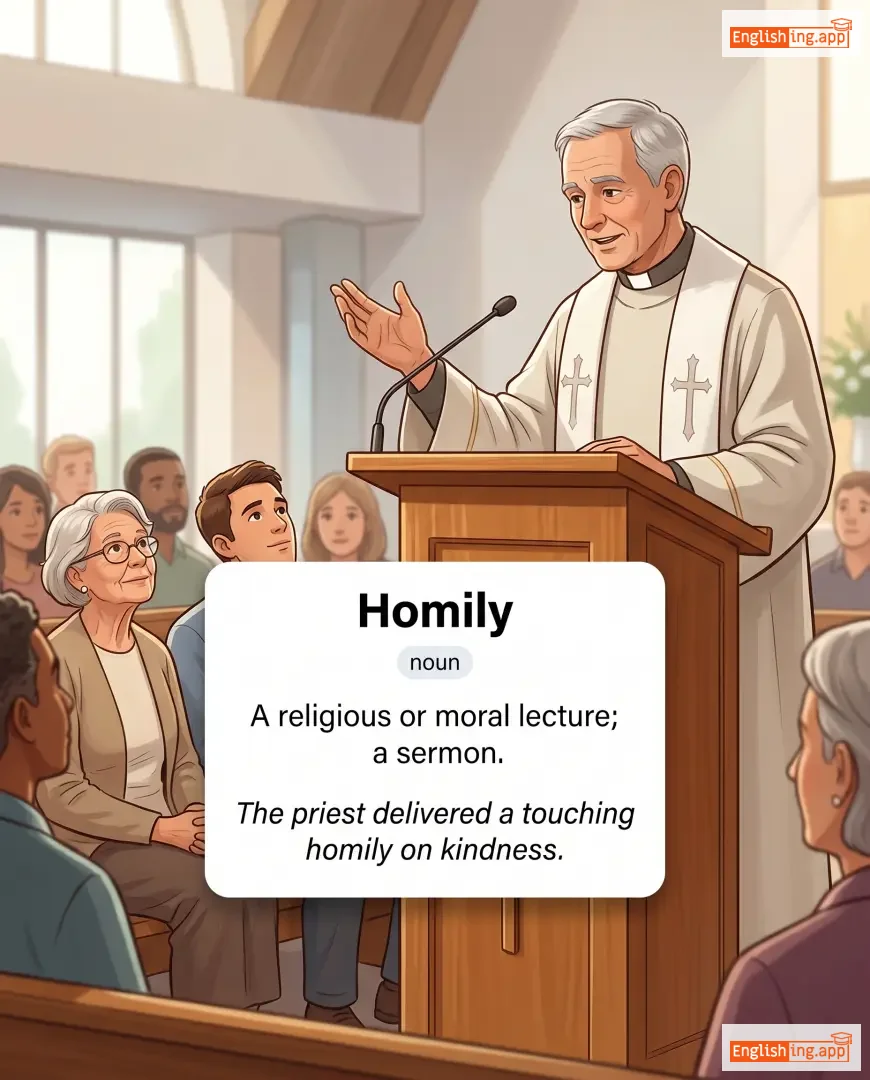
Homily definition card — visual illustration of the meaning
noun
/ˈhɑː.mə.li/
homélie (homelie)

A religious or moral lecture; a sermon.

"The priest delivered a touching homily on kindness."

"Le prêtre a prononcé une homélie émouvante sur la gentillesse." (Le prêtre a prononcé une homélie émouvante sur la gentillesse.)
noun
/ˌhoʊmə.dʒəˈniːəti/
homogénéité (ohmozhenetay)

The quality or state of being all the same or all of the same kind.

"The cultural homogeneity of the village made it feel unified."

"L'homogénéité culturelle du village donnait l'impression qu'il était uni." (Lhomogeneite culturelle du village donnait l impression quil etait uni)