Vokabulare

Englisches Vokabelwörterbuch | Wortbedeutungen, Definitionen & Beispiele

verb
/ˈmæk.sɪ.maɪz/
maximieren (maximieren)

to increase something as much as possible

"The company aims to maximize its profits this year."

"Das Unternehmen hat das Ziel, seine Gewinne in diesem Jahr zu maximieren." (Das Unternehmen hat das Ziel, seine Gewinne in diesem Jahr zu maximieren.)
noun
/ˈmæksɪm/
Maxime (Maxime)

a short, well-known statement expressing a general truth or rule of conduct

"Honesty is a timeless maxim valued in every culture."

"Ehrlichkeit ist eine zeitlose Maxime, die in jeder Kultur geschätzt wird." (Ehrlichkeit ist eine zeitlose Maxime, die in jeder Kultur geschätzt wird.)
adjective
/ˈmɔːkɪʃ/
übermäßig sentimental (uebermaessig sentimental)

excessively sentimental, often to the point of being sickly

"The movie was criticized for its mawkish sentimentality."

"Der Film wurde für seine übermäßige Sentimentalität kritisiert." (Der Film wurde fuer seine uebermaessige Sentimentalitaet kritisiert.)
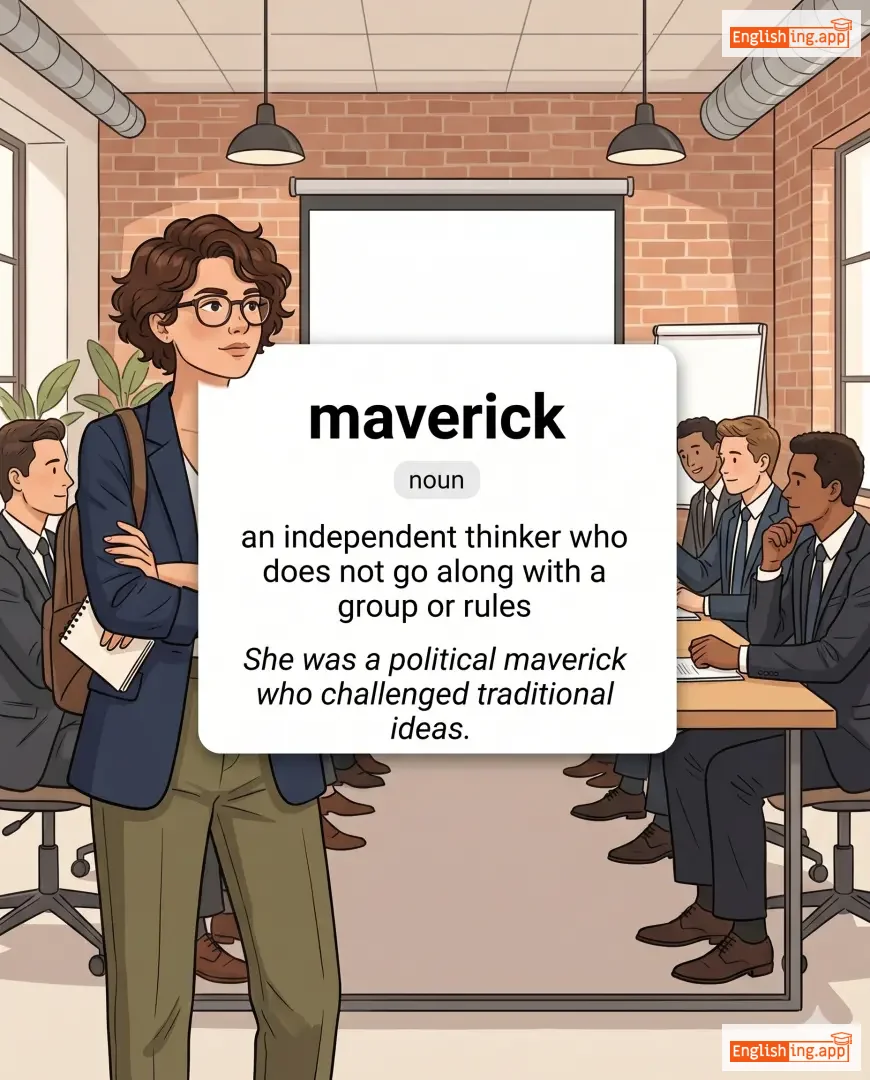
maverick definition card — visual illustration of the meaning
noun
/ˈmævərɪk/
Querdenker (Querdenker)

an independent thinker who does not go along with a group or rules

"She was a political maverick who challenged traditional ideas."

"Sie war eine politische Maverick, die traditionelle Ideen herausforderte." (Sie war eine politische Maverick, die traditionelle Ideen herausforderte.)
🧑‍🏫

maven (méwen)

noun
/ˈmeɪvən/
Experte (Experte)

an expert or connoisseur in a particular field

"He is a tech maven who always knows the latest trends."

"Er ist ein Tech-Experte, der immer die neuesten Trends kennt." (Er ist ein Tech-Experte, der immer die neuesten Trends kennt.)
adjective
/moʊv/
hellviolett (hellviolett)

a pale purple color with a grayish or bluish tinge

"She wore a beautiful mauve dress to the party."

"Sie trug ein schönes hellviolettes Kleid auf der Party." (Sie trug ein schönes hellviolettes Kleid auf der Party.)
noun
/ˌmɔːzəˈliːəm/
Mausoleum (Mausoleum)

A large stately building that houses a tomb or several tombs.

"The king was buried in a grand mausoleum."

"Der König wurde in einem prächtigen Mausoleum beerdigt." (Der König wurde in einem prächtigen Mausoleum beerdigt.)
verb
/ˈmɔːndər/
sinnlos reden (sinnlos reden)

To speak or move aimlessly and incoherently.

"He maundered on about his old memories."

"Er redete sinnlos über seine alten Erinnerungen." (Er redete sinnlos über seine alten Erinnerungen.)
verb
/mɔːl/
verletzt (verletzt)

To wound or injure someone by scratching or tearing; to handle roughly.

"The bear mauled the camper in the forest."

"Der Bär hat den Camper im Wald verletzt." (Der Bär hat den Camper im Wald verletzt.)
adjective
/ˈmɔːdlɪn/
zu sentimental (zu sentimental)

Overly sentimental, often tearfully or weakly emotional.

"He became maudlin after a few drinks."

"Er wurde sentimental, nachdem er ein paar Drinks getrunken hatte." (Er wurde sentimental, nachdem er ein paar Drinks getrunken hatte.)
noun
/məˈtʃʊrəti/
Reife (Reife)

The state of being mature; full development physically or emotionally

"With age comes wisdom and emotional maturity."

"Mit dem Alter kommen Weisheit und emotionale Maturität." (Mit dem Alter kommen Weisheit und emotionale Maturitat.)
adjective
/məˈtjʊr/
reif (reif)

fully developed or grown, especially emotionally or intellectually

"She has become a mature and confident leader."

"Sie ist eine reife und selbstbewusste Führerin geworden." (Sie ist eine reife und selbstbewusste Furherin geworden.)
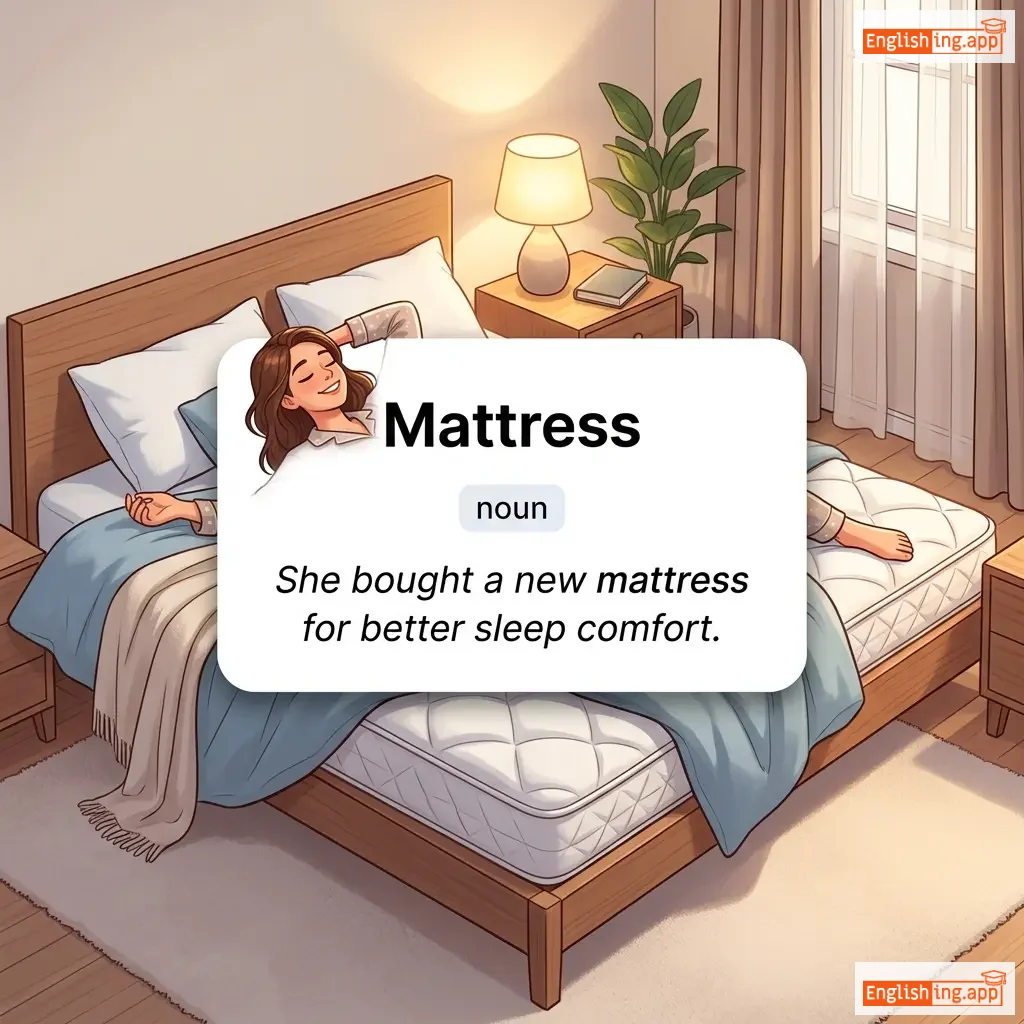
Mattress definition card — visual illustration of the meaning
noun
/ˈmætrəs/
Matratze (Matratze)

A large pad used as a bed or part of a bed, typically filled with soft material for sleeping on.

"She bought a new mattress for better sleep comfort."

"Sie kaufte eine neue Matratze für mehr Schlafkomfort." (Sie kaufte eine neue Matratze fuer mehr Schlafkomfort.)
noun/verb
/ˈmætərz/
Fragen / wichtig sein (fragen / wichtig sein)

important topics, concerns, or issues; as a verb, to be of importance or significance

"What she thinks really matters to me."

"Was sie denkt, ist mir wirklich wichtig." (Was sie denkt, ist mir wirklich wichtig.)
noun, verb
/ˈmætər/
Frage / Bedeutung (frage / bedeutung)

A subject or situation under consideration; to be important.

"It doesn’t matter what others think."

"Es ist nicht wichtig, was andere denken." (Es ist nicht wichtig, was andere denken.)
noun
/ˈmeɪ.trɪks/
Matrix, Struktur (Matrix, Struktur)

An environment or structure in which something develops; also a mathematical array of numbers.

"The cultural matrix shaped his worldview."

"Die kulturelle Matrix prägte seine Weltsicht." (Die kulturelle Matrix prägte seine Weltsicht.)
noun
/ˈmætrəˌmoʊni/
Ehe (Ehe)

The state of being married; marriage.

"They entered into matrimony after years of friendship."

"Sie gingen nach Jahren der Freundschaft in den Ehestand ein." (Sie gingen nach Jahren der Freundschaft in den Ehestand ein.)
verb
/məˈtrɪkjʊˌleɪt/
immatrikulieren (immatrikulieren)

To enroll as a student in a college or university.

"She matriculated at Oxford University last year."

"Sie hat sich letztes Jahr an der Universität Oxford eingeschrieben." (Sie hat sich letztes Jahr an der Universität Oxford eingeschrieben.)
noun
/ˈmætrɪˌsaɪd/
Muttertötung (Muttertoetung)

The act of killing one's own mother.

"The crime of matricide shocked the entire town."

"Das Verbrechen der Muttertötung schockierte die ganze Stadt." (Das Verbrechen der Muttertoetung schockierte die ganze Stadt.)
👩‍👩‍👧‍👦

matriarch (Matriarch)

noun
/ˈmeɪ.triˌɑːrk/
Matriarchin (Matriarchin)

A woman who is the head of a family or community.

"The matriarch of the family made all important decisions."

"Die Matriarchin der Familie traf alle wichtigen Entscheidungen." (Die Matriarchin der Familie traf alle wichtigen Entscheidungen.)
noun
/ˈmætɪneɪ/
Nachmittagsvorstellung (Nachmittagsvorstellung)

A performance, especially a play or movie, that takes place in the afternoon.

"We bought tickets for the Sunday afternoon matinee."

"Wir haben Tickets für die Sonntagnachmittagsvorstellung gekauft." (Wir haben Tickets fur die Sonntagnachmittagsvorstellung gekauft.)
noun
/ˌmæθəˈmætɪks/
mathematik (mathematik)

the abstract science of number, quantity, and space; the study of numbers and their operations

"Mathematics helps us understand patterns in nature and the universe."

"Mathematik hilft uns, Muster in der Natur und im Universum zu verstehen." (Mathematik hilft uns, Muster in der Natur und im Universum zu verstehen.)
adverb
/ˌmæθəˈmætɪkli/
mathematisch (mathematisch)

in a way that relates to mathematics; using numbers, formulas, or logical calculation

"The problem can be solved mathematically rather than by guesswork."

"Das Problem kann mathematisch statt durch Raten gelöst werden." (Das Problem kann mathematisch statt durch Raten geloest werden)
adjective
/ˌmæθəˈmætɪkəl/
mathematisch (mathematisch)

relating to mathematics or the use of mathematics

"The mathematical equation was difficult to solve."

"Die mathematische Gleichung war schwer zu lösen." (Die mathematische Gleichung war schwer zu losen.)
noun
/mæθ/
Mathematik (Mathematik)

The study of numbers, quantities, and shapes, also called mathematics.

"She is very good at math."

"Sie ist sehr gut in Mathematik." (Sie ist sehr gut in Mathematik.)
noun
/məˈtɜːrnəti/
maternität (maternitat)

The state of being a mother; motherhood

"The hospital has an excellent maternity ward for new mothers."

"Das Krankenhaus verfügt über eine ausgezeichnete Entbindungsstation für neue Mütter." (Das Krankenhaus verfuegt ueber eine ausgezeichnete Entbindungsstation fuer neue Muetter.)
adjective
/məˈtɜːnəl/
mütterlich (muetterlich)

Relating to a mother; showing motherly qualities such as care and protection.

"She showed great maternal affection toward the child."

"Sie zeigte große mütterliche Zuneigung gegenüber dem Kind." (Sie zeigte große mütterliche Zuneigung gegenüber dem Kind.)
verb
/məˈtɪərɪəlaɪz/
materialisieren (materialisieren)

To become real or actual; to appear suddenly or in a physical form.

"The opportunity he had been waiting for finally materialized."

"Die Gelegenheit, auf die er gewartet hatte, hat sich endlich materialisiert." (Die Gelegenheit, auf die er gewartet hatte, hat sich endlich materialisiert.)
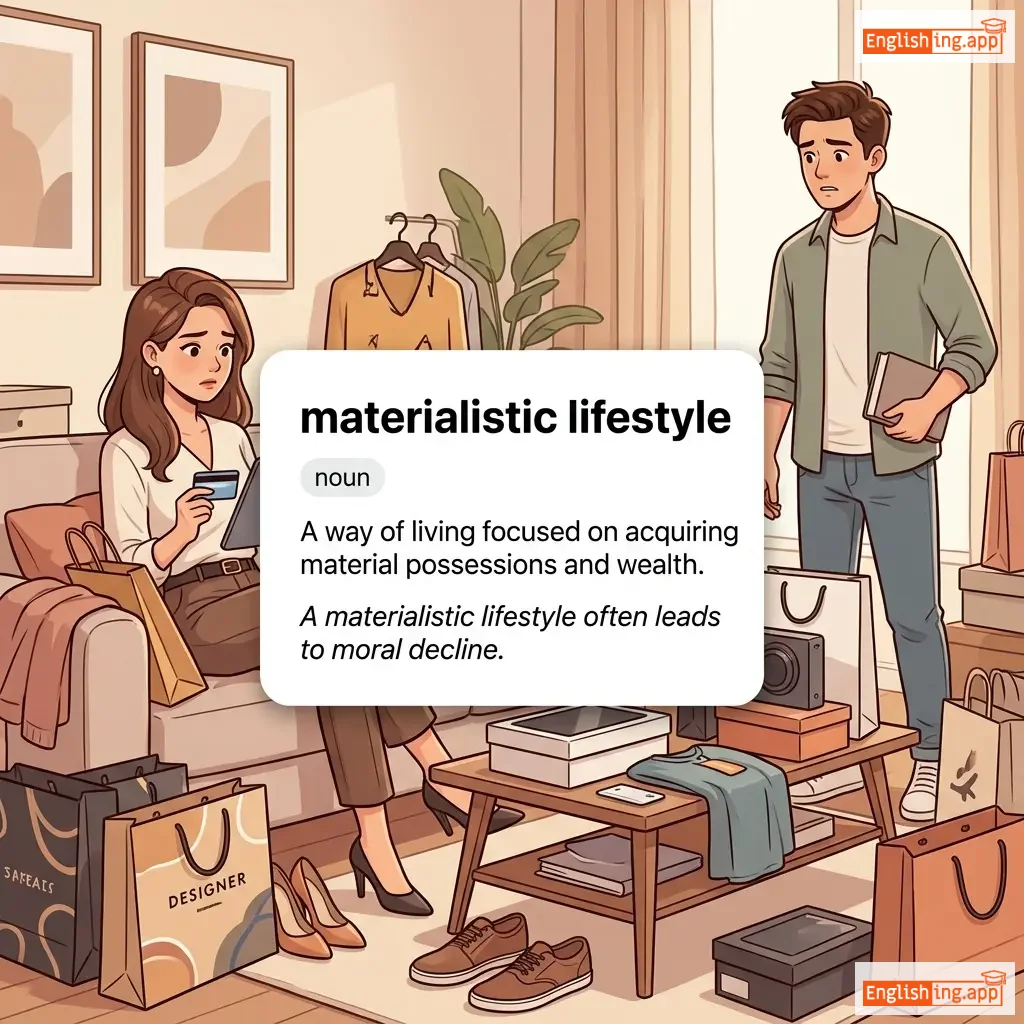
materialistic lifestyle definition card — visual illustration of the meaning
noun
məˌtɪərɪəˈlɪstɪk ˈlaɪfstaɪl
materialistische Lebensweise (materialistische Lebensweise)

A way of living focused on acquiring material possessions and wealth.

"A materialistic lifestyle often leads to moral decline."

"Ein materialistischer Lebensstil führt oft zu moralischem Verfall." (Ein materialistischer Lebensstil führt oft zu moralischem Verfall.)
noun
/məˈtɪəriəlɪzəm/
Materialismus (Materialismus)

A tendency to consider material possessions and physical comfort as more important than spiritual or moral values.

"The novel criticizes society's growing materialism."

"Der Roman kritisiert den wachsenden Materialismus der Gesellschaft." (Der Roman kritisiert den wachsenden Materialismus der Gesellschaft.)
noun, adjective
/məˈtɪəriəl/
Material (Material)

The substance or matter from which something is made; relating to physical things rather than ideas or emotions.

"The builder brought all the necessary material for the construction."

"Der Bauunternehmer brachte das gesamte notwendige Material für den Bau." (Der Bauunternehmer brachte das gesamte notwendige Material für den Bau.)
noun
/meɪt/
Freund, Partner (Freund, Partner)

a friend or companion; a partner in marriage or reproduction

"He went fishing with his old school mate."

"Er ging mit seinem alten Schulfreund angeln." (Er ging mit seinem alten Schulfreund angeln.)
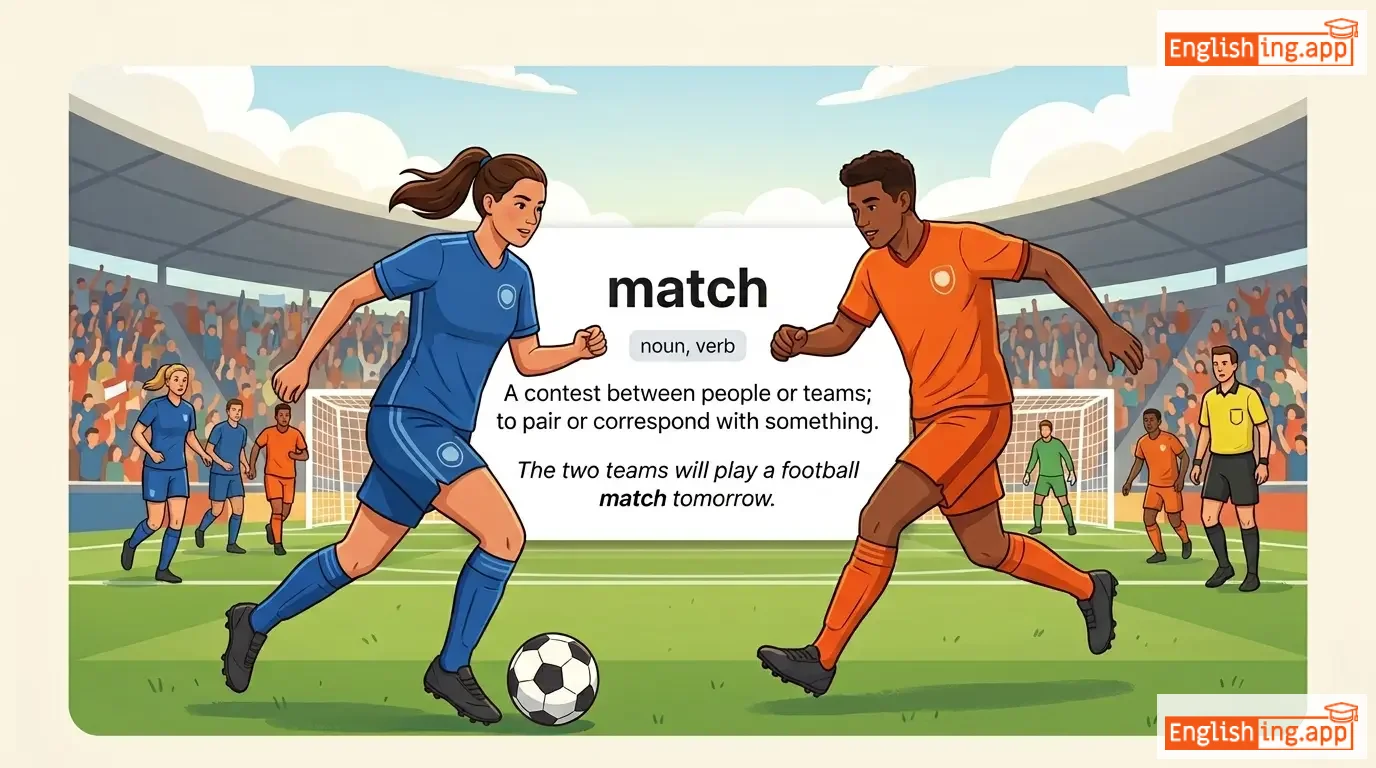
match definition card — visual illustration of the meaning
noun, verb
/mætʃ/
Spiel / Wettkampf (spiel / wettkampf)

A contest between people or teams; to pair or correspond with something.

"The two teams will play a football match tomorrow."

"Die beiden Teams spielen morgen ein Fußball-Match." (Die beiden Teams spielen morgen ein Fußball-Match.)
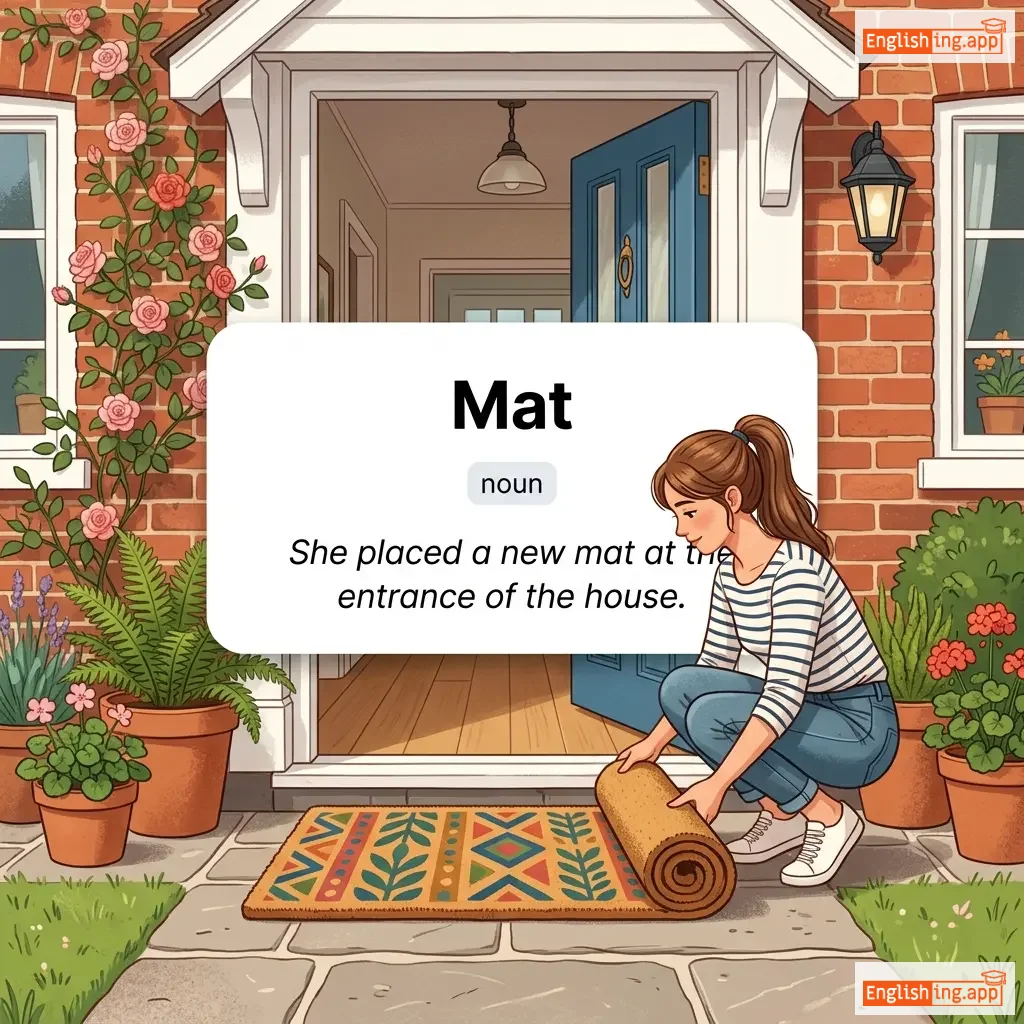
Mat definition card — visual illustration of the meaning
noun
/mæt/
matte (matte)

a piece of fabric material placed on a floor or surface for wiping feet or protection

"She placed a new mat at the entrance of the house."

"Sie legte eine neue Matte am Eingang des Hauses aus." (Sie legte eine neue Matte am Eingang des Hauses aus.)
verb
/ˈmæstɪkeɪt/
kauen (kauen)

to chew food thoroughly before swallowing

"He slowly masticated the bread before swallowing."

"Er kaute langsam das Brot, bevor er es herunter schluckte." (Er kaute langsam das Brot, bevor er es herunter schluckte.)
noun
/ˈmæstəri/
Meisterschaft (Meisterschaft)

comprehensive knowledge or skill in a subject or accomplishment

"She has achieved mastery in classical dance."

"Sie hat in klassischem Tanz Meisterschaft erreicht." (Sie hat in klassischem Tanz Meisterschaft erreicht.)
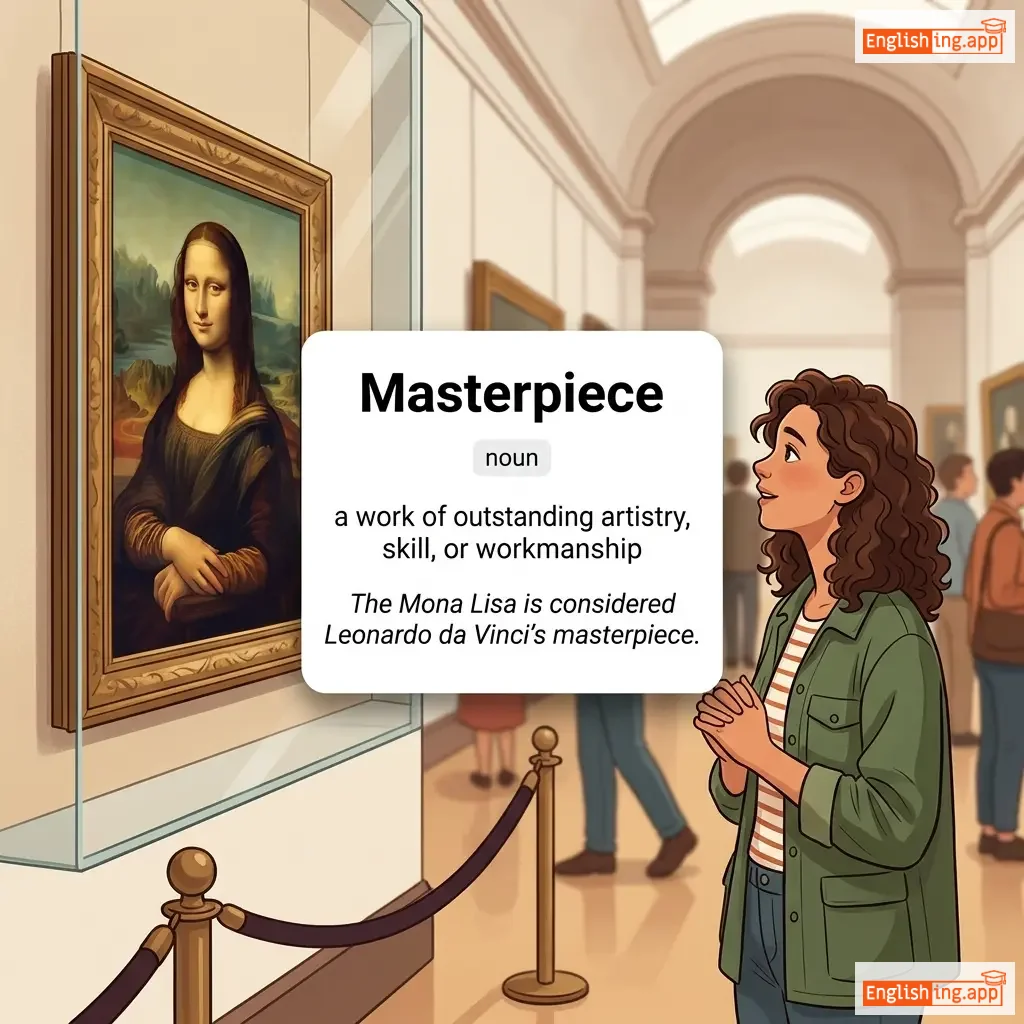
Masterpiece definition card — visual illustration of the meaning
noun
/ˈmæstərˌpiːs/
Meisterwerk (meisterwerk)

a work of outstanding artistry, skill, or workmanship

"The Mona Lisa is considered Leonardo da Vinci’s masterpiece."

"Die Mona Lisa gilt als das Meisterwerk von Leonardo da Vinci." (Die Mona Lisa gilt als das Meisterwerk von Leonardo da Vinci.)
noun, verb
/ˈmɑːstər/
Meister (Meister)

A person with great skill or control in a subject or activity; to gain full command over something.

"She mastered the art of cooking Italian dishes."

"Sie beherrschte die Kunst, italienische Gerichte zu kochen." (Sie beherrschte die Kunst, italienische Gerichte zu kochen.)
adjective
/ˈmæsɪv/
riesig (riesig)

extremely large, heavy, or solid in size or degree

"The company made a massive investment in renewable energy."

"Das Unternehmen tätigte eine massive Investition in erneuerbare Energien." (Das Unternehmen tätigte eine massive Investition in erneuerbare Energien.)
verb
/məˈsɑːʒ/
massieren (massieren)

to rub and press muscles to relieve pain or tension; to manipulate information

"The therapist will massage your back to reduce muscle tension."

"Der Therapeut wird deinen Rücken massieren, um die Muskelverspannung zu reduzieren." (Der Therapeut wird deinen Rücken massieren, um die Muskelverspannung zu reduzieren.)
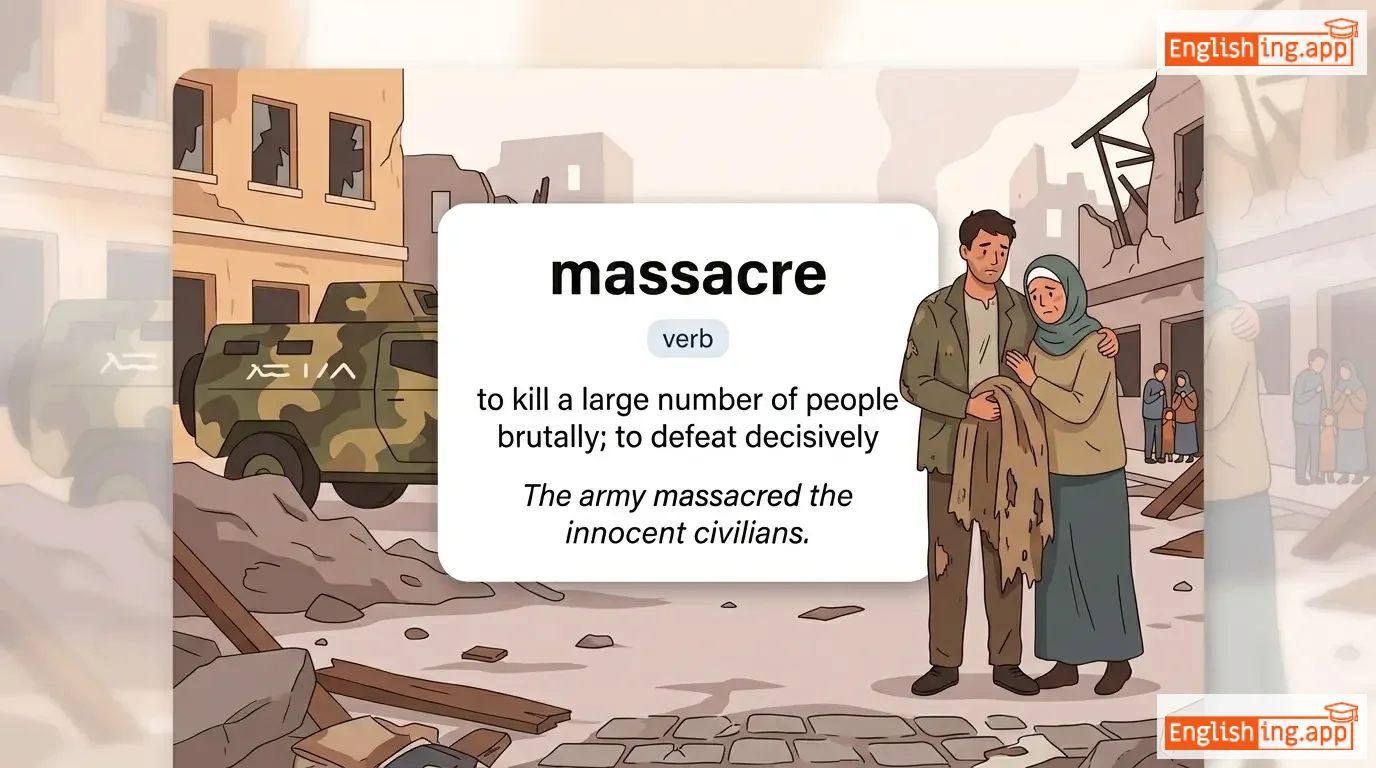
massacre definition card — visual illustration of the meaning
noun
/ˈmæsəkər/
massaker (massaker)

the killing of a large number of people, usually in a violent way

"The massacre resulted in the deaths of hundreds of civilians."

"Das Massaker führte zum Tod von Hunderten von Zivilisten." (Das Massaker fuehrte zum Tod von Hunderten von Zivilisten.)
verb
/mɑːr/
verderben (verderben)

to spoil or damage the appearance or quality of something

"The scratch will mar the beauty of the painting."

"Der Kratzer wird die Schönheit des Gemäldes verderben." (Der Kratzer wird die Schönheit des Gemäldes verderben.)
noun
/ˈmɑːrbəl/
Glück (Gluck)

a hard, smooth stone used in building and sculpture, often white with colored lines

"The floor of the palace was made of white marble."

"Sie konnte ihr Glück nicht verbergen, als sie den Preis erhielt." (Sie konnte ihr Gluck nicht verbergen, als sie den Preis erhielt.)
noun
/məˈrɔː.dər/
Plünderer (Pluendrer)

a person who roams around in search of things to steal or people to attack

"Villagers feared the marauders who raided their homes."

"Die Dorfbewohner fürchteten die Plünderer, die ihre Häuser überfielen." (Die Dorfbewohner fürchteten die Plünderer, die ihre Häuser überfielen.)
verb
/məˈrɔːd/
plündern (pluendern)

to roam in search of things to steal or attack

"The bandits marauded through the village at night."

"Die Banditen plünderten das Dorf in der Nacht." (Die Banditen plünderten das Dorf in der Nacht.)
🏃‍♀️

marathon (marathon)

noun
/ˈmærəθən/
marathon (marathon)

a long-distance running race, typically 42.195 kilometers (26.2 miles)

"She completed the marathon in under four hours."

"Sie beendete den Marathon in weniger als vier Stunden." (Sie beendete den Marathon in weniger als vier Stunden.)
adjective
/ˈmɛni/
viele (viele)

a large number of

"Many students attended the lecture."

"Viele Studenten nahmen an der Vorlesung teil." (Viele Studenten nahmen an der Vorlesung teil.)
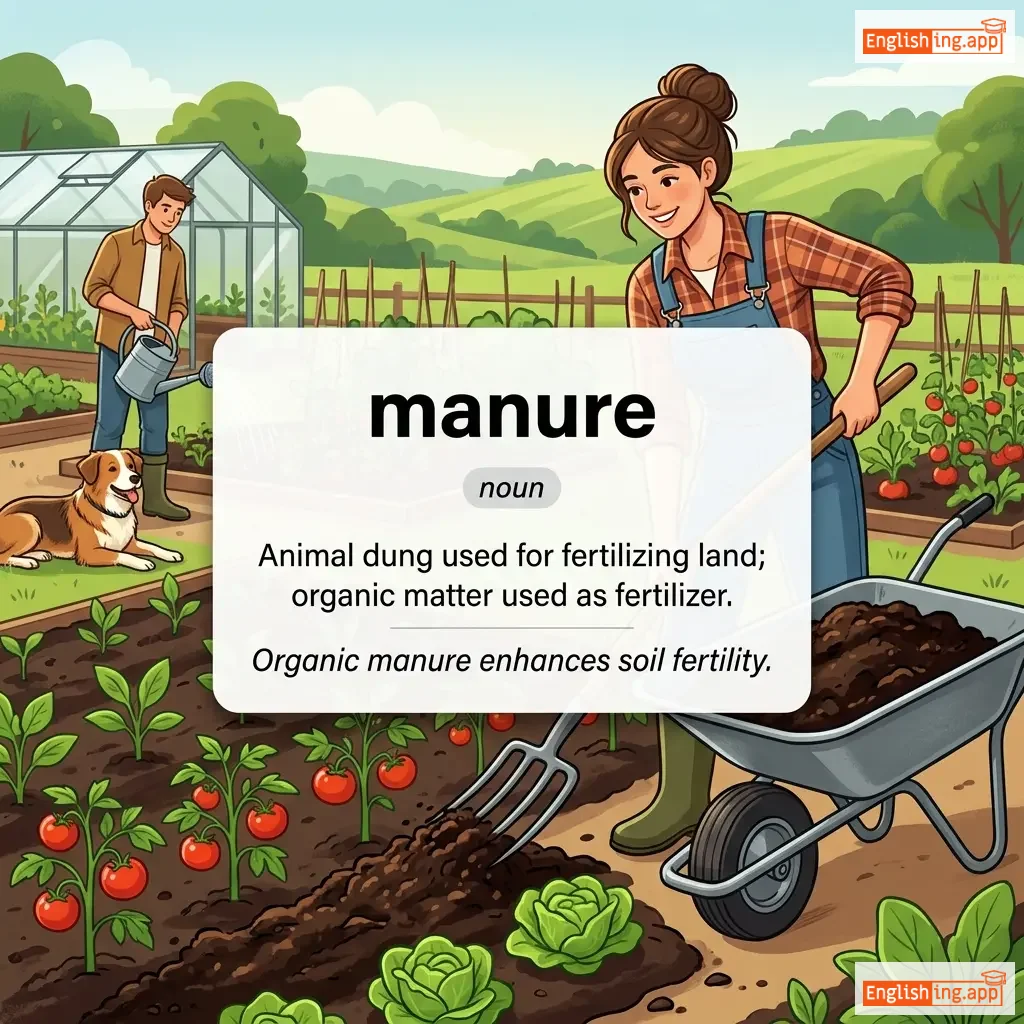
manure definition card — visual illustration of the meaning
noun
məˈnjʊər
Mist, organischer Dünger (Mist, organischer Dünger)

Animal dung used for fertilizing land; organic matter used as fertilizer.

"Organic manure enhances soil fertility."

"Organischer Mist verbessert die Fruchtbarkeit des Bodens." (Organischer Mist verbessert die Fruchtbarkeit des Bodens.)
noun
/ˈmæn.juˌskrɪpt/
manuskript (manuskript)

a handwritten or typed document, especially a writer’s draft before publication

"The author submitted her manuscript to the publisher."

"Die Autorin hat ihr Manuskript dem Verlag vorgelegt." (Die Autorin hat ihr Manuskript dem Verlag vorgelegt.)
🚶‍♂️

March (marsch)

verb
/mɑːrtʃ/
marschieren (marschieren)

to walk in a regular, rhythmic way, often in step with others; to proceed with determination

"The soldiers marched across the field."

"Die Soldaten marschierten über das Feld." (Die Soldaten marschierten über das Feld.)