Словари

Словарь английского языка | Значения слов, определения и примеры

adjective
/ʌnˈwəʊntɪd/
необычный (neobychnyj)

Unusual, uncommon, or out of the ordinary.

"She spoke with an unwonted gentleness that surprised everyone."

"Она говорила с необычной мягкостью, которая удивила всех." (Ona govoryla s neobychnoy myagkost'yu, kotoraya udivila vsekh.)
adjective
/ʌnˈwɜːrði/
недостойный; не заслуживающий (niedostoynyj; ne zasluzhivajushchij)

not deserving respect or attention; lacking worth or merit

"He felt unworthy of such praise and recognition."

"Он почувствовал себя недостойным такой похвалы и признания." (On pochuvstvoval sebya nedostoynym takoy pokhvaly i prizhnañya.)
verb
/ʌnˈræp/
разворачивать (razvorachivat)

remove wrapping or covering from something; reveal something gradually or clearly

"She carefully unwrapped the gift with excitement."
"Она осторожно развернула подарок с волнением." (Ona ostorozhno razvernula podarok s volneniem)
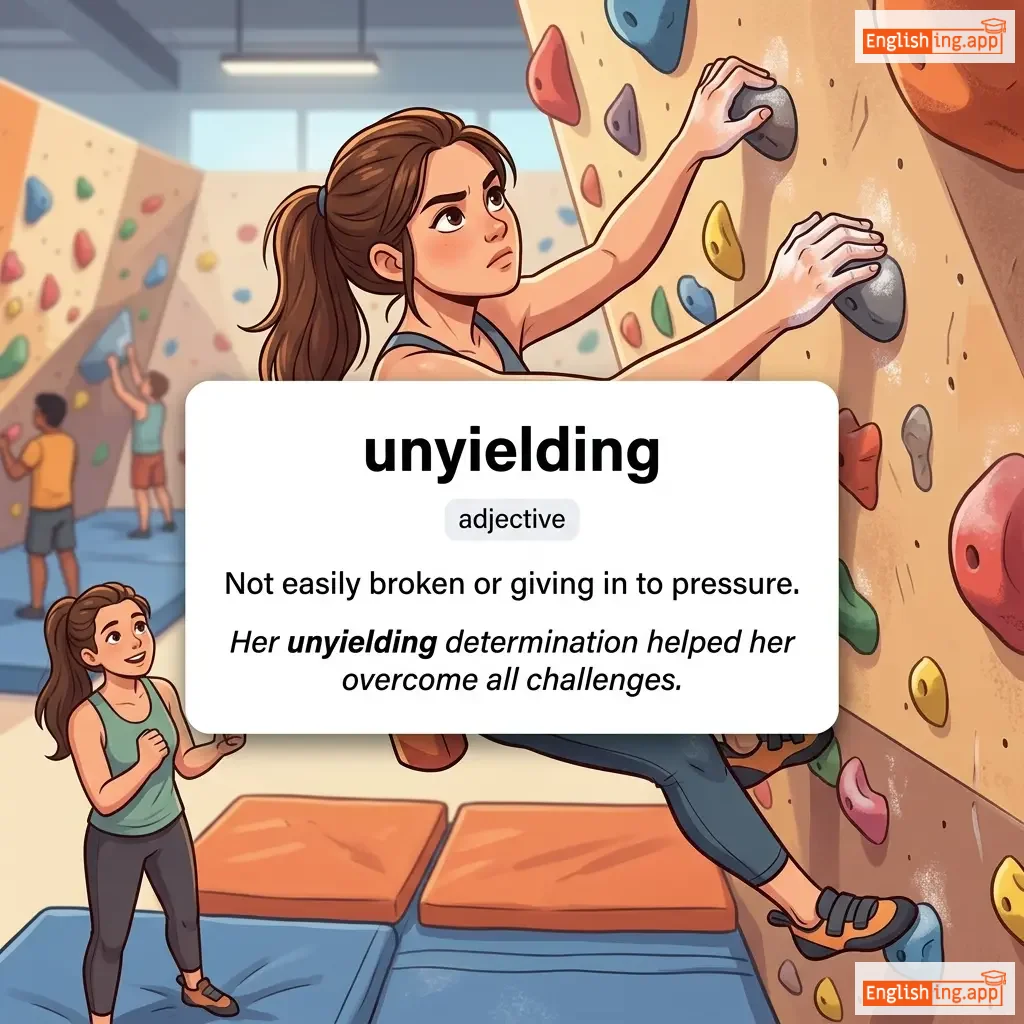
unyielding definition card — visual illustration of the meaning
adjective
ʌnˈjiːl.dɪŋ
непоколебимый или стойкий (nepokolebimyy ili stoykiy)

Not easily broken or giving in to pressure.

"Her unyielding determination helped her overcome all challenges."

"Её непоколебимая решимость помогла ей преодолеть все трудности." (Yeyo nepokolebimaya reshimost pomogla yey preodolety vse trudnosti.)
verb
/ʌnˈjoʊk/
развязать (razvyazat)

To release from a yoke or to free from restraint or obligation.

"The farmer unyoked the oxen after a long day of work."

"Фермер развязал волов после долгого рабочего дня." (Fermer razvyazal volov posle dolgogo rabochego dnya.)
⬆️

up (ap)

adverb
/ʌp/
вверх (vverkh)

towards a higher position or level

"He climbed up the ladder quickly."

"Он быстро поднялся по лестнице." (On bystro podnyalsya po lestnitse.)
noun
/ˈʌpˌkiːp/
обслуживание (obsluzhivanie)

The process or cost of maintaining something in good condition.

"The upkeep of the old house is very expensive."

"Обслуживание старого дома очень дорогое." (Obsluzhivanie starogo doma ochen' dorogoe.)
verb
/ʌpˈbreɪd/
отчитывать (otchityvat)

To scold or criticize someone harshly.

"The teacher upbraided the student for being late again."

"Учитель отругал студента за опоздание еще раз." (Uchitel' otrugal studenta za opozdanie eshche raz.)
noun/verb
/ˈʌpˌkæst/
бросить вверх (brosit vverkh)

Verb: To cast or throw upward. Noun: Something thrown or directed upward.

"The fisherman upcast his net into the air."

"Рыбак забросил свою сеть в воздух." (Rybak zabrosil svoyu set' v vozdukh.)
adjective
/ˈʌpˌkʌmɪŋ/
предстоящий (predstoyashchiy)

about to happen or appear

"The upcoming event will be held next week."

"Предстоящее событие состоится на следующей неделе." (Predstoyashchee sobytiye sostoyitsya na sleduyushchey nedele.)
update definition card — visual illustration of the meaning
verb
/ˈʌpdeɪt/

to make something more modern or accurate by adding new information or changing it

"Please update your profile information regularly."

verb
/ˈʌpˌɡreɪd/
обновить (obnovit)

to raise something to a higher standard, improve

"We decided to upgrade the software to the latest version."

"Мы решили обновить программное обеспечение до последней версии." (My reshilí obnovit' programnoye obespecheniye do posledney versii.)
noun
/ʌpˈhiːvəl/
переворот (perevorot)

a violent or sudden change or disruption to something

"The company faced a major upheaval after the sudden resignation of its CEO."

"Компания столкнулась с большим переворотом после внезапной отставки своего генерального директора." (Kompaniya stolknulas' s bol'shim perevorotom posle vnezapnoj otstavki svoego general'nogo direktora.)
verb
/ʌpˈhiːv/
поднимать (podnimat')

to lift or raise something forcefully; to cause to rise suddenly

"The workers had to upheave the heavy stone to clear the path."

"Рабочие должны были поднять тяжелый камень, чтобы очистить путь." (Rabochie dolzhny byli podnyat' tyazhelyy kamen', chtoby ochistit' put'.)
adjective
/ˈʌpˌhɪl/
трудный; требующий больших усилий; наклон вверх (trudnyy; trebuyushchiy bol'shikh usiliy; naklon vverkh)

difficult; requiring great effort; sloping upward

"Learning a new language can be an uphill battle."

"Изучение нового языка может быть трудной битвой." (Izucheniye novogo yazyka mozhet byt' trudnoy bitvoy.)
verb
/ʌpˈhoʊld/
поддерживать (podderzhivat)

to maintain or support a principle, law, or decision

"The judge promised to uphold justice at all costs."

"Судья пообещал поддерживать справедливость любой ценой." (Sud'ya poobeshchal podderzhivat' spravedlivost' lyuboy tsenoy.)
preposition
/əˈpɒn/
после (posle)

on or immediately after

"Upon hearing the news, he rushed to the hospital."

"После того как он услышал новость, он поспешил в больницу." (Posle togo kak on uslyshal novost', on pospeshil v bolnitsu.)
adjective
/ˈʌpər/
верхний (verkhniy)

higher in position or rank

"The upper floor of the building is under renovation."

"Верхний этаж здания находится на ремонте." (Verkhniy etazh zdaniya nakhoditsya na remonte.)
adjective
/ˈʌpərˌmoʊst/
высший (vysshiy)

situated at the highest place or most important

"Her family's safety was uppermost in her mind during the crisis."

"Безопасность её семьи была на первом месте в её мыслях во время кризиса." (Bezopasnost' yeye sem'i byla na pervom meste v yeye mysl'yakh vo vremya krizisa.)
adjective, adverb
/ˈʌpraɪt/
счастье (schastye)

positioned vertically; morally good and honest

"He remained upright despite the strong winds."

"Она не могла скрыть своего счастья, когда получила награду." (Ona ne mogla skryt' svoego schast'ya, kogda poluchila nagradu.)
noun
/ˈʌp.raɪt.nəs/
честность; целеустремленность (chestnost'; tseleustremlennost')

the quality of being honest and morally correct; integrity

"His uprightness in business dealings earned him great respect."
"Его прямота в деловых отношениях принесла ему большой уважение." (Ego pryamota v delovykh otnosheniyakh prinesla yemu bol'shoy uvazhenie.)
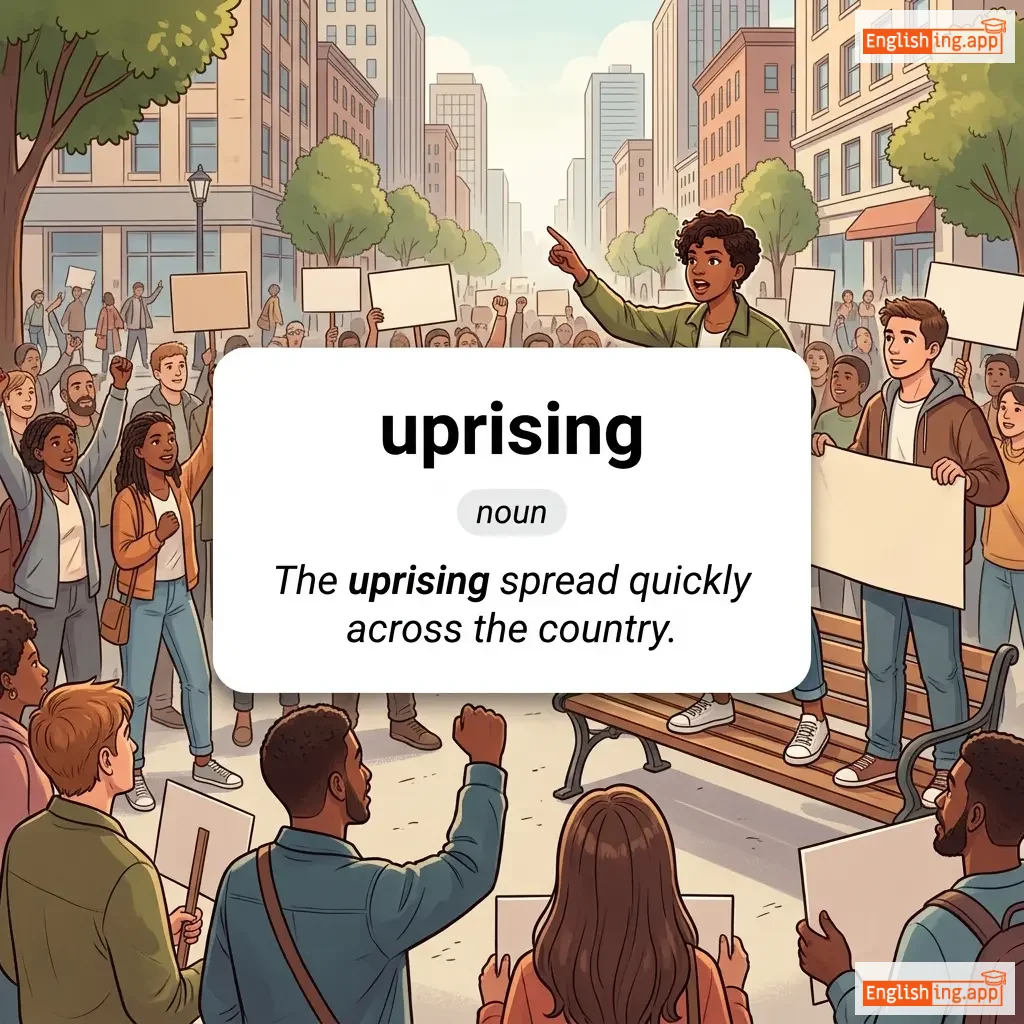
uprising definition card — visual illustration of the meaning
noun
/ˈʌpraɪzɪŋ/
восстание (vosstanie)

An act of resistance or rebellion; an attempt to overthrow authority or government.

"The uprising spread quickly across the country."

"Восстание быстро распространилось по всей стране." (Vosstanie bystro rasprostranilos' po vsey strane.)
noun
/ˈʌp.rɔːr/
беспорядок (besporyadok)

A loud noise, commotion, or disturbance caused by a group of people.

"The announcement caused an uproar in the audience."

"Объявление вызвало беспорядок среди зрителей." (Ob'yavleniye vyzvalo besporyadok sredi zritelyey.)
adjective
/ʌpˈrɔːr.i.əs/
крайне смешной (kraine smeshnoi)

Extremely funny or noisy; causing loud laughter or commotion.

"The comedian's jokes were absolutely uproarious."

"Шутки комика были абсолютно крайне смешные." (Shutki komika byli absolyutno kraine smeshnye.)
verb
/ʌpˈruːt/
выкорчевать (vykorchevat)

To pull something out of the ground; to remove or displace completely.

"They uprooted the old tree from the garden."
"Они вырвали старое дерево из сада." (Oni vyrvali staroe derevo iz sada.)
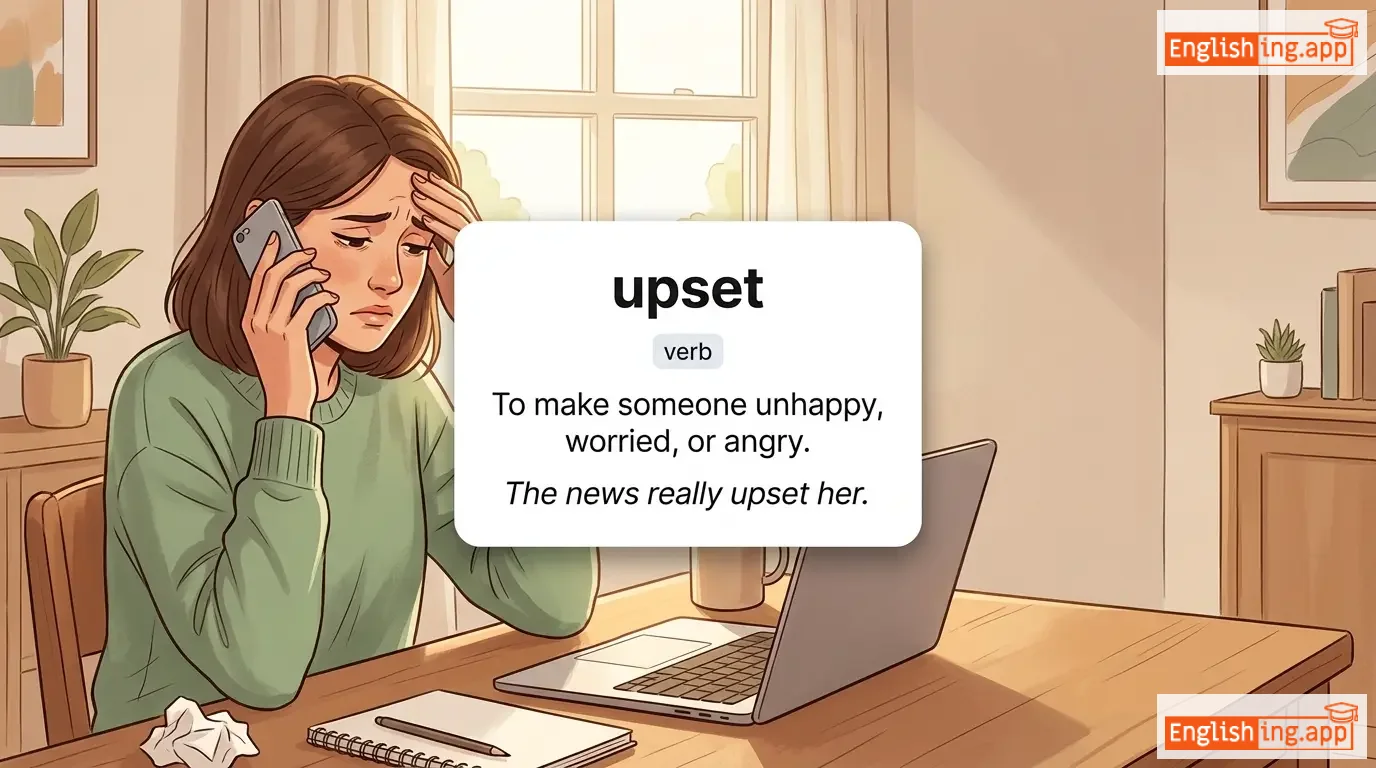
upset definition card — visual illustration of the meaning
verb
/ʌpˈsɛt/
расстраивать (rasstraivat')

To make someone unhappy, worried, or angry.

"The news really upset her."

"Новости действительно расстроили её." (Novosti deystvitel'no rasstroili yeyo.)
noun
/ˈʌp.ʃɒt/
результат (rezul'tat)

The final result or outcome of a process or situation.

"The upshot of the meeting was that the plan was postponed."

"Результатом встречи стало то, что план был отложен." (Rezultatom vstrechi stalo to, chto plan byl otlozhen.)
adverb
/ˌʌpsaɪd ˈdaʊn/
вверх ногами (vverkh nogami)

with the upper part at the bottom; in or into a reversed position

"The picture was hanging upside-down on the wall."

"Картина висела вверх ногами на стене." (Kartina visela vverkh nogami na stene)
🏠⬆️

Upstairs

adverb
/ˌʌpˈstɛərz/

on or to a higher floor of a building

"She went upstairs to her bedroom."

noun
/ˈʌp.tɜːn/
улучшение (uluchshenie)

An improvement or upward trend in a situation, especially in business or economy.

"The company experienced an upturn in sales last quarter."
"Компания испытала улучшение продаж в последнем квартале." (Kompaniya ispyitala ulichsheniye prodazh v poslednem kvartale.)
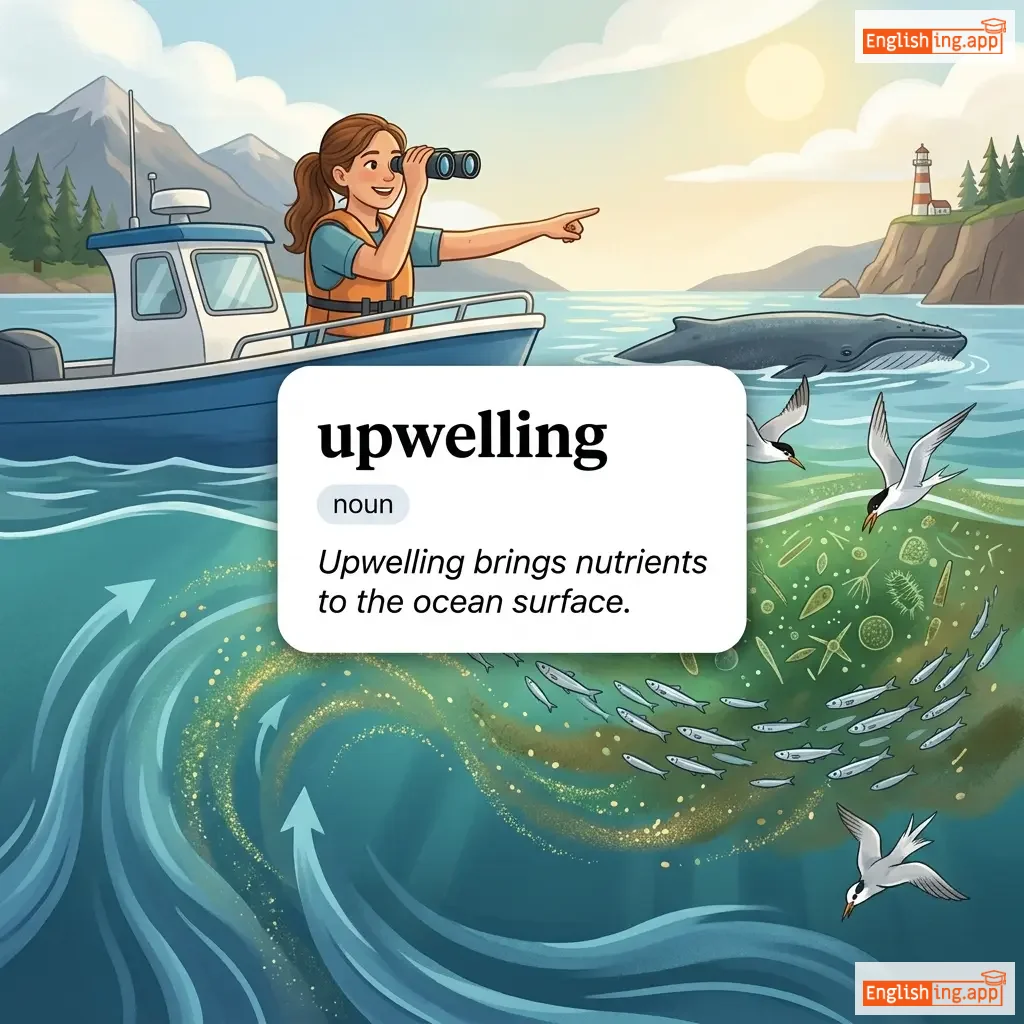
upwelling definition card — visual illustration of the meaning
noun
/ˈʌp.wel.ɪŋ/
Океанографическое явление, включающее движение плотной, холодной и богатой питательными веществами воды к поверхности океана. (Okeanograficheskoe yavlenie, vklyuchayushchee dvizhennye plotnoy, kholodnoy i bogatoy pitatel'nymi veshchestvami vody k poverkhnosti okeana.)

An oceanographic phenomenon that involves wind-driven motion of dense, cooler, and nutrient-rich water towards the ocean surface.

"Upwelling brings nutrients to the ocean surface."

"Апвеллинг приносит питательные вещества на поверхность океана." (Apwelling prinosit pitatelnye veshchestva na poverkhnost' okeana.)
adjective
/ˈɜːrbən/
городской (gorodskoy)

related to, characteristic of, or situated in a city or town

"Urban areas often have higher population density than rural areas."

"Городские районы часто имеют более высокую плотность населения, чем сельские районы." (Gorodskie rayony chasto imeyut bolee vysokuyu plotnost naseleniya, chem sel'skie rayony.)
adjective
/ɜːrˈbeɪn/
урбанистический (urbanisticheskiy)

showing polished manners, refinement, and sophistication

"He was an urbane gentleman who charmed everyone at the party."

"Он был урбанистическим джентльменом, который очаровал всех на вечеринке." (On byl urbanisticheskim dzentl'menom, kotoryy ocharoval vsekh na vecherinke.)
noun
/ɜːrˈbænɪti/
урбанизм (urbaniizm)

refined courtesy, elegance, and sophistication in manner

"Her urbanity made her popular among diplomats and leaders."
"Ее урбанизм сделал ее популярной среди дипломатов и лидеров." (Yeyo urbaniizm sdelal yeye populyarnoy sredi diplomatov i liderov.)
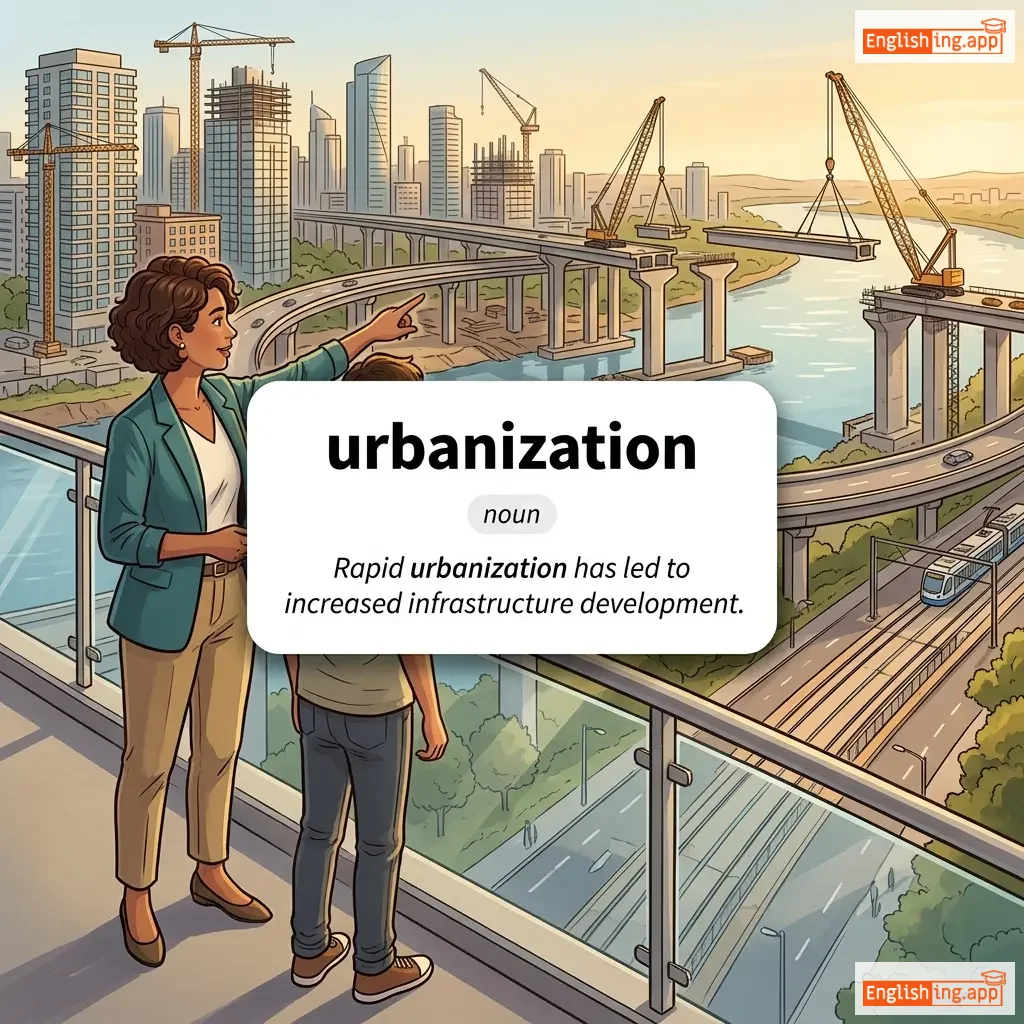
urbanization definition card — visual illustration of the meaning
noun
/ˌɜː.bən.aɪˈzeɪ.ʃən/
урбанизация (urbanizatsiya)

The process by which towns and cities are formed and become larger as more people begin living and working in central areas.

"Rapid urbanization has led to increased infrastructure development."

"Быстрая урбанизация привела к увеличению развития инфраструктуры." (Bystraya urbanizatsiya privedla k uvelicheniyu razvitiya infrastruktury.)
noun
/ˈɜːrtʃɪn/
уличный ребенок (ulichnyy rebenok)

a mischievous or poorly dressed child, often from the streets

"The ragged urchins played by the riverbank."

"Лохматые уличные дети играли у речного берега." (Lokhmatye ulichnye deti igrali u rechnogo berega.)
verb
/ɜːrdʒ/
побуждать (pobuzhdat)

to strongly encourage or try to persuade someone to do something

"Doctors urge patients to exercise regularly."

"Доктора призывают пациентов регулярно заниматься физическими упражнениями." (Doktora prizyvayut patsientov regulyarno zanimat'sya fizicheskimi uprazhneniyami.)
noun
/ˈɜːrdʒənsi/
срочность (srochnost)

The quality of requiring immediate attention or action.

"The doctor emphasized the urgency of starting treatment right away."

"Доктор подчеркнул срочность начала лечения немедленно." (Doktor podcherknul srochnost nachala lecheniya nemedlenno.)
adjective
/ˈɜːrdʒənt/
срочный (srochny)

Requiring immediate action or attention.

"She sent an urgent message to her manager."

"Она отправила срочное сообщение своему менеджеру." (Ona otpravila srochnoye soobshcheniye svoemu menedzheru.)
adverb
/ˈɜːrdʒəntli/
срочно (srochno)

in a way that requires immediate attention or action

"The patient urgently needs medical attention."

"Пациенту срочно нужна медицинская помощь." (patsientu srochno nuzhna meditsinskaya pomoshch)
adjective
/ˈɜːrsaɪn/
медвежий (medvezhiy)

Relating to or resembling a bear.

"The man’s ursine strength amazed everyone."

"Медвежья сила этого человека удивила всех." (Medvezh'ya sila etogo cheloveka udivila vsekh.)
pronoun
/ʌs/
мы (my)

used to refer to the speaker and one or more other people as the object of a verb or preposition

"She gave us a gift."

"Она дала нам подарок." (Ona dala nam podarok.)
noun
/ˈjuːsɪdʒ/
использование (ispol'zovanie)

The action of using something; the way in which a word or phrase is normally used.

"The book explains the proper usage of technical terms."
"Книга объясняет правильное использование технических терминов." (Kniga ob'yasnyayet pravil'noye ispol'zovaniye tekhnicheskikh terminov.)
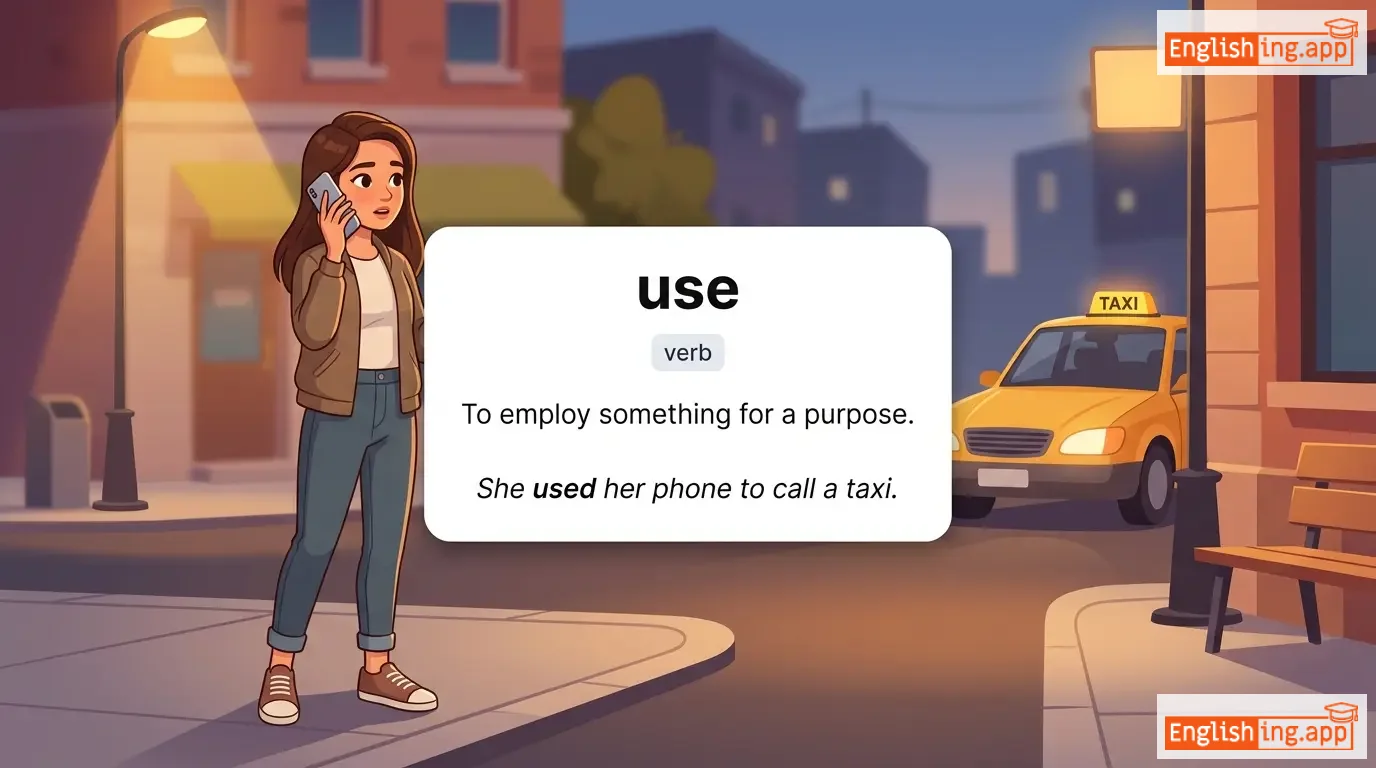
use definition card — visual illustration of the meaning
🛠️

use (yuz)

verb
/juːz/ (verb), /juːs/ (noun)
использовать (ispol'zovat')

To employ something for a purpose.

"She used her phone to call a taxi."

"Она использовала свой телефон, чтобы вызвать такси." (Ona ispol'zovala svoj telefon, chtoby vyzvat' taksi.)
adjective
/juːzd/
подержанный (poderzhannyy)

having already been used

"This is a used car."

"Это подержанный автомобиль." (Eto poderzhannyy avtomobil'.)
adjective
/ˈjuːsfəl/
полезный (polezny)

having a practical or beneficial use

"This tool is very useful."

"Этот инструмент очень полезен." (Etot instrument ochen' polezen.)
noun
/ˈjuːs.fəl.nəs/
полезность (poleznost)

the quality of being useful; practical value or helpfulness

"The usefulness of this tool became apparent during the project."

"Полезность этого инструмента стала очевидной в процессе проекта." (Poleznost' etogo instrumenta stala ochevidnoy v protsesse proyeka.)
adjective
/ˈjuːsləs/
бесполезный (bespolezny)

not serving any purpose or value

"The broken phone is completely useless."

"Сломанный телефон совершенно бесполезен." (Slomannyy telefon sovershenno bespolezen.)
noun
/ˈjuːzər/
пользователь (pol'zovatel')

a person who uses or operates something

"He is a frequent user of this app."

"Он частый пользователь этого приложения." (On chasty pol'zovatel' etogo prilozheniya.)
adjective
/ˈjuːʒəl/
обычный (obychny)

habitually or typically occurring or done

"It’s our usual meeting spot."

"Это наше обычное место для встреч." (Eto nashe obychnoye mesto dlya vstrech.)