Словари

Словарь английского языка | Значения слов, определения и примеры

adjective
/ˌθiːəˈrɛtɪkl/
теоретический (teoreticheskiy)

Concerned with or based on theory rather than practical application.

"The idea remains largely theoretical without real-world evidence."

"Идея остается в основном теоретической без реальных доказательств." (Ideya ostaetsya v osnovnom teoreticheskoy bez real'nykh dokazatel'stv.)
noun
/ˈθiːərɪst/
теоретик (teoretik)

A person who develops, studies, or explains theories in a particular field.

"The political theorist explained the impact of democracy on social structures."

"Политический теоретик объяснил влияние демократии на социальные структуры." (Politicheskiy teoretik ob'yasnil vliyaniye demokratii na sotsial'nye struktury.)
verb
/ˈθiːəraɪz/
теоризировать (teorizirovat)

To form a theory or set of ideas to explain something.

"Scientists often theorize about the origins of the universe."

"Учёные часто теоризируют о происхождении вселенной." (Uchyonye chasto teoriziruiut o proiskhozhdenii vselennoy.)
noun
/ˈθiːəri/
теория (teoriya)

An explanation of an idea or principle based on facts, reasoning, and evidence.

"Einstein's theory of relativity changed the way we understand physics."

"Теория относительности Эйнштейна изменила способ понимания физики." (Teoriya otnositel'nosti Eynshteyna izmenila sposob ponimaniya fiziki.)
noun
/θiˈɒsəfi/
теософия (teosofiya)

A religious or philosophical belief system that seeks direct knowledge of the mysteries of life and the divine.

"Theosophy attracted people interested in mysticism and spiritual growth."

"Теософия привлекла людей, интересующихся мистицизмом и духовным ростом." (Teosofiya privlekla lyudey, interesuyushchikhsya mistitsizmom i dukhovnym rostorm.)
therapeutic definition card — visual illustration of the meaning
adjective
/ˌθɛrəˈpjuːtɪk/
терапевтический (terapevticheskiy)

Related to healing, treatment, or providing a beneficial effect on the body or mind.

"Yoga can have a therapeutic effect on stress and anxiety."

"Йога может оказывать терапевтическое влияние на стресс и тревогу." (Yoga mozhet okazyvat' terapevticheskoe vliyanie na stress i trevogu.)
noun
/ˈθɛrəpɪst/
терапевт (terapevt)

a person trained to provide treatment or counseling for physical or mental health

"The therapist helped him overcome his anxiety."

"Терапевт помог ему преодолеть тревогу." (Terapevt pomog emu preodolet' trevogu.)
therapy definition card — visual illustration of the meaning
noun
/ˈθɛrəpi/
терапия (terapiya)

treatment intended to relieve or heal a disorder

"She is receiving therapy for her injury."

"Она получает терапию для своей травмы." (Ona poluchayet terapiyu dlya svoey travmy.)
adverb
/ðɛə/
там (tam)

in, at, or to that place or position

"We are going there tomorrow."

"Мы идем туда завтра." (My idem tuda zavtra.)
adverb
/ˌðɛrəˈbaʊt/
приблизительно (priblizitel'no)

Approximately or around that place, amount, or time.

"The repairs will cost five hundred dollars or thereabout."

"Ремонт будет стоить около пятисот долларов." (Remont budet stoit' okolo pyatisot dollarov.)
adverb
/ðɛrˈæftər/
после этого (posle etogo)

from that time on

"He moved to Canada and thereafter started a new life."

"Он переехал в Канаду, и после этого начал новую жизнь." (On pereekhal v Kanadu, i posle etogo nachal novuyu zhizn.)
adverb
/ˈðeə.baɪ/
таким образом (takim obrazom)

by that means; as a result of that

"She forgot to set the alarm, thereby missing her early flight."

"Она забыла установить будильник, таким образом опоздав на свой утренний рейс." (Ona zabula ustanovit' budil'nik, takim obrazom opozdav na svoi utrebnii reis.)
adverb
/ˈðɛərfɔːr/
за это (za eto)

For that or for it.

"He received payment and gave a receipt therefor."

"Он получил оплату и выдал чек за это." (On poluchil oplatu i vydal chek za eto.)
conjunction
/ðɛəˈfɔː/

for that reason; because of that

"She was tired; therefore, she went to bed early."

adverb
/ˌðɛərˈɪn/
в этом; (v etom)

in that place; in that respect

"The box contains many treasures, and therein lies its value."

"В коробке много сокровищ, и в этом заключается её ценность." (V korobke mnogo sokrovishch, i v etom zaklyuchayetsya yeye tsennost'.)
adverb
/ˌðɛərˈʌv/
от этого (ot etogo)

of that; from that

"The contract and all amendments thereof must be signed."

"Контракт и все изменения от этого должны быть подписаны." (Kontrakt i vse izmeneniya ot etogo dolzhny byt' podpisany.)
adverb
/ˌðɛərˈtu/
с этим; (s etim)

to that; in addition to that

"The house and the garden attached thereto were sold."

"Дом и сад, прикрепленные к нему, были проданы." (Dom i sad, prikreplennye k nemu, byli prodany.)
adverb
/ˌðeərəˈpɒn/
немедленно после; (nemedlenno posle)

immediately after that; following that event

"He finished his speech and thereupon left the stage."

"Он закончил свою речь и немедленно после этого покинул сцену." (On zakonchil svoyu rech' i nemedlenno posle etogo pokinul stseny.)
adverb
/ˌðeərˈwɪð/
с этим; (s etim)

together with that; in addition to that

"He handed me the contract and the pen therewith."

"Он передал мне контракт и ручку с этим." (On peredal mne kontrakt i ruchku s etim.)
adjective
/ˈθɜːrməl/
термический (termicheskiy)

Related to heat or temperature.

"She wore a thermal jacket to stay warm in winter."
"Она носила термическую куртку, чтобы оставаться в тепле зимой." (Ona nosila termicheskuyu kurtku, chtoby ostavat'sya v teple zimoy.)
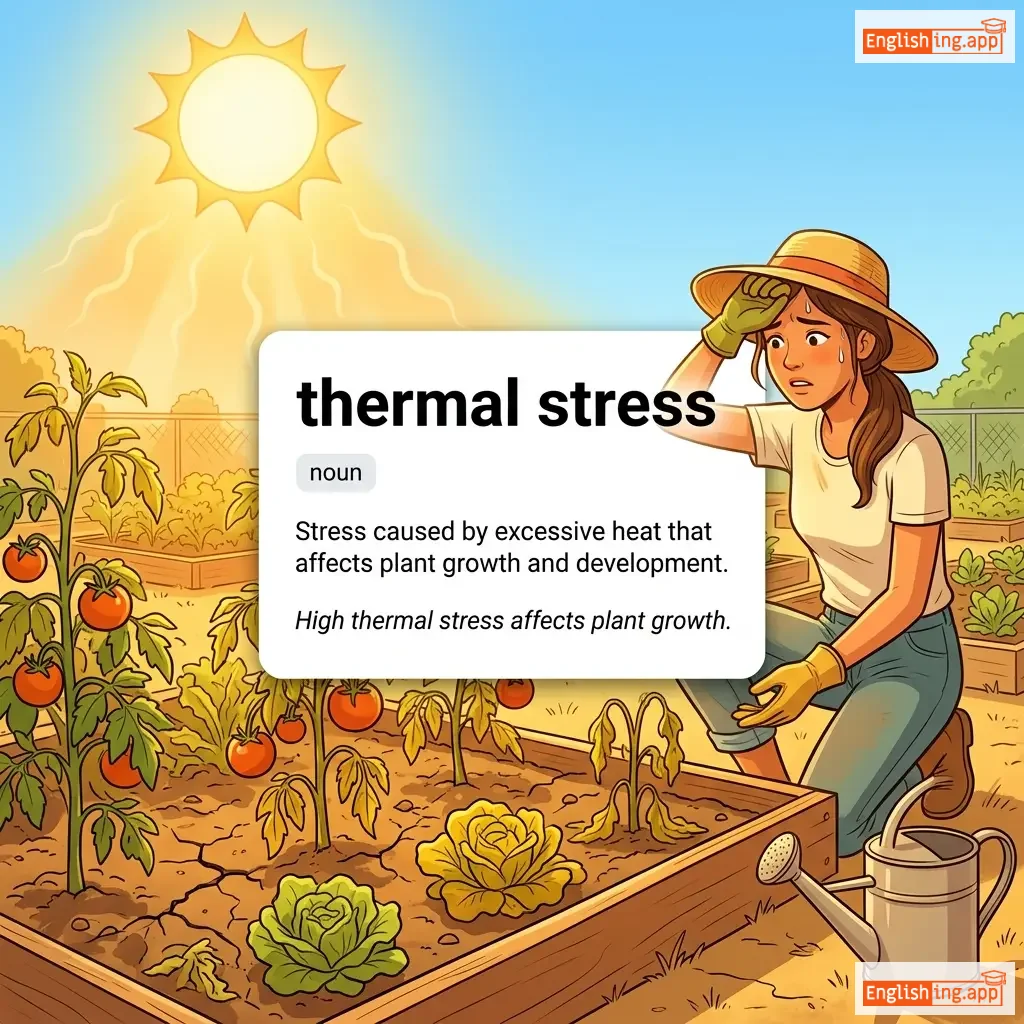
thermal stress definition card — visual illustration of the meaning
noun
ˈθɜː.məl stres
тепловой стресс (teplovoy stress)

Stress caused by excessive heat that affects plant growth and development.

"High thermal stress affects plant growth."
"Высокий тепловой стресс влияет на рост растений." (Vysokiy teplovoy stress vliyayet na rost rasteniy.)
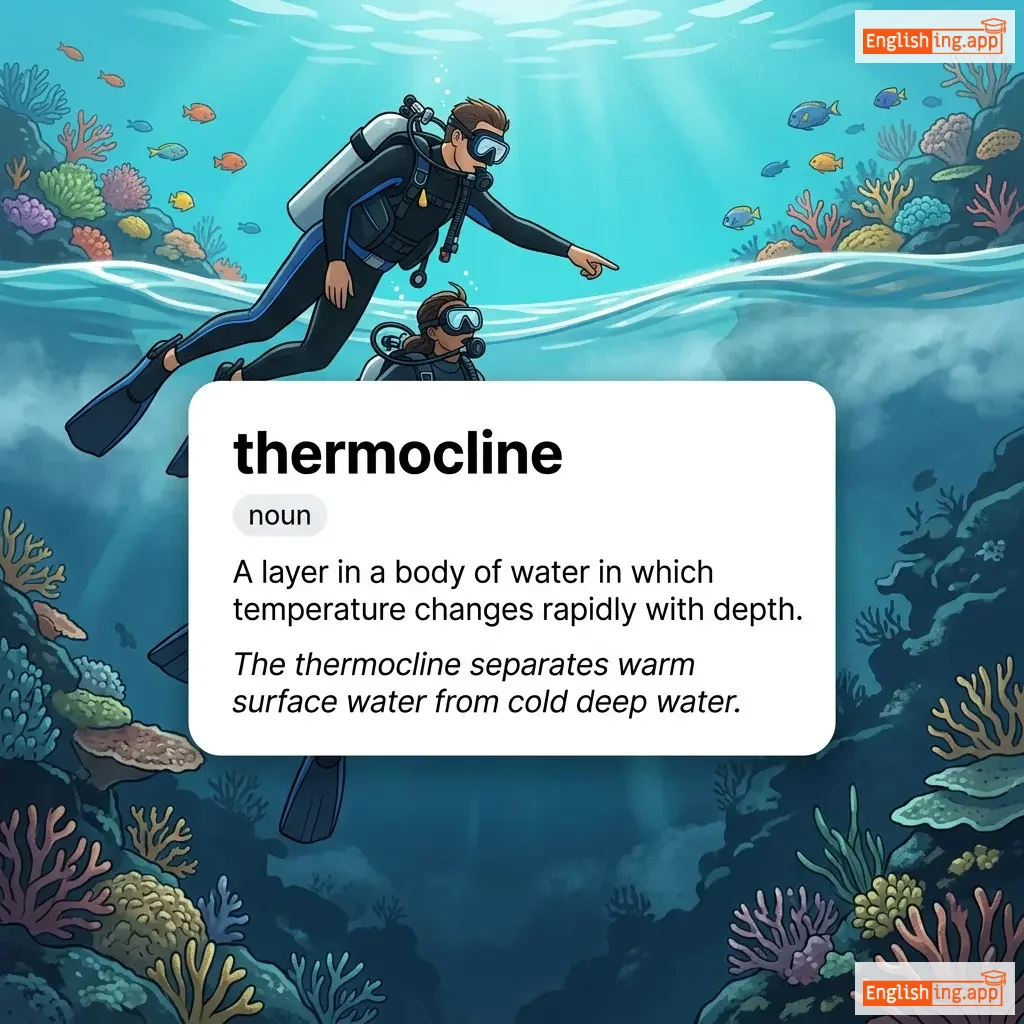
thermocline definition card — visual illustration of the meaning
noun
/ˈθɝː.moʊ.klaɪn/
термоклин (termoklin)

A layer in a body of water in which temperature changes rapidly with depth.

"The thermocline separates warm surface water from cold deep water."

"Термоклин разделяет тёплую поверхностную воду от холодной глубокой воды." (Termoklin razdelyayet tyopluyu poverkhnostnuyu vodu ot kholodnoy glubokoy vody.)
thermogenesis definition card — visual illustration of the meaning
noun
/ˌθɜː.məʊˈdʒen.ɪ.sɪs/
процесс производства тепла (process proizvodstva tepla)

The process of heat production in living organisms, often associated with burning calories and energy expenditure.

"Spicy foods can enhance thermogenesis and calorie burning."

"Острые продукты могут улучшить термогенез и сжигание калорий." (Ostrye produkty mogut uluchshit' termogenez i szhiganie kaloriy.)
pronoun
/ðiːz/
эти (eti)

used to refer to things or people that are near or present

"These are my friends."

"Это мои друзья." (Eto moi druz'ya.)
noun
/ˈθiːsɪs/
тезис (tezis)

A long piece of writing on a particular subject, usually for a degree at a university.

"She spent two years writing her doctoral thesis."

"Она потратила два года на написание своей докторской диссертации." (Ona potratila dva goda na napisanie svoey doktorskoy dissertatsii.)
thespian definition card — visual illustration of the meaning
noun
/ˈθɛspiən/
актер (akter)

An actor or actress; relating to drama or theater.

"The festival was filled with talented thespians from across the country."

"Фестиваль был полон талантливых актеров со всей страны." (Festival byl polon talantlivykh akterov so vsei strany.)
pronoun
/ðeɪ/
они (oni)

used to refer to people or things previously mentioned or easily identified

"They are going to the park."

"Они идут в парк." (Oni idut v park.)
adjective
/θɪk/
толстый (tolstyy)

having a large distance between two sides; not thin

"The book was so thick it took weeks to finish."

"Книга была такой толстой, что на её прочтение ушло несколько недель." (Kniga byla takoy tolstoy, chto na yeye prochtenie ushlo neskol'ko nedel')
noun
/ˈθɪk.ɪt/
заросли; кустарниковая чаща (thiket)

a dense group of bushes or trees; a thick growth of shrubs

"The rabbit disappeared into the thicket."

"Кролик исчез в зарослях." (Krolik ischez v zaroslyakh.)
adverb
/ˈθɪkli/
густо (gusto)

in a thick manner; densely; heavily

"The forest was thickly wooded with tall pine trees."

"Лес был густо покрыт высокими соснами." (Les byl gusto pokryt vysokimi sosnami.)
noun
/ˈθɪk.nəs/
толщина (tolschina)

The measure of how thick or dense something is

"The thickness of the book made it hard to carry."

"Толщина книги делала ее трудной для переноски." (Tolschina knigi delala ee trudnoy dlya perenoski.)
🦹‍♂️

Thief (θiːf)

noun
/θiːf/
вор (vor)

a person who steals things from others

"The thief was caught stealing from the jewelry store."

"Вор был пойман при попытке украсть в ювелирном магазине." (Vor byl poyman pri popytke ukrast' v yuvelirnom magazine.)
noun
/θaɪ/
бедро (bedro)

the part of the leg between the hip and the knee

"He felt pain in his right thigh after running for an hour."

"Он почувствовал боль в правом бедре после того, как пробежал час." (On pochuvstvoval bol' v pravom bedre posle togo, kak probeg nal chas.)
adjective
/θɪn/
тонкий (tonkiy)

having little thickness or width

"She wore a thin scarf in the winter."

"Она носила тонкий шарф зимой." (Ona nosila tonkiy sharf zimoy.)
noun
/θɪŋ/
вещь (veshch)

an object, idea, or matter that is being referred to or dealt with

"This is the thing I was looking for."

"Это вещь, которую я искал." (Eto veshch', kotoruyu ya iskal.)
think definition card — visual illustration of the meaning
verb
/θɪŋk/
думать (dumat')

to use one's mind to consider or reason about something

"I think this is a great idea."

"Я думаю, что это отличная идея." (Ya dumayu, chto eto otlichnaya ideya.)
adjective
/ˈθɪŋ.kə.bəl/
мысленный (myslennyy)

Capable of being imagined or conceived; possible to consider or believe

"It is hard to believe that such an outcome is even thinkable."

"Трудно поверить, что такой результат даже мыслим." (Trudno poverit', chto takoy rezul'tat dazhe myslim)
noun
/ˈθɪŋkɪŋ/
мышление (myshleniye)

the process of considering or reasoning about something

"Her thinking was clear and precise."

"Ее мышление было ясным и точным." (Eyo myshleniye bylo yasnym i tochnym.)
adjective
/θɜrd/
третий (tretiy)

constituting number three in a sequence

"She finished in third place."

"Она заняла третье место." (Ona zanyala tretye mesto.)
adjective
/ˈθɜːr.sti/
жаждущий (zhazhdushchiy)

feeling a need to drink; having a strong desire for something

"I am very thirsty after running in the heat."

"Я очень жажду после бега в жару." (Ya ochen' zhazhdu posle bega v zharu.)
3️⃣0️⃣

thirty (тёрти)

adjective
/ˈθɜrti/
тридцать (tridtsat)

equivalent to the number 30

"He is thirty years old."

"Ему тридцать лет." (Yemu tridtsat let.)
pronoun
/ðɪs/
это (eto)

used to refer to a person or thing that is close or near in space, time, or thought

"This is my favorite book."

"Это моя любимая книга." (Eto moya lyubimaya kniga.)
noun
/θɔːn/
шип (ship)

a sharp pointed part of a plant; something that causes pain or annoyance

"Be careful of the thorns on the rose bush."

"Осторожно с шипами на кустах роз." (Ostorozhno s shipami na kustakh roz.)
adjective
/ˈθɔːrni/
колючий, сложный (kolyuchiy, slozhnyy)

covered with thorns; causing difficulty or trouble

"They faced a thorny issue during the negotiation."

"Они столкнулись с колючей проблемой в ходе переговоров." (Oni stolknulis' s kolyuchyey problemy v khode peregovorov.)
adjective
/ˈθʌroʊ/
тщательный, подробный (tshchatel'nyy, podrobnnyy)

complete with regard to every detail; not superficial or partial

"The report was thorough and well-researched."

"Отчет был тщательным и хорошо исследованным." (Otchet byl tshchatel'nym i khorosho issledovannym.)
noun
/ˈθʌroʊˌbrɛd/
лошадь чистой породы (loshad chistoy porody)

a horse of pure and recognized breed; a person of good breeding or education

"The jockey rode a fast thoroughbred in the race."

"Жокей скакал на быстром Thoroughbred в гонке." (Zhockey skakal na bystrom Thoroughbred v gonke.)
noun
/ˈθʌroʊˌfɛr/
главная дорога (glavnaya doroga)

a main road or public highway that goes through a place

"The new mall is located along the main thoroughfare."

"Новый торговый центр находится вдоль главной дороги." (Novyy torgovyy tsentr nakhoditsya vdol' glavnoi dorogi.)
adjective
/ˈθʌroʊˌɡoʊɪŋ/
полный, абсолютный (polnyy, abslutnyy)

carried out to the full extent; absolute and complete

"She is a thoroughgoing professional in every sense."

"Она абсолютно профессионал во всех отношениях." (Ona absolyutno professional vovsekh otnosheniyakh.)
adverb
/ˈθʌr.ə.li/
тщательно (tshchatel'no)

completely and carefully; in a detailed way

"Please clean the kitchen thoroughly before the guests arrive."

"Пожалуйста, тщательно уберите кухню перед тем, как приедут гости." (Pozhaluysta, tshchatel'no ubirite kukhnyu pered tem, kak priedut gosti.)
pronoun
/ðoʊz/
те (te)

used to refer to people or things that are far away or distant in space, time, or thought

"Those are the shoes I want."

"Те туфли, которые я хочу." (Te tufli, kotorye ya khochu.)