Словари

Словарь английского языка | Значения слов, определения и примеры

adjective
/ˈspaɪn.ləs/
бесхарактерный; слабовольный; трусливый (spainles)

lacking courage or determination; weak-willed

"He was too spineless to stand up for his beliefs."

"Он был слишком безхарактерен, чтобы отстоять свои убеждения." (On byl slishkom bezkharakterny, chtoby otstoyat' svoi ubezhdeniya.)
adjective
/ˈspaɪnəs/
колючий (kolyuchiy)

Having spines or thorn-like projections

"The spinous cactus was difficult to handle without gloves."

"Этот колючий кактус было трудно держать без перчаток." (Eto kolyuchiy kaktus bylo trudno derzhat' bez perchatok.)
noun
/ˈspɪnstər/
незамужняя женщина (nezamuzhnyaya zhenshchina)

An unmarried woman, often one who is older and considered unlikely to marry

"The novel featured a kind-hearted spinster who cared for the village children."

"Роман изображал добросердечную незамужнюю женщину, которая заботилась о детях в деревне." (Roman izobrazhal dobrosserdechnuyu nezamuzhnyuyu zhenshchinu, kotoraya zabotilas o detyakh v derevne.)
adjective
/ˈspaɪni/
колючий (kolyuchiy)

covered with or full of spines; having sharp points

"The spiny cactus stood tall in the desert."

"Колючий кактус стоял высоко в пустыне." (Kolyuchiy kaktus stoyal vysoko v pustyne.)
adjective
/ˈspaɪ.rəl/
спираль (spiral)

winding in a continuous curve; helical

"The spiral staircase led to the top floor."

"Спиральная лестница вела на верхний этаж." (Spiral'naya lestnitsa vела na verkhniy etazh.)
noun
/ˈspaɪər/
шпиль (shpil)

a tall, pointed structure on top of a building, especially a church

"The church spire could be seen from miles away."

"Церковный шпиль был виден издалека." (Tserkovnyy shpil byl viden izdaleka.)
noun
/ˈspɪrɪt/
дух (dukh)

the non-physical part of a person, regarded as their true self

"Her spirit remained unbroken despite the hardships."

"Её дух остался непобежденным несмотря на трудности." (Eyo dukh ostalsya nepobezhdennym nesmotrya na trudnosti.)
Spiritual definition card — visual illustration of the meaning
adjective
/ˈspɪrɪtʃuəl/
духовный (duhovny)

relating to or affecting the human spirit or soul

"She practices spiritual meditation every morning."

"Она практикует духовную медитацию каждое утро." (Ona praktikuet dukhovnuyu meditaciyu kazhdoe utro.)
verb
/spɪt/
плевать (plevat')

to force liquid, especially saliva, out of the mouth

"He spat on the ground in anger."

"Он плевал на землю в гневе." (On pleval na zemlyu v gneve.)
noun
/spaɪt/
злоба (zloba)

a desire to hurt, annoy, or offend someone

"She refused the gift out of spite."

"Она отказалась от подарка из злобы." (Ona otkazalas' ot podarka iz zloby.)
noun
/spliːn/
сельца; гнев (sel'tsa; gnev)

an organ in the body that produces lymphocytes and filters blood; also refers to bad temper or spite

"He vented his spleen on his coworkers after the meeting."

"Он выплеснул свой гнев на коллег после встречи." (On vyplesnul svoj gnev na kolleg posle vstrechi.)
adjective
/ˈsplendɪd/
великолепный; замечательный; впечатляющий (velikolepnyj; zamechatelnyj; vpechatlyayushchij)

magnificent; excellent; very impressive

"The castle looked splendid in the sunset."

"Замок выглядел великолепно на закате." (Zamok vyglyadel velikolepno na zakate.)
adjective
/splɪˈnɛtɪk/
раздражительный, злобный (razdrazhitel'nyy, zlobnyy)

bad-tempered, irritable, spiteful

"His splenetic remarks offended everyone in the room."

"Его раздражительные замечания оскорбили всех в комнате." (Ego razdrazhitel'nye zamechaniya oskorbili vsekh v komnate.)
verb
/splaɪs/
соединять (soedinyat)

to join two pieces of rope, film, or other material by weaving or attaching them together

"The technician spliced the two wires to restore the connection."

"Техник соединил два провода, чтобы восстановить соединение." (Tekhnik soedinyal dva provoda, chtoby vosstanovit soedinenie.)
/splɪnt/
шина (shina)

A rigid device used to support and immobilize a broken or injured body part.

"The doctor applied a splint to stabilize the patient's broken arm."

"Врач наложил шину, чтобы стабилизировать сломанную руку пациента." (Vrach nalozhil shinu, chtoby stabilizirovat' slomannuyu ruku patsiyenta.)
verb
/splɪt/
делить (delit)

to divide or separate into parts or groups

"He split the log in two with an axe."

"Он разрубил бревно на два с помощью топора." (On razrubil brevno na dva s pomoshch'yu topora.)
verb
/spɔɪl/
испортить (isportit')

to damage or ruin something

"The rain spoiled the outdoor event."

"Дождь испортил мероприятие на открытом воздухе." (Dozhd' isportil meropriyatie na otkrytom vozdukhe.)
noun
/ˈspɔɪlˌspɔːrt/
зануда (zanuda)

A person who ruins other people's enjoyment or fun.

"Don't be a spoilsport and let us enjoy the party."

"Не будь занудой и позволь нам наслаждаться вечеринкой." (Ne bud' zanudoy i pozvol' nam naslazhdat'sya vecherinkoy.)
noun, verb
/spoʊk/
спицы / сказал (spitsy / skazal)

As a noun, a bar connecting the center of a wheel to its rim; as the past tense of 'speak'.

"The bicycle's spoke was bent after the accident."

"Спица велосипеда была согнута после аварии." (Spitsa velosipeda byla sognutá posle avarii.)
noun
/ˈspəʊksmən/
представитель (predstavitel)

a person who speaks on behalf of others, especially for a group or organization

"The spokesman addressed the crowd during the rally."

"Представитель выступил перед толпой во время митинга." (Predstavitel vystupil pered tolpoy vo vremya mitinga.)
noun
/ˈspəʊkspɜːrsən/
спикер (spiker)

a person who speaks on behalf of others or an organization

"The spokesperson addressed the press conference on behalf of the company."

"Спикер выступил на пресс-конференции от имени компании." (Spiker vystupil na press-konferentsii ot imeni kompanii.)
noun
/ˈspəʊkswɪmən/
женщина-пресс-секретарь (zhenshchina-press-sekretar)

a woman who speaks on behalf of a group or organization

"The spokeswoman for the company announced the new product."

"Пресс-секретарь компании объявила о новом продукте." (Press-sekretar kompanii ob'yavila o novom produkte.)
noun
/ˌspoʊliˈeɪʃən/
уничтожение (unichtozhenie)

The act of destroying or ruining something, often evidence or property.

"The court punished the company for the spoliation of evidence."

"Суд наказал компанию за уничтожение доказательств." (Sud nakazal kompaniyu za unichtozhenie dokazatel'stv.)
adjective
/ˈspʌndʒi/
пористый (poristyy)

soft and full of holes like a sponge; porous

"The cake had a light and spongy texture."

"Пирог имел легкую и пористую текстуру." (Pirog imel legkuyu i poristuyu teksturu.)
noun
/spʌndʒ ɡɔːrd/
тыквенный спонж (tykvennyy sponzh)

a fibrous gourd that becomes sponge-like when dried, used for cleaning and in cooking when young

"The sponge gourd can be eaten when young or dried to make natural scrubbers."

"Тыковный спонж может быть съеден, когда он молод, или высушен для изготовления натуральных губок." (Tykvennyy sponzh mozhet byt' syeden, kogda on molod, ili vysushen dlya izgotovleniya natural'nykh gubok.)
sponsor definition card — visual illustration of the meaning
noun
/ˈspɒnsər/
спонсор (sponsor)

a person or organization that provides funds for a project or activity in exchange for publicity or support

"The company became the main sponsor of the event."

"Компания стала основным спонсором мероприятия." (Kompaniya stala osnovnym sponsorom meropriyatiya.)
noun
/ˈspɒnsəʃɪp/
спонсорство (sponsorstvo)

the act of supporting an event, activity, person, or organization financially or through other resources

"The event was made possible due to the sponsorship of several big companies."

"Мероприятие стало возможным благодаря спонсорству нескольких крупных компаний." (Meropriyatie stalo vozmozhnym blagodarya sponsorstvu neskol'kikh krupnykh kompaniy.)
spontaneity definition card — visual illustration of the meaning
noun
/ˌspɑːntəˈneɪəti/
спонтанность (spontannost)

The quality of being natural, impulsive, and unplanned.

"Her spontaneity made the trip more exciting."

"Ее спонтанность сделала поездку более захватывающей." (ee spontannost sdelala poezdku bolee zakhvatyvayuschey.)
adjective
/spɒnˈteɪniəs/
спонтанный (spontanny)

Happening naturally without planning or external cause; impulsive or unplanned.

"Their spontaneous trip to the mountains turned out to be the highlight of the summer."
"Их спонтанное путешествие в горы стало кульминацией лета." (Ih spontannoe puteshestvie v gory stalo kul'minatsiey leta.)
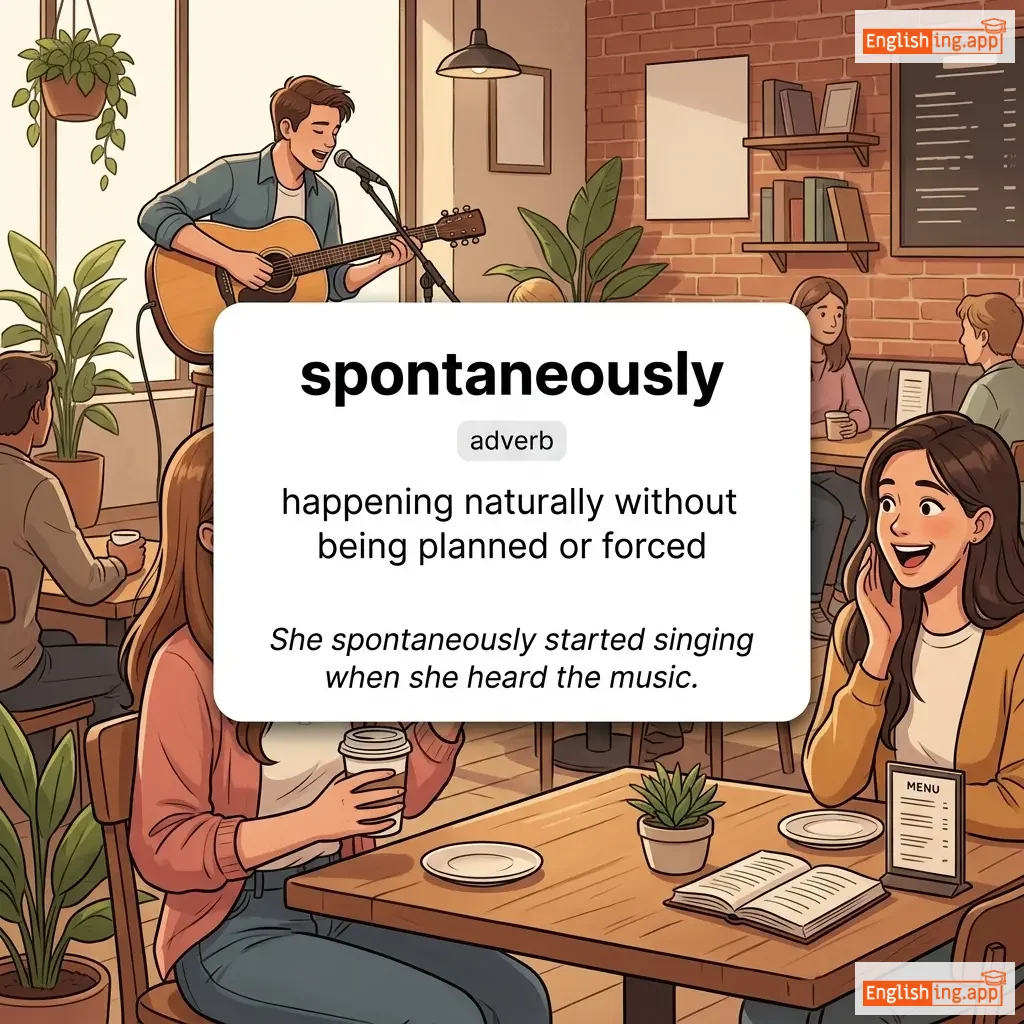
spontaneously definition card — visual illustration of the meaning
adverb
/spɒnˈteɪ.ni.əs.li/
спонтанно (spontanno)

happening naturally without being planned or forced

"She spontaneously started singing when she heard the music."

"Она начала петь спонтанно, когда услышала музыку." (Ona nachala pet' spontanno, kogda uslyshala muzyku.)
noun/verb
/spuːf/
юмористическое подражание (yumoristicheskoe podradanie)

A humorous imitation of something, or to trick or parody someone or something.

"The comedian spoofed the politician’s speech to entertain the audience."

"Комик пародировал речь политика, чтобы развеселить публику." (Komik parodiroval rech' politika, chtoby razveselet' publiku.)
noun
/spuːn/
ложка (lozhka)

a utensil consisting of a small shallow bowl with a handle, used for eating, stirring, or serving food

"She stirred her coffee with a silver spoon."

"Она размешала свой кофе серебряной ложкой." (Ona razmeshala svoy kofe serebryanoy lozhkoy.)
noun
/ˈspuːnərɪzəm/
спунеризм (spunerizm)

A verbal error in which the initial sounds of words are swapped to create a humorous effect.

"He made a spoonerism by saying 'queer old dean' instead of 'dear old queen'."
"Он сделал спунеризм, сказав 'странный старый декан' вместо 'дорогая старая королева'." (On sdelal spunerizm, skazav 'strannyy staryy dekan' vmesto 'dorogaya staraya koroleva'.)
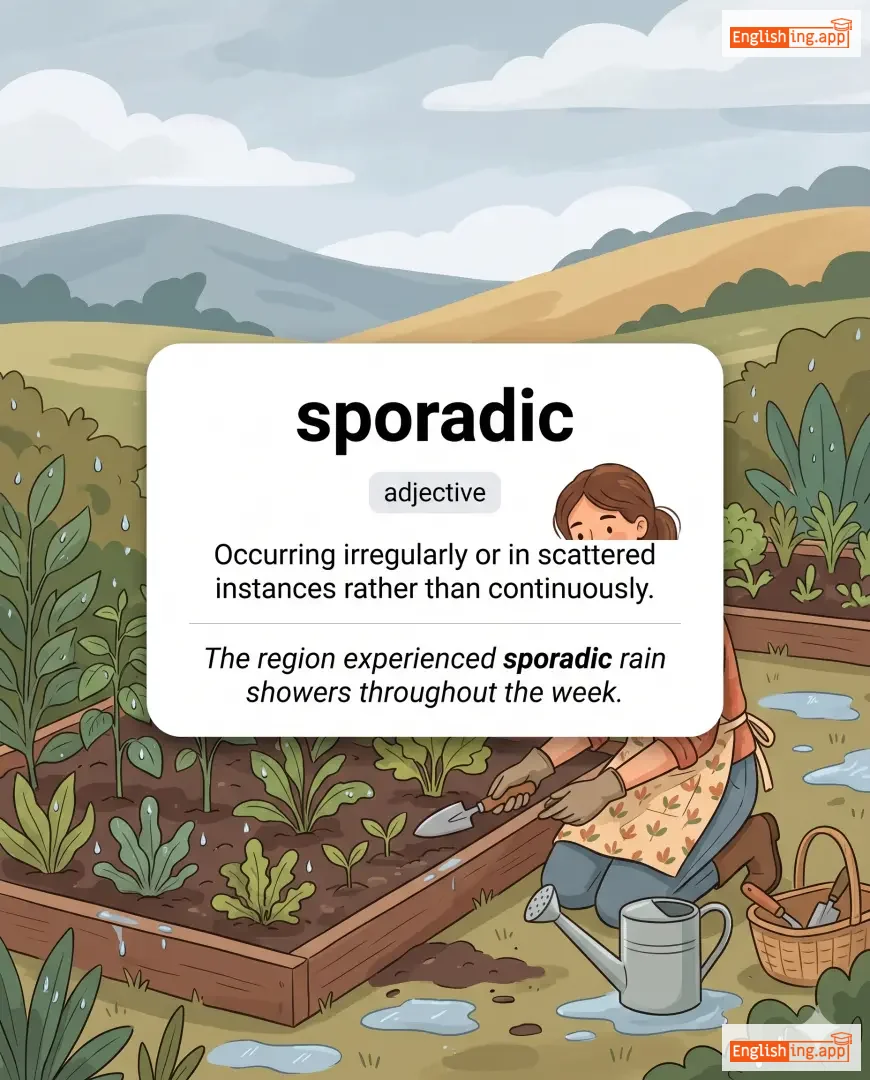
sporadic definition card — visual illustration of the meaning
adjective
/spəˈrædɪk/
спорадический (sporadicheskiy)

Occurring irregularly or in scattered instances rather than continuously.

"The region experienced sporadic rain showers throughout the week."

"Регион испытал спорадические дожди в течение недели." (Region ispyltal sporadicheskie dozhdi v techeniye nedeli.)
noun
/spɔːt/
спорт (sport)

an activity involving physical exertion and skill in which an individual or team competes against another or others for entertainment

"Football is a popular sport around the world."

"Футбол - популярный спорт во всем мире." (Futbol - populyarnyy sport vo vsyom mire.)
adjective
/ˈspɔːrtɪv/
спортивный (sportivnyy)

Playful, lively, or full of fun.

"The children were in a sportive mood during the picnic."

"Дети были в спортивном настроении во время пикника." (Deti byli v sportivnom nastroenii vo vremya piknika.)
noun
/ˈspɔːrtsmən/
спортсмен (sportsmen)

A person who is skilled in sports or enjoys participating in athletic activities.

"He is a true sportsman, always fair and respectful to his opponents."
"Он настоящий спортсмен, всегда честен и уважителен к своим соперникам." (On nastoyashchiy sportsmen, vsegda chesten i uvazhitelen k svoim sopernikam.)
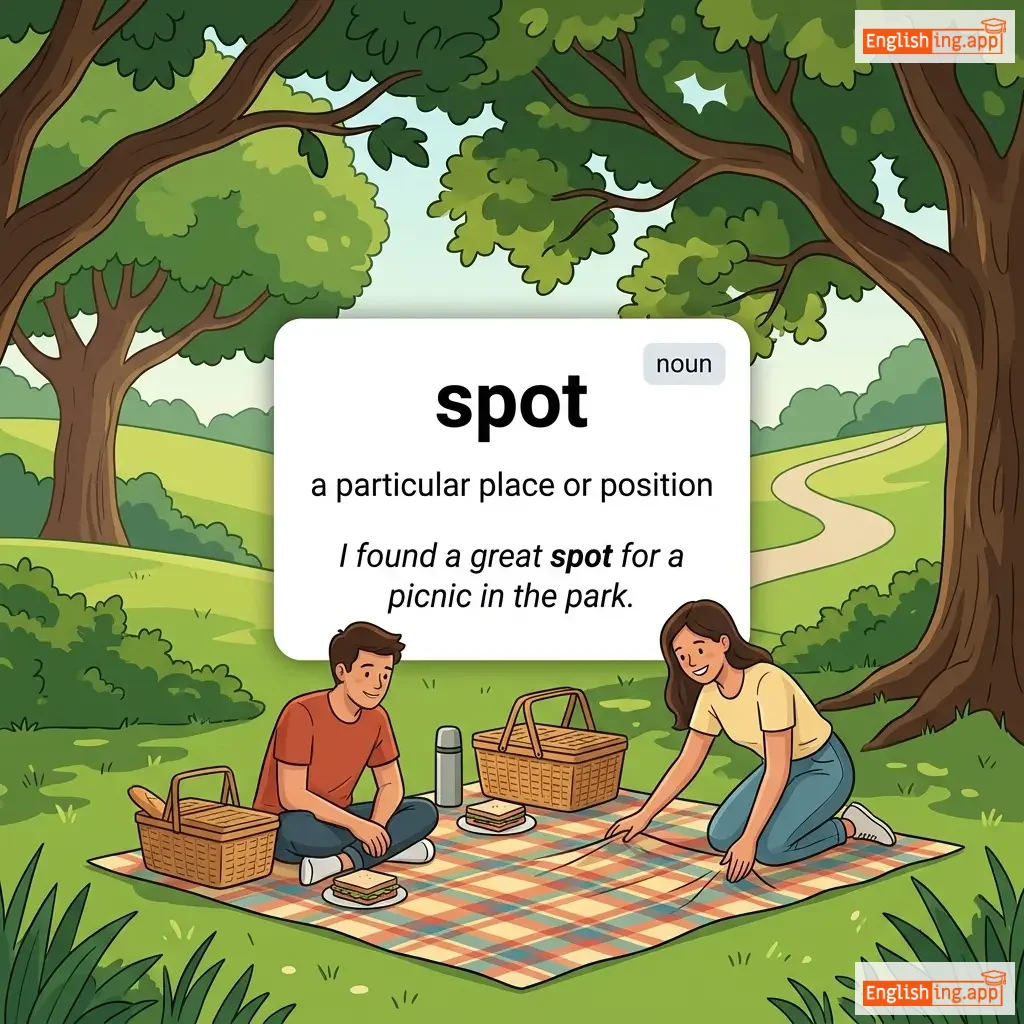
spot definition card — visual illustration of the meaning
noun
/spɒt/
место (mesto)

a particular place or position

"I found a great spot for a picnic in the park."

"Я нашел отличное место для пикника в парке." (Ya nashel otlichnoye mesto dlya piknika v parke.)
noun
/ˈspɒt.laɪt/
прожектор (spotlayt)

a strong beam of light directed onto a particular area; figuratively, public attention

"The singer stood proudly in the spotlight."

"Певец гордо стоял в свете прожектора." (Pevets gordo stoyal v svete prozhektora.)
adjective
/ˈspɒtɪd/
пятнистый; отмеченный; замеченный (pyatnistyy; otmechennyy; zamechennyy)

having spots or marks; noticed or seen

"The spotted leopard moved silently through the jungle."

"Пятнистая пантера двигалась бесшумно через джунгли." (Pyatnistaya pantera dvizhilas' besshumno cherez dzhungli.)
noun
/ˈspɒt.ɪd sneɪk hed/
пятнистая змееголовая рыба (pyatnistaya zmeegolovaya ryba)

a type of freshwater fish with spotted markings and an elongated head resembling a snake

"The spotted snake head is a popular fish for aquaculture in South Asia."

"Пятнистая змееголовая рыба популярна для аквакультуры в Южной Азии." (pyatnistaya zmeegolovaya ryba populyarna dlya akvakultury v yuzhnoy azii)
noun
/spaʊs/
супруг (suprug)

a person's husband or wife

"Each employee may include their spouse in the health insurance plan."

"Каждый сотрудник может включить своего супруга в план медицинского страхования." (Kazhdyi sotrudnik mozhet vklyuchit' svoego supruga v plan meditsinskogo strakhovaniya.)
noun, verb
/spreɪn/
растяжение (rastyazhenie)

an injury to a joint in which the ligaments are stretched or torn

"She sprained her ankle while running in the park."

"Она вывихнула лодыжку, когда бегала в парке." (Ona vyvihnula lodyzhku, kogda begala v parke.)
verb
/spreɪ/
распылять (raspylyat)

to apply liquid to something in a fine mist

"She sprayed perfume on her wrist before leaving."

"Она распылила духи на своё запястье перед тем, как уйти." (Ona raspylyla dukhi na svoe zapyaste pered tem, kak uyti.)
verb
/sprɛd/
раскрывать (raskryvat')

to open or extend something over an area

"She spread the blanket on the grass for a picnic."

"Она раскинула одеяло на траве для пикника." (Ona raskynula odeyalo na trave dlya piknika.)
adjective
/ˈspraɪtli/
живой (zhivoy)

full of energy and life; lively

"The sprightly old man danced with joy at the wedding."

"Живой старик танцевал с радостью на свадьбе." (Zhivoy starik tantseval s radost'yu na svad'be.)
noun
/sprɪŋ/
весна (vesna)

the season between winter and summer when plants begin to grow

"Flowers bloom in the spring."

"Цветы распускаются весной." (Tsvety raspuskajutsya vesnoj.)
verb
/ˈsprɪŋkəl/

to scatter small drops or particles of a substance over a surface

"She sprinkled sugar on top of the cake."

verb, noun
/spraʊt/
прорастать (prorastat')

to begin to grow; to produce new leaves or shoots

"The seeds began to sprout after a few days of rain."

"Семена начали прорастать после нескольких дней дождя." (Semena nachali prorastat' posle neskol'kikh dney dozhdya.)
verb, adjective, noun
/spruːs/
привести в порядок / тип дерева (privedi v poryadok / tip dereva)

to make neat or tidy in appearance; also refers to an evergreen tree

"He spruced up his room before the guests arrived."

"Он привел свою комнату в порядок до того, как пришли гости." (On privedi svoju komnatu v poryadok do togo, kak prishli gosti.)