Словари

Словарь английского языка | Значения слов, определения и примеры
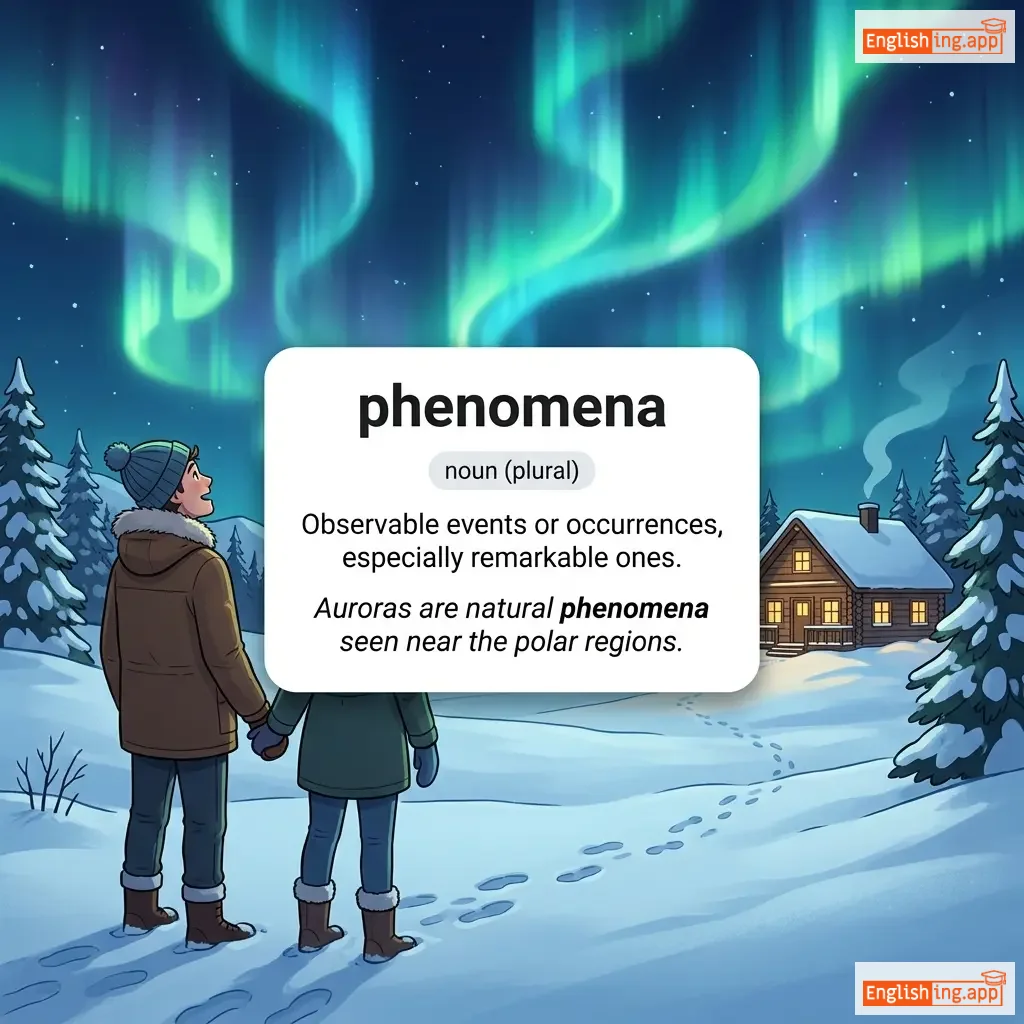
phenomena definition card — visual illustration of the meaning
noun (plural)
/fəˈnɒmɪnə/
феномены (fenomeny)

Observable events or occurrences, especially remarkable ones.

"Auroras are natural phenomena seen near the polar regions."

"Авроры — это природные феномены, которые наблюдаются вблизи полярных регионов." (Avrory — eto prirodnye fenomeny, kotorye nablyudayutsya vblizi polyarnykh regionov.)
adjective
/fəˈnɒmɪnəl/
феноменальный (fenomenal'nyy)

extraordinary, remarkable, or exceptional in a way that is very impressive

"The team achieved phenomenal success in the tournament."

"Команда достигла феноменального успеха на турнире." (Komanda dostigla fenomenal'nogo uspekha na turnire.)
noun
/fəˈnɒmɪnən/
феномен (fenomen)

an observable event, fact, or occurrence, often unusual or remarkable

"The Northern Lights are a natural phenomenon."

"Северное сияние — это природный феномен." (Severnoe siyanie — eto prirodnyy fenomen.)
noun
/ˈfaɪəl/
небольшая флакон (nebolshaya flakon)

a small glass container for liquids, especially medicines

"The doctor gave her a phial of medicine."

"Врач дал ей фиал с лекарством." (Vrach dal yey fial s lekarstvom.)
verb
/fɪˈlændər/
блуждать (bluzhdat)

to engage in casual or frivolous romantic or sexual relationships

"He was known to philander with many women in town."

"Он был известен своими отношениями с множеством женщин в городе." (On byl izvesten svoimi otnosheniyami s mnozhestvom zhenshchin v gorode.)
noun
/fɪˈlændərər/
бабник (babnik)

a man who habitually engages in casual romantic or sexual affairs

"The politician was exposed as a notorious philanderer."

"Политика раскрыли как печально известного бабника." (Politika raskryli kak pechal'no izvestnogo babnika.)
adjective
/ˌfɪl.ænˈθrɒp.ɪk/
филантропический (filantropicheskiy)

showing concern for the welfare of others; generous and charitable

"She is known for her philanthropic activities in the city."

"Она известна своими филантропическими деятельностями в городе." (Ona izvestna svoimi filantropicheskimi deyatel'nostyami v gorode.)
noun
/fɪˈlæn.θrə.pɪst/
филантроп (filantrop)

a person who seeks to promote the welfare of others, especially by donating money to good causes

"The philanthropist donated millions to build schools in rural areas."

"Филантроп пожертвовал миллионы на строительство школ в сельских районах." (Filantrop pozhertvoval milliony na stroitel'stvo shkol v selskih rajonah.)
noun
/fɪˈlæn.θrə.pi/
филантропия (filantropiya)

the desire to promote the welfare of others, often expressed by the generous donation of money to good causes

"Philanthropy has helped improve healthcare in many developing countries."

"Филантропия помогла улучшить здравоохранение в многих развивающихся странах." (Filantropiya pomogla uluchshit' zdravookhraneniye v mnogikh razvivayushchikhsya stranakh.)
noun
/fɪˈlæt.əl.ɪst/
коллекционер марок (kollektsioner marok)

a person who collects or studies postage stamps

"The philatelist spent years building a rare stamp collection."

"Филателист потратил годы на создание редкой коллекции марок." (Filatelist potratil gody na sozdaniye redkoy kollektsii marok.)
noun
/fɪˈlæt.əl.i/
филателия (filateliya)

the collection and study of postage stamps

"Philately is a hobby enjoyed by people of all ages."

"Филателия — это хобби, которым занимаются люди всех возрастов." (Filateliya – eto khobbi, kotorym zanimayutsya lyudi vsekh vozrastov.)
adjective
/ˌfɪl.hɑːrˈmɒn.ɪk/
относящийся к симфоническому оркестру (otnosyashchijsya k simfonicheskomu orkestru)

relating to a symphony orchestra or its music

"The philharmonic orchestra performed a stunning rendition of Beethoven's Ninth Symphony."

"Филармонический оркестр исполнил впечатляющее произведение Девятой симфонии Бетховена." (Filarmoničeskij orkestr ispolnil vpečatljajushchee proizoždenie Devjatoy simfonii Bethovena.)
noun
/ˈfɪl.ɪ.staɪn/
человек, равнодушный или враждебный к культуре и искусству (chelovek, ravnodushnyy ili vrashdebnyy k kul'ture i iskusstvy)

a person who is indifferent or hostile to culture and the arts

"He was criticized as a philistine for dismissing modern art."

"Его критиковали как филистинца за то, что он отверг современное искусство." (Ego kritikovali kak filistinza za to, chto on otverg sovremennoye iskusstvo.)
noun
/ˈfɪl.ə.dʒɪ.nɪst/
человек, который любит или восхищается женщинами (chelovek, kotoryj lyubit ili voskhishchajetsja zhenshhinami)

a person who loves or admires women

"As a known philogynist, he advocated for women's education."

"Как известный филоджиніст, он выступал за образование женщин." (Kak izvestnyj filodzhinist, on vystupal za obrazovanie zhenshhin.)
noun
/fɪˈlɒl.ə.dʒɪst/
филолог (filolog)

a person who studies languages and their history

"The philologist analyzed ancient texts to understand language evolution."

"Филолог проанализировал древние тексты, чтобы понять эволюцию языка." (Filolog proanaliziroval drevnie teksty, chtoby ponyat' evolyutsiyu yazyka.)
noun
/fɪˈlɒl.ə.dʒi/
изучение языка в письменных исторических источниках; лингвистика (izucheniye yazyka v pis'mennykh istoricheskikh istochnikakh; lingvistika)

the study of language in written historical sources; linguistics

"She devoted her career to philology, researching ancient manuscripts."

"Она посвятила свою карьеру филологии, исследуя древние манускрипты." (Ona posvyatila svoyu kar'yeru filologii, issleduya drevnie manuskripty.)
noun
/fɪˈlɒsəfə/
философ (filosof)

a person engaged in the study of philosophy or in serious thinking about fundamental questions

"Socrates was a famous philosopher of ancient Greece."

"Сократ был знаменитым философом древней Греции." (Sokrat byl znamenitym filosofom drevnej Gretsii.)
adjective
/ˌfɪl.əˈsɒf.ɪ.kəl/
философский (filosofskiy)

relating to the study of the fundamental nature of knowledge, reality, and existence

"She maintained a calm and philosophical attitude during the crisis."

"Она сохранила спокойное и философское отношение в кризисной ситуации." (Ona sokhranila spokoynoe i filosofskoe otnoshenie v krizisnoy situatsii.)
verb
/fɪˈlɒs.ə.faɪz/
философствовать (filosofstvovat')

to think or talk about the fundamental nature of knowledge, reality, and existence

"He likes to philosophize about life and its meaning."

"Ему нравится философствовать о жизни и её значении." (Emu nravitsya filosofstvovat' o zhizni i yey znachenii.)
noun
/fɪˈlɒs.ə.fi/
философия (filosofiya)

the study of the fundamental nature of knowledge, reality, and existence

"Her philosophy emphasizes kindness and empathy."

"Ее философия подчеркивает доброту и эмпатию." (Eyo filosofiya podcherkivayet dobroty i empatiyu.)
phishing definition card — visual illustration of the meaning
noun
/ˈfɪʃ.ɪŋ/
мошенничество с кражей информации (moshennichestvo s krazhey informatsii)

Deceptive technique for stealing personal information unauthorized

"Phishing emails trick users into revealing passwords."

"Фишинговые письма обманывают пользователей, заставляя их раскрывать пароли." (Fishingovye pis'ma obmanyvayut pol'zovateley, zastavlyaya ikh raskryvat' paroli.)
phlegmatic definition card — visual illustration of the meaning
adjective
/flɛgˈmæt.ɪk/
флегматичный (flegmatichny)

having an unemotional and stolidly calm disposition

"Despite the chaos, he remained phlegmatic and composed."

"Несмотря на хаос, он остался флегматичным и собранным." (Nesmotrya na khaos, on ostalsya flegmatichnym i sobrannym.)
noun
/ˈfəʊ.bi.ə/
фобия (fobiya)

an extreme or irrational fear of something

"She has a phobia of heights and avoids tall buildings."

"У неё фобия высоты, и она избегает высоких зданий." (U nee fobiya vysoty, i ona izbegayet vysokikh zdanii.)
noun
/ˈfiː.nɪks/
птица феникс (ptitsa feniks)

a mythical bird that is reborn from its ashes; symbol of immortality or renewal

"The legend says the phoenix rises from its ashes every 500 years."

"Легенда гласит, что феникс восстает из своих пепел каждый 500 лет." (Legenda glasit, chto feniks vosstoyot iz svoikh pepel' kazhdy 500 let.)
noun
/fəʊn/
телефон (telefon)

a device for communication, typically used to make calls or send messages

"I need to charge my phone."

"Мне нужно зарядить мой телефон." (Mne nuzhno zaryadit' moy telefon.)
adjective
/fəˈnɛtɪk/
фонетический (foneticheskiy)

relating to the sounds of speech or pronunciation

"The teacher taught the students the phonetic spelling of difficult words."

"Учитель научил студентов фонетическому написанию трудных слов." (Uchitel' nauchil studentov foneticheskomu napisaniyu trudnykh slov.)
adjective
/ˈfɒnɪk/
фонетический (foneticheskiy)

relating to speech sounds or their production; connected to phonics

"Children learn phonic rules to read new words accurately."

"Дети учат фонетические правила для правильного чтения новых слов." (Deti uchat foneticheskie pravila dlya pravil'nogo chteniya novyh slov.)
noun
/ˈfoʊ.nə.ɡræm/
фонический символ (fonicheskiy simvol)

a written symbol representing a speech sound

"The teacher showed how each phonogram represents a particular sound."

"Учитель показал, как каждая фоно́грамма представляет определённый звук." (Uchitel' pokazal, kak kazhdaya fonogramma predstavyayet opredelyonnyy zvuk.)
noun
/ˌfoʊ.nəˈlɑː.dʒi/
фонология (fonologiya)

the study of the sound system of a language

"She is studying phonology to understand how sounds function in English."

"Она изучает фонологию, чтобы понять, как звуки функционируют в английском языке." (Ona izuchayet fonologiyu, chtoby ponyat', kak zvuki funktsioniruyut v angliyskom yazyke.)
adjective
/ˈfoʊni/
фальшивый, поддельный (fal'shivy, poddel'nyy)

not genuine; fraudulent or insincere

"He gave a phony smile to hide his true feelings."

"Он дал фальшивую улыбку, чтобы скрыть свои настоящие чувства." (On dal fal'shivuyu ulybku, chtoby skryt' svoi nastoyashchiye chuvstva.)
noun
/ˌfɑːsfəˈrɛsəns/
фосфоресценция (fosforeskentsiya)

the property of emitting light without noticeable heat

"The deep-sea creatures displayed a beautiful phosphorescence."

"Глубоководные существа демонстрировали красивую фосфоресценцию." (Glubokovodnye sushchestva demonstrirovali krasivuyu fosforeskentsiyu.)
noun
/ˈfəʊtəʊ/
фото (foto)

a picture or image captured by a camera

"I took a photo of the sunset."

"Я сделал фото заката." (Ya sdelal foto zakata.)
noun, verb
/ˈfəʊtəʊˌkɒpi/
ксерокопия (kserokopiya)

a copy of a document made using a photocopying machine; to make such a copy

"Please photocopy these documents before the meeting."

"Пожалуйста, сделайте ксерокопию этих документов перед встречей." (Pozhaluysta sdelayte kserokopiyu etikh dokumentov pered vstrechey)
adjective
/ˌfoʊtoʊɪˈlɛktrɪk/
фотоэлектрический (fotoelektricheskiy)

relating to the emission of electrons or other free carriers when light shines on a material

"The photoelectric effect is fundamental in solar panels."

"Фотоэлектрический эффект является основным в солнечных панелях." (Fotoelektricheskiy effekt yavyayetsya osnovnym v solnechnykh panelyakh.)
noun
/ˈfəʊtəɡrɑːf/
фото (foto)

a picture made using a camera

"She took a photograph of the sunset."

"Она сделала фотографию заката." (Ona sdelala fotografiyu zakata.)
noun
/fəˈtɒɡrəfə/
фотограф (fotograf)

a person who takes photographs professionally

"The photographer captured the beauty of nature."

"Фотограф запечатлел красоту природы." (Fotograf zapechatlel krasotu prirody.)
noun
/fəˈtɒɡrəfi/
фотография (fotografiya)

the art or practice of taking and processing photographs

"She studied photography in college."

"Она учила фотографию в университете." (Ona uchila fotografiyu v universitete.)
noun
/ˌfoʊˈtɑːmɪtər/
фотометр (fotometr)

an instrument for measuring the intensity of light

"The scientist used a photometer to measure the light in the laboratory."

"Учёный использовал фотометр для измерения света в лаборатории." (Uchyonnyy ispol'zoval fotometr dlya izmereniya sveta v laboratorii.)
noun
/foʊˈtɑːmɪtri/
наука о измерении света (nauka o izmerenii sveta)

the science of measuring visible light in terms of its perceived brightness to human eyes

"Photometry helps in designing efficient lighting systems."

"Фотометрия помогает проектировать эффективные системы освещения." (Fotometriya pomogaet proyektirovat' effektivnye sistemy osveshcheniya.)
Photos definition card — visual illustration of the meaning
noun
ˈfoʊtoʊz
фотографии (fotografii)

Photographs; pictures taken with a camera.

"Adding photos to a family tree makes it more personal."
"Добавление фотографий в родословную дерево делает его более личным." (Dobavlenie fotografii v rodoslovnuyu derevo delaet ego bolee lichnym.)
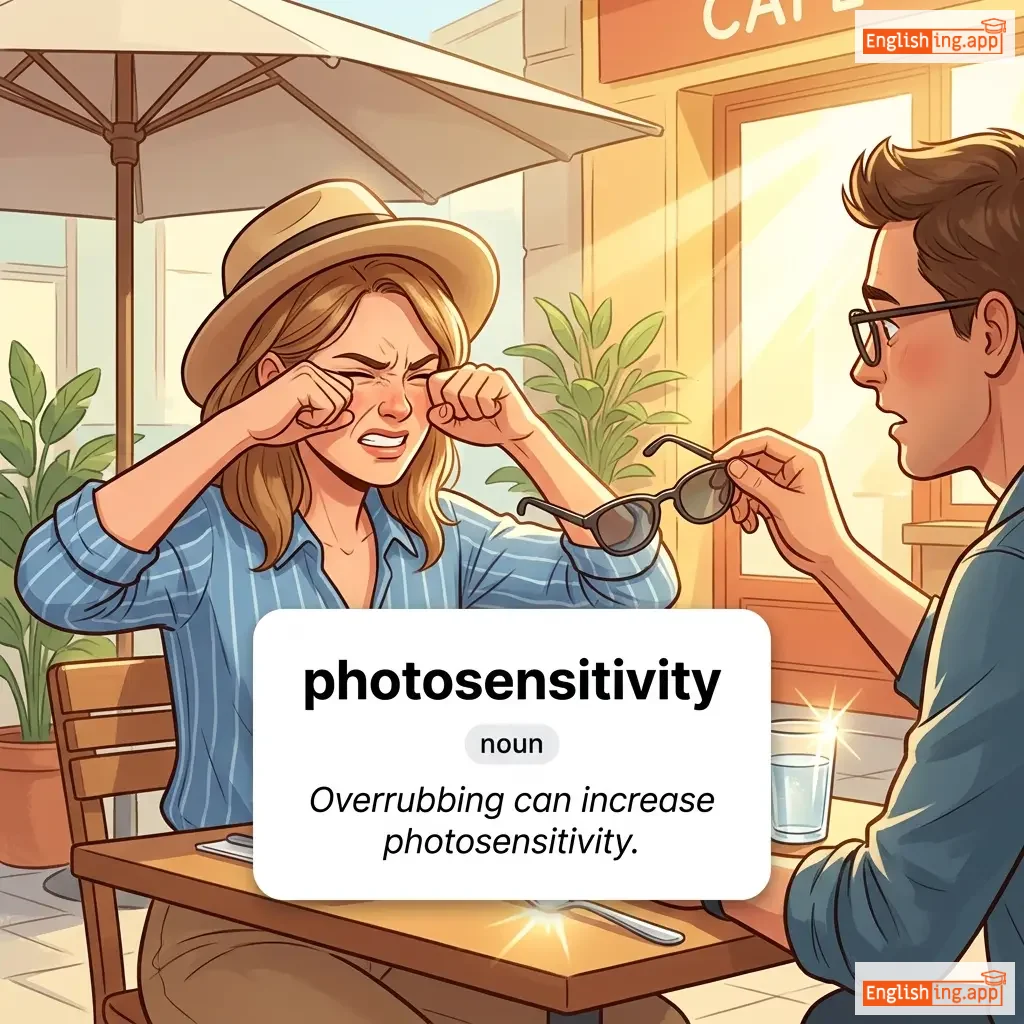
photosensitivity definition card — visual illustration of the meaning
noun
/ˌfəʊ.təʊ.sen.sɪˈtɪv.ɪ.ti/
светочувствительность (svetochuvstvitelnost)

Sensitivity to light, especially abnormal sensitivity that may cause discomfort or damage.

"Overrubbing can increase photosensitivity."
"Чрезмерное трение может повысить светочувствительность." (Chrezmernoye trenie mozhet povysit' svetochuvstvitel'nost'.)
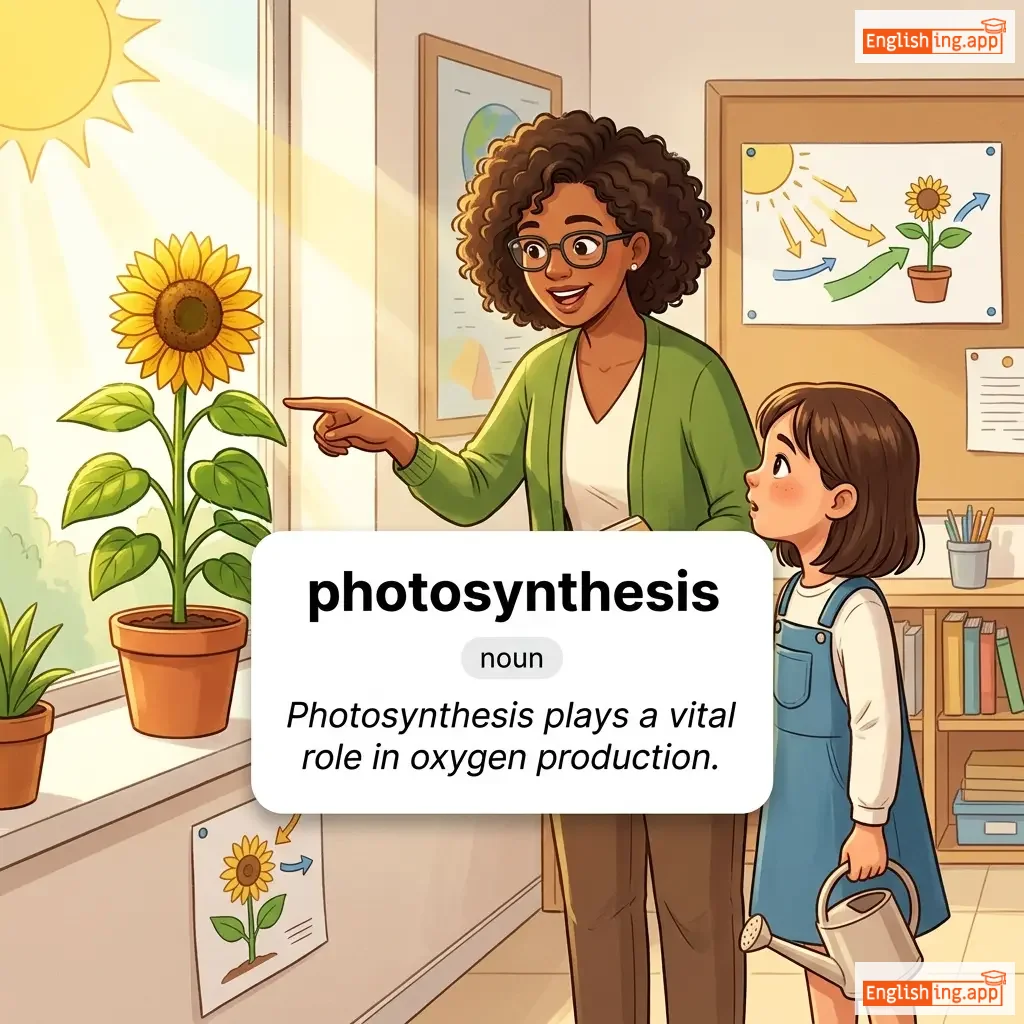
photosynthesis definition card — visual illustration of the meaning
noun
/ˌfoʊ.t̬oʊˈsɪn.θə.sɪs/
фотосинтез (fotosintez)

The process by which green plants and some other organisms use sunlight to synthesize nutrients from carbon dioxide and water.

"Photosynthesis plays a vital role in oxygen production."

"Фотосинтез играет важную роль в производстве кислорода." (Fotosintez igraet vazhnuyu rol' v proizvodstve kisloroda.)
photosynthetic efficiency definition card — visual illustration of the meaning
noun
/ˌfəʊtəʊˈsɪnθɛtɪk ɪˈfɪʃənsi/
эффективность фотосинтеза (photosynthetic efficiency)

The measure of how effectively plants convert light energy into chemical energy through the process of photosynthesis, directly affecting plant growth and crop yield.

"Improving photosynthetic efficiency can increase crop yields."

"Улучшение фотосинтетической эффективности может увеличить урожайность сельскохозяйственных культур." (Uluchshenie fotosinteticheskoy effektivnosti mozhet uvelichit urozhaynost selskokhozyaystvennykh kultur)
noun
/freɪz/
фраза (fraza)

a small group of words standing together as a conceptual unit

"He gave a memorable phrase at the conference."

"Он сказал памятную фразу на конференции." (On skazal pamyatnuyu frazu na konferentsii.)
phrases definition card — visual illustration of the meaning
noun
freɪzɪz
фразы (frazy)

A small group of words standing together as a conceptual unit, typically forming a component of a clause.

"Learn common phrases for daily use."

"Изучайте распространенные фразы для повседневного использования." (Izuchayte rasprostranennye frazy dlya povsednevnovo ispol'zovaniya.)
noun
/ˈfaɪləm/
основная категория в биологической классификации, выше класса и ниже царства (osnovnaya kategoriya v biologicheskoy klassifikatsii, vyshe klassa i nizhe tsarstva)

a primary category in the biological classification of organisms, above class and below kingdom

"Humans belong to the phylum Chordata."

"Человеки принадлежат к типу Хордовые." (Cheloveki prinadlezhat k tipy Khordovye.)
physical definition card — visual illustration of the meaning
adjective
/ˈfɪzɪkəl/
физический (fizicheskiy)

relating to the body or physical things

"He has excellent physical strength."

"У него отличная физическая сила." (U nego otlichnaya fizicheskaya sila.)
adverb
/ˈfɪzɪkəli/
физически (fizicheski)

in a physical manner; relating to the body

"She is physically strong and healthy."

"Она физически сильна и здорова." (Ona fizicheski silna i zdorova.)
noun
/fɪˈzɪʃən/
врач (vrach)

a person qualified to practice medicine; a doctor

"The physician prescribed some medicine to treat the condition."

"Врач прописал лекарства для лечения этого состояния." (Vrach propisal lekarstva dlya lecheniya etogo sostoyaniya.)
noun
/ˈfɪzɪsɪst/
физик (fizik)

a scientist who studies or specializes in physics

"The physicist explained the theory of relativity to the students."

"Физик объяснил студентам теорию относительности." (Fizik ob'yasnil studentam teoryu otnositel'nosti.)