Словари

Словарь английского языка | Значения слов, определения и примеры

noun
/moʊld/
форма; плесень (mould)

a hollow container used to give shape to molten material; fungus

"She poured chocolate into the mould to make candies."

"Она залила шоколад в форму, чтобы сделать конфеты." (Ona zalila shokolad v formu chtoby sdelat konfety.)
verb
/maʊnt/
устанавливать (ustanavlivat)

to climb up, rise, or fix something in place

"They plan to mount a camera on the wall."

"Они планируют установить камеру на стену." (Oni planiruyut ustanovit kameru na stenu.)
noun
/ˈmaʊntən/
гора (gora)

a large natural elevation of the earth’s surface

"They climbed the highest mountain in the region."

"Они поднялись на самую высокую гору в регионе." (Oni podnyalis' na samuyu vysokuyu goru v regione.)
noun
/ˌmaʊntəˈnɪə/
альпинист (al'pinist)

A person who climbs mountains as a sport or profession.

"The mountaineer reached the summit after a long climb."

"Альпинист достиг вершины после долгого подъема." (Al'pinist dostig vershiny posle dolgogo pod'yema.)
adjective
/ˈmaʊntənəs/
гористый (goristyy)

Having many mountains; very large or huge in size.

"They traveled through a mountainous region of Nepal."

"Они путешествовали через гористый регион Непала." (Oni puteshestvovali cherez goristyj region Nepala.)
noun
/ˈmaʊntɪˌbæŋk/
обманщик (obmanщик)

A charlatan or trickster who deceives others, often for personal gain.

"The crowd was fooled by the mountebank’s false promises."

"Толпа была обманута ложными обещаниями мошенника." (Tolpa byla obmanuta lozhnymi obeshchaniyami moshennika.)
verb
/mɔːrn/
оплакивать (oplakit)

To feel or express deep sadness or grief, especially because of someone's death.

"They gathered to mourn the loss of their friend."

"Они собрались, чтобы оплакать потерю своего друга." (Oni sobralis', chtoby oplakit' poteryu svoego druga.)
noun
/ˈmɔːr.nər/
человек, присутствующий на похоронах (chelovek, prisutstvuyushchiy na pokhoronakh)

a person who attends a funeral or shows grief for someone who has died

"The mourners gathered at the cemetery to pay their respects."

"Плакальщики собрались на кладбище, чтобы отдать дань уважения." (Plakalschiki sobralis' na kladbishche, chtoby otdat' dan' uzhazheniya.)
adjective
/ˈmɔːrn.fəl/
печальный (pechal'nyy)

feeling, expressing, or causing sadness or grief

"The mournful song reminded her of lost loved ones."

"Печальная песня напомнила ей о потерянных близких." (Pechal'naya pesnya napomnila yey o poteryannykh blizkikh.)
noun
/ˈmɔːr.nɪŋ/
траур (trau-r)

the expression of deep sorrow for someone who has died

"The family is in mourning for their grandmother."

"Семья в трауре по своей бабушке." (Sem'ya v traure po svoey babushke.)
noun
/maʊs/
мышь / компьютерная мышь (mysh' / komp'yuternaya mysh')

a small rodent with a pointed nose and long tail; also a computer input device

"The cat chased the mouse across the room."

"Кошка гонялась за мышью по комнате." (Koshka gonyalas' za mysh'yu po komnate.)
noun
/məˈstɑːʃ/
усы (usy)

hair that grows on the upper lip of a man's face

"He decided to grow a moustache for the first time."

"Он решил отрастить усы в первый раз." (On reshil otrastit' usy v pervyy raz.)
noun
/maʊθ/
рот (rot)

the opening in the face used for eating, speaking, and breathing

"She covered her mouth when she yawned."

"Она закрыла рот, когда зевала." (Ona zakryla rot, kogda zevala.)
noun
/ˈmaʊθ.fʊl/
глоток (glotok)

the amount of food or drink that fills the mouth, or a long and difficult word or phrase

"He took a big mouthful of water after the run."

"Он взял большой глоток воды после забега." (On vzyal bol'shoy glotok vody posle zabega.)
adjective
/ˈmuː.və.bl̩/
подвижный; переносной; перемещаемый (podvizhnyy; perenosnoy; peremeshchayemyy)

capable of being moved; not fixed in position

"The furniture is movable so we can rearrange the room easily."

"Мебель подвижная, поэтому мы можем легко переставить комнату." (Mebel' podvizhnaya, poetomu my mozhem legko perestavit' komnatu.)
move definition card — visual illustration of the meaning
verb
/muːv/
перемещать (peremeshchat)

To change position, place, or state.

"They decided to move to a new city."
"Они решили переехать в новый город." (Oni reshili pereyekhat' v novyy gorod.)
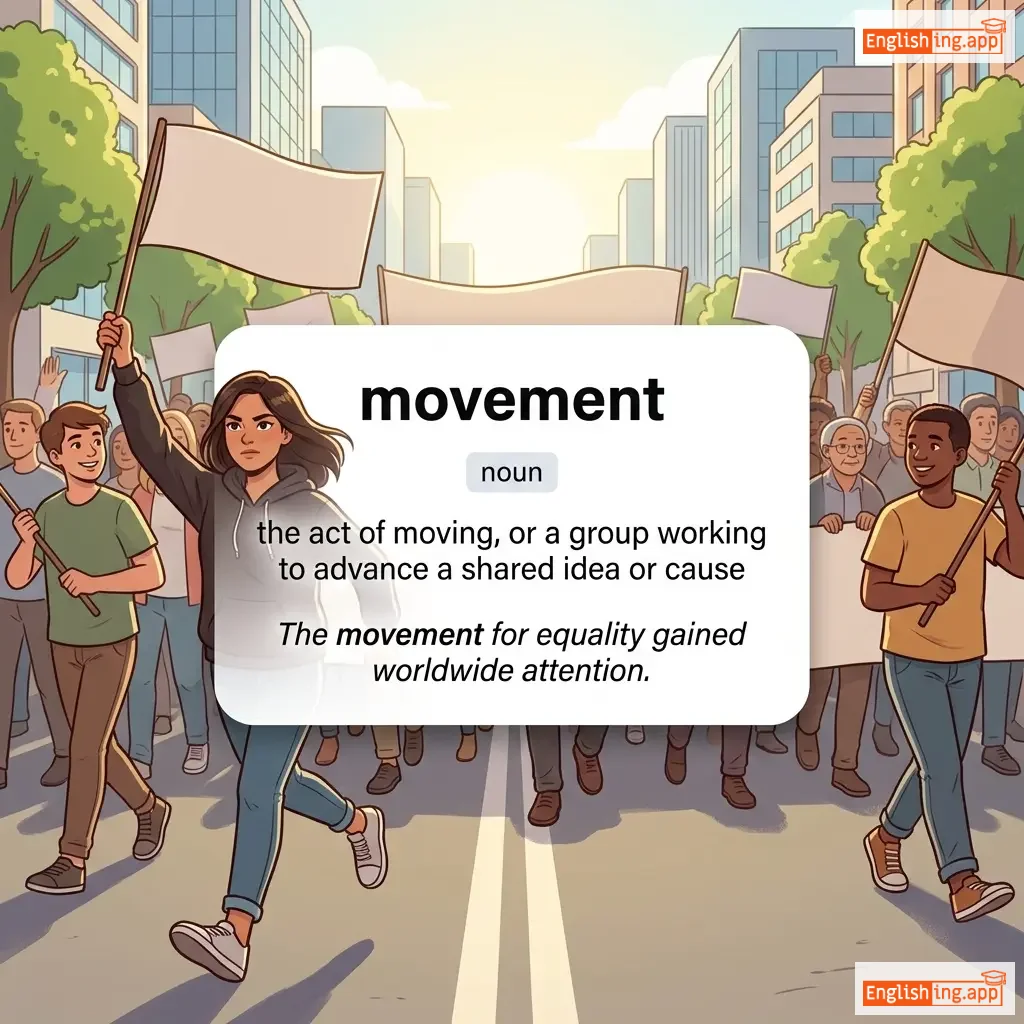
movement definition card — visual illustration of the meaning
noun
/ˈmuːv.mənt/
движение (dvizhénie)

the act of moving, or a group working to advance a shared idea or cause

"The movement for equality gained worldwide attention."

"Движение за равенство привлекло внимание всего мира." (Dvizhenie za ravenstvo privleklo vnimanie vsego mira.)
movements definition card — visual illustration of the meaning
noun
ˈmuːv.mənts
движения (dvizhniya)

Organized efforts by groups of people working together to advance their shared political, social, or artistic ideas.

"Freedom movements paved the way for independence."

"Движения за свободу проложили путь к независимости." (Dvizheniya za svobodu prolozhili put' k nezavisimosti.)
noun
/ˈmuːvi/
счастье (schastye)

A motion picture or film shown in a cinema or on television.

"We watched a movie together last night."

"Она не могла скрыть своего счастья, когда получила награду." (Ona ne mogla skryt' svoego schast'ya, kogda poluchila nagradu.)
movies definition card — visual illustration of the meaning
noun
ˈmuːviz
фильмы (fil'my)

A story or event recorded by a camera as a set of moving images and shown in a theater or on television.

"Watching movies helps in language learning."

"Просмотр фильмов помогает в изучении языков." (Prosmotr filmov pomogaet v izuchении yazykov.)
adjective
/ˈmuːvɪŋ/
трогательный (trogatelnij)

causing strong feelings, especially of sympathy or sadness

"Her speech was so moving that everyone cried."

"Её речь была настолько трогательной, что все заплакали." (Eyo rech' byla nastol'ko trogatelnoy, chto vse zaplakali.)
title
/ˈmɪstər/
г-н (g-n)

a title used before a man's name

"Mr. Rahman is our new teacher."

"Г-н Рахман — наш новый учитель." (G-n Rahman — nash novyy uchitel'.)
title
/ˈmɪsɪz/
миссис (missis)

a title used before a married woman's name

"Mrs. Karim is the headmistress of the school."

"Миссис Карим - директор школы." (Missis Karim - direktor shkoly.)
👩‍💼

ms (миз)

title
/mɪz/
Мисс (Miss)

a title used before a woman's name, regardless of marital status

"Ms. Akter will give a speech at the seminar."

"Мисс Акктер прочтет речь на семинаре." (Miss Akter prochtyot rech' na seminare.)
adjective, adverb, pronoun
/mʌtʃ/
много (mnogo)

a large amount or degree of something

"She doesn’t have much time to finish the project."

"У неё нет много времени, чтобы закончить проект." (U nee net mnogo vremeni, chtoby zakonchit' proyekt.)
noun
/mʌd/
грязь (gryaz)

soft, wet earth or soil

"The children were playing in the mud after the rain."

"Дети играли в грязи после дождя." (Deti igrali v gryazi posle dozhdya.)
verb
/ˈmʌd.əl/
перемешивать (peremeshivat)

to mix things up in a confused way or to make a mess of something

"He muddled the papers and couldn’t find the report."

"Он перемешал бумаги и не смог найти отчет." (On peremeshal bumagi i ne smog nayti otchet.)
adjective
/ˈmʌd.i/
грязный (gryazny)

covered in or full of mud; unclear or confused

"The children came back with muddy shoes after playing outside."

"Дети вернулись с грязными ботинками после игры на улице." (Deti vernulis' s gryaznymi botinkami posle igry na ulitse.)
verb
/ˈmʌfəl/
заглушить (zaglushit)

to make a sound quieter or less distinct; to cover or wrap something to reduce noise or warmth

"She tried to muffle her laughter with a scarf."

"Она пыталась заглушить свой смех шарфом." (Ona pytalas' zaglushit' svoy smekh sharfom.)
noun
/ˈmʌflər/
глушитель (glushitel)

a device on a vehicle's exhaust to reduce noise; also a scarf worn around the neck for warmth

"The car's muffler needs to be replaced."

"Глушитель автомобиля нужно заменить." (Glushitel avtomobilya nuzhno zamenit.)
noun
/mʌɡ/
кружка (kruzka)

a large cup, typically cylindrical and having a handle and used without a saucer

"She drank her morning coffee from a ceramic mug."

"Она выпила утренний кофе из керамической кружки." (Ona vypila utrejnii kofe iz keramicheskoj kruzhki.)
adjective
/ˈmʌɡi/
душно и влажно (dushno i vlazhno)

uncomfortably warm and humid

"It was a muggy afternoon in July."

"Это был душный день в июле." (Eto byl dushnyy den' v iyule.)
noun
/ˈmʌɡwʌmp/
независимый от партий человек (nezavisimyi ot partiy chelovek)

a person who remains independent from party politics or remains aloof from disputes

"He was called a mugwump for refusing to join either political side."

"Его называли магвампом, потому что он отказался присоединиться к какой-либо политической стороне." (Ego nazyvali magvampom, potomu chto on otkazalsya prisoyedinitsya k kakoy-libo politicheskoy storone.)
noun
/mjuːˈlætoʊ/
человек смешанной расы (устаревший и оскорбительный термин) (chelovek smeshannoy rasy (ustarevshiy i oskorbitel'nyy termin))

an outdated and now offensive term historically used to describe a person of mixed white and Black ancestry

"The word 'mulatto' is now considered outdated and offensive."

"Слово 'мулат' теперь считается устаревшим и оскорбительным." (Slovo 'mulat' teper' schitayetsya ustarevshim i oskorbitel'nym.)
verb
/mʌlkt/
штрафовать / обманывать (shtrafovat' / obmanyvat')

to punish by a fine or to defraud someone of money

"The corrupt official was mulcted for his misconduct."

"Коррупционный чиновник был оштрафован за свои проступки." (Korruptsionnyy chinovnik byl oshtrafovan za svoi prostupki.)
noun
/mjuːl/
мул (mul)

the offspring of a donkey and a horse, used as a working animal

"The farmer used a mule to carry heavy loads."

"Фермер использовал мула для транспортировки тяжелых грузов." (Fermyer ispol'zoval mula dlya transportirovki tyazhelykh gruzov.)
noun
/ˌmjuːlˈtɪər/
вьючный конюх (vyuchnyy konyukh)

a person who drives or takes care of mules

"The muleteer guided the animals safely across the mountain path."

"Вьючный конюх проводил животных по безопасному горному пути." (Vyuchnyy konyukh provodil zhivotnykh po bezopasnomu gornomu puti.)
noun
/muˈleθi/
корень лакрицы (koren' lakritsy)

licorice root, a sweet-tasting herb used in traditional medicine and cooking

"She prepared a herbal tea with mulethi to soothe her sore throat."

"Она приготовила травяной чай с мулети для облегчения боли в горле." (Ona prigotovila travyanoy chay s muleti dlya oblegcheniya boli v gorle.)
adjective
/ˈmjuːlɪʃ/

extremely stubborn or unwilling to change

"She remained mulish despite all the convincing arguments."

multifaceted definition card — visual illustration of the meaning
adjective
/ˌmʌltiˈfæsɪtɪd/
многогранный (mnogogranny)

having many different aspects or features

"Her career is multifaceted, involving teaching, research, and writing."

"Её карьера многогранна, она включает в себя преподавание, исследования и писательство." (Eyo kariera mnogogranna, ona vklyuchayet v sebya prepodavanie, issledovaniya i pisatel'stvo.)
multifaceted information frameworks definition card — visual illustration of the meaning
noun
ˌmʌltɪˈfæsɪtɪd ˌɪnfərˈmeɪʃən ˈfreɪmwɜːrks
многофункциональные информационные рамки (mnogofunktsional'nye informatsionnye ramki)

Complex, comprehensive structures for organizing and managing information that have multiple aspects or dimensions.

"Digital literacy involves building multifaceted information frameworks."

"Цифровая грамотность включает в себя создание многофункциональных информационных рамок." (Tsifrovaya gramotnost' vklyuchayet v sebya sozdanie mnogofunktsional'nykh informatsionnykh ramok.)
adjective
/ˌmʌltɪˈfɛərɪəs/
многообразный (mnogoobrazny)

having many different parts, elements, or kinds

"The museum displayed a multifarious collection of artifacts."

"Музей представил разнообразную коллекцию артефактов." (Muzyey predstavil raznoobraznuyu kollektsiyu artefaktov.)
adjective
/ˈmʌltɪfɔːrm/
многоликий (mnogolikiy)

Having many different forms or appearances.

"The festival was a multiform celebration of art, music, and culture."

"Фестиваль был многоликим праздником искусства, музыки и культуры." (Festival byl mnogolikim prazdnikom iskusstva, muzyki i kul'tury.)
adjective
/ˌmʌltɪˈlɪŋɡwəl/
многоязычный (mnogoyazychny)

Able to speak or written in several languages.

"She grew up in a multilingual household."

"Она выросла в многоязычной семье." (Ona vyrasla v mnogoyazychnoy sem'e.)
adjective
/ˈmʌltɪpl/
множество (mnozhestvo)

involving or consisting of many parts or elements

"The company faced multiple challenges during the year."

"Компания столкнулась с множеством проблем в течение года." (Kompaniya stolknulas' s mnozhestvom problem v techenie goda.)
noun
/ˌmʌltɪplɪˈkeɪʃən/
умножение (umnozhenie)

the mathematical process of combining numbers to get a product; the act of increasing in number or amount

"Multiplication is one of the basic operations taught in elementary mathematics."

"Умножение — одна из основных математических операций." (umnozhenie odna iz osnovnykh matematicheskikh operatsii)
noun
/ˌmʌltɪˈplɪsɪti/
множество (mnozhestvo)

A large number or variety of something.

"The project faced a multiplicity of challenges."

"Проект столкнулся с множеством проблем." (Proyekt stolknulsya s mnozhestvom problem.)
noun
/ˈmʌltɪplaɪər/
мультипликатор (multiplikator)

a number or factor by which another number is multiplied; something that increases the effect or value of something else

"In economics, government spending can act as a multiplier for economic growth."

"В экономике государственные расходы могут служить мультипликатором роста." (v ekonomike gosudarstvennye raskhody mogut sluzhit multiplikatorom rosta)
multiply definition card — visual illustration of the meaning
verb
/ˈmʌltɪplaɪ/
умножать (umnozhat)

to increase in number; to perform mathematical multiplication

"The bacteria multiply rapidly in warm conditions."

"Бактерии быстро размножаются в теплых условиях." (Bakterii bistro razmnozhayutsya v teplykh usloviyakh)
adjective
/ˌmʌl.tiˈpɜː.pəs/
многофункциональный (mnogofunktsional'nyy)

having multiple uses or functions; versatile

"This multipurpose tool can be used as a knife, screwdriver, and bottle opener."

"Этот многофункциональный инструмент может использоваться как нож, отвертка и открывалка для бутылок." (Etot mnogofunktsional'nyy instrument mozhet ispol'zovat'sya kak nozh, otver'tka i otkryvalka dlya butylok.)