Словари

Словарь английского языка | Значения слов, определения и примеры

verb
/ɪnˈfleɪt/
надувать; искусственно увеличивать (naduvat; iskusstvenno uvelichivat)

to fill with air or gas so it expands; to increase excessively or artificially

"The mechanic inflated the tire to the correct pressure."

"Механик накачал шину до нужного давления." (Mekhanik nakachal shinu do nuzhnogo davleniya)
adjective
/ɪnˈfleɪtɪd/
надувной (naduvnoi)

excessively increased in size, value, or importance; filled with air or gas

"The company faced criticism for its inflated prices."

"Компания столкнулась с критикой из-за своих надувных цен." (Kampaniya stolknulas' s kritikoy iz-za svoikh naduvnykh tsen.)
inflation definition card — visual illustration of the meaning
noun
/ɪnˈfleɪʃən/
инфляция (inflyatsiya)

A general increase in prices and fall in the purchasing value of money.

"The government is taking steps to control inflation."

"Правительство предпринимает шаги по контролю инфляции." (Pravitel'stvo predprinimayet shagi po kontrolyu inflyatsii.)
inflationary definition card — visual illustration of the meaning
adjective
/ɪnˈfleɪ.ʃə.ner.i/
инфляционный (inflyatsionny)

Causing or characterized by inflation of prices.

"Excessive money supply can lead to an inflationary economy."

"Избыточное предложение денег может привести к инфляционной экономике." (Izbytochnoe predlozhenie deneg mozhet privesti k inflyatsionnoi ekonomike.)
inflection definition card — visual illustration of the meaning
noun
/ɪnˈflɛk.ʃən/
изменение тона или интонации (izmeneniye tona ili intonatsii)

A change in the tone or pitch of the voice when speaking, which helps convey meaning and emotion.

"Her voice inflection conveyed deep emotion in the speech."

"Инфлексия её голоса передавала глубокие эмоции в речи." (Infleksiya yeyo golosa peredavala glubokie emotsii v rechi.)
noun
/ˌɪnflɛksɪˈbɪlɪti/
негибкость (negibkost)

the quality of being rigid or unwilling to change; lack of adaptability

"The inflexibility of the rules caused unnecessary delays."

"Негибкость правил вызвала ненужные задержки." (Negibkost pravil vyzvala nenuzhnye zaderzhki)
adjective
/ɪnˈflɛksəbl/
неподвижный (nepodvizhnyy)

Not able to bend or change; unwilling to change ideas or behavior.

"His inflexible attitude made negotiations difficult."

"Его неподвижная позиция усложнила переговоры." (Ego nepodvizhnaya pozitsiya uslozhnyla peregovory.)
verb
/ɪnˈflɪkt/
причинить (prichinit)

to cause something unpleasant or painful to be suffered by someone or something

"The storm inflicted considerable damage to the city."

"Шторм нанес значительный ущерб городу." (Shtorm nanes znachitel'nyy ushcherb gorodu.)
noun
/ˈɪn.floʊ/
поток (potok)

The movement of things such as money, people, or water into a place.

"The inflow of tourists boosted the local economy."

"Поток туристов стимулировал местную экономику." (Potok turystov stimulyroval mestnuyu ekonomiku.)
noun/verb
/ˈɪnfluəns/
влияние (vliyanie)

The power to affect how someone thinks or acts.

"Her teacher had a strong influence on her career choice."

"Ее учитель оказал сильное влияние на ее выбор карьеры." (Eе uchitel' okazal sil'noye vliyaniye na yeё vybor karyery.)
Influencer definition card — visual illustration of the meaning
noun
/ˈɪn.flu.ən.sər/
инфлюенсер, человек, влияющий на мнение (influencer, chelovek, vliyayushchiy na mnenie)

A person with the ability to influence potential buyers of a product or service by promoting or recommending the items on social media.

"Social media influencers shape consumer preferences."

"Инфлюенсеры в социальных сетях формируют предпочтения потребителей." (Influensery v sotsial'nykh setyakh formiruyut predpochteniya potrebiteley.)
adjective
/ˌɪnfluˈɛnʃl/
влиятельный (vliyatel'nyy)

Having great power to change or affect people or things.

"She is one of the most influential leaders of our time."

"Она одна из самых влиятельных лидеров нашего времени." (Ona odna iz samykh vliyatel'nykh liderov nashego vremeni.)
noun
/ˈɪnflʌks/
наплыв (naplyv)

A large arrival or flow of people or things.

"The city experienced an influx of tourists during the festival."

"Город испытал наплыв туристов во время фестиваля." (Gorod ispytal naplyv turistsov vo vremya festivala.)
noun
/ˈɪnfoʊ/
информация (informatsiya)

information; knowledge or facts about something or someone

"She gave me all the info I needed for the meeting."

"Она дала мне всю информацию, которую я нуждался для встречи." (Ona dala mne vsyu informatsiyu, kotoruyu ya nuzhdalsya dlya vstrechi.)
inform definition card — visual illustration of the meaning
verb
/ɪnˈfɔːrm/
информировать (informirovat)

To give someone facts or information.

"Please inform me if there are any changes to the schedule."

"Пожалуйста, информируйте меня, если будут изменения в расписании." (Pozhaluysta, informiruyte menya, yesli budut izmeneniya v raspisanii.)
adjective
/ɪnˈfɔːrməl/
неформальный (neformal'nyy)

relaxed, friendly, and not following strict rules or conventions

"They had an informal meeting at the coffee shop."

"Они провели неформальную встречу в кафе." (Oni proveli neformal'nuyu vstrechu v kafe.)
noun
/ˌɪnfərˈmeɪʃən/
информация (informatsiya)

Facts or knowledge provided or learned about something.

"The website provides useful information about travel destinations."

"Этот веб-сайт предоставляет полезную информацию о туристических направлениях." (Etot veb-sayt predostavlyaet poleznuyu informatsiyu o turistskikh napravleniyakh.)
adjective
/ɪnˈfɔːrmətɪv/
информативный (informativnyy)

giving or providing useful information; educational; instructive

"The documentary was very informative and educational."

"Документальный фильм был очень информативным и образовательным." (Dokumentalnyy film byl ochen informativnym i obrazovitelnym)
noun
/ɪnˈfrækʃən/
нарушение (narushenie)

A violation or breach of a rule, law, or agreement.

"The student was punished for a minor infraction of the school rules."

"Студент был наказан за незначительное нарушение школьных правил." (Student byl nakazan za neznachitel'noe narushenie shkol'nykh pravil.)
infrastructural development definition card — visual illustration of the meaning
noun
ˌɪnfrəˈstrʌktʃərəl dɪˈveləpmənt
инфраструктурное развитие (infrastrukturnoe razvitie)

The process of building and improving the basic physical and organizational structures and facilities needed for the operation of a society or enterprise.

"Infrastructural development is necessary for efficient recycling."

"Инфраструктурное развитие необходимо для эффективной переработки." (Infrastrukturnoe razvitie neobkhodimo dlya effektivnoy pererabotki.)
infrastructure definition card — visual illustration of the meaning
noun
/ˈɪnfrəˌstrʌktʃər/
инфраструктура (infrastruktura)

the basic physical and organizational structures and facilities needed for the operation of a society or enterprise

"The government is investing heavily in transport infrastructure."

"Правительство активно инвестирует в транспортную инфраструктуру." (Pravitel'stvo aktivno investiruet v transportnuyu infrastrukturu.)
noun
/ɪnˈfriːkwəns/
редкость (redkost)

The state of occurring rarely or at long intervals.

"The infrequence of their meetings made it hard to maintain close ties."

"Редкость их встреч усложняла поддержание близких связей." (Redkost' ikh vstrech uslozhnyala podderzhanie blizkikh svyazey.)
adjective
/ɪnˈfriːkwənt/
редкий (redkiy)

Happening rarely or not often.

"He made infrequent visits to his hometown after moving abroad."

"Он совершал редкие визиты в родной город после того, как переехал за границу." (On sovershal redkie vizity v rodnoy gorod posle togo, kak pereekhal za granitsu.)
verb
/ɪnˈfrɪndʒ/
нарушить (narushit)

To actively break the terms of a law, agreement, or right.

"Copying this software without permission will infringe copyright laws."

"Копирование этого программного обеспечения без разрешения нарушит авторские права." (Kopirovanie etogo programmnogo obespecheniya bez razresheniya narushit avtorskie prava.)
verb
/ɪnˈfjʊərieɪt/
раздражать (razdrazhat)

To make someone extremely angry.

"His careless remarks infuriated the entire team."

"Его неосторожные замечания вывели всю команду из себя." (Ego neostorozhnie zamechaniya vyyveli vsyu komandu iz sebya.)
verb
/ɪnˈfjuːz/
внушать (infyuz)

to fill or spread through something; to instill a quality, idea, or feeling

"The teacher tried to infuse her students with a love for reading."

"Учитель пытался привить своим ученикам любовь к чтению." (Uchitel pytalsya privit svoim uchenikam lyubov k chteniyu)
noun
/ɪnˈfjuːʒən/
настой (nastoy)

the act of introducing something into another; a drink made by steeping leaves or herbs in liquid

"She prepared a calming infusion of chamomile tea."

"Она приготовила успокаивающий настой из ромашкового чая." (Ona prigotovila uspokaivayushchiy nastoy iz romashkovogo chaya.)
ingenious definition card — visual illustration of the meaning
adjective
/ɪnˈdʒiːniəs/
гениальный (genial'nyy)

very clever and inventive; showing creativity in problem-solving

"The engineer came up with an ingenious solution to the problem."

"Инженер нашел гениальное решение проблемы." (Inzhener nashyel genial'noye resheniye problemy.)
noun
/ˈænʒənuː/
невинная молодая женщина (nevinnaya molodaya zhenshchina)

an innocent, naïve young woman, especially as represented in literature or theater

"She played the role of the ingénue in the play with great charm."

"Она сыграла роль невинной молодой женщины в пьесе с большим обаянием." (Ona sygrala rol' nevinnoy molodoy zhenshchiny v p'ese s bol'shim obayaniyem.)
ingenuity definition card — visual illustration of the meaning
noun
/ˌɪndʒəˈnjuːɪti/
изобретательность (izobretyel'nost')

the quality of being clever, original, and inventive

"The project was completed on time thanks to the ingenuity of the team."
"Проект был завершен вовремя благодаря изобретательности команды." (Proyekt byl zavershen vovremya blagodarya izobretyel'nosti komandy.)
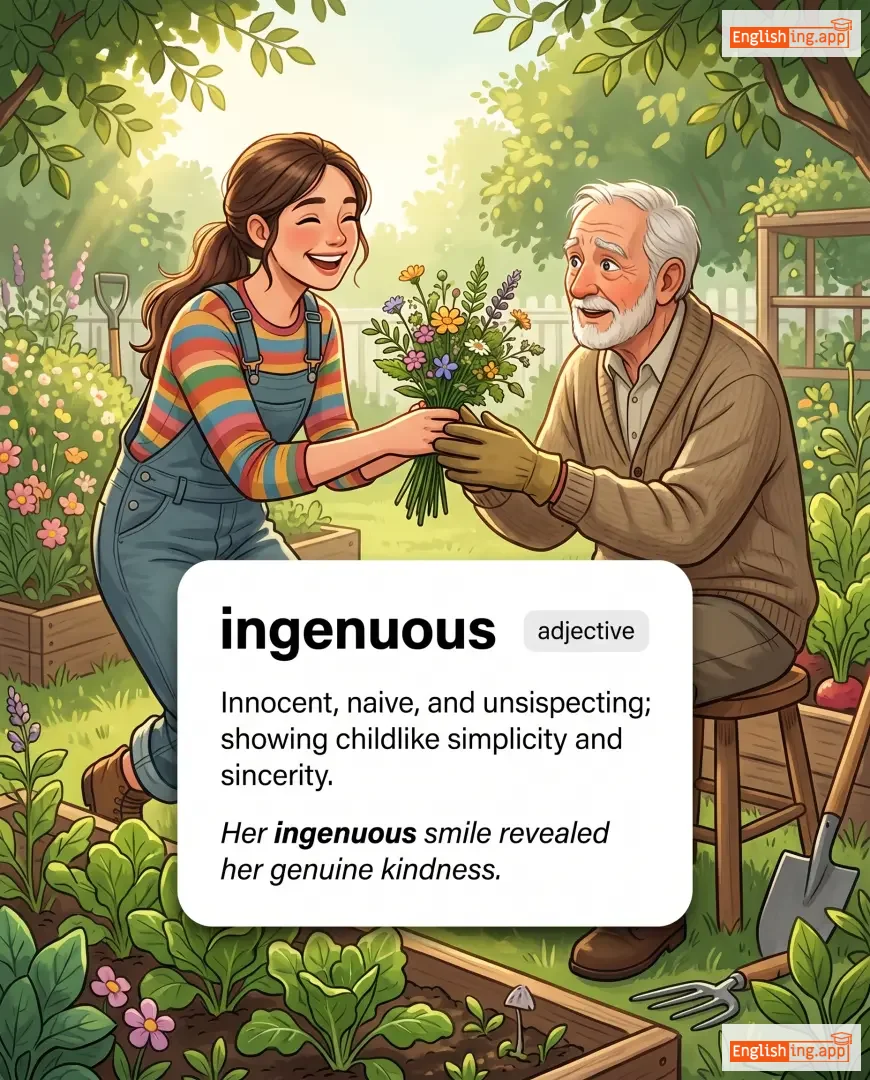
ingenuous definition card — visual illustration of the meaning
adjective
/ɪnˈdʒɛnjuəs/
наивный (naivnyy)

Innocent, naive, and unsuspecting; showing childlike simplicity and sincerity.

"Her ingenuous smile revealed her genuine kindness."

"Её наивная улыбка раскрыла её настоящую доброту." (Eё naivnaya ulybka raskryla yeye nastoyashchuyu dobroty.)
verb
/ɪnˈdʒɛst/
поглощать (pogloshchat')

To take food, drink, or another substance into the body, usually by swallowing.

"The patient must ingest the medicine with water."

"Пациент должен проглотить лекарство с водой." (Patsiyent dolzhen proglotit' lekarstvo s vodoy.)
adjective
/ɪnˈɡlɔːriəs/
позорный (pozornyy)

Causing shame or disgrace; not bringing honor or glory.

"The army suffered an inglorious defeat."

"Армия понесла позорное поражение." (Armiya ponésla pozornoye porazheniye.)
verb
/ɪnˈɡrɑːft/
внедрить (vnedrit')

To implant or fix deeply, often used in the sense of grafting an idea or quality.

"The teacher tried to ingraft good manners in the students."

"Учитель пытался привить хорошие манеры студентам." (Uchitel' pytalsya privit' khoroshie manery studentam.)
adjective
/ɪnˈɡreɪnd/
укоренившийся (ukorenivshiysya)

Firmly fixed or established; deeply rooted and difficult to change.

"His ingrained habits were hard to break."

"Его укоренившиеся привычки было трудно сломать." (Ego ukorenivshiesya privychki bylo trudno slomat'.)
noun
/ˈɪnˌɡreɪt/
неблагодарник (neblagodarnik)

An ungrateful person; someone who shows no appreciation.

"He worked hard for his friend, but the ingrate never thanked him."

"Он усердно работал ради своего друга, но неблагодарник так и не поблагодарил его." (On userdno rabotal radi svoego druga, no neblagodarnik tak i ne poblagodaril ego.)
verb
/ɪnˈɡreɪʃiˌeɪt/

To gain favor or approval by deliberate effort, often in a flattering way.

"She tried to ingratiate herself with her boss by complimenting him often."

adjective
/ɪnˈɡreɪʃiˌeɪtɪŋ/
подхалимский (podkhalimskiy)

Charming or flattering in a way intended to gain favor.

"His ingratiating smile made everyone trust him quickly."

"Его подхалимская улыбка заставила всех быстро довериться ему." (Ego podkhalimskaya ulybka zastavila vsekh bystro doverit'sya emu.)
noun
/ɪnˈɡrætɪˌtjuːd/
неблагодарность (neblagodarnost)

Lack of gratitude; failure to show thanks or appreciation.

"His ingratitude hurt her feelings after all she had done for him."

"Его неблагодарность ранила её чувства, несмотря на всё, что она сделала для него." (Ego neblagodarnost' ranila yeye chuvstva, nesmotrya na vsyo, chto ona sdelala dlya nego.)
noun
/ɪnˈɡriːdiənt/
ингредиент (ingredient)

A component part or element of something, especially in a recipe.

"Flour is a key ingredient in baking bread."

"Мука — ключевой ингредиент при выпечке хлеба." (Muka — klyuchevoy ingredient pri vypechke khleba.)
verb
/ɪnˈhæbɪt/
обитать (obitat)

to live in; to occupy as a dwelling

"Many animals inhabit the forest."

"Многие животные обитают в лесу." (Mnogie zhivotnye obitayut v lesu.)
noun
/ɪnˈhæbɪtənt/
житель (zhitel)

a person or animal that lives in a particular place

"The inhabitants of the village rely on farming for their livelihood."

"Жители деревни зависят от сельского хозяйства для своего существования." (Zhiteli derevni zavisyat ot selskokhozyaystva dlya svoego suschestvovaniya.)
inhale definition card — visual illustration of the meaning
verb
/ɪnˈheɪl/
вдыхать (vdykhat)

to breathe in; to draw air into the lungs

"Take a deep breath and inhale slowly."

"Сделайте глубокий вдох и медленно вдыхайте." (Sdelayte glubokiy vdokh i medlenno vdykhayte.)
adjective
/ɪnhɑːrˈmoʊniəs/
дисгармоничный (disgarmonichnyy)

lacking harmony; discordant in sound; not in tune

"The inharmonious sounds from the broken piano made everyone cover their ears."

"Не гармоничные звуки от сломанного пианино заставили всех прикрыть уши." (Ne garmonichnye zvuki ot slomannogo pianino zastavili vsekh prikryt' ushi.)
noun
/ɪnˈhɪərəns/
неотъемлемость (neot'yemlemost')

The state of being an essential or permanent part of something.

"The inherence of risk is part of every business venture."
"Присутствие риска является неотъемлемой частью каждого бизнеса." (Prisutstvie riska yavyayetsya neot'yemlemoy chast'yu kazhdogo biznesa.)
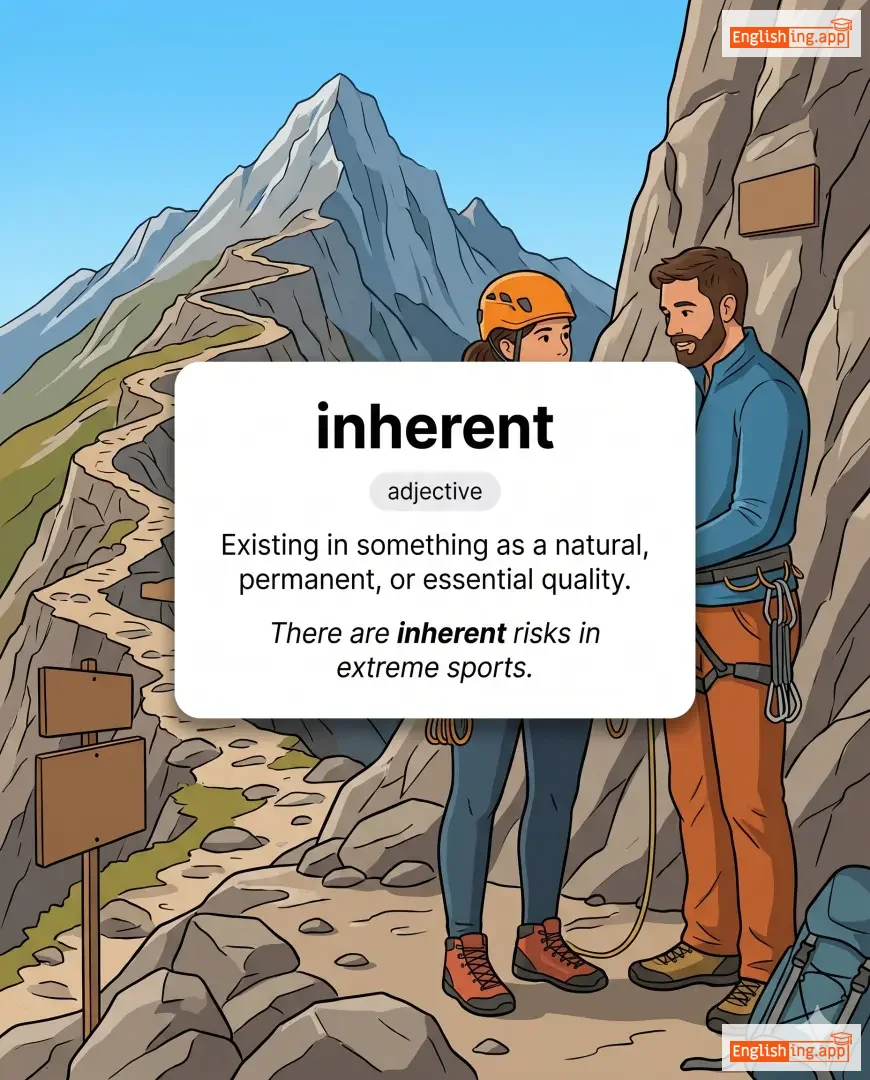
inherent definition card — visual illustration of the meaning
adjective
/ɪnˈhɛrənt/
неотъемлемый (neot'yemlemiy)

Existing in something as a natural, permanent, or essential quality.

"There are inherent risks in extreme sports."

"В экстремальных видах спорта существуют неотъемлемые риски." (V ekstremal'nykh vidakh sporta sushchestvuyut neot'yemlemye riski.)
inherit definition card — visual illustration of the meaning
verb
/ɪnˈhɛrɪt/
унаследовать (unasledovat)

to receive property, money, or traits from someone after their death or from ancestors

"She inherited her father's house after his death."

"Она унаследовала дом своего отца после его смерти." (Ona unasledovala dom svoego otca posle ego smerti.)
noun
/ɪnˈhɛrɪtər/
наследник (naslednik)

a person who receives money, property, or a title when someone dies

"She became the inheritor of her family's estate."

"Она стала наследницей семейного состояния." (Ona stala naslednitsей semeynogo sostoyaniya.)
inhibit definition card — visual illustration of the meaning
verb
/ɪnˈhɪbɪt/
подавлять (podavlyat)

To hinder, restrain, or prevent an action or process.

"Fear can inhibit creativity."

"Страх может подавить креативность." (Strakh mozhet podavit kreativnost.)
adjective
/ɪnˈhɪbɪtɪd/
сдержанный (sderzhannyy)

Unable to act in a relaxed and natural way, especially due to self-consciousness or restraint.

"He was too inhibited to express his true feelings."

"Он был слишком сдержан, чтобы выразить свои истинные чувства." (On byl slishkom sderzhan, chtoby vyrazit' svoi isstinnye chuvstva.)