Словари

Словарь английского языка | Значения слов, определения и примеры

noun
/hɒˈstɪləti/
враждебность (vrazhdebnost)

hostile behavior; unfriendliness or opposition

"The negotiations ended in an atmosphere of hostility."

"Переговоры завершились в атмосфере враждебности." (Peregovory zavershilis v atmosfere vrazhdebnosti.)
adjective
/hɒt/
горячий (goryachiy)

Having a high degree of heat or a high temperature.

"The soup is too hot to eat right now."

"Суп слишком горячий, чтобы есть сейчас." (Sup slishkom goryachiy, chtoby est' seychas.)
noun
/hɒt drɪŋk/
горячий напиток (goryachiy napitok)

a warm or heated beverage consumed for refreshment or comfort

"I prefer a hot drink like tea or coffee in the morning."

"Я предпочитаю горячий напиток, например, чай или кофе, по утрам." (Ya predpochitayu goryachiy napitok, naprimer, chai ili kofe, po utram.)
noun
/hɒtʃ pɒtʃ/
рагу (ragu)

A mixed dish; a hodgepodge of ingredients cooked together

"She made a delicious hotch potch with rice, lentils, and vegetables."

"Она приготовила вкусное хотч потч с рисом, чечевицей и овощами." (Ona prigotovila vkusnoe hotch potch s risom, chechevitsyei i ovochami.)
noun
/ˈhɑːtʃ.pɑːtʃ/
беспорядочная смесь; куча перемешанных вещей (besporyadochnaya smes; kucha peremeshannykh veshchey)

a confused mixture; a jumbled assortment of things

"The room was a hotchpotch of old furniture, books, and random decorations."

"Комната была беспорядочной смесью старой мебели, книг и случайных украшений." (Komnata byla besporyadochnoy smes'yu staroy mebeli, knig i sluchaynykh ukrasheny.)
noun
/hoʊˈtɛl/
отель (otel)

A building where people pay to stay and sleep, usually for short periods.

"We stayed at a hotel near the beach."

"Мы остановились в отеле рядом с пляжем." (My ostanovilis' v otele ryadom s plyazhem.)
noun
/ˈhɒthɛd/
вспыльчивый человек (vspylchivyy chelovek)

a person who acts quickly and without thinking when angry

"He is such a hothead that he often starts arguments."

"Он такой вспыльчивый, что часто начинает ссоры." (On takoy vspylchivyy, chto chasto nachinayet ssory.)
adverb
/ˈhɒtli/
гневно (gnevno)

in an intense, angry, or passionate way

"She hotly denied the accusations."

"Она с гневом отвергла обвинения." (Ona s gnevom otvergla obvineniya.)
verb
/haʊnd/
преследовать (presledovat)

to pursue or harass someone persistently

"Reporters hounded the actor for comments."

"журналисты преследовали актера за комментарии." (zhurnalisty presledovali aktora za kommentarii.)

hour

noun
/ˈaʊər/

A period of time equal to 60 minutes.

"The meeting lasted for two hours."

adverb
/ˈaʊər.li/
каждый час; происходящий или выполненный каждый час; непрерывно (kazhdyy chas; proiskhodyashchiy ili vypolnennyy kazhdyy chas; nepreryvno)

every hour; happening or done each hour; continuously

"The weather report is updated hourly."

"Метеорологический отчет обновляется каждый час." (Meteorologicheskiy otchet obnovlyayetsya kazhdyy chas.)
noun
/haʊs/
дом (dom)

A building for people to live in, usually with rooms and a roof.

"They bought a new house in the city."

"Они купили новый дом в городе." (Oni kupili novyy dom v gorode.)
noun
/ˈhaʊs boʊt/
дом на воде (dom na vode)

a boat that has been designed or modified to be used primarily as a home

"They spent their vacation on a beautiful house boat in the lake."

"Они провели свой отпуск на красивом доме на воде на озере." (oni proveli svoi otpusk na krasivom dome na vode na ozere)
noun
/ˈhaʊsˌbreɪkɪŋ/
взлом дома (vzlom doma)

the crime of breaking into a house with intent to steal

"The thief was arrested for housebreaking."

"Вора арестовали за взлом дома." (Vora arestovali za vzlom doma.)
👨‍👩‍👧‍👦

household (хаусхолд)

noun
/ˈhaʊshoʊld/
домохозяйство (domokhozyaystvo)

All the people living together in one house, considered as a unit.

"There are five people in our household."

"В нашем домохозяйстве пять человек." (V nashem domokhozyaystve pyat' chelovek.)
noun
/ˈhaʊswaɪf/
домохозяйка (domokhozyayka)

a married woman who manages a household and whose main occupation is caring for her family and home

"She chose to work as a housewife while raising her children."

"Она решила быть домохозяйкой, воспитывая детей." (Ona reshila byt domokhozyaykoy vospityvaya detey)
noun
/ˈhaʊzɪŋ/
жилище (zhilishche)

buildings or structures where people live; accommodation

"The government is working to provide affordable housing for everyone."

"Правительство работает над тем, чтобы предоставить доступное жилье для всех." (Pravitel'stvo rabotayet nad tem, chtoby predostavit' dostupnoye zhilye dlya vsekh.)
noun
/ˈhʌvəl/
хибара (khibara)

a small, poorly built, and dirty house

"The refugees lived in a makeshift hovel."

"Беженцы жили в самодельной хибаре." (bezhentsy zhili v samodelnoy khibare)
verb
/ˈhʌvər/
оставаться в воздухе на одном месте, не двигаясь вперед или назад (ostavat'sya v vozdukhe na odnom meste, ne dvizhushchikhsya vpered ili nazad)

to remain in the air in one place without moving forward or backward

"The helicopter hovered over the city."

"Вертолет висел над городом." (Vertelet visel nad gorodom.)
adverb
/haʊ/
как (kak)

in what way or manner; by what means

"How do you solve this problem?"

"Как ты решаешь эту проблему?" (Kak ty reshayesh etu problemu?)
adverb, conjunction
/haʊˈɛvər/
однако (odnako)

used to introduce a statement that contrasts with or seems to contradict something previously said

"The journey was long; however, it was enjoyable."

"Путешествие было долгим; однако оно было приятным." (Puteshestviye bylo dolgim; odnako ono bylo priyatnym.)
noun
/ˈhɔɪdən/
шаловливая девочка (shalovlivaya devochka)

a boisterous or tomboyish girl

"The hoyden preferred climbing trees to playing with dolls."

"Шаловливая девочка предпочитала лазить по деревьям, чем играть с куклами." (Shalovlivaya devochka predpochitala lazit' po derev'yam, chem igrat' s kuklami.)
noun
/hʌb/
центр (tsentr)

the central part of a place or activity where things converge

"The city is the hub of the country's trade network."

"Город является центром торговой сети страны." (Gorod yavlyaetsya tsentrom torgovoy seti strany.)
noun
/ˈhʌbʌb/
шум (shum)

a loud noise caused by a crowd of people talking or shouting

"There was a hubbub in the market as the sale began."

"На рынке был шум, когда началась распродажа." (Na rynke byl shum, kogda nachalas' rasprodazha.)
noun
/ˈhjuːbrɪs/
хабрис (khabris)

excessive pride or self-confidence

"His hubris led to his downfall."

"Его хабрис привел к его падению." (Yego khabris privyol k yego padeniyu.)
noun
/ˈhʌk.stər/
уличный торговец (ulichnyy torgovets)

A person who sells small items aggressively, often in a showy or dishonest way.

"The huckster loudly promoted his goods in the busy marketplace."

"Уличный торговец громко рекламировал свои товары на шумном рынке." (Ulichnyy torgovets gromko reklamiroval svoi tovar na shumom rynke.)
noun
/hjuː/
цвет (tsvet)

A color or shade.

"The artist chose a soft blue hue for the background."

"Художник выбрал мягкий синий цвет для фона." (Kudozhnik vybral myagkiy siniy tsvet dlya fona.)
noun phrase
/ˌhjuː ən ˈkraɪ/
громкий протест (gromkiy protest)

A loud public outcry or protest, often demanding action.

"There was a hue and cry over the new policy changes."

"Был громкий протест по поводу новых изменений в политике." (Byl gromkiy protest po povodu novykh izmeneniy v politike.)
verb
/hʌɡ/
обнимать (obnimat')

to hold someone tightly in your arms to show affection or comfort

"She hugged her friend before leaving for the airport."

"Она обняла свою подругу перед тем, как поехать в аэропорт." (Ona obnyala svoiu podrugu pered tem, kak poekhat' v aeroport.)
adjective
/hjuːdʒ/
огромный (ogromnyy)

extremely large in size or amount

"The stadium was filled with a huge crowd."

"Стадион был заполнен огромной толпой." (Stadion byl zapolnen ogromnoy tolpoy.)
interjection
/hʌ/
Что ты сказал? (Chto ty skazal?)

used to express confusion, surprise, or that you did not hear something

"Huh? What did you say?"

"Хэ? Что ты сказал?" (Khe? Chto ty skazal?)
noun
/hʌl/
корпус корабля / оболочка семени (korpus korablya / obolochka semeni)

The outer covering of a seed or fruit; also the main body of a ship.

"The sailors inspected the ship’s hull for any damage."

"Моряки осмотрели корпус корабля на наличие повреждений." (Moryaki osmotreli korpus korablya na nalichiye povrezhdeniy.)
noun
/hʌm/
гудение (gudenie)

a low continuous sound; to make a low continuous droning sound

"The constant hum of the air conditioner helped her fall asleep peacefully."

"Постоянное гудение кондиционера помогло ей спокойно уснуть." (Postoyannoe gudenie konditsionera pomoglo yey spokoyno usnut'.)
human definition card — visual illustration of the meaning
noun, adjective
/ˈhjuːmən/
человечество (chelovechestvo)

a person; relating to people

"Being human means having both strengths and weaknesses."

"Быть человеком означает иметь как силы, так и слабости." (Byt' chelovekom oznachayet imet' kak sily, tak i slabosti.)
human rights definition card — visual illustration of the meaning
noun
ˌhjuː.mən ˈraɪts
права человека (prava cheloveka)

A right that is believed to belong justifiably to every person.

"Human rights protect individual freedoms."

"Права человека защищают индивидуальные свободы." (Prava cheloveka zashchishchayut individual'nyye svobody.)
adjective
/hjuːˈmeɪn/
гуманный (gumannyy)

Showing compassion or benevolence.

"The doctor provided humane treatment to the injured animals."

"Доктор предоставил раненым животным гуманное лечение." (Doktor predostavil ranimym zhivotnym gumannoe lechenie.)
noun, adjective
/hjuːˌmænɪˈtɛəriən/
гуманитарный (gumanitarnyy)

A person who seeks to promote human welfare, or something relating to human welfare and compassion.

"The organization provides humanitarian aid to disaster victims."
"Организация оказывает гуманитарную помощь жертвам бедствий." (Organizatsiya okazyvayet gumanitarnuyu pomoshch' zhertvam bedstvi.)
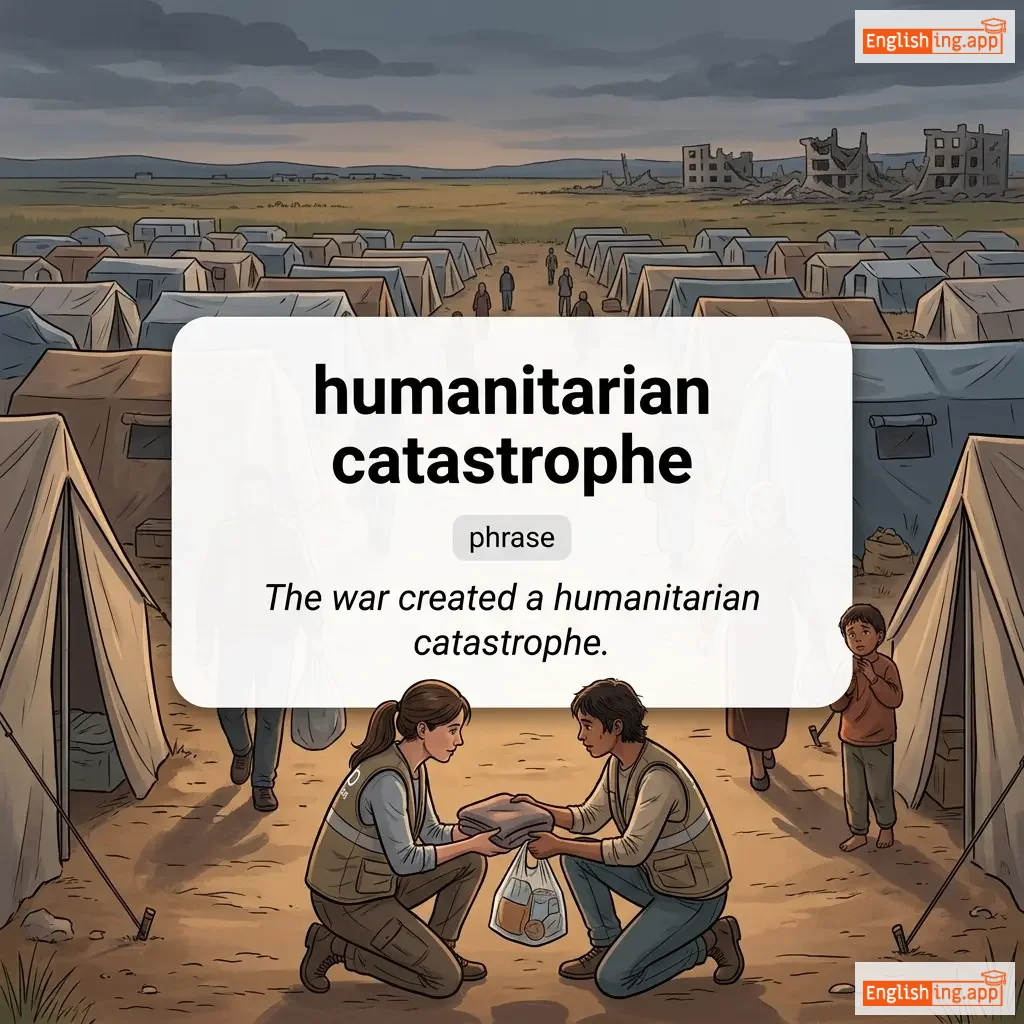
humanitarian catastrophe definition card — visual illustration of the meaning
phrase
ˌhjuː.məˈnɪt.ər.i.kəˈtæs.trə.fi
гуманитарная катастрофа (gumanitarnaya katastrofa)

A widespread disaster affecting human life, health, and well-being on a large scale.

"The war created a humanitarian catastrophe."

"Война создала гуманитарную катастрофу." (Voyna sozdala gumanitarnuyu katastrofu.)
noun
/hjuːˈmænɪti/
человечность (chelovechnost)

the quality of being human; kindness or compassion towards others; all human beings collectively

"Kindness is one of the greatest expressions of humanity."

"Доброта — одно из величайших проявлений человечности." (Dobrota — odno iz velichayshikh proyavleniy chelovechnosti.)
verb
/ˈhjuːmənaɪz/
гуманизировать (gumanizirovat)

To make something more humane, kind, or relatable.

"The teacher tried to humanize the lesson with personal stories."

"Учитель пытался гуманизировать урок с помощью личных историй." (Uchitel' pytalsya gumanizirovat' urok s pomoshch'yu lichnykh istoriy.)
adjective, verb
/ˈhʌmbəl/

Having or showing a modest view of one's importance; to lower pride or status.

"Despite his success, he remained humble."

noun
/ˈhʌmbʌɡ/
обман, чепуха (obman, chepukha)

Deceptive or false talk or behavior; nonsense.

"He dismissed the idea as humbug."

"Он отверг эту идею как чепуху." (On otverg etu ideyu kak chepukhu.)
adjective
/ˈhʌmdrʌm/
монотонный (monotonnij)

Lacking excitement or variety; dull and monotonous.

"She grew tired of the humdrum routine of office life."

"Она устала от однообразной рутины офисной жизни." (Ona ustala ot odnoobraznoj rutiny ofisnoj zhizni.)
adjective
/ˈhjuː.mɪd/
влажный (vlazhnyy)

Having a high amount of water vapor in the air; damp or moist.

"The weather was hot and humid during the summer."

"Погода была жаркой и влажной летом." (Pogoda byla zharkoy i vlazhnoy letom.)
noun
/ˌhjuː.mɪ.fɪˈkeɪ.ʃən/
гумификация (gumifikatsiya)

The process of organic matter decomposition to form humus in soil.

"Humification enhances soil structure and fertility."
"Гумификация улучшает структуру и плодородие почвы." (Gumifikatsiya uluchshaet strukturu i plodorodie pochvy.)
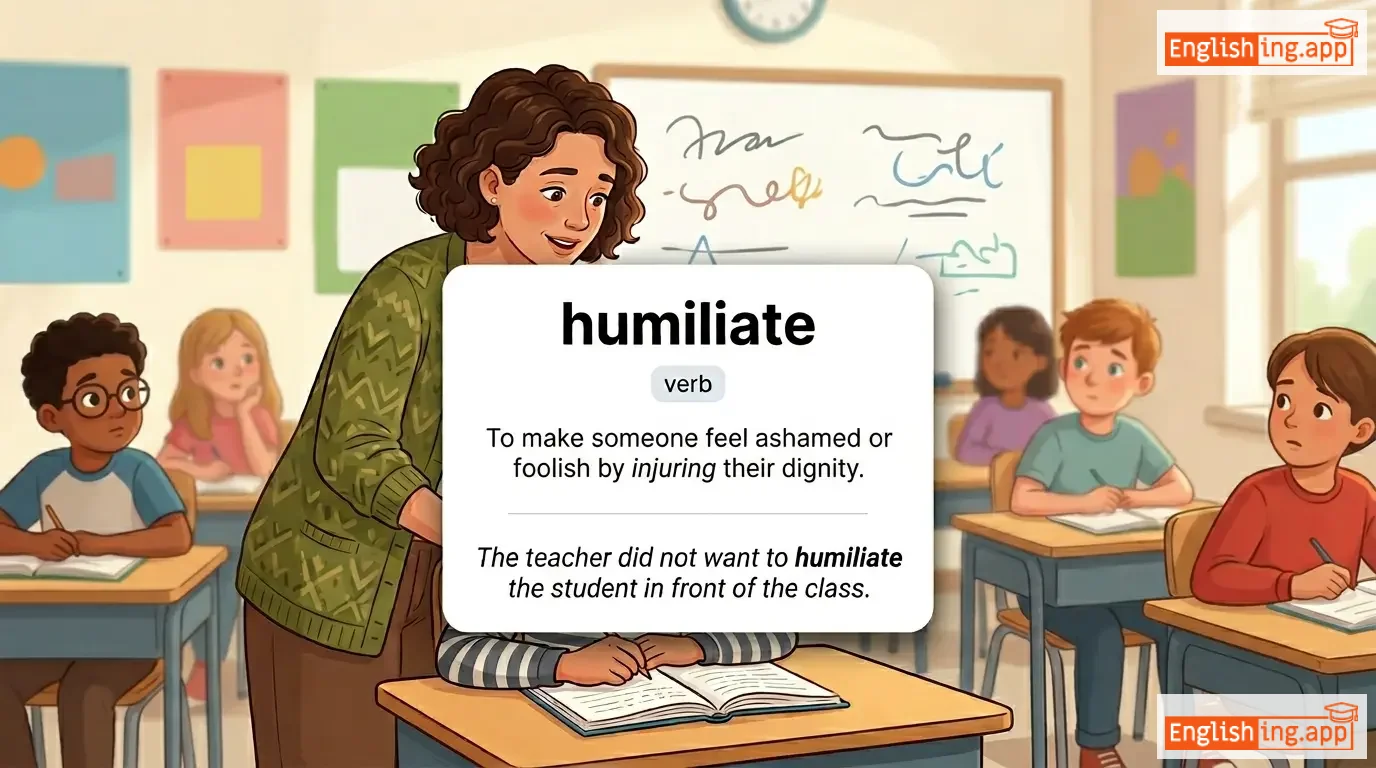
humiliate definition card — visual illustration of the meaning
verb
/hjuːˈmɪl.i.eɪt/

To make someone feel ashamed or foolish by injuring their dignity.

"The teacher did not want to humiliate the student in front of the class."

noun
/hjuːˈmɪl.ɪ.ti/
смирение (smirenie)

The quality of having a modest or low view of one's importance.

"She accepted the award with grace and humility."

"Она приняла награду с грацией и смирением." (Ona prinjala nagradu s graciey i smireniem.)
noun
/ˈhʌm.ək/
курган (kurgan)

A small hill, mound, or ridge of earth or ice.

"The hikers rested on a grassy hummock by the river."

"Путники отдохнули на травяном кургане у реки." (Putniki otdokhnuli na travyanom kurgane u reki.)
noun
/ˈhjuː.mər/
юмор (yumor)

The quality of being amusing or entertaining.

"His sense of humor always lightens the mood."

"Его чувство юмора всегда поднимает настроение." (Ego chuvstvo yumora vsegda podnimayet nastroenie.)
adjective
/ˈhjuː.mər.əs/
забавный; смешной; вызывающий смех; (zabavnyy; smeshnoy; vyzyvayushchiy smekh;)

funny; amusing; causing laughter;

"His humorous stories always make everyone laugh."

"Его забавные истории всегда заставляют всех смеяться." (Yego zabavnye istorii vsegda zastavlyayut vsekh smeyat'sya.)