Словари

Словарь английского языка | Значения слов, определения и примеры
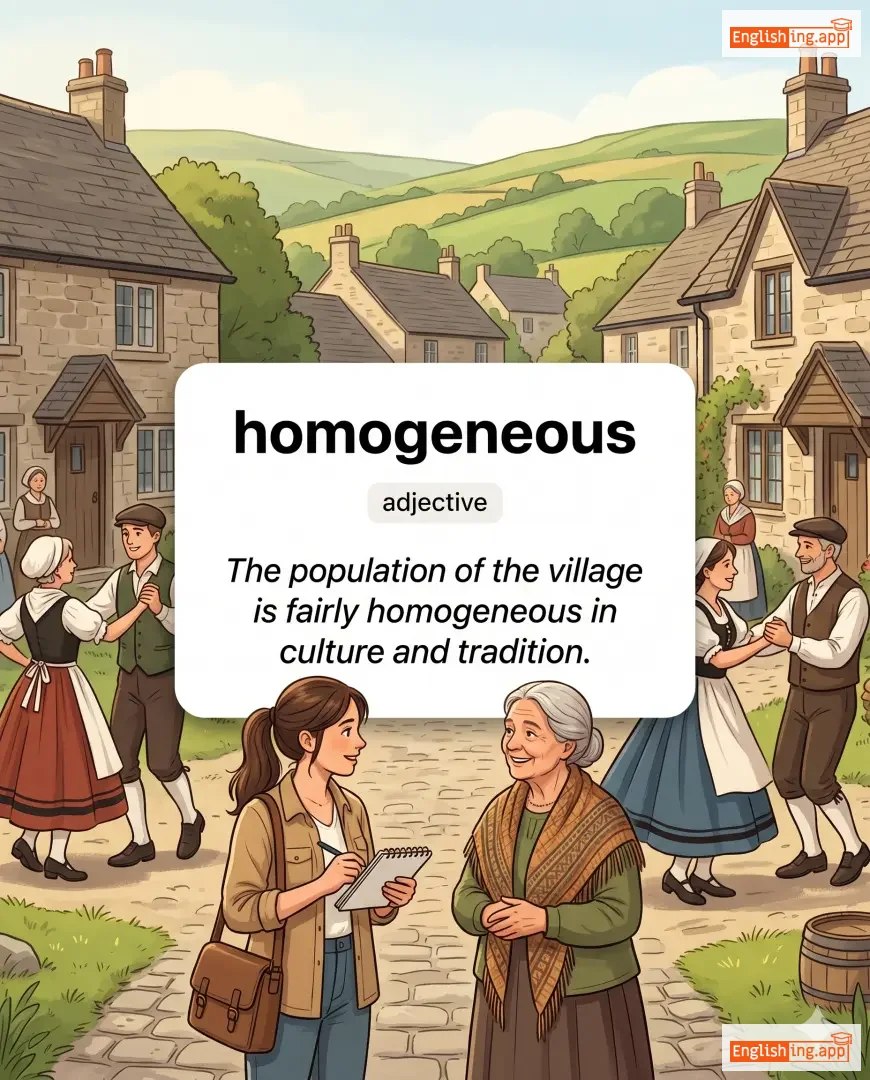
homogeneous definition card — visual illustration of the meaning
adjective
/ˌhoʊ.məˈdʒiː.ni.əs/
однородный (odnorodnyj)

Consisting of parts or elements that are all the same kind; uniform in composition.

"The population of the village is fairly homogeneous in culture and tradition."

"Население деревни довольно однообразно по культуре и традициям." (Naseleije derevni dovol'no odnorodno po kul'ture i tradicijam.)
verb
/həˈmɑː.dʒə.naɪz/
гомогенизировать (gomozenizirovat)

To make uniform or similar by blending or mixing different elements.

"The company tried to homogenize its products across global markets."

"Компания пыталась однородить свои продукты на глобальных рынках." (Kompanija pytalas' odnorodit' svoi produkty na global'nykh rynkakh.)
adjective
/həˈmɑː.dʒə.nəs/
однородный (odnorodny)

Similar or uniform in nature; often used interchangeably with 'homogeneous'.

"The class was made up of a homogenous group of students."

"Класс состоял из однородной группы студентов." (Klass sostoyal iz odnorodnoy gruppy studentov.)
adjective
/həˈmɑː.lə.ɡəs/
гомологичный (структура) (gomologichnyy (struktura))

Having the same relation, relative position, or structure, especially due to evolutionary origin.

"The wings of bats and the arms of humans are homologous structures."

"Крылья летучих мышей и руки людей - это гомологичные структуры." (Krylya letuchikh myshey i ruki lyudey - eto gomologichnye struktury.)
noun
/ˈhɑː.mə.nɪm/
омоним (omonim)

A word that is spelled and pronounced like another word but has a different meaning.

"The word 'bat' is a homonym because it can mean an animal or a sports tool."

"Слово 'летучая мышь' — это омоним, потому что оно может означать как животное, так и спортивный инструмент." (Slovo 'letuchaya mysh' - eto omonim, potomu chto ono mozhet oznachat' kak zhivotnoye, tak i sportivnyy instrument.)
noun
/ˈhɒməˌfoʊn/
омофон (omofon)

A word that is pronounced the same as another word but differs in meaning, and often spelling.

"The words 'pair' and 'pear' are homophones."

"Слова 'pair' и 'pear' — это омофоны." (Slova 'pair' i 'pear' - eto omofony.)
verb
/hoʊn/
точить, улучшать навыки (tochit', uluchshat' navyki)

To sharpen a blade or to improve a skill through practice.

"She honed her presentation skills before the big meeting."

"Она отточила свои навыки презентации перед большим собранием." (Ona ottochila svoi navyki prezentatsii pered bol'shim sobraniem.)
adjective
/ˈɑːnɪst/
честный (chestny)

free of deceit and untruthfulness; sincere

"She is known as an honest and trustworthy person."

"Она известна как честный и надежный человек." (Ona izvestna kak chestny i nadezhny chelovek.)
adverb
/ˈɒnɪstli/
честно (chestno)

in a truthful, sincere, or fair way

"She spoke honestly about her mistakes."

"Она честно рассказала о своих ошибках." (Ona chestno rasskazala o svoikh oshibkakh.)
noun
/ˈɒnɪsti/
честность (chestnost)

the quality of being truthful and sincere

"Honesty is the best policy in all situations."

"Честность — лучшая политика во всех ситуациях." (Chestnost' — luchshaya politika vo vsekh situatsiyakh.)
noun
/ˈhʌni/
мед (med)

A sweet, sticky substance made by bees from nectar.

"She likes to put honey in her tea."

"Ей нравится добавлять мед в чай." (Yey nravitsya dobavlyat med v chay.)
noun
/ˈɑːnər/
честь (chest')

high respect; great esteem

"He received an award in honor of his achievements."

"Он получил награду в честь своих достижений." (On poluchil nagradu v chest' svoikh dostizheniy.)
noun
/ˌɒnəˈreəriəm/
гонорар (gonorar)

A payment given for professional services that are rendered without a fee.

"The guest lecturer received an honorarium for her talk."

"Гость-лекционер получил гонорар за свою лекцию." (Gost' lektsioner poluchil gonorar za svoju lektsiju.)
honour definition card — visual illustration of the meaning
verb
/ˈɒnər/
чтить (chtit')

to show respect; to keep a promise

"We honour our veterans for their service."

"Мы чтим наших ветеранов за их службу." (My chtim nashikh veteranov za ikh sluzhbu.)
adjective
/ˈɒnərəbəl/
почётный (pochetnyy)

deserving respect or admiration because of moral integrity; showing honesty and fairness

"She is known as an honourable leader who always keeps her promises."

"Она известна как почётный лидер, который всегда держит свои обещания." (ona izvestna kak pochetnyy lider kotoryy vsegda derzhit svoi obeshchaniya)
adjective; past participle
/ˈɒnəd/
удостоенный (udostoyennyy)

treated with respect or distinction; feeling proud and privileged

"She felt deeply honoured to receive the award."

"Она была удостоена чести получить награду." (Ona byla udostoena chesti poluchit nagradu)
noun
/hʊd/
капюшон (kapyushon)

the expandable neck region of certain snakes like cobras; a covering for the head

"The cobra spread its hood when it felt threatened."

"Кобра расправила свой капюшон, когда почувствовала угрозу." (Kobra rasspravit svoi kapyushon, kogda pochuvstvovala ugrozu.)
verb
/ˈhʊdwɪŋk/
обманывать (obmanyvat)

To deceive or trick someone.

"The scammer hoodwinked many people with false promises."

"Мошенник обманул многих людей ложными обещаниями." (Moshenik obmanul mnogikh lyudey lozhnymi obeshchaniyami.)
noun
/huːf/
копыто (kopyto)

the hard part covering the foot of horses, cattle, sheep, and other animals

"The horse's hoof was injured after stepping on a sharp rock."
"Копыто лошади было повреждено после того, как оно наступило на острый камень." (Kopyto loshadi bylo povrezhdeno posle togo, kak ono nastupilo na ostryy kamen'.)
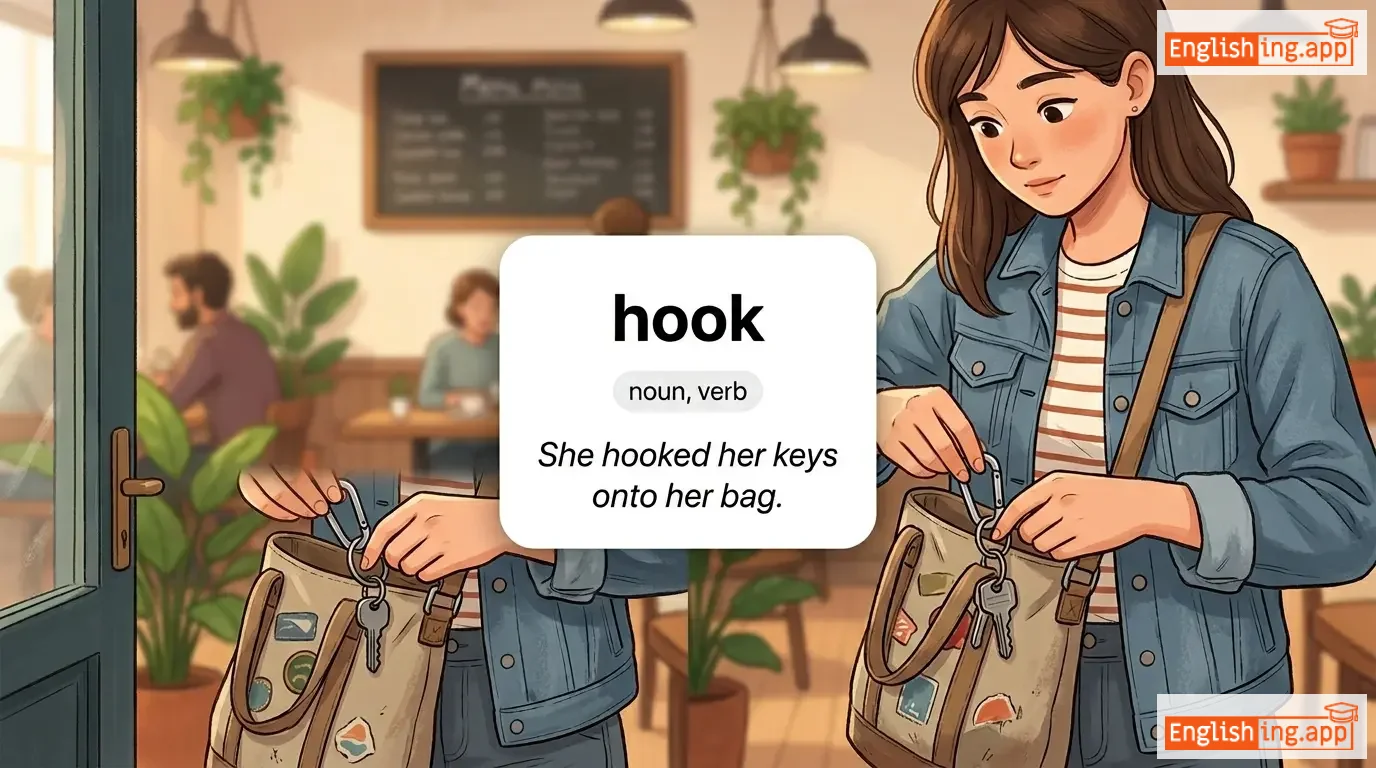
hook definition card — visual illustration of the meaning
noun, verb
/hʊk/
крюк или устройство для подвешивания (kryuk ili ustroystvo dlya podveshivaniya)

a curved piece of metal or other material used for catching, holding, or pulling something; to catch or attach with a hook

"She hooked her keys onto her bag."

"Она повесила свои ключи на сумку." (Ona povesila svoi klyuchi na sumku.)
🌟

hope

verb
/hoʊp/

To want something to happen or be true and think it is possible.

"I hope everything goes well with your exam."

adjective
/ˈhəʊpfʊl/
полный надежды (polnyy nadezhdy)

feeling or showing optimism about a future event

"She is hopeful about the results of the interview."

"Она полна надежды по поводу результатов собеседования." (Ona polna nadezhdy po povodu rezul'tatov sobesedovaniya.)
adverb
/ˈhoʊpfəli/
надеюсь (nadejus)

in a hopeful manner; expressing hope or optimism

"Hopefully, the weather will be nice tomorrow."

"Надеюсь, завтра будет хорошая погода." (Nadejus, zavtra budet horoshaya pogoda.)
adjective
/ˈhoʊpləs/
безнадежный; отчаянный (beznadezhny; otchayannyy)

feeling or causing despair about something; without hope; desperate

"The situation seemed hopeless until help arrived."

"Ситуация казалась безнадежной, пока не пришла помощь." (Situatsiya kazalas' beznadezhnoy, poka ne prishla pomoshch'.)
noun
/hɔːrd/
орда (orda)

A large group or crowd, especially one that is disorderly or difficult to control.

"A horde of fans gathered outside the stadium."

"Орда фанатов собралась у стадиона." (Orda fanatov sobrala's u stadiona.)
noun
/həˈraɪ.zən/
горизонт (gorizont)

the line where the earth seems to meet the sky; the limit of one's knowledge, experience, or interest

"The sun disappeared below the horizon."

"Солнце исчезло за горизонтом." (Solntse ischezlo za gorizontom.)
horizons definition card — visual illustration of the meaning
noun
/həˈraɪ.zənz/
горизонты (gorizonty)

The limit of a person's mental perception, experience, or interest.

"The telescope opens new horizons for astronomy."

"Телескоп открывает новые горизонты для астрономии." (Teleskop otkryvaet novye gorizonty dlya astronomii.)
adjective
/ˌhɒrɪˈzɒntəl/
горизонтальный (gorizontalnyi)

parallel to the horizon; flat and level from side to side

"The table must be perfectly horizontal to keep the glass from sliding."

"Стол должен быть горизонтальным, чтобы стакан не скользил." (Stol dolzhen byt gorizontalnym chtoby stakan ne skolzil)
noun
/ˈhɔːrmoʊn/
гормон (gormon)

a chemical substance produced in the body that influences how the body grows or functions

"Insulin is a hormone that controls blood sugar levels."

"Инсулин — это гормон, который контролирует уровень сахара в крови." (Insulin — eto gormon, kotoryy kontroliruet urovney sakhara v krovi.)
noun
/hɔːrn/
рог, гудок (rog, gudok)

a hard, pointed part growing from the head of some animals; a device that makes a loud sound as a warning

"The driver pressed the horn to warn the pedestrians."

"Водитель нажал на гудок, чтобы предупредить пешеходов." (Vozhitel nazhat na gudok, chtoby predskazat' peshekhodov.)
noun
/ˈhɔːrn.bɪl/
Птица хорнбил (ptitsa hornbil)

a large tropical bird with a large curved beak and often a horn-like projection

"The colorful hornbill perched on the highest branch."

"Яркий хорнбил сел на самую высокую ветку." (Yarkiy hornbil sel na samuyu vysokuyu vetku.)
noun
/ˈhɔːr.nət/
шершень (sheršen')

a large wasp that can sting and is often aggressive

"The hornet built its nest under the roof."

"Шершень построил свое гнездо под крышей." (Sheršen' postroil svoe gnezdo pod kryshey.)
noun
/ˈhɒrəˌskoʊp/
гороскоп (goroskop)

A forecast of a person's future based on the positions of the stars and planets at their birth.

"She read her horoscope every morning to see what the stars predicted."

"Она читала свой гороскоп каждое утро, чтобы увидеть, что предсказали звезды." (Ona chitala svoy goroskop kazhdoe utro, chtoby uvidet', chto predskazali zvezdy.)
adjective
/ˈhɔːrɪbəl/
ужасный, отвратительный (uzhasnyy, otvratitel'nyy)

very unpleasant or causing horror; extremely bad or unpleasant

"The food at that restaurant was horrible."

"Еда в этом ресторане была ужасной." (Yeda v etom restorane byla uzhasnoy.)
horrify definition card — visual illustration of the meaning
verb
/ˈhɔːrɪfaɪ/
ужасать (uzhasat)

to fill with horror; to shock or disgust greatly

"The violent scene horrified the audience."

"Жестокая сцена ужаснула публику." (zhestokaya stsena uzhasnula publiku)
noun
/ˈhɒr.ər/
ужас (uzhas)

an intense feeling of fear, shock, or disgust

"She screamed in horror when she saw the accident."

"Она закричала от ужаса, когда увидела аварию." (Ona zakrichala ot uzhasa, kogda uvidela avariyu.)
noun
/hɔːrs/
лошадь (loshad)

a large, strong animal used for riding, racing, or carrying loads

"The horse ran across the field."

"Лошадь бегала по полю." (Loshad' begala po polyu.)
noun
/ˈhɔːrs.liːt͡ʃ/
лошадинный пиявка (loshadinny pilyavka)

a large species of leech that was traditionally used in veterinary medicine

"The veterinarian explained that horse-leach was once commonly used to treat horses."

"Ветеринар объяснил, что лошадинные пиявки когда-то широко использовались для лечения лошадей." (Veterinar ob'yasnil, chto loshadinnyye pilyavki kogda-to shiroko ispol'zovalis' dlya lecheniya loshadey.)
adjective
/ˈhɔːrtətɪv/
ободряющий (obodryayushchiy)

Giving strong encouragement or urging.

"The teacher gave a hortative speech to motivate the students before the exam."

"Учитель произнес ободряющую речь, чтобы мотивировать учеников перед экзаменом." (Uchitel prozines obodryayushchuyu rech chtoby motivirovat uchenikov pered ekzamenom)
adjective
/ˈhɔːrtətɔːri/
побудительный (pobuditelnyy)

Intended to encourage or urge to action.

"The manager’s hortatory words inspired the team to work harder."

"Побудительные слова менеджера вдохновили команду работать усерднее." (Pobuditelnyye slova menedzhera vdokhnovili komandu rabotat userdnee)
adjective
/ˌhɔːrtɪˈkʌltʃərəl/
связанный с садоводством (svyazannyy s sadovodstvom)

Relating to the art or practice of garden cultivation and management.

"She studied horticultural science at the university."

"Она изучала садоводческие науки в университете." (Ona izuchala sadovodcheskie nauki v universitete.)
noun
/ˈhɔːrtɪˌkʌltʃər/

The art or practice of garden cultivation and management.

"Horticulture plays a vital role in producing fruits, vegetables, and ornamental plants."

noun
/ˈhoʊʒəri/
носки и одежда для ног (noski i odezhda dlya nog)

Stockings, socks, and other knitted clothing for the legs and feet.

"She bought new hosiery for the winter season."

"Она купила новые чулки для зимнего сезона." (Ona kupila novye chulki dlya zimnego sezona.)
adjective
/ˈhɑːspɪtəbl/
гостеприимный (gostepriimny)

Friendly and welcoming to guests or strangers.

"The villagers were very hospitable to the travelers."

"Жители деревни были очень гостеприимны к путешественникам." (Zhiteli derevni byli ochen' gostepriimny k puteshestvennikam.)
noun
/ˈhɒs.pɪ.təl/
больница (bol'nitsa)

an institution where sick or injured people are given medical treatment

"He was taken to the hospital after the accident."

"Его отвезли в больницу после аварии." (Ego otvezli v bol'nitsu posle avarii.)
noun
/ˌhɑːspɪˈtæləti/

The friendly and generous reception and entertainment of guests or strangers.

"We enjoyed the hospitality of our hosts during the holiday."

noun, verb
/hoʊst/
хозяин (hozyain)

a person who receives or entertains guests; to organize and provide for an event

"She will host the conference next week."

"Она будет принимать конференцию на следующей неделе." (Ona budet prinimat' konferentsiyu na sleduyushchey nedele.)
noun
/ˈhɑːstɪdʒ/
заложник (zalozhnik)

A person seized or held as security for the fulfillment of a condition.

"The rebels took several people as hostages."

"Повстанцы взяли нескольких человек в заложники." (Povstantsy vzyali neskol'ko chelovek v zalozhniki.)
noun
/ˈhɑːstəlri/
гостиница (gostinitsa)

An inn or lodging place, especially one for travelers.

"They stayed at a small hostelry near the mountains."

"Они остановились в маленькой гостинице у подножия гор." (Oni ostanovilis' v malen'koy gostinitse u podnozh'ya gor.)
adjective
/ˈhɒstaɪl/
враждебный (vrazhdebny)

showing or feeling opposition, dislike, or hatred

"The soldiers entered a hostile territory."

"Солдаты вошли на враждебную территорию." (Soldaty voshli na vrazhdebnuu territoriu.)