Словари

Словарь английского языка | Значения слов, определения и примеры

noun
/ˈhɛksəˌɡɒn/
шестигранник (shestigrannik)

A six-sided polygon.

"A honeycomb cell is shaped like a hexagon."

"Ячейка в улье имеет форму шестиугольника." (Yacheyka v ul'e imeyet formu shestiugol'nika.)
adjective
/hɛkˈsæŋɡjələr/
шестигранный (shestigrannyy)

Having six angles or corners.

"The artist designed a hexangular frame for the mirror."

"Художник создал шестигранную раму для зеркала." (Khodozhnik sozdal shestigrannuyu ramu dlya zerkala.)
noun
/ˈhɛksəˌpɒd/
гексапод (geksapod)

An insect or other organism with six legs.

"The scientist observed a hexapod crawling on the leaf."

"Учёный наблюдал за гексаподом, ползущим по листу." (Uchonyy nablyudal za geksapodom, polzyushchim po listu.)
interjection
/heɪ/
Эй (ey)

used to attract attention, express surprise, or greet someone

"Hey, how are you doing today?"

"Эй, как ты сегодня?" (Ey, kak ty segodnya?)
noun
/ˈheɪ.deɪ/
золотой век; расцвет; пик (zolotoy vek; rastsvet; pik)

the period of a person's or thing's greatest success, popularity, or vigor; prime time

"During her heyday as a singer, she performed in sold-out concerts around the world."

"Во время своего золотого века как певица она выступала на распроданных концертах по всему миру." (Vo vremya svoego zolotogo veka kak pevitsa ona vystupala na rasprodannykh kontsertakh po vsemy miru.)
noun
/ˈheɪˌdeɪ/
золотой век (zolotoy vek)

The period of greatest success, popularity, or power.

"In its heyday, the company dominated the market."

"На своем золотом веке компания доминировала на рынке." (Na svoem zolotom veke kompaniya dominirovala na rynke.)
interjection
/haɪ/
привет (privet)

a friendly greeting used when meeting someone

"Hi, it's nice to meet you!"

"Привет, приятно познакомиться!" (Privet, priyatno poznakomit'sya!)
noun
/haɪˈeɪtəs/
перерыв (pereryv)

A pause or break in continuity of a process or activity.

"The show returned after a long hiatus."

"Шоу вернулось после долгого перерыва." (Shou vernulos posle dolgogo pereryva.)
adjective
/haɪˈbɜːrnəl/
зимний (haibernal)

Relating to or occurring in winter.

"The hibernal season is often harsh in the mountains."

"Зимний сезон часто суров в горах." (Zimniy sezon chasto surov v gorakh)
verb
/ˈhaɪbərˌneɪt/
зимовать (zimovat)

To spend the winter in a dormant state, as some animals do.

"Bears hibernate in caves during the winter."

"Медведи зимуют в пещерах зимой." (Medvedi zimuyut v peshcherakh zimoy.)
adjective/noun
/haɪˈbɜːrniən/
хибернийский (khiberniiskii)

Relating to Ireland or the Irish.

"He enjoyed reading about Hibernian culture and history."

"Ему понравилось читать о хибернийской культуре и истории." (Emu ponravilos' chitat' o khiberniiskoi kul'ture i istorii.)
adjective
/hɪk/
деревенщина; мужик (derevenshchina; muzhik)

unsophisticated person from a rural area; country bumpkin

"He had a hick accent from growing up in a small town."

"У него был акцент деревенщины, потому что он вырос в маленьком городе." (U nego byl aktsent derevenshchiny, potomu chto on vyros v malen'kom gorode.)
🕵️‍♂️

Hidden (khɪdən)

adjective
/ˈhɪdən/
скрытый (skrytyy)

kept out of sight; concealed.

"The treasure was hidden under the old tree."

"Сокровище было скрыто под старым деревом." (Sokrovishe bylo skryto pod starym derevom.)
hide definition card — visual illustration of the meaning
verb
/haɪd/
прятать (pryatat)

to put something or oneself out of sight; to conceal

"She tried to hide the letter under the pillow."

"она пыталась спрятать письмо под подушкой." (ona pytalas' spryat'at' pis'mo pod podushkoy)
noun
/ˈhaɪdəweɪ/
убежище (ubezhishche)

A place used as a retreat or a place to hide.

"The cabin in the woods was their secret hideaway."

"Хижина в лесу была их секретным укрытием." (Khizhina v lesu byla ikh sekretным ukrytiyem.)
adjective
/ˈhaɪd.baʊnd/
закостенелый (zakosteneliy)

unwilling or unable to change because of tradition or convention

"He is too hidebound to accept new ideas."

"Он слишком консервативен, чтобы принять новые идеи." (On slishkom konservativen chtoby prinyat novye idei)
adjective
/ˈhɪd.i.əs/
ужасный (uzhasnyy)

extremely ugly or unpleasant

"The crime was so hideous that it shocked the whole town."

"Преступление было настолько ужасным, что оно шокировало весь город." (Prestuplenie bylo nastol'ko uzhasnym, chto ono shokirovalo ves' gorod.)
verb
/haɪ/
поспешить (pospeshit)

to go quickly; hasten

"He hied to the station to catch the train."

"Он поспешил на станцию, чтобы успеть на поезд." (On pospeshil na stantsiyu, chtoby uspety na poezd.)
adjective
/ˌhaɪəˈrɑː.kɪ.kəl/
иерархический (ierarkhicheskij)

arranged in order of rank or authority

"The company has a strict hierarchical structure."

"Компания имеет строгую иерархическую структуру." (Kompaniya imeet stroguju ierarkhicheskuyu strukturu.)
noun
/ˈhaɪəˌrɑːrki/
иерархия (ierarhiya)

A system in which people or things are arranged in levels of importance or authority.

"The corporate hierarchy determines who makes the final decision."

"Корпоративная иерархия определяет, кто принимает окончательное решение." (Korparativnaya ierarhiya opredelyayet, kto prinyet okonchatelnoe reshenie.)
noun
/ˈhaɪərəˌɡlɪf/
иероглиф (ieroglif)

A picture or symbol used in ancient writing systems, especially Egyptian writing.

"The walls of the temple were covered in hieroglyphs."

"Стены храма были покрыты иероглифами." (Steny khrama byli pokryty ieroglifami.)
adjective/noun
/ˌhaɪərəˈɡlɪfɪk/
иеоглифический (hieroglificheskiy)

Relating to or written in hieroglyphs; symbols or writing that is difficult to understand.

"The archaeologists studied the hieroglyphic inscriptions carefully."
"Археологи тщательно изучали иероглифические надписи." (Archeologi tchatel'no izuchali ieroglificheskie nadpisi.)
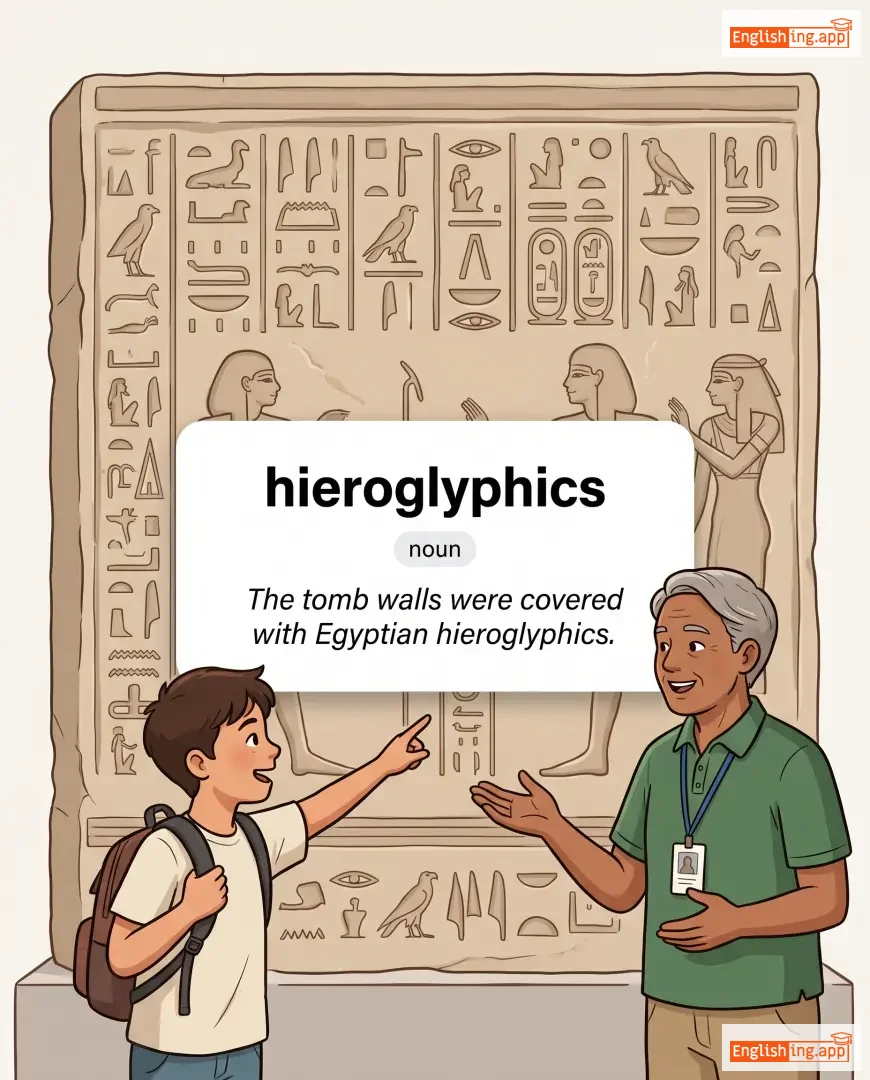
hieroglyphics definition card — visual illustration of the meaning
noun
/ˌhaɪ.roʊˈɡlɪf.ɪks/
иероглифы (ieroglify)

a system of writing using pictures or symbols, used especially by ancient Egyptians

"The tomb walls were covered with Egyptian hieroglyphics."

"Стены гробницы были покрыты египетскими иероглифами." (Steny grobnitsy byli pokryty egipetskymi ieroglifami.)
adjective
/haɪ/
высокий (vysokiy)

At or to a great height; greater than normal in amount, degree, or intensity.

"The mountain peak is very high."

"Вершина горы очень высокая." (Vershina gory ochen' vysokaya.)
adjective
/ˌhaɪ ˈfloʊn/
напыщенный (napyshchennyi)

Using fancy or pretentious language; lofty in style but often overblown.

"The politician gave a high-flown speech full of promises."

"Политик произнес напыщенную речь, полную обещаний." (Politik proznes napyshchennuyu rech', polnuyu obeshchanii.)
adjective
/ˈhaɪˌprəʊfaɪl/
высокий профиль (vysokiy profil)

having a lot of attention or public notice

"The CEO attended a high-profile conference in New York."

"Генеральный директор посетил высокопрофильную конференцию в Нью-Йорке." (General'nyy direktor posetil vysokoprofil'nuyu konferentsiyu v N'yu-Yorke.)
adjective
/ˌhaɪ ˈtɛk/
высокие технологии (vysokie tekhnologii)

using or involving advanced technology.

"The company produces high-tech medical devices."

"Компания производит медицинские устройства с использованием высоких технологий." (Kompaniya proizvodit meditsinskye ustroystva s ispol'zovaniem vysokikh tekhnologiy.)
adjective
/ˈhaɪˌbraʊ/
интеллектуально превосходящий (intellektual'no prevoshodyashchiy)

intellectually superior or cultured; often describing art, literature, or activities appealing to intellectual tastes

"The museum is known for its highbrow exhibitions."

"Музей известен своими интеллектуальными выставками." (Muzey izvesten svoimi intellektual'nymi vystavkami.)
verb
/ˈhaɪˌlaɪt/
выделить (vydelit')

to emphasize or make something stand out

"The teacher highlighted the most important points in the text."

"Учитель выделил самые важные моменты в тексте." (Uchitel' vydelil samye vazhnye momenty v tekste.)
adverb
/ˈhaɪli/
высоко (vysoko)

to a great degree; very

"She is highly respected in her field."

"Она высоко уважает в своей области." (Ona vysoko uzhajet v svoey oblasti.)
noun
/ˈhaɪ.nəs/
Высочество; королевский титул (vysochectvo, korolevskiy titul)

a title given to a person of royal rank; the quality or state of being high or elevated

"Your Highness, the royal carriage is ready to take you to the state banquet this evening."

"Ваше Высочество, королевская карета готова отвезти вас на государственный банкет сегодня вечером." (Vashe Vysochectvo, korolevskaya karet is ready to take you to the state banquet tonight.)
noun
/ˈhaɪ.weɪ/
шоссе (shosse)

A main road, especially one connecting major towns or cities.

"The highway was blocked due to an accident."

"Шоссе было заблокировано из-за аварии." (Shosse bylo zablokirovano iz-za avarii.)
hijack definition card — visual illustration of the meaning
verb
/ˈhaɪdʒæk/
угон (ugon)

to take control of a vehicle or situation illegally or by force

"The criminals attempted to hijack the airplane."

"Преступники пытались угнать самолет." (Prestuplniki pytalis' ugnat' samolet.)
🥾

hike

verb/noun
/haɪk/

To take a long walk in the countryside or mountains; also to increase suddenly (prices, rates, etc.).

"We decided to hike in the hills this weekend."

adjective
/hɪˈlɛəriəs/
крайне смешной (kraine smeshnoi)

Extremely funny or amusing.

"The comedian told a hilarious story that had everyone laughing."

"Комик рассказал крайне смешную историю, которая заставила всех смеяться." (Komik rasskazal kraine smeshnuyu istoriu, kotoraya zastavila vsekh smeyatsya.)
noun
/hɪˈlærɪti/
хихиканье (khikhikanye)

Extreme amusement, especially when expressed by laughter.

"The movie caused great hilarity among the audience."

"Фильм вызвал большое хихиканье среди зрителей." (Film vyzval bol'shoe khikhikanye sredi zriteley.)
noun
/hɪl/
холм (kholm)

A naturally raised area of land, smaller than a mountain.

"We climbed the hill to see the sunset."

"Мы поднялись на холм, чтобы увидеть закат." (My podnyalis' na kholm, chtoby uvidet' zakat.)
noun
/ˈhɪlək/
холмик (holmik)

A small hill or mound.

"The children climbed up the grassy hillock to watch the sunset."

"Дети поднялись на травяной холмик, чтобы посмотреть на закат." (Deti podnyalis' na travyanoy kholmik, chtoby posmotret' na zakat.)
adjective
/ˈhɪli/
холмистый (kholmisty)

having many hills; characterized by hills or slopes

"The village is located in a beautiful hilly region."

"Деревня расположена в красивом холмистом районе." (Derevnya raspolozhena v krasivom kholmistom rayone)
noun
/ˈhɪl.sə fɪʃ/
рыба хильса (ryba khil'sa)

a popular fish species found in South Asian rivers, especially prized in Bengali cuisine

"Hilsa fish is considered a delicacy in Bengali culture."

"Рыба хильса считается деликатесом в бенгальской культуре." (Ryba khil'sa schitayetsya delikatesom v bengalskoy kulture.)
pronoun
/hɪm/
его (ego)

Used to refer to a male person or animal already mentioned.

"I saw him at the park yesterday."

"Я видел его в парке вчера." (Ya videl ego v parke vchera.)
pronoun
/hɪmˈself/
сам (sam)

Used to emphasize that a male person does something by his own effort.

"He fixed the car himself."

"Он отремонтировал машину сам." (On otremontiroval mashinu sam.)
🦌♀️

Hind (haind)

noun
/haɪnd/
оленица (olenitsa)

a female deer, especially a red deer

"The hind protected her fawn from predators."
"Оленица защитила своего олененка от хищников." (Olenitsa zashchitila svoego olenenka ot khishchnikov.)
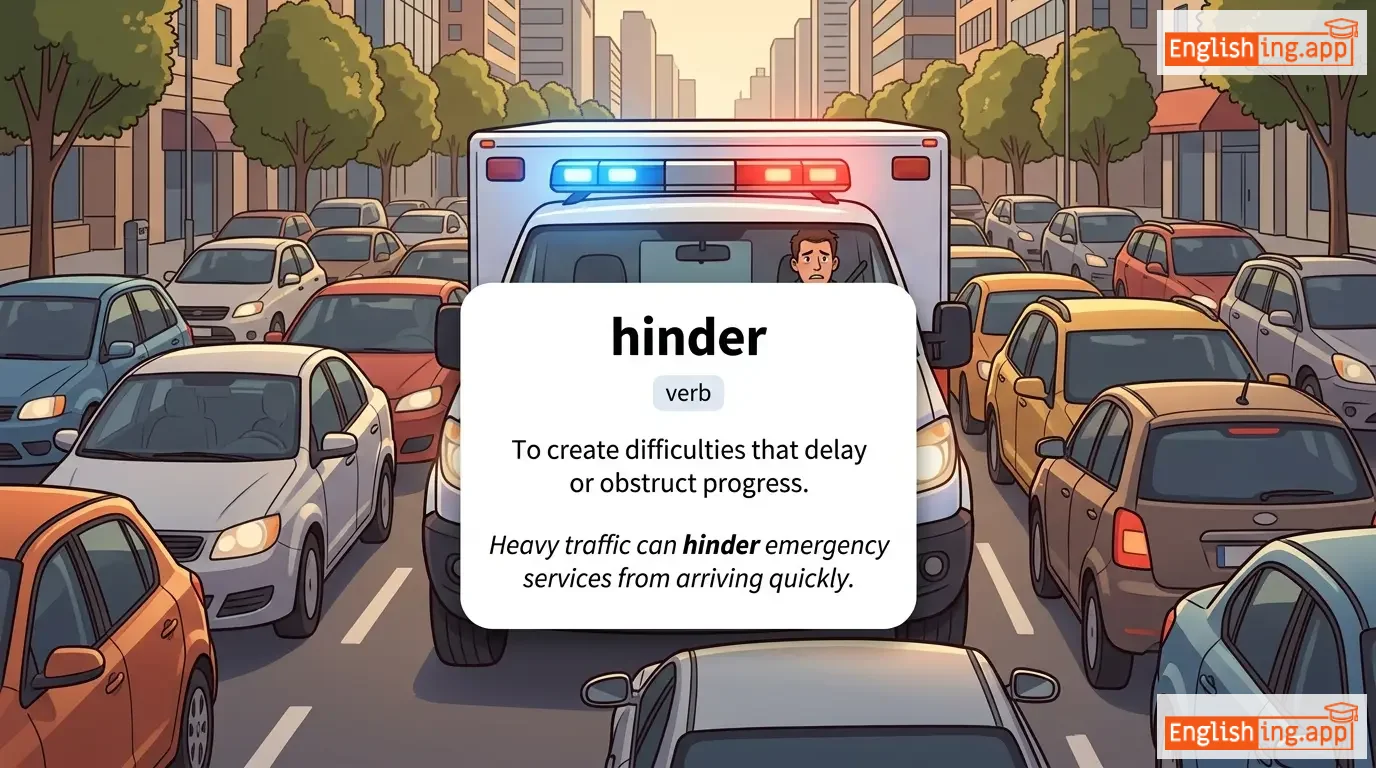
hinder definition card — visual illustration of the meaning
verb
/ˈhɪndər/
мешать (meshchat)

To create difficulties that delay or obstruct progress.

"Heavy traffic can hinder emergency services from arriving quickly."

"Тяжелое движение может помешать экстренным службам прибыть быстро." (Tyazheloe dvizhene mozhet pomesat' ekstreemnym sluzhbam pribyit' bystro.)
adjective
/ˈhaɪndmoʊst/
самый задний (samyy zadniy)

Farthest back; last in position.

"The hindmost car in the convoy broke down first."
"Самая задняя машина в колонне сломалась первой." (Samaya zadnyaya mashina v kolonne slomalas' pervoy.)
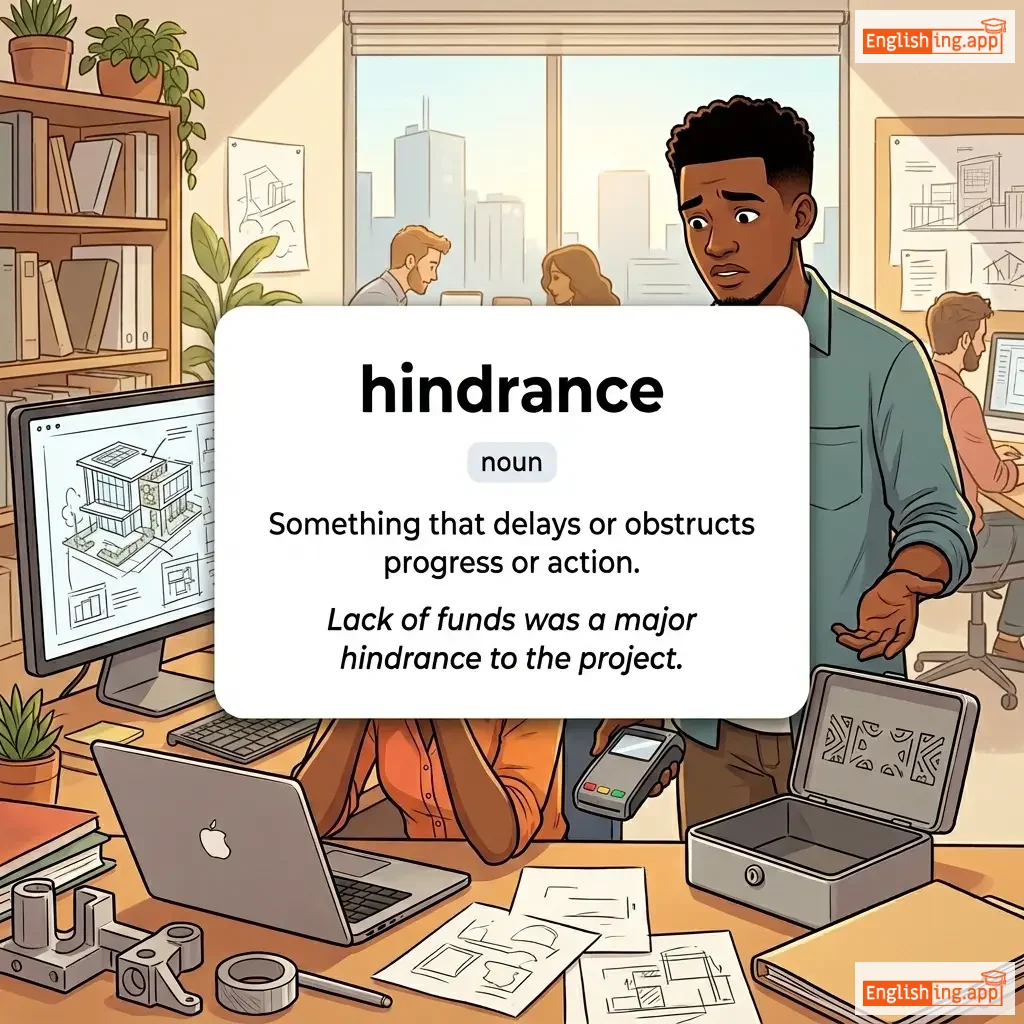
hindrance definition card — visual illustration of the meaning
noun
/ˈhɪndrəns/

Something that delays or obstructs progress or action.

"Lack of funds was a major hindrance to the project."

noun
/ˈhaɪndsaɪt/
задним числом (zadnim chislom)

Understanding of a situation only after it has happened.

"With the benefit of hindsight, we realized the decision was a mistake."

"Имея в виду задним числом, мы поняли, что решение было ошибкой." (Imei v vidu zadnim chislom, my ponyali, chto reshenie bylo oshibkoy.)
noun/verb
/hɪnt/
подсказка (podskazka)

a small piece of advice or suggestion; to suggest something indirectly

"She gave me a hint about the surprise party."

"Она дала мне подсказку о сюрпризной вечеринке." (Ona dala mne podskazku o syurpriznoy vecherinke.)
noun
/ˈhɪntərlænd/
внутренние районы (vnutrennie rayony)

The remote or less developed areas away from the coast or a city.

"The farmers came from the rural hinterland to sell their produce in the city."

"Фермеры приехали из сельских внутренних районов, чтобы продать свою продукцию в городе." (Fermery priekhali iz sel'skikh vnutrennikh raionov, chtoby prodat' svoiu produktsiiu v gorode.)
noun (plural)
/ˈhɪntərlændz/
отдалённые районы (otdalennye raiony)

Plural of hinterland; remote or less developed regions.

"Explorers traveled deep into the hinterlands of the country."

"Исследователи путешествовали глубоко в отдалённые районы страны." (Issledovateli puteshestvovali gluboko v otdalennye raiony strany.)