Словари

Словарь английского языка | Значения слов, определения и примеры
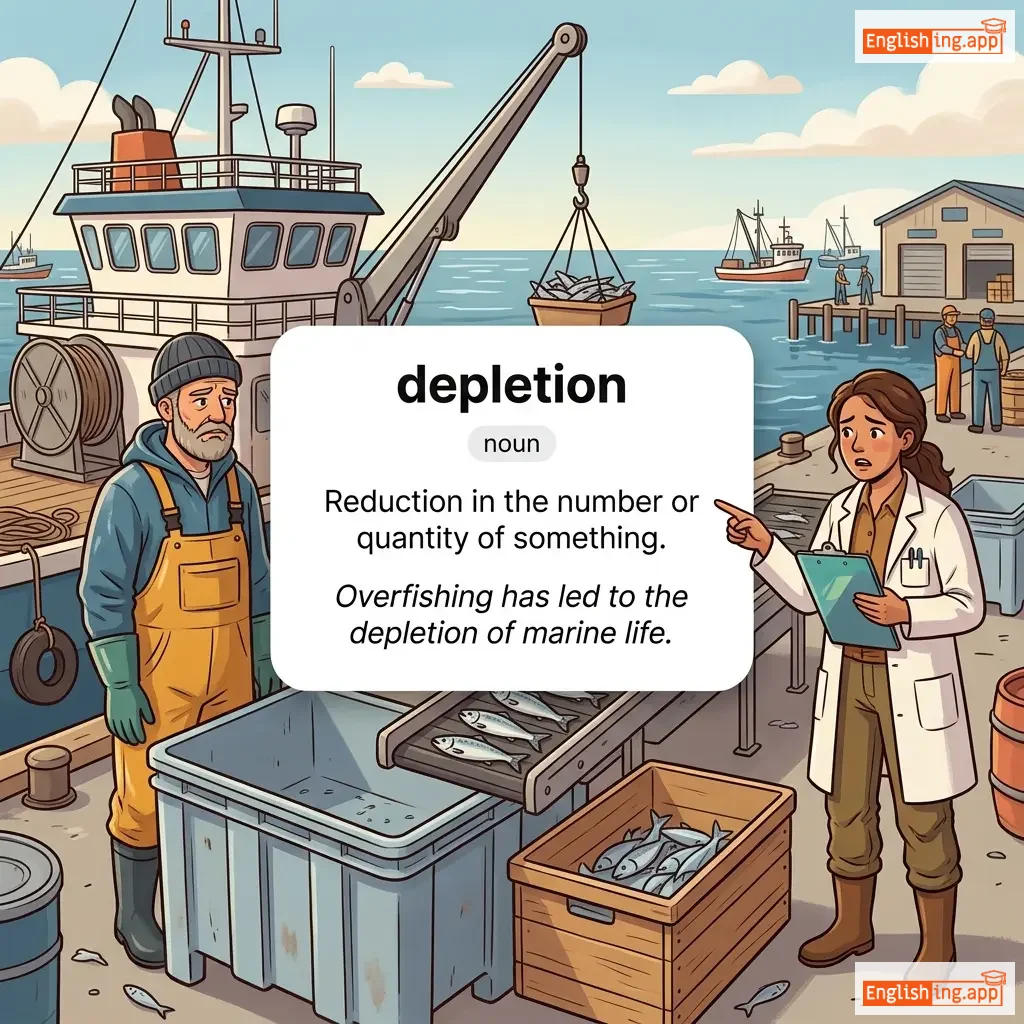
depletion definition card — visual illustration of the meaning
noun
dɪˈpliː.ʃən
истощение (istochenie)

Reduction in the number or quantity of something.

"Overfishing has led to the depletion of marine life."

"Перелов рыбы привел к истощению морской жизни." (Perelov ryby priyol k istochcheniyu morskoy zhizni.)
adjective
/dɪˈplɔːrəbl/
заслуживающий осуждения (zasluzhivayushchiy osuzhdeniya)

deserving strong condemnation; shockingly bad in quality

"The refugees were living in deplorable conditions."
"Беженцы жили в ужасных условиях." (Bezhtsy zhili v uzhasnykh usloviyakh.)
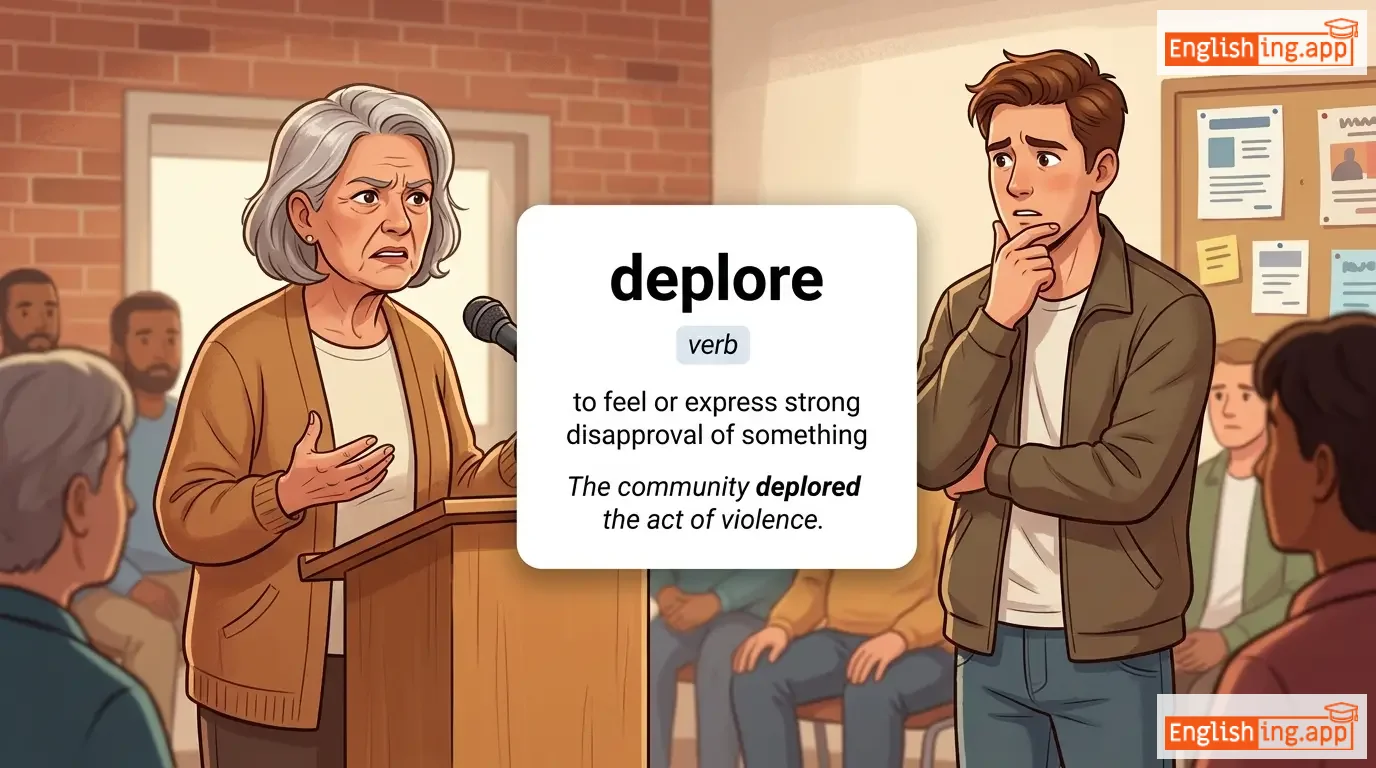
deplore definition card — visual illustration of the meaning
verb
/dɪˈplɔːr/
осуждать (osuzhdat')

to feel or express strong disapproval of something

"The community deplored the act of violence."
"Сообщество осудило акт насилия." (Soobshchestvo osudilo akt nasiliya.)
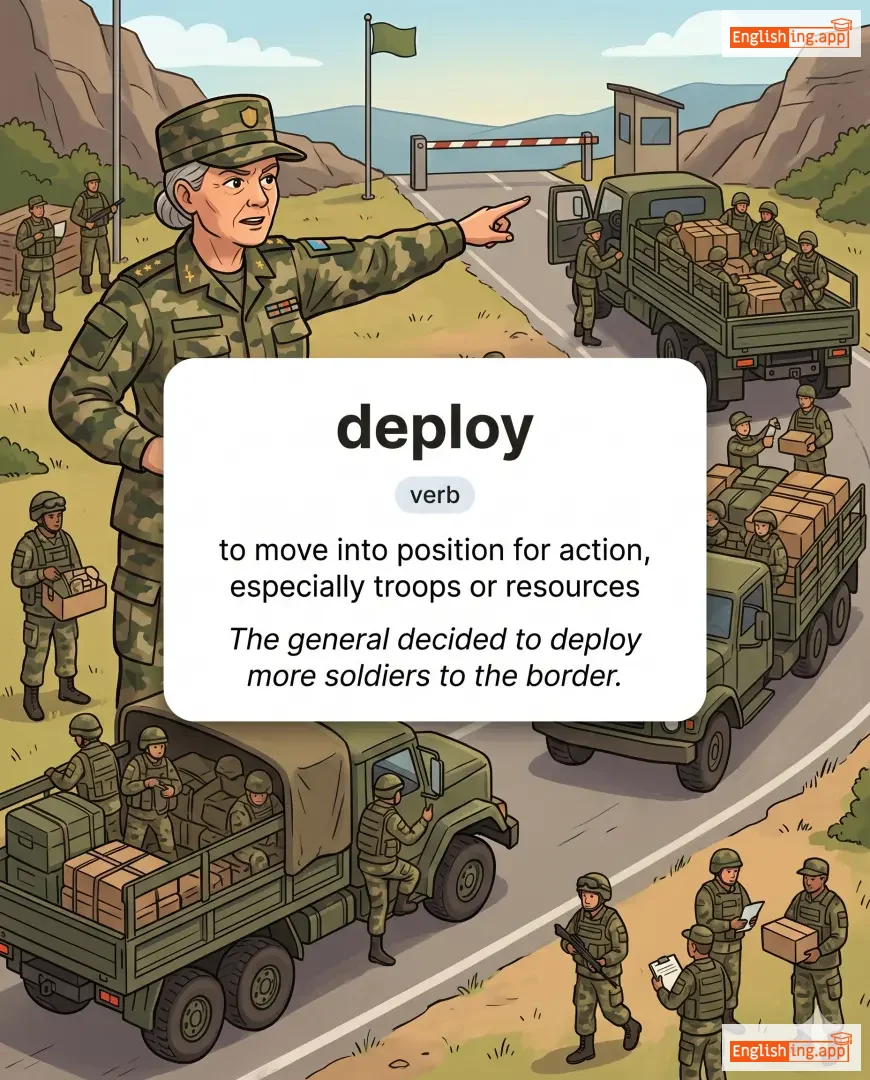
deploy definition card — visual illustration of the meaning
verb
/dɪˈplɔɪ/
развертывать (razvertyvat)

to move into position for action, especially troops or resources

"The general decided to deploy more soldiers to the border."

"Генерал решил направить больше солдат на границу." (General reshil napravit bolshe soldat na granitsu.)
deployment definition card — visual illustration of the meaning
noun
/dɪˈplɔɪmənt/
развертывание (razvertyvanie)

the action of moving or positioning something into place for use

"The deployment of the new software was completed successfully."

"Развертывание нового программного обеспечения было успешно завершено." (Razvertyvanie novogo programmogo obespecheniya bylo uspeshno zaversheno.)
noun
/dɪˈpoʊnənt/
свидетель (svidetel)

A person who gives testimony under oath, especially in a written deposition.

"The deponent confirmed the accuracy of the statement during the trial."

"Свидетель подтвердил точность заявления во время суда." (Svidetel podtverdil tochnost' zayavleniya vo vremya suda.)
verb
/diːˈpɒpjʊˌleɪt/
депопулировать (depopulirovat)

To reduce the number of people living in a place.

"The war threatened to depopulate the once-thriving town."

"Война угрожала депопулировать когда-то процветающий город." (Voyna ugrozhala depopulirovat' kogda-to protsvetyayushchiy gorod.)
verb
/dɪˈpɔːrt/
депортировать (deportirovat')

To expel a foreigner from a country, usually for legal or political reasons.

"The government decided to deport the illegal immigrants."

"Правительство решило депортировать незаконных иммигрантов." (Pravitel'stvo reshilo deportirovat' nezakonnykh immigranta.)
noun
/ˌdiːpɔːrˈteɪʃən/
депортация (deportatsiya)

The act of expelling a foreigner from a country.

"The deportation of hundreds of workers sparked international criticism."

"Депортация сотен рабочих вызвала международную критику." (deportatsiya soten rabochikh vyzvala mezhdunarodnuyu kritiku.)
noun
/dɪˈpɔːrtmənt/
поведение (povedenie)

A person's behavior or manners, especially in a formal situation.

"Her deportment during the ceremony impressed everyone."

"Её поведение во время церемонии впечатлило всех." (Yeyo povedenie vo vremya tseremonii vpechatlilo vsekh.)
verb
/dɪˈpoʊz/
свергнуть (svergnut)

to remove someone from office or power, especially suddenly and forcefully

"The rebels managed to depose the dictator after years of unrest."

"Повстанцы смогли свергнуть диктатора после лет беспокойства." (Povstantsy smogli svergnut' diktatora posle let bespokoystva.)
noun/verb
/dɪˈpɑːzɪt/
депозит, аванс (deposit, avans)

to place money in a bank account, or a sum paid in advance as security; a layer of material left naturally

"She deposited $500 into her savings account."
"Она внесла 500 долларов на свой сберегательный счет." (Ona vnesla 500 dollarov na svoi sberegatel'nyi schet.)
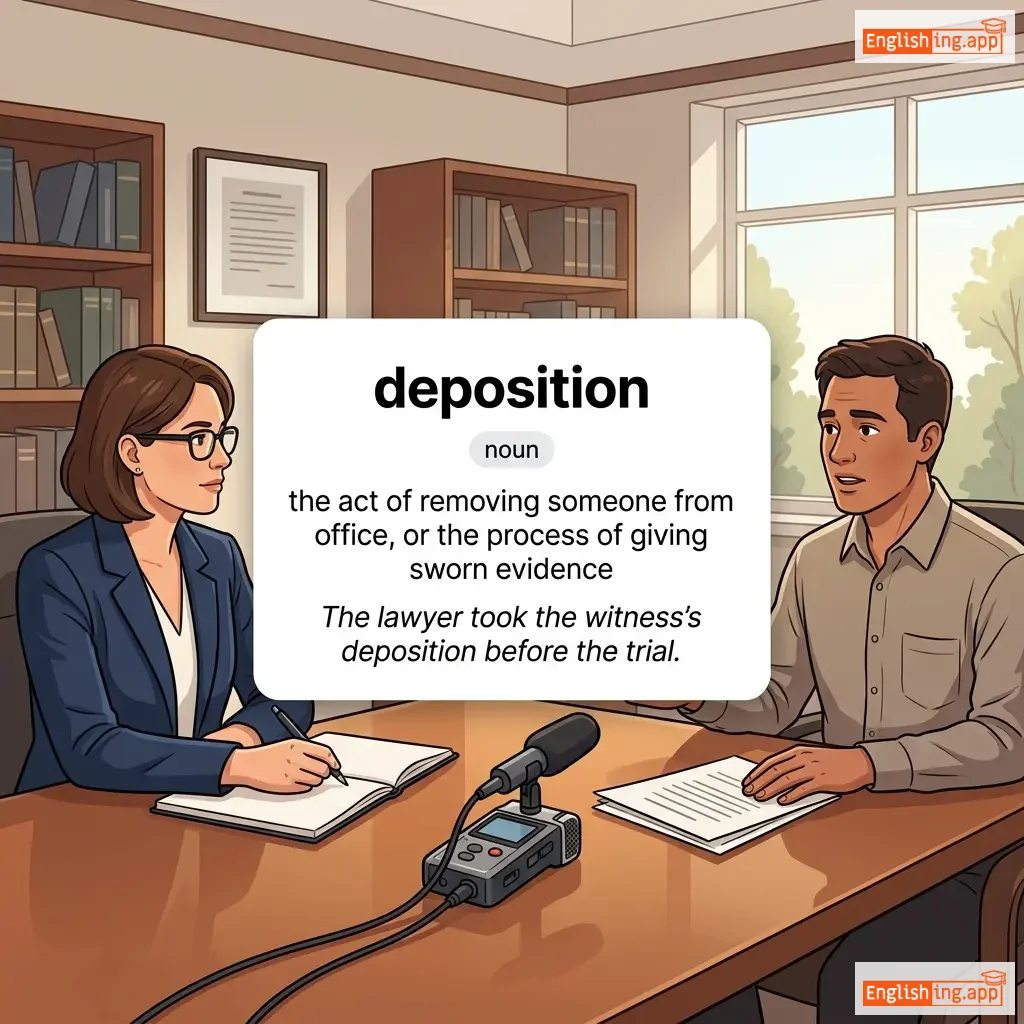
deposition definition card — visual illustration of the meaning
noun
/ˌdepəˈzɪʃən/
депозиция, заявление (depozitsiya, zayavleniye)

the act of removing someone from office, or the process of giving sworn evidence

"The lawyer took the witness’s deposition before the trial."

"Адвокат взял показания свидетеля до начала суда." (Advokat vzyal pokazanija svidetelya do nachala suda.)
noun
/dɪˈpɑːzɪtər/
вкладчик (vkladchik)

a person who places money in a bank or financial institution

"The bank provides insurance to protect depositors’ funds."

"Банк предоставляет страховку для защиты средств вкладчиков." (Bank predostavlyayet strakhovku dlya zashchity sredstv vkladchikov.)
noun
/dɪˈpɑːzətɔːri/
депозитарий, хранилище (depozitariy, khraniteli)

a place where things are stored or deposited, especially financial assets

"The national depository safeguards all government bonds."

"Национальный депозитарий защищает все государственные облигации." (Natsional'nyy depozitarij zashchishchayet vse gosudarstvennye obligatsii.)
verb
/dɪˈpreɪv/
развращать (razvraschayat)

to corrupt morally; to make someone immoral or wicked

"The novel was criticized for attempting to deprave the minds of young readers."

"Роман был раскритикован за попытку развратить умы молодых читателей." (Roman byl raskritikovann za popytku razvратить umy molodykh chitateley.)
adjective
/dɪˈpreɪvd/
развращенный (razvrashchyonny)

morally corrupt or wicked

"The film depicts the life of a depraved criminal."

"Фильм изображает жизнь развращенного преступника." (Film izobrazhaet zhizn' razvrashchennogo prestupnika.)
noun
/dɪˈprævɪti/
упадок нравственности (upadok nravstvennosti)

moral corruption; wickedness

"The film portrays the moral depravity of a corrupt society."

"Фильм изображает моральный упадок коррумпированного общества." (Film izobrazhaet moral'nyy upadok korrumpirovannogo obshchestva.)
verb
/ˈdɛprɪˌkeɪt/
осуждать (osuzhdat)

to express disapproval of something

"The teacher deprecated the use of slang in academic essays."

"Учитель осудил использование сленга в академических эссе." (Uchitel' osudil ispol'zovanie slenga v akademicheskikh esse.)
adjective
/ˈdɛprɪkətɔːri/
уничижительный (unichizhitel'nyy)

expressing disapproval or belittling

"He gave a deprecatory remark about their performance."

"Он сделал уничижительное замечание о их выступлении." (On sdelal unichizhitel'noye zamechaniye o ikh vystuplenii.)
verb
/dɪˈpriːʃieɪt/
обесценивать (obescenivat)

to reduce in value over time

"Cars tend to depreciate quickly in their first few years."
"Автомобили обычно быстро теряют свою стоимость в первые годы." (Avtomobili obychno bystro teryayut svoyu stoimost' v pervye gody.)
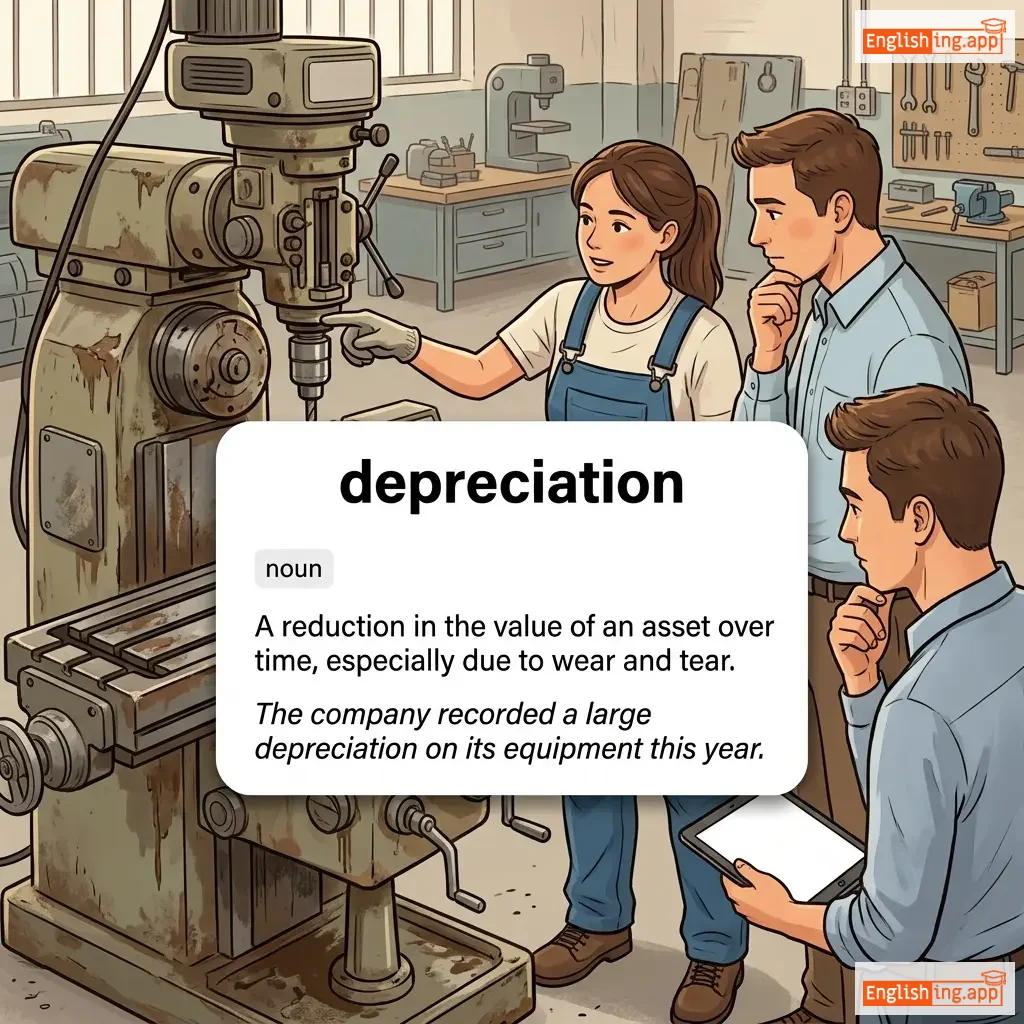
depreciation definition card — visual illustration of the meaning
noun
/dɪˌpriːʃiˈeɪʃən/
амортизация (amortizatsiya)

A reduction in the value of an asset over time, especially due to wear and tear.

"The company recorded a large depreciation on its equipment this year."

"Компания учла большую амортизацию на своем оборудовании в этом году." (Kompaniya uchla bol'shuyu amortizatsiyu na svoem oborudovanii v etom godu.)
noun
/ˌdɛprɪˈdeɪʃən/
разорение (razoerenie)

An act of attacking or plundering; damage caused by such acts.

"The villagers feared the depredation of wild animals at night."

"Жители деревни боялись разорения от диких животных ночью." (Zhiteli derevni boyalis' razoereniya ot dikikh zhivotnykh noch'yu.)
verb
/dɪˈprɛs/
депрессировать (depressirovat)

To make someone feel sad or without hope; to reduce the level or strength of something.

"The gloomy weather tends to depress people."

"Мрачная погода часто депрессирует людей." (Mrachnaya pogoda chasto depressiruet lyudey.)
noun
/dɪˈprɛsənt/
депрессант (depressant)

A drug that reduces functional or nervous activity in the body.

"Alcohol acts as a depressant on the central nervous system."

"Алкоголь действует как депрессант на центральную нервную систему." (Alkogol' deystvuet kak depressant na tsentral'nuyu nervnuyu sistemu.)
adjective
/dɪˈprɛst/
депрессия (depressiya)

Feeling very sad and without hope; in a state of unhappiness.

"She felt depressed after losing her job."

"Она чувствовала себя депрессивно после потери работы." (Ona chuvstvovala sebya depressivno posle poteri raboty.)
noun
/dɪˈprɛʃən/
депрессия (depressiya)

A state of severe sadness or hopelessness; also a prolonged downturn in economic activity.

"She has been battling depression for several months."
"Она борется с депрессией уже несколько месяцев." (Ona boretsya s depressiyey uzhe neskol'ko mesyatsev.)
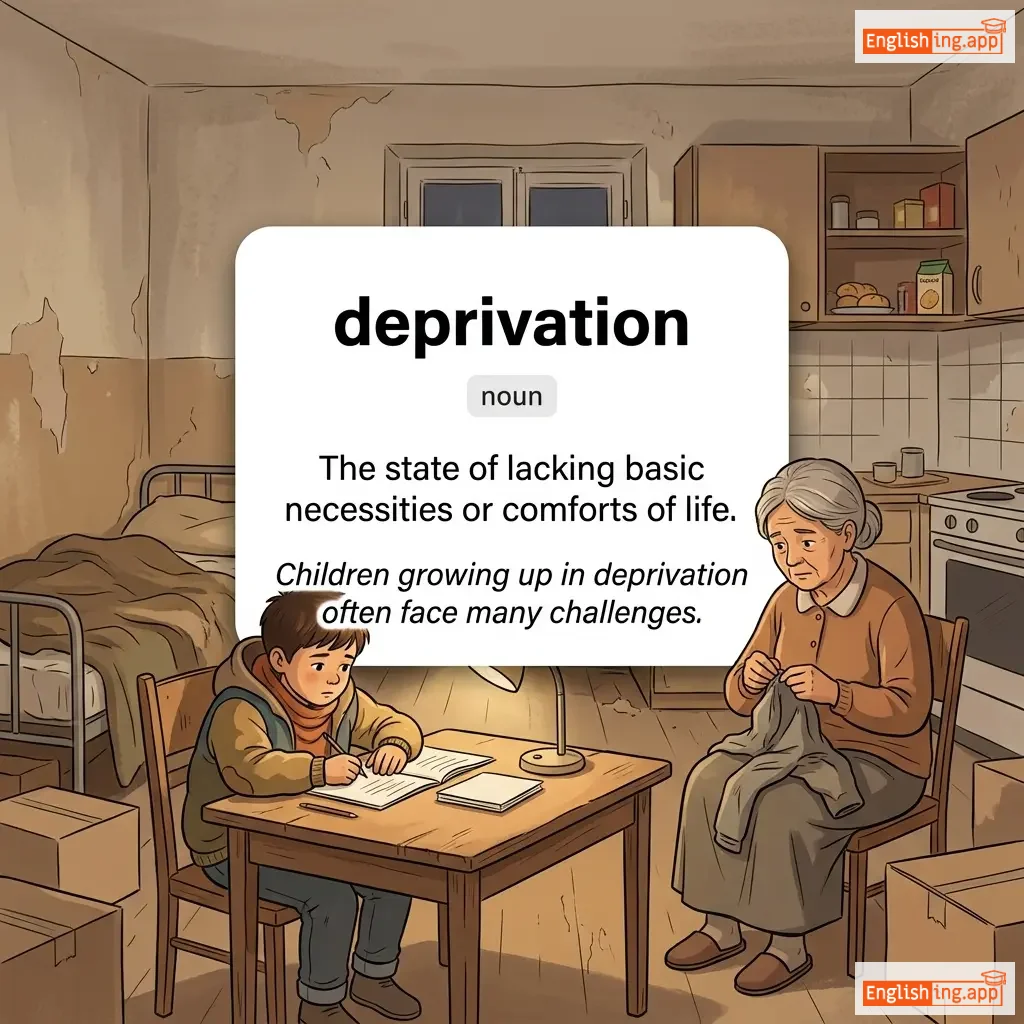
deprivation definition card — visual illustration of the meaning
noun
/ˌdɛprɪˈveɪʃən/
лишение (lishenie)

The state of lacking basic necessities or comforts of life.

"Children growing up in deprivation often face many challenges."

"Дети, растущие в лишении, часто сталкиваются с множеством трудностей." (Deti, rastushchie v lishenii, chasto stalkivayutsya s mnozhestvom trudnostey.)
verb
/dɪˈpraɪv/
лишать (leeshat)

to take something away from someone, or prevent them from having it

"The new law may deprive people of their rights."

"Новый закон может лишить людей их прав." (Novyy zakon mozhet lishit' lyudey ikh prav.)
noun
/dɛpθ/
глубина (glubina)

The distance from the top to the bottom of something; the intensity or complexity of a subject.

"The diver measured the depth of the ocean trench."

"Ныряльщик измерил глубину океанской впадины." (Nyrjalschik izmeril glubinu okeanskoy vpadyiny.)
verb
/ˈdɛpjʊˌtaɪz/
назначить помощником (naznachit pomoshchnikom)

To appoint someone as a deputy; to act as a substitute or representative.

"The sheriff decided to deputize several locals to help maintain order."

"Шериф решил назначить несколько местных жителей, чтобы помочь поддерживать порядок." (Sherif reshil naznachit neskol'ko mestnykh zhiteley, chtoby pomoch' podderzhivat' poryadok.)
noun
/ˈdɛpjʊti/
заместитель (zamestitel')

A person appointed as a substitute with power to act.

"The deputy will lead the meeting in the manager’s absence."

"Заместитель возглавит собрание в отсутствие менеджера." (Zamestitel' vozglavit sobranie v otsutstvie menedzhera.)
verb
/dɪˈræsɪˌneɪt/
вырывать с корнем (vyrivat' s kornem)

To uproot something completely; to displace people from their native environment or culture.

"The conflict deracinated many families from their homeland."

"Конфликт вырвал многие семьи из их родных мест." (Konflikt vyrval mnogie sem'i iz ikh rodnykh mest.)
adjective
/dɪˈreɪndʒd/
психопат (psikhopat)

mentally disturbed or insane; behaving irrationally

"The deranged man shouted nonsense in the street."
"Психопат кричал чепуху на улице." (Psikhopat krichal chepukhu na ulitse.)
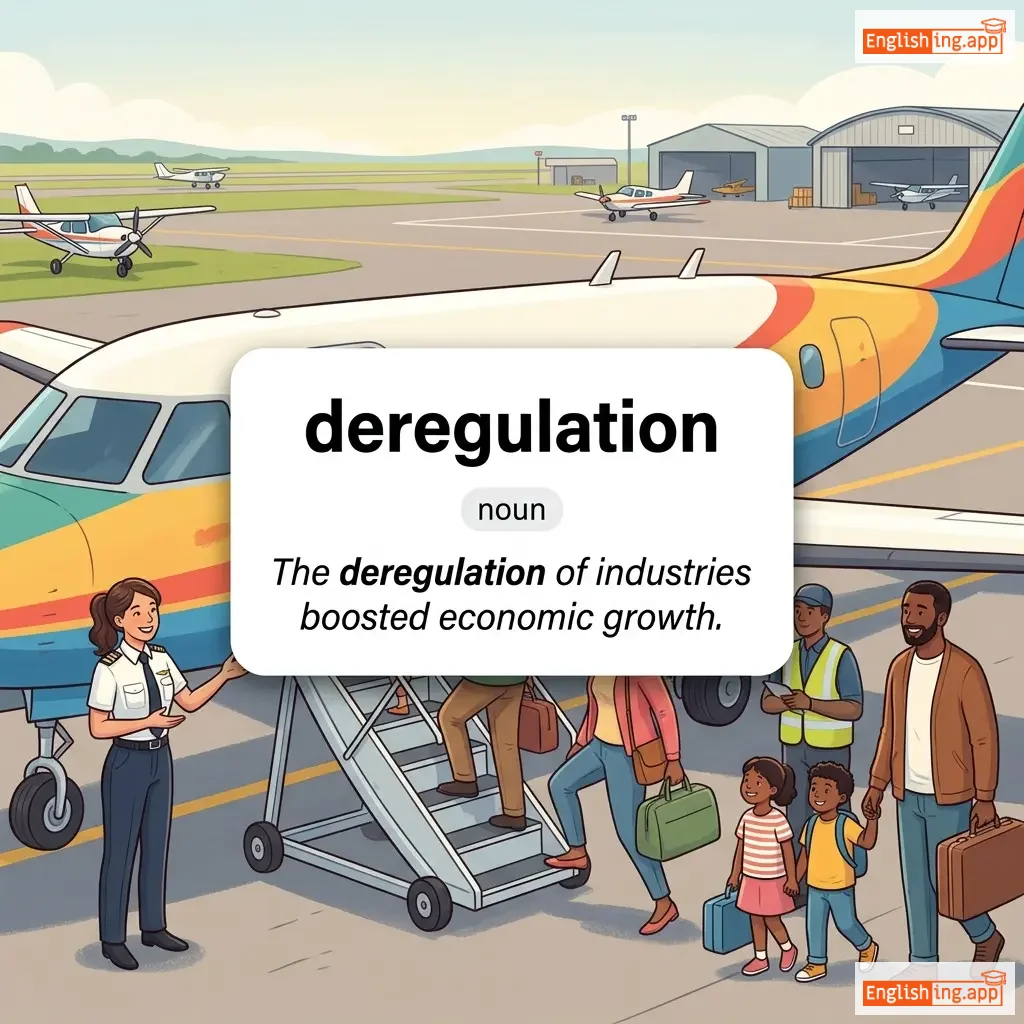
deregulation definition card — visual illustration of the meaning
noun
/ˌdiː.rɛɡ.jʊˈleɪ.ʃən/
дерегуляция (deregulyatsiya)

The removal or reduction of government regulations and controls, often involving liberalization, free market policies, or privatization.

"The deregulation of industries boosted economic growth."

"Дерегуляция промышленности способствовала экономическому росту." (Deregulyatsiya promyshlennosti sposobstvovala ekonomicheskomu rostu.)
adjective, noun
/ˈdɛrəlɪkt/
заброшенный (zabroshennyy)

in poor condition due to neglect or disuse; a homeless or neglected person

"The old factory stood derelict for decades."

"Старая фабрика стояла заброшенной десятилетиями." (Staryya fabrikа stoyalа zabroshennoy desyatiletyami.)
noun
/ˌdɛrɪˈlɪkʃən/
небрежность (nebrezhnost)

the state of being abandoned; neglect of duty

"The officer was charged with dereliction of duty."
"Офицера обвинили в нарушении долга." (Ofitsiera obvinili v narushenii dolga.)
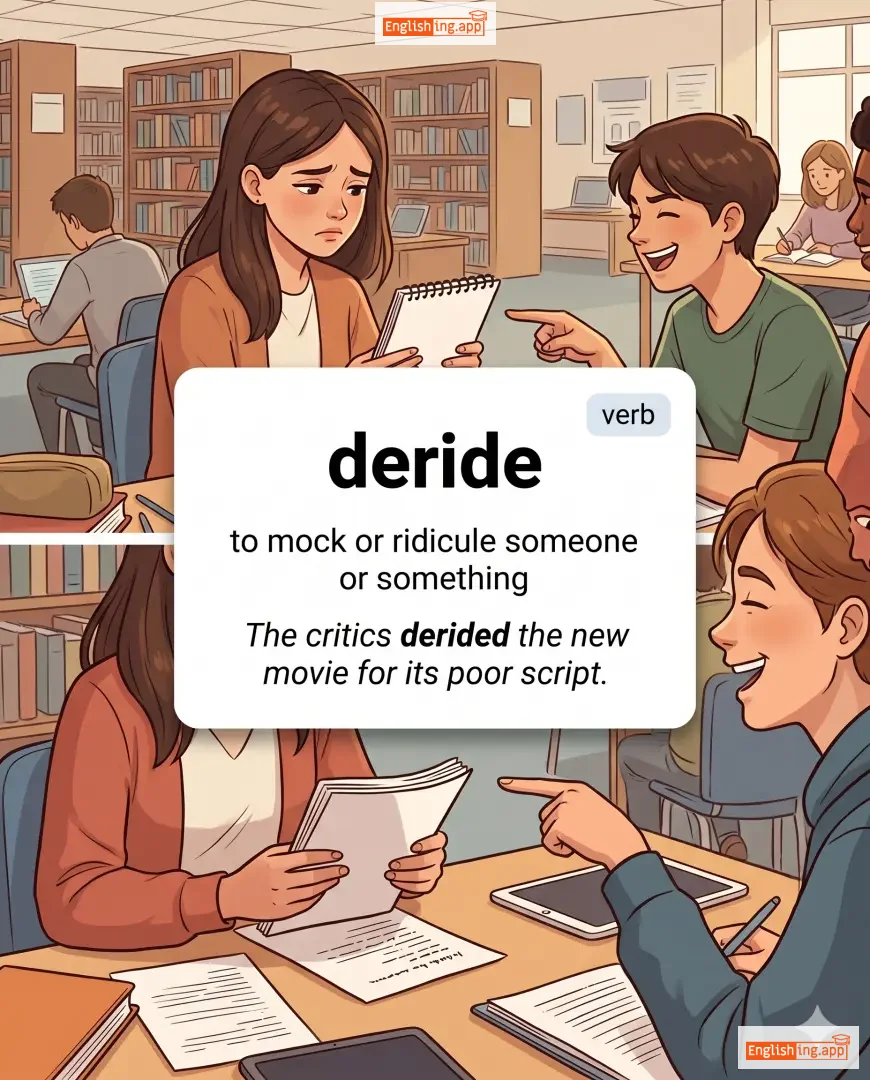
deride definition card — visual illustration of the meaning
verb
/dɪˈraɪd/
насмехаться (nasmehat'sya)

to mock or ridicule someone or something

"The critics derided the new movie for its poor script."

"Критики насмехались над новым фильмом за его плохой сценарий." (Kritiki nasmekhalis' nad novym filmom za ego plokhoy stsenariy.)
adjective
/dɪˈrɪzəbl/
достойный насмешки (dostoynyy nasmeshki)

deserving ridicule or mockery

"His excuse was so weak that it was plainly derisible."

"Его оправдание было настолько слабым, что оно явно достойно насмешки." (Ego opravdanie bylo nastol'ko slabym, chto ono yavno dostoyno nasmeshki.)
noun
/dɪˈrɪʒən/
презрение (prezrenie)

Contemptuous ridicule or mockery.

"His ideas were greeted with derision by the audience."

"Его идеи были встречены презрением аудиторией." (Yego idei byli vstrechены prezreniem auditoriey.)
adjective
/dɪˈraɪsɪv/
презрительный (prezritel'nyy)

Expressing contempt or ridicule.

"She gave a derisive laugh at his attempt to sing."

"Она издевательски засмеялась над его попыткой петь." (Ona izdevatelski zasmeyalas' nad yego popytkoy pet'.)
noun
/ˌdɛrɪˈveɪʃən/
происхождение (proiskhozhdeniye)

The origin or development of something from a source.

"The derivation of the word comes from Latin."
"Происхождение слова происходит от латинского." (Proiskhozhdeniye slova proiskhodit ot latinskogo.)
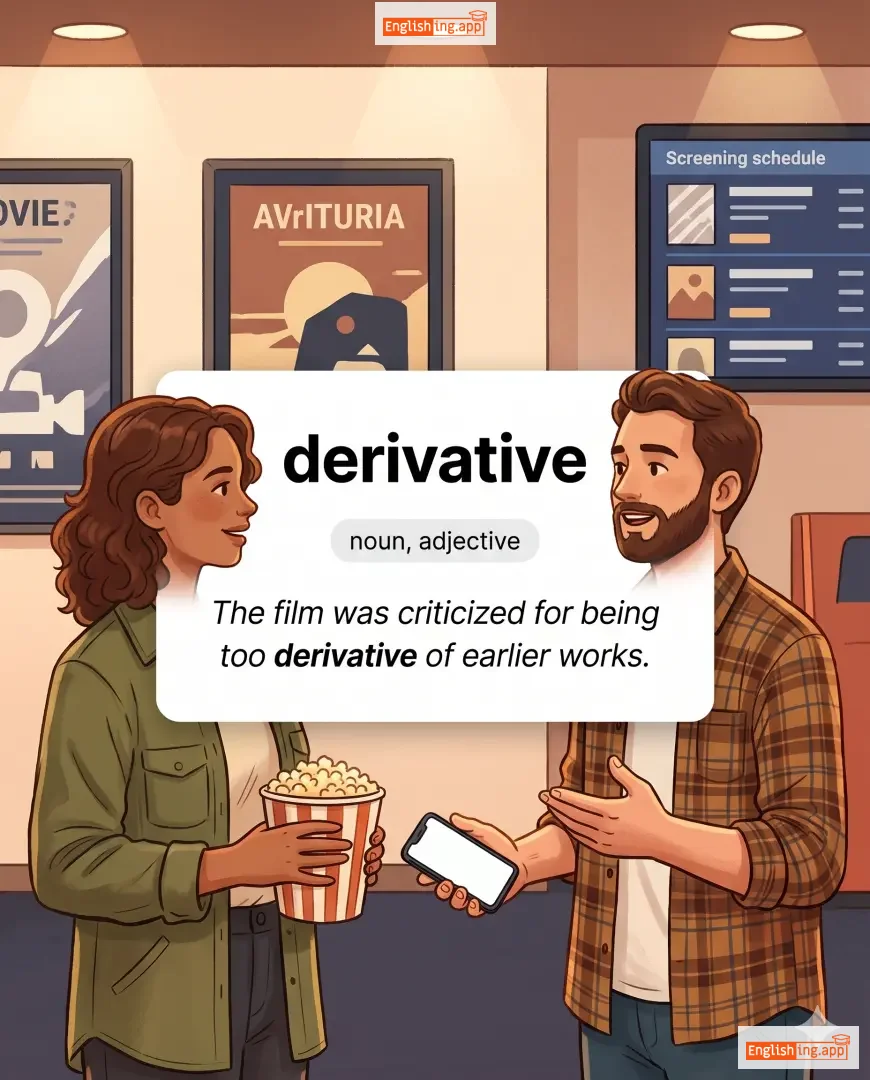
derivative definition card — visual illustration of the meaning
noun, adjective
/dɪˈrɪvətɪv/
дериватив (derivativ)

Something that is based on another source; in math, a measure of how a function changes.

"The film was criticized for being too derivative of earlier works."

"Фильм был раскритикован за слишком большое сходство с предыдущими работами." (Film byl raskritikovann za slishkom bol'shoe skhodstvo s predydushchimi rabotami.)
verb
/dɪˈraɪv/
получать (poluchat)

To obtain something from a source.

"Many English words derive from Latin."

"многие английские слова происходят от латинского." (mnogie angliiskie slova proiskhodyat ot latinskogo.)
adjective
/dɪˈraɪvd/
происходящий (proiskhodyashchiy)

Developed or obtained from something else; not original.

"The word is derived from Latin."

"Это слово происходит от латинского." (Eto slovo proiskhodit ot latinskogo.)
noun
/ˌdɜːrməˈtɑːlədʒɪst/
дерматолог (dermatolog)

A doctor who specializes in the treatment of skin diseases.

"She consulted a dermatologist for her skin allergy."

"Она проконсультировалась с дерматологом по поводу своей аллергии на кожу." (Ona prokonsul'tirovalas' s dermatologom po povodu svoej allergii na kozhu.)
noun
/ˌdɜːrməˈtɑːlədʒi/
дерматология (dermatologiya)

The branch of medicine concerned with the skin and its diseases.

"He studied dermatology at medical school."

"Он изучал дерматологию в медицинском университете." (On izuchal dermatologiyu v meditsinskom universitete.)
adjective
/dɪˈrɒɡətɪv/
уничижительный (unichizhitielnyy)

Expressing a low opinion or showing lack of respect.

"He made a derogative remark about her work."

"Он сделал уничижительное замечание о её работе." (On sdelal unichizhitiel'noye zamechaniye o yey rabotie.)
adjective
/dɪˈrɒɡətɔːri/
уничижительный (unichizhitelny)

Showing a critical or disrespectful attitude.

"The article contained derogatory comments about the politician."

"Статья содержала уничижительные комментарии о политике." (Stat'ya soderzhala unichizhitel'nyye kommentarii o politike.)
noun
/ˈdɛrɪk/
буровая вышка (burovaya vyshka)

A framework or tower used for supporting a crane, especially for oil drilling or lifting heavy loads.

"The workers assembled a derrick at the oil drilling site."

"Рабочие собрали буровую вышку на нефтяной буровой площадке." (Rabotchiye sobrali burovuyu vyshku na neftyanoi burovoy ploshchadke.)