Словари

Словарь английского языка | Значения слов, определения и примеры

adjective
/dɪˈstrɔːt/
расстроенный (rasstroennyy)

extremely upset and anxious, often to the point of being unable to think clearly

"She was distraught after losing her pet."

"Она была расстроена после потери своего питомца." (Ona byla rasstroena posle poteri svoego pitomtsa.)
noun
/dɪsˈtrɛs/
стресс (stress)

extreme anxiety, sorrow, or pain

"He felt a deep sense of distress when he heard the bad news."

"Он почувствовал глубокий стресс, когда услышал плохие новости." (On pochuvstvoval glubokiy stress, kogda uslyshal plokhiye novosti.)
adjective
/dɪˈstrɛst/
стрессированный (stressirovannyy)

feeling or showing extreme anxiety, sorrow, or pain

"She looked distressed after hearing the bad news."
"Она выглядела стрессированной после того, как услышала плохие новости." (Ona vyglyadela stressirovannoy posle togo, kak uslyshala plokhie novosti.)
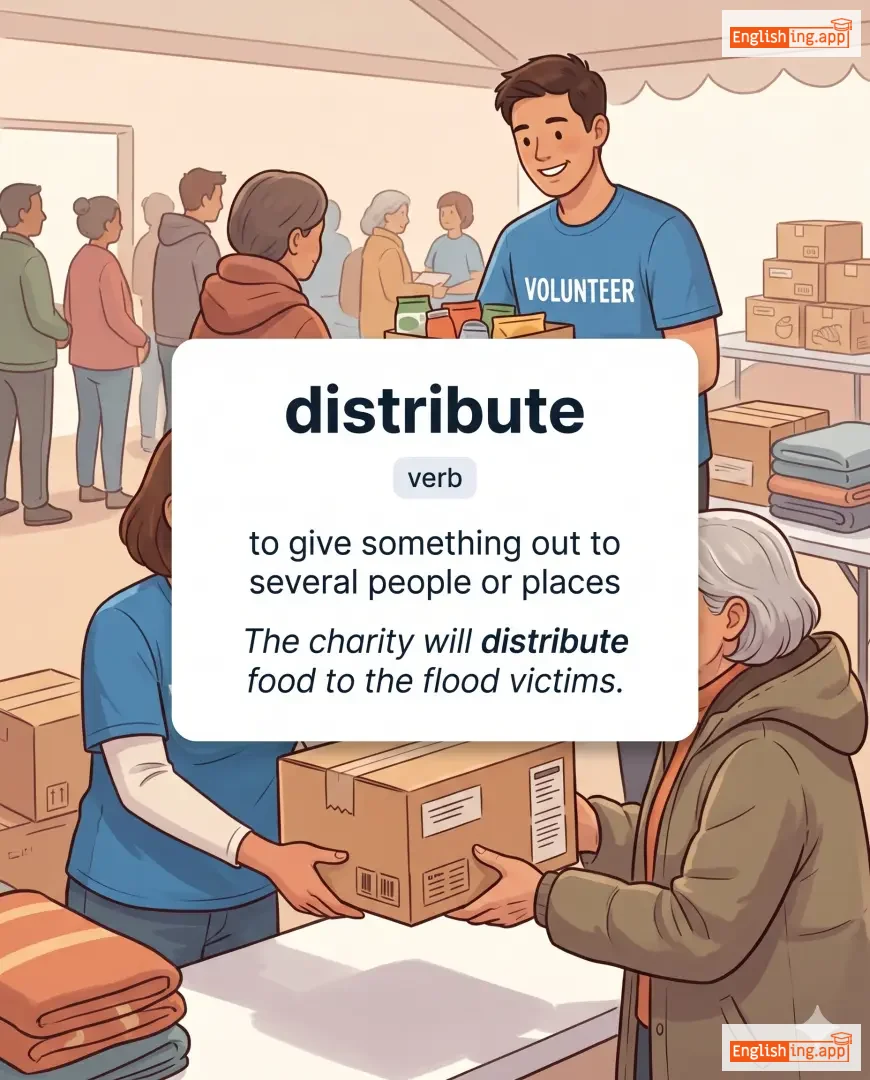
distribute definition card — visual illustration of the meaning
verb
/dɪˈstrɪbjuːt/
распределять (raspredelyat')

to give something out to several people or places

"The charity will distribute food to the flood victims."

"Благотворительная организация распределит продукты среди пострадавших от наводнения." (Blagotvoritelnaya organizatsiya raspredelit produkty sredi postradavshikh ot navodneniya.)
noun
/ˌdɪstrɪˈbjuːʃən/
распределение (raspredelenie)

the act of sharing or delivering something to multiple people or places

"The company manages the distribution of food supplies to rural areas."

"Компания управляет распределением продуктов питания в сельские районы." (Kompaniya upravlyaet raspredeleniem produktov pitaniya v selskiye rayony.)
noun
/ˈdɪstrɪkt/
район (rayon)

a specific area of a country, city, or town, often with official boundaries

"She lives in the northern district of the city."

"Она живет в северном районе города." (Ona zhivyot v severnom rayone goroda.)
verb
/dɪsˈtrʌst/
не доверять (ne doveriat)

to have no confidence or trust in someone or something

"Many people distrust politicians."

"Многие люди не доверяют политикам." (Mnogie lyudi ne doveryayut politikam.)
verb
/dɪsˈtɜːb/
мешать (meshchat)

to interrupt or cause someone to stop what they are doing

"Please don’t disturb me while I’m studying."

"Пожалуйста, не мешайте мне, пока я учусь." (Pozhaluysta, ne meshayte mne, poka ya uchus'.)
noun
/dɪˈstɜː.bəns/
нарушение; беспокойство; беспорядок (narushenie; bespokoystvo; besporyadok)

the interruption of a settled and peaceful condition; anxiety or mental uneasiness

"The loud music created a disturbance that bothered all the neighbors."

"Громкая музыка вызвала нарушение, которое беспокоило всех соседей." (Gromkaya muzyka vyzvala narushenie, kotoroye bespokoilo vsekh sosedey.)
adjective
/dɪˈstɜː.bɪŋ/
тревожный (trevozhny)

causing anxiety, worry, or emotional distress

"The news about the accident was deeply disturbing."

"Новости о происшествии были глубоко тревожными." (Novosti o proisshestvii byli gluboko trevozhnymi.)
noun
/dɪsˈjuːnjən/
раскол (raskol)

the state of being separated or not united

"Civil wars often result from national disunion."

"Гражданские войны часто происходят из-за национального раскола." (Grazhdanskie voiny chasto proiskhodyat iz-za natsional'nogo raskola.)
noun
/ˈdaɪˌsɪləbəl/
двусложное слово (dvuslozhnoe slovo)

a word consisting of two syllables

"The word 'happy' is a disyllable."

"Слово ‚счастье‘ — это двусложное слово." (Slovo 'schast'ye' — eto dvuslozhnoe slovo.)
verb
/ˈdɪðər/
колебаться (kolebat'sya)

to be indecisive or unable to make a decision

"He dithered for hours before choosing a restaurant."

"Он колебался часами, прежде чем выбрать ресторан." (On kolebalsya chasami, prezhde chem vybrat' restoran.)
noun
/ˈdɪti/
короткая песня (korotkaya pesnya)

a short, simple song or poem

"She sang a cheerful little ditty while cooking."

"Она пела веселую короткую песню, готовя еду." (Ona pela veselyu korotkuyu pesnyu, gotovya yedu.)
diuretic definition card — visual illustration of the meaning
noun
/ˌdaɪ.jʊˈret.ɪk/
диуретик (diuretik)

A substance that promotes the production of urine.

"Coffee has a mild diuretic effect."

"Кофе имеет легкий диуретический эффект." (Kofe imeet legkiy diureticheskiy effekt.)
adjective
/daɪˈɜːrnəl/
дневной (dnevnoi)

active during the day; occurring daily

"Most birds are diurnal creatures, active in daylight hours."

"Большинство птиц — дневные существа, активные в дневные часы." (Bol'shinstvo ptic — dnevnye sushchestva, aktivnye v dnevnye chasy.)
noun
/ˈdiːvə/
известная певица (izvestnaya pevitsa)

a famous female singer; a woman who is admired or behaves like a star

"The pop diva performed her latest hit to a cheering crowd."

"Поп-дива исполнила свой последний хит перед аплодирующей толпой." (Pop-diva ispolnila svoy posledniy khit pered aplodiruyushchey tolpoy.)
noun
/ˌdaɪvəˈɡeɪʃən/
отклонение (otklonenie)

digression; wandering from a path or subject

"His lecture was full of divagation, making it hard to follow the main point."

"Его лекция была полна отклонений, что затрудняло следование за основной мыслью." (Ego lektsiya byla polna otkloneniy, chto zatrudnyalo sleduyushchego za osnovnoy myslyu.)
verb
/daɪv/
нырять (nyryat)

to plunge headfirst into water or another substance

"He decided to dive into the pool on a hot day."

"Он решил нырнуть в бассейн в жаркий день." (On reshil nyrnut' v basseyn v zharkiy den'.)
noun
/ˈdaɪ.vər/
нырок (nyrok)

a type of water bird that dives underwater to catch fish

"The diver disappeared beneath the surface to catch a fish."

"Нырок исчез под поверхностью, чтобы поймать рыбу." (Nyrok ischez pod poverkhnost'yu, chtoby poymat' rybu.)
diverge definition card — visual illustration of the meaning
↔️

diverge

verb
/daɪˈvɜːrdʒ/

to separate from a path, opinion, or standard

"The two friends began to diverge in their career choices."
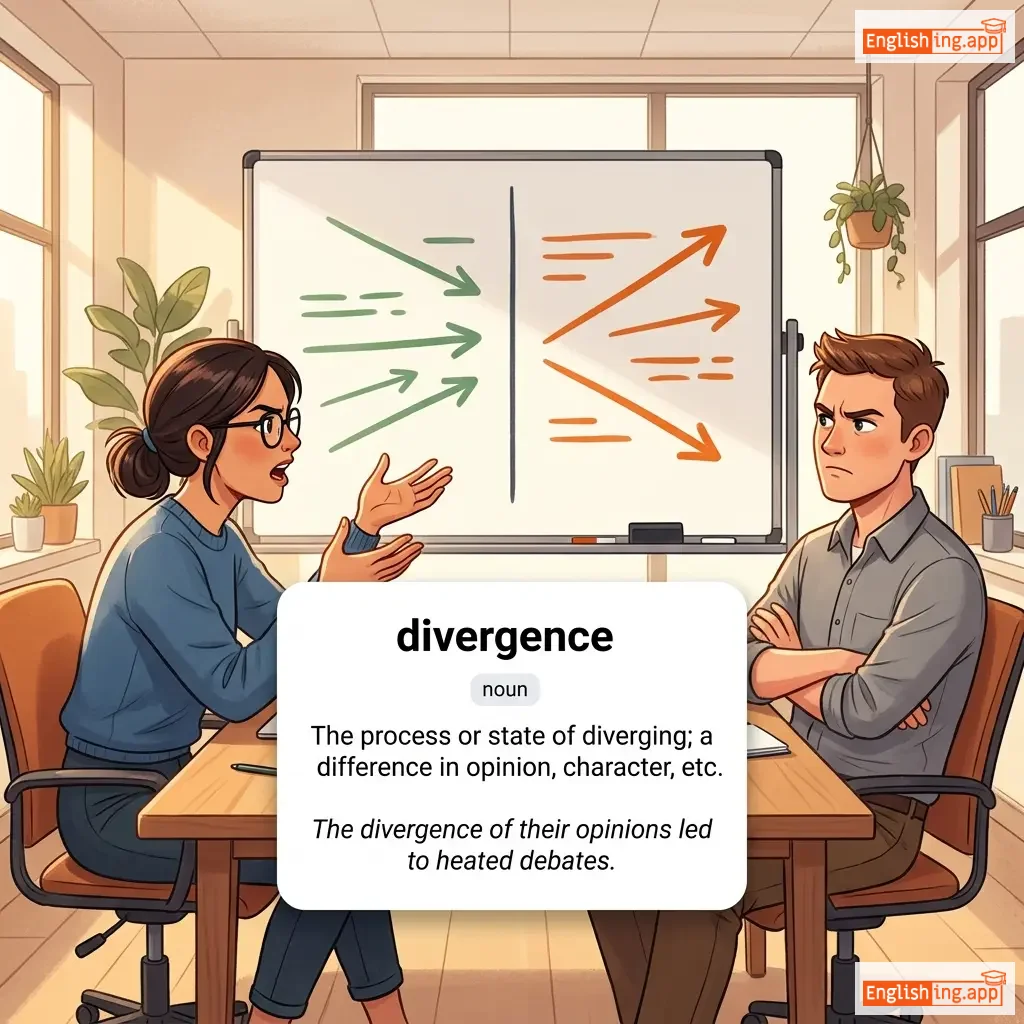
divergence definition card — visual illustration of the meaning
noun
daɪˈvɜː.dʒəns
дивергенция (divergentsiya)

The process or state of diverging; a difference in opinion, character, etc.

"The divergence of their opinions led to heated debates."
"Дивергенция их мнений привела к жарким дебатам." (Divergentsiya ikh mneniy privela k zharkim debatam.)
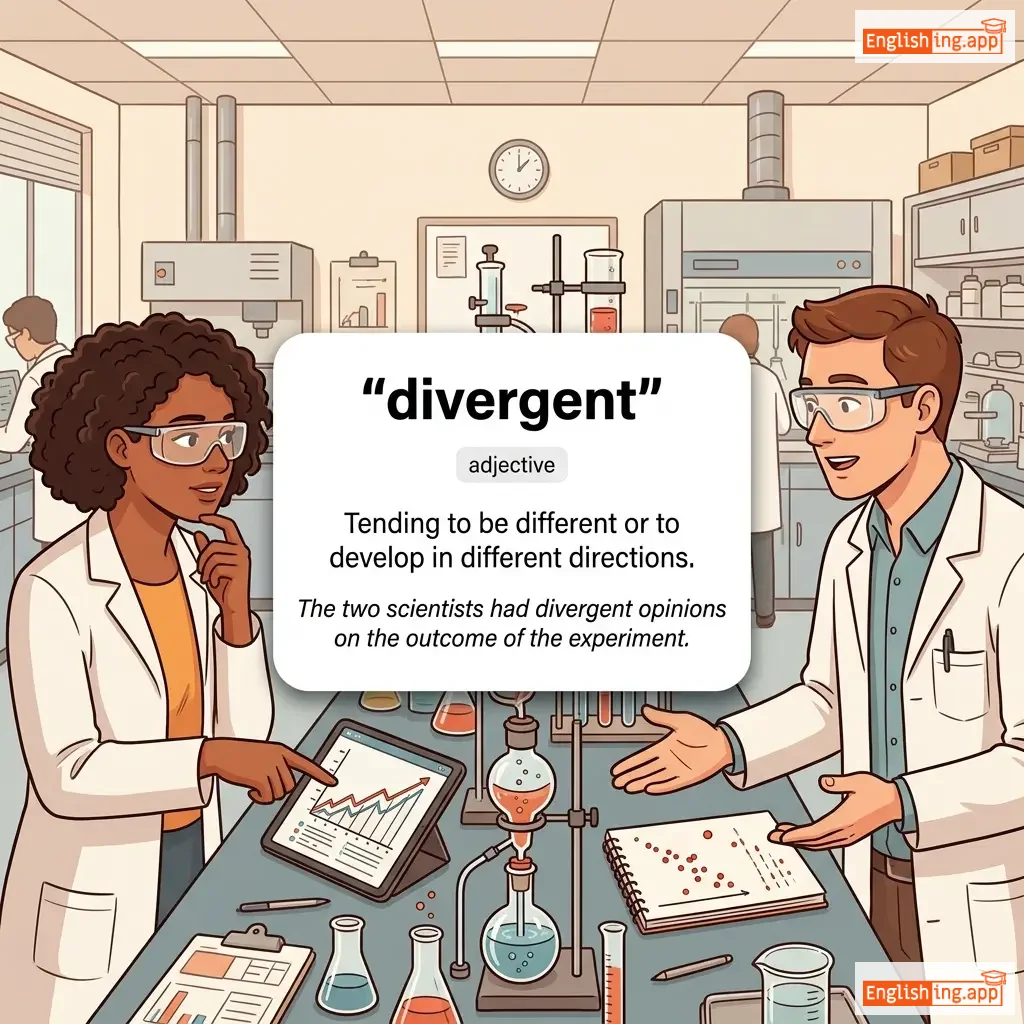
divergent definition card — visual illustration of the meaning
adjective
/daɪˈvɜːrdʒənt/
дивергентный (divergentny)

Tending to be different or to develop in different directions.

"The two scientists had divergent opinions on the outcome of the experiment."
"У двух ученых были разные мнения по поводу результата эксперимента." (U dvukh uchenykh byli raznye mneniya po povodu rezul'tata eksperimenta.)
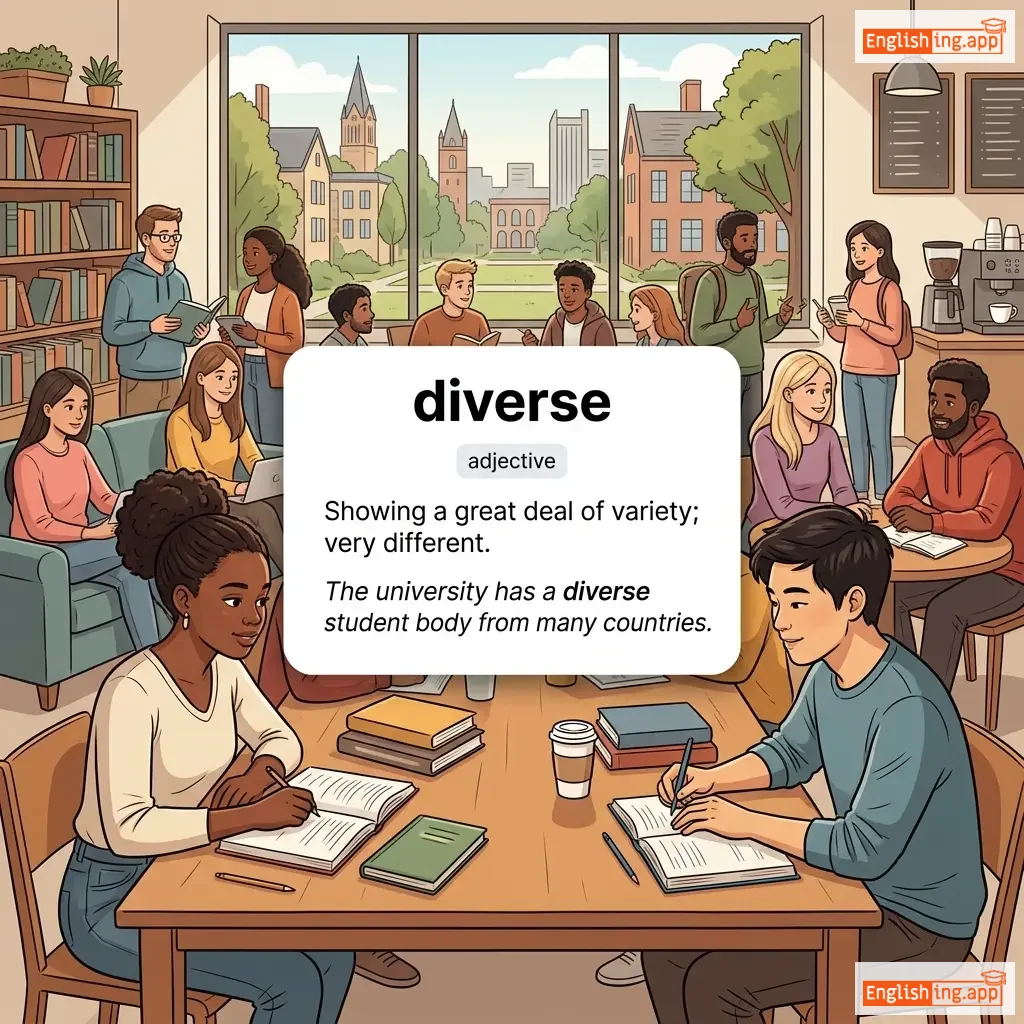
diverse definition card — visual illustration of the meaning
adjective
/daɪˈvɜːrs/
разнообразный (raznoobraznyj)

Showing a great deal of variety; very different.

"The university has a diverse student body from many countries."
"Университет имеет разнообразный студенческий корпус из многих стран." (Universitet imeyet raznoobraznyj studencheskij korpus iz mnogikh stran.)
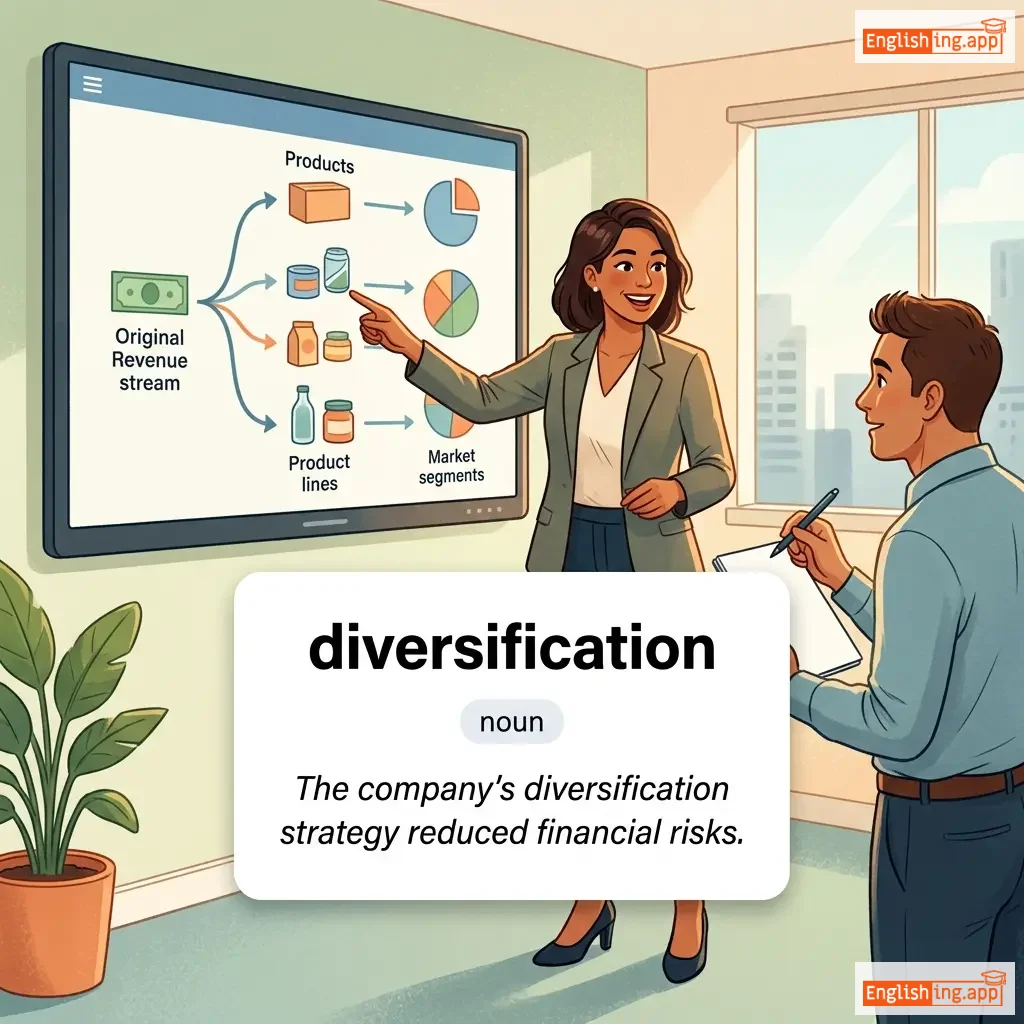
diversification definition card — visual illustration of the meaning
noun
/daɪˌvɜː.sɪ.fɪˈkeɪ.ʃən/
диверсификация (diversifikatsiya)

The process of a business expanding into different product lines or markets to spread risk and reduce dependence on a single source of income.

"The company's diversification strategy reduced financial risks."

"Стратегия диверсификации компании снизила финансовые риски." (Strategiya diversifikatsii kompanii snizila finansovye riski.)
adjective
/daɪˈvɜːrsɪfaɪd/
диверсифицированный (diversifitsirovanny)

Made or having variety in form, nature, or content.

"The company adopted a diversified business strategy to reduce risks."

"Компания приняла диверсифицированную бизнес-стратегию для снижения рисков." (Kompaniya prinila diversifitsirovannuyu biznes-strategiyu dlya snizheniya riskov.)
noun
/daɪˈvɜːrʒən/
объезд (diversion)

The act of changing direction or being distracted; an activity that entertains.

"The road was closed, so we had to take a diversion through the village."

"Дорога была закрыта, поэтому нам пришлось сделать объезд через деревню." (Doroga byla zakryta, poetomu nam prishlos sdelat obyed cherez derevnyu.)
diversity definition card — visual illustration of the meaning
noun
/daɪˈvɜːrsəti/
разнообразие (raznoobrazie)

A range of different things or people; variety.

"Workplace diversity helps foster innovation and creativity."

"Разнообразие на рабочем месте способствует инновациям и креативности." (Raznoobrazie na rabochem meste sposobstvuet innovatsiyam i kreativity.)
↪️

divert

verb
/daɪˈvɜːrt/

to turn aside from a course; to redirect or entertain

"The police diverted traffic to a side road."

adjective
/daɪˈvɜːrtɪbəl/
перенаправляемый (perenapravlyaemyy)

capable of being turned aside or redirected

"Funds from the budget are not legally divertible."

"Средства из бюджета не могут быть законно перенаправлены." (Sredstva iz byudzheta ne mogut byt' zakonno perenapravleny.)
divest definition card — visual illustration of the meaning
verb
/daɪˈvɛst/

to strip away possessions, rights, or assets; to rid oneself of

"The company decided to divest its unprofitable division."

noun
/daɪˈvɛstɪtʃər/
дезинвестиция (dezinvestitsiya)

the action of selling off or disposing of business interests or assets

"The divestiture of the subsidiary was completed last year."
"Дезинвестиция дочерней компании была завершена в прошлом году." (Dezinvestitsiya dacherskoy kompanii byla zavershena v proshlom godu.)
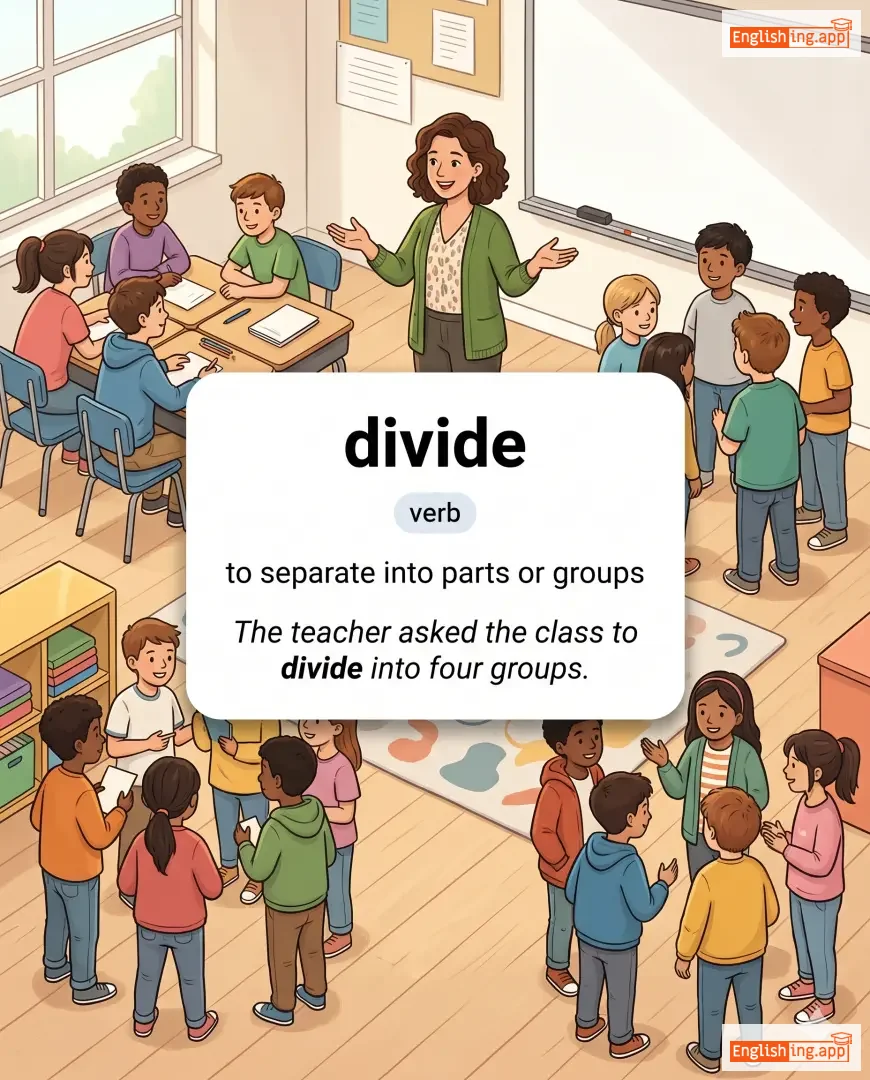
divide definition card — visual illustration of the meaning
verb
/dɪˈvaɪd/
делить (delit)

to separate into parts or groups

"The teacher asked the class to divide into four groups."

"Учитель попросил класс разделиться на четыре группы." (Uchitel' poprosil klass razdelit'sya na chetyre gruppy.)
noun
/ˌdɪvɪˈneɪʃən/
гадание (gadanije)

the practice of seeking knowledge of the future or the unknown by supernatural means

"Ancient people often relied on divination to guide important decisions."

"Древние люди часто полагались на гадание для принятия важных решений." (Drevnie lyudi chasto polagalís' na gadanie dlya prinyatiya vazhnykh reshenij.)
adjective, verb
/dɪˈvaɪn/
божественный (bozhestvennyy)

Relating to God or a deity; exceptionally wonderful or pleasing; to discover or foresee by intuition or supernatural means.

"She believed the divine power guided her actions."

"Она верила, что божественная сила направляла её действия." (Ona verila, chto bozhesvtennaya sila napravyala yeye deystviya.)
noun
/dɪˈvɪnɪti/
божественность (bozhestvennost)

The quality or state of being divine; a deity.

"The priest spoke about the divinity of the soul."

"Священник говорил о божественности души." (Svyashchennik govoril o bozestvennosti dushi.)
adjective
/dɪˈvɪzəbl/
делимый (delimyj)

Capable of being divided by another number without leaving a remainder.

"Twelve is divisible by three and four."

"Двенадцать делится на три и четыре." (Dvenadtsat' delitsya na tri i chetyre.)
noun
/dɪˈvɪʒən/
подразделение (podrazdelenie)

the action of separating something into parts; or a large administrative unit

"The company has a separate division for research and development."

"У компании есть отдельное подразделение для исследований и разработок." (U kompanii yest' otdel'noe podrazdelenie dlya issledovaniy i razrabotok.)
noun
/dɪˈvaɪzər/
делитель (delitel)

A number by which another number is divided.

"In the equation 12 ÷ 3, the number 3 is the divisor."

"В уравнении 12 ÷ 3, число 3 является делителем." (V uravnenii 12 ÷ 3, chislo 3 yavyayetsya delitelem.)
noun/verb
/dɪˈvɔːrs/
развод (razvod)

the legal ending of a marriage; to officially end a marriage

"After years of conflict, they decided to get a divorce."

"После лет конфликтов они решили развестись." (Posle let konfliktov oni reshilì razvéstis'.)
adjective
/dɪˈvɔːrst/
разведенный (razvedennyy)

No longer married because the marriage has been legally dissolved.

"She has been divorced for five years."
"Она разведена уже пять лет." (Ona razvedena uzhe pyat' let.)
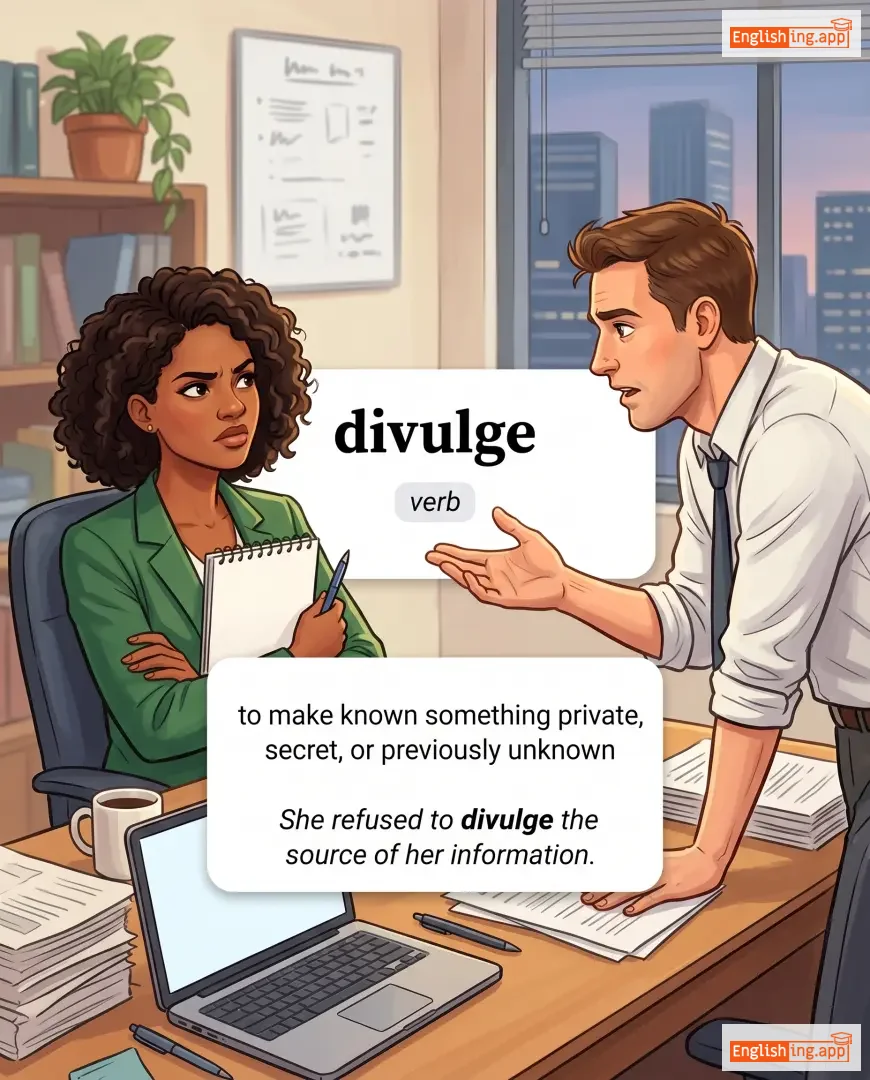
divulge definition card — visual illustration of the meaning
verb
/daɪˈvʌldʒ/
раскрыть (raskryt)

to make known something private, secret, or previously unknown

"She refused to divulge the source of her information."

"Она отказалась раскрыть источник своей информации." (Ona otkazalas raskryt istochnik svoey informatsii.)
noun
/daɪˈvʌldʒəns/
разглашение (razglashenie)

the act of revealing or disclosing something secret or private

"The divulgence of company secrets caused a major scandal."

"Разглашение корпоративных тайн вызвало большой скандал." (Razglashenie korporativnykh tayn vyzvalo bol'shoy skandal.)
noun
/ˌdiː.enˈeɪ/
Дезоксирибонуклеиновая кислота (DNA)

Deoxyribonucleic acid, the molecule that carries genetic information in living organisms.

"Scientists extracted DNA from the ancient bones."

"Ученые извлекли ДНК из древних костей." (Uchyonye izvlekli DNA iz drevnikh kostey.)
verb
/duː/
делать (delat')

To perform an action, task, or activity.

"I need to do my homework before dinner."

"Мне нужно сделать домашку до ужина." (Mne nuzhno sdelat' domashku do uzhina.)
adjective
/ˈdɑːsəl/ or /ˈdəʊsaɪl/
послушный (poslushny)

easily managed, taught, or controlled; submissive

"The docile puppy quickly learned new tricks."

"Послушный щенок быстро научился новым трюкам." (Poslushny shchenok bystro nauchilsya novym tryukam.)
noun
/dɒk/
пристань (pristan')

a structure where ships are loaded, unloaded, or repaired

"The ship stayed at the dock for two days."

"Корабль оставался на пристани два дня." (Korabl' ostavalsya na pristani dva dnya.)
noun
/ˈdɒkɪt/
список (spisok)

a list or schedule of cases to be tried in a court or items to be done

"The judge reviewed the docket before starting the session."

"Судья просмотрел список до начала заседания." (Sud'ya prosmotreli spisok do nachala zasedaniya.)
doctor definition card — visual illustration of the meaning
noun
/ˈdɒktər/
врач (vrach)

A qualified medical professional who treats illnesses and injuries.

"The doctor prescribed medicine for the patient."

"Доктор прописал лекарства для пациента." (Doktor propisal lekarstva dlya patsiyenta.)
doctrinaire definition card — visual illustration of the meaning
adjective
/ˌdɒktrɪˈnɛər/
догматичный (dogmatichny)

stubbornly devoted to a theory or doctrine without regard to practical considerations

"His doctrinaire approach to politics alienated many supporters."

"Его догматичный подход к политике оттолкнул многих сторонников." (Ego dogmatichny podkhod k politike ottolknul mnogikh storonnikov.)