Словари

Словарь английского языка | Значения слов, определения и примеры

noun
/sɛnˈtjʊəriən/
центурион (centurion)

A commander of a unit of one hundred soldiers in the ancient Roman army.

"The centurion led his men into battle with courage."

"Центурион вел своих солдат в бой с храбростью." (Centurion vel svoikh soldat v boy s khrabrost'yu.)
noun
/ˈsɛnʧəri/
век (vek)

A period of one hundred years.

"The 20th century saw significant technological progress."

"20-й век стал временем значительных технологических достижений." (20-y vek stal vremenem znachitel'nykh tekhnologicheskikh dostizheniy.)
noun
/ˌsiːiːˈoʊ/
генеральный директор (generalnyy direktor)

The highest-ranking person in a company, responsible for overall management.

"The CEO announced a new strategy for the company."

"Генеральный директор объявил новую стратегию для компании." (General'nyy direktor obyavil novuyu strategiyu dlya kompanii.)
noun
/ˈsɪə.ri.əl/

a common breakfast food made from processed grains such as wheat, oats, or corn

"She eats a bowl of cereal every morning before work."

cerebral definition card — visual illustration of the meaning
adjective
/səˈriː.brəl/
церебральный (tse-re-bral'nyy)

relating to the brain or intellect; intellectual rather than emotional

"He is known for his cerebral approach to problem-solving."

"Он известен своим церебральным подходом к решению проблем." (On izvesten svoim tseryebral'nym podkhodom k resheniyu problem.)
noun
/ˌser.əˈbreɪ.ʃən/
церебрация (tserebratsiya)

the process of thinking or using the brain actively

"The lecture sparked intense cerebration among the students."

"Лекция вызвала интенсивную церебрацию среди студентов." (Lektsiya vyzvala intensivnuyu tserebratsiyu sredi studentov.)
adjective
/ˌser.ɪˈməʊ.ni.əl/
церемониальный (tseremonial'nyy)

relating to or used in a ceremony or formal occasion

"The president wore a ceremonial robe during the inauguration."

"Президент носил церемониальную одежду во время инаугурации." (Prezident nosil tseremoniyal'nuyu odezhdu vo vremya inaguratsii.)
adjective
/ˌser.ɪˈməʊ.ni.əs/
церемониальный и вежливый (tseremonialnyy i vezhlivyy)

marked by formality, politeness, or strict observance of customs

"He gave her a ceremonious bow before entering the hall."

"Он сделал церемониальный поклон перед тем, как войти в зал." (On sdelal tseremonial'nyy poklon pered tem, kak voiti v zal.)
noun
/ˈsɛrəˌmoʊni/

A formal event or occasion, often with rituals and traditions.

"The graduation ceremony was held in the university hall."

adjective
/ˈsɜːr.tən/
уверенный (uverennyy)

Known for sure; having no doubt.

"I am certain that she will succeed."

"Я уверен, что она добьётся успеха." (ya uveren chto ona dob'yotsya uspeha.)
adverb
/ˈsɜːrtənli/
определенно (opredelenno)

without doubt; surely; used to emphasize certainty

"I will certainly help you with your project."

"Я обязательно помогу тебе с твоим проектом." (Ya obazatel'no pomogu tebe s tvoyim proyektom.)
noun
/ˈsɜːtənti/
уверенность (uverennost)

the state of being sure or confident about something

"There is no certainty about the weather tomorrow."

"Нет уверенности в завтрашней погоде." (Net uverennosti v zavtrashney pogode.)
noun
/sərˈtɪfɪkət/
сертификат (sertifikat)

a document serving as proof of achievement or qualification

"She received a certificate for completing the course."

"Она получила сертификат за завершение курса." (Ona poluchila sertifikat za zavershenie kursa.)
noun
/ˌsɜːrtɪfɪˈkeɪʃən/
сертификация (sertifikatsiya)

the process of officially recognizing or confirming that something or someone meets required standards; an official document proving qualification

"She received her professional certification after completing the training program."

"Она получила профессиональную сертификацию после завершения учебной программы." (ona poluchila professionalnuyu sertifikatsiyu posle zaversheniya uchebnoi programmy)
noun
/ˈsɜːrtɪˌtjuːd/
уверенность (uverennost)

Absolute certainty or conviction about something.

"She spoke with certitude about the outcome of the case."

"Она говорила с уверенностью о результате дела." (Ona govorila s uverennost'yu o rezul'tate dela.)
noun
/sɛˈseɪʃən/
прекращение (prekrashchenie)

The fact or process of ending or being brought to an end.

"There was a temporary cessation of hostilities."

"Было временное прекращение враждебных действий." (Bylo vremennoye prekrashcheniye vrazhdebnykh deystviy.)
noun
/ˈsɛʃən/
передача прав или собственности (peredacha prav ili sobstvennosti)

The formal giving up of rights, property, or territory, especially by a state.

"The treaty resulted in the cession of land to the neighboring country."

"Договор привел к передаче земли соседней стране." (Dogovor privel k peredache zemli sosedney strane.)
noun
/ˈsɛtərə/
и так далее (i tak dalee)

Latin for 'the rest' or 'others'; commonly used in the phrase 'et cetera' meaning 'and so on'.

"We need to buy pens, paper, notebooks, et cetera."

"Нам нужно купить ручки, бумагу, тетради, и так далее." (Nam nuzhno kupit' ruchki, bumagu, tetradi, i tak dalee.)
😣

chafe

verb
/ʧeɪf/

To make or become sore by rubbing; to feel irritation or impatience.

"The tight shoes began to chafe his heels."

noun
/tʃæf/
шелуха (shelukha)

The husks of corn or other seed separated by winnowing or threshing; worthless or trivial matter.

"The farmer separated the wheat from the chaff."

"Фермер отделил пшеницу от шелухи." (Fermyer otdelil pshenytsu ot shelukhi.)
verb
/ˈtʃæfɪŋ/
подшучивать (podshuchivat)

Teasing or joking in a lighthearted way.

"They were chaffing each other during lunch."

"Они подшучивали друг над другом во время обеда." (Oni podshuchivali drug nad drugom vo vremya obeda.)
verb
/ˈtʃeɪfɪŋ/
натирать до боли (natyirat do boli)

To make sore by rubbing; to become irritated.

"The rough shoes were chafing his heels."

"Жесткие туфли натирали его пятки." (Zhestkiye tufli natirali ego pyatki.)
noun
/ʃəˈɡrɪn/
огорчение (ogorchenie)

Distress or embarrassment at having failed or been humiliated.

"She left the room in chagrin after forgetting her lines."

"Она покинула комнату в огорчении после того, как забыла свои реплики." (Ona pokinula komnatu v ogorchenii posle togo, kak zabula svoi repliky.)
noun
/tʃeɪn/
цепь (tsep)

a connected series of metal rings used for fastening or securing things; a series of connected events or businesses

"He wore a gold chain around his neck."

"Он носил золотую цепочку на шее." (On nosil zolotuyu tsepochku na sheye.)
noun
/tʃɛr/
стул (cheyr)

a piece of furniture for one person to sit on, typically having a back and four legs

"She pulled up a chair and sat beside me."

"Она подтянула стул и села рядом со мной." (Ona podtyanula stul i sela ryadom so mnoy.)
noun
/ˈtʃɛərmən/
счастье (schast'ye)

the leader or head of a meeting, committee, or organization

"The chairman opened the meeting with a short speech."

"Она не смогла скрыть своего счастья, когда получила награду." (Ona ne smogla skryt' svoego schast'ya, kogda poluchila nagradu.)
chairperson definition card — visual illustration of the meaning
noun
ˈtʃeə.pɜː.sən
председатель (predsedatel)

A person who is in charge of a meeting or organization; the presiding officer of a committee, board, or organization.

"The chairperson ensures procedural integrity."

"Председатель обеспечивает соблюдение процедурной целостности." (Predsedatel obespechivaet soblyudenie protsedurnoy tselyostnosti.)
noun
/ˈtʃɛərˌwʊmən/
председательница (predsedatelnitsa)

a woman who presides over a meeting, committee, or organization; a female leader of a board or council

"She was elected chairwoman of the company after years of experience."

"После многих лет опыта она была избрана председательницей компании." (Posle mnogikh let opyta ona byla izbrana predsedatelnitsei kompanii)
noun
/ˈtʃælɪs/
чаша (chasha)

A large cup or goblet, typically used for drinking wine in religious ceremonies.

"The priest lifted the golden chalice during the ceremony."

"Священник поднял золотой чашу во время церемонии." (Svyashchennik podnyal zolotoy chashu vo vremya tseremonii.)
challenge definition card — visual illustration of the meaning
noun/verb
/ˈtʃælɪndʒ/
вызов (vyzov)

a difficult task or problem that requires effort to overcome; to question or dispute

"Climbing the mountain was the biggest challenge of his life."

"Подъем на гору был самым большим вызовом в его жизни." (Podyom na goru byl samym bol'shim vyzovom v yego zhizni.)
noun
/ˈtʃælɪndʒɪz/
проблемы (problemy)

Difficult tasks or situations that test someone's abilities or resources.

"Overcoming challenges is the key to personal growth."

"Преодоление проблем — ключ к личностному росту." (Preodolenie problem - klyuch k lichnostnomu rostu.)
adjective
/ˈtʃælɪndʒɪŋ/
сложный (slozhny)

difficult in a way that tests one's abilities

"The mountain climb was challenging but rewarding."

"Подъем на гору был сложным, но полезным." (Podyem na goru byl slozhnym, no poleznym.)
noun
/ˈtʃeɪmbər/
камера (kamera)

a large room used for formal or public events, or a private room.

"The king held meetings in his private chamber."

"Царь проводил встречи в своей частной камере." (Tsar' provodil vstrechi v svoey chastnoy kamere.)
noun
/kəˈmiːliən/
хамелеон (khameleon)

a lizard known for its ability to change color to blend with its surroundings.

"The chameleon changed its color to hide from predators."

"Хамелеон изменил свой цвет, чтобы скрыться от хищников." (Khameleon izmenil svoi tsvet, chtoby skrytsya ot khishchnikov.)
noun
/tʃəˈmeɪ.li/
жасмин (zhasmin)

a variety of jasmine flower with small white fragrant petals

"The chameli flowers are commonly used to make garlands and perfumes."

"Цветы жасмина обычно используют для изготовления гирлянд и духов." (tsvety zhasmina obychno ispolzuyut dlya izgotovleniya girlyand i dukhov.)
noun
/tʃæmp/
чемпион / победитель (chempion / pobeditel)

an informal word for champion or winner.

"He is the new champ of the boxing tournament."

"Он новый чемпион боксерского турнира." (On novyy chempion bokserskogo turnira.)
noun
/ˈtʃæm.pæk/
шампак (shampak)

a fragrant yellow or white flower from a tree native to South Asia, used in perfumes and religious ceremonies

"The champak tree in the temple courtyard bloomed with golden flowers."
"Дерево шампака во дворе храма расцвело золотыми цветами." (Derevo shampaka vo dvore khrama ratsvelo zolotymi tsvetami.)
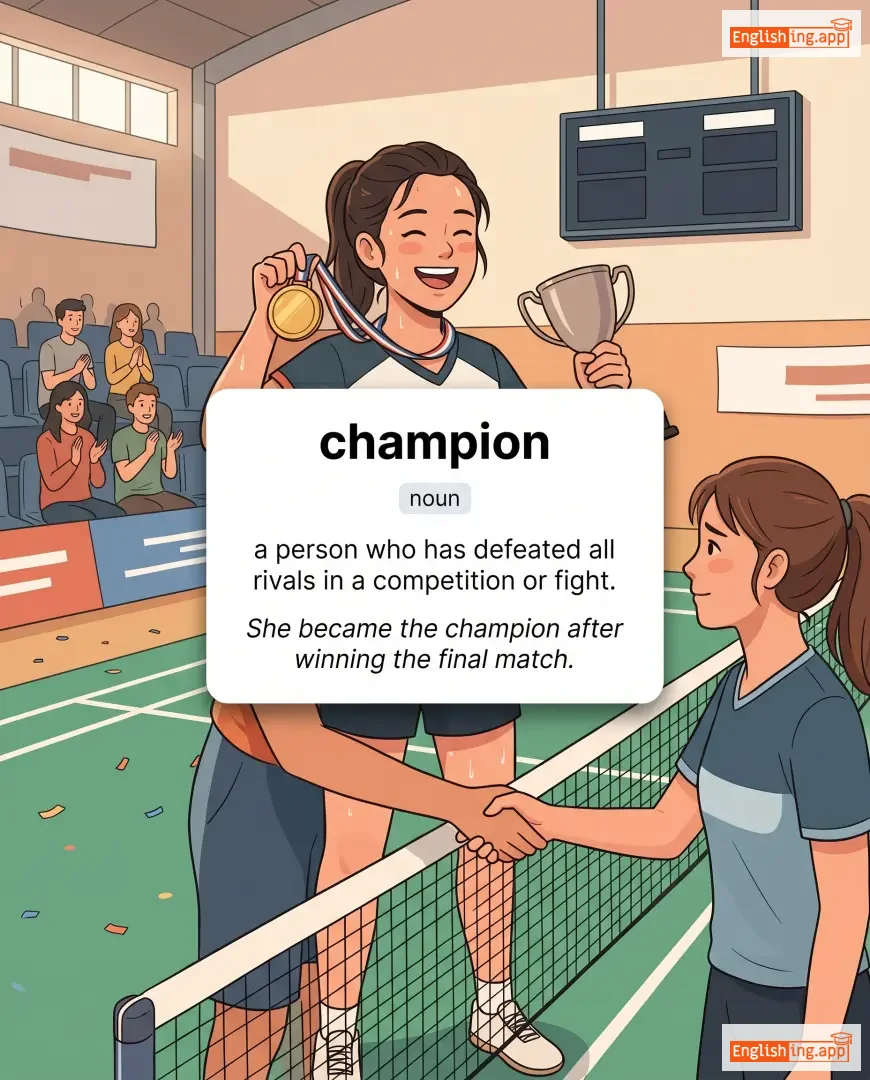
champion definition card — visual illustration of the meaning
noun
/ˈtʃæmpiən/
чемпион (chempion)

a person who has defeated all rivals in a competition or fight.

"She became the champion after winning the final match."

"Она стала чемпионкой после победы в финальном матче." (Ona stala chempionkoy posle pobedy v final'nom matche.)
noun
/ˈtʃæmpiənʃɪp/
чемпионат (chempionat)

a competition to decide who is the best in a particular sport or activity.

"The championship will be held next month."

"Чемпионат пройдет в следующем месяце." (Chempionat proydet v sleduyushchem mesyatse.)
noun
/tʃæns/
шанс (shans)

An opportunity or possibility of something happening.

"He took a chance and applied for the job."

"Он рискнул и подал заявку на работу." (On risknul i podal zayavku na rabotu.)
noun
/ˈtʃænsələr/
канцлер / ректор (kantzler / rektor)

A senior state or legal official, or the head of a university.

"The chancellor delivered an inspiring speech at the graduation ceremony."

"Канцлер произнес вдохновляющую речь на церемонии вручения дипломов." (Kantsler proiznes vdokhnovlyayushchuyu rech' na tseremonii vrucheniya diplomov.)
noun
/ˈtʃænsəri/
канцелярский суд (kantsel'yarskiy sud)

A court of equity or the office of a chancellor.

"The case was taken to the chancery court for resolution."

"Дело было передано в канцелярский суд для разрешения." (Delo bylo peredano v kantsel'yarskiy sud dlya razresheniya.)
change definition card — visual illustration of the meaning
verb
/tʃeɪndʒ/
изменение (izmenenie)

To make something different or to become different.

"She decided to change her career path."

"Она решила изменить свой карьерный путь." (Ona reshila izmenit' svoy kar'ernyy put'.)
change management definition card — visual illustration of the meaning
noun
/ˈʃeɪndʒ ˈmænɪdʒmənt/
управление изменениями (upravlenie izmeneniyami)

The discipline that guides how we prepare, equip and support individuals, teams and organizations in making organizational change.

"Change management ensures smooth transitions."

"Управление изменениями обеспечивает плавные переходы." (Upravlenie izmeneniyami obespechivaet plavnye perekhody.)
adjective
/ˈtʃeɪn.dʒə.bəl/
изменяемый; переменчивый (izmenyayemyj; peremenchivyy)

able to be changed; likely to change frequently

"The weather is very changeable in spring."

"Погода очень переменчива весной." (Pogoda ochen' peremenchiva vesnoy.)
verb
/ˈtʃeɪndʒɪŋ/
изменение (izmenenie)

The act of becoming different; ongoing process of change.

"The weather is changing rapidly."

"Погода меняется быстро." (Pogoda menyayetsya bystro.)
noun
/ˈtʃænəl/
канал / средство (kanal / sredstvo)

A means of communication, or a passage for water or information.

"They launched a new TV channel last year."
"Они запустили новый телевизионный канал в прошлом году." (Oni zapustili novyy televizionnyy kanal v proshlom godu.)
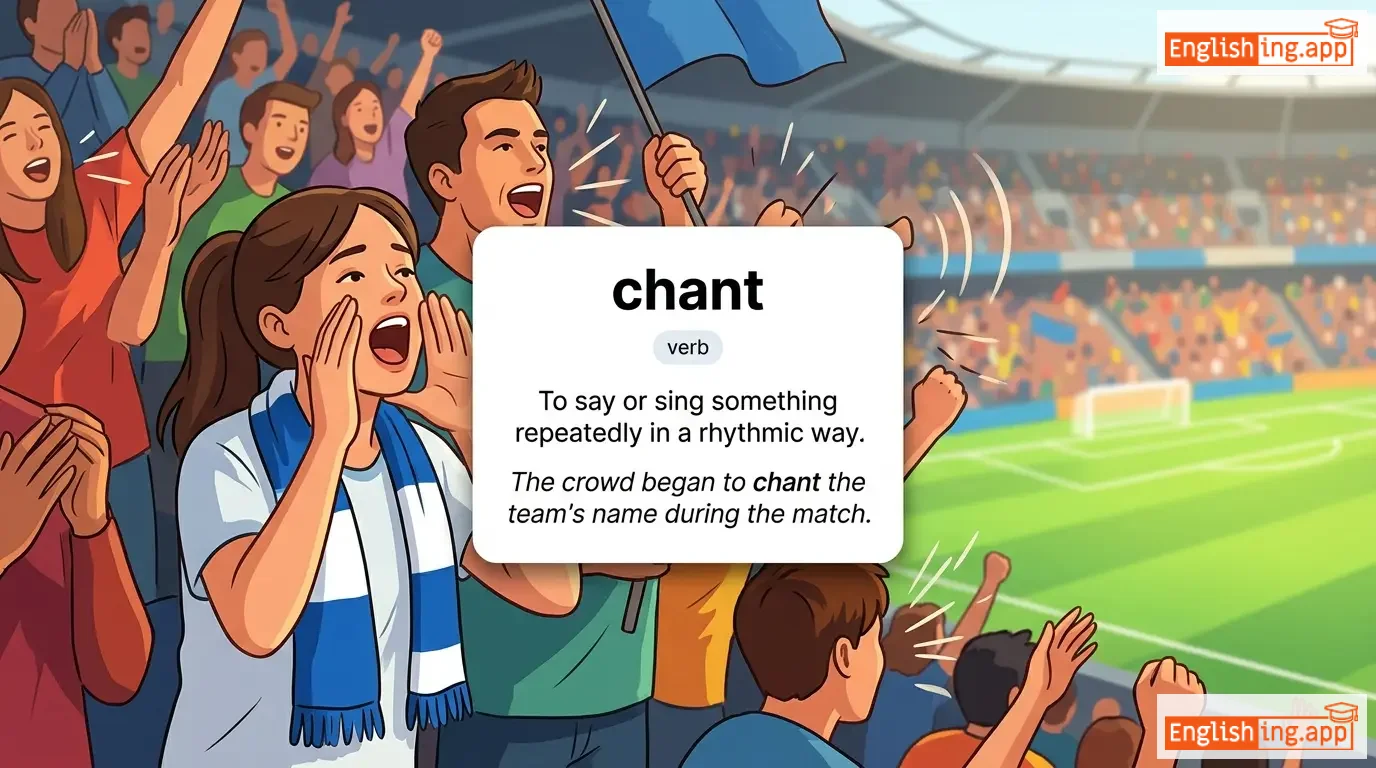
chant definition card — visual illustration of the meaning
verb
/tʃænt/
петь лозунги (pet' lozungi)

To say or sing something repeatedly in a rhythmic way.

"The crowd began to chant the team's name during the match."

"Толпа начала скандировать имя команды во время матча." (Tolpa nachala skandirovat' imya komandy vo vremya matcha.)
noun
/ˈkeɪɒs/
хаос (khaos)

A state of complete disorder and confusion.

"The sudden storm caused chaos in the city."

"Внезапная буря вызвала хаос в городе." (Vnezapnaya burya vyzvala khaos v gorode.)
adjective
/keɪˈɒtɪk/
хаотичный (khaotichny)

Completely disordered or confusing.

"The classroom became chaotic when the teacher left."

"Класс стал хаотичным, когда учитель ушел." (Klass stal khaotichnym, kogda uchitel' ushel.)