Словари

Словарь английского языка | Значения слов, определения и примеры

noun
/krʊk/
мошенник (moshennik)

a dishonest person, especially a criminal

"The police finally caught the crook who had been stealing cars."

"Полиция наконец поймала мошенника, который крал машины." (Politsiya nakonec poymala moshennika, kotoryy král mashiny.)
verb
/kruːn/
петь или напевать мягким, низким и нежным голосом (pet' ili napeyavat' myagkim, nizkim i nezhnym golosom)

to sing or hum in a soft, low, and gentle voice

"She crooned a lullaby to help the baby fall asleep."

"Она напевала колыбельную, чтобы помочь малышу уснуть." (Ona napeyavala kolybel'nuyu, chtoby pomoch' malyshu usnut'.)
noun
/krɒp/
урожай (urozhay)

plants that are grown and harvested for food or other use

"The farmers harvested their rice crop in autumn."

"Фермеры собрали свой урожай риса осенью." (Fermery sobrali svoj urozhaj risa osenyu.)
verb
/krɒs/
пересекать (peresekat)

to go from one side to another, or to pass through

"We crossed the river using a wooden bridge."

"Мы пересекли реку, используя деревянный мост." (My peresekli reku, ispol'zuya derevyannyy most.)
verb
/ˈkrɒs.briːd/
скрещивать (skreshchivat)

to produce an animal or plant by mating two different breeds, varieties, or species

"Farmers crossbreed cows to improve milk production."

"Фермеры скрещивают коров для улучшения производства молока." (Fermery skreshchivayut korov dlya uluchsheniya proizvodstva moloka.)
adverb
/ˈkrɒswaɪz/
по диагонали (po diagonal)

in the form of a cross; diagonally across

"Place the logs crosswise to build a stable fire."

"Положите дрова по диагонали, чтобы построить стабильный огонь." (Polozhite drova po diagonal, chtoby postroit' stabil'nyy ogon'.)
adjective
/ˈkrɒtʃ.ə.ti/
сердитый (serdityy)

bad-tempered, easily annoyed, and often complaining

"The crotchety old man yelled at the children for playing near his house."

"Сердитый старик кричал на детей, играющих рядом с его домом." (Serdityy starik krichal na detey, igrayushchikh ryadom s yego domom.)
verb
/kraʊtʃ/

to bend your knees and lower your body close to the ground

"The cat crouched before leaping at its prey."

🐦‍⬛

Crow (kro)

noun
/kroʊ/
ворон (voron)

a large black bird known for its intelligence and harsh call

"The crow cawed loudly from the tree branch."

"Ворон каркал громко с ветки дерева." (Voron karkanil gromko s vetki dereva.)
noun
/ˈkroʊ.bɑːr/
лом (lom)

a heavy iron bar with a curved end used as a lever for prying things apart

"He used a crowbar to remove the old nails."

"Он использовал лом, чтобы удалить старые гвозди." (On ispol'zoval lom, chtoby udalit' starye gvozdi.)
noun
/kraʊd/
толпа (tolpa)

a large number of people gathered together

"A huge crowd gathered to watch the concert."

"Огромная толпа собралась, чтобы посмотреть концерт." (Ogromnaya tolpa sobralas', chtoby posmotret' kontsert.)
🚶‍♂️🚶‍♀️

crowded (happiness)

adjective
/ˈkraʊdɪd/
счастье (schastye)

filled with too many people or things

"The bus was so crowded that I could hardly move."

"Она не могла скрыть своего счастья, когда получила награду." (Ona ne mogla skryt' svoego schast'ya, kogda poluchila nagradu.)
noun
/kraʊn/
корона (korona)

a circular ornamental headdress worn by a monarch as a symbol of authority

"The king wore his golden crown at the ceremony."

"Царь носил свою золотую корону на церемонии." (Tsar' nosil svoyu zolotuyu koronu na tseremonii.)
crucial definition card — visual illustration of the meaning
adjective
/ˈkruːʃəl/
критически важный (kriticheski vazhny)

extremely important or necessary

"Trust is crucial for a strong relationship."

"Доверие критически важно для крепких отношений." (Doverye kriticheski vazhno dlya krepkikh otnosheniy.)
noun
/ˈkruːsɪbəl/
жесткое испытание, плавильный тигель (zhestkoe ispytanie, plavilyj tigel')

a severe test or trial; a container used for heating substances to very high temperatures

"The team emerged stronger from the crucible of competition."

"Команда вышла сильнее из плавильного тигля соревнования." (Komanda vyshla sil'nee iz plavil'nogo tiglya sorevnovaniya.)
adjective
/kruːd/
сырой (syroy)

in a natural or raw state; not yet processed or refined

"The crude oil is processed into fuel and chemicals."

"Сырая нефть перерабатывается в топливо и химикаты." (Syraja neft pererabotivayetsya v toplivo i khimikaty.)
adjective
/ˈkruːəl/
жестокий (zhestokiy)

Willfully causing pain or suffering to others, or feeling no concern about it.

"It was cruel to make fun of the injured boy."

"Было жестоко смеяться над раненым мальчиком." (Bylo zhestoko smeyat'sya nad ranyenym mal'chikom.)
noun
/ˈkruː.əl.ti/
жестокость; бесчеловечное обращение; поведение, причиняющее боль (zhestokost', beschelovechnoe obshchenie, povedenie, prichinyayushchee bol')

behavior that causes pain or suffering to others; the quality of being cruel

"The documentary exposed the cruelty of factory farming to animals."

"Документальный фильм продемонстрировал жестокость промышленного животноводства по отношению к животным." (Dokumental'nyy film prodemonstriroval zhestokost' promyshlennogo zhivotnovodstva po otnosheniyu k zhivotnym.)
noun
/ˈkruːɪt/
небольшой контейнер (nebol'shoy konteyner)

a small container, especially for salt, pepper, oil, or vinegar, used at a dining table

"She filled the cruet with olive oil for the salad."

"Она наполнила круэт оливковым маслом для салата." (Ona napolnila kruet olivkovym maslom dlya salata.)
🛳️

cruise

verb
/kruːz/
счастье (schast'ye)

to travel smoothly at a moderate speed, especially for pleasure

"They decided to cruise along the coast during their vacation."

"Она не могла скрыть своего счастья, когда получила награду." (Ona ne mogla skryt' svoego schast'ya, kogda poluchila nagradu.)
verb
/ˈkrʌmpəl/
смять (smyat)

to crush something into folds or wrinkles

"He crumpled the paper and threw it in the bin."

"Он смял бумагу и бросил её в корзину." (On smyal bumagu i brosil yey v korzinu.)
noun/verb
/kruːˈseɪd/
крестовый поход, интенсивная кампания (krestovyy pokhod, intensivnaya kampaniya)

a vigorous campaign for a social, political, or religious cause; to fight passionately for a cause

"She has been crusading for women's rights all her life."

"она боролась за права женщин всю свою жизнь." (ona borolas' za prava zhenshchin vsyu svoyu zhizn'.)
verb
/krʌʃ/
сжать или раздавить что-то так сильно, что оно повреждается или разрушается (szhat' ili razdavít' chto-to tak sil'no, chto ono povrezhdaetsya ili razrushayetsya)

to press or squeeze something so hard that it is damaged or destroyed

"He accidentally crushed the paper cup in his hand."

"Он случайно раздавил бумажный стаканчик в своей руке." (On sluchayno razdavíl bumazhnyy stakanchik v svoey ruke.)
noun
/krʌst/
корка (korka)

the hard outer surface of something, especially bread or the Earth's outer layer

"He cut off the crust of the bread before eating."

"Он отрезал корку хлеба перед тем, как съесть." (On otrezal korku khleba pered tem, kak s'yest'.)
noun
/krʌˈsteɪʃən/
водное существо с жесткой оболочкой (vodnoe sushchestvo s zhestkoy obolochkoj)

an aquatic animal with a hard shell, such as crabs, lobsters, and shrimps

"Crabs and lobsters are well-known crustaceans."

"Крабы и омары хорошо известны среди ракообразных." (Kraby i omary khorosho izvestny sredi rakoobraznykh.)
adjective
/krʌˈsteɪʃəs/
с жесткой оболочкой (s zhestkoy obolochkoy)

relating to or having a hard shell like a crustacean

"The scientist studied the crustaceous fossils."

"Учёный изучал окаменелости с жесткой оболочкой." (Uchyonnyy izuchal okamenelosti s zhestkoy obolochkoj.)
noun
/krʌtʃ/
костыль, опора (kostyl', opora)

a support used by someone injured to walk; also something relied upon for support or help

"He had to use crutches after breaking his leg."

"Ему пришлось использовать костыли после того, как он сломал ногу." (Yemu prishlos' ispol'zovat' kostyli posle togo, kak on slomal nogu.)
noun
/krʌks/
суть (sut)

the most important or decisive point of an issue

"The crux of the problem lies in poor communication."

"Суть проблемы заключается в плохой коммуникации." (Sut problemy zaklyuchayetsya v plokhoy kommunikatsii.)
verb, noun
/kraɪ/
плакать (plakat)

To shed tears as an expression of emotion such as sadness or pain; also a loud call or shout.

"The baby began to cry when she was hungry."

"Малыш начал плакать, когда она была голодна." (Malysh nachal plakat', kogda ona byla golodna.)
noun
/krɪpt/
склеп (sklep)

an underground chamber, especially one beneath a church, used as a burial place

"The tourists explored the ancient crypt beneath the cathedral."

"Туристы исследовали древнюю крипту под кафедральным собором." (Turisty issledovali drevnyuyu kriptu pod kafedral'nym soborom.)
cryptic definition card — visual illustration of the meaning
adjective
/ˈkrɪptɪk/
криптографический (kriptograficheskiy)

having a meaning that is mysterious or obscure

"She left a cryptic message on his voicemail."

"Она оставила криптографическое сообщение на его голосовой почте." (Ona ostavila kriptograficheskoe soobshchenie na ego golosovoy pochty.)
cryptocurrency definition card — visual illustration of the meaning
noun
/ˌkrɪptəˈkʌrənsɪ/
цифровая валюта (tsifrovaya valyuta)

A digital currency in which transactions are verified and records maintained by a decentralized system

"Cryptocurrencies are revolutionizing the financial landscape."

"Криптовалюты революционизируют финансовый ландшафт." (Kriptovalyuty revolyutsioniruyut finansovyy landshaft.)
noun
/ˈkrɪptəɡræm/
секретный код (sekretnyy kod)

a text written in code or cipher

"The detective solved the cryptogram hidden in the letter."

"Детектив решил криптограмму, скрытую в письме." (Detektiv reshil kriptogrammu, skrytuyu v pis'me.)
cryptographic definition card — visual illustration of the meaning
adjective
/ˌkrɪp.təˈɡræf.ɪk/
криптографический (kriptograficheskiy)

Relating to cryptography; involving or using secret codes or ciphers for security.

"Banks use cryptographic technology to protect transactions."

"Банки используют криптографические технологии для защиты транзакций." (Banki ispol'zuyut kriptograficheskiye tekhnologii dlya zashchity tranzaktsiy.)
cryptography definition card — visual illustration of the meaning
noun
/krɪpˈtɒɡ.rə.fi/
практика защиты информации с помощью шифрования или кодирования (praktika zashchity informatsii s pomoshch'yu shifrovaniya ili kodirovaniya)

The practice of securing information through encryption or coding techniques

"Modern cryptography ensures secure online transactions."

"Современная криптография обеспечивает безопасные онлайн-транзакции." (Sovremennaya kriptografiya obespechivayet bezopasnye onlayn-tranzaktsii.)
noun
/ˈkrɪstəl/
кристалл (kristall)

a clear, transparent mineral or glass that forms a solid structure with regular patterns

"She wore a necklace made of sparkling crystal."

"Она носила ожерелье из сверкающего кристалла." (Ona nosila ozherelye iz sverkayushchego kristalla.)
verb
/ˈkrɪstəlaɪz/
кристаллизовать (kristal-lizovat)

to form crystals; to make an idea or plan clear and definite

"Her vague thoughts began to crystallize into a solid plan."

"Её неопределённые мысли начали кристаллизоваться в чёткий план." (Ejo neopredelyonnye mysli nachali kristallizovatsya v chotkiy plan.)
noun
/kʌb/
медвежонок (medvezhonok)

a young bear, lion, tiger, or other large carnivorous mammal

"The bear cub stayed close to its mother for protection."

"Медвежонок оставался рядом с матерью для защиты." (Medvezhonok ostavalsya ryadom s mater'yu dlya zashchity.)
adjective
/ˈkjuːbən/
кубинский (kubinskiy)

relating to Cuba, its people, or its culture

"We enjoyed delicious Cuban coffee at the café."

"Мы наслаждались вкусным кубинским кофе в кафе." (My naslazhdalis' vkusnym kubinskim kofe v kafe.)
noun, verb
/kjuːb/
куб (kub)

As a noun: a solid object with six equal square faces. As a verb: to cut food into small square pieces.

"She put a sugar cube in her tea."

"Она положила кубик сахара в свой чай." (Ona polozhila kubik sakhara v svoy chay.)
noun
/ˈkjuːbeb ˈpepər/
кубеба перец (kubeva perets)

aromatic spice with a slightly bitter taste and cooling aftertaste

"Cubeb pepper is used in traditional Indonesian cuisine."

"Кубеба перец используется в традиционной индонезийской кухне." (Kubeva perets ispol'zuyetsya v traditsionnoy indoneziyskoy kukhne)
noun
/ˈkjuː.bɪ.kəl/
кабинка (kabinka)

A small partitioned-off area of a room, typically in an office.

"She works in a cubicle with three other colleagues."

"Она работает в кабинке с тремя другими коллегами." (Ona rabotayet v kabinke s teryma drugimi kollegami.)
noun
/ˈkʊk.uː/
кукушка (kukushka)

a bird known for its distinctive call and for laying eggs in other birds' nests

"We heard the cuckoo calling from the forest early in the morning."

"Мы слышали кукушку, поющую в лесу рано утром." (My slyshali kukushku, poyushchuyu v lesu rano utrom.)
noun
/ˈkjuː.kʌm.bər/
огурец (ogurets)

a long green vegetable with watery flesh, eaten raw in salads or cooked

"I added fresh cucumber slices to my salad."

"Я добавил свежие ломтики огурца в мой салат." (Ya dobavil svezhie lomtiki ogurtsa v moy salat.)
noun/verb
/ˈkʌdʒ.əl/
палка (palka)

A short, thick stick used as a weapon; to beat with a cudgel.

"The guard used a cudgel to chase away the thief."

"Охранник использовал палку, чтобы прогнать вора." (Okhrannik ispol'zoval palku, chtoby prozhnat' vor.)
noun/verb
/kjuː/
сигнал (signal)

A signal or prompt for action; to give a signal.

"The actor waited for his cue before entering the stage."

"Актер ждал своего сигнала перед тем, как выйти на сцену." (Aktor zhdal svoego signala pered tem, kak vyyti na stsenu.)
cues definition card — visual illustration of the meaning
noun
kjuːz
подсказки (podskazki)

Signals or hints from conversation or environment that help understanding

"Facial expressions provide cues about a person's emotions."

"Лицевые выражения дают подсказки о эмоциях человека." (Litsevye vyrazheniya dayut podskazki o emotsiyakh cheloveka.)
noun
/kwɪˈziːn/
кухня (kukhnya)

A style or method of cooking, especially characteristic of a particular country or region.

"Italian cuisine is famous all over the world."

"Итальянская кухня известна по всему миру." (Italianskaya kukhnya izvestna po vsemy miru.)
noun
/ˌkʌl də ˈsæk/
тупик (tupik)

A street or passage closed at one end; a dead end.

"They bought a house at the end of a quiet cul de sac."
"Они купили дом в конце тихой тупиковой улицы." (Oni kupili dom v kontse tikhoy tupikovoy ulitsy.)
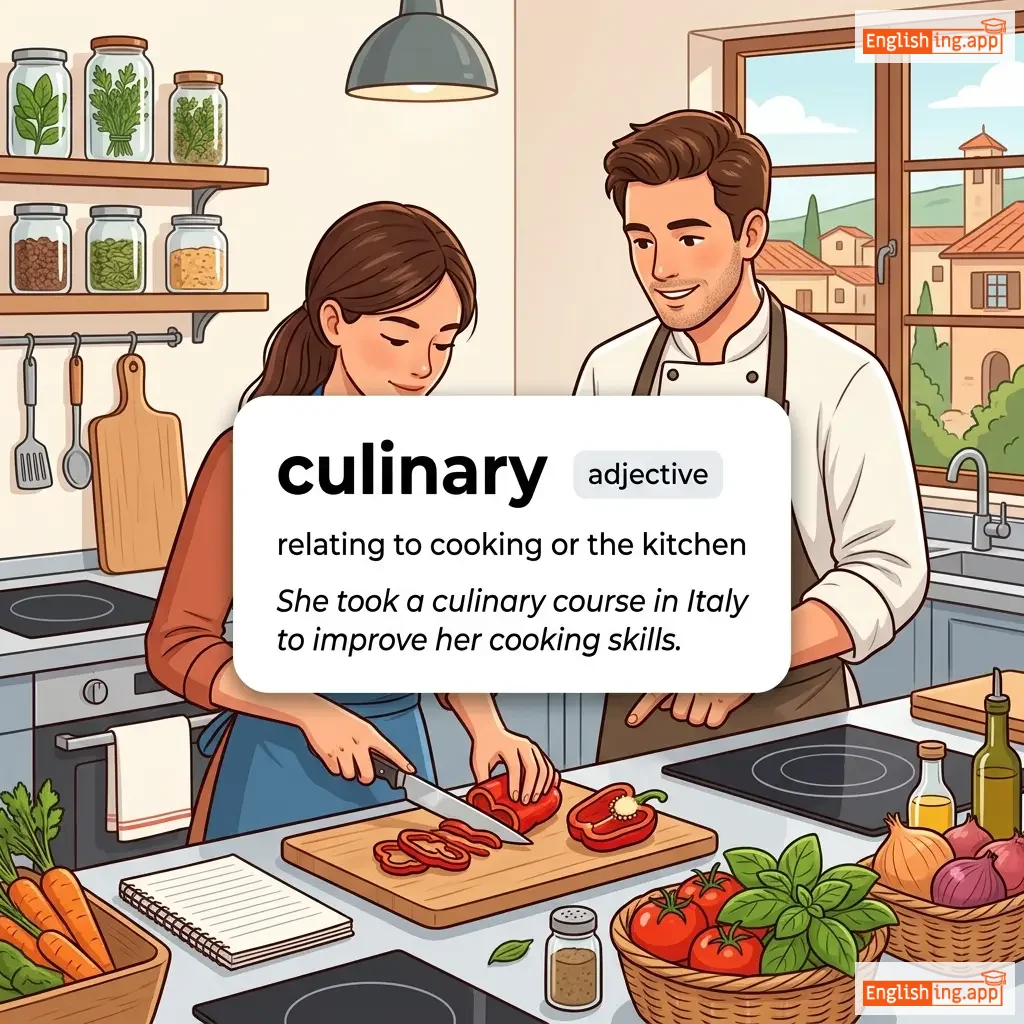
culinary definition card — visual illustration of the meaning
adjective
/ˈkʌl.ɪ.nɛr.i/
кулинарный (kulinarnyj)

relating to cooking or the kitchen

"She took a culinary course in Italy to improve her cooking skills."

"Она прошла кулинарный курс в Италии, чтобы улучшить свои кулинарные навыки." (Ona proshla kulinarnyj kurs v Italii, chtoby uluchshit' svoi kulinarnye navyki.)