Словари

Словарь английского языка | Значения слов, определения и примеры

verb
/ˈkɒsɪt/
баловать (balovat')

to care for and protect in an overindulgent way

"The little girl was cosseted by her grandparents."

"Маленькую девочку баловали её бабушка и дедушка." (Malen'kuyu devochku balovali yey babushka i dedushka.)
adjective
/ˈkɒs.ɪ.tɪd/
балованный (balovannyy)

pampered, treated with excessive care and attention

"The cosseted child always got what he wanted."

"Балованный ребенок всегда получал то, что хотел." (Balovannyy rebenok vsegda poluchal to, chto khotel.)
cost definition card — visual illustration of the meaning
noun, verb
/kɒst/
стоимость (stoimost)

The amount of money needed to buy or do something.

"The cost of living has increased significantly."

"Стоимость жизни значительно возросла." (Stoimost' zhizni znacitel'no vozrosla.)
cost-efficient definition card — visual illustration of the meaning
adjective
/ˌkɒst.ɪˈfɪʃ.ənt/
экономичный (ekonomichnyy)

Achieving maximum productivity with minimum wasted effort or expense.

"Cost-efficient solutions benefit industries."

"Экономичные решения приносят пользу отраслям." (Ekonomichnye resheniya prinosyat pol'zu otraslyam.)
adjective
/ˈkɔːstli/
дорогой (dorogoy)

expensive or causing a lot of money, time, or effort

"Their mistake proved to be very costly for the company."
"Их ошибка оказалась очень дорогой для компании." (Ikh oshibka okazalas' ochen' dorogoy dlya kompanii.)
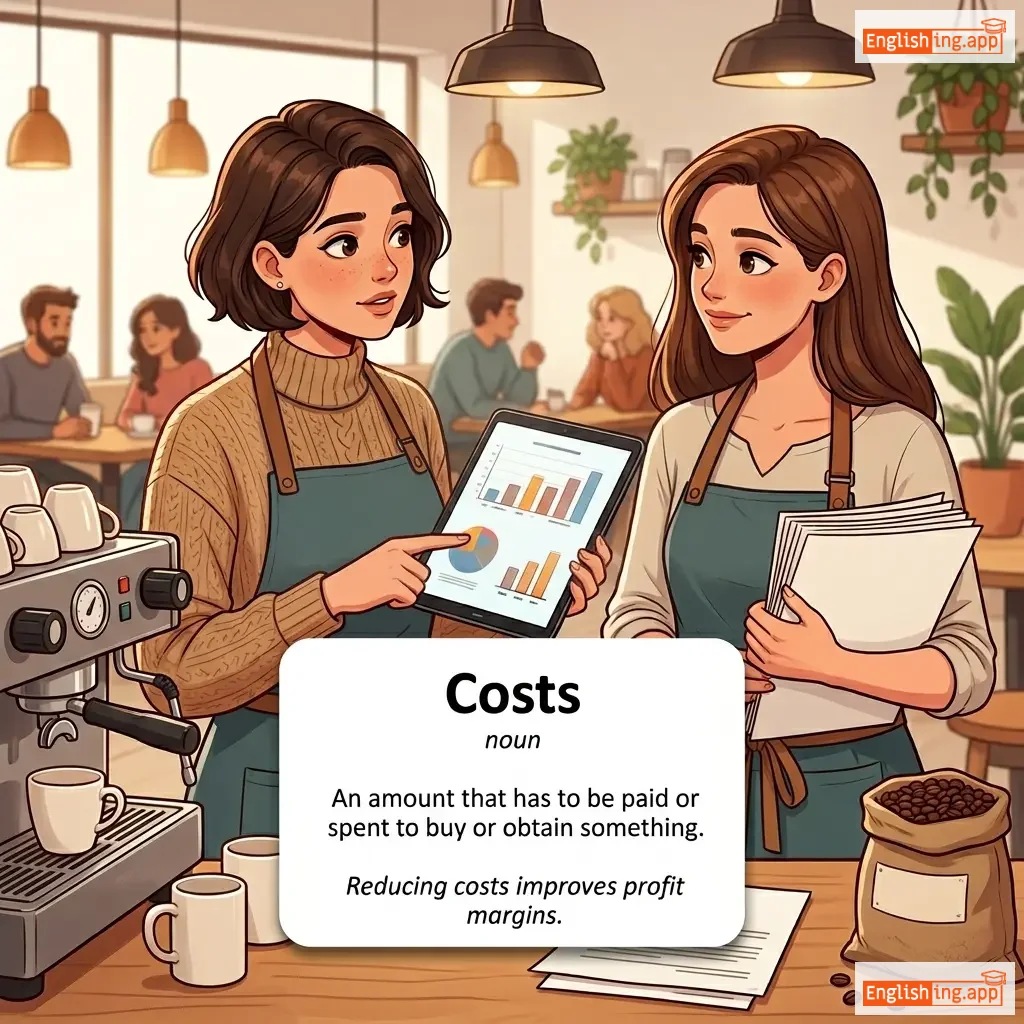
Costs definition card — visual illustration of the meaning
noun
kɒsts
затраты (zatraty)

An amount that has to be paid or spent to buy or obtain something.

"Reducing costs improves profit margins."

"Снижение затрат улучшает прибыльность." (Snizhenie zatrat uluchshaet pribylnost'.)
noun
/ˈkɒstjuːm/
костюм (kostyum)

a set of clothes worn to represent a particular character, culture, or occasion

"She wore a beautiful costume for the Halloween party."

"Она надела красивый костюм на Хэллоуин-вечеринку." (Ona nadela krasivyy kostyum na Khellouin-vecherinku.)
noun
/kɒt/
кроватка (cot)

a small bed, especially a portable one or one for a baby

"The baby sleeps peacefully in her cot."

"Ребёнок мирно спит в её кроватке." (Rebyonok mirno spit v eyo krovatke.)
noun
/ˈkoʊ.tə.ri/
небольшая, эксклюзивная группа (nebol'shaya, eksklyuzivnaya gruppa)

a small, exclusive group of people with shared interests

"He belonged to a coterie of artists who met every Friday."

"Он был частью группы художников, которые встречались каждую пятницу." (On byl chastyu gruppy khudozhnikov, kotorye vstrechalis' kazhduyu pyatnitsu.)
adjective
/koʊˈtɜːr.mɪ.nəs/
совпадающий (sovpadayushchiy)

having the same boundaries or extent in space, time, or meaning

"The two jurisdictions are coterminous, sharing the same borders."

"Два юрисдикции совпадают, деля одинаковые границы." (Dva yurisdiktsii sovpadayut, delya odinakovyye granitsy.)
noun
/ˈkɒtɪdʒ/
домик (domik)

a small simple house, typically in the countryside

"They spent their vacation in a cozy cottage by the lake."

"Они провели свой отпуск в уютном домике у озера." (Oni proveli svoy otpusk v uyutnom domike u ozera.)
noun
/ˈkɒtən/
счастье (schastye)

A soft white fibrous substance used to make cloth and thread.

"This shirt is made of pure cotton."

"Она не могла скрыть своего счастья, когда получила награду." (Ona ne mogla skryt' svoego schast'ya, kogda poluchila nagradu.)
noun
/ˈkɒt.ən ˈfæb.rɪk/
хлопковая ткань (khlopkovaya tkan)

textile made from cotton fibers, known for being soft, breathable, and comfortable

"Cotton fabric is perfect for summer clothing."

"Хлопковая ткань идеально подходит для летней одежды." (Khlopkovaya tkan ideal'no podkhodit dlya letney odezhdy.)
noun
/kaʊtʃ/
диван (divan)

a comfortable seat for two or more people, typically upholstered

"They sat on the couch and watched TV."

"Они сели на диван и смотрели телевизор." (Oni sели na divan i smotreli televizor.)
noun, verb
/kɒf/
кашель (kashel)

a sudden noisy release of air from the lungs to clear the throat or airway; to expel air suddenly from the lungs with a cough

"He has a bad cough and stayed home today."

"У него сильный кашель, и сегодня он остался дома." (u nego silnyy kashel i segodnya on ostalsya doma)
modal verb
/kʊd/
мог (mog)

Used to indicate possibility, ability, or permission in the past or as a polite suggestion.

"He could swim when he was a child."

"Он мог плавать, когда был ребенком." (On mog plavat', kogda byl rebenkom.)
noun
/ˈkaʊn.səl/
совет (sovet)

an assembly of people chosen or elected to make decisions or advise on matters

"The city council voted to improve public transportation."

"Городской совет проголосовал за улучшение общественного транспорта." (Gorodskoy sovet pro-golosoval za uluchshenie obshchestvennogo transporta.)
noun
/ˈkaʊnsələr/
советник (sovetnik)

an elected member of a local council who helps make decisions and represent the community

"The councillor spoke to residents about improving local roads."

"Советник говорил о местных дорогах." (sovetnik govoril o mestnykh dorogakh)
noun
/ˈkaʊnsɪlər/
член совета (chlen soveta)

an elected member of a council, especially a local government body

"The councilor held a public meeting to discuss local issues."

"Член совета провел публичное собрание для обсуждения местных проблем." (Chlen soveta provel publichnoe sobranie dlya obsuzhdeniya mestnykh problem.)
verb
/ˈkaʊnsəl/
консультировать (konsul'tirovat')

to give professional advice or guidance to someone

"The teacher counseled the students on their career choices."

"Учитель консультировал студентов по вопросам карьеры." (Uchitel' konsultiroval studentov po voprosam kariery.)
noun
/ˈkaʊnsəlɪŋ/
консультирование (konsul'tirovanie)

professional guidance or therapy to help resolve personal or psychological problems

"She decided to go for counseling after feeling stressed for months."

"Она решила пройти консультирование после того, как чувствовала стресс в течение нескольких месяцев." (Ona reshilas' proyti konsultirovanie posle togo, kak chuvstvovala stress v techeniye neskol'kikh mesyatsev.)
noun
/ˈkaʊn.səl.ɪŋ/
консультирование (konsultirovanie)

the process of giving professional guidance and support to help someone deal with personal, social, psychological, or career-related problems

"She decided to seek counselling to manage stress and anxiety."

"Она решила пройти консультирование, чтобы справиться со стрессом." (ona reshila proiti konsultirovanie chtoby spravitsya so stressom)
noun
/ˈkaʊnsələr/
консультант (konsultant)

a person trained to give guidance on personal, social, or psychological problems; an advisor

"She spoke to a counsellor to get advice about her career."

"Она поговорила с консультантом о своей карьере." (ona pogovorila s konsultantom o svoey karere)
noun
/ˈkaʊn.səl.ər/
консультант (konsultant)

a person trained to give guidance on personal, social, or psychological problems

"The school counselor helped the student deal with stress."

"Школьный консультант помог ученику справиться со стрессом." (Shkol'nyy konsultant pomog uchenniku spravitsya so stressom.)
verb
/kaʊnt/
считать (schitat)

to determine the total number of something

"She carefully counted the money on the table."

"Она осторожно посчитала деньги на столе." (Ona ostorozhno poschitala dengi na stole.)
noun
/ˈkaʊn.tə.nəns/
лицо, выражение; поддержка (litsо, vyrazhenie; podderzhka)

a person's face or expression; support or approval

"Her cheerful countenance brightened the room."

"Ее радостное лицо осветило комнату." (Eeyo radostnoe litso osvetilo komnatu.)
noun
/ˈkaʊn.tər/
прилавок (prilavok)

a flat surface in a shop, bank, or kitchen where transactions or work are done

"The cashier stood behind the counter."

"Кассир стоял за прилавком." (Kassir stoyal za prilavkom.)
noun
/ˈkaʊn.tər kleɪm/
контриск (kontrisk)

a claim made to rebut a previous claim, often in legal contexts

"The defendant filed a counter-claim against the plaintiff."

"Ответчик подал контриск против истца." (Otvetchik podal kontrisk protiv istsa.)
verb
/ˌkaʊntərˈækt/
противодействовать (protivodeystvovat')

to act against something in order to reduce its effect

"The medicine helps counteract the side effects of the treatment."

"Препарат помогает нейтрализовать побочные эффекты лечения." (Preparat pomogaet neytralizovat' pobochniye effekty lecheniya.)
verb
/ˌkaʊntərˈbæləns/
компенсировать (kompensirovat)

to offset or balance the effect of something

"Exercise can counterbalance the negative effects of stress."

"Упражнения могут компенсировать негативные последствия стресса." (Uprazhneniya mogut kompenosirovat negativnye posledstviya stressa.)
noun, verb
/ˈkaʊntərˌtʃɑːrdʒ/
встречный иск (vstrechnyy isk)

an opposing charge or accusation; to make an opposing attack

"The lawyer filed a countercharge against the accuser."

"Адвокат подал встречный иск против обвинителя." (Advokat podal vstrechnyy isk protiv obvinityelya.)
adjective, verb, noun
/ˈkaʊntərfɪt/
подделка (poddielka)

made to look like something genuine in order to deceive

"The police seized a batch of counterfeit currency."

"Полиция изъяла партию фальшивых денег." (Politsiya izyala partiyu fal'shivyh deneg.)
adjective
/ˌkaʊntərɪnˈtuːɪtɪv/
неинтуитивный (neintuitivnyy)

contrary to what one would intuitively expect

"His approach seems counterintuitive but it actually works."

"Его подход кажется неинтуитивным, но на самом деле работает." (Ego podkhod kazhetsya neintuitivnym, no na samom dele rabotayet.)
verb
/ˌkaʊntərˈmænd/
отменить приказ (otmenit' prikaz)

to revoke or cancel an order or command

"The general countermanded the previous orders immediately."

"Генерал немедленно отменил предыдущие приказы." (General nemedlenno otmenil predydushchie prikazy.)
noun
/ˈkaʊntərˌpɑːrt/
аналог (analog)

a person or thing that corresponds to or has the same function as another

"The CEO met with his counterpart in the partner company."

"Генеральный директор встретился со своим аналогом в партнерской компании." (General'nyy direktor vstretilsya so svoim analogom v partnyorskoy kompanii.)
noun
/ˈkaʊntərˌpɔɪnt/
контрапункт (kontrapunkt)

an argument, idea, or theme contrasting with another; also a musical term for independent melody

"Her calm attitude was a counterpoint to his anger."

"Её спокойное поведение было контрапунктом его гнева." (Yeyo spokoynoye povedeniye bylo kontrapunktom yego gneva.)
counterproductive definition card — visual illustration of the meaning
adjective
/ˌkaʊntərprəˈdʌktɪv/
контрпродуктивный (kontraproduktivnyy)

having the opposite of the desired effect; harmful to achieving goals

"Skipping breakfast is counterproductive to your energy levels."

"Пропуск завтрака контрпродуктивен для вашего уровня энергии." (Propusk zavtraka kontrproduktivyen dlya vashego urovnya energii.)
verb
/ˌkaʊntərˈveɪl/
компенсировать (kompensirovat)

to offset or counteract the effect of something

"The benefits of the new policy countervail its drawbacks."

"Польза от новой политики компенсирует её недостатки." (Pol'za ot novoy politiki kompensiruyet yeye nedostatki.)
noun
/ˈkaʊntɪŋˌhaʊs/
офис бухгалтерии (ofis buhgalterii)

a business office where accounts are kept and financial transactions are managed

"The merchant spent most of his day in the counting-house reviewing ledgers."

"Торговец провел большую часть дня в офисе бухгалтерии, проверяя книги учета." (Torgovets provel bol'shuyu chast' dnya v ofise buhgalterii, proveryaya knigi ucheta.)
adjective
/ˈkaʊntləs/
несчётный (neschotny)

too many to be counted; innumerable

"There are countless stars in the sky."

"На небе бесчисленные звезды." (Na nebe beskichlenniye zvezdy.)
noun
/ˈkʌn.tri/
страна (strana)

a nation with its own government and borders

"Bangladesh is a beautiful country with rich culture."

"Бангладеш - это красивая страна с богатой культурой." (Bangladesh - eto krasivaya strana s bogatoy kul'turoy.)
noun
/ˈkʌntrɪmən/
соотечественник (sootechestvennik)

a person from one's own country or rural area

"He was proud to meet a fellow countryman at the international conference."

"Он гордился тем, что встретил соотечественника на международной конференции." (On gordilsya tem, chto vstretit sootechestvennika na mezhdunarodnoy konferencii.)
noun
/ˈkʌntrisaɪd/
сельская местность (selskaya mestnost)

land outside cities and towns; rural areas with farms, fields, and villages

"She enjoys the peace and beauty of the countryside."

"Она наслаждается тишиной и красотой сельской местности." (ona naslazhdaetsya tishinoy i krasotoy selskoy mestnosti)
noun
/ˈkaʊnti/
округ (okrug)

A territorial division within a country, typically a region with its own local government.

"She grew up in a small county in northern England."

"Она выросла в маленьком округе на севере Англии." (Ona vyrosla v malen'kom okruge na severe Anglii.)
noun
/kuː/
переворот (perevorot)

a sudden, decisive action that brings about a change, especially in government

"The military staged a coup to overthrow the existing regime."

"Армия устроила переворот, чтобы свергнуть существующий режим." (Armiya ustroila perevorot, chtoby svergnut' sushchestvuyushchiy rezim.)
noun
/ˈkʌpəl/
пара (para)

two people or things considered together; a pair

"They make a lovely couple and have been married for five years."
"Они составляют прекрасную пару и состоят в браке уже пять лет." (Oni sostavlyayut prekrasnuyu paru i sostoyat v brake uzhe pyat' let.)
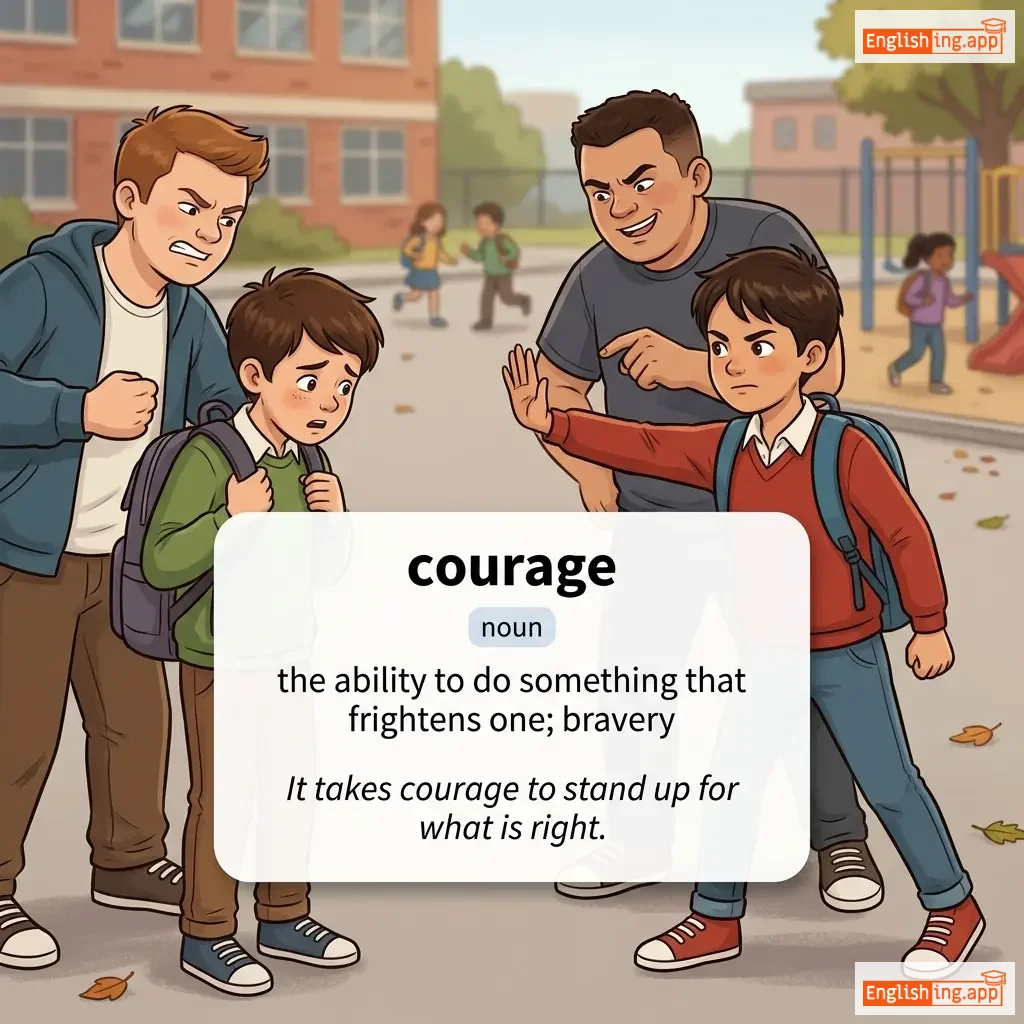
courage definition card — visual illustration of the meaning
noun
/ˈkʌrɪdʒ/
мужество (muzhestvo)

the ability to do something that frightens one; bravery

"It takes courage to stand up for what is right."

"Для того, чтобы стоять за правду, нужно мужество." (Dlya togo, chtoby stoyat' za pravdu, nuzhno muzestvo.)
adjective
/kəˈreɪdʒəs/
смелый (smelyi)

having or showing bravery; able to face danger or difficulty

"The firefighter was courageous as he rescued the children from the burning building."

"Пожарный был смелым, когда спасал детей из горящего здания." (Pozharnyi byl smelym, kogda spasal detei iz goryashchego zdaniya.)
noun
/ˈkʊriər/
курьер (kuryer)

a person or company that delivers messages, packages, or mail

"The courier delivered the documents on time."

"Курьер доставил документы вовремя." (Kuryer dostavil dokumenty vovremya.)
noun
/kɔːrs/
курс, путь или набор образовательных уроков (kurs, put' ili nabór obuchatel'nykh urokov)

a direction, path, or a set of educational lessons

"She enrolled in a computer science course."

"Она записалась на курс по информатике." (Ona zapisalas' na kurs po informatike.)