Словари

Словарь английского языка | Значения слов, определения и примеры

noun
/kəˈmændər/
командир (komandir)

a person in authority, especially over a military group

"The commander led his troops into battle."

"Командир повел свои войска в бой." (Komandir poyel svoi voiska v boy.)
noun
/kəˈmændər ɪn tʃiːf/
главнокомандующий (glavokomanduyushchiy)

the supreme leader of a nation's armed forces

"The president serves as the commander-in-chief of the military."

"Президент выполняет обязанности главнокомандующего армии." (Prezident vipolnyayet obyazannosti glavokomanduyushchego armii.)
verb
/kəˈmɛmɔˌreɪt/
коммеморировать (kommemorirovat')

To honor and remember someone or something through a ceremony or action.

"The statue was built to commemorate the fallen heroes."

"Статуя была построена в память о павших героях." (Statuya byla postroena v pamyat' o pavshikh geroyakh.)
adjective
/kəˈmɛmərətɪv/
памятный (pamyatny)

Serving as a reminder or in honor of a person or event.

"They issued a commemorative coin for the independence anniversary."

"Они выпустили памятную монету в честь годовщины независимости." (Oni vypustili pamyatnuyu monetu v chest' godovshchiny nezavisimosti.)
verb
/kəˈmɛns/
начинать (nachinat)

to begin or start something

"The ceremony will commence at noon."

"Церемония начнется в полдень." (Tseremoniya nachnyotsya v poldyen.)
commencement definition card — visual illustration of the meaning
noun
/kəˈmɛnsmənt/
начало, церемония вручения академических степеней (nachalo, tseremoniya vrucheniya akademicheskikh stepeney)

the beginning of something; a ceremony for conferring academic degrees

"The commencement of the project was delayed by two weeks."

"Начало проекта было задержано на две недели." (Nachalo proyeka bylo zaderzhano na dve nedeli.)
verb
/kəˈmɛnd/
хвалить (khvalit')

to praise formally or officially

"The teacher commended the students for their hard work."

"Учитель похвалил студентов за их тяжелую работу." (Uchitel' pokhvalil studentov za ikh tyazholuyu rabotu.)
adjective
/kəˈmɛndəbl̩/
достойный похвалы (dostoynyy pokhvaly)

deserving praise or approval

"Her dedication to the project was truly commendable."

"Её преданность проекту была действительно достойна похвалы." (Eyo predannost' proyektu byla deystvitel'no dostoyna pokhvaly.)
commendable initiatives definition card — visual illustration of the meaning
adjective + noun
kəˈmendəbəl ɪˈnɪʃətɪvz
похвенные инициативы (pokhvennye initsiativy)

Praiseworthy efforts or actions that deserve admiration and approval.

"The commendable initiatives aim to raise awareness."

"Похвальные инициативы направлены на повышение осведомленности." (Pokhvennye initsiativy napravleny na povyshenie osvedomlennosti.)
commensurate definition card — visual illustration of the meaning
adjective
/kəˈmɛnʃərət/
пропорциональный (proportsional'nyy)

corresponding in size, degree, or extent; proportionate

"Salary will be commensurate with experience."

"Зарплата будет пропорциональна опыту." (Zarplata budet proportional'na opytu.)
noun
/ˈkɒm.ent/
комментарий (kommentariy)

a verbal or written remark expressing an opinion or reaction

"She posted a kind comment on my photo."

"Она оставила добрый комментарий под моей фотографией." (Ona ostavila dobryy kommentariy pod moyey fotografiyey.)
noun
/ˈkɒmənˌtɛri/
комментарий (kommentari)

An expression of opinions or explanations about an event, situation, or text.

"The professor's commentary on the novel was insightful."

"Комментарий профессора по роману был проницательным." (Kommentariy professora po romanu byl pronitsatel'nym.)
noun
/ˈkɒmənˌteɪtər/
комментатор (kommentator)

a person who reports and discusses events, especially on TV or radio

"The commentator described the football match in detail."

"Комментатор подробно описал футбольный матч." (Kommentator podrobno opisal futbol'nyj match.)
noun
/ˈkɒmɜːs/
торговля (torgovlya)

the activity of buying and selling goods and services

"International commerce has expanded significantly in recent years."

"Международная торговля значительно расширилась в последние годы." (Mezhdunarodnaya torgovlya znachitel'no rasshirilas' v poslednie gody.)
commercial definition card — visual illustration of the meaning
adjective
/kəˈmɜːʃəl/
коммерческий (kommercheskiy)

Concerned with or engaged in commerce; intended to make a profit.

"The company focused on commercial success rather than artistic value."

"Компания сосредоточила внимание на коммерческом успехе, а не на художественной ценности." (Kompaniya sosredotochila vnimanie na kommercheskom uspekhe, a ne na khudozhestvennoy tsennosti.)
verb
/kəˈmɪŋɡəl/
смешивать (smeshivat)

To mix or blend different things together.

"The charity does not commingle donations with operational funds."

"Благотворительная организация не смешивает пожертвования с операционными фондами." (Blagotvoritel'naya organizatsiya ne smeshivayet pozhertvovaniya s operatsionnymi fondami.)
commiserate definition card — visual illustration of the meaning
verb
/kəˈmɪzəˌreɪt/
сочувствовать (sochuvstvovat)

To express sympathy or pity for someone.

"Friends came to commiserate with her after the loss."

"Друзья пришли сочувствовать ей после потери." (Druz'ya prishli sochuvstvovat' yey posle poteri.)
noun
/ˌkɒməˈsɛəriət/
снабженческий отдел (snabzhencheskiy otdel)

A department responsible for supplying food and equipment, especially in the military.

"The army commissariat ensured that the soldiers had enough supplies."

"Армейский снабженческий отдел обеспечил, чтобы солдаты имели достаточно припасов." (Armeyskiy snabzhencheskiy otdel obespechil, chtoby soldaty imeli dostatochno pripasov.)
commission definition card — visual illustration of the meaning
noun
/kəˈmɪʃən/

An instruction, command, or duty given to a person or group; also a fee paid to an agent or employee for a transaction.

"The artist received a commission to paint a portrait."

noun
/kəˈmɪʃənər/
комиссар (komissar)

an official in charge of a particular department or area

"The police commissioner addressed the media about the incident."

"Полицейский комиссар рассказал СМИ о происшествии." (Politseyskiy komissar rasskazal SMI o proisshestvii.)
✍️

commit

verb
/kəˈmɪt/

To carry out or perpetrate an act; to pledge or bind to a course of action.

"He committed a serious mistake in the report."

commitment definition card — visual illustration of the meaning
noun
/kəˈmɪtmənt/
приверженность (kommitment)

A promise or firm decision to do something; dedication or obligation to a cause or activity.

"She showed great commitment to her studies."

"Она проявила большую приверженность учёбе." (Ona proyavila bolshuyu priverezhennost uchebe.)
commitments definition card — visual illustration of the meaning
noun
kəˈmɪt.mənts
обязательства (obyazatel'stva)

Formal pledges or promises to do something, especially in terms of obligations or agreements.

"Global commitments to renewable energy are increasing."

"Глобальные обязательства в области возобновляемой энергии растут." (Global'nye obyazatel'stva v oblasti vozobnovlyaemoy energii rastut.)
noun
/kəˈmɪtl̩/
арест / заключение (arest / zaklyucheniye)

The action of sending a person to prison or a mental hospital; also the act of committing something to a particular place.

"The judge ordered the committal of the accused to custody."

"Судья приказал отправить обвиняемого в заключение." (Sudya prikazal otpravit' obvinyayemogo v zaklyucheniye.)
adjective
/kəˈmɪtɪd/
преданный (predanny)

Dedicated and loyal to a cause, activity, or relationship.

"She is a committed teacher who cares deeply for her students."
"Она преданный учитель, который заботится о своих учениках." (Ona predannyy uchitel', kotoryy zabotitsya o svoikh uchenikakh.)
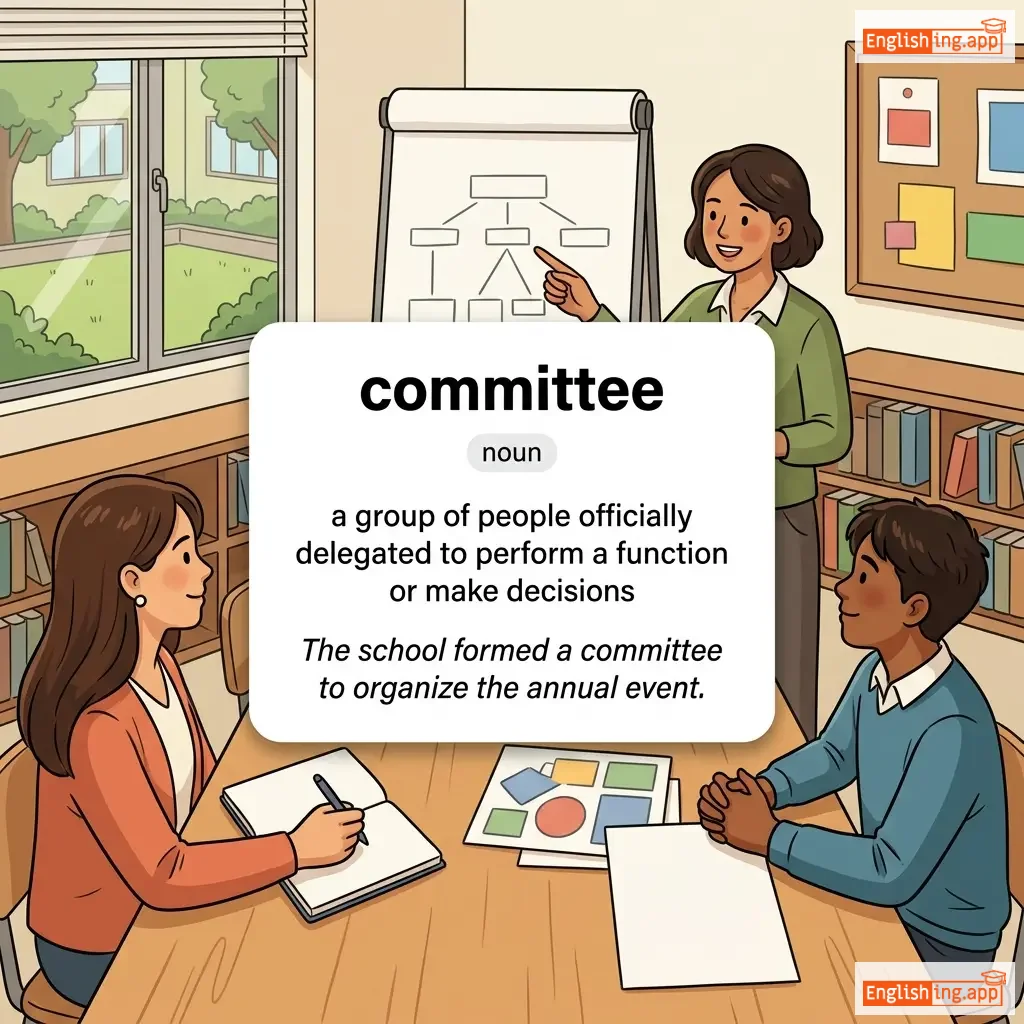
committee definition card — visual illustration of the meaning
noun
/kəˈmɪt.i/
комитет (komitet)

a group of people officially delegated to perform a function or make decisions

"The school formed a committee to organize the annual event."
"Школа создала комитет для организации ежегодного мероприятия." (Shkola sozdala komitet dlya organizatsii ezhegodnogo meropriyatiya.)
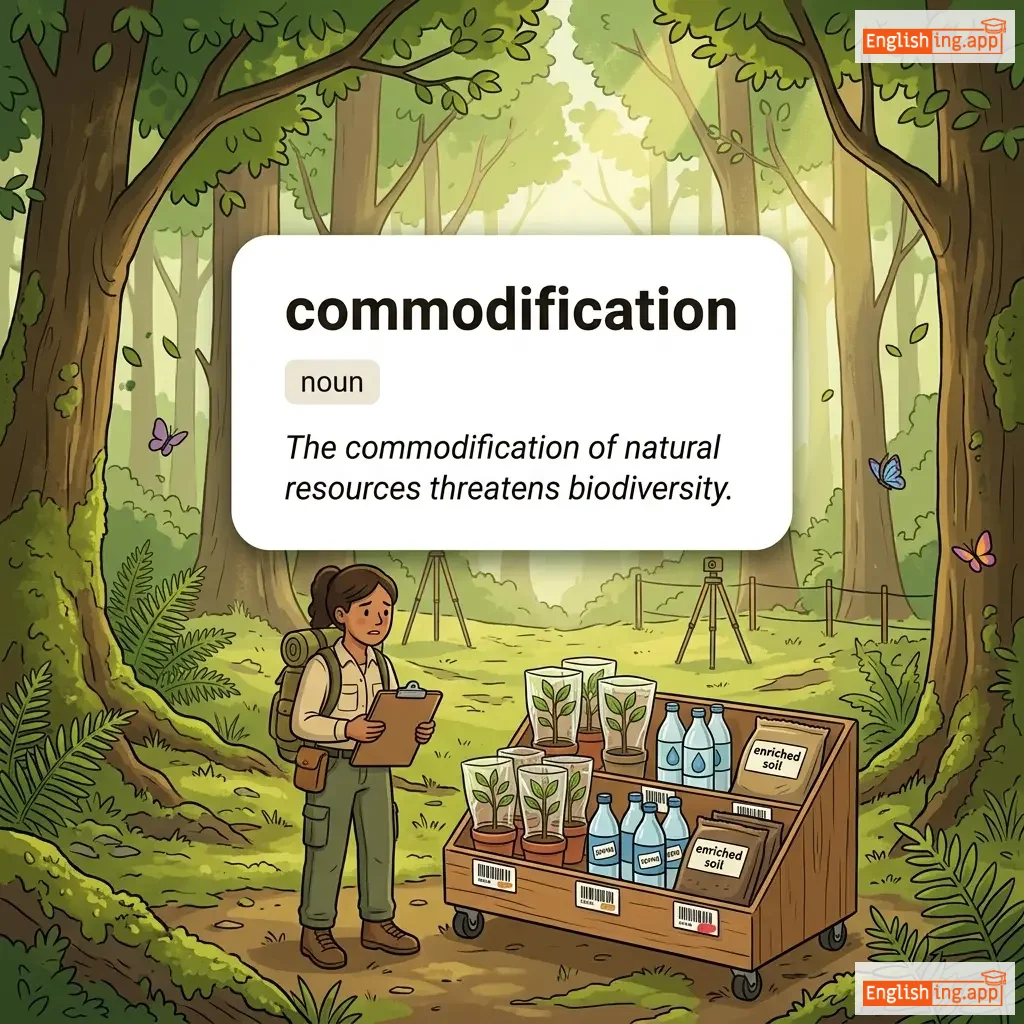
commodification definition card — visual illustration of the meaning
noun
kəˌmɒd.ɪ.fɪˈkeɪ.ʃən
преобразование товаров, услуг, идей или других объектов в рыночные товары (preobrazovanie tovarov, uslug, idey ili drugikh ob'ektov v rynochnye tovarы)

The transformation of goods, services, ideas, or other entities that may not normally be considered goods into market goods.

"The commodification of natural resources threatens biodiversity."

"Комодификация природных ресурсов угрожает биологическому разнообразию." (Komodifikatsiya prirodnykh resursov ugrozhaet biologicheskomu raznoobraziyu.)
adjective
/kəˈmoʊdiəs/
просторный (prostornyy)

spacious and comfortable; having plenty of room

"They rented a commodious apartment in the city."

"Они арендовали просторную квартиру в городе." (Oni arendovali prostornuyu kvartiru v gorode.)
commodities definition card — visual illustration of the meaning
noun
/kəˈmɒd.ə.tiz/
товары (tovary)

Raw materials or primary agricultural products that can be bought and sold.

"The price of commodities fluctuates due to market demand."

"Цена товаров колеблется из-за рыночного спроса." (Tsená tovarov koleblyetsya iz-za rynochnogo sprosa.)
commodity definition card — visual illustration of the meaning
noun
/kəˈmɑːdəti/
товар (tovar)

a raw material or primary product that can be bought and sold

"Oil is the most traded commodity in the world."

"Нефть — это самый торгуемый товар в мире." (Neft eto samyi torguemyi tovar v mire)
adjective
/ˈkɒm.ən/
общий (obshchiy)

occurring frequently or widely; shared by all

"It is common to see traffic in the city during rush hour."

"Обычно в городе можно увидеть пробки в часы пик." (Obychno v gorode mozhno uvidet' probki v chasy pik)
noun
/ˈkɒmən kɑːp/
обыкновенный карп (obyknovennyy karp)

A large freshwater fish widely cultivated for food

"Common carp is an important fish in aquaculture."

"Обыкновенный карп — важная рыба в аквакультуре." (obyknovennyy karp vazhnaya ryba v akvakulture)
adverb
/ˈkɒmənli/
обычно (obychno)

usually or by most people

"This phrase is commonly used in everyday speech."

"Эта фраза обычно используется в повседневной речи." (Eta fraza obychno ispol'zuetsya v povsednevnoj rechi.)
adjective, noun
/ˈkɑːmənpleɪs/
обычное явление (obychnoe yavlenie)

ordinary or unremarkable; something that is usual or commonly found

"Smartphones have become commonplace in modern life."

"Смартфоны стали обычным явлением в современной жизни." (Smartfony stali obychnym yavleniem v sovremennoy zhizni.)
adjective
/ˌkɑːmənˈsɛnsɪkəl/
здравомыслящий (zdravomyslyashchiy)

based on or showing sound practical judgment; sensible

"It was commonsensical to carry an umbrella on a rainy day."

"Было здравомысляще взять зонт в дождливый день." (Bylo zdravomyslyashche vzyat zont v dozhdlivyy den.)
noun
/ˈkɑːmənˌwɛlθ/
Содружество (Sodruzhestvo)

an independent community or state, especially one founded for the common good; also an association of nations

"Australia is a member of the Commonwealth of Nations."

"Австралия является членом Содружества Наций." (Avstraliya yavlyaetsya chlenom Sodruzhestva Natsiy.)
noun
/kəˈmoʊʃən/
суматоха (sumatoha)

A state of noisy confusion or disturbance.

"The sudden commotion in the market drew everyone's attention."

"Внезапная суматоха на рынке привлекла внимание всех." (Vnezapnaya sumatoha na rynke privlekla vnimanie vsekh.)
adjective
/ˈkɑːmjənl/
общинный (obshchinnij)

Shared by all members of a community; for common use.

"The villagers worked together in the communal garden."
"Жители деревни вместе работали в общинном саду." (Zhiteli derevni vmeste rabotali v obshchinnom sadu.)
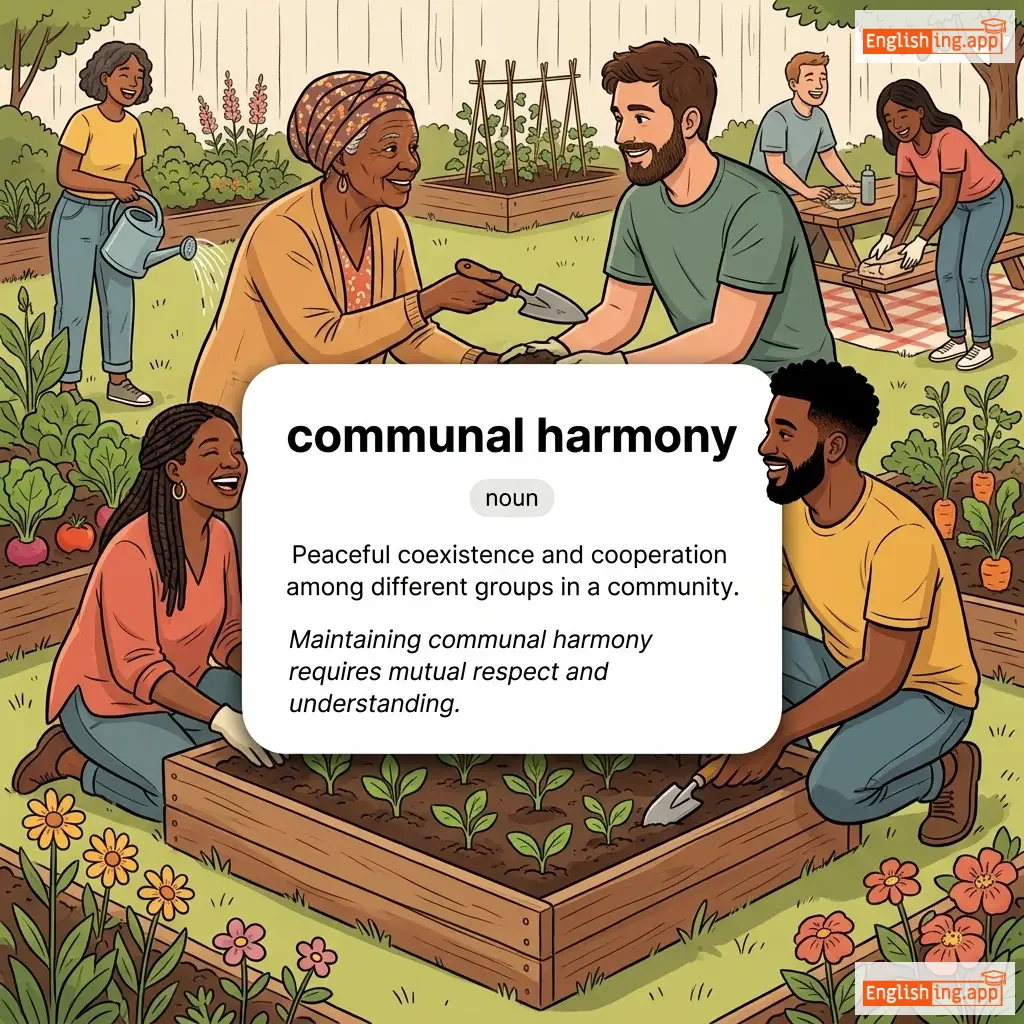
communal harmony definition card — visual illustration of the meaning
noun
kəˈmjunəl ˈhɑrməni
межобщинное согласие (mezhobschinnoe soglasie)

Peaceful coexistence and cooperation among different groups in a community.

"Maintaining communal harmony requires mutual respect and understanding."

"Поддержание межобщинного согласия требует взаимного уважения и понимания." (podderzhanie mezhobschinnogo soglasiya trebuet vzaimnogo uvazheniya i ponimaniya)
noun, verb
/ˈkɒmjuːn/
коммуна / общаться душевно (kommuna / obshchatsya dushevno)

Noun: a group of people living together and sharing possessions; Verb: to share one's thoughts or feelings intimately.

"She went to the countryside to commune with nature."

"Она поехала в деревню, чтобы общаться с природой." (Ona poekhaya v derevnyu chtoby obshchatsya s prirodoy.)
verb
/kəˈmjuː.nɪ.keɪt/

to share or exchange information, ideas, or feelings

"They used gestures to communicate across the noisy room."

communication definition card — visual illustration of the meaning
noun
/kəˌmjuː.nɪˈkeɪ.ʃən/
коммуникация (kommunikatsiya)

the act or process of sharing information, ideas, or feelings

"Good communication is essential for a strong relationship."

"Хорошая коммуникация важна для крепких отношений." (Khoroshaya kommunikatsiya vazhna dlya krepkikh otnosheniy.)
noun
/ˈkɒmjʊnɪst/

a person who supports or believes in the principles of communism

"The communist ideology aims for a classless society."

noun
/kəˈmjuː.nə.ti/
сообщество (soobshchestvo)

a group of people living in the same place or sharing common interests

"The community worked together to clean the park."

"Сообщество работало вместе, чтобы очистить парк." (Soobshchestvo rabotalo vmeste, chtoby ochistit' park.)
Community Programs definition card — visual illustration of the meaning
noun
kəˈmjuːnɪti ˈprəʊɡræmz
общественные программы (obshchestvennye programmy)

Organized activities involving local groups to promote environmental conservation.

"Community programs raise awareness about butterfly conservation."

"Общественные программы повышают осведомленность о сохранении бабочек." (Obshchestvennye programmy povyshayut osvedomlennost' o sokhranenii babochek.)
community service ideals definition card — visual illustration of the meaning
noun
kəˈmjuːnɪti ˈsɜːrvɪs aɪˈdiːəlz
идеалы общественной службы (idealy obshchestvennoy sluzhby)

Principles and standards of serving the community for social good.

"Community service ideals must be taught in schools."

"Идеалы общественной службы должны преподаваться в школах." (Idealy obshchestvennoy sluzhby dolzhny prepodavat'sya v shkolakh.)
verb, noun
/kəˈmjuːt/
поездка на работу (poezdka na rabotu)

Verb: to travel regularly between home and work; Noun: the journey to and from work.

"He commutes two hours every day to reach his office."

"Он каждый день ездит по два часа, чтобы добраться до офиса." (On kazhdyi den ezdit po dva chasa chtoby dobratsya do ofisa)
commuting definition card — visual illustration of the meaning
noun/verb
/kəˈmjuː.tɪŋ/
ежедневные поездки (ezhednevnie poezdki)

Regular travel to and from workplace, daily journey for work.

"He spends two hours commuting to work every day."

"Он тратит два часа на поездки на работу каждый день." (On tratit dva chasa na poezdki na rabotu kazhdyi den.)
adjective, noun, verb
/ˈkɒmpækt/ (adj, n), /kəmˈpækt/ (verb)
компактный / маленький / соглашение (kompaktny / malenkiy / soglashenie)

Adjective: closely and neatly packed together; Noun: a small case or agreement; Verb: to pack closely together.

"The car is small and compact, perfect for city driving."

"Машина маленькая и компактная, идеально подходит для городской езды." (mashina malenkiya i kompaktnaya, idealno podkhodit dlya gorodskoy ezdy.)
compactly definition card — visual illustration of the meaning
adverb
kəmˈpæktli
компактно (kompaktno)

In a closely packed or dense manner.

"Protons and neutrons are compactly arranged."

"Протоны и нейтроны организованы компактно." (Protony i neytrony organizovany kompaktno.)