Vocabulaires

Découvrez, apprenez et maîtrisez le vocabulaire anglais

adjective
/ˈsɛksi/
attirant (attirant)

sexually attractive or exciting

"She wore a sexy red dress to the party."

"Elle portait une robe rouge attirante à la fête." (Elle portait une robe rouge attirante à la fête.)
adjective
/ˈʃæbi/
usé (use)

In poor condition through long use or lack of care; of low quality.

"The hotel room looked shabby and old-fashioned."

"La chambre d'hôtel avait l'air usée et démodée." (La chambre d'hôtel avait l'air usée et démodée.)
noun
/ʃæk/
cabane (cabane)

a small, roughly built house or hut, often poor or temporary

"They spent the weekend in a small wooden shack by the river."

"Ils ont passé le week-end dans une petite cabane en bois près de la rivière." (Ils ont passe le weekend dans une petite cabane en bois pres de la riviere.)
verb
/ˈʃækəl/
chaîner (chainé)

to chain or restrain; to restrict someone’s actions or freedom

"Outdated regulations shackle small businesses and slow innovation."

"Les anciennes régulations enchaînent les petites entreprises et ralentissent l'innovation." (Les anciennes régulations enchaînent les petites entreprises et ralentissent l'innovation.)
noun
/ˈʃæd.ək/
pomelo (pomelo)

a large citrus fruit similar to grapefruit; pomelo

"The shaddock is the largest citrus fruit in the world."

"Le shadok est le plus grand fruit agrume du monde." (Le shadok est le plus grand fruit agrume du monde.)
noun, verb
/ʃeɪd/
ombre (ombre)

a sheltered or darker area where direct light is blocked; to block light from something

"We sat under the tree for some shade."

"Nous nous sommes assis sous l'arbre pour un peu d'ombre." (Nous nous sommes assis sous l'arbre pour un peu d'ombre.)
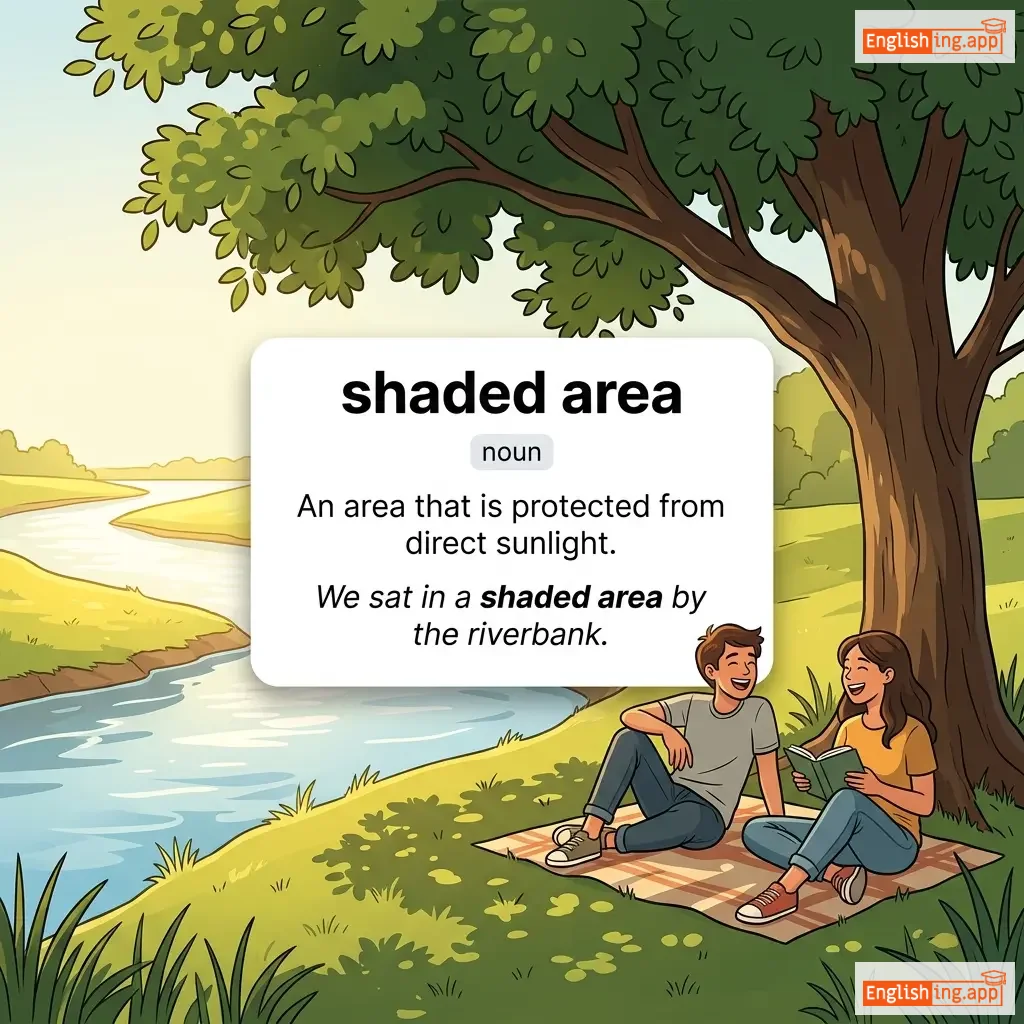
shaded area definition card — visual illustration of the meaning
noun
ˈʃeɪdɪd ˈɛəriə
zone ombragée (zone ombragee)

An area that is protected from direct sunlight.

"We sat in a shaded area by the riverbank."

"Nous nous sommes assis dans une zone ombragée près de la rive." (Nous nous sommes assis dans une zone ombragee pres de la rive.)
noun, verb
/ˈʃæd.oʊ/
ombre (ombre)

a dark area or shape made when something blocks light; to follow or observe secretly

"His shadow stretched long in the evening sun."

"Son ombre s'étirait longue sous le soleil du soir." (Son ombre s'étirait longue sous le soleil du soir.)
adjective
/ˈʃeɪ.di/
ombragé; suspect; malhonnête; (ombrege; suspect; malhonnete)

providing shade; dishonest; suspicious

"The shady businessman made a suspicious deal."

"Le commerçant ombragé a conclu une affaire suspecte." (Le commerçant ombragé a conclu une affaire suspecte.)
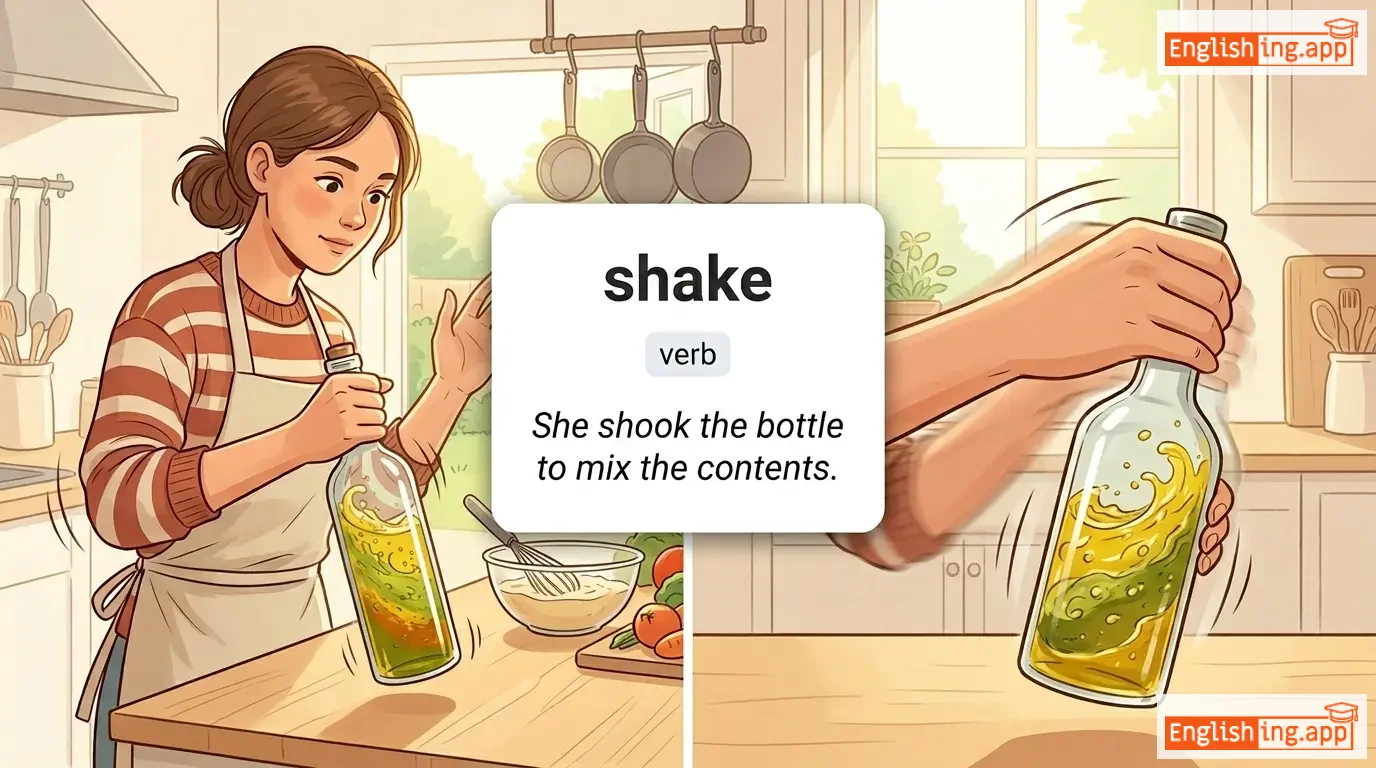
shake definition card — visual illustration of the meaning
verb
/ʃeɪk/
secouer (secouer)

to move or cause to move up and down or from side to side with rapid, short movements

"She shook the bottle to mix the contents."

"Elle secoua la bouteille pour mélanger le contenu." (Elle secoua la bouteille pour mélanger le contenu.)
adjective
/ˈʃeɪ.ki/
instable; tremblant; peu fiable; faible (instable; tremblant; peu fiable; faible)

unstable; trembling; unreliable; weak

"His voice was shaky with nervousness."

"Sa voix était tremblante de nervosité." (Sa voix était tremblante de nervosité.)
noun
/ʃeɪl/
schiste (schiste)

a fine-grained sedimentary rock that can be split into thin layers

"The region is rich in shale and natural gas deposits."

"La région est riche en schiste et en dépôts de gaz naturel." (La région est riche en schiste et en dépôts de gaz naturel.)
modal verb
/ʃæl/
devoir (devoir)

used to express the future or indicate an intention or determination

"I shall return before sunset."

"Je reviendrai avant le coucher du soleil." (Je reviendrai avant le coucher du soleil.)
adjective
/ˈʃæl.oʊ/
peu profond (peu profond)

not deep; lacking depth of thought or feeling

"The children played in the shallow water near the shore."

"Les enfants jouaient dans l'eau peu profonde près du rivage." (Les enfants jouaient dans l'eau peu profonde près du rivage.)
noun, adjective, verb
/ʃæm/
supercherie (supercherie)

something that is not what it appears to be; a false or fake thing; to pretend

"The deal turned out to be a sham."

"L'accord s'est avéré être une supercherie." (L'accord s'est avéré être une supercherie.)
noun
/ˈʃæmbəlz/
désordre total (desordre total)

a state of complete disorder or ruin

"After the storm, the whole town was in shambles."

"Après la tempête, toute la ville était en désordre total." (Apres la tempete, toute la ville etait en desordre total.)
noun
/ʃeɪm/
honte (honte)

a painful feeling of humiliation or distress caused by the consciousness of wrong or foolish behavior

"He felt deep shame after lying to his friend."

"Il ressentit une profonde honte après avoir menti à son ami." (Il ressentit une profonde honte apres avoir menti a son ami.)
adjective
/ˈʃeɪm.fəl/
honteux; disgracieux; embarrassant (honteux; disgracieux; embarrassant)

causing shame; disgraceful; embarrassing

"His shameful behavior embarrassed the entire family."

"Son comportement honteux a embarrassé toute la famille." (Son comportement honteux a embarrassé toute la famille.)
adjective
/ˈʃeɪm.ləs/
impudique (shaymless)

having no shame; bold and rude; impudent

"The shameless politician refused to apologize for his mistakes."

"Le politicien sans honte a refusé de s'excuser pour ses erreurs." (lepoliticiensanshontearefusedesexcuserpourseserreurs)
noun
/ˌʃæŋɡriˈlɑː/
paradis imaginaire (paradis imaginaire)

a remote, beautiful, imaginary place where life is perfect and peaceful

"They described the island as a modern-day Shangri-La."

"Ils ont décrit l'île comme un Shangri-La moderne." (Ils ont décrit l'île comme un Shangri-La moderne.)
noun
/ʃeɪp/
forme (forme)

the external form, contours, or outline of someone or something

"The shape of the mountain was clearly visible from the valley."

"La forme de la montagne était clairement visible depuis la vallée." (La forme de la montagne était clairement visible depuis la vallée.)
adjective
/ʃeɪpt/
formé (formé)

having a particular form or appearance

"The sculpture was shaped like a human figure."

"La sculpture était formée comme une figure humaine." (La sculpture était formée comme une figure humaine.)
adjective
/ˈʃeɪp.ləs/
sans forme (sans forme)

having no definite or well-defined shape or form

"The fog created a shapeless mass in the distance."

"Le brouillard a créé une masse sans forme au loin." (Le brouillard a créé une masse sans forme au loin.)
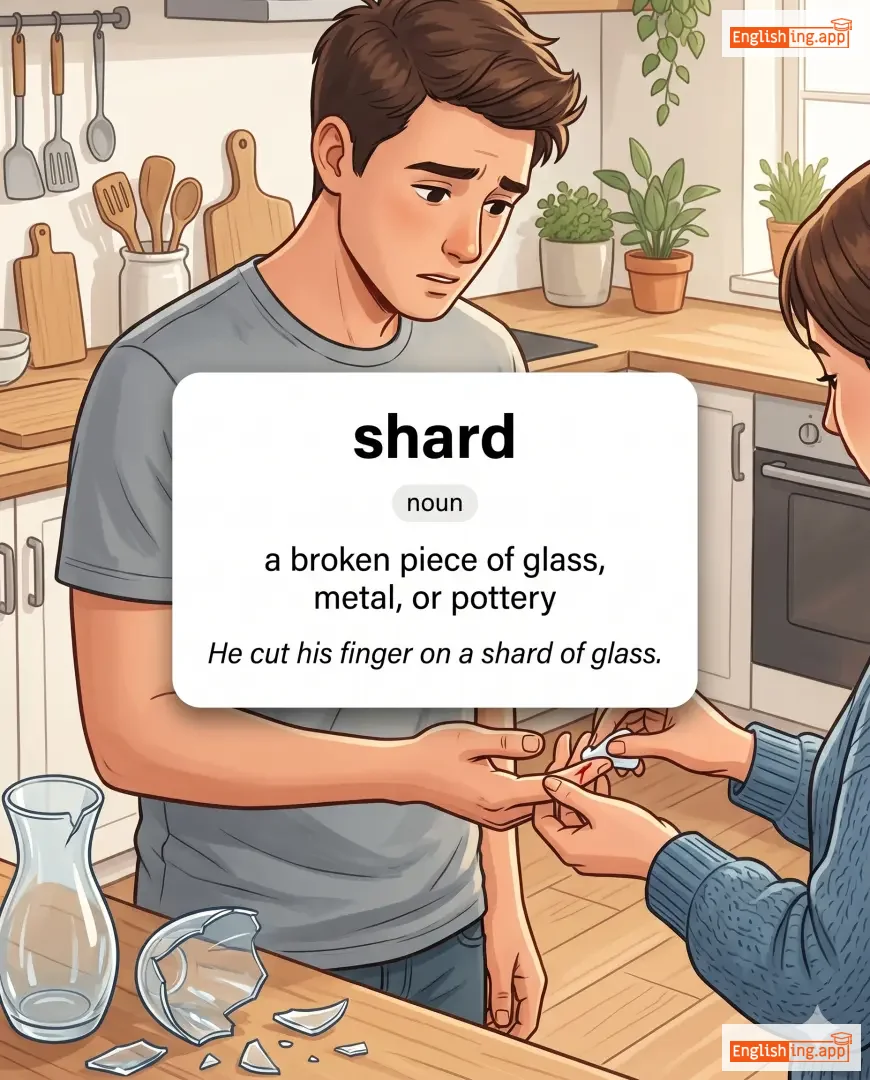
shard definition card — visual illustration of the meaning
noun
/ʃɑːrd/
éclat (eclat)

a broken piece of glass, metal, or pottery

"He cut his finger on a shard of glass."

"Il s'est coupé le doigt avec un éclat de verre." (Il s'est coupé le doigt avec un éclat de verre.)
verb
/ʃɛər/
partager (partager)

to give a portion of (something) to others or allow others to use or enjoy it

"She decided to share her lunch with her friends."

"Elle a décidé de partager son déjeuner avec ses amis." (Elle a décidé de partager son déjeuner avec ses amis.)
adjective
/ʃɛrd/
partagé (partage)

used, done, or experienced by two or more people together

"They live in a shared apartment near the university."

"Ils vivent dans un appartement partagé près de l'université." (Ils vivent dans un appartement partagé près de l'université.)
noun
/ˈʃɛərˌhoʊldər/
actionnaire (actionnaire)

an individual or organization that owns shares in a company

"Each shareholder has the right to vote at the annual meeting."

"Chaque actionnaire a le droit de voter lors de l'assemblée générale annuelle." (Chaque actionnaire a le droit de voter lors de l'assemblée générale annuelle.)
noun
/ʃɑːrk/
requin (requin)

a large fish with sharp teeth known for being a strong predator in the ocean

"The shark swam silently beneath the boat."

"Le requin nageait silencieusement sous le bateau." (Le requin nageait silencieusement sous le bateau.)
noun
/ˈʃær.ən fruːt/
fruit shéron (fruit sheron)

a sweet orange persimmon fruit that can be eaten when firm

"The Sharon fruit is sweet and can be eaten like an apple."

"le fruit shéron est sucré et peut être mangé comme une pomme." (le fruit shéron est sucré et peut être mangé comme une pomme.)
adjective
/ʃɑːrp/
tranchant (tranchant)

having a fine edge or point; keen

"The knife is sharp enough to cut through the meat easily."

"Le couteau est assez tranchant pour couper facilement la viande." (Le couteau est assez tranchant pour couper facilement la viande.)
adverb
/ˈʃɑːrpli/
brusquement (brusquement)

suddenly and strongly; in a cutting or intense way

"Prices rose sharply after the announcement."

"Les prix ont augmenté brusquement après l'annonce." (Les prix ont augmenté brusquement après l'annonce.)
verb
/ˈʃætər/
briser (briser)

To break suddenly into many small pieces.

"The glass will shatter if you drop it."

"Le verre se brisera si vous le laissez tomber." (Le verre se brisera si vous le laissez tomber.)
verb, noun
/ʃeɪv/
raser (raser)

To remove hair from the body, typically using a razor; the act of removing hair

"He likes to shave every morning before work."

"Il aime se raser chaque matin avant le travail." (Il aime se raser chaque matin avant le travail)
noun
/ˈʃeɪvɪŋ/
rasage (rasage)

the act of removing hair with a razor; a thin strip or piece shaved from something

"He bought a new cream for shaving."

"Il a acheté une nouvelle crème pour le rasage." (Il a acheté une nouvelle crème pour le rasage.)
pronoun
/ʃi/
elle (elle)

a female person or animal previously mentioned or easily identified

"She is going to the market to buy vegetables."

"Elle va au marché acheter des légumes." (Elle va au marche acheter des legumes.)
noun
/ʃiːf/
gerbe de blé (gerbe de ble)

a bundle of grain stalks laid lengthwise and tied together after reaping; a bundle of objects tied together

"The farmer carried a sheaf of wheat on his shoulder."

"Le fermier portait une gerbe de blé sur son épaule." (Le fermier portait une gerbe de blé sur son épaule.)
verb
/ʃɪə/
couper (couper)

to cut the wool off a sheep or to cut something with sharp tools like scissors or shears

"The farmer will shear the sheep in the spring."

"L'agriculteur shear le mouton au printemps." (L'agriculteur shear le mouton au printemps.)
noun
/ʃiːt fɪʃ/
silure (silur)

A large freshwater catfish with a broad flat head and long barbels

"The sheat-fish is one of the largest freshwater fish in South Asia."

"Le silure est l’un des plus grands poissons d’eau douce d’Asie du Sud." (Le silur est lun des plu gran poisson do douce dAsi du Sud)
verb
/ʃiːð/
remettre dans le fourreau (remettre dans le fourreau)

to put a sword or knife back into its cover

"He quickly sheathed his sword after the duel."

"Il remit rapidement son épée dans son fourreau après le duel." (Il remit rapidement son épée dans son fourreau après le duel.)
verb
/ʃɛd/
perdre (perdre)

to let something fall off naturally, such as leaves, hair, or tears

"Trees shed their leaves in autumn."

"Les arbres perdent leurs feuilles en automne." (Les arbres perdent leurs feuilles en automne.)
noun
/ʃiːp/
mouton (mouton)

a farm animal with thick wool that is raised for its wool, meat, and milk

"The farmer keeps a large flock of sheep."

"Le fermier garde un grand troupeau de moutons." (Le fermier garde un grand troupeau de moutons.)
adjective
/ʃɪə/
total (total)

complete and utter; very steep or transparent

"The cliff was a sheer drop into the sea."

"La falaise était une chute complète dans la mer." (La falaise était une chute complète dans la mer.)
noun
/ʃiːt/
drap (drap)

a large piece of cloth or paper, typically used to cover or protect something

"I need a clean sheet to cover the bed."

"J'ai besoin d'un drap propre pour couvrir le lit." (J'ai besoin d'un drap propre pour couvrir le lit.)
noun
/ʃɛlf/
étagère (etagere)

a flat surface used for storing or displaying things, typically fixed to a wall or inside a cabinet

"I placed the books on the shelf next to the window."

"J'ai posé les livres sur l'étagère près de la fenêtre." (J'ai posé les livres sur l'étagère près de la fenêtre.)
noun
/ʃɛl/
coquillage (koyiyaj)

the hard outer covering of a mollusk or a crustacean, or something similar

"She picked up a beautiful seashell on the beach."

"Elle a ramassé un joli coquillage sur la plage." (Elle a ramassé un joli coquillage sur la plage.)
noun
/ˈʃɛltər/
abri (abri)

a place giving temporary protection from bad weather or danger

"They found shelter from the storm in the nearby barn."

"Ils ont trouvé un abri contre la tempête dans la grange voisine." (Ils ont trouvé un abri contre la tempête dans la grange voisine.)
noun
/ˈʃepərd/
berger (berger)

a person who tends and guards sheep

"The shepherd guided his flock to the green pasture."

"Le berger guida son troupeau vers le pâturage vert." (Le berger guida son troupeau vers le pâturage vert.)
noun
/ˈʃɜːrbət/
sorbet (sorbet)

a sweet flavored drink or a frozen dessert made from sweetened fruit juice

"On hot days, she enjoys a glass of lemon sherbet."

"Lors des journées chaudes, elle apprécie un verre de sorbet au citron." (Lors des journées chaudes, elle apprécie un verre de sorbet au citron.)
noun
/ˈʃɪbəˌlɛθ/
expression ou croyance distinctive d'un groupe particulier (expression ou croyance distinctive d'un groupe particulier)

A custom, phrase, or belief distinguishing a particular group of people, often used to identify outsiders.

"The phrase became a political shibboleth during the campaign."

"La phrase est devenue un chibboleth politique pendant la campagne." (La phrase est devenue un chibboleth politique pendant la campagne.)
verb
/ʃɪft/
déplacer (deplacer)

To move or change from one place, position, or situation to another.

"She had to shift her focus to the new project."

"Elle a dû déplacer son attention vers le nouveau projet." (Elle a du deplacer son attention vers le nouveau projet.)