Vocabularios

Descubra, aprenda y domine el vocabulario en inglés

adjective
/dɪˈsɛnʃəs/
divisivo (divisivo)

Causing or likely to cause disagreement and conflict.

"His dissentious remarks divided the group further."

"Sus comentarios divisivos dividieron aún más al grupo." (Sus comentarios divisivos dividieron aún más al grupo.)
noun
/ˌdɪsərˈteɪʃən/
tesis (tesis)

A long piece of writing on a particular subject, usually written for a university degree.

"She spent two years writing her doctoral dissertation."

"Ella pasó dos años escribiendo su tesis doctoral." (Ella pasó dos años escribiendo su tesis doctoral.)
noun
/dɪsˈsɜːrvɪs/
perjuicio (perjuicio)

A harmful action; something that does damage rather than help.

"Spreading false information is a disservice to the community."

"Difundir información falsa es un perjuicio para la comunidad." (Difundir informacion falsa es un perjuicio para la comunidad.)
verb
/dɪˈsɛvər/
separar (separar)

To separate or cut apart.

"The treaty sought to dissever the two hostile regions."

"El tratado buscó separar las dos regiones hostiles." (El tratado busco separar las dos regiones hostiles.)
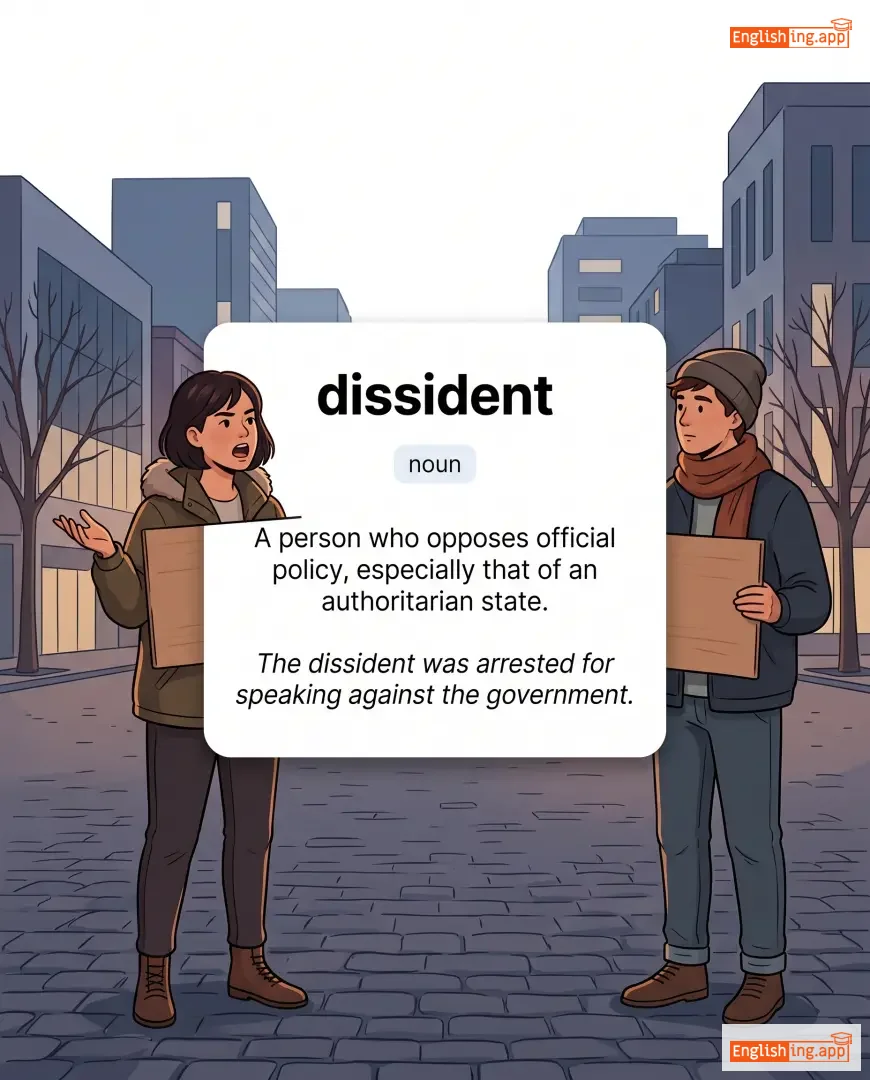
dissident definition card — visual illustration of the meaning
noun
/ˈdɪsɪdənt/
disidente (disidente)

A person who opposes official policy, especially that of an authoritarian state.

"The dissident was arrested for speaking against the government."

"El disidente fue arrestado por hablar en contra del gobierno." (El disidente fue arrestado por hablar en contra del gobierno.)
adjective
/dɪsˈsɪmɪlər/
diferente (diferente)

Not alike; different.

"Though they are twins, their personalities are dissimilar."

"Aunque son gemelos, sus personalidades son diferentes." (Aunke son jemelos, sus personalidades son diferentes.)
verb
/dɪˈsɪmjʊˌleɪt/
disimular (disimular)

To disguise or conceal one's true feelings or intentions.

"He tried to dissimulate his fear with a smile."

"Él intentó disimular su miedo con una sonrisa." (Él intentó disimular su miedo con una sonrisa.)
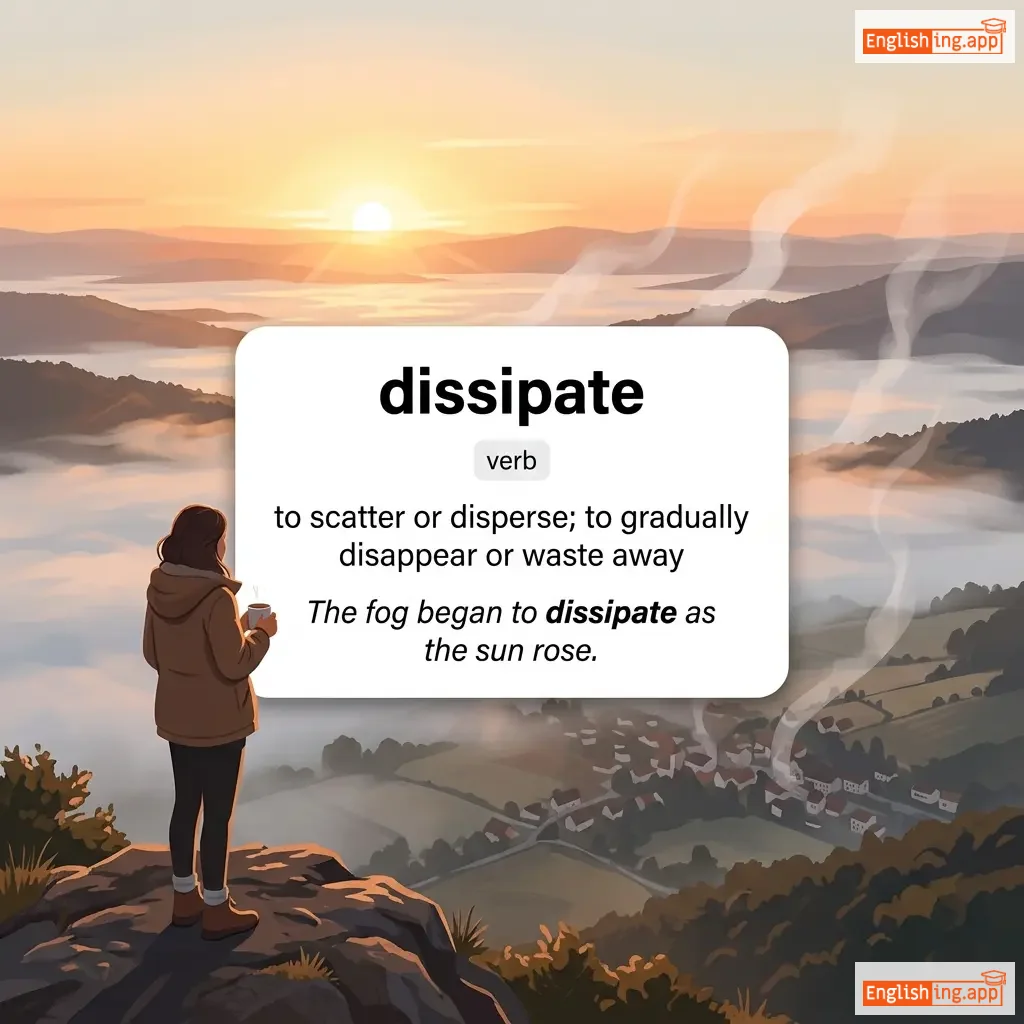
dissipate definition card — visual illustration of the meaning
verb
/ˈdɪsɪpeɪt/
disiparse (disiparse)

to scatter or disperse; to gradually disappear or waste away

"The fog began to dissipate as the sun rose."

"La niebla comenzó a disiparse cuando salió el sol." (La niebla comenzó a disiparse cuando salió el sol.)
noun
/ˌdɪsɪˈpeɪʃən/
desperdicio (desperdicio)

the process of disappearing or wasting; excessive indulgence in pleasure

"The dissipation of his fortune left him in poverty."

"El desperdicio de su fortuna lo dejó en la pobreza." (El desperdicio de su fortuna lo dejó en la pobreza.)
adjective
/ˈdɪsəluːt/
disoluto (disoluto)

lacking moral restraint; indulging excessively in sensual pleasures

"He led a dissolute life filled with parties and gambling."

"Él llevó una vida disoluta llena de fiestas y apuestas." (El llevo una vida disoluta llena de fiestas y apuestas.)
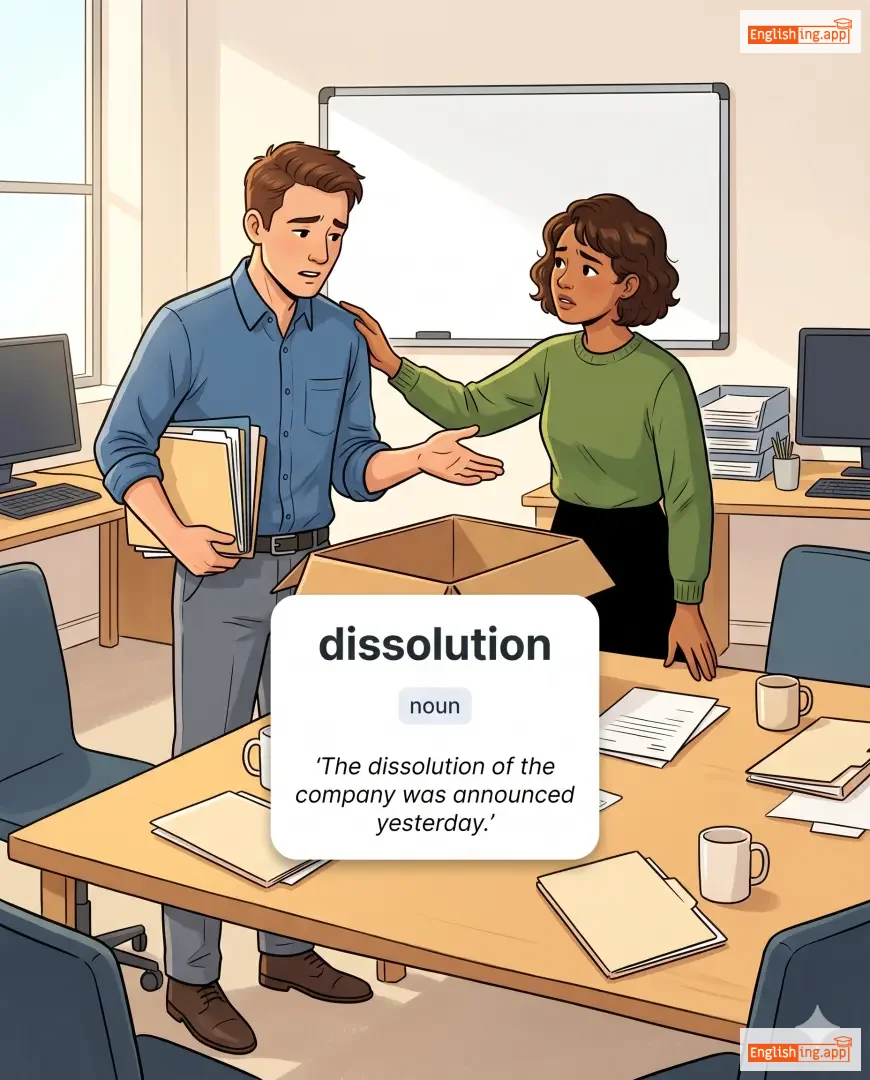
dissolution definition card — visual illustration of the meaning
noun
/ˌdɪsəˈluːʃən/
disolución (disolucion)

the act of formally ending or breaking apart something, such as an organization or marriage

"The dissolution of the company was announced yesterday."

"La disolución de la empresa fue anunciada ayer." (La disolucion de la empresa fue anunciada ayer.)
verb
/dɪˈzɒlv/
disolver (disolver)

to melt or become liquid; to officially end or break up an agreement or organization

"The sugar will dissolve quickly in hot tea."

"El azúcar se disolverá rápidamente en té caliente." (El azucar se disolvera rapidamente en te caliente.)
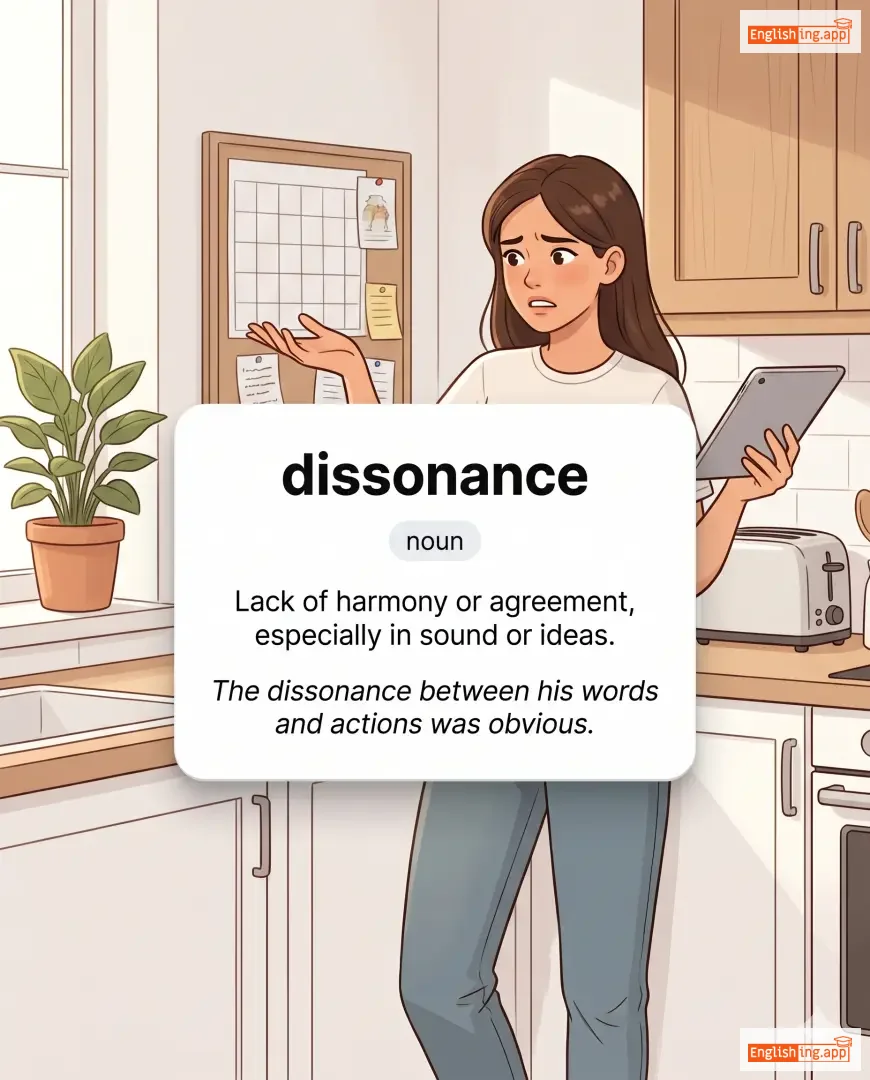
dissonance definition card — visual illustration of the meaning
noun
/ˈdɪsənəns/
disonancia (disonancia)

Lack of harmony or agreement, especially in sound or ideas.

"The dissonance between his words and actions was obvious."

"La disonancia entre sus palabras y acciones era evidente." (La disonancia entre sus palabras y acciones era evidente.)
adjective
/ˈdɪsənənt/
disonante (disonante)

Harsh and lacking harmony; conflicting.

"The orchestra produced a dissonant sound during rehearsal."

"La orquesta produjo un sonido disonante durante el ensayo." (La orquesta produjo un sonido disonante durante el ensayo.)
verb
/dɪˈsweɪd/
disuadir (disuadir)

To persuade someone not to do something.

"She tried to dissuade him from quitting his job."

"Ella intentó disuadirlo de dejar su trabajo." (Ella intentó disuadirlo de dejar su trabajo.)
noun
/dɪˈsweɪʒən/
desacuerdo (desacuerdo)

The act of persuading someone not to take a course of action.

"Her dissuasion prevented him from making a bad investment."

"Su desacuerdo le impidió hacer una mala inversión." (Su desacuerdo le impidió hacer una mala inversión.)
noun/adjective
/ˈdɪstæf/
relacionado con las mujeres, lado materno (relacionado con las mujeres, lado materno)

Relating to women or the maternal side of a family; also a tool for spinning thread.

"She came from the distaff side of a noble family."

"Ella vino del lado materno de una familia noble." (Ella vino del lado materno de una familia noble.)
verb
/dɪsˈteɪn/
despreciar (despreciar)

to treat with scorn or contempt (archaic form of disdain)

"He would never distain those who had less fortune than him."

"Él nunca despreciaba a aquellos que tenían menos fortuna que él." (El nunca despreciaba a aquellos que tenian menos fortuna que el.)
adjective
/ˈdɪstəl/
distal (distal)

situated away from the center of the body or from the point of attachment

"The doctor examined the distal end of the patient’s arm."

"El doctor examinó el extremo distal del brazo del paciente." (El doctor examino el extremo distal del brazo del paciente.)
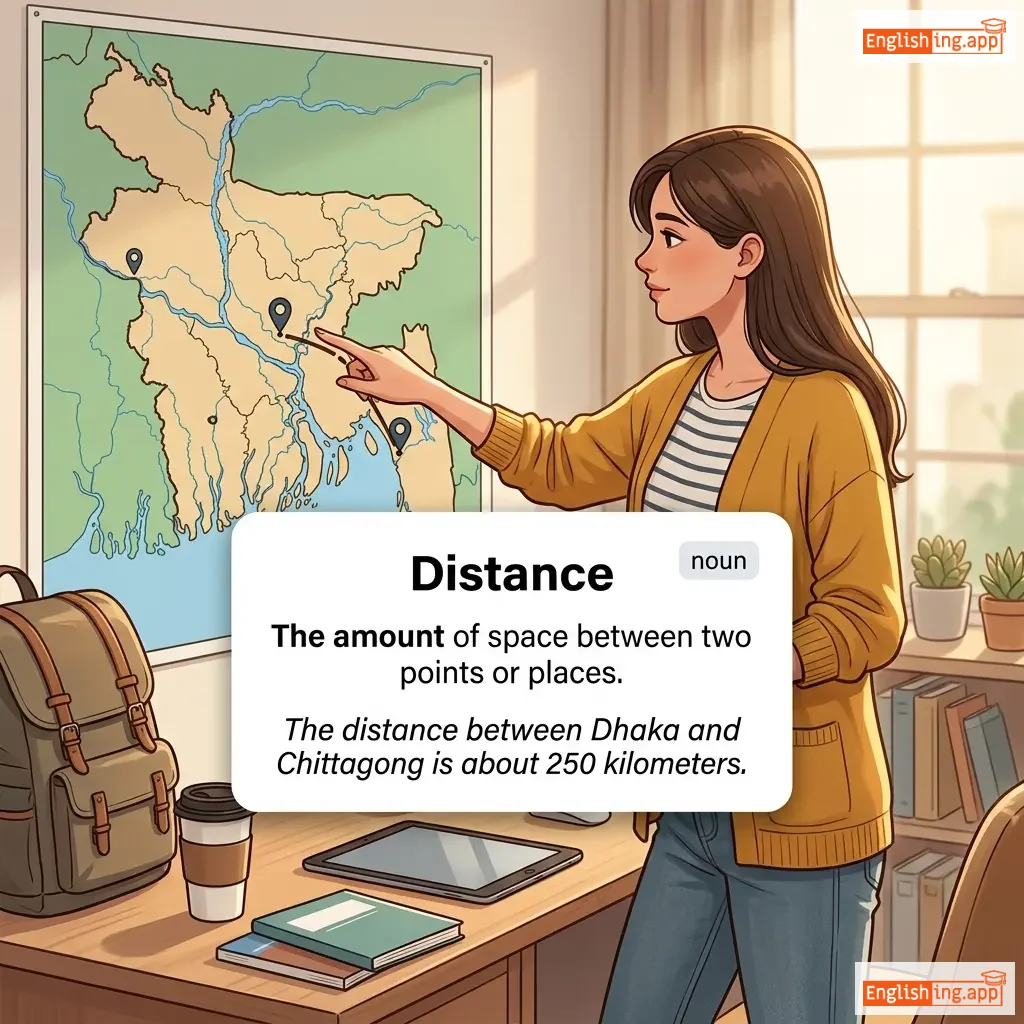
Distance definition card — visual illustration of the meaning
noun
/ˈdɪstəns/
distancia (distancia)

The amount of space between two points or places.

"The distance between Dhaka and Chittagong is about 250 kilometers."

"La distancia entre Dhaka y Chittagong es de aproximadamente 250 kilómetros." (La distancia entre Dhaka y Chittagong es de aproximadamente 250 kilómetros.)
adjective
/ˈdɪstənt/
distante (distante)

far away in space or time

"They could see the distant mountains from their home."

"Ellos podían ver las montañas distantes desde su casa." (Ellos podian ver las montañas distantes desde su casa.)
noun
/dɪsˈtɛmpər/
enfermedad viral que afecta a los animales, especialmente a los perros (enfermedad viral que afecta a los animales, especialmente a los perros)

a viral disease affecting animals, especially dogs; also refers to a state of disorder

"The dog was diagnosed with distemper and needed immediate care."

"El perro fue diagnosticado con distemper y necesitaba atención inmediata." (El perro fue diagnosticado con distemper y necesitaba atención inmediata.)
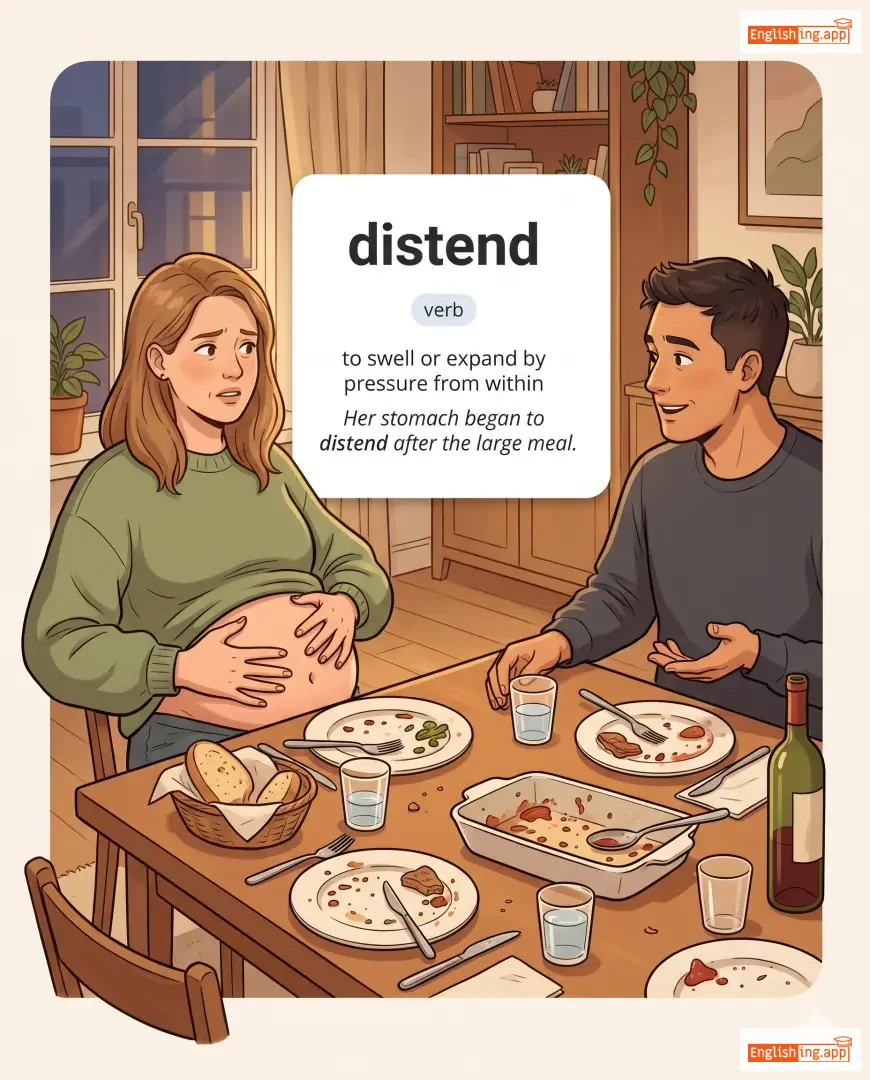
distend definition card — visual illustration of the meaning
verb
/dɪsˈtɛnd/
hinchar (hinchar)

to swell or expand by pressure from within

"Her stomach began to distend after the large meal."

"Su estómago comenzó a distenderse después de la gran comida." (Su estomago comenzo a distenderse despues de la gran comida.)
adjective
/dɪˈstɛnsəbl̩/
distensible (distensible)

Capable of being stretched or expanded.

"The stomach is a distensible organ that can expand after eating."

"El estómago es un órgano distensible que puede expandirse después de comer." (El estómago es un órgano distensible que puede expandirse después de comer.)
noun
/dɪˈstɛnʃən/
distensión (distension)

The state of being swollen due to internal pressure.

"The patient complained of abdominal pain and distention."

"El paciente se quejó de dolor abdominal y distensión." (El paciente se quejó de dolor abdominal y distensión.)
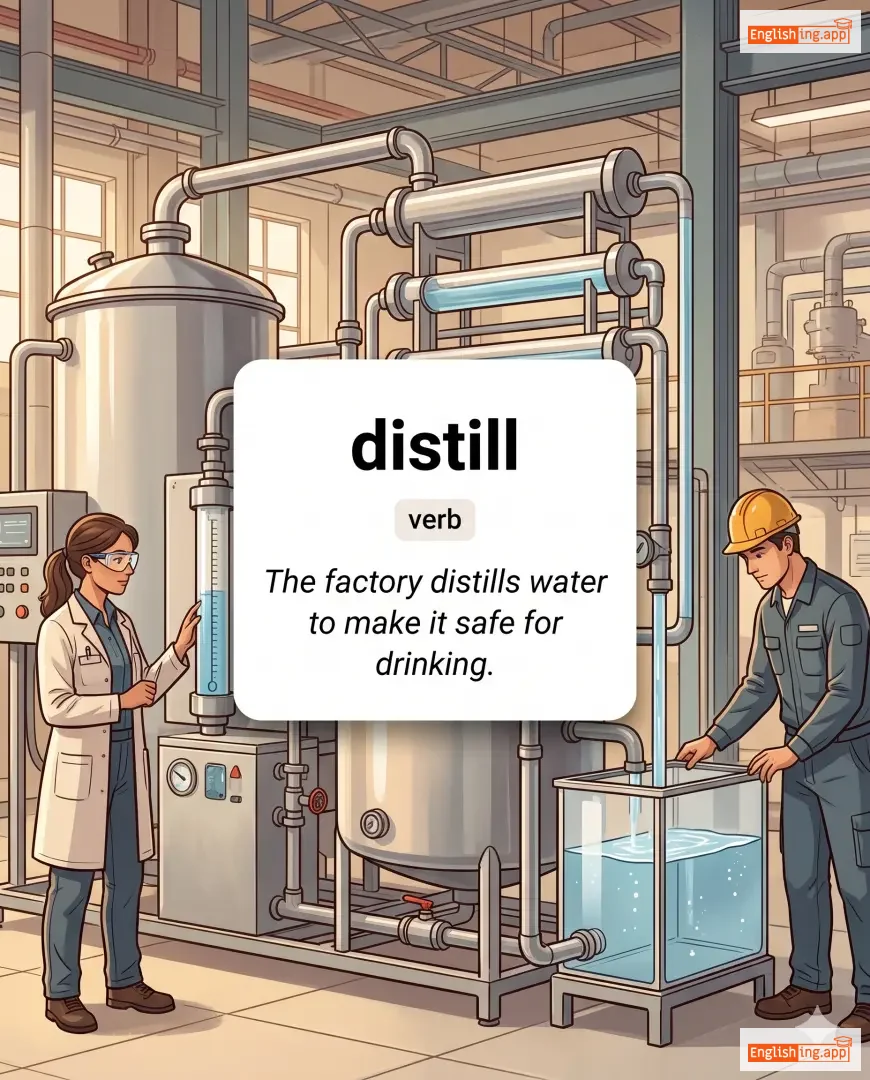
distill definition card — visual illustration of the meaning
verb
/dɪˈstɪl/
destilar (destilar)

To purify a liquid by heating and cooling; to extract the essential meaning or most important aspects.

"The factory distills water to make it safe for drinking."

"La fábrica destila agua para hacerla segura para beber." (La fabrica destila agua para hacerla segura para beber.)
noun
/ˌdɪstɪˈleɪʃən/
destilación (destilacion)

The process of purifying a liquid by heating and cooling; the extraction of the essential meaning.

"Distillation is commonly used to produce alcoholic beverages."

"La destilación se usa comúnmente para producir bebidas alcohólicas." (La destilacion se usa comunmente para producir bebidas alcoholicass.)
noun
/dɪˈstɪlər/
destilador (destilador)

A person or company that makes alcoholic drinks or purified liquids by distillation.

"The distiller introduced a new brand of whiskey last year."

"El destilador presentó una nueva marca de whisky el año pasado." (El destilador presentó una nueva marca de whisky el año pasado.)
adjective
/dɪˈstɪŋkt/
distinto (distinto)

clearly different or separate from others of its kind

"The twins have distinct personalities."

"Los gemelos tienen personalidades distintas." (Los gemelos tienen personalidades distintas.)
noun
/dɪˈstɪŋkʃən/
distinción (distincion)

a difference or contrast between similar things or people; excellence that sets someone apart

"She graduated with distinction from the university."

"Se graduó con distinción en la universidad." (Se graduo con distincion en la universidad.)
adjective
/dɪˈstɪŋktɪv/
distintivo (distintivo)

having a quality or characteristic that makes something different and easily noticed

"The restaurant is known for its distinctive flavors."

"El restaurante es conocido por sus sabores distintivos." (El restaurante es conocido por sus sabores distintivos.)
verb
/dɪˈstɪŋɡwɪʃ/
distinguir (distinguir)

to recognize or show the differences between two or more things; to set apart as different

"It can be difficult to distinguish between truth and rumor."

"Puede ser difícil distinguir entre la verdad y el rumor." (Puede ser difícil distinguir entre la verdad y el rumor.)
adjective
/dɪˈstɪŋɡwɪʃt/
distinguido; honorable; famoso; de apariencia o comportamiento digno (distinguido; honorable; famoso)

notable; honored; famous; having a dignified appearance or manner

"He is a distinguished professor at the university."

"Él es un profesor distinguido en la universidad." (Él es un profesor distinguido en la universidad.)
verb
/dɪˈstɔːrt/
distorsionar (distorsionar)

to twist or change the shape, appearance, or meaning of something so it is not true or accurate

"The mirror distorted her reflection."

"El espejo distorsionó su reflejo." (El espejo distorsionó su reflejo.)
noun
/dɪˈstɔːrʃən/
distorsión, presentación errónea (distorsion, presentacion erronea)

the action of twisting, changing, or misrepresenting the shape, sound, or truth of something

"There was a distortion in the radio signal."

"Hubo una distorsión en la señal de radio." (Hubo una distorsion en la senal de radio.)
verb
/dɪˈstrækt/
distraer (distraer)

to take someone's attention away from what they are doing or focusing on

"The loud noise distracted her during the exam."

"El ruido fuerte distrajo a ella durante el examen." (El ruido fuerte distrajo a ella durante el examen.)
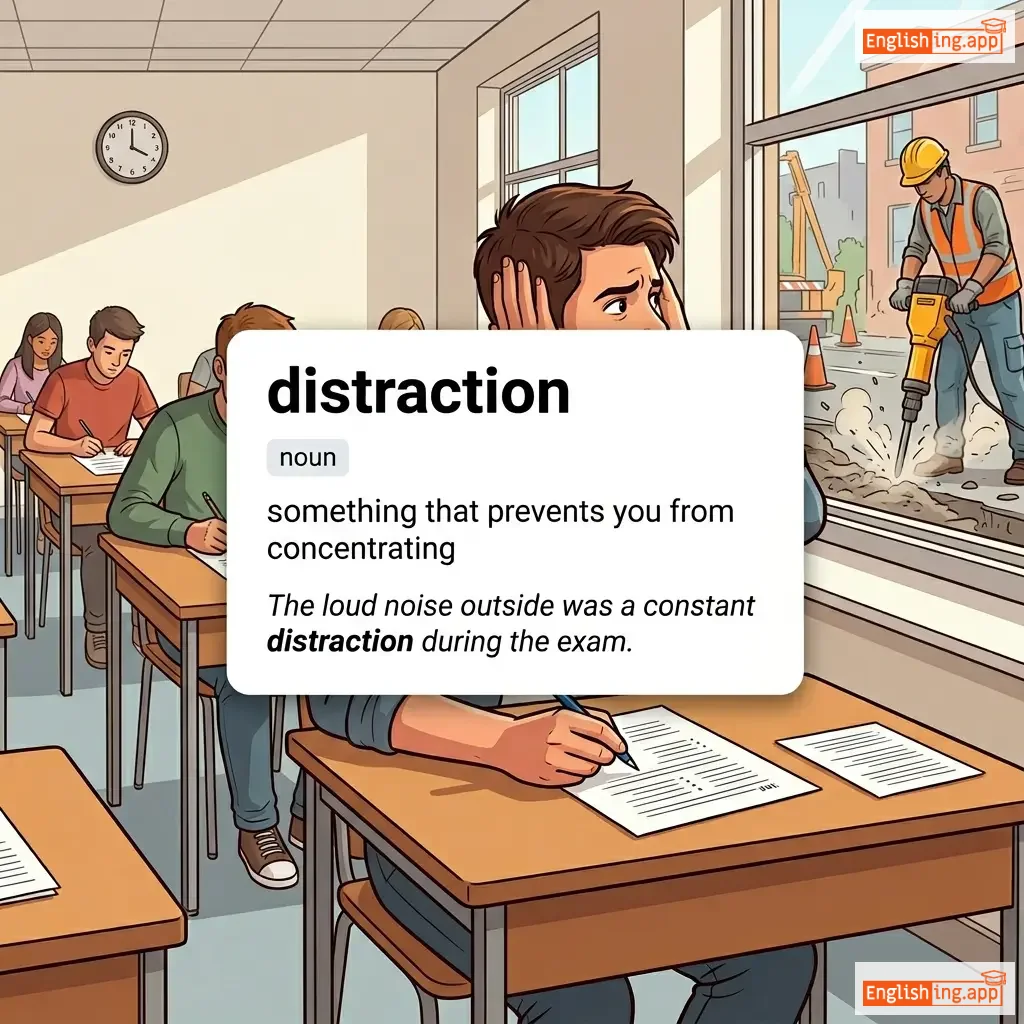
distraction definition card — visual illustration of the meaning
noun
/dɪˈstrækʃən/
distracción (distraccion)

something that prevents you from concentrating

"The loud noise outside was a constant distraction during the exam."

"El ruido fuerte fuera fue una distracción constante durante el examen." (El ruido fuerte fuera fue una distraccion constante durante el examen.)
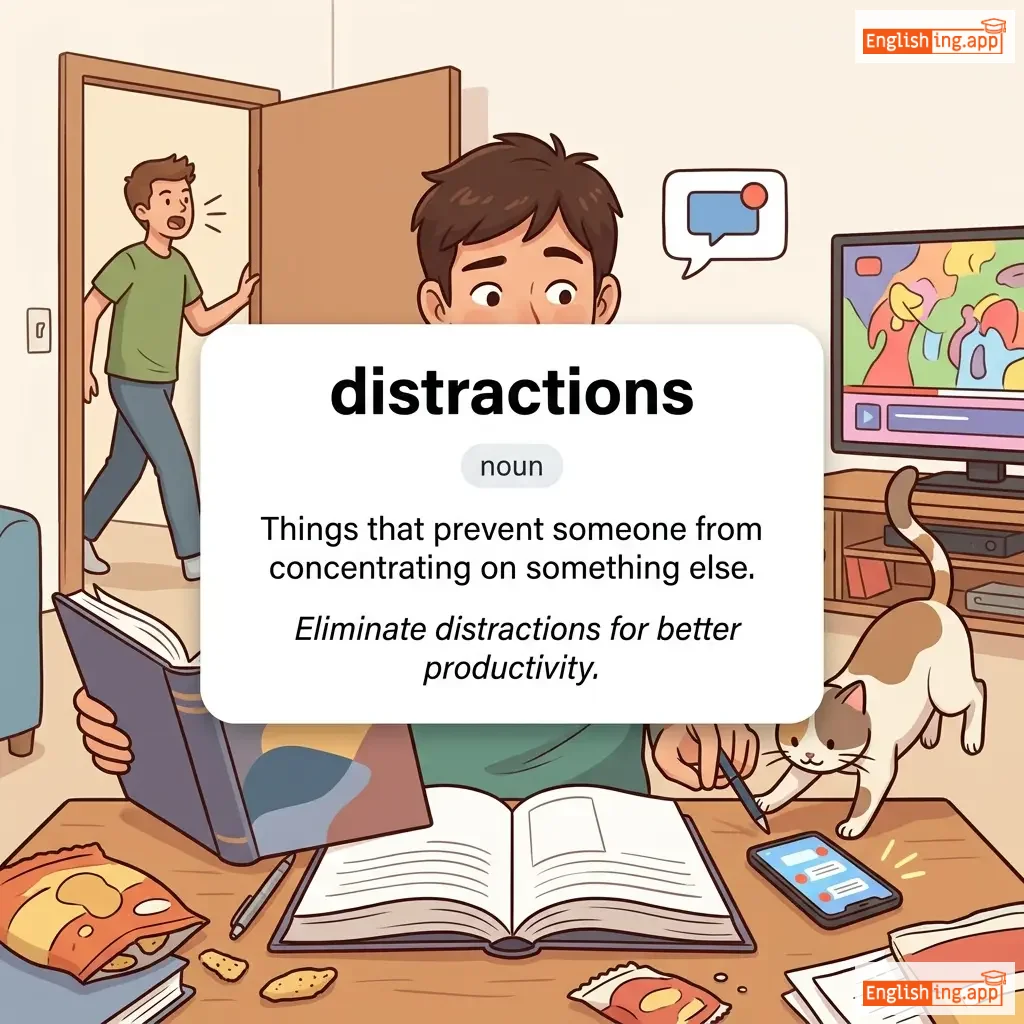
distractions definition card — visual illustration of the meaning
noun
/dɪˈstrækʃənz/
distracciones (distracciones)

Things that prevent someone from concentrating on something else.

"Eliminate distractions for better productivity."

"Elimina las distracciones para una mejor productividad." (Elimina las distracciones para una mejor productividad.)
verb
/dɪˈstreɪn/
embargar (embargar)

to seize someone's property in order to obtain payment of rent or other money owed

"The landlord distrained the tenant's furniture for unpaid rent."

"El arrendador embargó los muebles del inquilino por el alquiler impago." (El arrendador embargó los muebles del inquilino por el alquiler impago.)
noun
/dɪˈstreɪnər/
persona que embarga propiedades (persona que embarga propiedades)

a person, usually a landlord, who seizes another's property for unpaid debt or rent

"The distrainor took possession of the tenant's car until the debt was cleared."

"El distrainor tomó posesión del coche del inquilino hasta que la deuda fue saldada." (El distrainor tomó posesión del coche del inquilino hasta que la deuda fue saldada.)
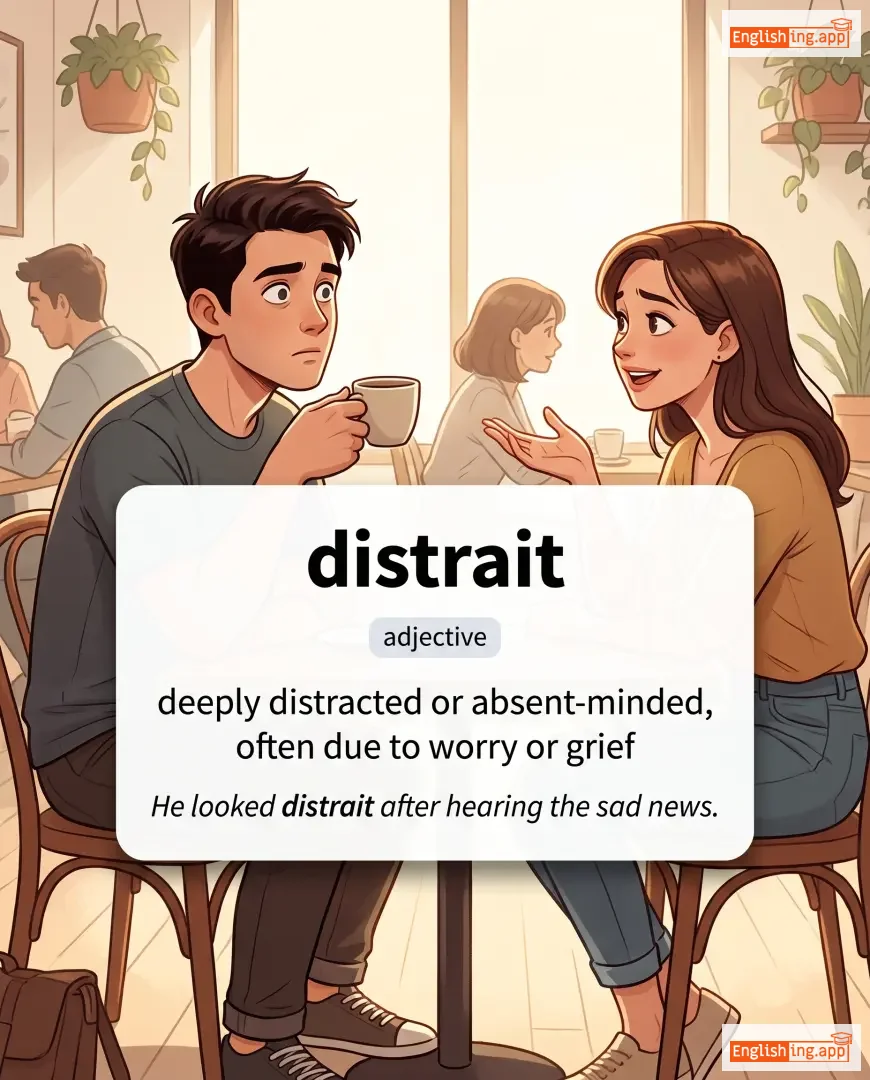
distrait definition card — visual illustration of the meaning
adjective
/dɪˈstreɪ/
distraído (distraido)

deeply distracted or absent-minded, often due to worry or grief

"He looked distrait after hearing the sad news."

"Él parecía distraído después de escuchar las malas noticias." (El parecia distraido despues de escuchar las malas noticias.)
adjective
/dɪˈstrɔːt/
desconcertado (desconcertado)

extremely upset and anxious, often to the point of being unable to think clearly

"She was distraught after losing her pet."

"Ella estaba desconcertada después de perder su mascota." (Ella estaba desconcertada después de perder su mascota.)
noun
/dɪsˈtrɛs/
angustia (angustia)

extreme anxiety, sorrow, or pain

"He felt a deep sense of distress when he heard the bad news."

"Sintió una gran angustia cuando escuchó las malas noticias." (Sintió una gran angustia cuando escuchó las malas noticias.)
adjective
/dɪˈstrɛst/
angustiado (angustiado)

feeling or showing extreme anxiety, sorrow, or pain

"She looked distressed after hearing the bad news."

"Ella se veía angustiada después de escuchar las malas noticias." (Ella se veía angustiada después de escuchar las malas noticias.)
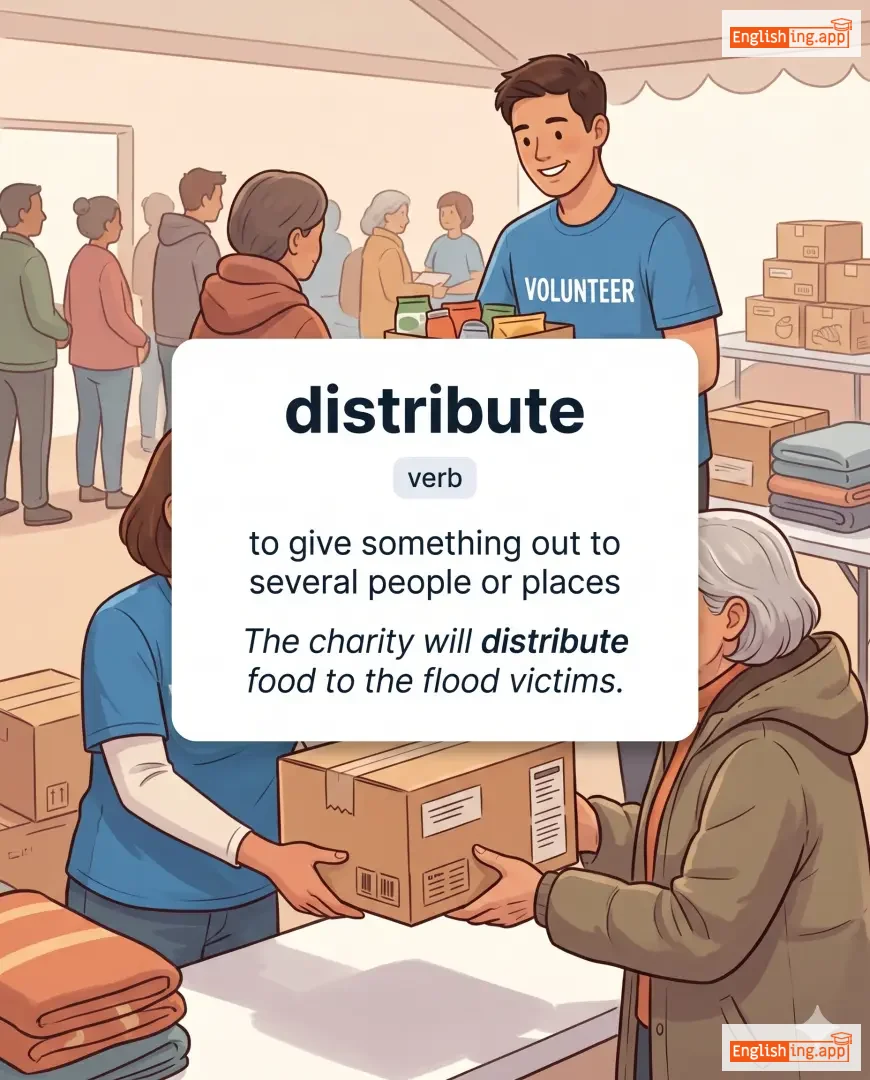
distribute definition card — visual illustration of the meaning
verb
/dɪˈstrɪbjuːt/
distribuir (distribuir)

to give something out to several people or places

"The charity will distribute food to the flood victims."

"La caridad distribuirá comida a las víctimas de las inundaciones." (La caridad distribuirá comida a las víctimas de las inundaciones.)
noun
/ˌdɪstrɪˈbjuːʃən/
distribución (distribucion)

the act of sharing or delivering something to multiple people or places

"The company manages the distribution of food supplies to rural areas."

"La empresa gestiona la distribución de suministros de alimentos a áreas rurales." (La empresa gestiona la distribucion de suministros de alimentos a areas rurales.)
noun
/ˈdɪstrɪkt/
distrito (distrito)

a specific area of a country, city, or town, often with official boundaries

"She lives in the northern district of the city."

"Ella vive en el distrito norte de la ciudad." (Ella vive en el distrito norte de la ciudad.)
verb
/dɪsˈtrʌst/
desconfiar (desconfiar)

to have no confidence or trust in someone or something

"Many people distrust politicians."

"Muchas personas desconfían de los políticos." (Muchas personas desconfían de los políticos.)
verb
/dɪsˈtɜːb/
molestar (molestar)

to interrupt or cause someone to stop what they are doing

"Please don’t disturb me while I’m studying."

"Por favor, no me moleste mientras estudio." (Por favor, no me moleste mientras estudio.)
noun
/dɪˈstɜː.bəns/
perturbación; disturbio; trastorno (perturbacion; disturbio; trastorno)

the interruption of a settled and peaceful condition; anxiety or mental uneasiness

"The loud music created a disturbance that bothered all the neighbors."

"La música alta causó una perturbación que molestó a todos los vecinos." (La musica alta causo una perturbacion que molesto a todos los vecinos.)