Vocabularios

Descubra, aprenda y domine el vocabulario en inglés

adjective
/ˈsɛksi/
atractivo (atraktivo)

sexually attractive or exciting

"She wore a sexy red dress to the party."

"Ella llevaba un vestido rojo atractivo en la fiesta." (Ella llevaba un vestido rojo atractivo en la fiesta.)
adjective
/ˈʃæbi/
desgastado (desgastado)

In poor condition through long use or lack of care; of low quality.

"The hotel room looked shabby and old-fashioned."

"La habitación del hotel se veía desgastada y anticuada." (La habitación del hotel se veía desgastada y anticuada.)
noun
/ʃæk/
choza (choza)

a small, roughly built house or hut, often poor or temporary

"They spent the weekend in a small wooden shack by the river."

"Pasaron el fin de semana en una pequeña choza de madera junto al río." (Pasaron el fin de semana en una pequena choza de madera junto al rio.)
verb
/ˈʃækəl/
esposar (esposar)

to chain or restrain; to restrict someone’s actions or freedom

"Outdated regulations shackle small businesses and slow innovation."

"Las regulaciones anticuadas encadenan a las pequeñas empresas y ralentizan la innovación." (Las regulaciones anticuadas encadenan a las pequeñas empresas y ralentizan la innovación.)
noun
/ˈʃæd.ək/
pomelo (pomelo)

a large citrus fruit similar to grapefruit; pomelo

"The shaddock is the largest citrus fruit in the world."

"El shádok es la fruta cítrica más grande del mundo." (El shádok es la fruta cítrica más grande del mundo.)
noun, verb
/ʃeɪd/
sombra (sombra)

a sheltered or darker area where direct light is blocked; to block light from something

"We sat under the tree for some shade."

"Nos sentamos bajo el árbol para un poco de sombra." (Nos sentamos bajo el arbol para un poco de sombra.)
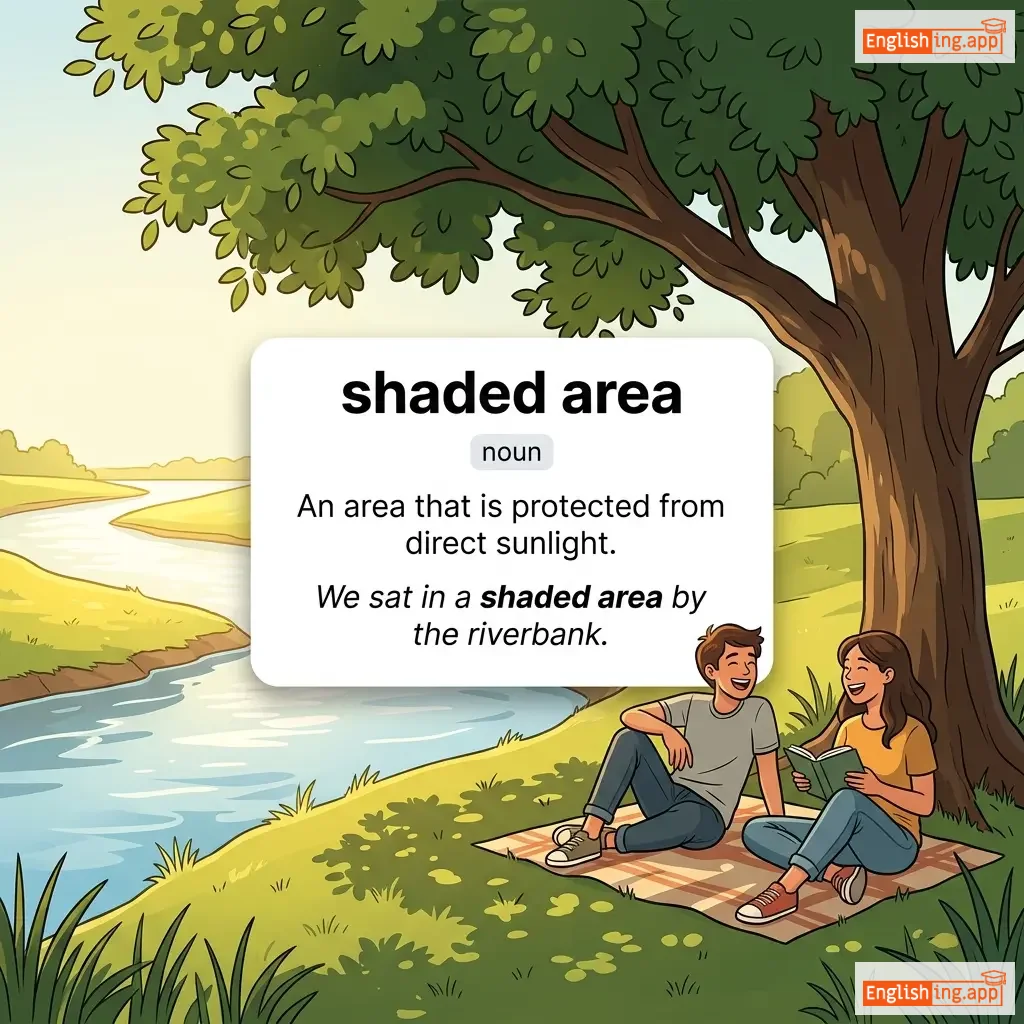
shaded area definition card — visual illustration of the meaning
noun
ˈʃeɪdɪd ˈɛəriə
área sombreada (area sombreada)

An area that is protected from direct sunlight.

"We sat in a shaded area by the riverbank."

"Nos sentamos en un área sombreada junto al río." (Nos sentamos en un area sombreada junto al río.)
noun, verb
/ˈʃæd.oʊ/
sombra (sombra)

a dark area or shape made when something blocks light; to follow or observe secretly

"His shadow stretched long in the evening sun."

"Su sombra se estiró larga en el sol de la tarde." (Su sombra se estiró larga en el sol de la tarde.)
adjective
/ˈʃeɪ.di/
sombrío; sospechoso; deshonesto; (sombrio; sospechoso; deshonesto)

providing shade; dishonest; suspicious

"The shady businessman made a suspicious deal."

"El comerciante sombrío hizo un trato sospechoso." (El comerciante sombrío hizo un trato sospechoso.)
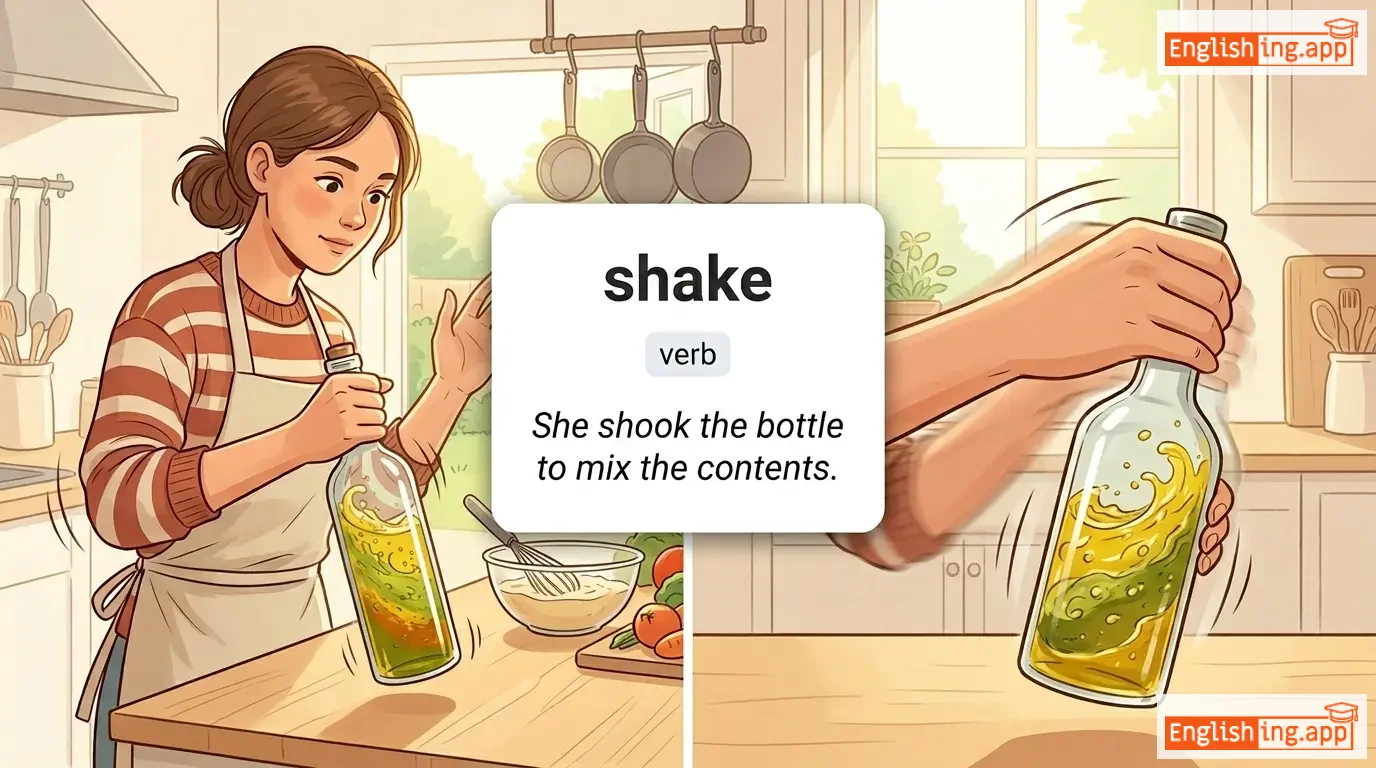
shake definition card — visual illustration of the meaning
verb
/ʃeɪk/
sacudir (sacudir)

to move or cause to move up and down or from side to side with rapid, short movements

"She shook the bottle to mix the contents."

"Ella sacudió la botella para mezclar los contenidos." (Ella sacudió la botella para mezclar los contenidos.)
adjective
/ˈʃeɪ.ki/
inestable; tembloroso; poco fiable; débil (inestable; tembloroso; poco fiable; debil)

unstable; trembling; unreliable; weak

"His voice was shaky with nervousness."

"Su voz estaba temblorosa por los nervios." (Su voz estaba temblorosa por los nervios.)
noun
/ʃeɪl/
pizarra (pizarra)

a fine-grained sedimentary rock that can be split into thin layers

"The region is rich in shale and natural gas deposits."

"La región es rica en pizarra y depósitos de gas natural." (La región es rica en pizarra y depósitos de gas natural.)
modal verb
/ʃæl/
deber (deber)

used to express the future or indicate an intention or determination

"I shall return before sunset."

"Volveré antes del atardecer." (Volveré antes del atardecer.)
adjective
/ˈʃæl.oʊ/
poco profundo (poco profundo)

not deep; lacking depth of thought or feeling

"The children played in the shallow water near the shore."

"Los niños jugaban en el agua poco profunda cerca de la orilla." (Los niños jugaban en el agua poco profunda cerca de la orilla.)
noun, adjective, verb
/ʃæm/
farsa (farsa)

something that is not what it appears to be; a false or fake thing; to pretend

"The deal turned out to be a sham."

"El trato resultó ser una farsa." (El trato resultó ser una farsa.)
noun
/ˈʃæmbəlz/
desorden total (desorden total)

a state of complete disorder or ruin

"After the storm, the whole town was in shambles."

"Después de la tormenta, toda la ciudad estaba en desorden total." (Despuéz de la tormenta, toda la ciudad estaba en desorden total.)
noun
/ʃeɪm/
vergüenza (verguenza)

a painful feeling of humiliation or distress caused by the consciousness of wrong or foolish behavior

"He felt deep shame after lying to his friend."

"Sintió una profunda vergüenza después de mentirle a su amigo." (Sintió una profunda verguenza despues de mentirle a su amigo.)
adjective
/ˈʃeɪm.fəl/
vergonzoso; deshonroso; embarazoso (vergonzoso; deshonroso; embarazoso)

causing shame; disgraceful; embarrassing

"His shameful behavior embarrassed the entire family."

"Su comportamiento vergonzoso avergonzó a toda la familia." (Su comportamiento vergonzoso avergonzó a toda la familia.)
adjective
/ˈʃeɪm.ləs/
desvergonzado (Shameless)

having no shame; bold and rude; impudent

"The shameless politician refused to apologize for his mistakes."

"El político desvergonzado se negó a disculparse por sus errores." (El politico desvergonzado se nego a disculparse por sus errores)
noun
/ˌʃæŋɡriˈlɑː/
paraíso imaginario (paraiso imaginario)

a remote, beautiful, imaginary place where life is perfect and peaceful

"They described the island as a modern-day Shangri-La."

"Describieron la isla como un Shangri-La moderno." (Describieron la isla como un Shangri-La moderno.)
noun
/ʃeɪp/
forma (forma)

the external form, contours, or outline of someone or something

"The shape of the mountain was clearly visible from the valley."

"La forma de la montaña era claramente visible desde el valle." (La forma de la montaña era claramente visible desde el valle.)
adjective
/ʃeɪpt/
formado (formado)

having a particular form or appearance

"The sculpture was shaped like a human figure."

"La escultura estaba formada como una figura humana." (La escultura estaba formada como una figura humana.)
adjective
/ˈʃeɪp.ləs/
sin forma (sin forma)

having no definite or well-defined shape or form

"The fog created a shapeless mass in the distance."

"La niebla creó una masa sin forma a lo lejos." (La niebla creó una masa sin forma a lo lejos.)
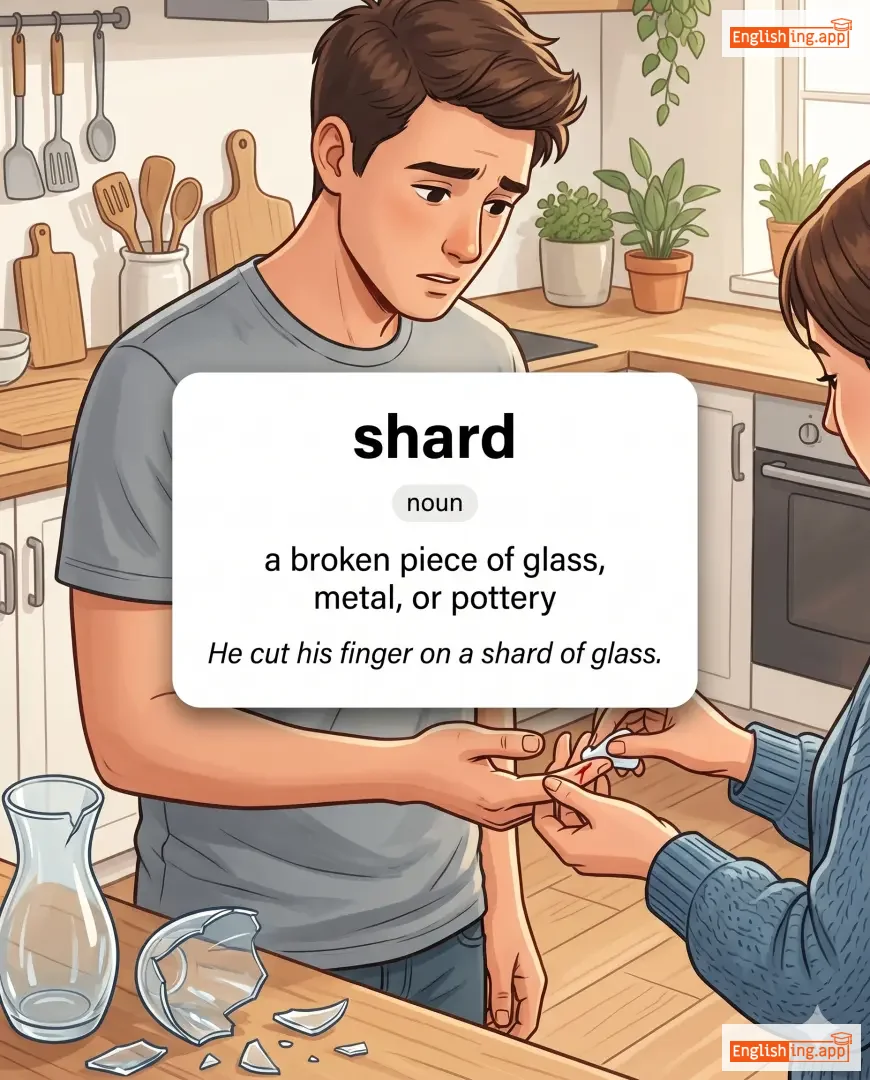
shard definition card — visual illustration of the meaning
noun
/ʃɑːrd/
fragmento (fragmento)

a broken piece of glass, metal, or pottery

"He cut his finger on a shard of glass."

"Se cortó el dedo con un fragmento de vidrio." (Se cortó el dedo con un fragmento de vidrio.)
verb
/ʃɛər/
compartir (kompartir)

to give a portion of (something) to others or allow others to use or enjoy it

"She decided to share her lunch with her friends."

"Ella decidió compartir su almuerzo con sus amigos." (Ella decidió compartir su almuerzo con sus amigos.)
adjective
/ʃɛrd/
compartido (kompartido)

used, done, or experienced by two or more people together

"They live in a shared apartment near the university."

"Ellos viven en un apartamento compartido cerca de la universidad." (Ellos viven en un apartamento compartido cerca de la universidad.)
noun
/ˈʃɛərˌhoʊldər/
accionista (accionista)

an individual or organization that owns shares in a company

"Each shareholder has the right to vote at the annual meeting."

"Cada accionista tiene derecho a votar en la reunión anual." (Cada accionista tiene derecho a votar en la reunion anual.)
noun
/ʃɑːrk/
tiburón (tiburon)

a large fish with sharp teeth known for being a strong predator in the ocean

"The shark swam silently beneath the boat."

"El tiburón nadaba silenciosamente debajo del barco." (El tiburon nadaba silenciosamente debajo del barco.)
noun
/ˈʃær.ən fruːt/
fruta shéron (fruta sheron)

a sweet orange persimmon fruit that can be eaten when firm

"The Sharon fruit is sweet and can be eaten like an apple."

"la fruta shéron es dulce y se puede comer como una manzana." (La fruta shéron es dulce y se puede comer como una manzana.)
adjective
/ʃɑːrp/
afilado (afilado)

having a fine edge or point; keen

"The knife is sharp enough to cut through the meat easily."

"El cuchillo está lo suficientemente afilado como para cortar la carne fácilmente." (El cuchillo está lo suficientemente afilado como para cortar la carne fácilmente.)
adverb
/ˈʃɑːrpli/
bruscamente (bruscamente)

suddenly and strongly; in a cutting or intense way

"Prices rose sharply after the announcement."

"Los precios subieron bruscamente después del anuncio." (Los precios subieron bruscamente después del anuncio.)
verb
/ˈʃætər/
romper (romper)

To break suddenly into many small pieces.

"The glass will shatter if you drop it."

"El vidrio se romperá si lo dejas caer." (El vidrio se romperá si lo dejas caer.)
verb, noun
/ʃeɪv/
afeitar (afeitar)

To remove hair from the body, typically using a razor; the act of removing hair

"He likes to shave every morning before work."

"Le gusta afeitarse todas las mañanas antes del trabajo." (Le gusta afeitarse todas las mananas antes del trabajo)
noun
/ˈʃeɪvɪŋ/
afeitado (afeitado)

the act of removing hair with a razor; a thin strip or piece shaved from something

"He bought a new cream for shaving."

"Compró una nueva crema para afeitarse." (Compro una nueva crema para afeitarse.)
pronoun
/ʃi/
ella (ella)

a female person or animal previously mentioned or easily identified

"She is going to the market to buy vegetables."

"Ella va al mercado a comprar verduras." (Ella va al mercado a comprar verduras.)
noun
/ʃiːf/
manojo de trigo (manojo de trigo)

a bundle of grain stalks laid lengthwise and tied together after reaping; a bundle of objects tied together

"The farmer carried a sheaf of wheat on his shoulder."

"El agricultor llevaba un manojo de trigo sobre su hombro." (El agricultor llevaba un manojo de trigo sobre su hombro.)
verb
/ʃɪə/
cortar (cortar)

to cut the wool off a sheep or to cut something with sharp tools like scissors or shears

"The farmer will shear the sheep in the spring."

"El agricultor sheará la oveja en la primavera." (El agricultor sheará la oveja en la primavera.)
noun
/ʃiːt fɪʃ/
siluro (siluro)

A large freshwater catfish with a broad flat head and long barbels

"The sheat-fish is one of the largest freshwater fish in South Asia."

"El siluro es uno de los peces de agua dulce más grandes del sur de Asia." (El siluro es uno de los peces de agua dulce mas grandes del sur de Asia)
verb
/ʃiːð/
volver a meter en la vaina (volver a meter en la vaina)

to put a sword or knife back into its cover

"He quickly sheathed his sword after the duel."

"Él rápidamente volvió a meter su espada en su vaina después del duelo." (Él rápidamente volvió a meter su espada en su vaina después del duelo.)
verb
/ʃɛd/
dejar caer (dejar caer)

to let something fall off naturally, such as leaves, hair, or tears

"Trees shed their leaves in autumn."

"Los árboles dejan caer sus hojas en otoño." (Los árboles dejan caer sus hojas en otoño.)
noun
/ʃiːp/
oveja (oveja)

a farm animal with thick wool that is raised for its wool, meat, and milk

"The farmer keeps a large flock of sheep."

"El granjero mantiene un gran rebaño de ovejas." (El granjero mantiene un gran rebaño de ovejas.)
adjective
/ʃɪə/
total (total)

complete and utter; very steep or transparent

"The cliff was a sheer drop into the sea."

"El acantilado era una caída total al mar." (El acantilado era una caída total al mar.)
noun
/ʃiːt/
sábana (sabana)

a large piece of cloth or paper, typically used to cover or protect something

"I need a clean sheet to cover the bed."

"Necesito una sábana limpia para cubrir la cama." (Necesito una sabana limpia para cubrir la cama.)
noun
/ʃɛlf/
estante (estante)

a flat surface used for storing or displaying things, typically fixed to a wall or inside a cabinet

"I placed the books on the shelf next to the window."

"Puse los libros en el estante junto a la ventana." (Puse los libros en el estante junto a la ventana.)
noun
/ʃɛl/
concha (koncha)

the hard outer covering of a mollusk or a crustacean, or something similar

"She picked up a beautiful seashell on the beach."

"Ella recogió una hermosa concha en la playa." (Ella recogió una hermosa concha en la playa.)
noun
/ˈʃɛltər/
refugio (refugio)

a place giving temporary protection from bad weather or danger

"They found shelter from the storm in the nearby barn."

"Encontraron refugio de la tormenta en el granero cercano." (Encontraron refugio de la tormenta en el granero cercano.)
noun
/ˈʃepərd/
pastor (pastor)

a person who tends and guards sheep

"The shepherd guided his flock to the green pasture."

"El pastor guió su rebaño hacia el pasto verde." (El pastor guió su rebaño hacia el pasto verde.)
noun
/ˈʃɜːrbət/
sorbete (sorbete)

a sweet flavored drink or a frozen dessert made from sweetened fruit juice

"On hot days, she enjoys a glass of lemon sherbet."

"En los días calurosos, disfruta de un vaso de sorbete de limón." (En los días calurosos, disfruta de un vaso de sorbete de limón.)
noun
/ˈʃɪbəˌlɛθ/
expresión o creencia distintiva de un grupo particular (expresion o creencia distintiva de un grupo particular)

A custom, phrase, or belief distinguishing a particular group of people, often used to identify outsiders.

"The phrase became a political shibboleth during the campaign."

"La frase se convirtió en un shibboleth político durante la campaña." (La frase se convirtio en un shibboleth politico durante la campana.)
verb
/ʃɪft/
trasladar (trasladar)

To move or change from one place, position, or situation to another.

"She had to shift her focus to the new project."

"Ella tuvo que trasladar su enfoque al nuevo proyecto." (Ella tuvo que trasladar su enfoque al nuevo proyecto.)