

Обновитесь для доступа ко всему словарю
Получите неограниченный доступ ко всем словам с подпиской Pro
Обновить до ProПеревод
Прошедшее
Причастие прошедшего времени
Третье лицо единственного числа
Герундий
Значение
Пример предложения
Перевод примера предложения
Синонимы
Антонимы
Коллокации
Мнемоника

Swipe left or right, or use the buttons. Tap image to zoom.
Обновитесь для доступа ко всем предложениям
Получите неограниченный доступ ко всем предложениям с подпиской Pro
Обновить до ProПеревод примера предложения
Слово
Lesson 20: Names of War and WeaponsLesson 20: Names of War and Weapons - Переключатель маски
|
Эмодзи
|
Слово | Images | Перевод | Значение | Пример предложения | Перевод примера предложения | Синонимы | Антонимы | Коллокации | Мнемоника |
|---|---|---|---|---|---|---|---|---|---|---|
|
#954
🚁🔫
|
/ˈænti ˈeəkræft ɡʌn/
noun
(анти-воздушная пушка)
••••••
|
- •••••• |
зенитное орудие
zenitnoe orudiye
••••••
|
a weapon designed to attack aircraft from the ground
••••••
|
The anti-aircraft gun was positioned to defend the military base. |
Зенитное орудие было расположено для защиты военной базы.
Zenitnoye orudiye bylo raspolozheno dlya zashchity voyennoy bazy.
••••••
|
anti-aircraft cannon, air defense gun, AA gun
••••••
|
- •••••• |
anti-aircraft defense, heavy anti-aircraft gun, anti-aircraft battery
••••••
|
Imagine an anti-aircraft gun defending the sky!
••••••
|
|
#955
✈️
|
/ˈeər fɔːrs/
noun
(эйр форс)
••••••
|
- •••••• |
воздушные силы
vozdushnye sily
••••••
|
the military organization of a country that uses aircraft for fighting
••••••
|
The air force conducted a training exercise over the mountains. |
Воздушные силы провели тренировочное задание над горами.
Vozdushnye sily proveli trenirovochnoe zadanie nad gorami.
••••••
|
aerial force, aviation branch, air service
••••••
|
navy, army
••••••
|
air force base, air force pilot, join the air force
••••••
|
Воздушные силы, как воздушная армия, использующая самолёты.
••••••
|
|
#956
🔫
|
/rɪˈvɒl.vər/
noun
(револьвер)
••••••
|
- •••••• |
револьвер
revolver
••••••
|
a pistol with revolving chambers enabling several shots to be fired without reloading
••••••
|
The detective drew his revolver from its holster.
Детектив вытащил свой револьвер из кобуры.
••••••
|
Детектив вытащил свой револьвер из кобуры.
Detektiv vytashchil svoy revolver iz kobury.
••••••
|
pistol, handgun, firearm, gun
••••••
|
- •••••• |
draw a revolver, loaded revolver, police revolver
••••••
|
Револьвер = 'революция' выстрелов без перезарядки.
••••••
|
|
#957
✈️
|
/ˈfaɪ.tər/
noun
(fayter)
••••••
|
- •••••• |
истребитель
istrebitel
••••••
|
a military aircraft designed for attacking other aircraft; a person who fights
••••••
|
The fighter jet flew overhead during the military parade.
Боевой самолет пролетел над нами во время военного парада.
••••••
|
Боевой самолет пролетел над нами во время военного парада.
Boievoi samolyot proletehl nad nami vo vremya voennogo parada.
••••••
|
warrior, combatant, aircraft
••••••
|
peacekeeper, civilian
••••••
|
fighter jet, fighter pilot, freedom fighter
••••••
|
Istrebitel, to chto vy bodite v nebe
••••••
|
|
#958
👨✈️
|
/kəˈmændər ɪn tʃiːf/
noun
(командующий главнокомандующий)
••••••
|
- •••••• |
главнокомандующий
glavokomanduyushchiy
••••••
|
the supreme leader of a nation's armed forces
••••••
|
The president serves as the commander-in-chief of the military.
Президент выполняет обязанности главнокомандующего армии.
••••••
|
Президент выполняет обязанности главнокомандующего армии.
Prezident vipolnyayet obyazannosti glavokomanduyushchego armii.
••••••
|
supreme commander, military leader, chief commander
••••••
|
subordinate, follower, private
••••••
|
supreme commander-in-chief, military commander-in-chief, armed forces commander-in-chief
••••••
|
Главнокомандующий - главный командующий армией.
••••••
|
|
#959
🐚
|
/ʃel/
noun
(шэл)
••••••
|
- •••••• |
оболочка
obolochka
••••••
|
hard outer covering of an animal; explosive projectile for a gun
••••••
|
The artillery fired a shell at the enemy position. |
Армия выстрелила снаряд в позицию противника.
Armiya vystrelila snaryad v pozitsiyu protivnika.
••••••
|
casing, husk, projectile, missile
••••••
|
core, interior, center
••••••
|
artillery shell, shell shock, shell out
••••••
|
Obolochka is the shell, the outer covering of an animal!
••••••
|
|
#960
🏰
|
/kænˈtoʊnmənt/
noun
(kantonment)
••••••
|
- •••••• |
казарма
kazarma
••••••
|
a military base or permanent military station
••••••
|
The soldiers lived in the cantonment outside the city.
Солдаты жили в кантонменте за пределами города.
••••••
|
Солдаты жили в казарме за пределами города.
Soldaty zhili v kazarme za predelami goroda.
••••••
|
military base, garrison, barracks
••••••
|
civilian area, residential zone
••••••
|
military cantonment, cantonment area, cantonment board
••••••
|
Казарма = место, где находятся солдаты, как в казармах.
••••••
|
|
#961
🏹
|
/boʊ/
noun
(bo)
••••••
|
- •••••• |
лук
luk
••••••
|
a weapon for shooting arrows, made of a curved piece of wood
••••••
|
The archer drew his bow and aimed at the target. |
Лучник натянул свой лук и прицелился в мишень.
Luchnik natyanyul svoy luk i pritselilsya v mishen'.
••••••
|
longbow, crossbow, archer's bow
••••••
|
- •••••• |
draw a bow, bow and arrow, bow string
••••••
|
Лук помогает целиться, как линия в небе, точно направленная к цели.
••••••
|
|
#962
⚔️
|
/wɔːr/
noun
(вaр)
••••••
|
- •••••• |
война
voyna
••••••
|
a state of armed conflict between different countries or different groups within a country
••••••
|
The war lasted for five years and caused great destruction.
Война длилась пять лет и вызвала большое разрушение.
••••••
|
Война длилась пять лет и вызвала большое разрушение.
Voyna dlinilas' pyat' let i vyzvala bol'shoe razrushenie.
••••••
|
conflict, battle, combat, warfare
••••••
|
peace, harmony, ceasefire
••••••
|
civil war, world war, war zone, declare war
••••••
|
‘Voyna’ in Russian translates directly to ‘war,’ highlighting conflict between groups.
••••••
|
|
#963
🔫
|
/ˈbʊlɪt/
noun
(byulet)
••••••
|
- •••••• |
пуля
pulya
••••••
|
a metal projectile fired from a gun
••••••
|
The bullet missed its target and hit the wall.
пуля промахнулась по цели и ударила в стену.
••••••
|
Пуля промахнулась по цели и ударила в стену.
Pulya promakhnylas' po tseli i udarila v stenu.
••••••
|
projectile, ammunition, round, slug
••••••
|
- •••••• |
bullet point, bullet train, bullet wound, dodge a bullet
••••••
|
Пуля летит быстро, как молния.
••••••
|
|
#964
⛺
|
/kæmp/
noun
(kemps)
••••••
|
- •••••• |
лагерь
lagery
••••••
|
a place where soldiers live temporarily; a place with tents or huts for temporary accommodation
••••••
|
The military established a camp near the border.
Армия создала лагерь возле границы.
••••••
|
Армия создала лагерь возле границы.
Armiya sozdala lager’ vozle granitsy.
••••••
|
base, encampment, bivouac, barracks
••••••
|
home, permanent residence
••••••
|
military camp, training camp, set up camp
••••••
|
Солдаты живут в лагере, как в кемпе.
••••••
|
|
#965
🪖
|
/tæŋk/
noun
(тæнк)
••••••
|
- •••••• |
танк
tank
••••••
|
a heavily armored fighting vehicle moving on a continuous track
••••••
|
The tank rolled through the battlefield with powerful armor.
Танк проехал по полю боя с мощной броней.
••••••
|
Танк прошел по полю боя с мощной броней.
Tank proshel po polyu boya s moshchnoy bron'yu.
••••••
|
armored vehicle, battle tank, combat vehicle
••••••
|
- •••••• |
main battle tank, tank crew, tank warfare, heavy tank
••••••
|
Танк — это огромный, мощный железный зверь на поле боя.
••••••
|
|
#966
🚢
|
/ˈsʌb.mə.riːn/
noun
(субмарина)
••••••
|
- •••••• |
подводная лодка
podvodnaya lodka
••••••
|
a warship with a streamlined hull designed to operate completely submerged in the sea
••••••
|
The submarine dived deep into the ocean to avoid detection.
Субмарина нырнула глубоко в океан, чтобы избежать обнаружения.
••••••
|
Субмарина нырнула глубоко в океан, чтобы избежать обнаружения.
Submarina nyrnula gluboko v okean, chtoby izbezhat' obnaruzheniya.
••••••
|
underwater vessel, sub, U-boat
••••••
|
surface ship, aircraft
••••••
|
nuclear submarine, submarine warfare, submarine captain
••••••
|
Подводная лодка как лодка под водой, которая плавает в море.
••••••
|
|
#967
🏳️
|
/dɪˈfiːt/
verb
(dɪˈfiːt)
••••••
|
- •••••• |
поражение
porazhenie
••••••
|
to win a victory over; to overcome in battle or competition
••••••
|
The army managed to defeat the enemy forces. |
Армия смогла победить вражеские силы.
Armiya smogla pobedit vrageskiye sily.
••••••
|
conquer, overcome, vanquish, beat
••••••
|
victory, triumph, win, succeed
••••••
|
defeat the enemy, admit defeat, crushing defeat
••••••
|
Поражение in Russian means defeat, remember it as 'po' (over) and 'razhenie' (loss).
••••••
|
|
#968
⚔️
|
/ˈen.ə.mi/
noun
(энеми)
••••••
|
- •••••• |
враг
vrag
••••••
|
a person who is actively opposed or hostile to someone or something
••••••
|
The soldiers fought bravely against their enemy.
Солдаты храбро сражались с их врагом.
••••••
|
Солдаты храбро сражались с их врагом.
Soldaty khrabro srazhalis' s ikh vragom.
••••••
|
foe, adversary, opponent, rival
••••••
|
friend, ally, supporter, companion
••••••
|
sworn enemy, deadly enemy, enemy forces, enemy territory
••••••
|
Враг и враг в русском языке звучат похоже, чтобы запомнить.
••••••
|
|
#969
⚔️
|
/ɑːrmz/
noun
(армы)
••••••
|
- •••••• |
оружие
oruzhie
••••••
|
weapons and ammunition; firearms
••••••
|
The soldiers carried their arms into battle. |
Солдаты несли своё оружие в битву.
Soldaty nesli svoe oruzhie v bitvu.
••••••
|
weapons, firearms, armaments
••••••
|
peace tools, non-weapons
••••••
|
bear arms, arms control, small arms
••••••
|
Запомни 'оружие' для сражений.
••••••
|
|
#970
🔫
|
/ɡʌn/
noun
(gan)
••••••
|
- •••••• |
огнестрельное оружие
ognestryel'noe oruzhie
••••••
|
a weapon that fires bullets or other projectiles from a metal tube
••••••
|
The soldier cleaned his gun after the training session. |
Солдат почистил свое оружие после тренировки.
Soldat pochistil svoe oruzhie posle trenirovki.
••••••
|
firearm, pistol, rifle, weapon
••••••
|
peace, shield, protection
••••••
|
gun control, gun safety, load a gun
••••••
|
огнестрельное оружие = 'огонь' для запоминания оружия.
••••••
|
|
#971
⚔️
|
/sɔːrd/
noun
(сворд)
••••••
|
- •••••• |
меч
mech
••••••
|
a weapon with a long metal blade and a handle, used for fighting
••••••
|
The knight drew his sword to defend the castle.
рыцарь вытащил свой меч, чтобы защитить замок.
••••••
|
Рыцарь вытащил свой меч, чтобы защитить замок.
rytsar' vytashchil svoy mech, chtoby zashchitit' zamok.
••••••
|
blade, saber, cutlass, rapier
••••••
|
shield, armor, protection
••••••
|
sharp sword, double-edged sword, sword fight, sword blade
••••••
|
В русском языке меч похож на английское sword.
••••••
|
|
#972
🎺
|
/ˈtrʌmpɪt/
noun
(трампет)
••••••
|
- •••••• |
труба
truba
••••••
|
a brass musical instrument with a brilliant tone; military signal instrument
••••••
|
The soldier played the trumpet to signal the troops.
Солдат играл на трубе, чтобы подать сигнал войскам.
••••••
|
Солдат играл на трубе, чтобы подать сигнал войскам.
Soldat igral na trube, chtoby podat' signal voiskam.
••••••
|
bugle, horn, cornet
••••••
|
- •••••• |
military trumpet, trumpet call, trumpet signal, brass trumpet
••••••
|
Tруба = Труба (сигнал для армии)
••••••
|
|
#973
🏆
|
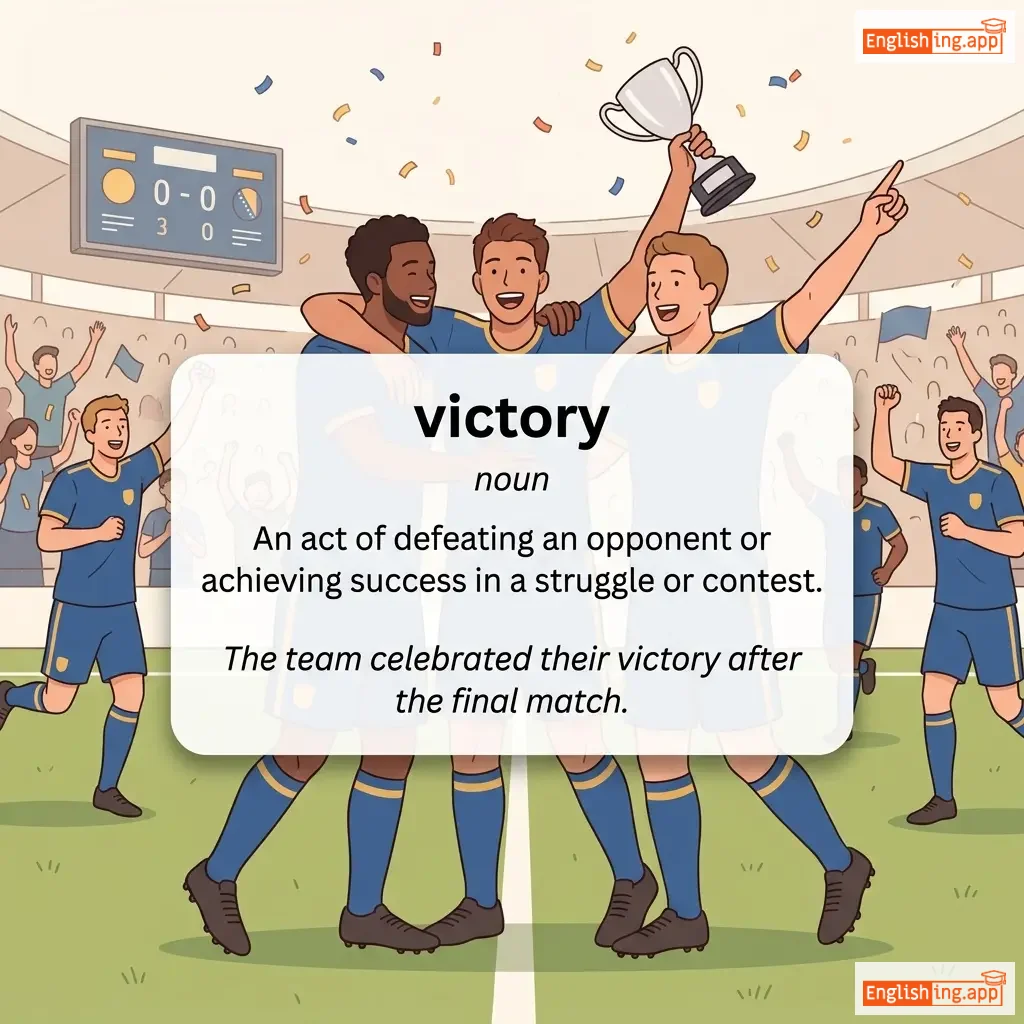
/ˈvɪk.tər.i/
noun
(vikˈtɔrɪ)
••••••
|
|
победа
pobeda
••••••
|
an act of defeating an enemy or opponent in a battle, game, or other competition
••••••
|
The army celebrated their victory over the enemy forces. |
Армия отпраздновала свою победу над вражескими силами.
Armiya otprazdnovala svoyu pobedu nad vrazheskimi silami.
••••••
|
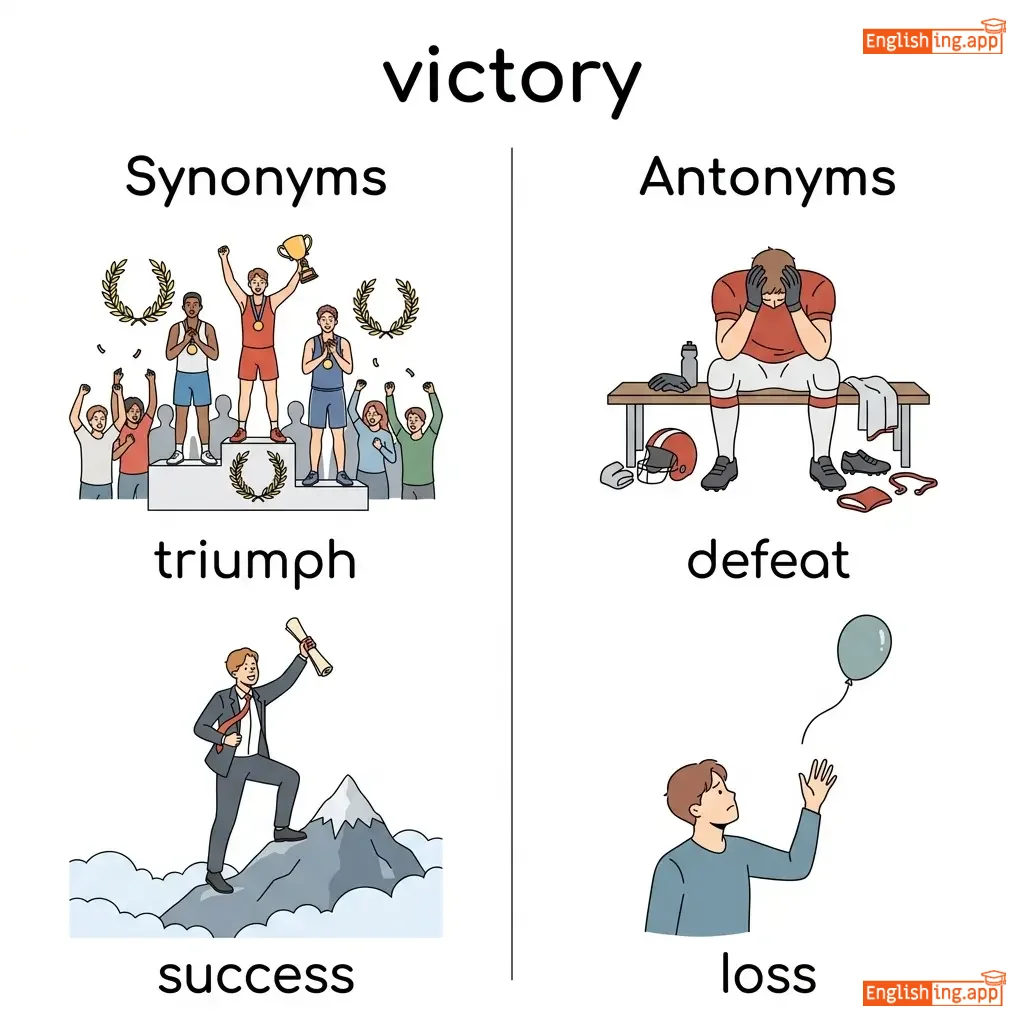
triumph, win, success, conquest
••••••
|
defeat, loss, failure
••••••
|
military victory, victory parade, decisive victory
••••••
|
Победа и Victory означают успех в борьбе.
••••••
|
|
#974
🔫
|
/ˈraɪfəl/
noun
(райфел)
••••••
|
- •••••• |
винтовка
vintovka
••••••
|
a gun with a long barrel that is fired from the shoulder
••••••
|
The soldier carried a rifle during the mission.
Солдат нес винтовку во время задания.
••••••
|
Солдат нес винтовку во время задания.
Soldat nes vintovku vo vremya zadaniya.
••••••
|
firearm, gun, carbine, musket
••••••
|
- •••••• |
assault rifle, hunting rifle, rifle range, sniper rifle
••••••
|
In Russian, 'винтовка' (vintovka) is a rifle, sounding like 'win' for soldiers' victory.
••••••
|
|
#975
🗡️
|
/læns/
noun
(lants)
••••••
|
- •••••• |
копье
kop'yo
••••••
|
a long weapon with a sharp metal point, used by soldiers on horseback
••••••
|
The knight charged forward with his lance ready. |
Рыцарь ринулся вперед с готовым копьем.
Rytsar' rinulsya vpered s gotovym kop'yom.
••••••
|
spear, pike, javelin
••••••
|
- •••••• |
knight's lance, cavalry lance, charge with a lance
••••••
|
копье: похожее по звучанию, но четко отличается от других видов оружия.
••••••
|
|
#976
🪖
|
/ˈɪn.fən.tri/
noun
(инфантерии)
••••••
|
- •••••• |
пехота
pekhotа
••••••
|
soldiers marching or fighting on foot; foot soldiers collectively
••••••
|
The infantry advanced across the battlefield on foot. |
Пехота продвинулась по полю битвы пешком.
Pekhota prodvinulas po polyu bitvy peshkom.
••••••
|
foot soldiers, ground troops, riflemen
••••••
|
cavalry, air force, navy
••••••
|
infantry regiment, infantry division, light infantry
••••••
|
Infantry = 'пехота', солдаты, которые ходят по полю битвы.
••••••
|
|
#977
👨✈️
|
/kəˈmændər/
noun
(командант)
••••••
|
- •••••• |
командир
komandir
••••••
|
a person in authority over a military unit; leader of armed forces
••••••
|
The commander ordered his troops to advance.
Командант приказал своим войскам двигаться вперед.
••••••
|
Командант приказал своим войскам двигаться вперед.
Komandant prikazal svoim voiskam dvigatsya vpered.
••••••
|
leader, general, chief, captain
••••••
|
subordinate, follower, private
••••••
|
military commander, commanding officer, field commander
••••••
|
Komandir in Russian means a leader with authority over troops.
••••••
|
|
#978
🛡️
|
/ˈɑːr.mər/
noun
(армор)
••••••
|
- •••••• |
бронирование
bronirovanie
••••••
|
protective covering worn by soldiers; metal plating for military vehicles
••••••
|
The knight wore heavy armour to protect himself in battle.
Рыцарь носил тяжелую броню, чтобы защитить себя в бою.
••••••
|
Рыцарь носил тяжелую броню, чтобы защитить себя в бою.
Ritsar' nosil tyazheluyu bron'yu, chtoby zashchitit' sebya v boyu.
••••••
|
protection, shield, mail, plating
••••••
|
vulnerability, exposure, nakedness
••••••
|
body armour, armour plating, suit of armour
••••••
|
Броня защищает рыцаря в бою.
••••••
|
|
#979
🔫
|
/ˈkænən/
noun
(канон)
••••••
|
- •••••• |
пушка
pushka
••••••
|
large heavy gun that fires cannonballs or shells
••••••
|
The castle was defended by several large cannons.
Замок был защищен несколькими большими пушками.
••••••
|
Замок был защищен несколькими большими пушками.
Zamok byl zashchishchyon neskol'kimi bol'shimi pushkami.
••••••
|
artillery, gun, howitzer, mortar
••••••
|
shield, defense, protection
••••••
|
cannon fire, cannon ball, water cannon
••••••
|
Think of 'pushka' as the cannon used for defense.
••••••
|
|
#980
📨
|
/ˈmes.ɪn.dʒər/
noun
(мэсэнджэр)
••••••
|
- •••••• |
посланник
poslannik
••••••
|
a person who carries messages or communications between parties
••••••
|
The messenger delivered important battle plans to the commander. |
Посланник доставил командующему важные боевые планы.
Poslannik dostavil komanduyushchemu vazhnyye boevyye plany.
••••••
|
courier, envoy, herald, carrier
••••••
|
recipient, receiver, addressee
••••••
|
messenger service, royal messenger, send a messenger
••••••
|
Посланник всегда доставляет важные сообщения, как 'посланник', который передает информацию.
••••••
|
|
#981
⚓
|
/ˈneɪ.vəl fɔːrs/
noun
(нэйвл форс)
••••••
|
- •••••• |
военно-морские силы
voenno-morskie sily
••••••
|
the branch of a nation's armed services that conducts military operations at sea
••••••
|
The naval force protected the country's coastline from enemy attacks. |
Военно-морские силы защитили побережье страны от вражеских атак
Voyenno-morskie sily zashchitili poberezhe strany ot vrazheskikh atak
••••••
|
navy, fleet, maritime force, sea force
••••••
|
army, air force
••••••
|
naval force commander, strong naval force, naval force operations
••••••
|
Военно-морские силы - защита от атак с моря
••••••
|
|
#982
⚓
|
/ˈneɪvi/
noun
(неɪви)
••••••
|
- •••••• |
военно-морской флот
voyenno-morskoy flot
••••••
|
the branch of armed forces that conducts military operations at sea
••••••
|
He joined the navy after graduating from college. |
Он поступил в военно-морской флот после окончания колледжа.
On postupil v voyenno-morskoy flot posle okonchaniya kolledzha.
••••••
|
fleet, naval force, maritime force
••••••
|
- •••••• |
navy blue, royal navy, navy ship, navy seal
••••••
|
Военно-морской флот — это сила, которая действует на воде.
••••••
|
|
#983
🔫
|
/ˈpɪs.təl/
noun
(пистолет)
••••••
|
- •••••• |
пистолет
pistolet
••••••
|
a small gun that can be held and fired with one hand
••••••
|
The officer drew his pistol from the holster.
Офицер вытащил свой пистолет из кобуры.
••••••
|
Офицер вытащил свой пистолет из кобуры.
Ofitser vytashchil svoi pistolet iz kobury.
••••••
|
handgun, revolver, firearm
••••••
|
- •••••• |
draw a pistol, pistol holster, load a pistol
••••••
|
Пистолет = Маленькое оружие, подходящее для одной руки.
••••••
|
|
#984
🏰
|
/fɔːrt/
noun
(форт)
••••••
|
- •••••• |
крепость
krepost
••••••
|
a strong building or group of buildings where soldiers live and defend
••••••
|
The ancient fort stood on top of the hill for centuries.
Древний форт стоял на вершине холма веками.
••••••
|
Древний форт стоял на вершине холма веками.
Drevniy fort stoyal na vershine kholma vekami.
••••••
|
fortress, castle, stronghold, citadel
••••••
|
open field, plain, vulnerability
••••••
|
military fort, ancient fort, fort walls, fort defense
••••••
|
Krepost (fort) - Imagine a fortress (krepost) standing tall and proud. Defend!
••••••
|
|
#985
🗡️
|
/ˈdæɡər/
noun
(dagger)
••••••
|
- •••••• |
кинжал
kinzhal
••••••
|
a short knife with a pointed and edged blade, used as a weapon
••••••
|
The assassin concealed a dagger beneath his cloak. |
Убийца спрятал кинжал под своим плащом.
Ubiytsa spryatal kinzhal pod svoim plashchom.
••••••
|
knife, blade, stiletto
••••••
|
shield, armor, protection
••••••
|
sharp dagger, silver dagger, dagger blade
••••••
|
Кинжал – как Dagger, острый нож для скрытных атак
••••••
|
|
#986
✈️
|
/ˈbɒmər/
noun
(бомбер)
••••••
|
- •••••• |
бомбардировщик
bombardirovshchik
••••••
|
military aircraft designed to drop bombs on targets
••••••
|
The bomber squadron flew over the city at dawn.
эскадрилья бомбардировщиков пролетела над городом на рассвете.
••••••
|
Эскадрилья бомбардировщиков пролетела над городом на рассвете.
eskadril'ya bombardirovshchikov proletela nad gorodom na rassvete.
••••••
|
warplane, aircraft, fighter plane
••••••
|
rescue plane, transport plane, civilian aircraft
••••••
|
bomber pilot, bomber squadron, stealth bomber
••••••
|
‘Bomber’ sounds like Russian ‘Bombardirovshchik’ — both start with ‘Bomb’!
••••••
|
|
#987
⛺
|
/tent/
noun
(тент)
••••••
|
- •••••• |
палатка
palatka
••••••
|
a portable shelter made of cloth or canvas; military accommodation
••••••
|
The soldiers set up their tent in the military camp.
Солдаты установили свой тент в военном лагере.
••••••
|
Солдаты установили свой тент в военном лагере.
Soldaty ustanovili svoi tent v voennom lagere.
••••••
|
shelter, pavilion, canvas shelter
••••••
|
permanent structure, building
••••••
|
military tent, field tent, tent camp, army tent
••••••
|
The Russian word for tent is 'палатка', imagine a tent made of 'palace' material!
••••••
|
|
#988
📜
|
/ˈtriː.ti/
noun
(triti)
••••••
|
- •••••• |
договор
dogovor
••••••
|
a formally concluded and ratified agreement between countries; a formal agreement to end a war
••••••
|
The two nations signed a peace treaty to end the conflict. |
Две нации подписали мирный договор для окончания конфликта.
Dve natsii podpisali mirnyy dogovor dlya okonchaniya konflikta.
••••••
|
agreement, pact, accord, contract
••••••
|
disagreement, conflict, war
••••••
|
peace treaty, trade treaty, treaty negotiation
••••••
|
Treaty и договор (dogovor) - формальные соглашения
••••••
|
|
#989
⚔️
|
/ˈwɔːriər/
noun
(воин)
••••••
|
- •••••• |
воин
voin
••••••
|
a brave or experienced soldier or fighter
••••••
|
The warrior fought bravely in the ancient battle.
воин сражался смело в древней битве.
••••••
|
Воин сражался смело в древней битве.
Voin srazhalsya smelo v drevnej bitve.
••••••
|
fighter, soldier, combatant
••••••
|
pacifist, civilian, peacemaker
••••••
|
brave warrior, ancient warrior, warrior spirit
••••••
|
Voin sounds like 'Violet' - warriors are strong like violets.
••••••
|
|
#990
💥
|
/ˈɡʌnˌpaʊdər/
noun
(ɡʌnˌpaʊdər)
••••••
|
- •••••• |
порох
porokh
••••••
|
explosive powder used in guns and fireworks
••••••
|
Gunpowder was invented in ancient China. |
Порох был изобретен в Древнем Китае.
Porokh byl izobreten v Drevnem Kitae.
••••••
|
explosive, black powder, ammunition
••••••
|
water, extinguisher, safety device
••••••
|
gunpowder plot, gunpowder tea, gunpowder keg
••••••
|
Порох в оружии – мощь древнего Китая!
••••••
|
|
#991
💣
|
/bɑːm/
noun
(бом)
••••••
|
- •••••• |
бомба
bomba
••••••
|
an explosive device designed to cause damage or destruction
••••••
|
The bomb disposal unit carefully defused the explosive device. |
Подразделение по обезвреживанию бомб осторожно разминировало взрывное устройство.
Podrazdelenie po obezvrezhivaniyu bomb ostorozhno razminirovalo vzryvnoe ustroystvo.
••••••
|
explosive, mine, grenade, device
••••••
|
safety, protection, peace
••••••
|
bomb squad, time bomb, bomb shelter
••••••
|
Бомба (bomba) – когда слышишь бомбу, нужно ее обезвредить.
••••••
|
|
#992
👥⚔️
|
/truːp/
noun
(труп)
••••••
|
- •••••• |
группа
gruppa
••••••
|
a group of soldiers; military personnel organized as a unit
••••••
|
The troop marched in formation across the parade ground.
Труппа маршировала в строю по площади парада.
••••••
|
Группа маршировала в строю по площади парада.
Gruppa marshirovala v stroyu po ploshchadi paradi.
••••••
|
soldiers, battalion, regiment, squad
••••••
|
civilians, non-combatants
••••••
|
elite troop, troop movement, troop deployment, special forces troop
••••••
|
Группа - это солдаты, которые маршируют вместе.
••••••
|
|
#993
🕳️
|
/trentʃ/
noun
(тренч)
••••••
|
- •••••• |
траншея
transheya
••••••
|
a long narrow ditch dug in the ground for defense in warfare
••••••
|
Soldiers hid in the trench during the enemy attack. |
Солдаты прятались в траншее во время вражеской атаки.
Soldaty priyatalis v transheye vo vremya vrazheskoy ataki.
••••••
|
ditch, foxhole, dugout, moat
••••••
|
elevation, hill, mound, ridge
••••••
|
deep trench, muddy trench, trench warfare, front-line trench
••••••
|
Траншея - это яма для защиты солдат в бою
••••••
|
|
#994
👨✈️
|
/ˈkæptɪn/
noun
(капитан)
••••••
|
- •••••• |
капитан
kapitan
••••••
|
a military officer of middle rank; the person in command of a ship or aircraft
••••••
|
The captain ordered his troops to advance forward.
Капитан отдал приказ своим солдатам продвигаться вперёд.
••••••
|
Капитан отдал приказ своим солдатам продвигаться вперёд.
Kapitan otdal prikaz svoim soldatam prodvigat'sya vperyod.
••••••
|
commander, leader, officer, chief
••••••
|
subordinate, follower, private
••••••
|
team captain, ship captain, army captain, captain's orders
••••••
|
Капитан ведет корабль, чтобы достигнуть победы.
••••••
|
|
#995
🐎
|
/ˈkæv.əl.ri/
noun
(kavalerija)
••••••
|
- •••••• |
кавалерия
kavalerija
••••••
|
soldiers who fight on horseback; the part of an army formerly composed of troops on horseback
••••••
|
The cavalry charged across the field with great speed. |
Кавалерия с большим ускорением атаковала поле.
Kavaleriya s bol'shim uskoreniem atakovala pole.
••••••
|
horsemen, mounted troops, horse soldiers
••••••
|
infantry, foot soldiers
••••••
|
cavalry charge, heavy cavalry, light cavalry
••••••
|
Русский: Лошадь (horse) + армия (army) = кавалерия
••••••
|
|
#996
🏰
|
/siːdʒ/
noun
(сиг)
••••••
|
- •••••• |
осада
osada
••••••
|
a military operation to capture a place by surrounding it and cutting off supplies
••••••
|
The siege of the castle lasted for three months.
Осадка замка продолжалась три месяца.
••••••
|
Осадка замка продолжалась три месяца.
Osadka zamka prodolzhalsya tree mesyatsa.
••••••
|
blockade, encirclement, investment
••••••
|
relief, liberation
••••••
|
lay siege, under siege, siege warfare
••••••
|
Осада: когда окружаете крепость и блокируете её.
••••••
|
|
#997
📡
|
/ˈreɪ.dɑːr/
noun
(ˈrädär)
••••••
|
- •••••• |
радар
radar
••••••
|
a system for detecting the presence, direction, distance of aircraft, ships by sending out radio waves
••••••
|
The radar detected an unknown aircraft approaching the base. |
Радар зафиксировал неизвестный самолет, приближающийся к базе.
Radar zafiksiroval neizvestnyy samolyot, priblizhayushchijsya k baze.
••••••
|
detection system, sonar, tracking device
••••••
|
- •••••• |
radar screen, radar signal, radar detection
••••••
|
Радар использует радиоволны для обнаружения объектов.
••••••
|
Vocabulary Quiz
Test your vocabulary by matching words with their translations or meanings.
Login to take the quiz
Comments (0)
Share your thoughts and join the discussion.
Join the discussion by logging in
Login to CommentNo comments yet
Be the first to share your thoughts!