Vocabulaires

Découvrez, apprenez et maîtrisez le vocabulaire anglais

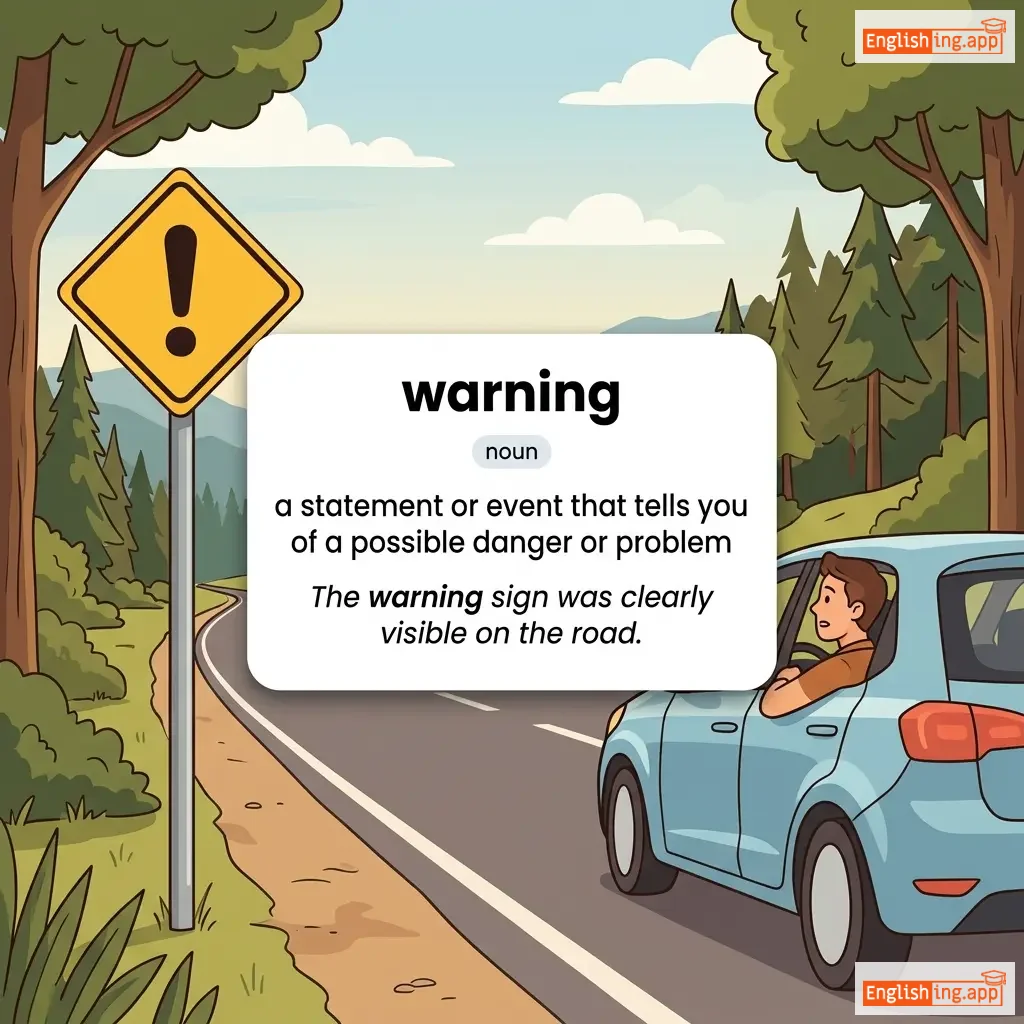
warning definition card — visual illustration of the meaning
noun
/ˈwɔːrnɪŋ/
avertissement (avertissement)

a statement or event that tells you of a possible danger or problem

"The warning sign was clearly visible on the road."

"Le panneau d'avertissement était clairement visible sur la route." (Le panneau d'avertissement etait clairement visible sur la route.)
verb
/wɔːrp/
déformer (déformer)

To twist or bend out of shape, often due to heat or moisture.

"The wooden door warped in the summer heat."

"La porte en bois s'est déformée sous la chaleur de l'été." (La porte en bois s'est déformée sous la chaleur de l'été.)
noun/verb
/ˈwɒrənt/
mandat (mandat)

As a noun: An official authorization or order. As a verb: To justify or make something necessary.

"The judge issued a warrant for his arrest."

"Le juge a émis un mandat pour son arrestation." (Le juge a émis un mandat pour son arrestation.)
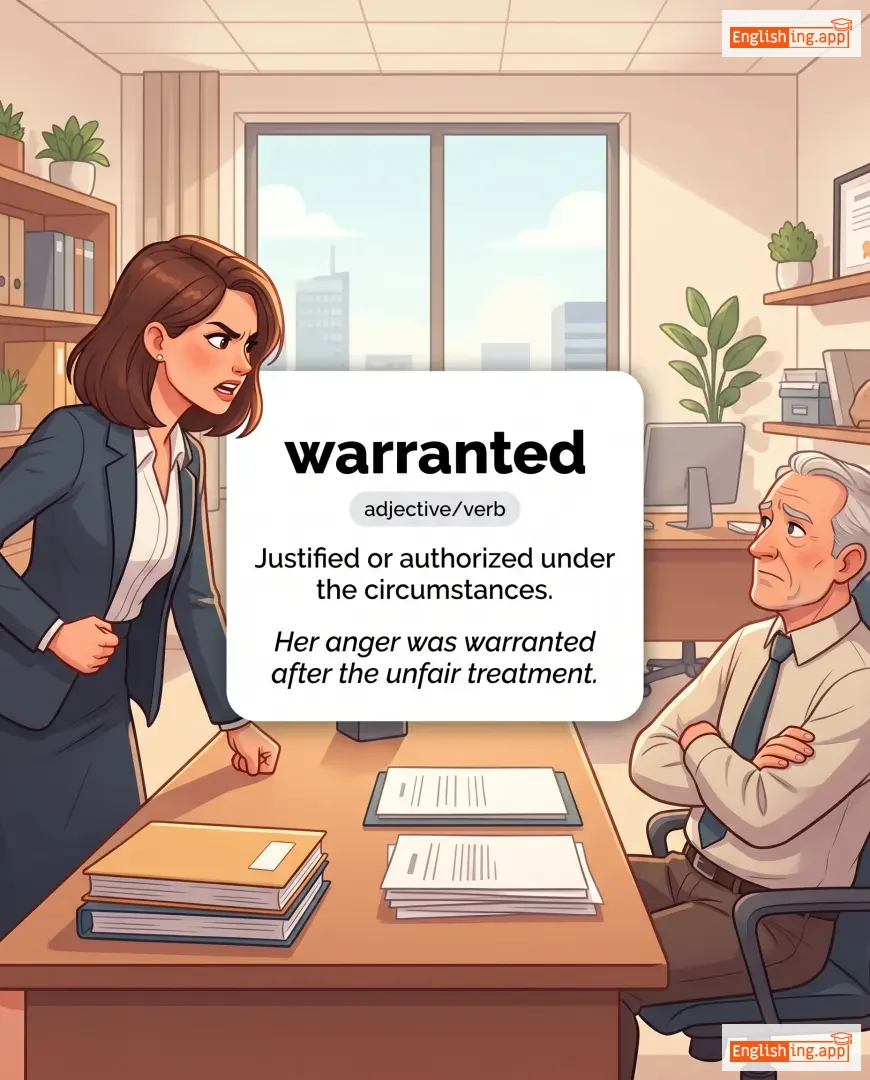
warranted definition card — visual illustration of the meaning
adjective/verb
/ˈwɒrəntɪd/
justifié (justifie)

Justified or authorized under the circumstances.

"Her anger was warranted after the unfair treatment."

"Sa colère était justifiée après le traitement injuste." (Sa colère était justifiée après le traitement injuste.)
noun
/ˈwɒrənti/
garantie (garanti)

A written guarantee given by a manufacturer or seller promising to repair or replace a product if necessary within a specified period.

"The laptop comes with a two-year warranty."

"L'ordinateur portable vient avec une garantie de deux ans." (L'ordinateur portable vient avec une garantie de deux ans.)
noun
/ˈwɒrən/
un réseau de terriers (warren)

A network of interconnected rabbit burrows; also used metaphorically for a densely populated building or district.

"The old part of the city is a warren of narrow streets."

"La vieille partie de la ville est un réseau de rues étroites." (La vieille partie de la ville est un réseau de rues étroites.)
noun
/ˈwɒriər/
guerrier (guerrier)

a person engaged or experienced in warfare; a brave or experienced fighter

"The ancient warrior fought fearlessly to protect his land."

"L'ancien guerrier a combattu sans peur pour protéger sa terre." (L'ancien guerrier a combattu sans peur pour protéger sa terre.)
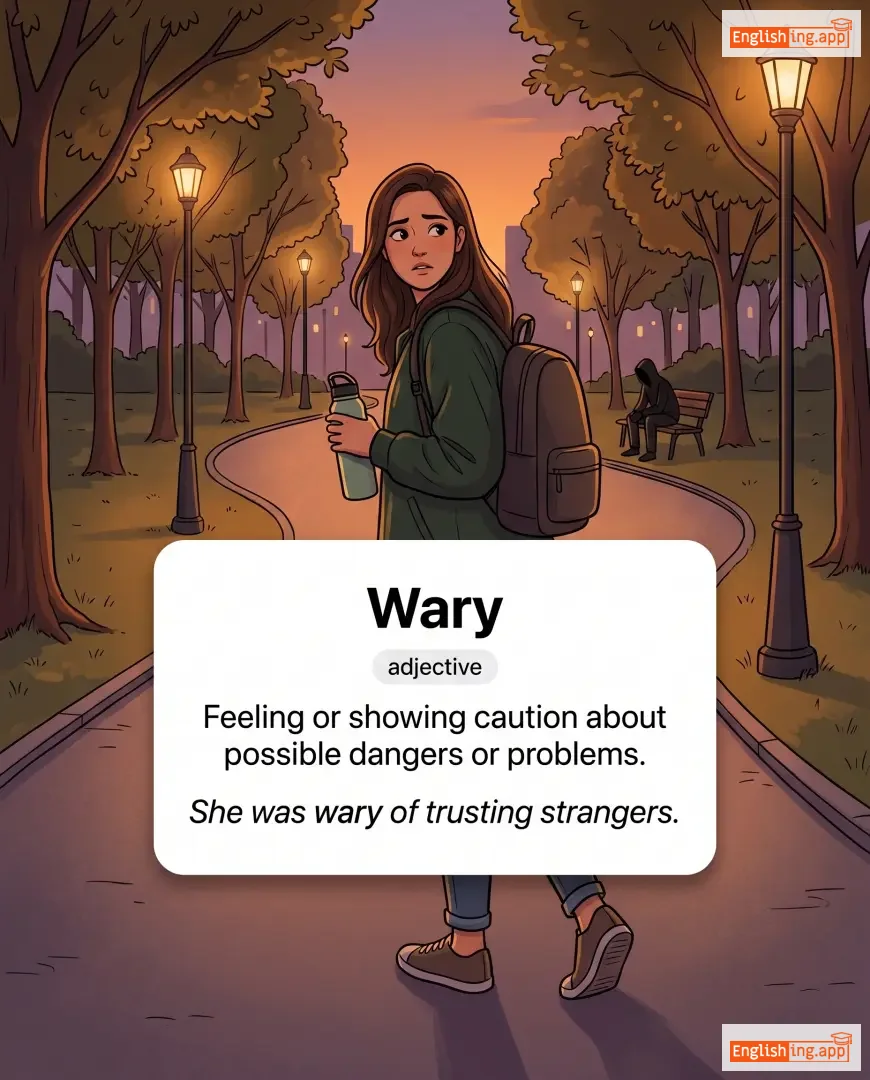
Wary definition card — visual illustration of the meaning
adjective
/ˈweəri/
prudent (wary)

Feeling or showing caution about possible dangers or problems.

"She was wary of trusting strangers."

"Elle était prudente à l'idée de faire confiance aux étrangers." (Elle était prudente à l'idée de faire confiance aux étrangers.)
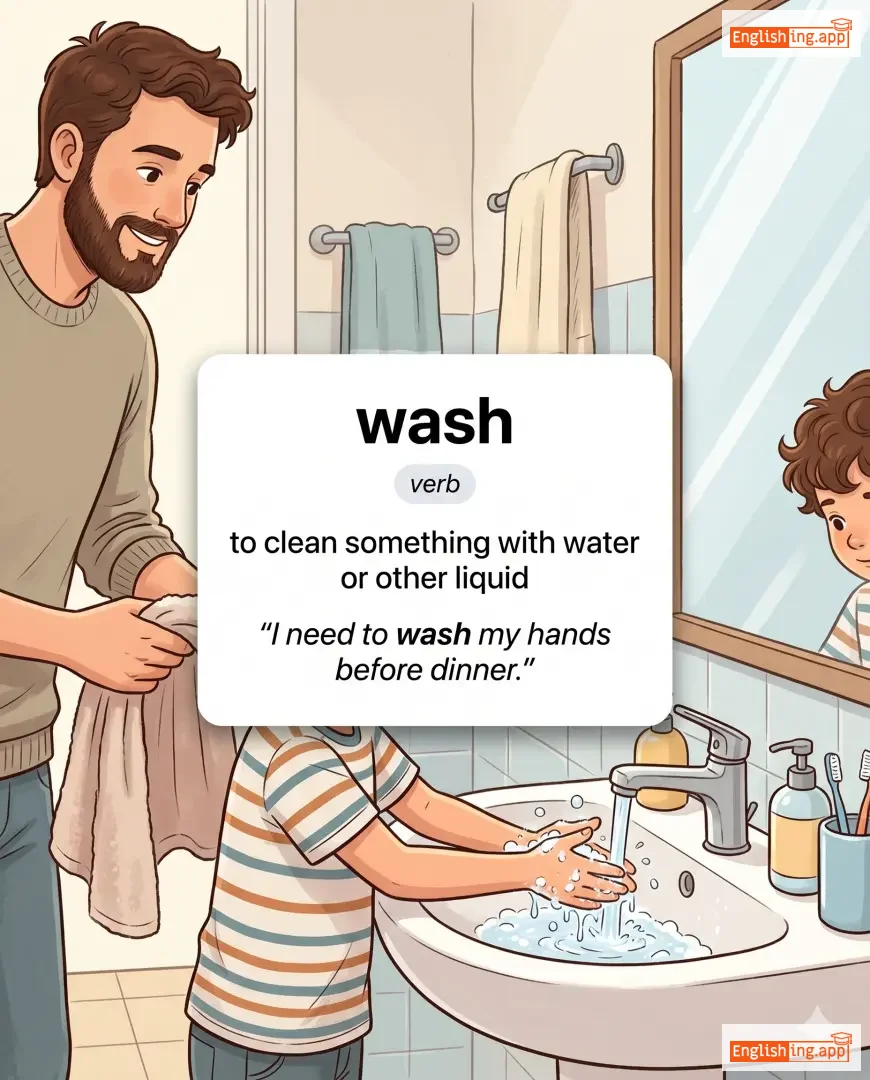
wash definition card — visual illustration of the meaning
verb
/wɒʃ/
laver (laver)

to clean something with water or other liquid

"I need to wash my hands before dinner."

"Je dois laver mes mains avant le dîner." (Je dois laver mes mains avant le dîner.)
noun
/ˈwɑː.ʃər mæn/
blanchisseur (blanchisseur)

a person whose job is to wash clothes and linens for others

"The washer man collected dirty clothes from every household in the village."

"Le blanchisseur a collecté les vêtements sales de chaque maison du village." (Le blanchisseur a collecté les vetements sales de chaque maison du village)
noun; gerund
/ˈwɒʃɪŋ/
lavage (lavage)

the act of cleaning with water or other liquid; clothes or items that are being washed

"Washing clothes regularly helps maintain hygiene."

"Le lavage régulier des vêtements aide à maintenir l'hygiène." (Le lavage regulier des vetements aide a maintenir l hygiene)
noun
/ˈwɒʃ.ɪŋ məˌʃiːn/
lave-linge (lavlanj)

a machine for washing clothes and other textiles

"The washing machine broke down and needs repair."

"Le lave-linge est tombé en panne et a besoin de réparation." (Le lave linge est tombe en panne et a besoin de reparation)
noun
/wɒsp/
guêpe (guepe)

a flying insect with a yellow and black striped body and a painful sting

"The wasp stung me when I disturbed its nest."

"La guêpe m'a piqué quand j'ai dérangé son nid." (La guepe m'a pique quand j'ai derange son nid.)
noun
/ˈweɪ.stɪdʒ/
gaspillage (gaspillage)

the action of using or expending something carelessly or without purpose

"The company reduced food wastage by implementing better inventory management."

"L'entreprise a réduit le gaspillage alimentaire en mettant en place une meilleure gestion des stocks." (L'entreprise a reduit le gaspillage alimentaire en mettant en place une meilleure gestion des stocks.)
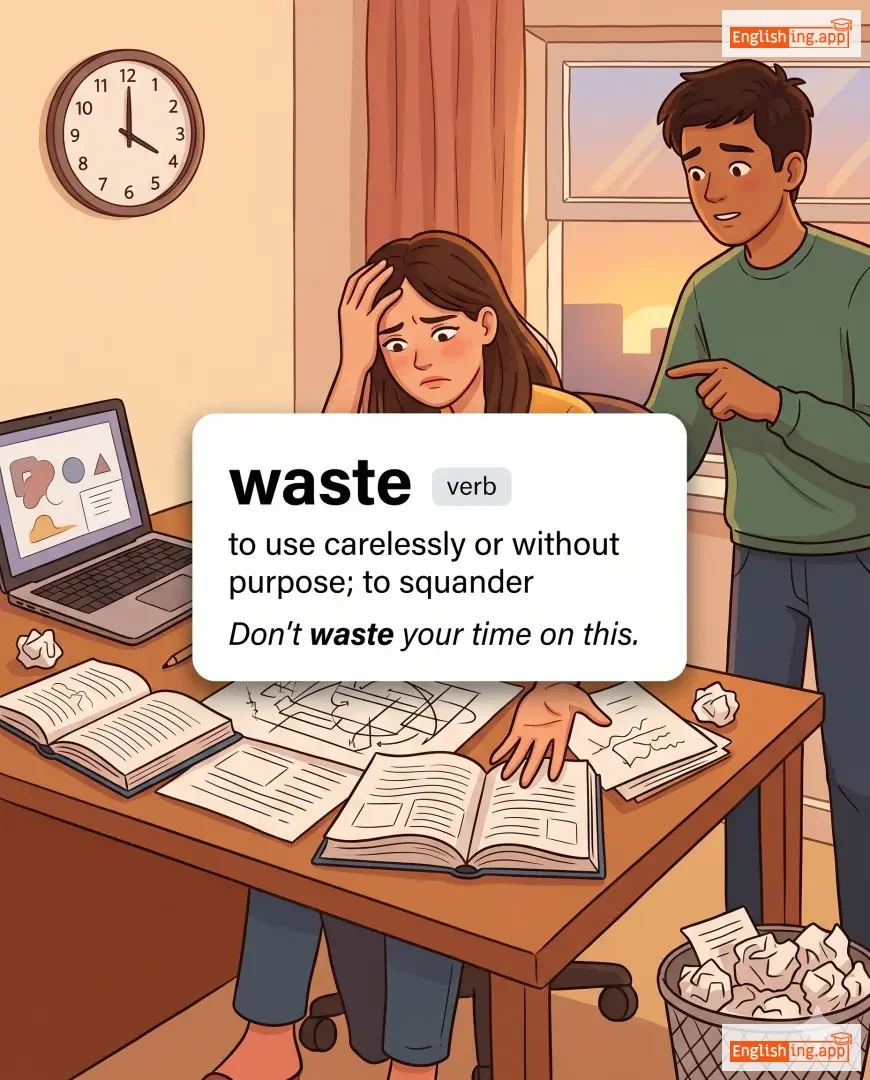
waste definition card — visual illustration of the meaning
noun
/weɪst/
gaspillage (gaspillage)

something that is not useful and is thrown away

"Don't waste your time on unnecessary tasks."

"Ne perds pas ton temps sur des tâches inutiles." (Ne perds pas ton temps sur des taches inutiles.)
noun
/ˈweɪstrəl/
dépensier, fainéant (wastrel)

A person who wastes time, money, or resources; an idler or spendthrift.

"The young man was dismissed as a wastrel by his family."

"Le jeune homme a été rejeté comme un gaspilleur par sa famille." (Le jeune homme a été rejeté comme un gaspilleur par sa famille.)
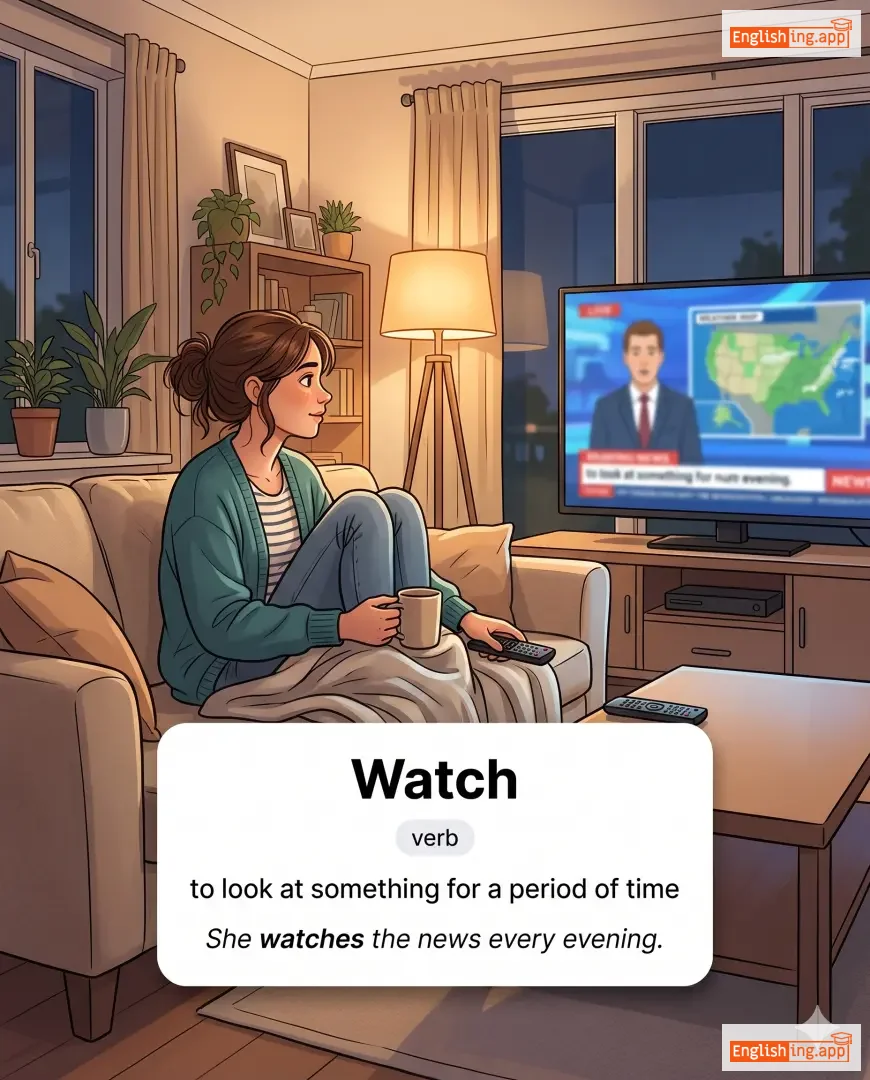
Watch definition card — visual illustration of the meaning
verb
/wɒtʃ/
regarder (regarder)

to look at something for a period of time

"She watches the news every evening."

"Elle regarde les nouvelles chaque soir." (Elle regarde les nouvelles chaque soir.)
noun
/ˈwɒtʃ.mən/
gardien (gardien)

a person employed to guard or watch over a building or area, especially at night

"The watchman patrols the factory every hour to ensure security."

"Le gardien patrouille l'usine toutes les heures pour assurer la sécurité." (Le gardien patrouille l'usine toutes les heures pour assurer la sécurité.)
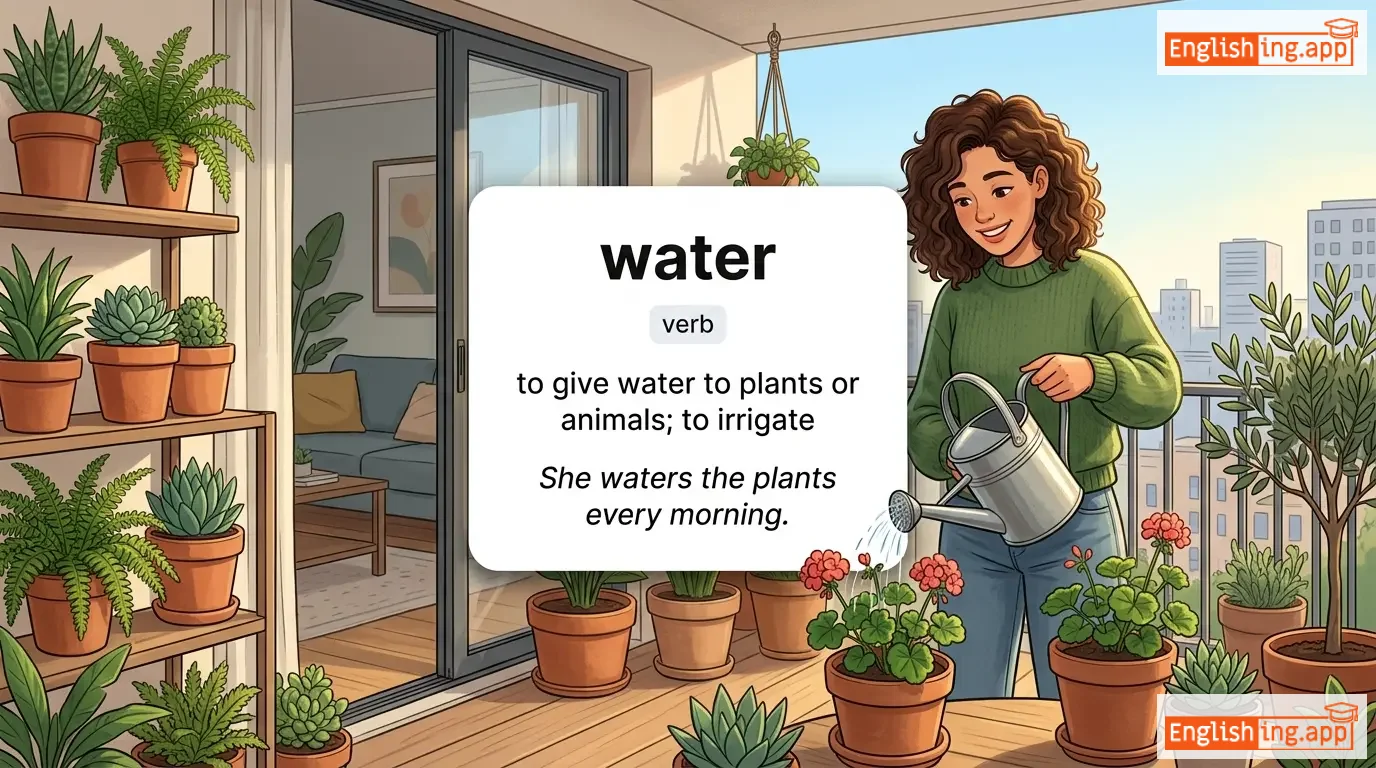
water definition card — visual illustration of the meaning
noun
/ˈwɔːtər/
eau (o)

a clear, colorless, odorless, and tasteless liquid that is essential for life

"We need to drink water to stay hydrated."

"Nous devons boire de l'eau pour rester hydratés." (Nous devons boire de l'eau pour rester hydratés.)
noun
/ˈwɔː.tər ˈtʃes.nʌt/
châtaigne d'eau (chataigne d'eau)

aquatic plant with edible white crisp tubers

"Water chestnuts add a nice crunch to stir-fry dishes."

"Les châtaignes d'eau ajoutent un croquant agréable aux plats sautés." (Les chataignes d'eau ajoutent un croquant agréable aux plats sautés)
noun
/ˈwɔː.tər hen/
poule d'eau (poule d'eau)

a waterbird with dark plumage that lives near ponds and wetlands

"The water hen swam gracefully across the pond."

"La poule d'eau nagea gracieusement à travers l'étang." (La poule d'eau nagea gracieusement à travers l'étang.)
noun
/ˈwɔː.tər pɒt/
pot d'eau (pot d'eau)

a container used for storing or carrying water

"The water pot in the kitchen was filled with fresh drinking water."

"Le pot d'eau dans la cuisine était rempli d'eau potable fraîche." (Le pot d'eau dans la cuisine était rempli d'eau potable fraîche.)
noun
/ˈwɔtər ˈpjʊrəˌfaɪər/
purificateur d'eau (purificateur d'eau)

A device that removes contaminants and impurities from water to make it safe for drinking

"We installed a water purifier in our kitchen to ensure clean drinking water."

"Nous avons installé un purificateur d'eau dans notre cuisine pour garantir une eau potable propre." (Nous avons installé un purificateur d'eau dans notre cuisine pour garantir une eau potable propre.)
noun
/ˈwɔː.tər ˈspɪn.ɪtʃ/
épinard d'eau (epinard d'eau)

A semi-aquatic leafy vegetable with hollow stems, popular in Asian cuisine

"Water spinach grows well in wet soil."

"L'épinard d'eau pousse bien dans les sols humides." (L'épinard d'eau pousse bien dans les sols humides)
noun
/ˈwɔː.tər ˌlɪl.i/
nénuphar (nenufar)

a floating flower that grows on the surface of ponds and lakes

"The white water-lily floated gracefully on the pond."

"Le nénuphar blanc flottait gracieusement sur l'étang." (le nenufar blan flotte grasyusman syr letan)
noun
/ˈwɔːtərfɔːl/
cascade (kaskad)

a cascade of water falling from a height, formed when a river or stream flows over a precipice or steep incline

"The magnificent waterfall attracts thousands of tourists every year."

"La magnifique cascade attire des milliers de touristes chaque année." (La magnifique cascade attire des milliers de touristes chaque annee)
noun
/ˈwɔː.tər.mel.ən/
pastèque (pasteque)

a large round fruit with a hard green skin and sweet red flesh with black seeds

"I bought a fresh watermelon from the market for the summer picnic."

"J'ai acheté une pastèque fraîche au marché pour le pique-nique d'été." (J'ai acheté une pasteque fraiche au marché pour le pique-nique d'été.)
noun
/ˈwɔːtəʃɛd/
point tournant, ligne de partage des eaux (watershed)

An event or period marking a turning point in a situation; also refers to a ridge dividing two drainage areas.

"The independence movement was a watershed in the nation's history."

"Le mouvement d'indépendance a été un tournant dans l'histoire de la nation." (Le mouvement d'indépendance a été un tournant dans l'histoire de la nation.)
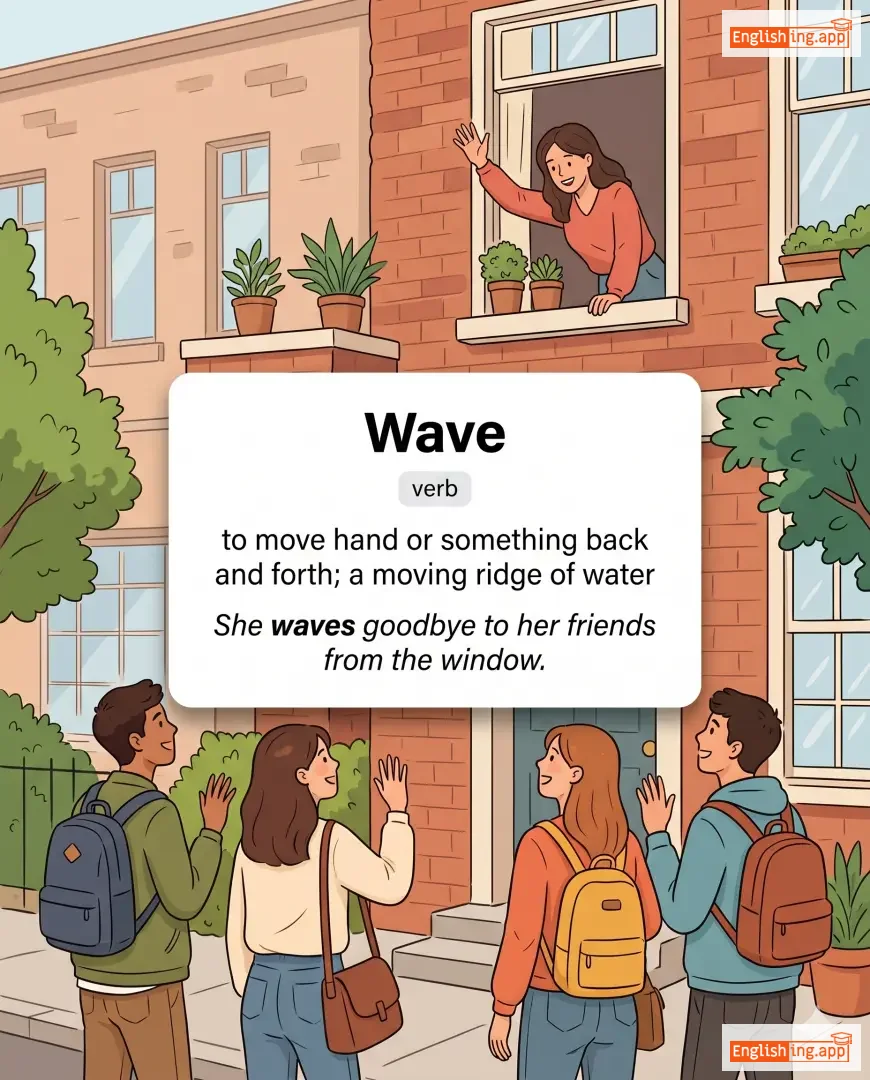
Wave definition card — visual illustration of the meaning
noun
/weɪv/
vague (vague)

a long body of water curling into an arched form and breaking on the shore

"The waves crashed against the rocks during the storm."

"Les vagues se sont écrasées contre les rochers pendant la tempête." (Les vagues se sont écrasées contre les rochers pendant la tempête.)
noun
/ˈweɪvlət/
petite vague (petite vague)

a small wave or ripple on the surface of water or another medium

"The pond was disturbed only by the tiny wavelets caused by the breeze."

"L'étang n'a été perturbé que par les petites vagues causées par la brise." (L'étang n'a été perturbé que par les petites vagues causées par la brise.)
verb
/ˈweɪvər/
hésiter (hesiter)

to become unsteady or indecisive; to hesitate or shake

"She began to waver in her decision to move abroad."

"Elle a commencé à hésiter dans sa décision de partir à l'étranger." (Elle a commence a hesiter dans sa decision de partir a l'etranger.)
verb
/wæks/
augmenter progressivement (augmenter progressivement)

to increase gradually in size, number, strength, or intensity

"The moon will wax until it becomes full."

"La lune va augmenter jusqu'à ce qu'elle devienne pleine." (La lune va augmenter jusqu'à ce qu'elle devienne pleine.)
noun
/wæks ɡɔːrd/
courge cireuse (courge cireuse)

a large white or green gourd with waxy skin, commonly used in Asian cooking

"The wax gourd soup is very nutritious and helps with digestion."

"La soupe de courge cireuse est très nutritive et aide à la digestion." (La soupe de courge cireuse est tres nutritive et aide a la digestion.)
noun
/wæks ˈkændəl/
bougie (bougie)

a cylinder of wax with a wick through it that burns to give light

"We lit a wax candle during the power outage."

"Nous avons allumé une bougie pendant la panne de courant" (Nous avons allumé une bougie pendant la panne de courant)
🛣️

Way (oué)

noun
/weɪ/
chemin / façon (chemin / façon)

a path, direction, or method of doing something

"He found a new way to solve the problem."

"Il a trouvé une nouvelle façon de résoudre le problème." (Il a trouve une nouvelle facon de resoudre le probleme.)
verb
/ˌweɪˈleɪ/
arrêter / attaquer de manière inattendue (arreter / attaquer de maniere inattendue)

to stop or interrupt someone unexpectedly, often to attack or detain them

"He was waylaid by reporters as he left the courthouse."

"Il a été attaqué par des journalistes alors qu'il quittait le tribunal." (Il a ete attaque par des journalistes alors qu'il quittait le tribunal.)
adjective
/ˈweɪwərd/
rebelle (rebelle)

Difficult to control or predict because of unusual or perverse behavior.

"The teacher struggled to manage the wayward students."

"L'enseignant avait du mal à gérer les élèves rebelles." (L'enseignant avait du mal à gérer les élèves rebelles.)
pronoun
/wi/
nous (nous)

used by a speaker to refer to himself or herself and one or more other people

"We are going to the park this afternoon."

"Nous allons au parc cet après-midi." (Nous allons au parc cet après-midi.)
adjective
/wiːk/
faible (faible)

lacking physical strength or energy

"She felt weak after the long run."

"Elle se sentait faible après la longue course." (Elle se sentait faible apres la longue course.)
adjective
/ˈwiːk niːd/
faible (faible)

Lacking determination or courage; easily frightened or yielding.

"The leader was criticized for being weak-kneed in the face of opposition."

"Le leader a été critiqué pour être faible face à l'opposition." (Le leader a ete critique pour etre faible face a l'opposition.)
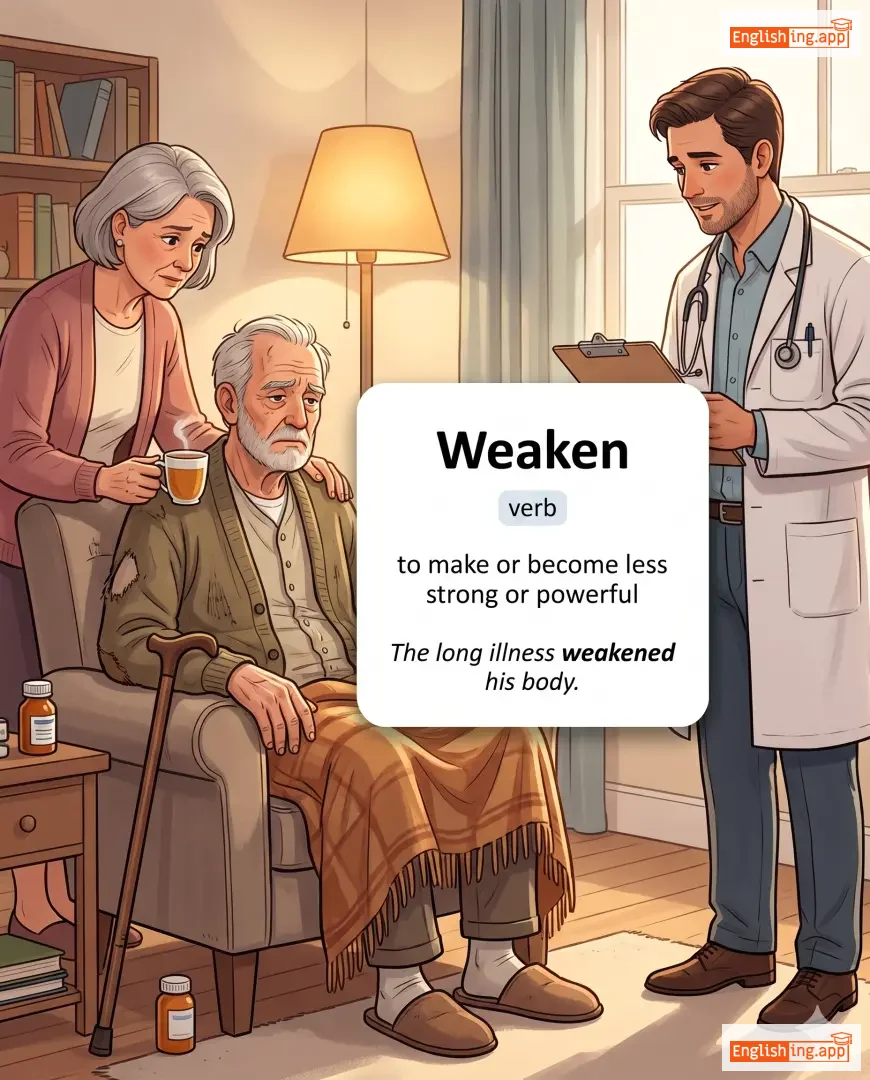
Weaken definition card — visual illustration of the meaning
verb
/ˈwiːkən/
affaiblir (affaiblir)

to make or become less strong or powerful

"The long illness weakened his body."

"La longue maladie a affaibli son corps." (La longue maladie a affaibli son corps.)
noun
/ˈwiːknəs/
faiblesse (faiblesse)

a state of being weak; a flaw or shortcoming in character or structure

"His main weakness is his lack of patience."

"Sa principale faiblesse est son manque de patience." (Sa principale faiblesse est son manque de patience.)
noun
/wiːl/
bonheur (bonheur)

A raised mark on the skin left after a blow; or general well-being and prosperity.

"The charity worked for the common weal of the community."

"Elle n'a pas pu cacher son bonheur lorsqu'elle a reçu le prix." (Elle n'a pas pu cacher son bonheur lorsqu'elle a recu le prix.)
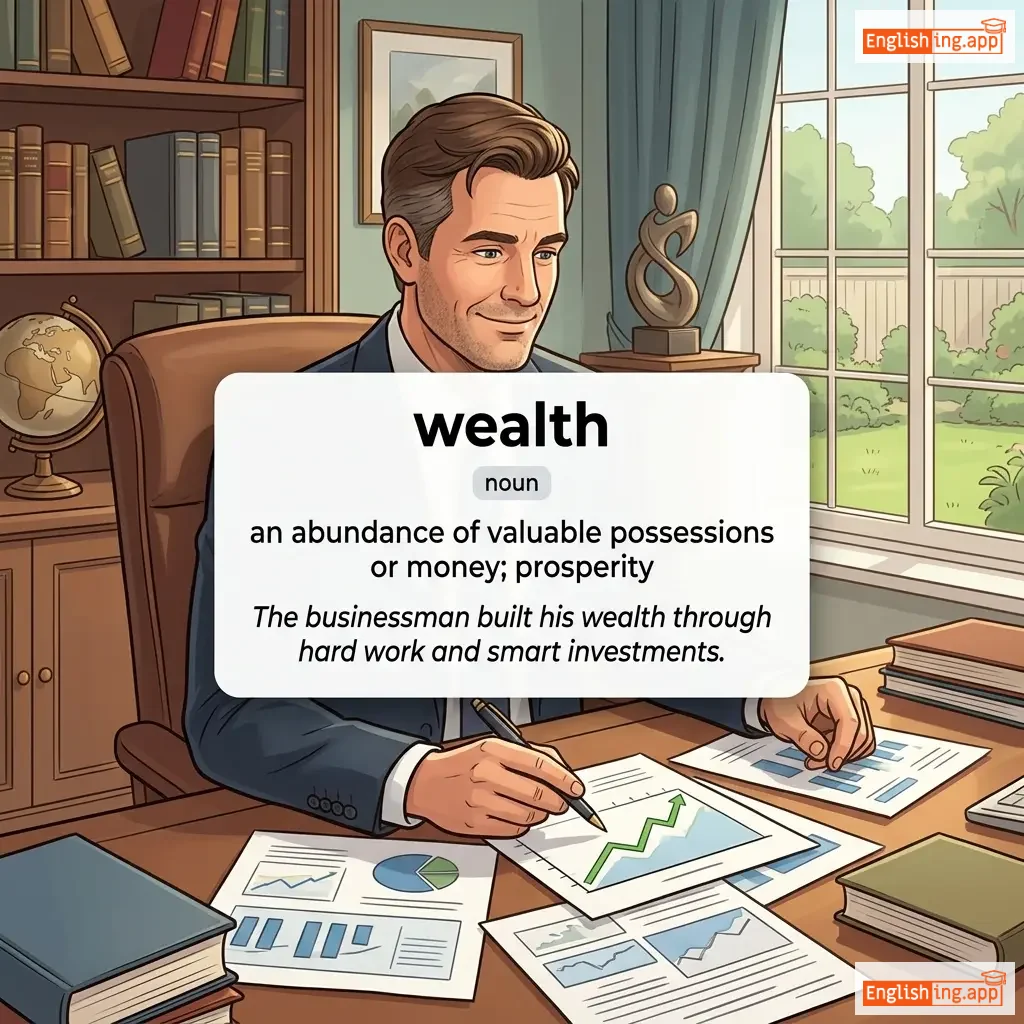
wealth definition card — visual illustration of the meaning
noun
/wɛlθ/
richesse (richesse)

an abundance of valuable possessions or money; prosperity

"The businessman built his wealth through hard work and smart investments."

"L'homme d'affaires a construit sa richesse grâce à un travail acharné et des investissements intelligents." (L'homme d'affaires a construit sa richesse grâce à un travail acharné et des investissements intelligents.)
adjective
/ˈwɛlθi/
riche (riche)

having a great deal of money, resources, or assets

"He became wealthy after investing in real estate."

"Il est devenu riche après avoir investi dans l'immobilier." (Il est devenu riche après avoir investi dans l'immobilier.)
verb
/wiːn/
sevrer (sevrer)

To gradually stop a child or animal from breastfeeding; to detach from a habit.

"Parents often wean their babies around six months old."

"Les parents sevrent souvent leurs bébés vers six mois." (Les parents sevrent souvent leurs bébés vers six mois.)
noun
/ˈwɛpən/
arme (arme)

a thing designed or used for inflicting harm or damage

"He carried a weapon for self-defense."

"Il portait une arme pour se défendre." (Il portait une arme pour se défendre.)
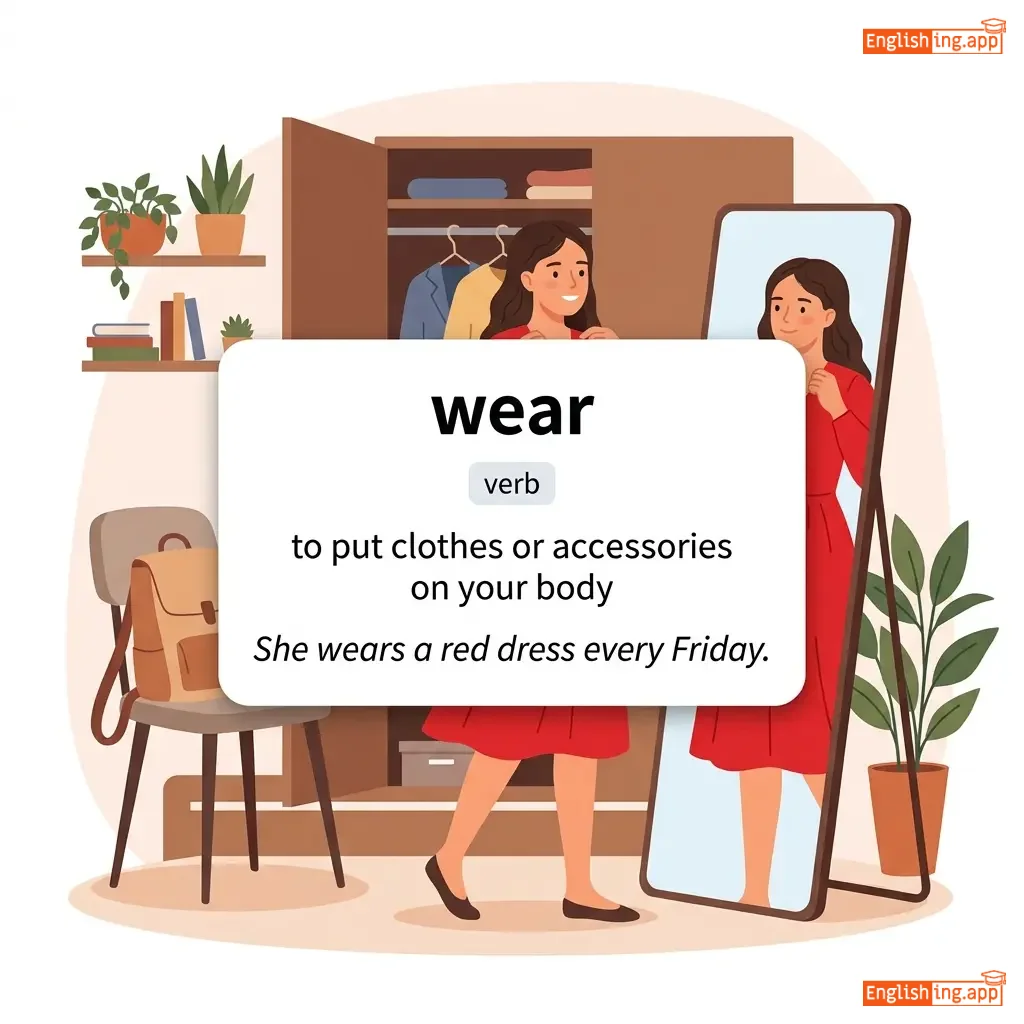
wear definition card — visual illustration of the meaning
verb
/wɛə(r)/
porter (porter)

to put clothes or accessories on your body

"She wears a red dress every Friday."

"Elle porte une robe rouge chaque vendredi." (Elle porte une robe rouge chaque vendredi.)
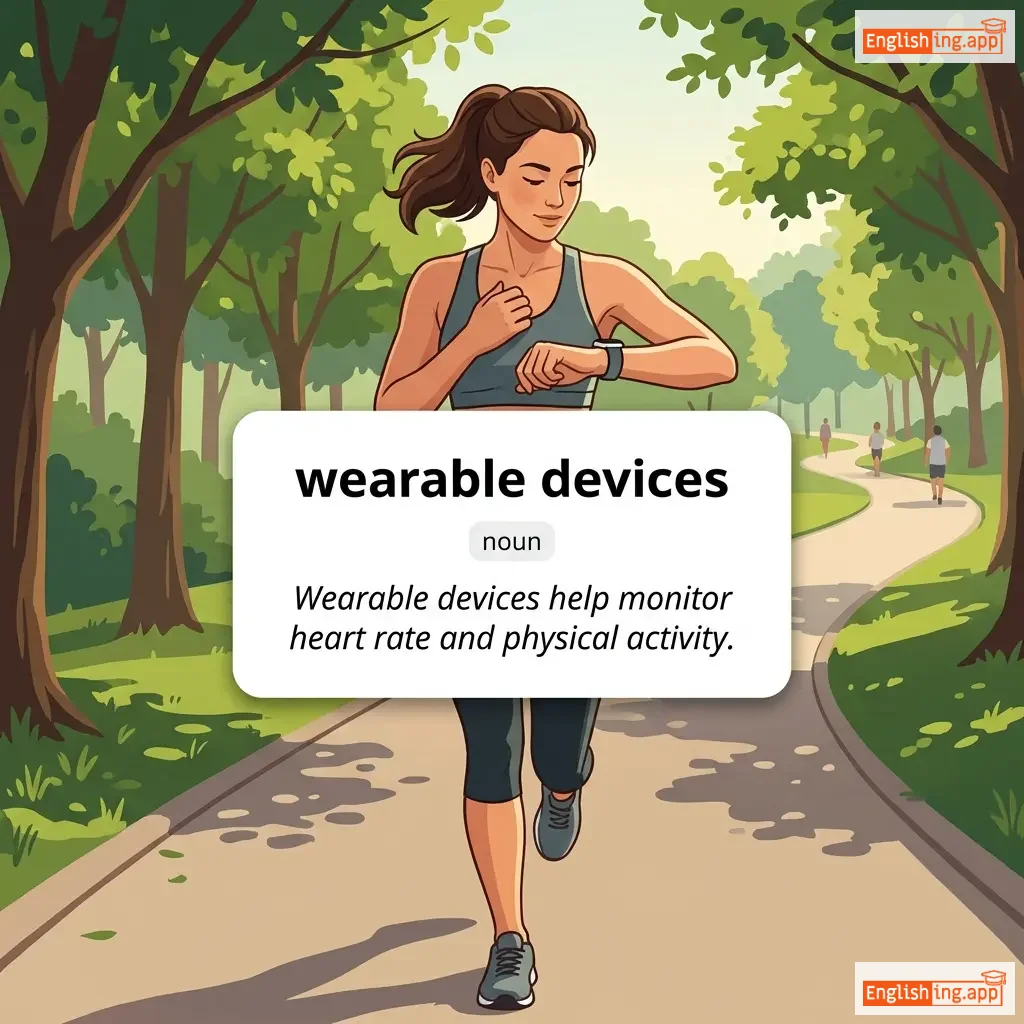
wearable devices definition card — visual illustration of the meaning
noun
ˈweə.rə.bəl dɪˈvaɪ.sɪz
dispositifs portables (dispositifs portables)

Electronic devices that can be worn on the body, typically incorporating smart technology for monitoring health or providing information.

"Wearable devices help monitor heart rate and physical activity."

"Les dispositifs portables aident à surveiller le rythme cardiaque et l'activité physique." (Les dispositifs portables aident a surveiller le rythme cardiaque et l'activite physique.)
adjective
/ˈwɪərɪsəm/
épuisant (epwizã)

Causing one to feel tired or bored.

"The long and wearisome lecture put the students to sleep."

"La longue et épuisante conférence a endormi les étudiants." (La longue et épuisante conférence a endormi les étudiants.)