Vocabulaires

Découvrez, apprenez et maîtrisez le vocabulaire anglais

noun
/ˈtɛmpoʊ/
tempo, rythme (tempo, rythme)

The speed or pace at which a piece of music or activity is performed.

"The band played the song at a faster tempo than usual."

"Le groupe a joué la chanson à un tempo plus rapide que d'habitude." (Le groupe a joué la chanson à un tempo plus rapide que d'habitude.)
adjective
/ˈtɛmpərəl/
temporel (temporel)

Relating to worldly affairs or to time rather than spiritual matters.

"The monk gave up his temporal possessions to live a simple life."

"Le moine a renoncé à ses possessions temporelles pour vivre une vie simple." (Le moine a renoncé à ses possessions temporelles pour vivre une vie simple.)
adverb
/ˈtɛmpərɛrɪli/
temporairement (temporairement)

for a limited time; not permanently

"The road is closed temporarily for repairs."

"La route est fermée temporairement pour des réparations." (La route est fermée temporairement pour des réparations.)
adjective
/ˈtɛmpərɛri/
temporaire (temporaire)

Lasting for only a limited period of time; not permanent.

"She found a temporary job during the summer break."

"Elle a trouvé un travail temporaire pendant les vacances d'été." (Elle a trouvé un travail temporaire pendant les vacances d'été.)
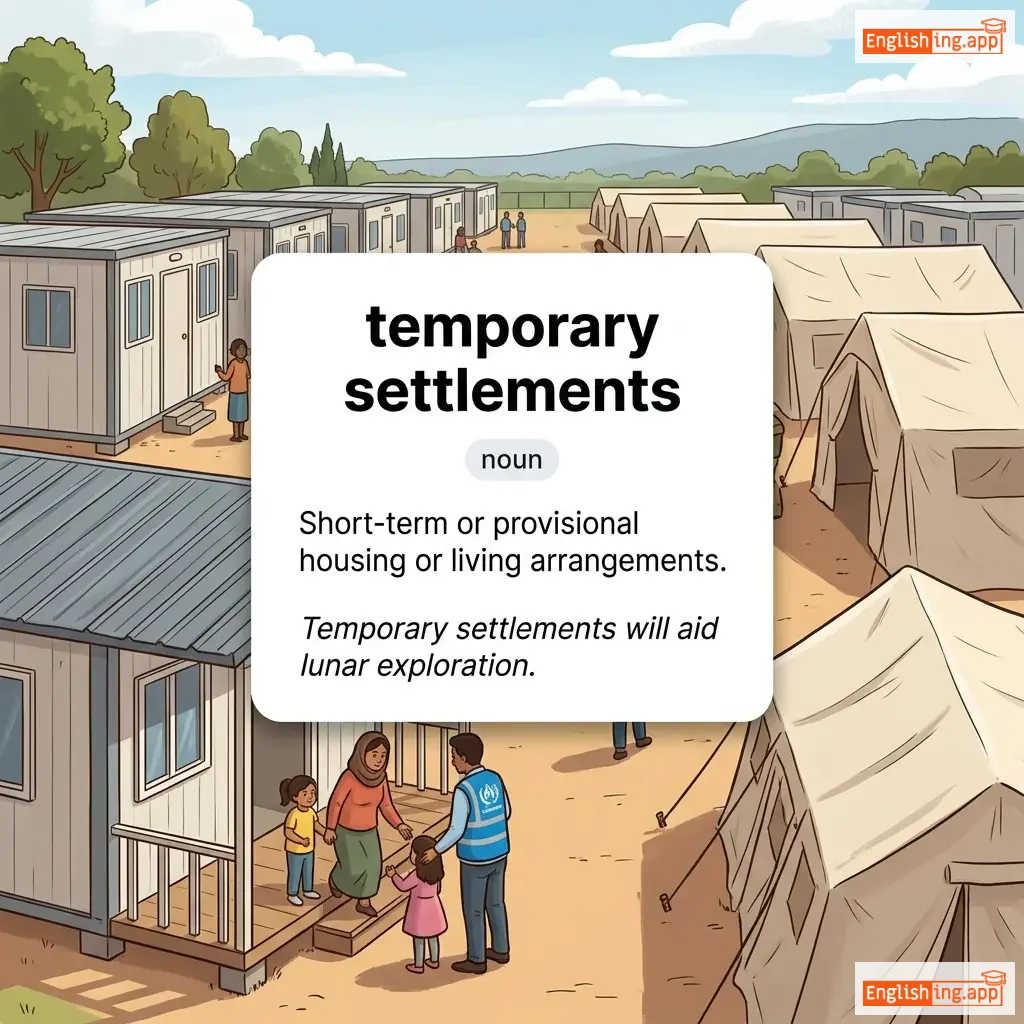
temporary settlements definition card — visual illustration of the meaning
noun
ˈtempəreri ˈsetlmənts
établissements temporaires (etablissements temporaires)

Short-term or provisional housing or living arrangements.

"Temporary settlements will aid lunar exploration."

"Les établissements temporaires aideront à l'exploration lunaire." (Les etablissements temporaires aideront a l'exploration lunaire.)
verb
/ˈtɛmpəˌraɪz/
temporiser (temporiser)

To delay making a decision or taking action in order to gain time.

"The politician temporized when asked about the controversial issue."

"Le politicien a temporisé lorsqu'on lui a demandé à propos de la question controversée." (Le politicien a temporisé lorsqu'on lui a demandé à propos de la question controversée.)
verb
/tɛmpt/
tenter (tenter)

to entice or attract someone to do something, often something wrong or unwise

"The smell of fresh bread tempted him to enter the bakery."

"L'odeur du pain frais l'a tenté d'entrer dans la boulangerie." (L'odeur du pain frais l'a tenté d'entrer dans la boulangerie.)
noun
/temp.ˈteɪ.ʃən/
tentation (tentasyon)

the desire to do something wrong or unwise; an urge to have or do something

"He resisted the temptation to eat the entire chocolate cake."

"Il a résisté à la tentation de manger tout le gâteau au chocolat." (Il a resisté à la tentation de manger tout le gâteau au chocolat.)
noun
/ˈtɛmptər/
tentateur (tentateur)

a person or thing that entices someone into doing something wrong

"The tempter whispered false promises into his ear."

"Le tentateur chuchota de fausses promesses à son oreille." (Le tentateur chuchota de fausses promesses à son oreille.)
adjective
/ˈtemptɪŋ/
tentant (tantant)

appealing to or attracting someone, even if wrong or inadvisable; alluring

"The chocolate cake looked very tempting in the bakery window."

"Le gâteau au chocolat semblait très tentant dans la vitrine de la pâtisserie." (Le gateau au chocolat semblait tres tentant dans la vitrine de la patisserie.)
noun
/tɛn/
dix (dis)

the number following nine and preceding eleven

"I have ten apples in the basket."

"J'ai dix pommes dans le panier." (J'ai dix pommes dans le panier.)
adjective
/ˈtɛnəbl/
défendable (defendable)

able to be defended or maintained against attack or objection

"His argument was strong and tenable in court."

"Son argument était fort et défendable au tribunal." (Son argument était fort et défendable au tribunal.)
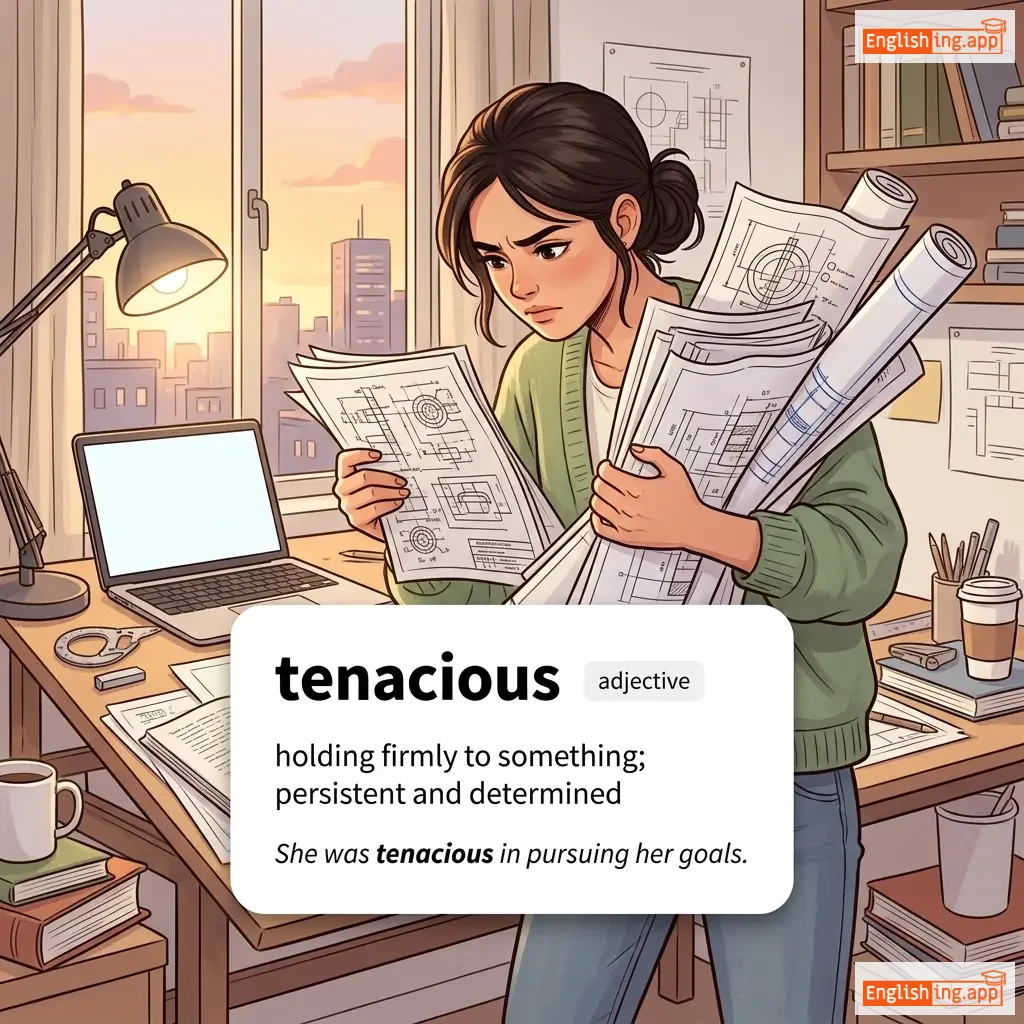
tenacious definition card — visual illustration of the meaning
adjective
/təˈneɪʃəs/
tenace (tenas)

holding firmly to something; persistent and determined

"She was tenacious in pursuing her goals."

"Elle était tenace dans la poursuite de ses objectifs." (Elle était tenace dans la poursuite de ses objectifs.)
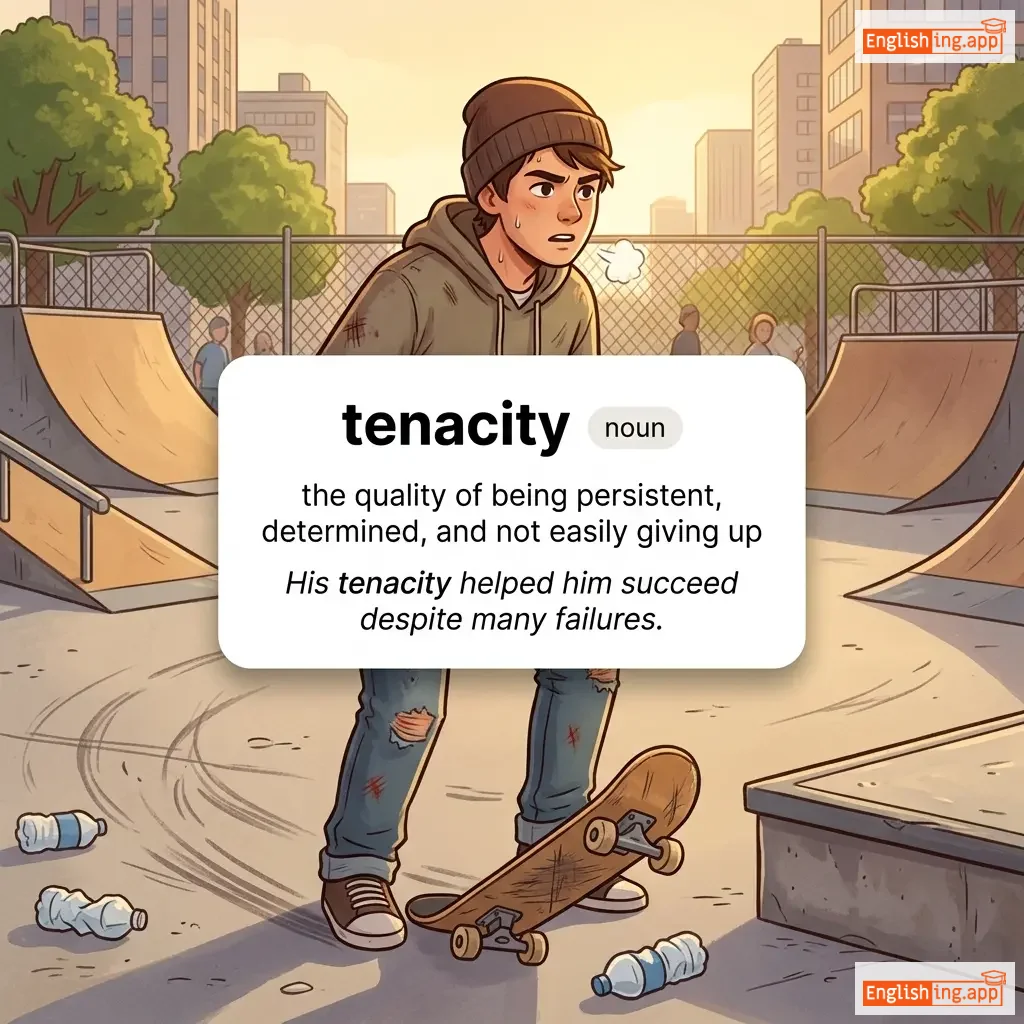
tenacity definition card — visual illustration of the meaning
noun
/təˈnæsəti/
tenacité (tenacite)

the quality of being persistent, determined, and not easily giving up

"His tenacity helped him succeed despite many failures."

"Sa ténacité l'a aidé à réussir malgré de nombreux échecs." (Sa tenacite l'a aide a reussir malgre de nombreux echecs.)
noun
/ˈtɛnənsi/
bail (bail)

The possession or occupation of land or property as a tenant.

"The tenancy agreement was signed for two years."

"Le contrat de bail a été signé pour deux ans." (Le contrat de bail a été signé pour deux ans.)
noun
/ˈtɛnənt/
locataire (locataire)

A person who occupies land or property rented from a landlord.

"The tenant paid the rent on time every month."

"Le locataire a payé le loyer à temps chaque mois" (Le locataire a payé le loyer à temps chaque mois)
verb
/tɛnd/
avoir tendance à/s'occuper de (avoir tendance à/s'occuper de)

To regularly behave in a particular way or to take care of something.

"She tends to wake up early in the morning."

"Elle a tendance à se lever tôt le matin." (Elle a tendance à se lever tôt le matin.)
noun
/ˈtɛndənsi/
tendance (tendance)

An inclination or likelihood to behave in a certain way.

"He has a tendency to forget small details."

"Il a tendance à oublier les petits détails." (Il a tendance a oublier les petits details.)
adjective
/tɛnˈdɛnʃəs/
partisan (partisan)

Expressing or promoting a particular cause or point of view, often biased.

"The article was criticized for its tendentious tone."

"L'article a été critiqué pour son ton partisan." (L'article a été critiqué pour son ton partisan.)
verb, noun, adjective
/ˈtɛndər/
proposition / tendre (proposition / tendre)

to offer formally; soft and delicate in texture or character; a formal offer or proposal

"The company tendered its resignation to the board."

"La société a présenté sa démission au conseil." (La societe a presente sa demission au conseil.)
noun
/ˈten.dər.nəs/
tendresse (tendresse)

gentleness and kindness; the quality of being easily hurt or damaged

"The mother showed great tenderness while caring for her sick child."

"La mère a montré une grande tendresse en s'occupant de son enfant malade." (La mere a montre une grande tendresse en s'occupant de son enfant malade.)
adjective
/ˈtɛnɪbrəs/
ténébreux (tenebreux)

dark, shadowy, or obscure

"The cave was damp and tenebrous, filled with eerie sounds."

"La grotte était humide et ténébreuse, remplie de bruits étranges." (La grotte etait humide et tenebreuse, remplie de bruits etranges.)
noun
/ˈtɛnəmənt/
immeuble locatif (immeuble locatif)

a large building divided into separate apartments, often in poor condition

"The family lived in a crowded tenement in the city."

"La famille vivait dans un tenement bondé en ville." (La famille vivait dans un tenement bondé en ville.)
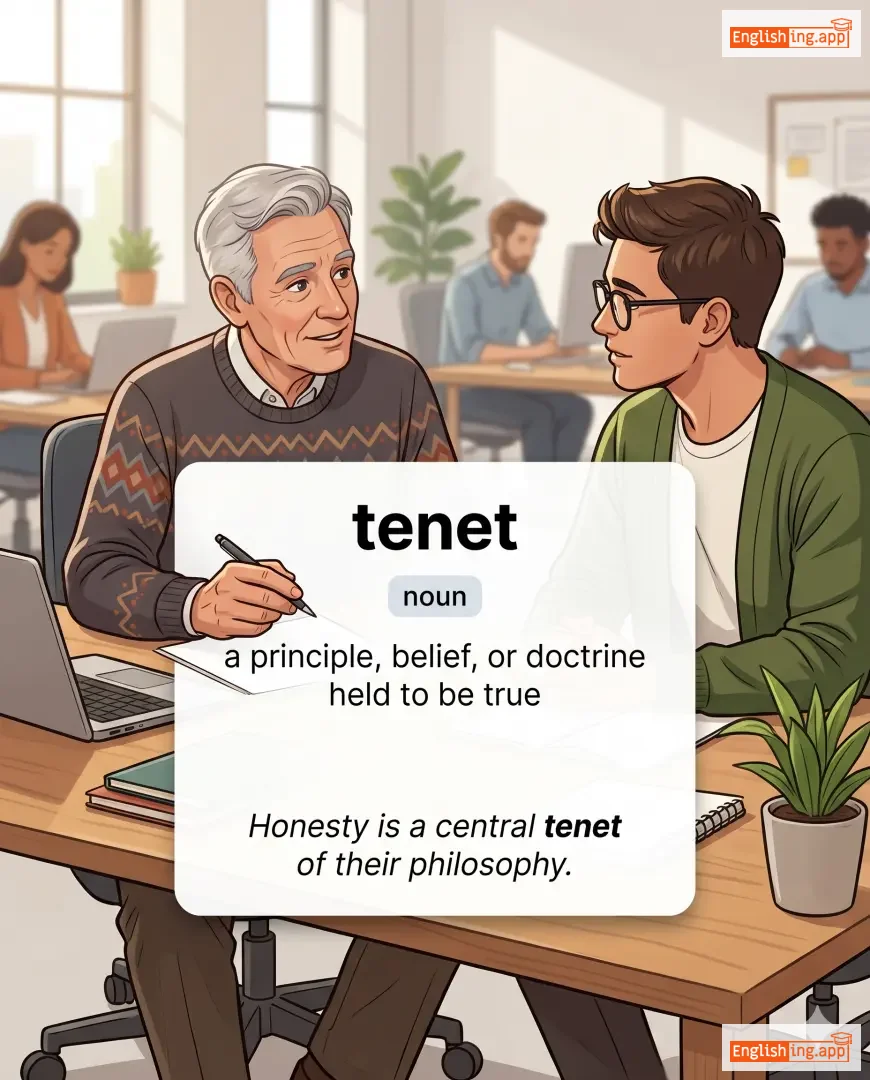
tenet definition card — visual illustration of the meaning
noun
/ˈtɛnɪt/
principe (principe)

a principle, belief, or doctrine held to be true

"Honesty is a central tenet of their philosophy."

"L'honnêteté est un principe central de leur philosophie." (L'honnêteté est un principe central de leur philosophie.)
noun
/ˈtɛnɪs/
tennis (tennis)

a sport played with rackets and a ball on a rectangular court

"He enjoys playing tennis with his friends on the weekends."

"Il aime jouer au tennis avec ses amis le week-end." (Il aime jouer au tennis avec ses amis le week-end.)
noun
/ˈtɛnər/
ténor / ton général (tenor / ton general)

the general meaning, drift, or character of something; a male singing voice between baritone and alto

"The overall tenor of his speech was hopeful and reassuring."

"Le ton général de son discours était plein d'espoir et rassurant." (Le ton général de son discours était plein d'espoir et rassurant.)
noun, adjective, verb
/tɛns/
tendu / temps grammatical (tendu / temps grammatical)

a grammatical category showing time reference; stretched tight or anxious

"She felt tense before the interview."

"Elle se sentait tendue avant l'entretien." (Elle se sentait tendue avant l'entretien.)
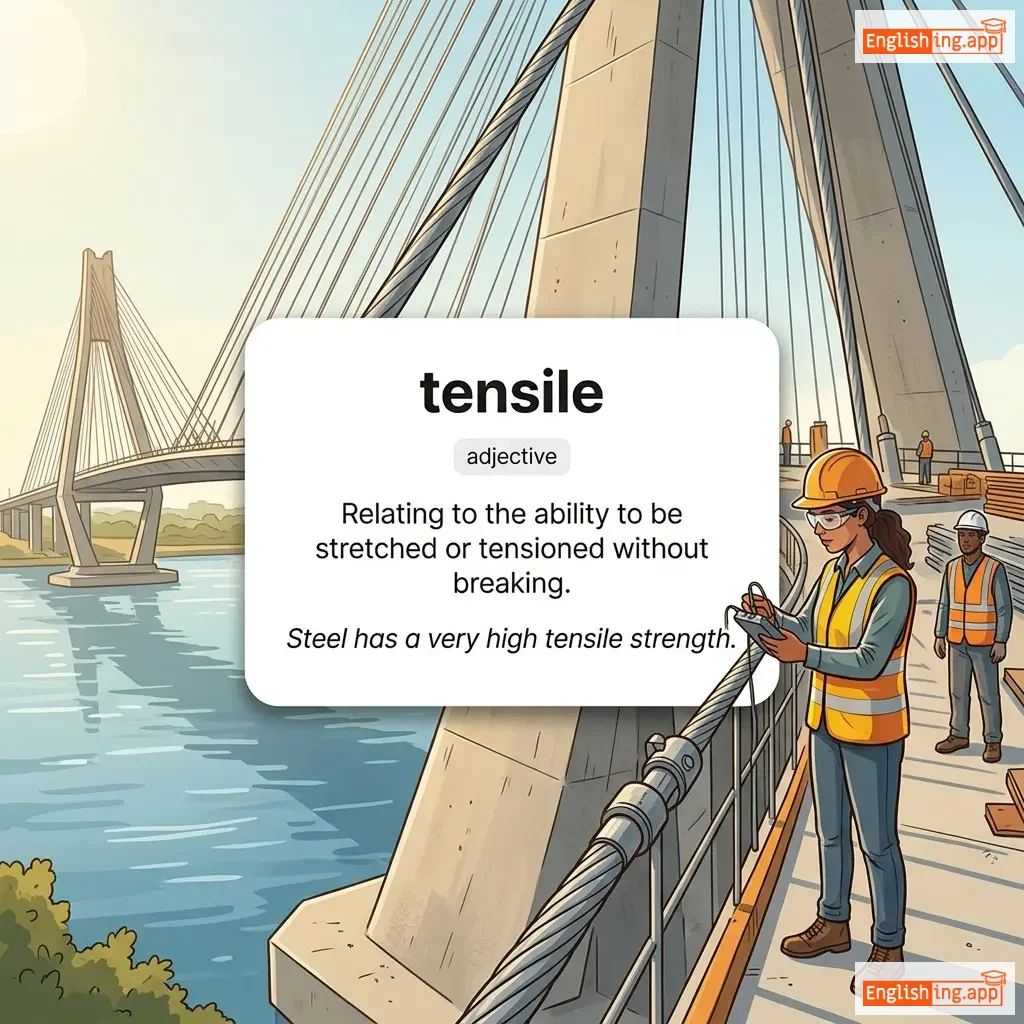
tensile definition card — visual illustration of the meaning
adjective
/ˈtɛn.saɪl/
extensible (extensible)

Relating to the ability to be stretched or tensioned without breaking.

"Steel has a very high tensile strength."

"L'acier a une résistance extensible très élevée." (L'acier a une résistance extensible très élevée.)
noun
/ˈtɛn.ʃən/
tension (tension)

A state of being stretched tight; mental or emotional strain.

"There was a lot of tension in the room before the exam results were announced."

"Il y avait beaucoup de tension dans la salle avant l'annonce des résultats de l'examen." (Il y avait beaucoup de tension dans la salle avant l'annonce des résultats de l'examen.)
noun
/tɛnt/
tente (tente)

a portable shelter made of fabric, supported by poles and ropes

"We set up a tent for the camping trip."

"Nous avons monté une tente pour le voyage de camping." (Nous avons monté une tente pour le voyage de camping.)
adjective
/ˈtɛn.tə.tɪv/
tentatif (tentatif)

Not certain or fixed; done without confidence.

"She gave a tentative smile before agreeing."

"Elle a donné un sourire tentatif avant d'accepter." (Elle a donné un sourire tentatif avant d'accepter.)
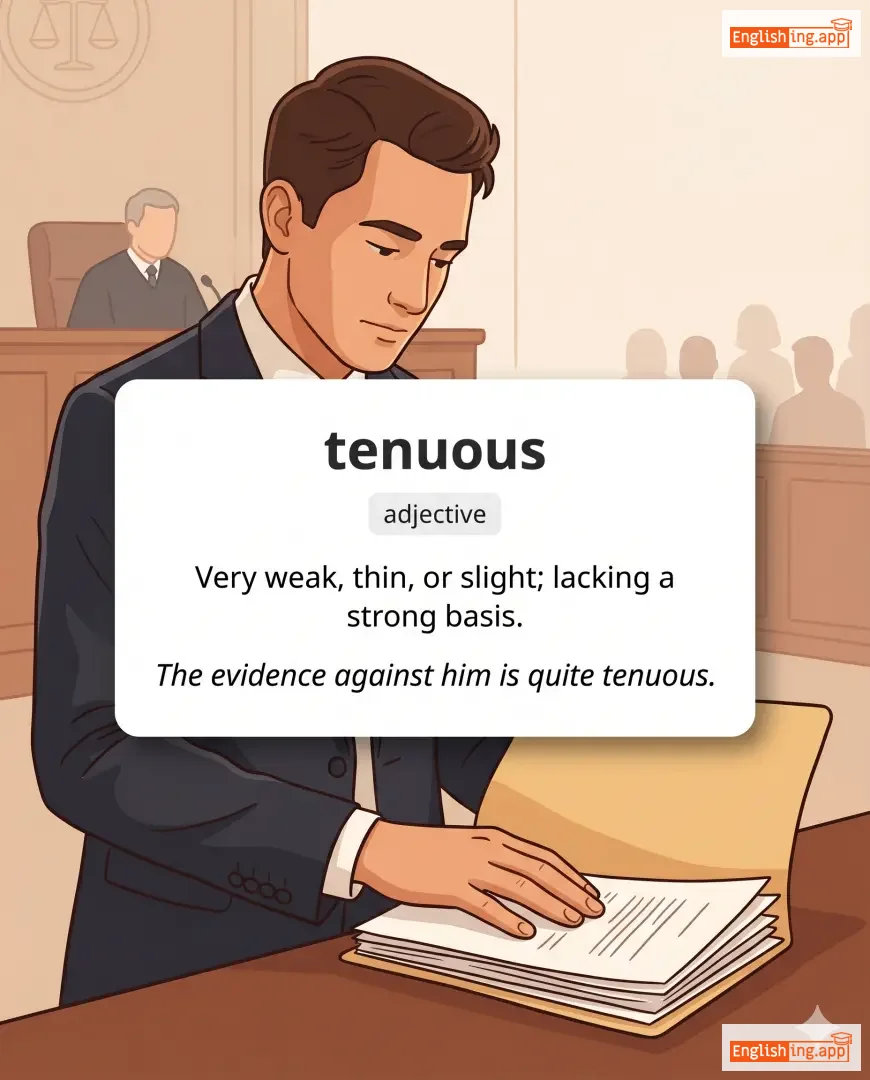
tenuous definition card — visual illustration of the meaning
adjective
/ˈtɛn.ju.əs/
faible / mince (faible / mince)

Very weak, thin, or slight; lacking a strong basis.

"The evidence against him is quite tenuous."

"La preuve contre lui est assez faible." (La preuve contre lui est assez faible.)
noun
/ˈtɛnjər/
mandat (mandat)

The period of time during which someone holds a position, office, or land.

"His tenure as president lasted for five years."

"Son mandat en tant que président a duré cinq ans." (Son mandat en tant que president a dure cinq ans.)
adjective
/ˈtɛpɪd/
tiède, indifférent (tiede, indifferente)

Lukewarm; showing little enthusiasm or force.

"His speech received only a tepid response from the audience."

"Son discours n'a reçu qu'une réponse tiède de la part du public." (Son discours n'a reçu qu'une réponse tiède de la part du public.)
noun
/ˌtɜːsənˈtɛnəri/
tercentenaire (tercentenaire)

The 300th anniversary of an event.

"The city celebrated its tercentenary with a grand festival."

"La ville a célébré son tercentenaire avec un grand festival." (La ville a célébré son tercentenaire avec un grand festival.)
noun
/ˌtɜːdʒɪvərˈseɪʃən/
évasion, retournement (evazion, retournement)

Evasion of straightforward action or speech; changing sides or being inconsistent.

"The politician’s tergiversation frustrated his supporters."

"La tergiversation du politicien a frustré ses partisans." (La tergiversation du politicien a frustre ses partisans.)
noun
/tɜːm/
terme (terme)

a word or phrase used to describe a thing or to express a concept

"The term 'machine learning' is commonly used in technology."

"Le terme 'apprentissage automatique' est couramment utilisé dans la technologie." (Le terme 'apprentissage automatique' est couramment utilise dans la technologie.)
noun
/ˈtɜːrməɡənt/
femme autoritaire et irritable (femme autoritaire et irritable)

A harsh-tempered or overbearing woman.

"The character was portrayed as a loud and domineering termagant."

"Le personnage a été dépeint comme une femme bruyante et dominatrice." (Le personnage a été dépeint comme une femme bruyante et dominatrice.)
noun/adjective
/ˈtɜːrmɪnəl/
terminal, final, maladie terminale (terminal, final, maladie terminale)

As a noun: A place where transport routes begin or end. As an adjective: Relating to the end or final stage of something, often an illness.

"He waited for the bus at the central terminal."

"Il attendait le bus à la terminale centrale." (Il attendait le bus à la terminale centrale.)
verb
/ˈtɜːrmɪˌneɪt/
terminer (terminer)

to bring something to an end or to stop something from continuing

"The company decided to terminate his contract."

"L'entreprise a décidé de mettre fin à son contrat." (L'entreprise a décidé de mettre fin à son contrat.)
noun
/ˌtɜːrmɪˈneɪʃən/
résiliation (resiliation)

the act of ending something or the state of being ended

"The termination of the contract caused financial loss."

"La résiliation du contrat a causé une perte financière." (La resiliation du contrat a cause une perte financiere.)
noun
/ˌtɜːrməˈnɑːlədʒi/
terminologie (terminologie)

the set of technical or special words used in a particular subject

"Medical terminology can be difficult for new students to understand."

"La terminologie médicale peut être difficile à comprendre pour les nouveaux étudiants." (La terminologie medicale peut etre difficile a comprendre pour les nouveaux etudiants.)
noun
/ˈtɜːrmɪnəs/
point final (pwan fianal)

the final point or end of something, especially the final station on a railway line

"The train finally arrived at the terminus after a long journey."

"Le train est finalement arrivé au terminus après un long voyage." (Le tran é finaleman arrivé o terminus après un long voyaj.)
noun
/tɜːmz/
termes (termes)

plural of term; conditions or rules in a contract or agreement

"The terms of the agreement are clearly outlined in the contract."

"Les termes de l'accord sont clairement définis dans le contrat." (Les termes de l'accord sont clairement definis dans le contrat.)
noun
/təˈreɪn/
terrain (terrain)

a stretch of land, especially with regard to its physical features

"The soldiers had to cross rough terrain during the mission."

"Les soldats ont dû traverser un terrain difficile pendant la mission." (Les soldats ont du traverser un terrain difficile pendant la mission.)
noun
/ˈterəpɪn/
une petite tortue d'eau douce (une petite tortue d'eau douce)

a small freshwater turtle, especially one found in North America

"The terrapin slowly crawled into the pond."

"Le terrapin se glissa lentement dans l'étang." (Le terrapin se glissa lentement dans l'étang.)
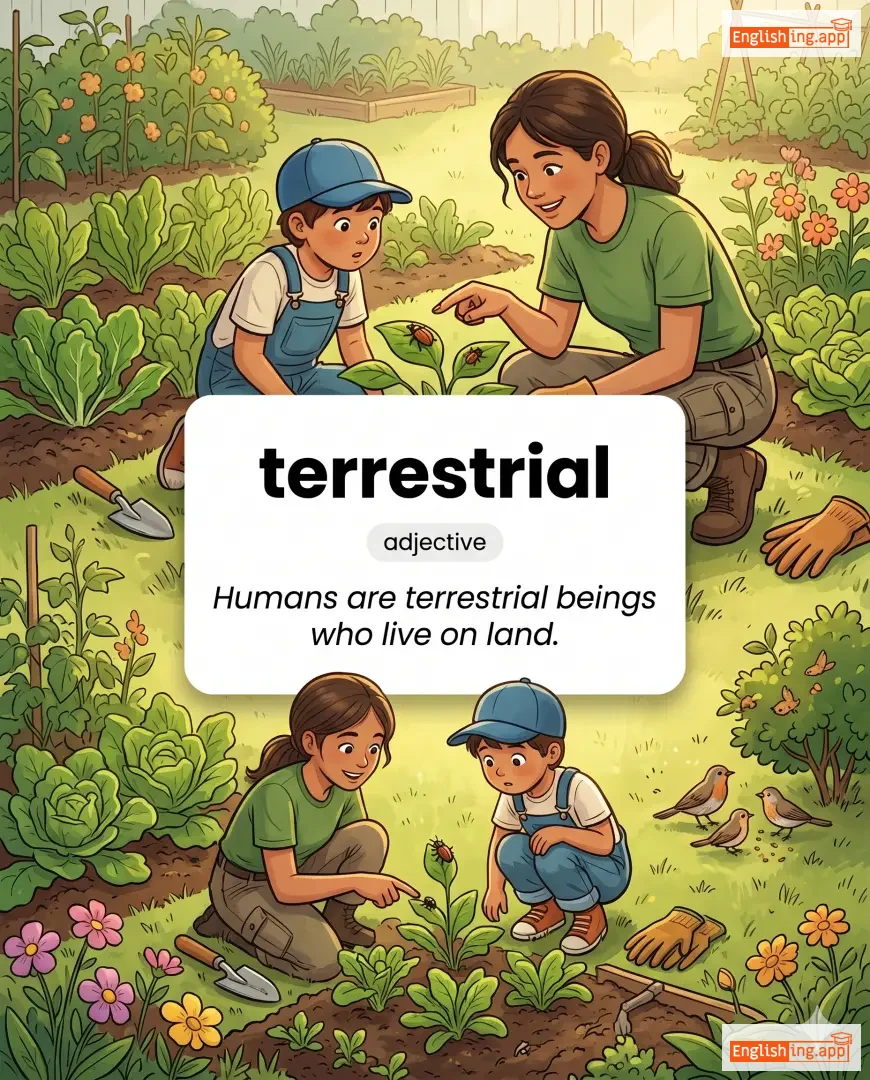
terrestrial definition card — visual illustration of the meaning
adjective
/təˈrɛstriəl/
terrestre (terrestre)

Relating to the Earth or land as opposed to the sea or air; living or growing on land.

"Humans are terrestrial beings who live on land."

"Les humains sont des êtres terrestres qui vivent sur la terre." (Les humains sont des êtres terrestres qui vivent sur la terre.)
adjective
/ˈtɛrɪbəl/
terrible (terble)

extremely bad or unpleasant

"The food at that restaurant was terrible."

"La nourriture de ce restaurant était terrible." (La nourriture de ce restaurant etait terrible.)
adverb
/ˈtɛrəbli/
terriblement (terriblement)

to a very great or extreme degree; very badly or unpleasantly

"He felt terribly sad after hearing the news."

"Il se sentait terriblement triste après avoir entendu la nouvelle." (Il se sentait terriblement triste après avoir entendu la nouvelle.)
adjective
/təˈrɪfɪk/
fantastique (fantastik)

extremely good or excellent; very great or intense

"The concert last night was absolutely terrific."

"Le concert d'hier soir était absolument fantastique." (Le concert d'hier soir etait absolument fantastique.)