Vocabulaires

Découvrez, apprenez et maîtrisez le vocabulaire anglais

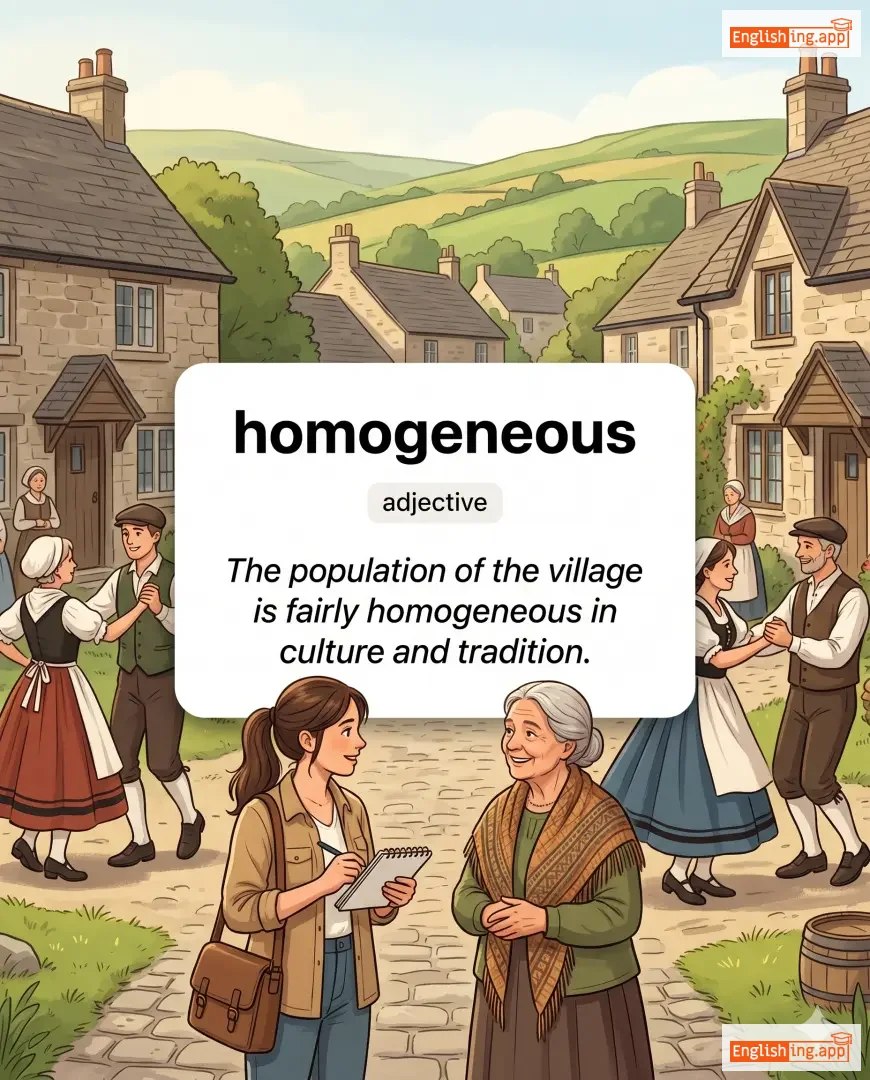
homogeneous definition card — visual illustration of the meaning
adjective
/ˌhoʊ.məˈdʒiː.ni.əs/
homogène (homogène)

Consisting of parts or elements that are all the same kind; uniform in composition.

"The population of the village is fairly homogeneous in culture and tradition."

"La population du village est assez homogène en culture et tradition." (La population du village est assez homogène en culture et tradition.)
verb
/həˈmɑː.dʒə.naɪz/
homogénéiser (homogeneizer)

To make uniform or similar by blending or mixing different elements.

"The company tried to homogenize its products across global markets."

"L'entreprise a essayé d'homogénéiser ses produits sur les marchés mondiaux." (L'entreprise a essayé d'homogénéiser ses produits sur les marchés mondiaux.)
adjective
/həˈmɑː.dʒə.nəs/
homogène (homogene)

Similar or uniform in nature; often used interchangeably with 'homogeneous'.

"The class was made up of a homogenous group of students."

"La classe était composée d'un groupe homogène d'étudiants." (La classe était composée d'un groupe homogène d'étudiants.)
adjective
/həˈmɑː.lə.ɡəs/
homologue (structure) (homologue (structure))

Having the same relation, relative position, or structure, especially due to evolutionary origin.

"The wings of bats and the arms of humans are homologous structures."

"Les ailes des chauves-souris et les bras des humains sont des structures homologues." (Les ailes des chauves-souris et les bras des humains sont des structures homologues.)
noun
/ˈhɑː.mə.nɪm/
homonyme (homonyme)

A word that is spelled and pronounced like another word but has a different meaning.

"The word 'bat' is a homonym because it can mean an animal or a sports tool."

"Le mot 'chauve-souris' est un homonyme car il peut signifier un animal ou un outil de sport." (Le mot 'chauve-souris' est un homonyme car il peut signifier un animal ou un outil de sport.)
noun
/ˈhɒməˌfoʊn/
homophone (omofon)

A word that is pronounced the same as another word but differs in meaning, and often spelling.

"The words 'pair' and 'pear' are homophones."

"Les mots 'pair' et 'pear' sont des homophones." (Les mots 'pair' et 'pear' sont des homophones.)
verb
/hoʊn/
aiguiser, améliorer une compétence (aiguiser, ameliorer une competence)

To sharpen a blade or to improve a skill through practice.

"She honed her presentation skills before the big meeting."

"Elle a affiné ses compétences en présentation avant la grande réunion." (Elle a affiné ses compétences en présentation avant la grande réunion.)
adjective
/ˈɑːnɪst/
honnête (honette)

free of deceit and untruthfulness; sincere

"She is known as an honest and trustworthy person."

"Elle est connue comme une personne honnête et digne de confiance." (Elle est connue comme une personne honnête et digne de confiance.)
adverb
/ˈɒnɪstli/
honnêtement (honetement)

in a truthful, sincere, or fair way

"She spoke honestly about her mistakes."

"Elle a parlé honnêtement de ses erreurs." (Elle a parlé honnêtement de ses erreurs.)
noun
/ˈɒnɪsti/
honnêteté (honnete)

the quality of being truthful and sincere

"Honesty is the best policy in all situations."

"L'honnêteté est la meilleure politique dans toutes les situations." (L'honnete est la meilleure politique dans toutes les situations.)
noun
/ˈhʌni/
miel (miel)

A sweet, sticky substance made by bees from nectar.

"She likes to put honey in her tea."

"Elle aime mettre du miel dans son thé." (Elle aime mettre du miel dans son thé.)
noun
/ˈɑːnər/
honneur (honneur)

high respect; great esteem

"He received an award in honor of his achievements."

"Il a reçu un prix en l'honneur de ses réalisations." (Il a reçu un prix en l'honneur de ses réalisations.)
noun
/ˌɒnəˈreəriəm/
honoraires (honoraires)

A payment given for professional services that are rendered without a fee.

"The guest lecturer received an honorarium for her talk."

"Le conférencier invité a reçu un honorarium pour sa conférence." (Le conférencier invité a reçu un honorarium pour sa conférence.)
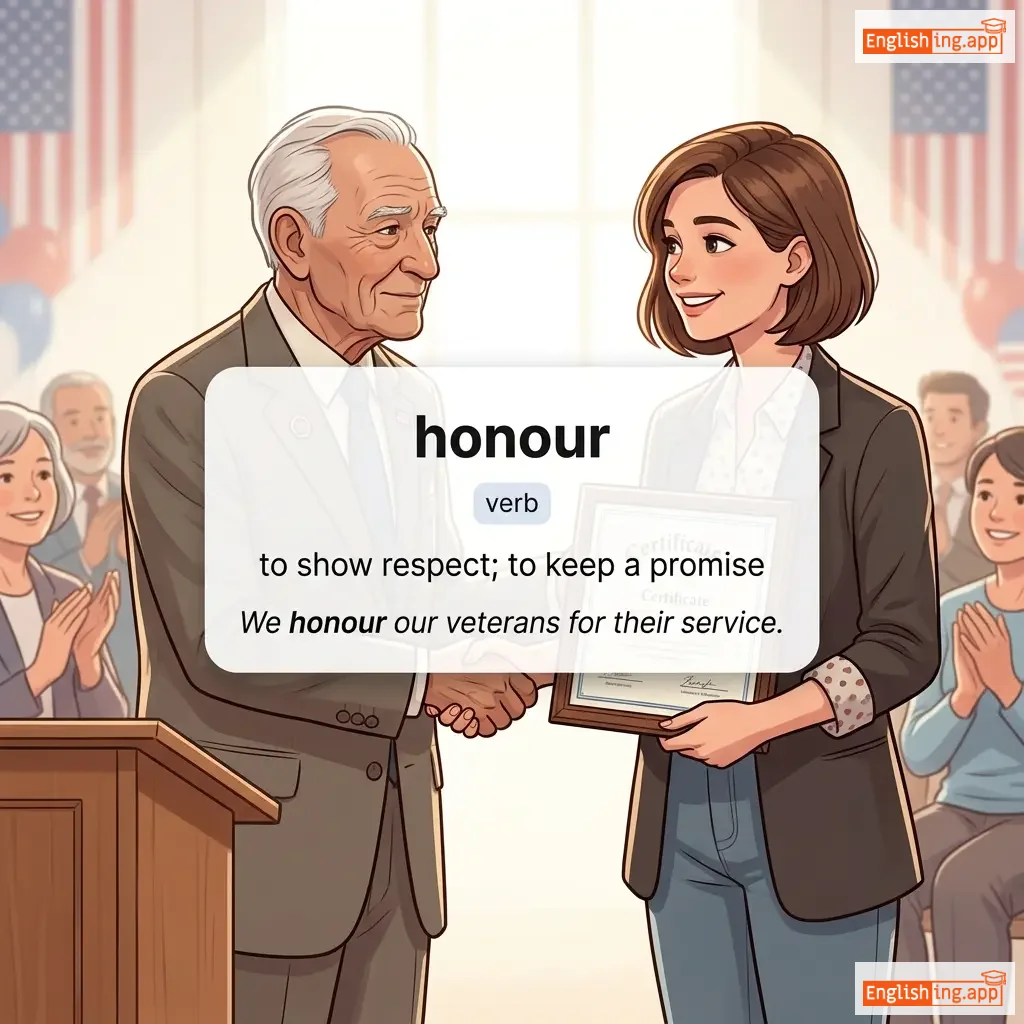
honour definition card — visual illustration of the meaning
verb
/ˈɒnər/
honorer (honorer)

to show respect; to keep a promise

"We honour our veterans for their service."

"Nous honorons nos vétérans pour leur service." (Nous honorons nos vétérans pour leur service.)
adjective
/ˈɒnərəbəl/
honorable (honorable)

deserving respect or admiration because of moral integrity; showing honesty and fairness

"She is known as an honourable leader who always keeps her promises."

"Elle est connue comme une dirigeante honorable qui tient toujours ses promesses." (elle est connue comme une dirigeante honorable qui tient toujours ses promesses)
adjective; past participle
/ˈɒnəd/
honoré (honore)

treated with respect or distinction; feeling proud and privileged

"She felt deeply honoured to receive the award."

"Elle s’est sentie honorée de recevoir le prix." (Elle s est sentie honoree de recevoir le prix)
noun
/hʊd/
capuche (kapuʃ)

the expandable neck region of certain snakes like cobras; a covering for the head

"The cobra spread its hood when it felt threatened."

"Le cobra a étendu son capuchon lorsqu'il a ressenti une menace." (Le cobra a etendu son capuchon lorsqu'il a ressenti une menace.)
verb
/ˈhʊdwɪŋk/
tromper (tromper)

To deceive or trick someone.

"The scammer hoodwinked many people with false promises."

"Le fraudeur a trompé de nombreuses personnes avec de fausses promesses." (Le fraudeur a trompé de nombreuses personnes avec de fausses promesses.)
noun
/huːf/
fer (fer)

the hard part covering the foot of horses, cattle, sheep, and other animals

"The horse's hoof was injured after stepping on a sharp rock."

"Le fer du cheval a été blessé après avoir marché sur une roche tranchante." (Le fer du cheval a été blessé après avoir marché sur une roche tranchante.)
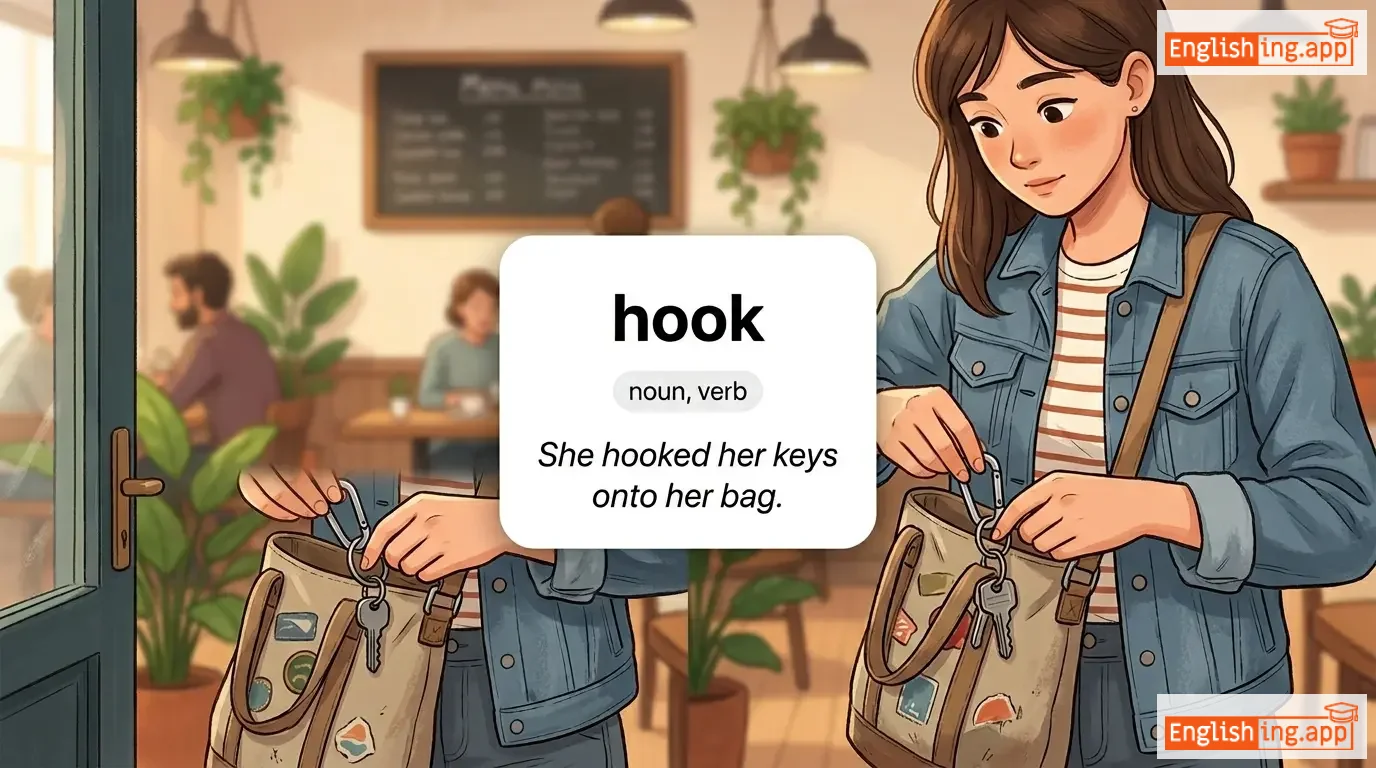
hook definition card — visual illustration of the meaning
noun, verb
/hʊk/
crochet ou dispositif pour suspendre (crochet ou dispositif pour suspendre)

a curved piece of metal or other material used for catching, holding, or pulling something; to catch or attach with a hook

"She hooked her keys onto her bag."

"Elle a accroché ses clés à son sac." (Elle a accroché ses clés à son sac.)
verb
/hoʊp/
espoir (espoir)

To want something to happen or be true and think it is possible.

"I hope everything goes well with your exam."

"J'espère que tout va bien se passer pour ton examen." (J'espère que tout va bien se passer pour ton examen.)
adjective
/ˈhəʊpfʊl/
optimiste (optimiste)

feeling or showing optimism about a future event

"She is hopeful about the results of the interview."

"Elle est optimiste à propos des résultats de l'entretien." (Elle est optimiste à propos des résultats de l'entretien.)
adverb
/ˈhoʊpfəli/
espérément (esperement)

in a hopeful manner; expressing hope or optimism

"Hopefully, the weather will be nice tomorrow."

"Espérons que le temps sera agréable demain." (Esperons que le temps sera agreable demain.)
adjective
/ˈhoʊpləs/
désespéré; sans espoir (desespere; san espoir)

feeling or causing despair about something; without hope; desperate

"The situation seemed hopeless until help arrived."

"La situation semblait désespérée jusqu'à l'arrivée de l'aide." (La situation semblait desesperée jusqu'à l'arrivée de l'aide.)
noun
/hɔːrd/
horde (horde)

A large group or crowd, especially one that is disorderly or difficult to control.

"A horde of fans gathered outside the stadium."

"Une horde de fans s'est rassemblée devant le stade." (Une horde de fans s'est rassemblee devant le stade.)
noun
/həˈraɪ.zən/
horizon (horizon)

the line where the earth seems to meet the sky; the limit of one's knowledge, experience, or interest

"The sun disappeared below the horizon."

"Le soleil a disparu sous l'horizon." (Le soleil a disparu sous l'horizon.)
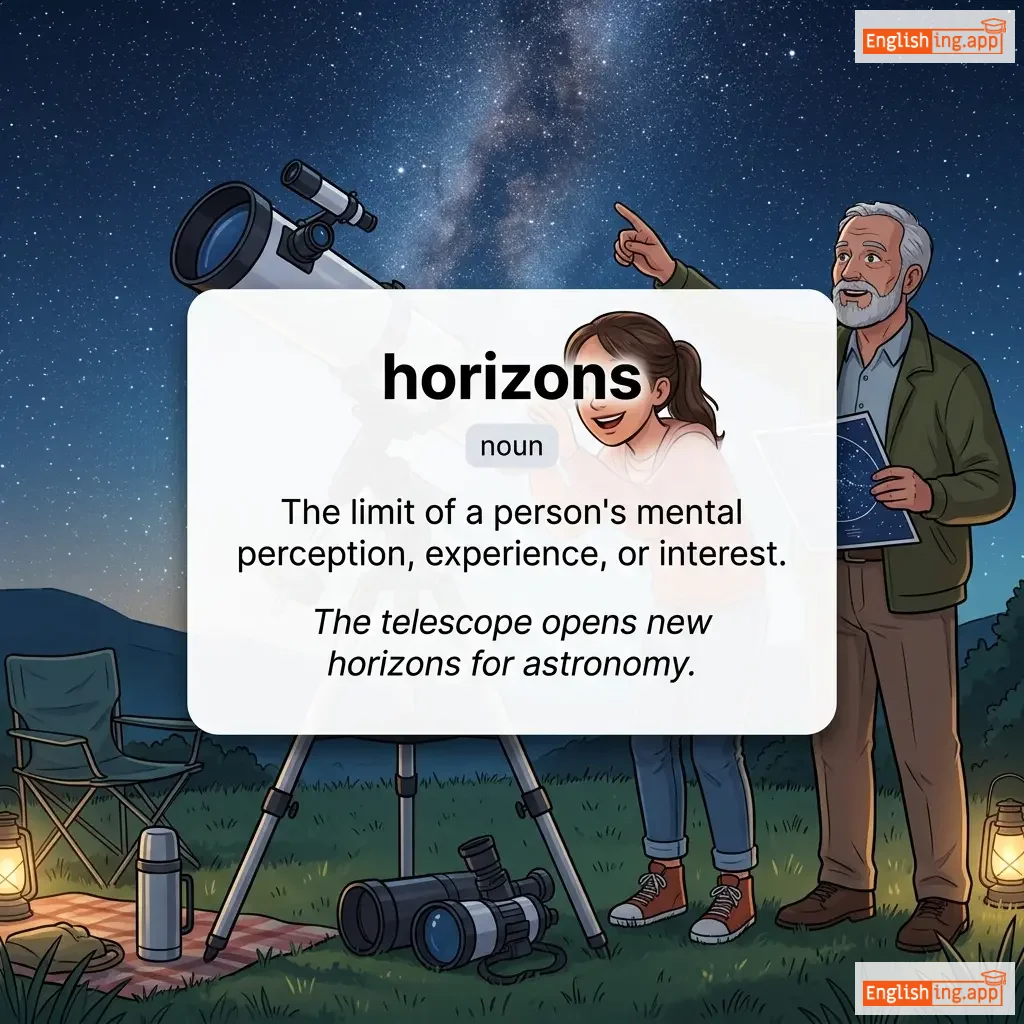
horizons definition card — visual illustration of the meaning
noun
/həˈraɪ.zənz/
horizons (horizons)

The limit of a person's mental perception, experience, or interest.

"The telescope opens new horizons for astronomy."

"Le télescope ouvre de nouveaux horizons pour l'astronomie." (Le telescope ouvre de nouveaux horizons pour l'astronomie.)
adjective
/ˌhɒrɪˈzɒntəl/
horizontal (horizontal)

parallel to the horizon; flat and level from side to side

"The table must be perfectly horizontal to keep the glass from sliding."

"La table doit être parfaitement horizontale pour éviter que le verre glisse." (La table doit etre parfaitement horizontale pour eviter que le verre glisse)
noun
/ˈhɔːrmoʊn/
hormone (hormone)

a chemical substance produced in the body that influences how the body grows or functions

"Insulin is a hormone that controls blood sugar levels."

"L'insuline est une hormone qui contrôle les niveaux de sucre dans le sang." (L'insuline est une hormone qui controle les niveaux de sucre dans le sang.)
noun
/hɔːrn/
corne, klaxon (corne, klaxon)

a hard, pointed part growing from the head of some animals; a device that makes a loud sound as a warning

"The driver pressed the horn to warn the pedestrians."

"Le conducteur a appuyé sur le klaxon pour avertir les piétons." (Le conducteur a appuyé sur le klaxon pour avertir les piétons.)
noun
/ˈhɔːrn.bɪl/
Oiseau hornbill (oiseau hornbill)

a large tropical bird with a large curved beak and often a horn-like projection

"The colorful hornbill perched on the highest branch."

"Le hornbill coloré s'est posé sur la branche la plus haute." (Le hornbill coloré s'est posé sur la branche la plus haute.)
noun
/ˈhɔːr.nət/
frelon (frelon)

a large wasp that can sting and is often aggressive

"The hornet built its nest under the roof."

"Le frelon a construit son nid sous le toit." (Le frelon a construit son nid sous le toit.)
noun
/ˈhɒrəˌskoʊp/
horoscope (horoscope)

A forecast of a person's future based on the positions of the stars and planets at their birth.

"She read her horoscope every morning to see what the stars predicted."

"Elle lisait son horoscope chaque matin pour voir ce que les étoiles prédisaient." (Elle lisait son horoscope chaque matin pour voir ce que les etoiles predisaient.)
adjective
/ˈhɔːrɪbəl/
horrible, épouvantable (horrible, epouvantable)

very unpleasant or causing horror; extremely bad or unpleasant

"The food at that restaurant was horrible."

"La nourriture dans ce restaurant était horrible." (La nourriture dans ce restaurant etait horrible.)
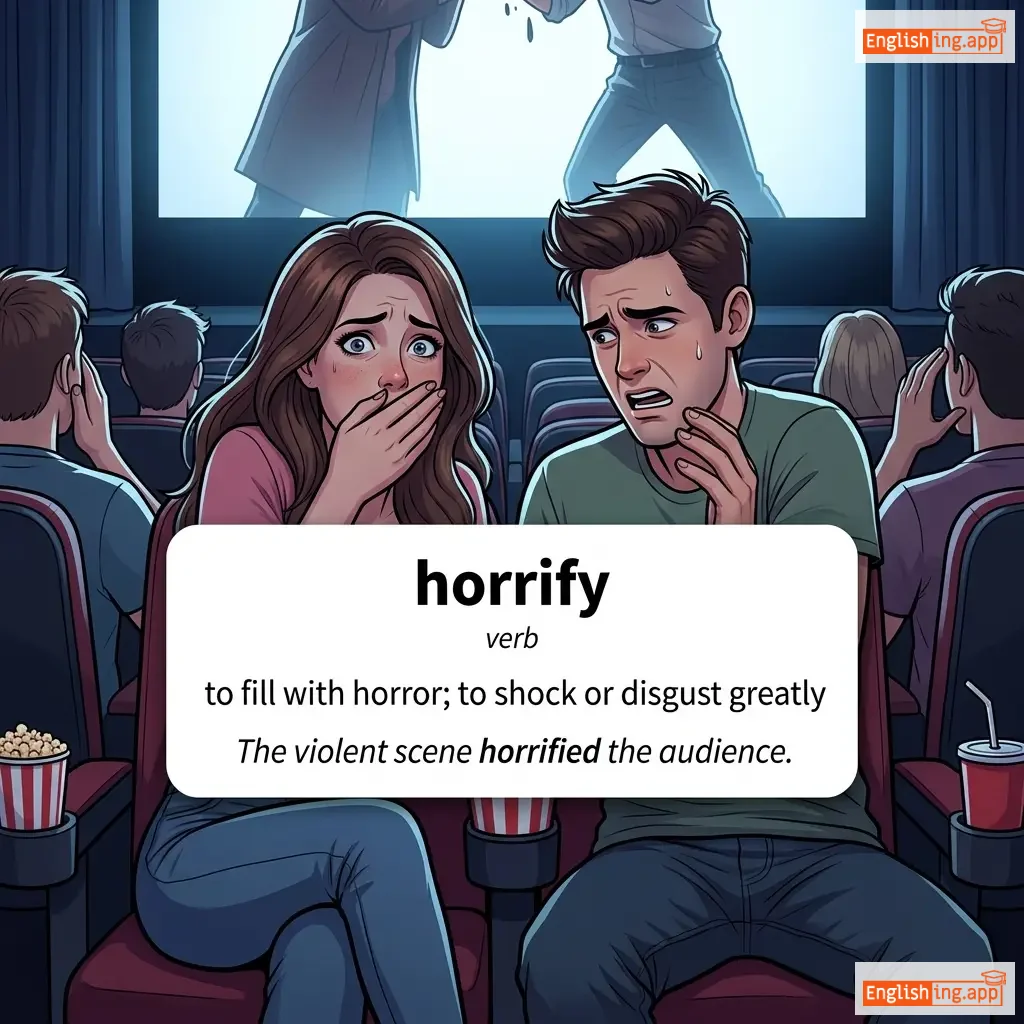
horrify definition card — visual illustration of the meaning
verb
/ˈhɔːrɪfaɪ/
horrifier (horrifier)

to fill with horror; to shock or disgust greatly

"The violent scene horrified the audience."

"La scène violente a horrifié le public." (la sen violont a horrifie le publik)
noun
/ˈhɒr.ər/
horreur (horreur)

an intense feeling of fear, shock, or disgust

"She screamed in horror when she saw the accident."

"Elle a crié de terreur lorsqu'elle a vu l'accident." (Elle a crie de terreur lorsqu'elle a vu l'accident.)
noun
/hɔːrs/
cheval (shuh-vahl)

a large, strong animal used for riding, racing, or carrying loads

"The horse ran across the field."

"Le cheval a couru à travers le champ." (Le cheval a couru à travers le champ.)
noun
/ˈhɔːrs.liːt͡ʃ/
sangsue de cheval (sangsue de cheval)

a large species of leech that was traditionally used in veterinary medicine

"The veterinarian explained that horse-leach was once commonly used to treat horses."

"Le vétérinaire a expliqué que la sangsue de cheval était couramment utilisée pour traiter les chevaux." (Le vétérinaire a expliqué que la sangsue de cheval était couramment utilisée pour traiter les chevaux.)
adjective
/ˈhɔːrtətɪv/
hortatoire (hortativ)

Giving strong encouragement or urging.

"The teacher gave a hortative speech to motivate the students before the exam."

"Le professeur a prononcé un discours hortatoire pour motiver les élèves avant l'examen." (Le professeur a prononce un discours hortatoire pour motiver les eleves avant l'examen.)
adjective
/ˈhɔːrtətɔːri/
hortatoire (ortwatwar)

Intended to encourage or urge to action.

"The manager’s hortatory words inspired the team to work harder."

"Les paroles exhortantes du directeur ont inspiré l'équipe à travailler plus dur." (Les paroles exhortantes du directeur ont inspire l equipe a travailler plus dur)
adjective
/ˌhɔːrtɪˈkʌltʃərəl/
relatif à l'horticulture (relatif à l'horticulture)

Relating to the art or practice of garden cultivation and management.

"She studied horticultural science at the university."

"Elle a étudié la science horticole à l'université." (Elle a étudié la science horticole à l'université.)
noun
/ˈhɔːrtɪˌkʌltʃər/
horticulture (horticulture)

The art or practice of garden cultivation and management.

"Horticulture plays a vital role in producing fruits, vegetables, and ornamental plants."

"L'horticulture joue un rôle essentiel dans la production de fruits, de légumes et de plantes ornementales." (Lhorticulture joue un role essentiel dans la production de fruits legumes et plantes ornamentales)
noun
/ˈhoʊʒəri/
chaussettes et vêtements pour les jambes (chaussettes et vetements pour les jambes)

Stockings, socks, and other knitted clothing for the legs and feet.

"She bought new hosiery for the winter season."

"Elle a acheté de nouveaux bas pour la saison hivernale." (Elle a achete de nouveaux bas pour la saison hivernale.)
adjective
/ˈhɑːspɪtəbl/
hospitalier (hospitalier)

Friendly and welcoming to guests or strangers.

"The villagers were very hospitable to the travelers."

"Les villageois étaient très hospitaliers avec les voyageurs." (Les villageois etaient tres hospitaliers avec les voyageurs.)
noun
/ˈhɒs.pɪ.təl/
hôpital (hopital)

an institution where sick or injured people are given medical treatment

"He was taken to the hospital after the accident."

"Il a été emmené à l'hôpital après l'accident." (Il a ete emmene a l'hopital apres l'accident.)
noun
/ˌhɑːspɪˈtæləti/
hospitalité (hospitalite)

The friendly and generous reception and entertainment of guests or strangers.

"We enjoyed the hospitality of our hosts during the holiday."

"Nous avons apprécié l'hospitalité de nos hôtes pendant les vacances." (Nous avons apprecie l hospitalite de nos hotes pendant les vacances.)
noun, verb
/hoʊst/
hôte (hote)

a person who receives or entertains guests; to organize and provide for an event

"She will host the conference next week."

"Elle accueillera la conférence la semaine prochaine." (Elle accueillera la conference la semaine prochaine.)
noun
/ˈhɑːstɪdʒ/
otage (otaj)

A person seized or held as security for the fulfillment of a condition.

"The rebels took several people as hostages."

"Les rebelles ont pris plusieurs personnes en otages." (Les rebelles ont pris plusieurs personnes en otages.)
noun
/ˈhɑːstəlri/
auberge (auberge)

An inn or lodging place, especially one for travelers.

"They stayed at a small hostelry near the mountains."

"Ils ont séjourné dans une petite auberge près des montagnes." (Ils ont séjourné dans une petite auberge près des montagnes.)
adjective
/ˈhɒstaɪl/
hostile (hostile)

showing or feeling opposition, dislike, or hatred

"The soldiers entered a hostile territory."

"Les soldats sont entrés dans un territoire hostile." (Les soldats sont entres dans un territoire hostile.)