Vocabulaires

Découvrez, apprenez et maîtrisez le vocabulaire anglais

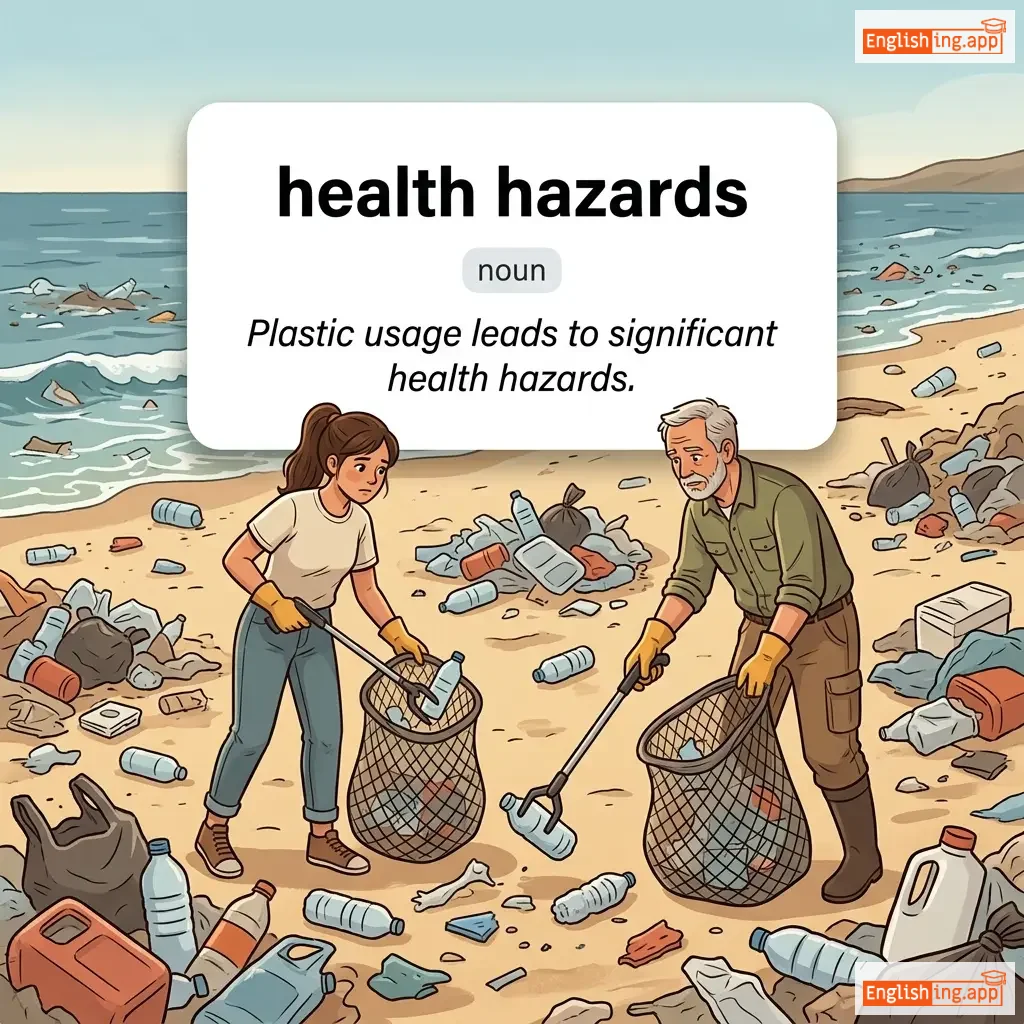
health hazards definition card — visual illustration of the meaning
noun
helθ ˈhæzərdz
risques pour la santé (risques pour la santé)

Risks or dangers to physical health and well-being that can cause illness or injury.

"Plastic usage leads to significant health hazards."

"L'utilisation du plastique entraîne des risques de santé importants." (L'utilisation du plastique entraîne des risques de santé importants.)
noun
/ˈhɛlθˌkɛər/
bonheur (bonheur)

the organized provision of medical services to maintain or improve health

"Access to quality health-care is essential for every citizen."

"Elle ne pouvait pas cacher son bonheur lorsqu'elle a reçu le prix." (Elle ne pouvait pas cacher son bonheur lorsqu'elle a reçu le prix.)
noun
/ˈhɛlθˌkɛər/
soins de santé (soin de sante)

the organized provision of medical care to people

"The country invested heavily in healthcare to improve public health."

"Le pays a investi massivement dans les soins de santé pour améliorer la santé publique." (Le pays a investi massivement dans les soins de sante pour ameliorer la sante publique.)
adjective
/ˈhɛlθfəl/
salubre (salubre)

Promoting good health; beneficial to health.

"A healthful diet includes fresh fruits and vegetables."

"Un régime salubre comprend des fruits et des légumes frais." (Un régime salubre comprend des fruits et des légumes frais.)
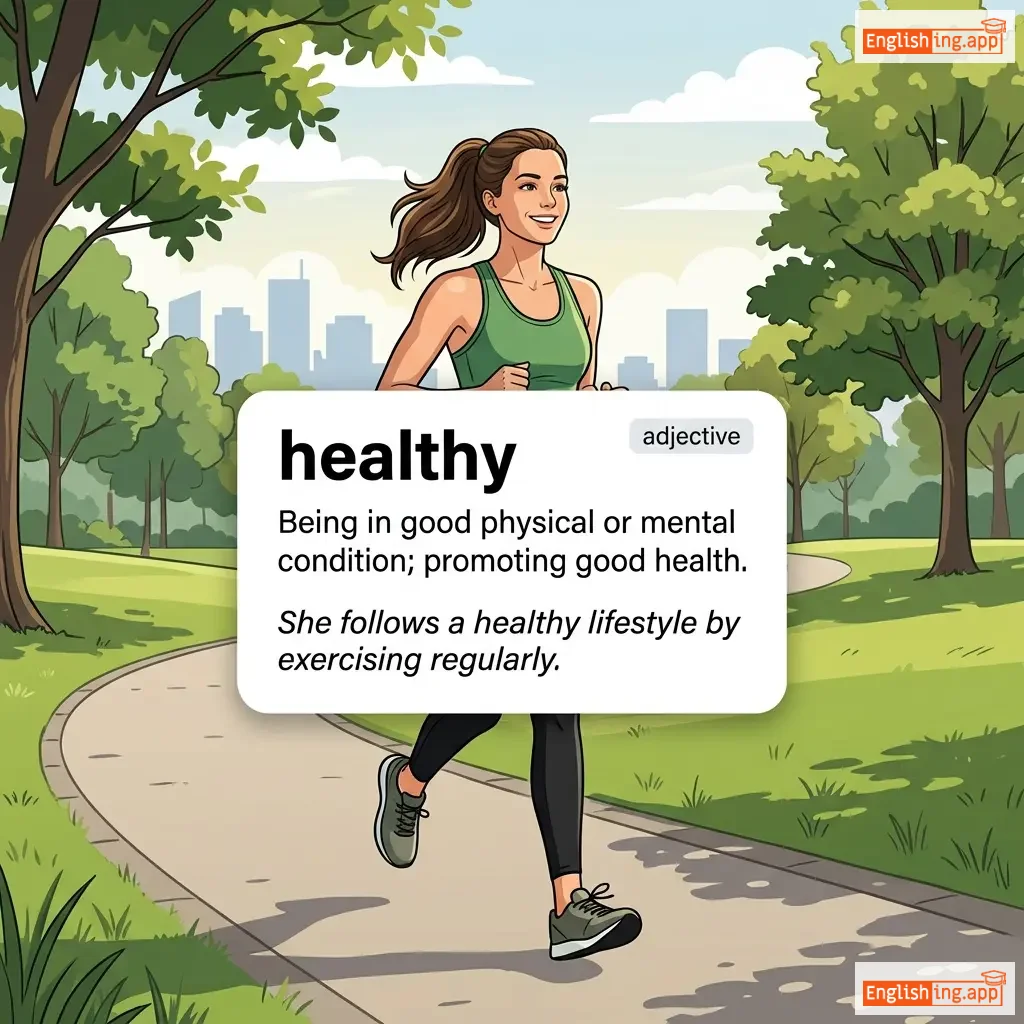
healthy definition card — visual illustration of the meaning
adjective
/ˈhɛlθi/
bonheur (bonheur)

Being in good physical or mental condition; promoting good health.

"She follows a healthy lifestyle by exercising regularly."

"Elle n'a pas pu cacher son bonheur lorsqu'elle a reçu le prix." (Elle n'a pas pu cacher son bonheur lorsqu'elle a reçu le prix.)
verb
/hɪr/
entendre (entendre)

To perceive sound with the ear.

"I can hear birds singing outside."

"Je peux entendre des oiseaux chanter dehors." (Je peux entendre des oiseaux chanter dehors.)
noun
/ˈhɪərɪŋ/
audition / audition (audition / audition)

the ability to perceive sounds or an official meeting to listen to arguments or evidence

"The judge scheduled a hearing for next week."

"Le juge a programmé une audition pour la semaine prochaine." (Le juge a programme une audition pour la semaine prochaine.)
verb
/ˈhɑːrkən/
écouter attentivement (ecouter attentivement)

To listen attentively; to give heed.

"He would hearken to his mentor’s advice before making decisions."

"Il écouterait attentivement les conseils de son mentor avant de prendre des décisions." (Il écouterait attentivement les conseils de son mentor avant de prendre des décisions.)
noun
/ˈhɪərseɪ/
rumeur (rumeur)

Information received from other people that cannot be substantiated; rumor.

"The decision was based on hearsay, not evidence."

"La décision était basée sur des rumeurs, pas sur des preuves." (La decision etait basee sur des rumeurs, pas sur des preuves.)
noun
/hɜːrs/
voiture funéraire; (voiture funerai)

a vehicle for conveying the coffin at a funeral; a funeral car

"The black hearse slowly made its way to the cemetery, followed by a procession of mourners."

"Le corbillard noir s'est lentement dirigé vers le cimetière, suivi par une procession de personnes en deuil." (Le corbillard noir s'est lentement dirige vers le cimetiere, suivi par une procession de personnes en deuil.)
noun
/hɑːrt/
cœur (coeur)

the organ that pumps blood through the body; also the center of emotions

"Her heart was beating fast with excitement."

"Son cœur battait fort d'excitation." (Son coeur battait fort d'excitation.)
heartbeat definition card — visual illustration of the meaning
noun
/ˈhɑːt.biːt/
battement du cœur (battement du coeur)

A pulsation of the heart, especially as perceptible to the touch or audible with a stethoscope.

"Rubbing the eyes helps normalize the heartbeat."

"Frotter les yeux aide à normaliser le battement du cœur." (Frotter les yeux aide à normaliser le battement du coeur.)
adjective
/ˈhɑːrtˌbreɪkɪŋ/
dévastateur; déchirant; émouvant (devastateur; dechirant; emouvant)

causing overwhelming distress; very sad or disappointing

"The documentary showed heartbreaking scenes of children in poverty."

"Le documentaire montrait des scènes dévastatrices d'enfants vivant dans la pauvreté." (Le documentaire montrait des scenes devastatrices d'enfants vivant dans la pauvreté.)
verb
/ˈhɑːrtən/
donner du courage (donner du courage)

To give courage, confidence, or hope.

"The teacher’s encouragement heartened the students."

"L'encouragement de l'enseignant a donné du courage aux étudiants." (L'encouragement de l'enseignant a donné du courage aux étudiants.)
adverb
/ˈhɑr.tɪ.li/
chaleureusement; de tout cœur (cha-leu-reu-se-ment; de tout cœur)

in a sincere and enthusiastic manner; wholeheartedly

"She heartily welcomed her guests to the party."

"Elle a chaleureusement accueilli ses invités à la fête." (El a cha-leu-reu-se-ment ac-cueilli ses in-vi-tés à la fête.)
adjective
/ˈhɑːrtˌrɛndɪŋ/
déchirant (dechirant)

Causing great sadness or distress; very moving emotionally.

"The documentary showed heartrending scenes of war victims."

"Le documentaire montrait des scènes déchirantes des victimes de la guerre." (Le documentaire montrait des scènes déchirantes des victimes de la guerre.)
adjective
/ˈhɑːrti/
enthousiaste et amical; substantiel et nourrissant (enthousiaste et amical; substantiel et nourrissant)

enthusiastic and friendly; substantial and nourishing

"He gave us a hearty welcome when we arrived at his home."

"Il nous a donné un accueil chaleureux lorsque nous sommes arrivés chez lui." (Il nous a donné un accueil chaleureux lorsque nous sommes arrivés chez lui.)
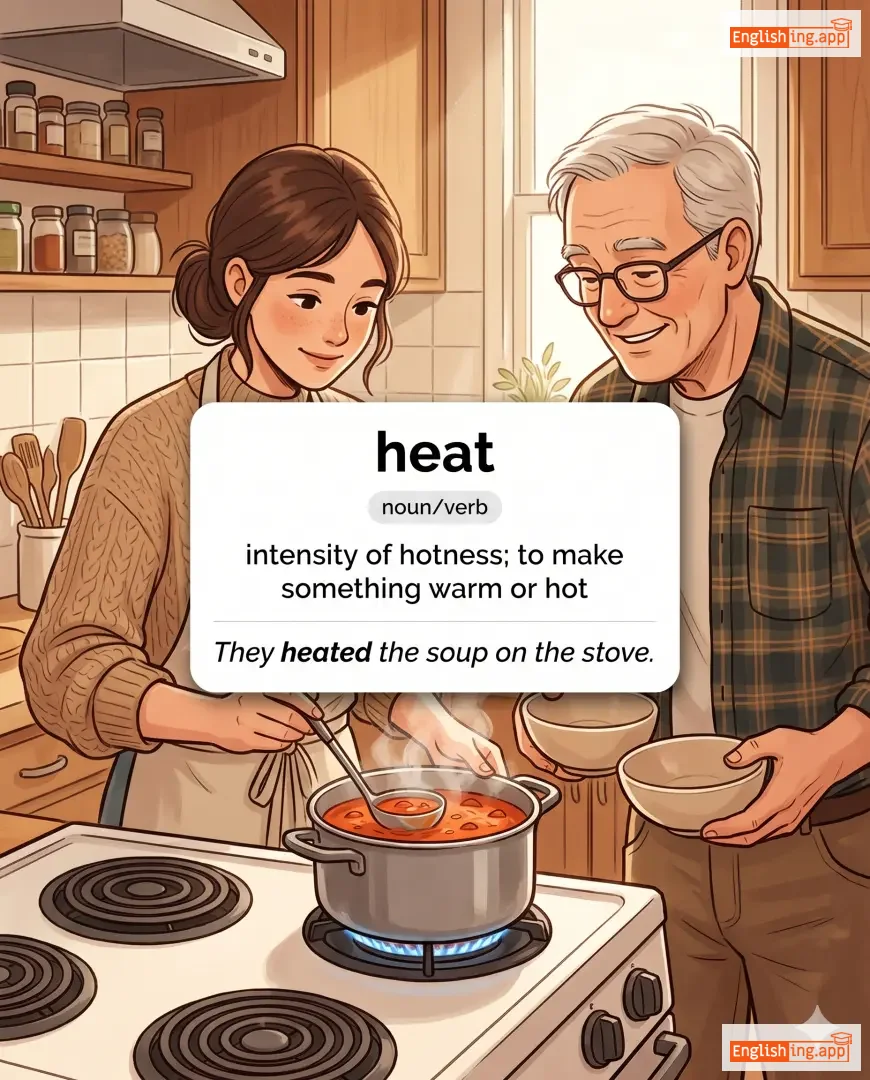
heat definition card — visual illustration of the meaning
noun/verb
/hiːt/
chaleur / chauffage (chaleur / chauffage)

intensity of hotness; to make something warm or hot

"They heated the soup on the stove."

"Ils ont chauffé la soupe sur la cuisinière." (Ils ont chauffé la soupe sur la cuisinière.)
adjective
/ˈhiːðənɪʃ/
barbare (barbare)

Lacking culture or religion; barbaric or uncivilized.

"They considered the ancient tribe’s rituals heathenish."

"Ils considéraient les rituels de la tribu ancienne comme païens." (Ils considéraient les rituels de la tribu ancienne comme païens.)
noun
/ˈhɛvən/
ciel (siel)

the place believed to be the home of God and the afterlife of the good; a state of extreme happiness

"They believe that good people go to heaven after death."

"Ils croient que les bonnes personnes vont au ciel après la mort." (Ils croient que les bonnes personnes vont au ciel après la mort.)
adjective
/ˈhevənli/
céleste; divin; délicieux (celeste; divin; délicieux)

relating to heaven; extremely pleasant or beautiful

"The chocolate cake had a heavenly taste that melted in my mouth."

"Le gâteau au chocolat avait un goût céleste qui fondait dans ma bouche." (Le gâteau au chocolat avait un goût céleste qui fondait dans ma bouche.)
adverb
/ˈhɛvɪli/
lourdement / fortement (lourdement / fortement)

to a great degree; with a lot of weight, intensity, or force

"It rained heavily all night."

"Il a plu lourdement toute la nuit." (Il a plu lourdement toute la nuit.)
adjective
/ˈhɛvi/
lourd (lourd)

having great weight; difficult to lift or move

"The box was too heavy for her to carry alone."

"La boîte était trop lourde pour qu'elle la porte seule." (La boîte était trop lourde pour qu'elle la porte seule.)
noun
/ˈhɛklər/
perturbateur (perturbateur)

A person who interrupts a speaker with rude or aggressive comments.

"The politician remained calm despite the heckler shouting from the crowd."

"Le politicien est resté calme malgré le perturbateur criant depuis la foule." (Le politicien est resté calme malgré le perturbateur criant depuis la foule.)
adjective
/ˈhek.tɪk/
agité; frénétique; plein d'activités (agite; frenetik; plein d'activites)

very busy and full of activity; frantic; characterized by intense activity or excitement

"My schedule has been hectic lately with back-to-back meetings."

"Mon emploi du temps a été agité dernièrement avec des réunions successives." (Mon emploi du temps a ete agite dernièrement avec des réunions successives.)
verb
/ˈhɛktər/
parler de manière intimidante (parler de manière intimidante)

To talk to someone in a bullying or intimidating way.

"The manager hectored the staff into working overtime."

"Le manager a menacé le personnel de faire des heures supplémentaires." (Le manager a menacé le personnel de faire des heures supplémentaires.)
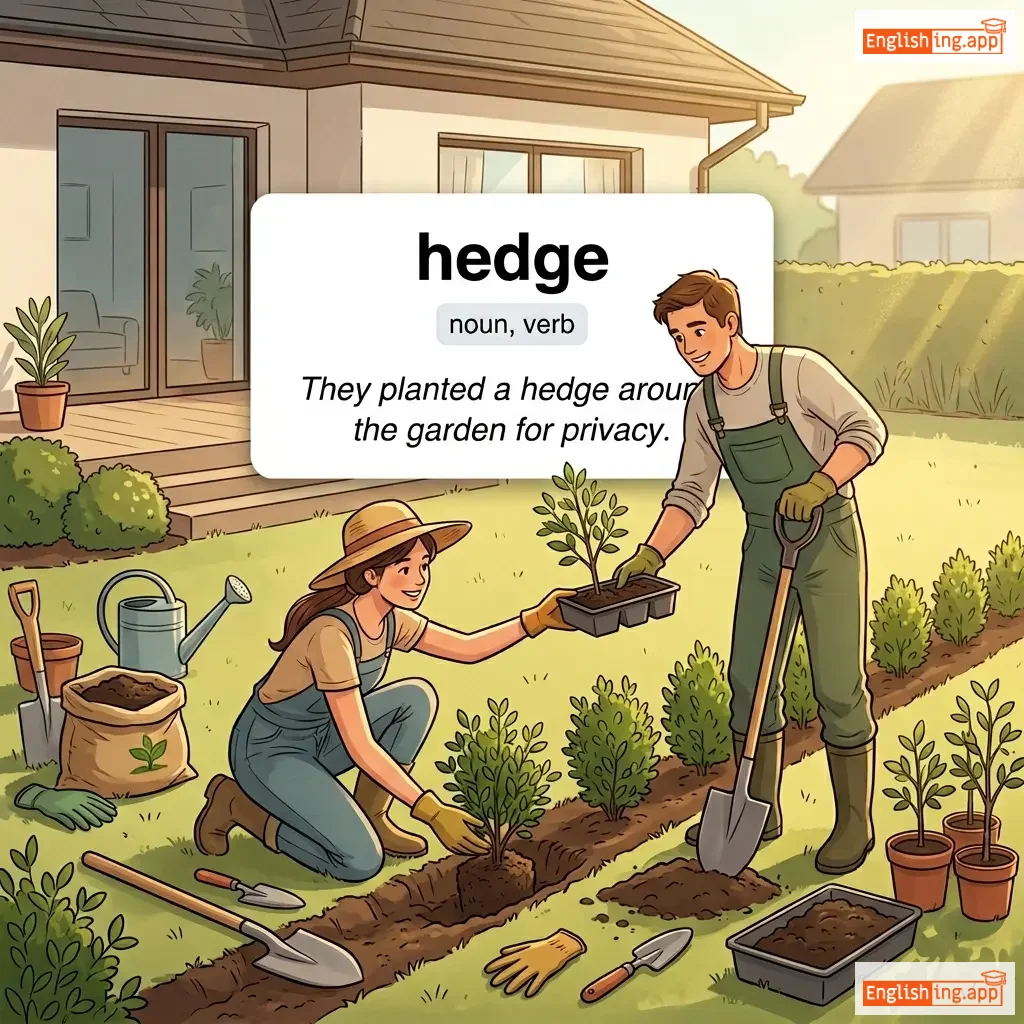
hedge definition card — visual illustration of the meaning
noun, verb
/hɛdʒ/
haie (haie)

A fence or boundary formed by closely planted shrubs; also, to limit or qualify a statement.

"They planted a hedge around the garden for privacy."

"Ils ont planté une haie autour du jardin pour la confidentialité." (Ils ont planté une haie autour du jardin pour la confidentialité.)
noun
/ˈhedʒhɒɡ/
hérisson (herisson)

a small mammal with a spiny coat that can roll into a ball for defense

"The hedgehog rolled into a ball when it felt threatened."

"Le hérisson s'est roulé en boule quand il s'est senti menacé." (Le hérisson s'est roulé en boule quand il s'est senti menacé.)
noun
/ˈhiːdəˌnɪzəm/
hédonisme (hedonisme)

The pursuit of pleasure and self-indulgence as the highest goal.

"The lifestyle of the rich is often criticized as pure hedonism."

"Le mode de vie des riches est souvent critiqué comme étant un pur hédonisme." (Le mode de vie des riches est souvent critique comme etant un pur hedonisme.)
noun
/ˈhiːdənɪst/
hédoniste (hedoniste)

A person who believes that the pursuit of pleasure is the most important thing in life.

"She was called a hedonist because she always prioritized enjoyment over duty."

"Elle a été qualifiée d'hédoniste car elle privilégiait toujours le plaisir au devoir." (Elle a été qualifiée d'hédoniste car elle privilégiait toujours le plaisir au devoir.)
verb
/hiːd/
prêter attention (pretre attention)

to pay attention to; to take notice of

"You should heed the teacher's advice."

"Tu devrais prêter attention aux conseils de l'enseignant." (Tu devrais preter attention aux conseils de l'enseignant.)
adjective
/ˈhiːdləs/
insouciant (insouciant)

showing a reckless lack of care or attention

"He drove with heedless disregard for the rules."

"Il a conduit avec un mépris total pour les règles." (Il a conduit avec un mépris total pour les règles.)
noun
/hiːl/
talon (talon)

the back part of the human foot below the ankle

"Her shoe was rubbing against her heel."

"Sa chaussure frottait contre son talon." (Sa chaussure frottait contre son talon.)
noun
/hɪˈdʒɛməni/ or /ˈhɛdʒəmoʊni/
hégémonie (hegemonie)

leadership or dominance, especially by one state or group over others

"The empire maintained its hegemony over neighboring states."

"L'empire a maintenu sa hégémonie sur les états voisins." (L'empire a maintenu sa hegemonie sur les etats voisins.)
🚶‍♂️

hegira (hégira)

noun
/ˈhɛdʒɪrə/ or /hɪˈdʒaɪrə/
exode, migration (exode, migration)

a journey, especially when undertaken to escape from a dangerous or undesirable situation

"The refugees began their hegira across the desert."

"Les réfugiés ont commencé leur exode à travers le désert." (Les refugies ont commence leur exode a travers le desert.)
noun
/ˈhɛfər/
génisse (genisse)

a young cow that has not borne a calf

"The farmer raised a heifer for dairy production."

"L'agriculteur a élevé une génisse pour la production laitière." (L'agriculteur a élevé une génisse pour la production laitière.)
noun
/haɪt/
hauteur (hauteur)

the measurement of someone or something from base to top

"The height of the tower impressed the visitors."

"La hauteur de la tour a impressionné les visiteurs." (La hauteur de la tour a impressionné les visiteurs.)
verb
/ˈhaɪtən/
accentuer (accentuer)

to make or become greater in intensity or degree

"The announcement served to heighten the excitement in the room."

"L'annonce a servi à accentuer l'excitation dans la pièce." (L'annonce a servi à accentuer l'excitation dans la pièce.)
adjective
/ˈheɪ.nəs/
horrible (horrible)

extremely wicked, deeply offensive, or shockingly evil

"The dictator was condemned for his heinous crimes against humanity."

"Le dictateur a été condamné pour ses crimes horribles contre l'humanité." (Le dictateur a été condamné pour ses crimes horribles contre l'humanité.)
noun
/er/
héritier (heritier)

a person legally entitled to the property or rank of another on that person's death

"The young prince was the rightful heir to the throne and would become king someday."

"Le jeune prince était le véritable héritier du trône et deviendrait un jour roi." (Le jeune prince était le véritable héritier du trône et deviendrait un jour roi.)
noun
/ˈɛər.luːm/
héritage (heritage)

a valuable object that has belonged to a family for several generations

"The ring is a family heirloom passed down from her grandmother."

"L'anneau est un héritage familial transmis par sa grand-mère." (L'anneau est un héritage familial transmis par sa grand-mère.)
noun
/ˈhɛlɪˌkɒptər/
hélicoptère (helicoptere)

an aircraft with rotating blades that can take off and land vertically

"The helicopter landed safely on the hospital roof."

"L'hélicoptère a atterri en toute sécurité sur le toit de l'hôpital." (L'helicoptere a atterri en toute securite sur le toit de l'hopital.)
noun
/hɛl/
enfer (enfer)

a place or state of great suffering and torment, often in religious belief

"He feared that his sins would send him to hell."

"Il craignait que ses péchés ne l'envoient en enfer." (Il craignait que ses péchés ne l'envoient en enfer.)
interjection
/həˈloʊ/
bonjour (bonjour)

a greeting or expression used when meeting someone or starting a conversation

"She answered the phone with a cheerful hello."

"Elle a répondu au téléphone avec un joyeux bonjour." (Elle a repondu au telephone avec un joyeux bonjour.)
noun
/hɛlm/
direction, gouvernail (direction, gouvernail)

a position of leadership or the steering apparatus of a ship

"After years of service, she finally took the helm of the company."

"Après des années de service, elle a enfin pris la tête de l'entreprise." (Apres des annees de service, elle a enfin pris la tete de l'entreprise.)
noun
/ˈhɛl.mət/
casque (casque)

a hard protective hat worn to protect the head

"The rider put on his helmet before starting the motorcycle."

"Le cavalier a mis son casque avant de commencer à conduire la moto." (Le cavalier a mis son casque avant de commencer à conduire la moto.)
noun
/ˈhelmz.mən/
barreur; capitaine (barreur; capitaine)

a person who steers a ship or boat; the person at the helm of a vessel

"The experienced helmsman skillfully guided the yacht through the narrow channel during the storm."

"Le barreur expérimenté a habilement guidé le yacht à travers le canal étroit pendant la tempête." (Le barreur expérimenté a habilement guidé le yacht à travers le canal étroit pendant la tempête.)
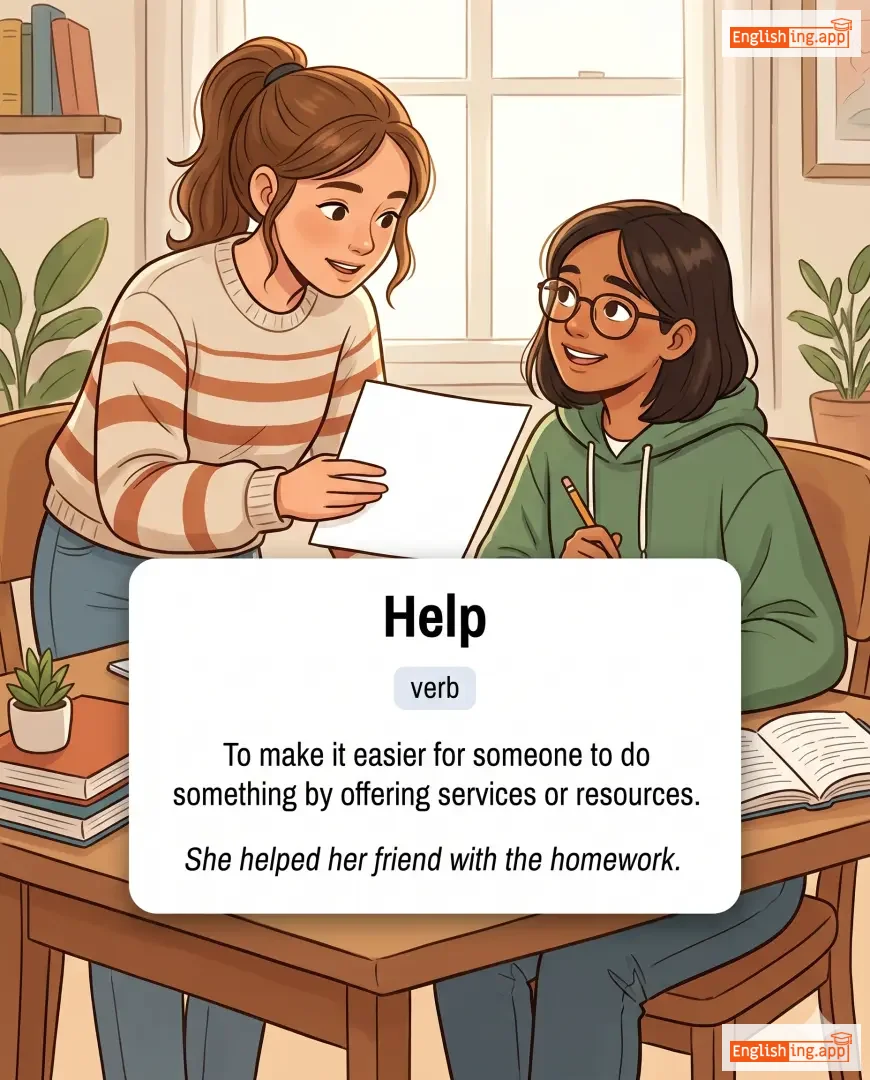
Help definition card — visual illustration of the meaning
verb
/hɛlp/
aider (aider)

To make it easier for someone to do something by offering services or resources.

"She helped her friend with the homework."

"Elle a aidé son amie avec les devoirs." (Elle a aide son amie avec les devoirs.)
adjective
/ˈhɛlpfəl/
utile (utile)

giving help or being useful

"The guide was very helpful during our trip."

"Le guide était très utile pendant notre voyage." (Le guide etait tres utile pendant notre voyage.)
adjective
/ˈhelp.ləs/
sans défense; impuissant; vulnérable (sans defense; impuissant; vulnerable)

unable to defend oneself or act without help; powerless; vulnerable

"The child felt helpless when lost in the crowded market."

"L'enfant se sentait sans défense lorsqu'il s'est perdu dans le marché bondé." (L'enfant se sentait sans défense lorsqu'il s'est perdu dans le marché bondé.)