Vocabulaires

Découvrez, apprenez et maîtrisez le vocabulaire anglais

verb
/ɡruːm/
toiletter (toiletter)

to clean, brush, and care for the appearance of someone or something

"She spends hours grooming her dog every week."

"Elle passe des heures à toiletter son chien chaque semaine." (Elle passe des heures à toiletter son chien chaque semaine.)
noun
/ɡruːv/
rainure / rythme (rainure / rythme)

a long narrow cut or depression, or a rhythmic pattern in music

"The DJ kept the crowd dancing to the groove."

"Le DJ a fait danser la foule sur le groove." (Le DJ a fait danser la foule sur le groove.)
adjective
/ɡroʊs/
dégoutant / grossier (degoutant / grossier)

extremely unpleasant or disgusting; total before deductions

"He thought the food looked gross, but it tasted fine."

"Il pensait que la nourriture avait l'air dégoûtante, mais elle avait bon goût." (Il pensait que la nourriture avait l'air dégoûtante, mais elle avait bon goût.)
adjective
/ɡroʊˈtɛsk/
grotesque (grotesk)

comically or repulsively ugly or distorted

"The sculpture was so grotesque that it frightened the children."

"La sculpture était tellement grotesque qu'elle effrayait les enfants." (La sculpture etait tellement grotesque qu'elle effrayait les enfants.)
noun
/ˈɡrɑːtoʊ/
grotte (grotte)

a small picturesque cave, often artificial

"Tourists visited the grotto hidden behind the waterfall."

"Les touristes ont visité la grotte cachée derrière la cascade." (Les touristes ont visité la grotte cachée derrière la cascade.)
noun/verb
/ɡraʊtʃ/
râleur (râleur)

a person who complains a lot or to complain in a grumpy way

"He is such a grouch in the morning before coffee."

"Il est toujours de mauvaise humeur avant le café." (Il est toujours de mauvaise humeur avant le café.)
noun/verb
/ɡraʊnd/
sol (sol)

the solid surface of the earth; to prohibit someone (often a child) from going out

"The children played on the ground near the house."

"Les enfants ont joué sur le sol près de la maison." (Les enfants ont joué sur le sol près de la maison.)
noun
/ˈɡraʊnd kruː/
équipe au sol (equipe au sol)

a team of people who maintain and service aircraft on the ground

"The ground crew prepared the plane for takeoff."

"L'équipe au sol a préparé l'avion pour le décollage." (L'équipe au sol a préparé l'avion pour le décollage.)
noun
/ˈɡraʊnd flɔːr/
rez-de-chaussée (rez-de-chaussee)

the floor of a building at ground level; the starting level of an organization or activity

"The grocery shop is located on the ground floor of the building."

"L’épicerie se trouve au rez-de-chaussée." (L epicerie se trouve au rez-de-chaussee)
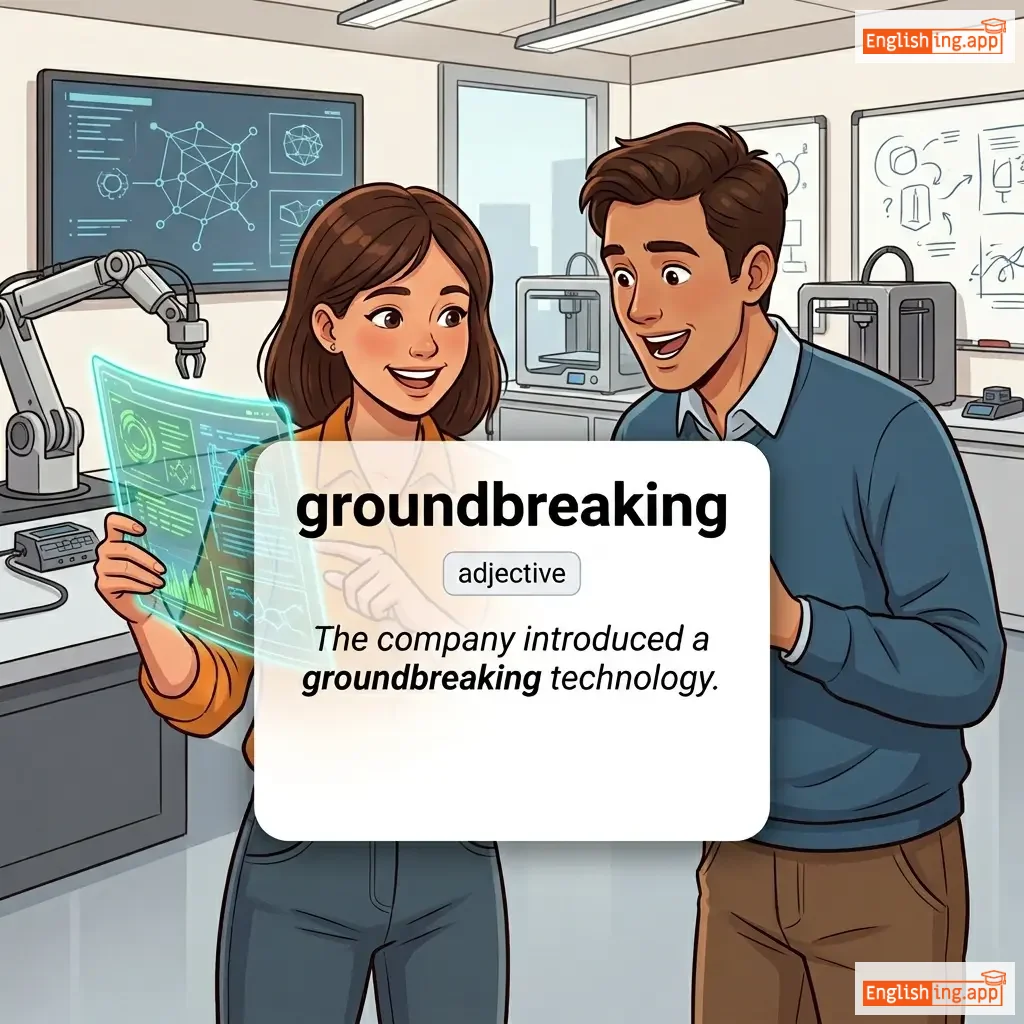
groundbreaking definition card — visual illustration of the meaning
adjective
ˈɡraʊndˌbreɪ.kɪŋ
révolutionnaire (revolutionnaire)

Innovative and pioneering; introducing new ideas or methods that change conventional approaches.

"The company introduced a groundbreaking technology."

"L'entreprise a introduit une technologie révolutionnaire." (L'entreprise a introduit une technologie révolutionnaire.)
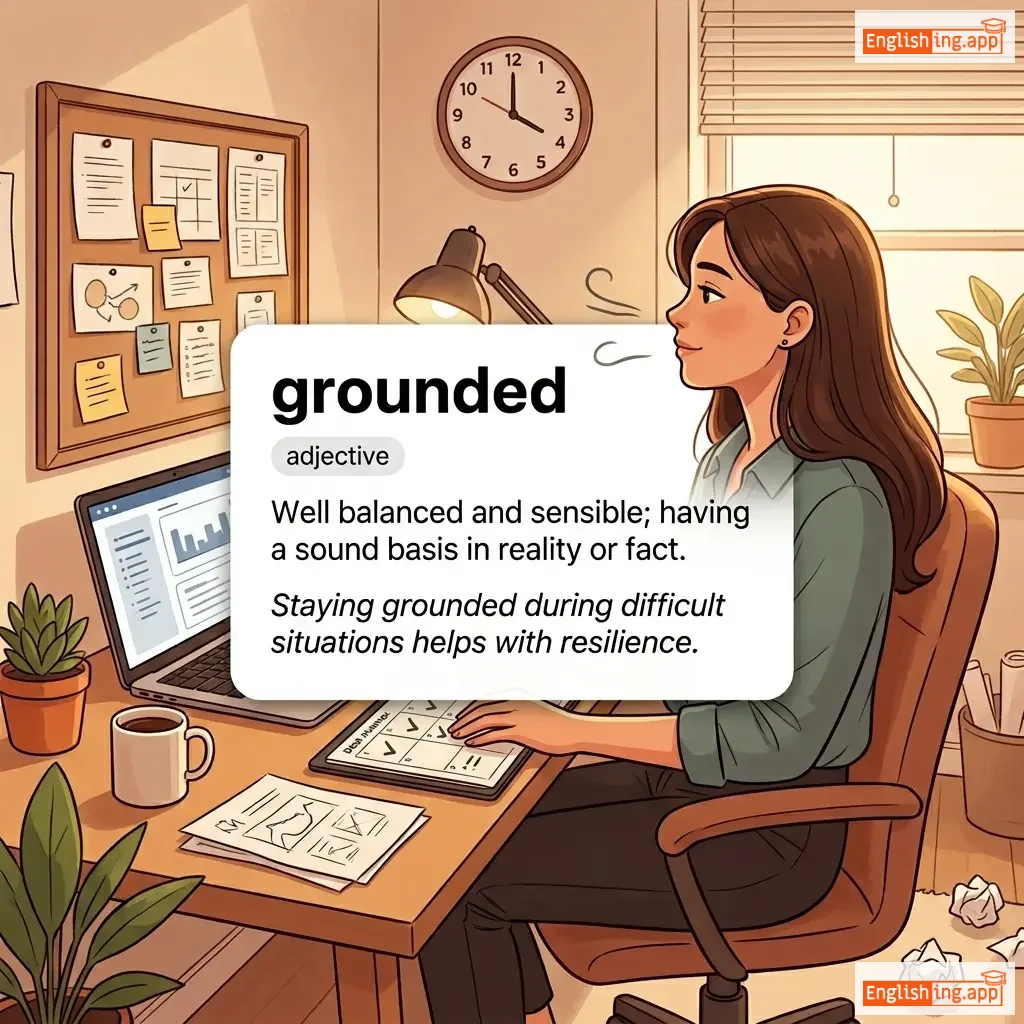
grounded definition card — visual illustration of the meaning
adjective
/ˈɡraʊndɪd/
équilibré (equilibre)

Well balanced and sensible; having a sound basis in reality or fact.

"Staying grounded during difficult situations helps with resilience."

"Rester grounded pendant les situations difficiles aide à la résilience." (Rester grounded pendant les situations difficiles aide à la résilience.)
adjective
/ˈɡraʊnd.ləs/
sans fondement; infondé (sans fondement; infonde)

without foundation or justification; baseless

"His accusations against her were completely groundless."

"Ses accusations contre elle étaient complètement infondées." (Ses accusations contre elle étaient complètement infondées.)
noun, verb
/ɡruːp/
groupe (groupe)

A number of people or things considered together; to arrange things or people into categories.

"The students formed a study group."

"Les étudiants ont formé un groupe d'étude." (Les étudiants ont formé un groupe d'étude.)
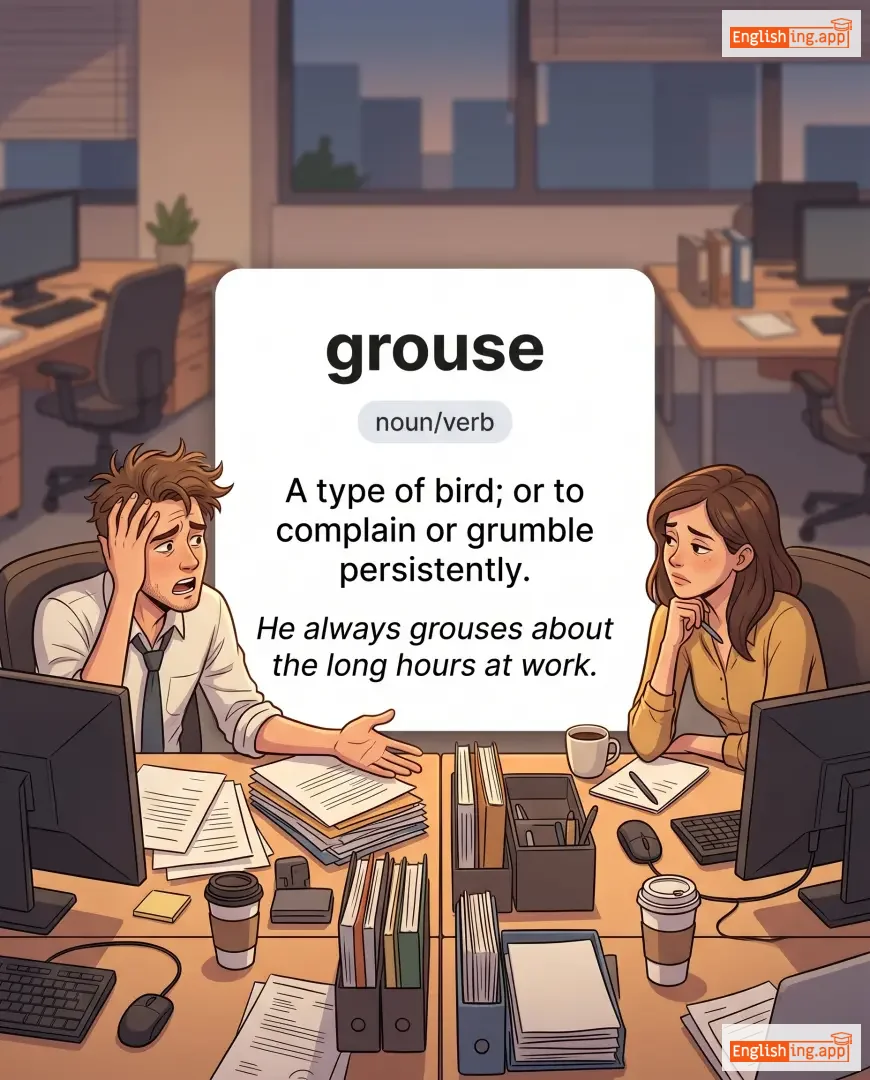
grouse definition card — visual illustration of the meaning
noun/verb
/ɡraʊs/
se plaindre / un type d'oiseau (se plaindre / un type d'oiseau)

A type of bird; or to complain or grumble persistently.

"He always grouses about the long hours at work."

"Il se plaint toujours des longues heures de travail." (Il se plaint toujours des longues heures de travail.)
noun
/ɡroʊv/
bosquet / petit verger (boské / petit verger)

A small group of trees growing close together.

"They walked through the orange grove."

"Ils marchaient à travers le verger d'oranges." (Ils marchaient à travers le verger d'oranges.)
verb
/ˈɡrʌvəl/
se vautrer (se vautrer)

To act in an excessively humble or submissive way to gain favor.

"He groveled before his boss to avoid punishment."

"il s'est vautré devant son patron pour éviter la punition." (il s'est vautré devant son patron pour éviter la punition.)
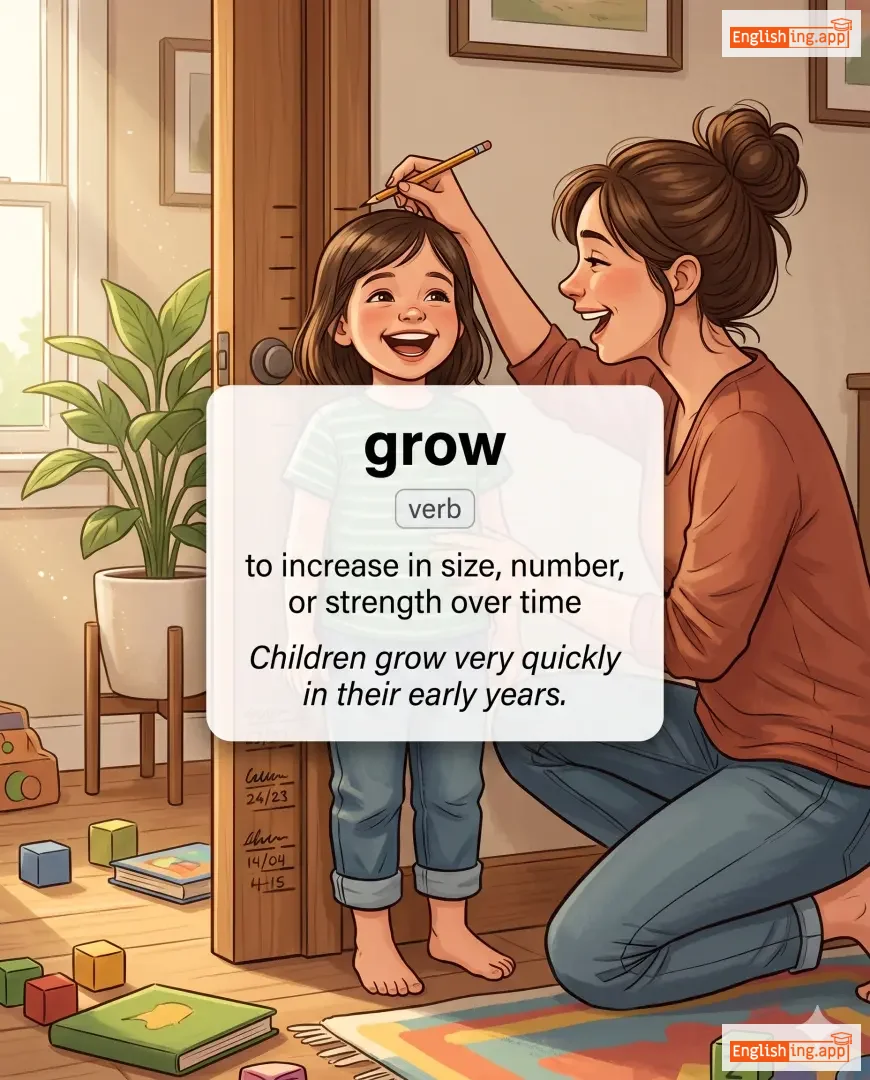
grow definition card — visual illustration of the meaning
verb
/ɡroʊ/
grandir (grandir)

to increase in size, number, or strength over time

"Children grow very quickly in their early years."

"Les enfants grandissent très rapidement au cours de leurs premières années." (Les enfants grandissent tres rapidement au cours de leurs premieres annees.)
verb
/ˈɡroʊ.ɪŋ/
croissant (krwasã)

continuously increasing or developing

"There is a growing demand for renewable energy."

"Il y a une demande croissante pour l'énergie renouvelable." (Il ya une demande kroissant pour l'energie renouvelable.)
verb/noun
/ɡraʊl/
grogner (grogner)

To make a low, guttural sound, often in anger (by animals or humans).

"The dog growled at the stranger."

"Le chien a grogné à l'inconnu." (Le chien a grogne a l'inconnu.)
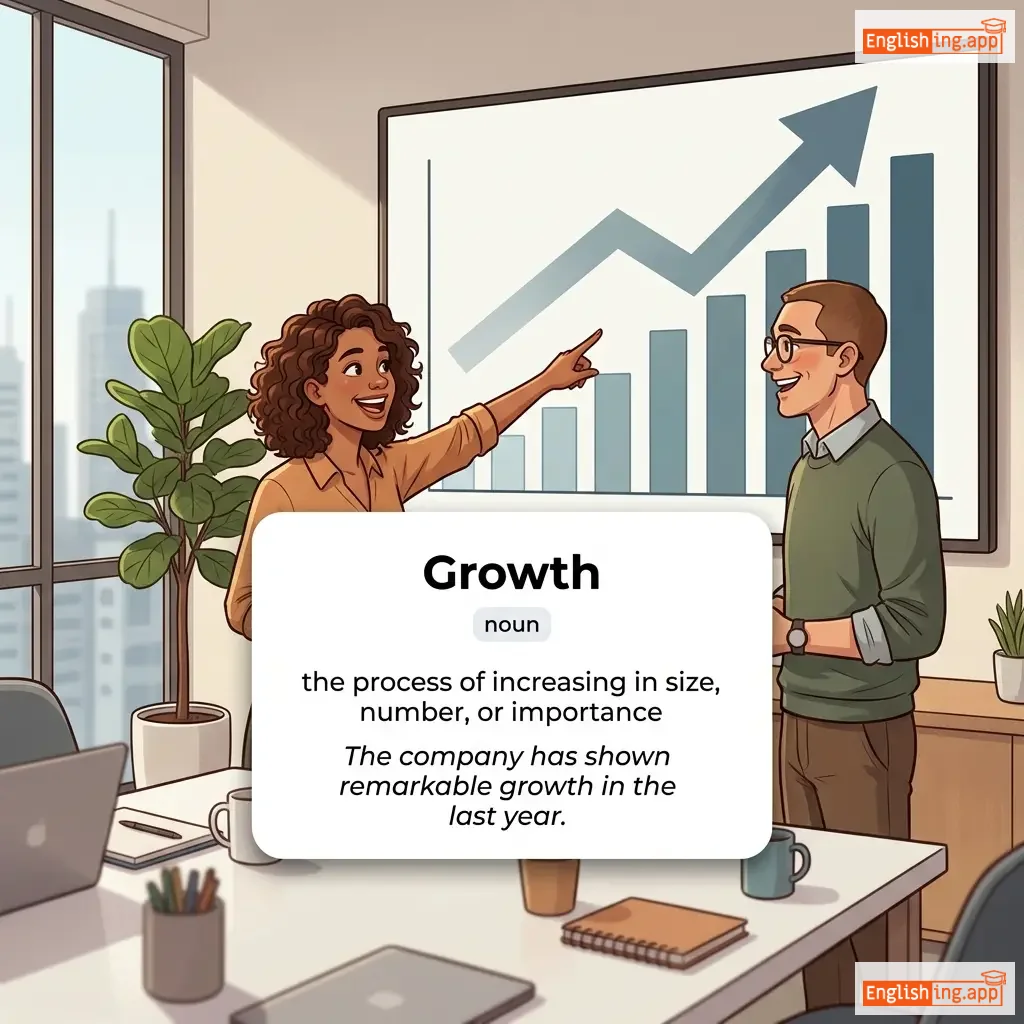
Growth definition card — visual illustration of the meaning
noun
/ɡroʊθ/
croissance (croissance)

the process of increasing in size, number, or importance

"The company has shown remarkable growth in the last year."

"L'entreprise a montré une croissance remarquable au cours de l'année dernière." (L'entreprise a montré une croissance remarquable au cours de l'année dernière.)
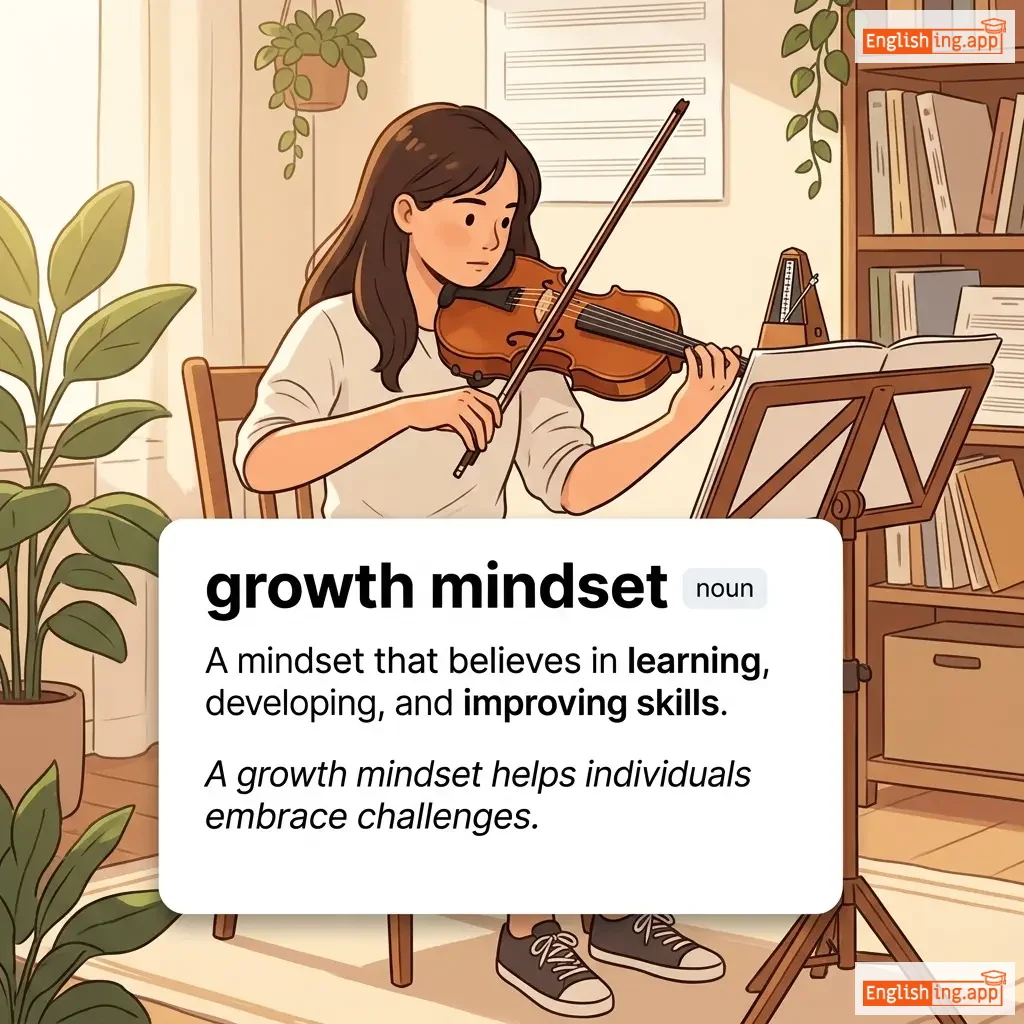
growth mindset definition card — visual illustration of the meaning
noun
/ɡroʊθ ˈmaɪnd.sɛt/
mentalité de croissance (mentalité de croissance)

A mindset that believes in learning, developing, and improving skills.

"A growth mindset helps individuals embrace challenges."

"Une mentalité de croissance aide les individus à relever les défis." (Une mentalité de croissance aide les individus à relever les défis.)
noun/verb
/ɡrʌdʒ/
rancune (rancune)

A persistent feeling of ill will or resentment from a past insult or injury.

"She still holds a grudge against him for what happened years ago."

"Elle garde toujours une rancune contre lui pour ce qui s'est passé il y a des années." (Elle garde toujours une rancune contre lui pour ce qui s'est passé il y a des années.)
adjective
/ˈɡrʌdʒɪŋ/
réticent (reticent)

Reluctant or unwilling; given or allowed only with hesitation.

"She gave him a grudging smile after the argument."

"Elle lui donna un sourire réticent après la dispute." (Elle lui donna un sourire reticent après la dispute.)
noun
/ˈɡruːəl/
bouillie liquide préparée en faisant cuire des céréales dans de l'eau ou du lait (bouillie liquide preparée en faisant cuire des céréales dans de l'eau ou du lait)

A thin liquid food made by boiling cereal (like oats) in water or milk.

"The poor children were given a bowl of gruel each morning."

"Les enfants pauvres recevaient un bol de bouillie chaque matin." (Les enfants pauvres recevaient un bol de bouillie chaque matin.)
adjective
/ˈɡruːəlɪŋ/
épuisant (epuisant)

Extremely tiring and demanding.

"The athletes faced a grueling training session."

"Les athlètes ont fait face à une séance d'entraînement épuisante." (Les athlètes ont fait face à une séance d'entraînement épuisante.)
adjective
/ˈɡruːsəm/
horrible (horrible)

Causing horror or disgust.

"The police discovered a gruesome crime scene."

"La police a découvert une scène de crime horrible." (La police a découvert une scène de crime horrible.)
adjective
/ɡrʌf/
rude (rude)

Rough or stern in manner, speech, or voice.

"Despite his gruff manner, he was very kind-hearted."

"Malgré son comportement rude, il était très gentil." (Malgre son comportement rude, il etait tres gentil.)
verb
/ˈɡrʌmbəl/
râler (raler)

to complain quietly or in a low voice

"She often grumbles about the traffic."

"Elle râle souvent à propos du trafic." (Elle râle souvent à propos du trafic.)
adjective
/ˈɡrʌm.pi/
grincheux; irritable; (grincheux; irritable;)

bad-tempered and irritable; easily annoyed

"He was grumpy all morning because he didn't sleep well."

"Il était grincheux toute la matinée parce qu'il n'a pas bien dormi." (Il était grincheux toute la matinée parce qu'il n'a pas bien dormi.)
verb
/ɡrʌnt/
grogner (grogner)

to make a low, rough sound, often when exerting effort or expressing annoyance

"He grunted as he lifted the heavy box."

"Il grogna en soulevant la boîte lourde." (Il grogna en soulevant la boîte lourde.)
noun/verb
/ˌɡærənˈtiː/
garantie (garantie)

a formal promise or assurance, especially about the quality or durability of a product

"The company guarantees a refund if the product is faulty."

"L'entreprise garantit un remboursement si le produit est défectueux." (L'entreprise garantit un remboursement si le produit est défectueux.)
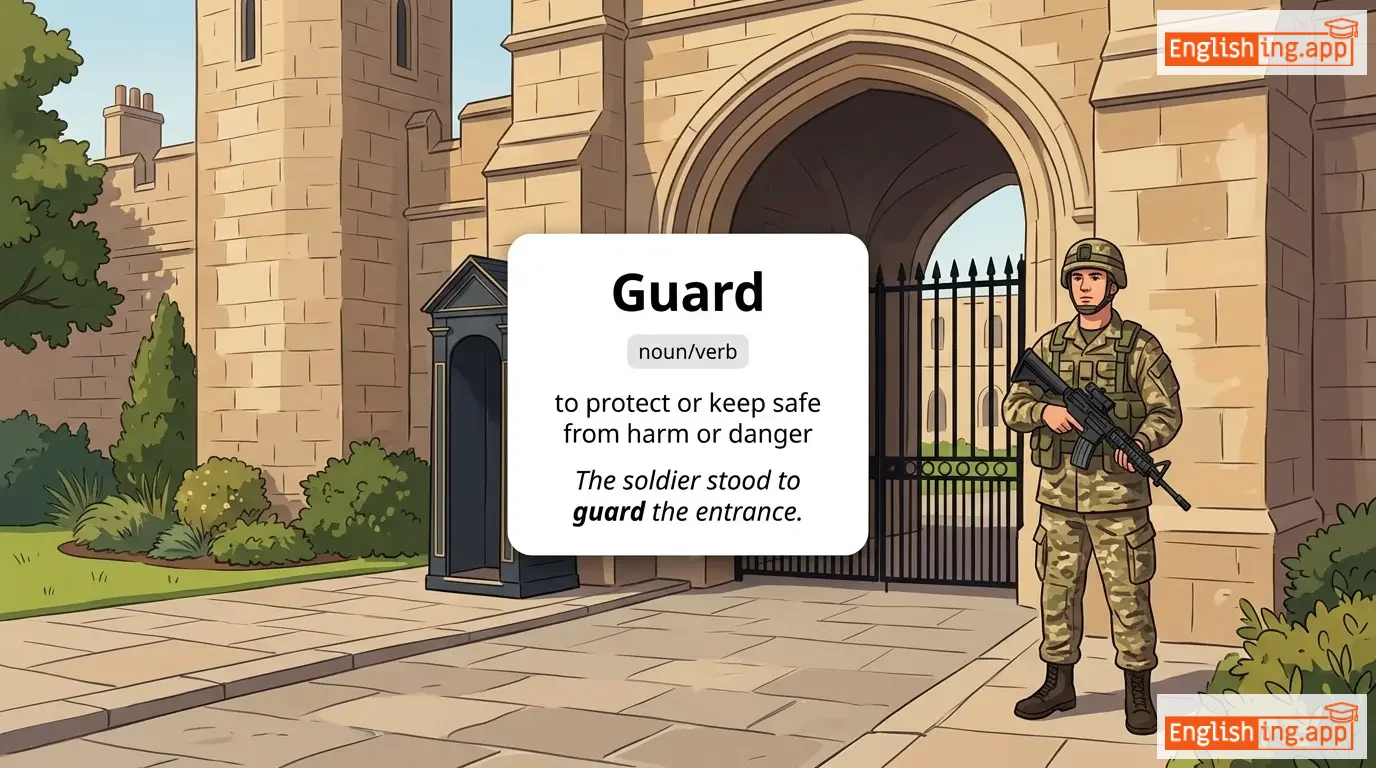
Guard definition card — visual illustration of the meaning
noun/verb
/ɡɑːrd/
garde / protéger (garde / proteger)

to protect or keep safe from harm or danger

"The soldier stood to guard the entrance."

"Le soldat se tenait pour garder l'entrée." (Le soldat se tenait pour garder l'entrée.)
adjective
/ˈɡɑːrdɪd/
réservé (reserve)

Cautious and careful in speech or action, often to avoid giving too much away.

"He gave a guarded reply to the journalist."

"Il a donné une réponse réservée au journaliste." (Il a donné une réponse réservée au journaliste.)
👨‍👩‍👧‍👦

Guardian (garde-ien)

noun
/ˈɡɑːr.di.ən/
gardien; tuteur (gardien; tuteur)

a defender, protector, or keeper; a person legally responsible for the care of someone unable to manage their own affairs

"After her parents died, her uncle became her legal guardian and took care of her."

"Après la mort de ses parents, son oncle est devenu son tuteur légal et a pris soin d'elle." (Après la mort de ses parents, son oncle est devenu son tuteur légal et a pris soin d'elle.)
noun
/ˈɡwɑːvə/
goyave (goyav)

a tropical fruit with sweet pink or white flesh and small seeds

"I love eating fresh guava from the tree in our garden."

"J'adore manger de la goyave fraîche du jardin." (J'adore manger de la goyave fraiche du jardin)
noun
/ˈɡɜːrn.zi/
pull-over (pull-over)

a knitted sweater; a type of woolen pullover

"He wore a warm guernsey during the cold winter evening."

"Il portait un pull chaud lors de la froide soirée d'hiver." (Il portait un pull chaud lors de la froide soirée d'hiver.)
noun
/ɡəˈrɪlə/
guérillero (guerrillero)

a member of a small independent group taking part in irregular fighting, typically against larger forces

"The guerrilla fighters used ambushes to attack enemy positions."

"Les combattants guérilleros ont utilisé des embuscades pour attaquer les positions ennemies." (Les combattants guérilleros ont utilisé des embuscades pour attaquer les positions ennemies.)
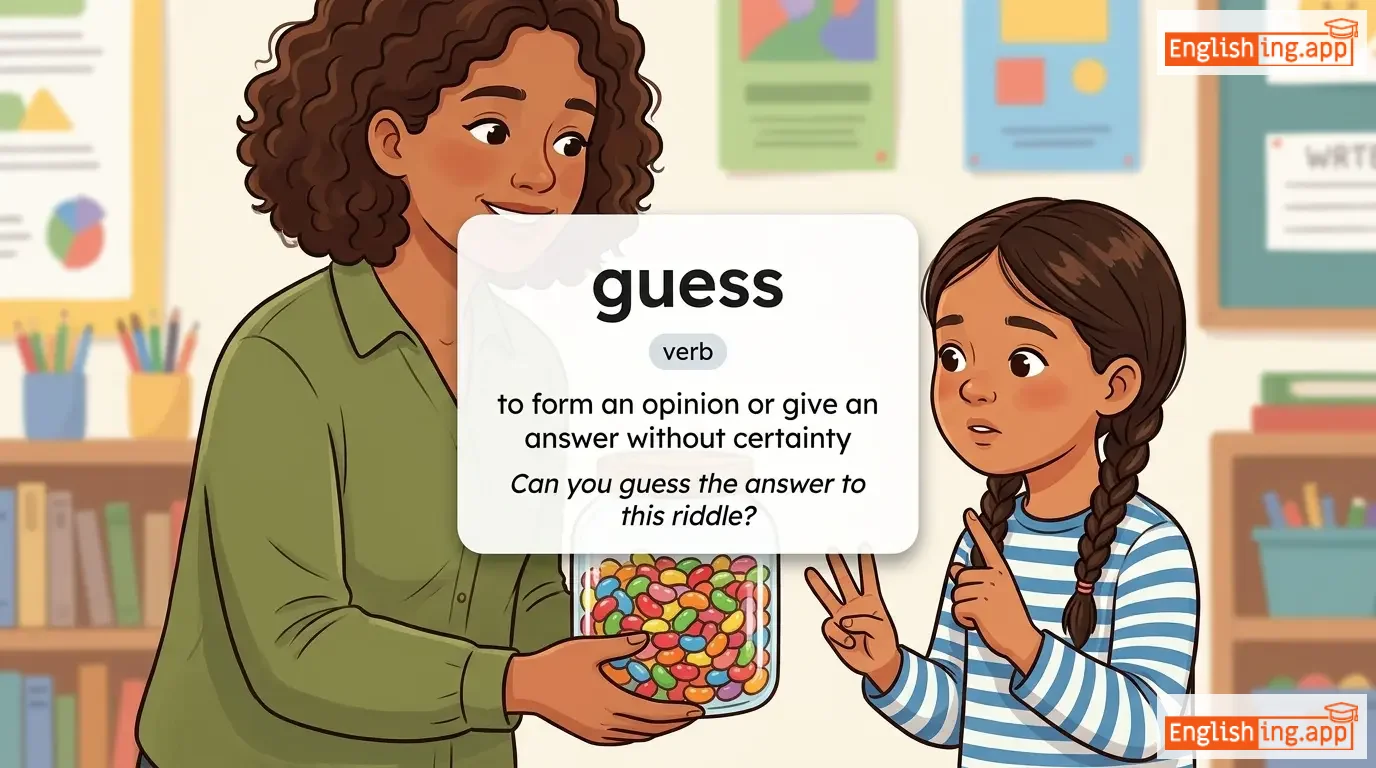
guess definition card — visual illustration of the meaning
verb
/ɡɛs/
deviner (deviner)

to form an opinion or give an answer without certainty

"Can you guess the answer to this riddle?"

"Peux-tu deviner la réponse à cette devinette ?" (Peux-tu deviner la reponse à cette devinette ?)
noun
/ɡɛst/
invité (invite)

a person invited to visit or stay in someone's home or attend an event

"We welcomed our guest with a warm smile."

"Nous avons accueilli notre invité avec un sourire chaleureux." (Nous avons accueilli notre invité avec un sourire chaleureux.)
noun/verb
/ɡəˈfɔː/
grand éclat de rire (grand eklat de rire)

a loud and boisterous laugh

"The audience guffawed at the comedian’s joke."

"Le public a éclaté de rire à la blague du comédien." (Le public a éclaté de rire à la blague du comédien.)
noun
/ˈɡaɪdəns/
orientation (orientation)

help or advice that is given to someone about what to do

"She sought her teacher’s guidance before making a decision."

"Elle a cherché l'orientation de son professeur avant de prendre une décision." (Elle a cherche l'orientation de son professeur avant de prendre une decision.)
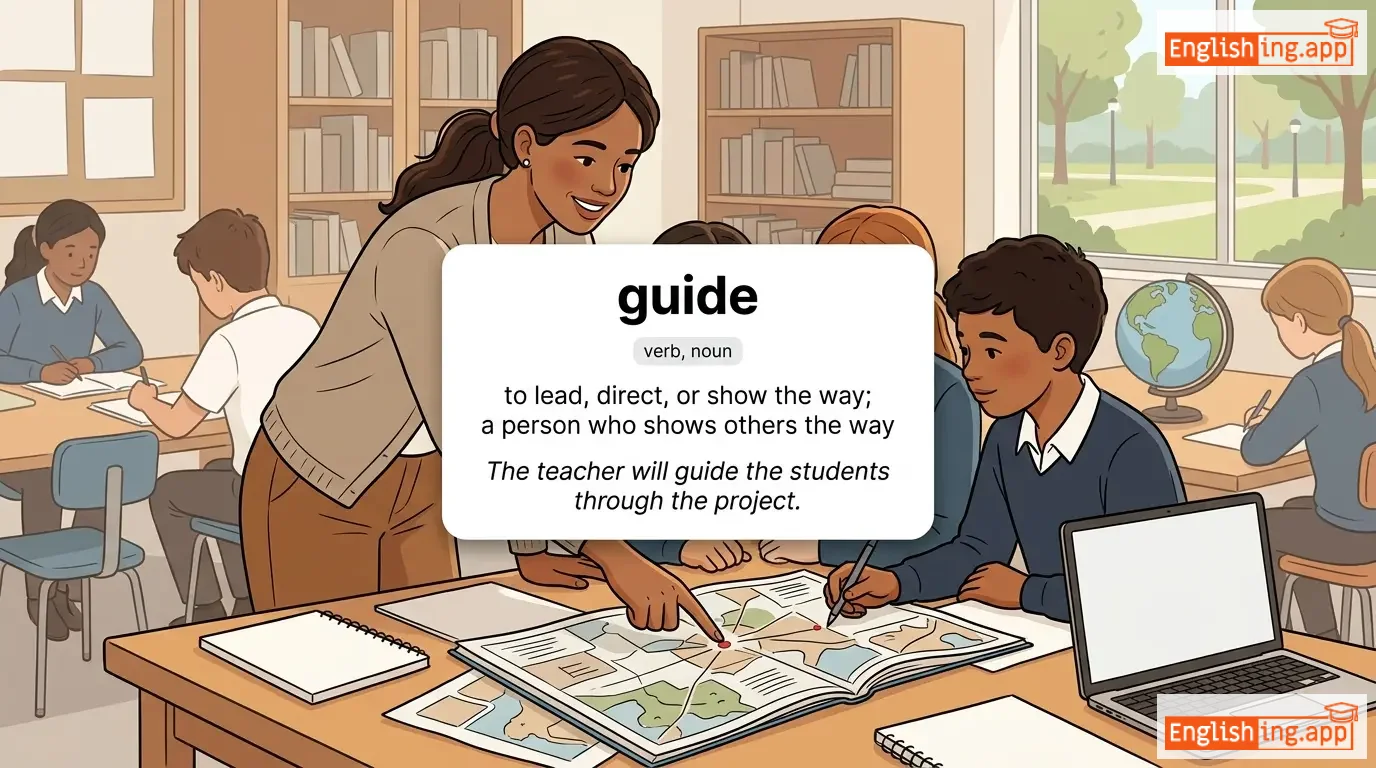
guide definition card — visual illustration of the meaning
verb, noun
/ɡaɪd/
bonheur (bonheur)

to lead, direct, or show the way; a person who shows others the way

"The teacher will guide the students through the project."

"Elle n'a pas pu cacher son bonheur lorsqu'elle a reçu le prix." (Elle n'a pas pu cacher son bonheur lorsqu'elle a reçu le prix.)
noun
/ˈɡaɪd.laɪn/
ligne directrice (ligne directrice)

a rule, instruction, or principle that provides direction

"The company issued new guidelines for employee safety."

"L'entreprise a émis de nouvelles lignes directrices pour la sécurité des employés." (L'entreprise a émis de nouvelles lignes directrices pour la sécurité des employés.)
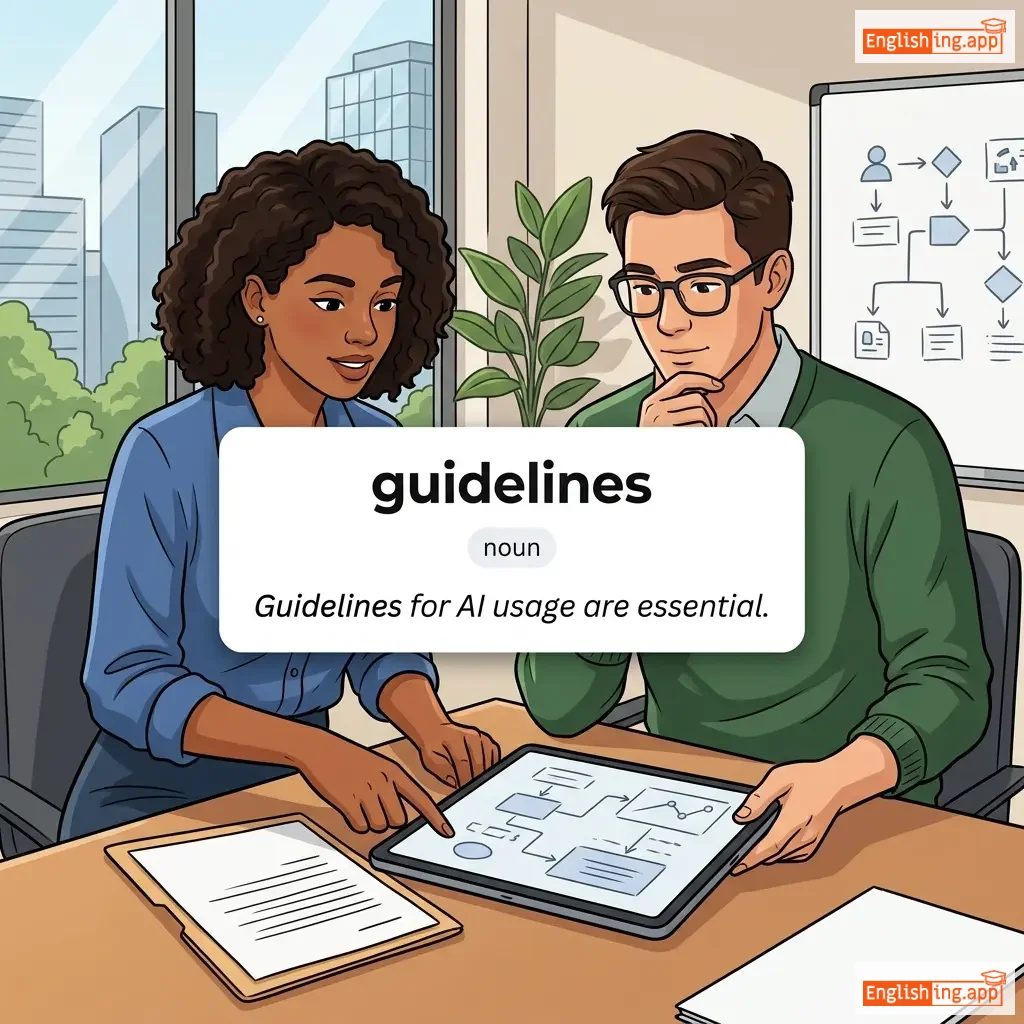
guidelines definition card — visual illustration of the meaning
noun
ˈɡaɪd.laɪnz
directives (directives)

Rules or instructions that are given by an official organization telling you how to do something

"Guidelines for AI usage are essential."

"Les lignes directrices pour l'utilisation de l'IA sont essentielles." (Les lignes directrices pour l'utilisation de l'IA sont essentielles.)
noun
/ɡaɪl/
ruse (ruse)

Cleverness or cunning used to achieve a goal, often in a deceptive way

"He used guile to win the negotiation."

"Il a utilisé la ruse pour gagner la négociation." (Il a utilisé la ruse pour gagner la négociation.)
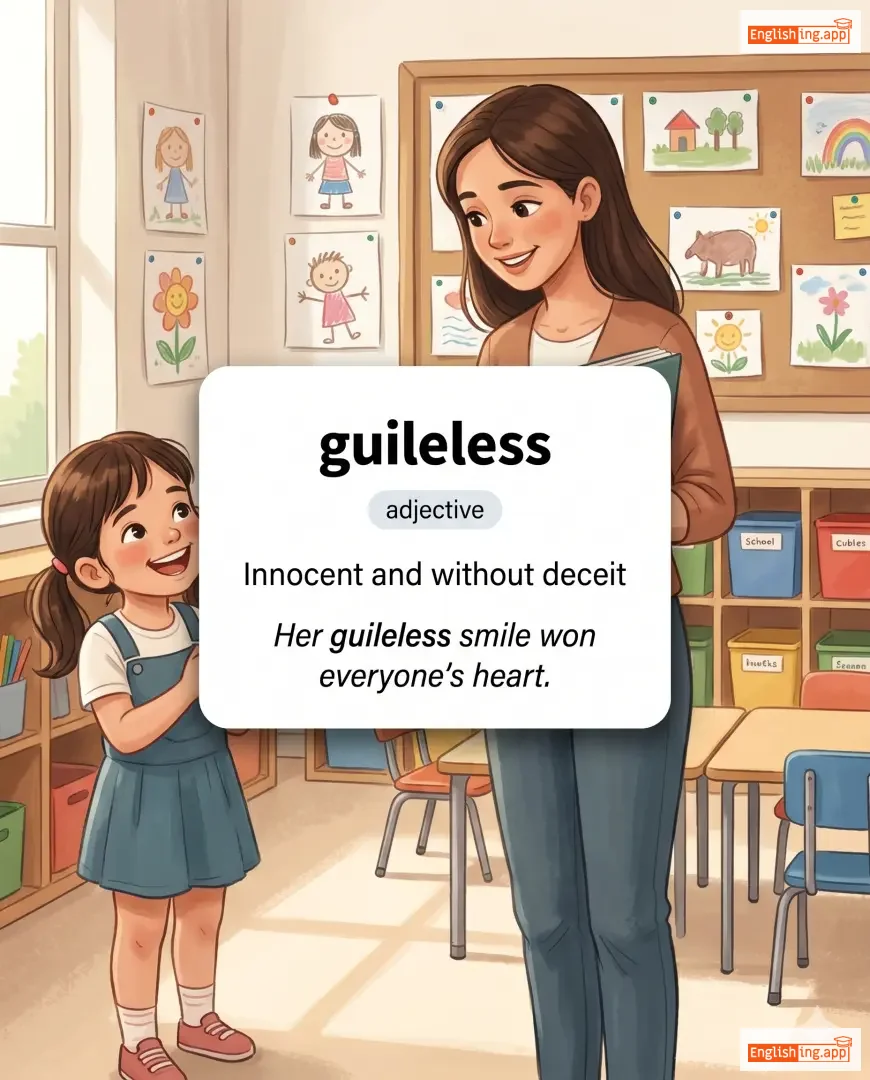
guileless definition card — visual illustration of the meaning
adjective
/ˈɡaɪlləs/
ingénu (ingenou)

Innocent and without deceit

"Her guileless smile won everyone’s heart."

"Son sourire ingénu a conquis le cœur de tout le monde." (Son sourire ingénu a conquis le cœur de tout le monde.)
noun
/ɡɪlt/
culpabilité (culpabilite)

A feeling of responsibility or remorse for an offense or wrongdoing

"She felt deep guilt after lying to her friend."

"Elle a ressenti une profonde culpabilité après avoir menti à son amie." (Elle a ressenti une profonde culpabilite apres avoir menti a son amie.)
adjective
/ˈɡɪl.ti/
coupable (coupable)

responsible for a crime or wrongdoing; feeling shame or regret

"He felt guilty after lying to his friend."

"Il se sentit coupable après avoir menti à son ami." (Il se sentit coupable après avoir menti à son ami.)
noun
/ˈɡɪni/
guinée (ancienne monnaie britannique en or) (guinee)

A former British gold coin; also refers to Guinea, a country in West Africa

"The antique coin was worth one guinea."

"La pièce antique valait une guinée." (La piece antique valait une guinee.)
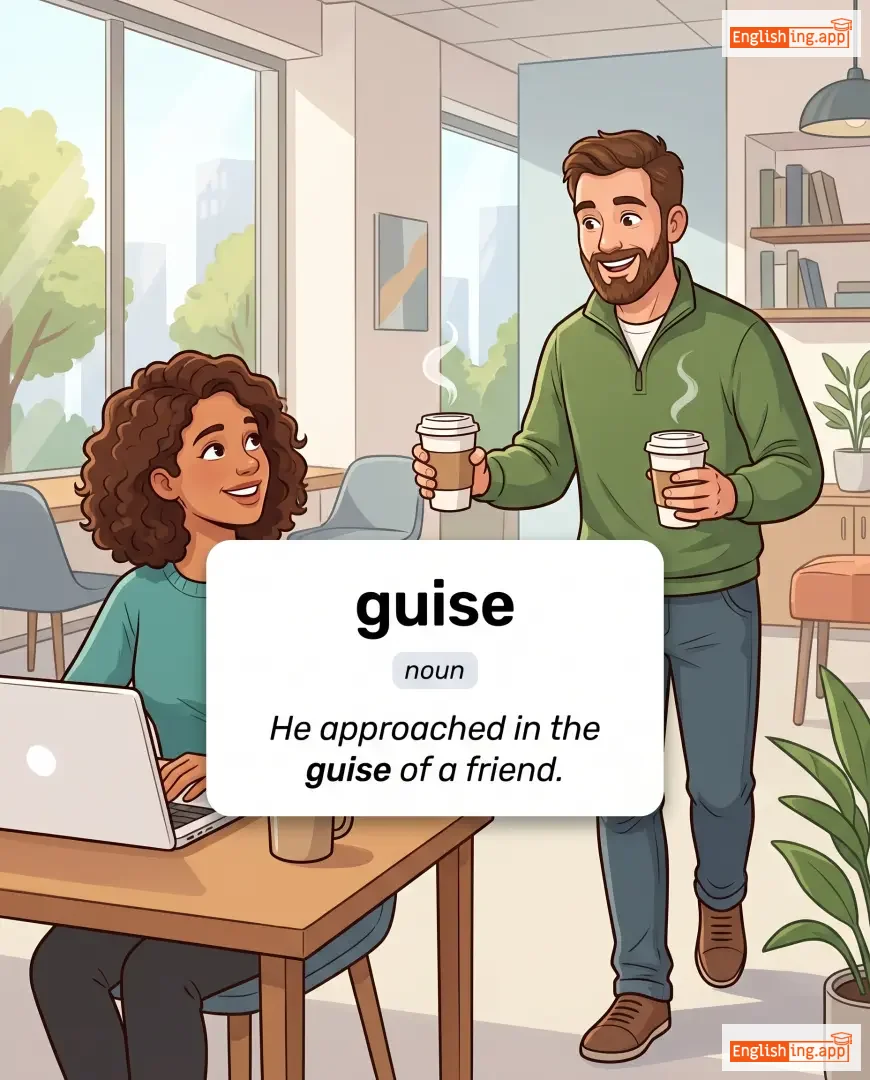
guise definition card — visual illustration of the meaning
noun
/ɡaɪz/
déguisement (deguisement)

An external form, appearance, or manner of presentation, often hiding the true nature

"He approached in the guise of a friend."

"Il s'est approché sous le déguisement d'un ami." (Il s'est approché sous le déguisement d'un ami.)