Vocabulaires

Découvrez, apprenez et maîtrisez le vocabulaire anglais

adverb
/ˈɡrædʒuəli/
graduellement (graduellement)

Slowly and steadily, taking place step by step.

"She gradually improved her English over the year."

"Elle a progressivement amélioré son anglais au cours de l'année." (Elle a progressivement amélioré son anglais au cours de l'année.)
noun, verb
/ˈɡrædʒuət/ (noun), /ˈɡrædʒueɪt/ (verb)
diplômé (diplome)

As a noun: a person who has completed a course of study; As a verb: to complete a course of study successfully.

"She will graduate from university next year."

"Elle obtiendra son diplôme de l'université l'année prochaine." (Elle obtiendra son diplôme de l'université l'année prochaine.)
adjective
/ˈɡrædʒuˌeɪtɪd/
gradué / en étapes (gradue / an etap)

Arranged in steps, levels, or stages; having completed a course of study and received a degree

"The scientist used a graduated cylinder to measure the liquid precisely."

"Le scientifique a utilisé un cylindre gradué pour mesurer le liquide précisément." (Le scientifique a utilise un cylindre gradue pour mesurer le liquide precisement.)
noun
/ˌɡrædʒ.uˈeɪ.ʃən/
bonheur (bonheur)

the act of receiving a degree or diploma after completing a course of study

"Her parents attended her graduation ceremony with pride."

"Elle n'a pas pu cacher son bonheur lorsqu'elle a reçu le prix." (Elle n'a pas pu cacher son bonheur lorsqu'elle a reçu le prix.)
noun
/ɡrəˈfiː.ti/
écriture ou dessins illégaux faits sur un mur ou une autre surface dans un lieu public (graffiti)

writing or drawings scribbled, scratched, or sprayed illicitly on a wall or other surface in a public place

"The subway walls were covered with colorful graffiti created by local street artists."

"Les murs du métro étaient couverts de graffiti colorés créés par des artistes locaux." (Les murs du métro étaient couverts de graffiti colorés créés par des artistes locaux.)
noun/verb
/ɡræft/
greffe / pot-de-vin (greffe / pot-de-vin)

To join or insert a part of one plant or tissue into another; also refers to corruption or bribery

"The surgeon performed a skin graft to treat the burn victim."

"Le chirurgien a effectué une greffe de peau pour traiter la victime des brûlures." (Le chirurgien a effectué une greffe de peau pour traiter la victime des brûlures.)
noun
/ɡreɪn/
grain (grain)

a small hard seed of a cereal plant such as wheat or rice; a tiny particle of a substance

"A grain of rice fell off the plate."

"Un grain de riz est tombé du plat." (Un grain de riz est tombe du plat.)
noun
/ɡræm/
pois chiche (pois chiche)

chickpea; a leguminous plant and its edible seed

"She cooked gram curry for lunch today."

"Elle a préparé du curry de pois chiches pour le déjeuner aujourd'hui." (Elle a préparé du curry de pois chiches pour le déjeuner aujourd'hui.)
noun
/ˈɡræmər/
grammaire (grammaire)

the system and structure of a language, including rules for syntax, morphology, and usage

"She studied grammar to improve her writing skills."

"Elle a étudié la grammaire pour améliorer son écriture." (elle a etudie la grammaire pour ameliorer son ecriture)
noun
/ˈɡrænəri/
grange (grange)

A storehouse for grain; a region that produces a large amount of grain

"The farmers stored their harvest in the village granary."

"Les agriculteurs ont stocké leur récolte dans le grenier du village." (Les agriculteurs ont stocké leur récolte dans le grenier du village.)
adjective
/ɡrænd/
grandiose (grandiose)

magnificent and impressive in appearance, size, or style

"They stayed at a grand hotel in Paris."

"Ils sont restés dans un hôtel grandiose à Paris." (Ils sont restés dans un hôtel grandiose à Paris.)
noun
/ˈɡrænd.tʃaɪld/
petit-fils ou petite-fille (petit-fils ou petite-fille)

the child of one's son or daughter

"They love spending time with their grandchild on weekends."

"Ils adorent passer du temps avec leur petit-fils ou petite-fille le week-end." (Ils adorent passer du temps avec leur petit-fils ou petite-fille le week-end.)
noun
/ˈɡræn(d)ˌdɔːtər/
petite-fille (petite-fille)

the daughter of one’s son or daughter

"Her granddaughter visits her every weekend."

"Sa petite-fille lui rend visite chaque week-end." (sa petite-fille lui rend visite chaque week-end)
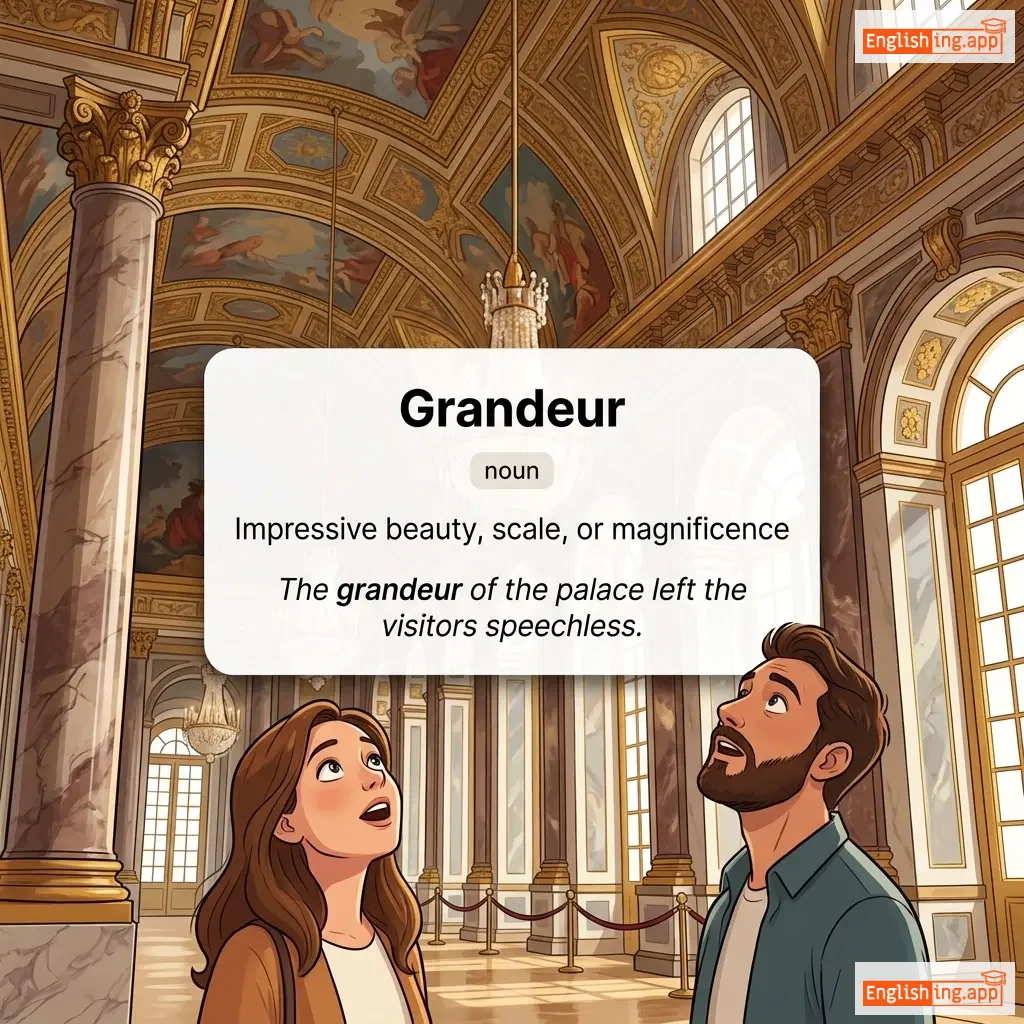
Grandeur definition card — visual illustration of the meaning
noun
/ˈɡrændʒər/
grandeur (grandeur)

Impressive beauty, scale, or magnificence

"The grandeur of the palace left the visitors speechless."

"La grandeur du palais a laissé les visiteurs sans voix." (La grandeur du palais a laissé les visiteurs sans voix.)
noun
/ˈɡrændˌfɑːðər/
grand-père (grand-père)

the father of one's father or mother

"My grandfather tells us stories every evening."

"Mon grand-père nous raconte des histoires tous les soirs." (Mon grand-père nous raconte des histoires tous les soirs.)
noun
/ˈɡrændɪləkwəns/
langage pompeux (langage pompeux)

Pompous or extravagant language, style, or manner, often intended to impress

"The politician’s speech was full of empty grandiloquence."

"Le discours du politicien était rempli de langage pompeux et vide." (Le discours du politicien était rempli de langage pompeux et vide.)
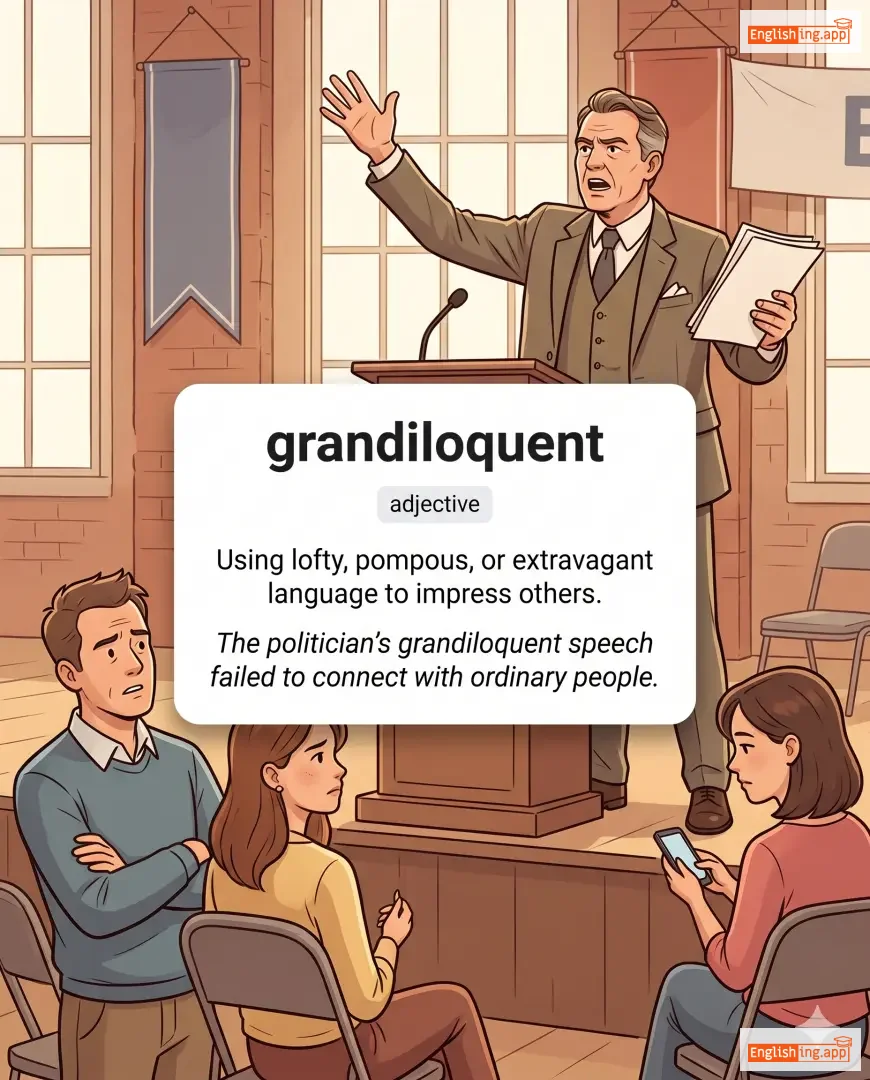
grandiloquent definition card — visual illustration of the meaning
adjective
/ɡrænˈdɪləkwənt/
langage pompeux (langage pompeux)

Using lofty, pompous, or extravagant language to impress others.

"The politician’s grandiloquent speech failed to connect with ordinary people."

"Le discours pompeux du politicien n'a pas réussi à se connecter avec le peuple ordinaire." (Le discours pompeux du politicien n'a pas réussi à se connecter avec le peuple ordinaire.)
adjective
/ˈɡrændioʊs/
grandiose (grandiose)

Impressive or magnificent in appearance or style, often pretentiously so.

"He had grandiose plans of building a futuristic city in the desert."

"Il avait des projets grandioses de construire une ville futuriste dans le désert." (Il avait des projets grandioses de construire une ville futuriste dans le désert.)
noun
/ˈɡrændˌmʌðər/
grand-mère (grand-mere)

the mother of one's father or mother

"My grandmother makes delicious cakes."

"Ma grand-mère fait des gâteaux délicieux." (Ma grand-mère fait des gâteaux délicieux.)
noun
/ˈɡrændˌpeə.rənt/
grand-père/grand-mère (grand-père/grand-mère)

the parent of one's father or mother

"My grandparents live in a small village near the hills."

"Mes grands-parents vivent dans un petit village près des collines." (Mes grands-parents vivent dans un petit village près des collines.)
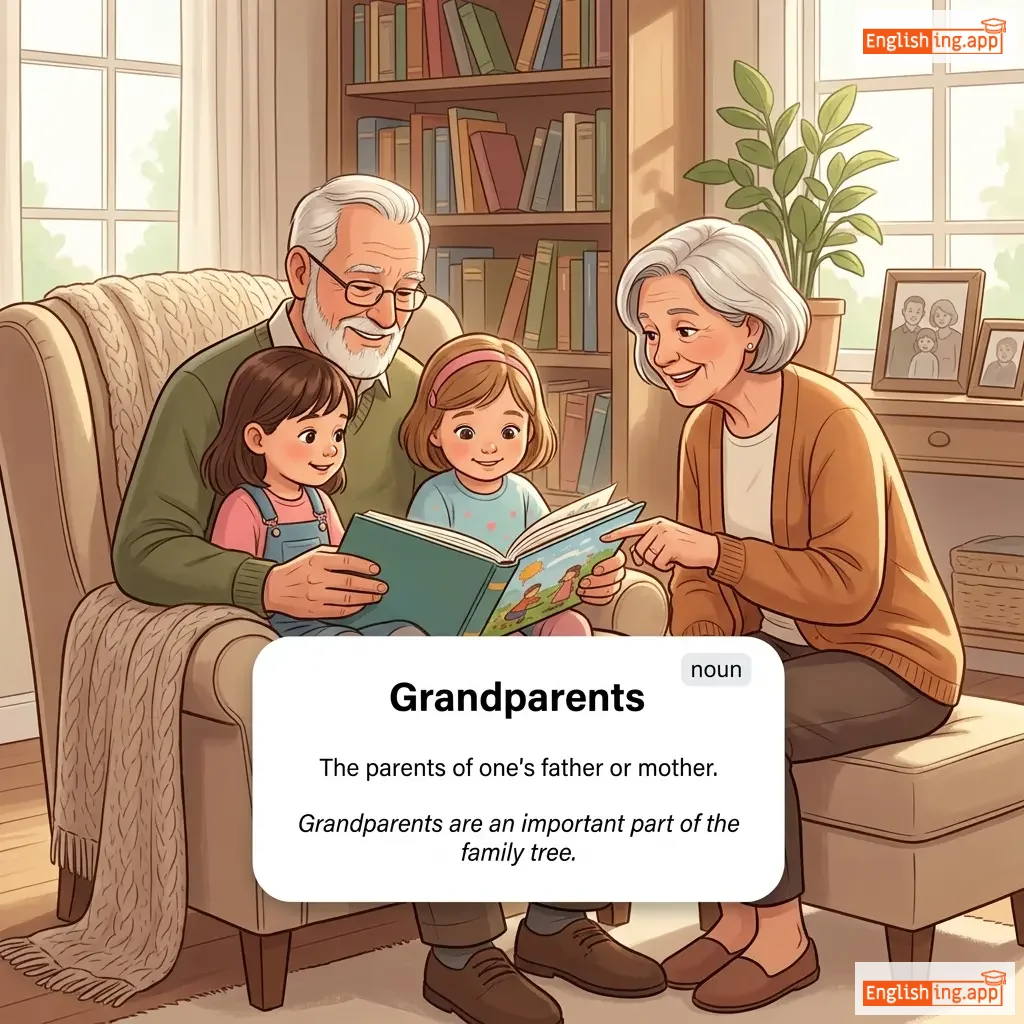
Grandparents definition card — visual illustration of the meaning
noun
ˈɡrænˌpɛrənts
Grands-parents (grands-parents)

The parents of one's father or mother.

"Grandparents are an important part of the family tree."

"Les grands-parents sont une partie importante de l'arbre généalogique." (Les grands-parents sont une partie importante de l'arbre généalogique.)
noun
/ˈɡrændsʌn/
petit-fils (petit-fils)

the son of one's son or daughter

"His grandson visits him every weekend."

"Son petit-fils lui rend visite chaque week-end." (son petit-fils lui rend visite chaque week-end)
verb
/ˈɡrændstænd/
chercher à attirer l'attention ou à recevoir des applaudissements en se comportant de manière ostentatoire (chercher a attirer l'attention ou a recevoir des applaudissements en se comportant de maniere ostentatoire)

To seek attention or applause by behaving or speaking in a showy way.

"The actor was accused of grandstanding during the charity event."

"L'acteur a été accusé de grandstanding lors de l'événement caritatif." (L'acteur a ete accuse de grandstanding lors de l'evenement caritatif.)
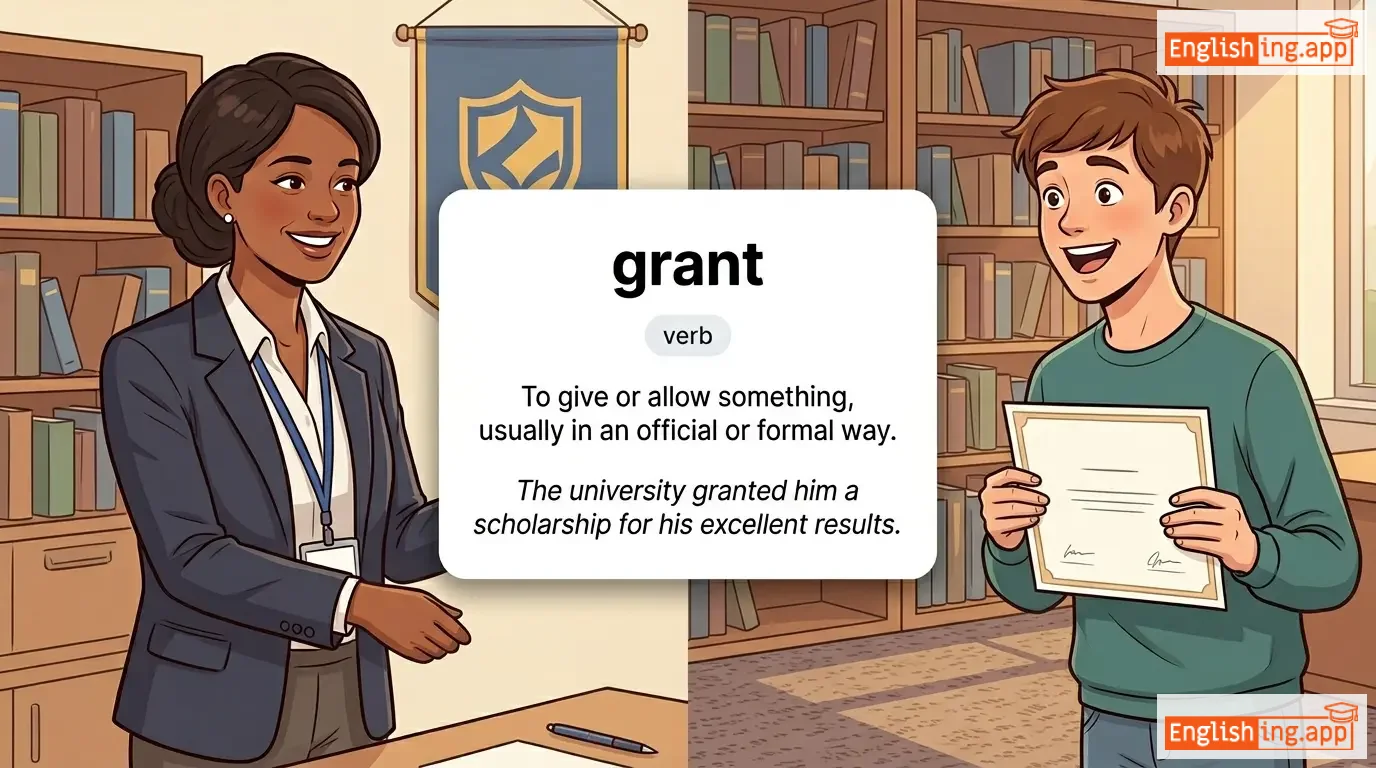
grant definition card — visual illustration of the meaning
verb
/ɡrænt/
accorder (accorder)

To give or allow something, usually in an official or formal way.

"The university granted him a scholarship for his excellent results."

"L'université lui a accordé une bourse pour ses excellents résultats." (L'université lui a accordé une bourse pour ses excellents résultats.)
noun
/ɡrænˈtiː/
bénéficiaire (beneficiaire)

A person or organization that receives a grant or benefit.

"The grantee must submit a progress report every six months."

"Le bénéficiaire doit soumettre un rapport d'avancement tous les six mois." (Le beneficiaire doit soumettre un rapport d'avancement tous les six mois.)
noun
/ˈɡræn.tɔːr/
donateur (donateur)

A person or entity that makes a grant or transfers property or rights to another.

"The grantor transferred the property rights to the nonprofit organization."

"Le donateur a transféré les droits de propriété à l'organisation à but non lucratif." (Le donateur a transféré les droits de propriété à l'organisation à but non lucratif.)
adjective
/ˈɡræn.jʊ.lər/
granulaire (granulaire)

Consisting of small grains or particles; detailed and specific.

"The report provided a granular analysis of the market data."

"Le rapport a fourni une analyse détaillée des données du marché." (Le rapport a fourni une analyse détaillee des données du marché.)
verb
/ˈɡræn.jʊ.leɪt/
granuler (granuler)

To form or cause to form into grains or small particles.

"The sugar began to granulate as it cooled."

"Le sucre a commencé à se granuler lorsqu'il a refroidi." (Le sucre a commencé à se granuler lorsqu'il a refroidi.)
noun
/ˈɡræn.juːl/
granule (granule)

A small compact particle of a substance.

"Each granule of salt sparkled under the sunlight."

"Chaque granule de sel scintillait sous la lumière du soleil." (Chaque granule de sel scintillait sous la lumière du soleil.)
noun
/ɡreɪp/
raisin (raisin)

a small, round fruit that grows in clusters on vines and is used to make wine or eaten as food

"She picked a bunch of grapes from the vine."

"Elle a cueilli une grappe de raisins sur la vigne." (Elle a cueilli une grappe de raisins sur la vigne.)
noun
/ɡreɪps/
raisins (raizons)

small round fruits that grow in clusters on vines; used to make wine

"She bought a bunch of grapes from the market."

"Elle a acheté une grappe de raisins au marché." (Elle a acheté une grappe de raisins au marché.)
adjective
/ˈɡræf.ɪk/
graphique (graphique)

Relating to visual art, especially involving drawing, design, or vivid description.

"The movie contained graphic scenes of violence."

"Le film contenait des scènes graphiques de violence." (Le film contenait des scenes graphiques de violence.)
noun
/ˈɡræfɪks/
graphismes (graphismes)

visual images, designs, or drawings used to convey information or artistic expression

"The website uses stunning graphics to attract visitors."

"Le site utilise des graphismes impressionnants pour attirer les visiteurs." (Le site utilise des graphismes impressionnants pour attirer les visiteurs.)
noun
/ˈɡræfaɪt/
graphite (graphite)

a soft, black form of carbon used in pencils and as a lubricant

"The artist sketched the portrait using a graphite pencil."

"L'artiste a esquissé le portrait avec un crayon graphite." (L'artiste a esquisse le portrait avec un crayon graphite.)
verb
/ˈɡræpəl/
lutter, se battre (lutter, se battre)

to struggle or wrestle with something, often a problem or opponent

"The company is grappling with financial difficulties."

"L'entreprise lutte avec des difficultés financières." (L'entreprise lutte avec des difficultés financières.)
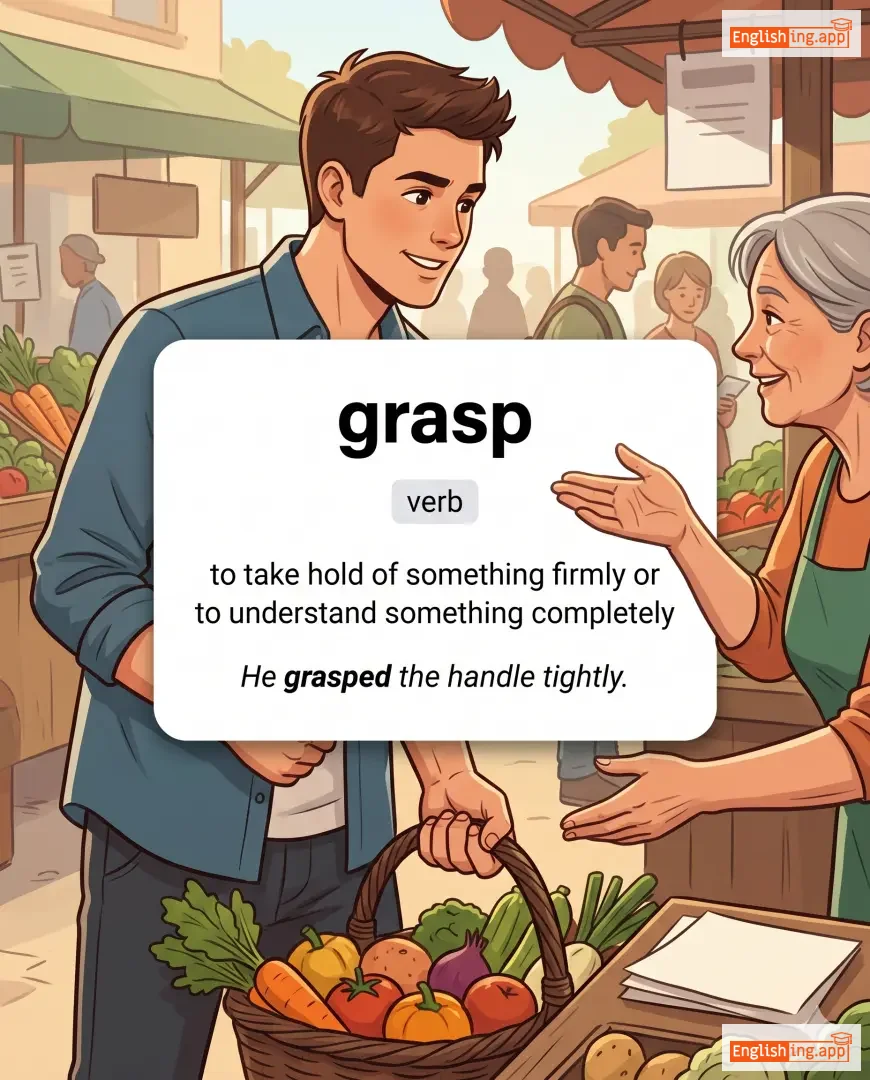
grasp definition card — visual illustration of the meaning
verb
/ɡrɑːsp/
saisir fermement ou comprendre complètement (saisir fermement ou comprendre complètement)

to take hold of something firmly or to understand something completely

"He grasped the handle tightly."

"Il saisit fermement la poignée." (Il saisit fermement la poignée.)
verb/adjective
/ˈɡræspɪŋ/
saisir / avare (saisir / avare)

Holding firmly; or (as an adjective) excessively greedy.

"The child was grasping her mother’s hand tightly."

"L'enfant saisissait fermement la main de sa mère." (L'enfant saisissait fermement la main de sa mère.)
noun
/ɡræs/
bonheur (bonheur)

plants with narrow green leaves, often covering the ground in fields or gardens

"Children are playing on the grass."

"Elle ne pouvait pas cacher son bonheur lorsqu'elle a reçu le prix." (Elle ne pouvait pas cacher son bonheur lorsqu'elle a reçu le prix.)
noun
/ˈɡræs.hɒp.ər/
saute-mouton (saute-mouton)

a jumping insect with long hind legs that feeds on grass and plants

"The grasshopper jumped from one leaf to another."

"Le sauterelle a sauté d'une feuille à une autre." (Le sauterelle a sauté d'une feuille à une autre.)
adjective
/ˈɡræs.i/
herbeux (erbuh)

covered with grass; resembling grass in color; green like grass

"The grassy field stretched as far as the eye could see."

"Le champ herbeux s'étendait à perte de vue." (Le champ herbeux setendait a perte de vue.)
verb
/ɡreɪt/
râper, irriter (râper, irriter)

to shred food into small pieces using a grater; to irritate or annoy

"She grated the cheese for the pasta dish."

"Elle a râpé le fromage pour le plat de pâtes." (Elle a rapé le fromage pour le plat de pâtes.)
adjective
/ˈɡreɪtfəl/
reconnaissant (reconnaissant)

feeling or showing thanks for something or someone

"I am grateful for your help."

"Je suis reconnaissant pour ton aide." (Je suis reconnaissant pour ton aide.)
noun
/ˈɡreɪt.fəl.nəs/
reconnaissance (reconnaissance)

the quality of being thankful; readiness to show appreciation for kindness

"She expressed her gratefulness to the doctors who saved her life."

"elle a exprimé sa reconnaissance aux médecins qui lui ont sauvé la vie." (elle a exprimé sa reconnaissance aux médecins qui lui ont sauvé la vie.)
noun
/ˈɡreɪ.tər/
râpe (rape)

a kitchen utensil with a rough surface for grating food into small pieces

"Use the grater to grate cheese for the pizza."

"Utilisez la râpe pour râper le fromage pour la pizza." (Utilisez la râpe pour râper le fromage pour la pizza.)
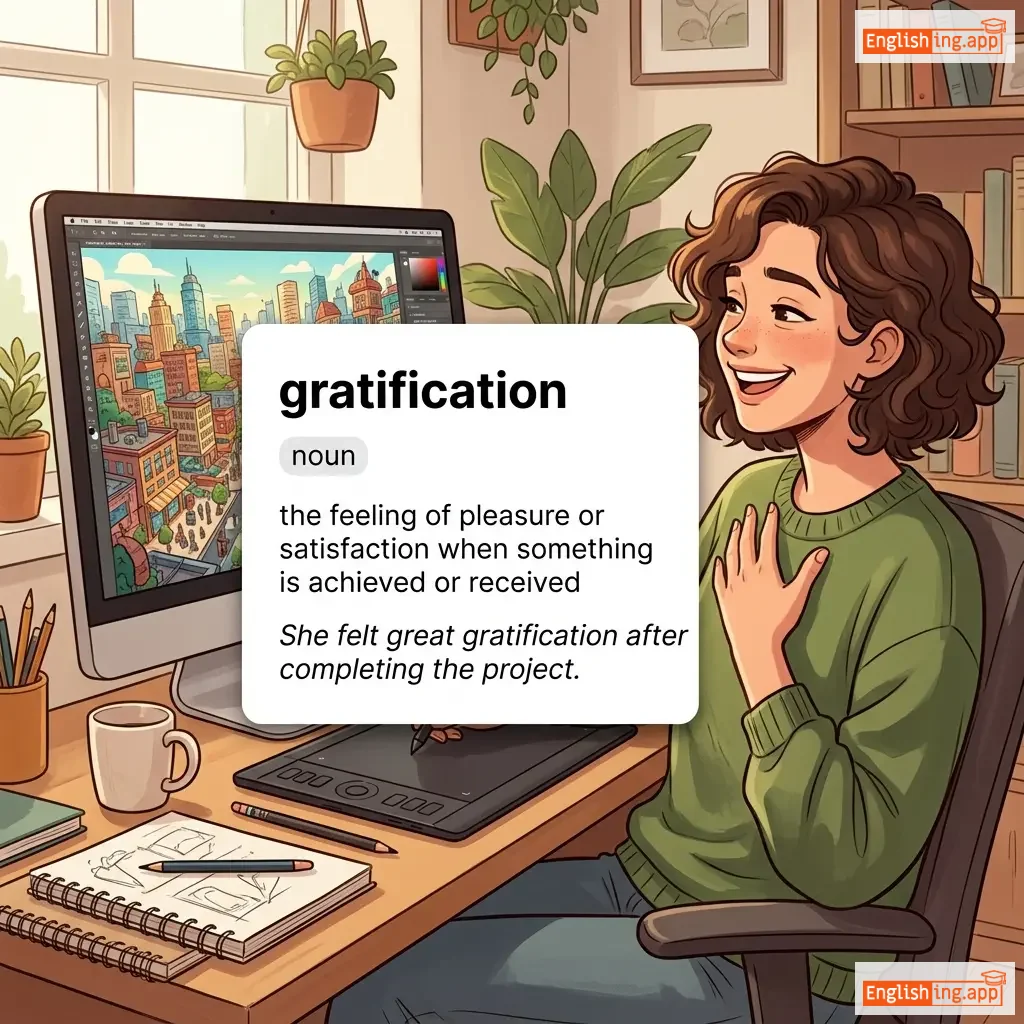
gratification definition card — visual illustration of the meaning
noun
/ˌɡrætɪfɪˈkeɪʃən/
satisfaction, gratification (satisfaction, gratification)

the feeling of pleasure or satisfaction when something is achieved or received

"She felt great gratification after completing the project."

"Elle a ressenti une grande satisfaction après avoir terminé le projet." (Elle a ressenti une grande satisfaction après avoir terminé le projet.)
verb
/ˈɡrætɪfaɪ/
satisfaire, rendre heureux (satisfaire, rendre heureux)

to give pleasure or satisfaction to someone

"It gratified him to know his work was appreciated."

"Il a été satisfait de savoir que son travail avait été apprécié." (Il a été satisfait de savoir que son travail avait été apprécié.)
adjective, noun
/ˈɡreɪtɪŋ/
son désagréable / grille métallique (son désagréable / grille métallique)

Harsh and unpleasant to the senses, especially sound; a framework of bars covering an opening.

"The teacher's grating voice made it hard to concentrate."

"La voix désagréable de l'enseignant rendait la concentration difficile." (La voix désagréable de l'enseignant rendait la concentration difficile.)
adverb, adjective
/ˈɡrætɪs/ or /ˈɡreɪtɪs/
gratuit (gratwee)

Without charge; free of cost.

"The drinks at the event were provided gratis."

"Les boissons à l'événement étaient fournies gratuitement." (Les boissons à l'événement étaient fournies gratuitement.)
gratitude definition card — visual illustration of the meaning
noun
/ˈɡrætɪˌtjuːd/
gratitude (gratitude)

The quality of being thankful; readiness to show appreciation for and return kindness.

"She expressed her gratitude to the team for their support."

"Elle a exprimé sa gratitude envers l'équipe pour leur soutien." (Elle a exprimé sa gratitude envers l'équipe pour leur soutien.)
adjective
/ɡrəˈtjuːɪtəs/
injustifié (injustifie)

Unnecessary, unwarranted, or given freely without reason or cause.

"The movie was criticized for its gratuitous violence."

"Le film a été critiqué pour sa violence injustifiée" (Le film a ete critique pour sa violence injustifiee)