Vocabulaires

Découvrez, apprenez et maîtrisez le vocabulaire anglais

adjective
/fɔːls/
faux (faux)

not true or correct; intended to deceive

"He was accused of giving false information."

"Il a été accusé d'avoir donné de fausses informations." (Il a été accusé d'avoir donné de fausses informations.)
noun
/ˈfɔːlshʊd/
mensonge (mensonge)

the state of being untrue or a lie

"He was punished for spreading falsehoods about his colleague."

"Il a été puni pour avoir répandu des mensonges sur son collègue." (Il a été puni pour avoir répandu des mensonges sur son collègue.)
verb
/ˈfɔːlsɪfaɪ/
falsifier (falsifier)

to make something false or to misrepresent

"He tried to falsify the documents to avoid taxes."

"Il a essayé de falsifier les documents pour éviter les impôts." (Il a essayé de falsifier les documents pour éviter les impôts.)
verb
/ˈfɔːltər/
hésiter ou perdre de la force ou de l'élan (hesiter ou perdre de la force ou de l'élan)

to hesitate or lose strength or momentum

"Her voice faltered as she delivered the speech."

"Sa voix a faibli lorsqu'elle a prononcé son discours." (Sa voix a faibli lorsqu'elle a prononcé son discours.)
noun
/feɪm/
renommée (renommee)

the state of being known or recognized by many people

"She achieved worldwide fame for her acting."

"Elle a atteint la renommée mondiale grâce à son jeu d'acteur." (Elle a atteint la renommée mondiale grâce à son jeu d'acteur.)
adjective
/fəˈmɪliər/
familier (familier)

Well known or easily recognized from previous experience.

"The town looked familiar to me after so many years."

"La ville me paraissait familière après tant d'années." (La ville me paraissait familière après tant d'années.)
👨‍👩‍👧‍👦

family (famili)

noun
/ˈfæməli/
famille (famille)

A group consisting of parents and their children, or all the descendants of a common ancestor.

"She spends most of her weekends with her family."

"Elle passe la plupart de ses week-ends avec sa famille." (Elle passe la plupart de ses week-ends avec sa famille.)
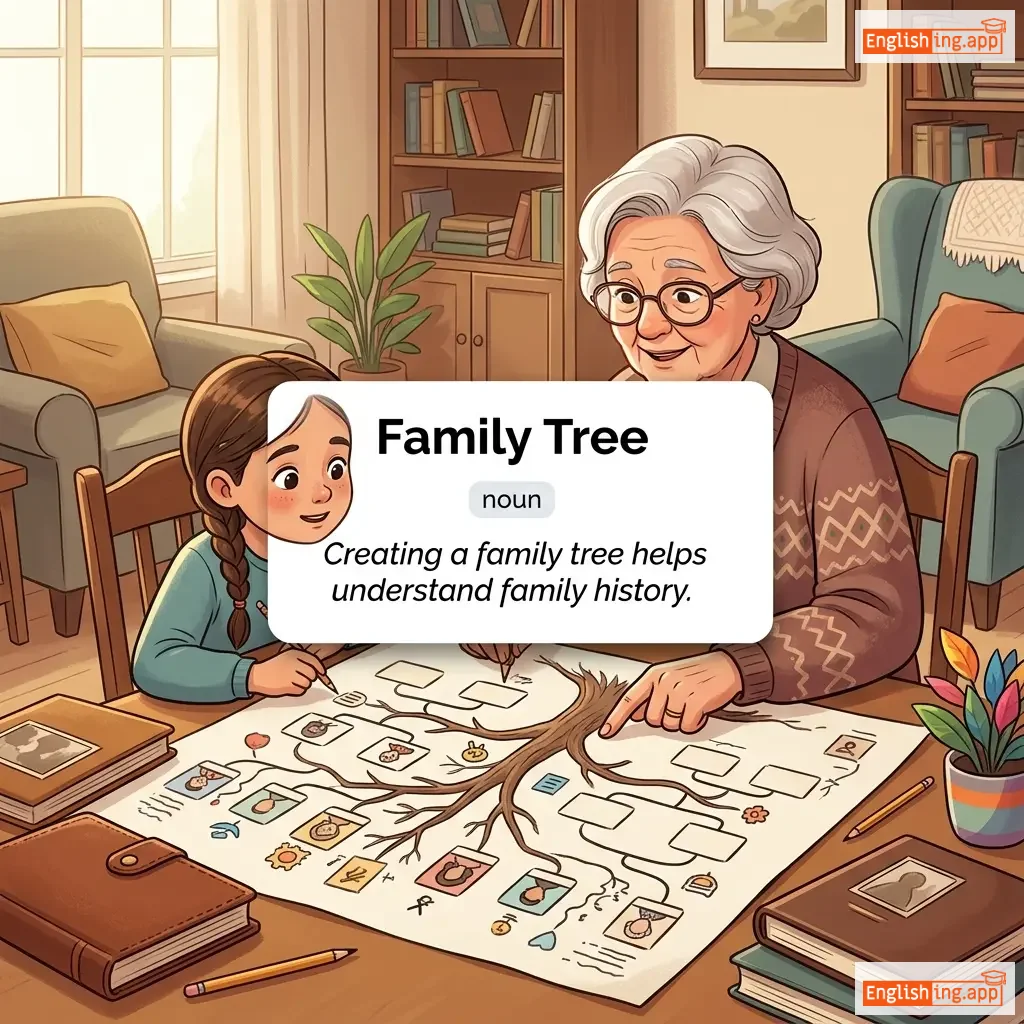
Family Tree definition card — visual illustration of the meaning
noun
ˈfæmɪli triː
Arbre généalogique (Arbre genealogique)

A diagram showing the relationships between people in several generations of a family.

"Creating a family tree helps understand family history."

"Créer un arbre généalogique aide à comprendre l'histoire familiale." (Creer un arbre genealogique aide a comprendre l'histoire familiale.)
noun
/ˈfæm.ɪn/
famine (famine)

extreme scarcity of food; a period when food is extremely scarce

"The severe drought led to widespread famine in the region."

"La grave sécheresse a provoqué une famine généralisée dans la région." (La grave secheresse a provoque une famine generalisee dans la region.)
verb
/ˈfæmɪʃ/
mourir de faim (mourir de faim)

to suffer or cause to suffer from extreme hunger

"The stranded hikers began to famish after several days without food."

"Les randonneurs bloqués ont commencé à mourir de faim après plusieurs jours sans nourriture." (Les randonneurs bloqués ont commencé à mourir de faim après plusieurs jours sans nourriture.)
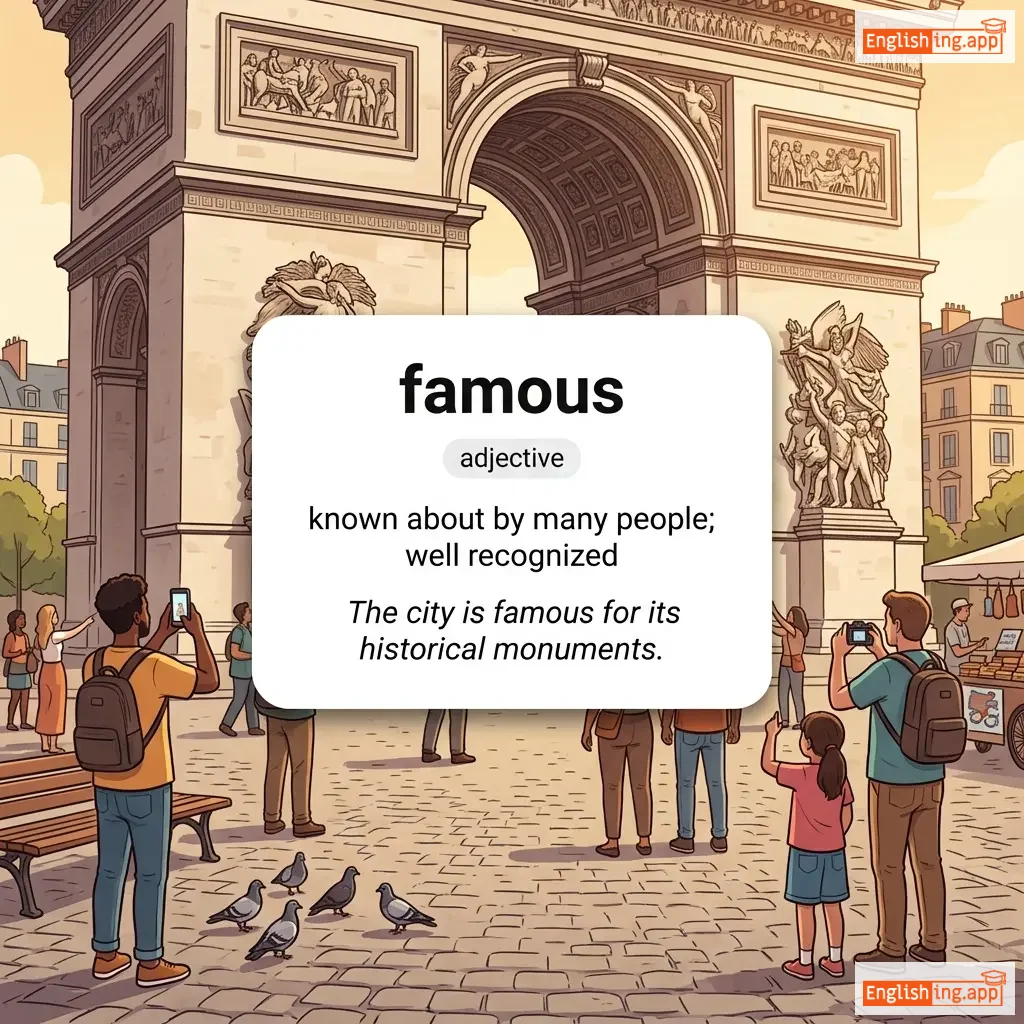
famous definition card — visual illustration of the meaning
adjective
/ˈfeɪməs/
célèbre (celeb-rah)

known about by many people; well recognized

"The city is famous for its historical monuments."

"La ville est célèbre pour ses monuments historiques." (La ville est célèbre pour ses monuments historiques.)
noun
/fæn/
bonheur (bonheur)

a device with rotating blades that creates a current of air; also a person who admires or supports someone or something

"The fan kept the room cool during the hot summer day."

"Elle ne pouvait pas cacher son bonheur lorsqu'elle a reçu le prix." (Elle ne pouvait pas cacher son bonheur lorsqu'elle a reçu le prix.)
noun
/fəˈnætɪk/
fanatique (fanatique)

a person with extreme and uncritical enthusiasm for a cause or belief

"He is a football fanatic, never missing a match of his favorite team."

"Il est un fanatique de football, il ne rate jamais un match de son équipe préférée." (Il est un fanatique de football, il ne rate jamais un match de son équipe préférée.)
adjective
/fəˈnætɪkəl/
fanatique (fanatique)

showing extreme enthusiasm or obsession

"She has a fanatical interest in collecting vintage stamps."

"Elle a un intérêt fanatique pour la collection de timbres anciens." (Elle a un interet fanatique pour la collection de timbres anciens.)
noun
/fəˈnætɪsɪzəm/
fanatisme (fanatisme)

the quality of being fanatical; extreme zeal or obsession

"Religious fanaticism can lead to intolerance and conflict."

"Le fanatisme religieux peut mener à l'intolérance et au conflit." (Le fanatisme religieux peut mener à l'intolérance et au conflit.)
adjective
/ˈfænsiːd/
imaginé, désiré (imagine, desire)

imagined, desired, or believed without evidence

"He is a fancied suitor in the eyes of the young lady."

"Il est un prétendant imaginé aux yeux de la jeune fille." (Il est un prétendant imaginé aux yeux de la jeune fille.)
noun
/ˈfænsiər/
amateur (amateur)

a person who has a special interest in a particular thing or activity, especially animals or hobbies

"He is a fancier of rare birds."

"Il est un amateur d'oiseaux rares." (Il est un amateur d'oiseaux rares.)
adjective
/ˈfæn.sɪ.fəl/
fantaisiste, irréaliste (fantaisiste, irrealiste)

overimaginative, unrealistic, or whimsical

"The story was too fanciful to be true."

"L'histoire était trop fantaisiste pour être vraie." (L'histoire était trop fantaisiste pour être vraie.)
adjective
/ˈfæn.sɪ.ləs/
sans imagination, ordinaire (sans imagination, ordinaire)

without imagination or creativity; plain or ordinary

"His drawings were simple and fanciless."

"Ses dessins étaient simples et sans imagination." (Ses dessins etaient simples et sans imagination.)
verb
/ˈfæn.si/
imaginer, désirer, aimer (imaginer, désirer, aimer)

to imagine, desire, or like something; to have a liking for

"She fancies a cup of tea in the morning."

"Elle désire une tasse de thé le matin." (Elle désire une tasse de thé le matin.)
noun
/ˈfæn.feər/
grande pompe, publicité (grande pompe, publicite)

a short ceremonial tune or display of publicity to attract attention

"The new product was launched with much fanfare."

"Le nouveau produit a été lancé avec beaucoup de fanfare." (Le nouveau produit a ete lance avec beaucoup de fanfare.)
adjective
/fænˈtæstɪk/
fantastique (fantastique)

extraordinary, extremely good or impressive

"The concert last night was absolutely fantastic."

"Le concert de la nuit dernière était absolument fantastique." (Le concert de la nuit derniere etait absolument fantastique.)
noun
/ˈfæntəsi/
fantaisie (fantaisie)

a creation of the imagination, especially something improbable or impossible

"She has a vivid fantasy about traveling to space."

"Elle a une fantaisie vive de voyager dans l'espace." (Elle a une fantaisie vive de voyager dans l'espace.)
adverb
/fɑːr/
loin (lwan)

at, to, or by a great distance

"The school is far from my house."

"L'école est loin de ma maison." (L'école est loin de ma maison.)
adjective
/ˌfɑːrˈfɛtʃt/
farfelu (farfelu)

unlikely to happen or be true; improbable

"His explanation for being late was a bit far-fetched."

"Son explication pour être en retard était un peu farfelue." (Son explication pour être en retard était un peu farfelue.)
noun
/fɑːrs/
farce (farce)

a comic dramatic work using buffoonery and horseplay, or a ridiculous situation

"The meeting turned into a complete farce with everyone arguing."

"La réunion est devenue une vraie farce avec tout le monde qui se disputait." (La reunion est devenue une vraie farce avec tout le monde qui se disputait.)
noun
/fɛər/
tarif (tarif)

the money paid for a journey on public transport; also food or treatment provided

"The bus fare to the city center is five dollars."

"Le tarif du bus pour le centre-ville est de cinq dollars." (Le tarif du bus pour le centre-ville est de cinq dollars.)
noun
/ˌfer.ˈwel/
adieu (adieu)

an act of parting or of marking someone's departure

"The company organized a farewell party for the retiring manager."

"L'entreprise a organisé une fête d'adieu pour le directeur partant." (L'entreprise a organisé une fête d'adieu pour le directeur partant.)
adjective
/ˌfɑːrˈfetʃt/
improbable ou peu probable (improbable ou peu probable)

unlikely to happen or be true; improbable

"His explanation for being late sounded farfetched."

"Son explication pour son retard semblait invraisemblable." (Son explication pour son retard semblait invraisemblable.)
noun
/fɑːrm/
ferme (ferme)

an area of land used for growing crops and raising animals

"They live on a farm with many animals."

"Ils vivent dans une ferme avec de nombreux animaux." (Ils vivent dans une ferme avec de nombreux animaux.)
👨‍🌾

Farmer (farmer)

noun
/ˈfɑːrmər/
fermier (fermier)

a person who owns or manages a farm

"The farmer works hard to grow crops."

"Le fermier travaille dur pour cultiver les récoltes." (Le fermier travaille dur pour cultiver les récoltes.)
noun
/ˈfɑː.mɪŋ/
agriculture (agriculture)

the activity or business of growing crops and raising animals for food or other products

"Farming requires both hard work and knowledge about the land."

"L'agriculture nécessite à la fois du travail acharné et des connaissances sur la terre." (L'agriculture nécessite à la fois du travail acharné et des connaissances sur la terre.)
verb
/ˈfæs.ɪ.neɪt/
fasciner (fasciner)

to attract and hold the attention of someone; to charm or captivate

"The magician's performance fascinated the audience."

"La performance du magicien a fasciné le public." (La performance du magicien a fasciné le public.)
adjective
/ˈfæsɪneɪtɪŋ/
fascinant (fascinant)

extremely interesting or charming

"The history of ancient Egypt is truly fascinating."

"L'histoire de l'Égypte ancienne est vraiment fascinante." (L'histoire de l'Égypte ancienne est vraiment fascinante.)
noun
/ˌfæs.ɪˈneɪ.ʃən/
fascination; attrait; émerveillement (fascination, attrait, émerveillement)

the power to fascinate someone; the state of being intensely interested

"Her fascination with ancient history led her to become an archaeologist."

"Sa fascination pour l'histoire ancienne l'a poussée à devenir archéologue." (Sa fascination pour l'histoire ancienne l'a poussée à devenir archéologue.)
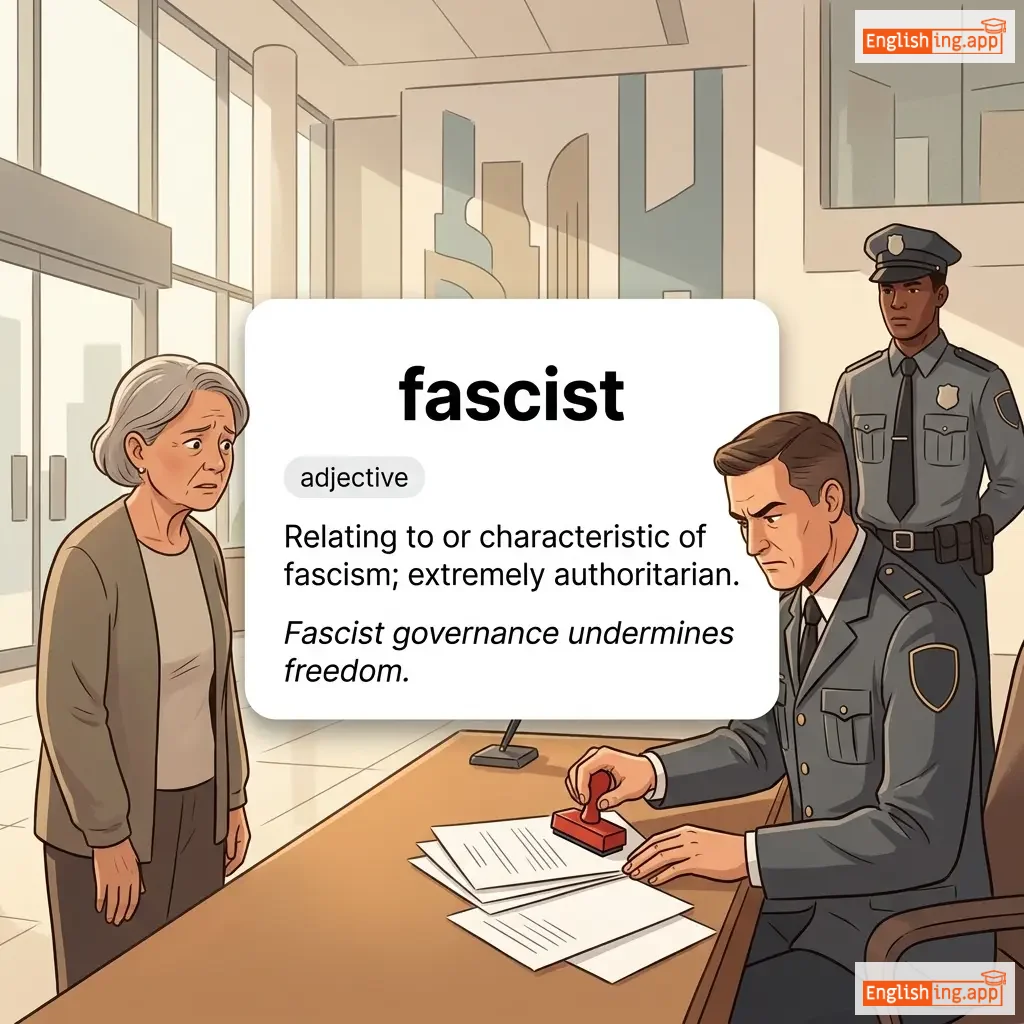
fascist definition card — visual illustration of the meaning
adjective
ˈfæʃ.ɪst
fasciste (fasciste)

Relating to or characteristic of fascism; extremely authoritarian.

"Fascist governance undermines freedom."

"Le gouvernement fasciste sape la liberté." (Le gouvernement fasciste sape la liberté.)
noun
/ˈfæʃ.ən/
mode (mode)

a popular or accepted style of clothing, behavior, or way of doing something

"She always keeps up with the latest fashion."

"Elle suit toujours la dernière mode." (Elle suit toujours la dernière mode.)
adjective
/ˈfæʃənəbəl/
à la mode (a la mode)

Following the latest styles or trends in clothing, behavior, or ideas

"She always wears fashionable clothes to every party."

"Elle porte toujours des vêtements à la mode à chaque fête." (Elle porte toujours des vetements a la mode a chaque fete.)
adjective, adverb
/fæst/
rapide, fermement fixé (rapide, fermement fixe)

moving or capable of moving at high speed; firm or securely fixed

"He drives very fast on the highway."

"Il conduit très vite sur l'autoroute." (Il conduit tres vite sur l'autoroute.)
verb
/ˈfæsən/
attacher (attacher)

To attach or secure something firmly in place

"Please fasten your seatbelt before the plane takes off."

"Veuillez attacher votre ceinture avant le décollage de l'avion." (Veuillez attacher votre ceinture avant le decollage de l'avion.)
adjective, adverb
/ˈfæstər/
plus rapide (plus rapide)

moving or able to move quickly; more quickly than usual

"This car is faster than the old one."

"Cette voiture est plus rapide que l'ancienne." (Cette voiture est plus rapide que l'ancienne.)
adjective
/ˈfæstɪst/
le plus rapide (le plus rapide)

moving or capable of moving at the highest speed

"Usain Bolt is the fastest runner in the world."

"Usain Bolt est le coureur le plus rapide du monde." (Usain Bolt est le coureur le plus rapide du monde.)
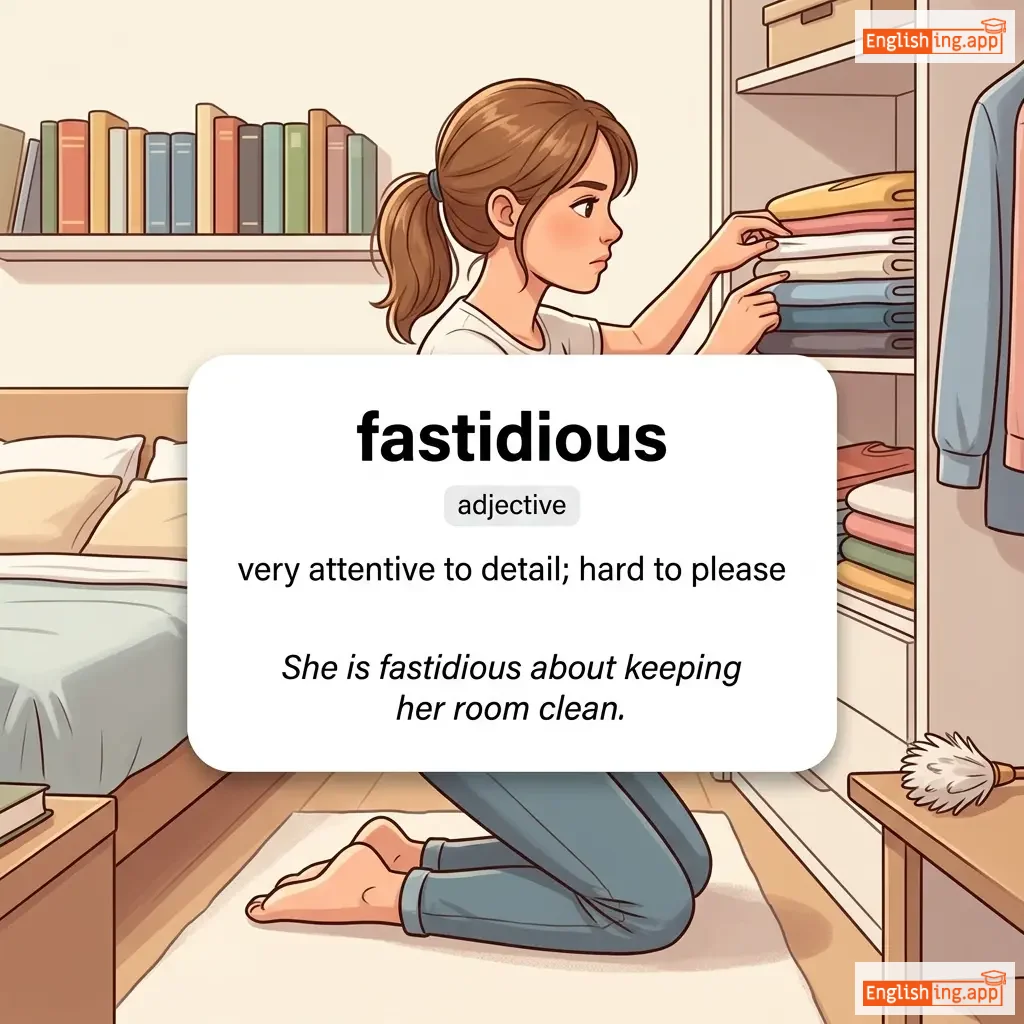
fastidious definition card — visual illustration of the meaning
adjective
/fæˈstɪdiəs/
méticuleux, exigeant (meticuleux, exigeant)

very attentive to detail; hard to please

"She is fastidious about keeping her room clean."

"Elle est méticuleuse pour garder sa chambre propre." (Elle est meticuleuse pour garder sa chambre propre.)
adjective, noun
/fæt/
gros (gros)

having a lot of excess flesh; a natural oily substance in animal bodies

"Eating too much fast food can make you fat."

"Manger trop de fast-food peut vous rendre gros." (Manger trop de fast-food peut vous rendre gros.)
adjective
/ˈfeɪtl/
fatal (fatal)

causing death; leading to disaster

"The accident proved fatal for the driver."

"L'accident a été fatal pour le conducteur." (L'accident a été fatal pour le conducteur.)
noun
/ˈfeɪ.tə.lɪ.zəm/
fatalisme (fatalisme)

the belief that all events are predetermined and inevitable

"He embraced fatalism, believing that nothing he did could change his destiny."

"Il a adopté le fatalisme, croyant que rien de ce qu'il faisait ne pouvait changer son destin." (Il a adopté le fatalisme, croyant que rien de ce qu'il faisait ne pouvait changer son destin.)
noun
/fəˈtæləti/
fatalité (fatalite)

An occurrence of death by accident, disaster, or violence.

"The accident resulted in one fatality."

"L'accident a entraîné une fatalité." (L'accident a entraine une fatalite.)
adverb
/ˈfeɪ.təl.i/
fatalement (fatalement)

in a way that causes death; with deadly consequences; critically

"The accident fatally injured two passengers."

"L'accident a blessé deux passagers de manière fatale." (L'accident a blesse deux passagers de maniere fatale.)
noun
/feɪt/
destin (destin)

the development of events beyond a person's control, regarded as determined by a supernatural power

"She believed it was her fate to become a teacher."

"Elle croyait que c'était son destin de devenir enseignante." (Elle croyait que c'était son destin de devenir enseignante.)
adjective
/ˈfeɪt.fəl/
décisif ou fatal (decisif ou fatal)

having significant or disastrous consequences

"Their fateful decision changed the course of history."

"Leur décision décisive a changé le cours de l'histoire." (Leur décision décisive a changé le cours de l'histoire.)