Vocabulaires

Découvrez, apprenez et maîtrisez le vocabulaire anglais

noun, verb
/fɔːrd/
gué (gue)

A shallow place in a river where one can cross; to cross a river at such a place.

"The travelers decided to ford the river at dawn."

"Les voyageurs ont décidé de traverser la rivière par un gué à l'aube." (Les voyageurs ont décidé de traverser la rivière par un gué à l'aube.)
noun
/ˈfɔːrˌbɛər/
ancêtre (ancetre)

An ancestor, especially one who lived a long time ago.

"He often speaks of his forebears with great respect."

"Il parle souvent de ses ancêtres avec beaucoup de respect." (Il parle souvent de ses ancêtres avec beaucoup de respect.)
noun
/ˈfɔːrˌbɛərz/
ancêtres (ancetres)

Ancestors or people in previous generations from whom one is descended.

"We must honor the traditions of our forebears."

"Nous devons honorer les traditions de nos ancêtres." (Nous devons honorer les traditions de nos ancetres.)
verb
/fɔːrˈboʊd/
présager (presager)

To predict or have a strong inner feeling of a future misfortune or evil.

"Dark clouds forebode a coming storm."

"Les nuages sombres présagent une tempête à venir." (Les nuages sombres presagent une tempete a venir.)
noun/adjective
/fɔːrˈboʊdɪŋ/
présage inquiétant (presage inquietetant)

A feeling that something bad will happen; ominous.

"She felt a deep sense of foreboding as she entered the abandoned house."

"Elle ressentit une profonde sensation de présage inquiétant en entrant dans la maison abandonnée." (Elle ressentit une profonde sensation de presage inquietant en entrant dans la maison abandonnee.)
noun/verb
/ˈfɔːrkæst/
prévision (prevision)

To predict future events, especially weather or economic trends.

"The weather office forecast heavy rain for tomorrow."

"Le bureau météorologique a prédit une forte pluie pour demain." (Le bureau météorologique a prédit une forte pluie pour demain.)
noun
/ˈfoʊksl/
forecastle (forecastle)

The forward part of a ship below the deck, traditionally used as living quarters for the crew.

"The sailors gathered in the forecastle after their shift."

"Les marins se sont rassemblés dans le forecastle après leur quart." (Les marins se sont rassemblés dans le forecastle après leur quart.)
verb
/fɔːrˈkloʊz/
saisir (saisir)

to take possession of a property due to the owner's failure to keep up mortgage payments

"The bank decided to foreclose on the property after months of missed payments."

"La banque a décidé de saisir la propriété après plusieurs mois de paiements manqués." (La banque a décidé de saisir la propriété après plusieurs mois de paiements manqués.)
noun
/fɔːrˈkloʊʒər/
saisie immobilière (saisie immobilière)

The legal process by which a lender takes control of a property from a borrower who has failed to make payments.

"The family lost their home due to foreclosure after missing several mortgage payments."

"La famille a perdu sa maison à cause de la saisie immobilière après avoir manqué plusieurs paiements hypothécaires." (La famille a perdu sa maison à cause de la saisie immobilière après avoir manqué plusieurs paiements hypothécaires.)
noun
/ˈfɔːrkɔːrt/
cour (cour)

an open area in front of a large building, especially a petrol station or hotel

"The car was parked in the hotel forecourt."

"La voiture était garée dans la cour de l'hôtel." (La voiture etait garee dans la cour de l'hotel.)
noun
/ˈfɔːrˌfɑːðər/
ancêtre (ancetre)

an ancestor, especially one who was part of an earlier generation of a family or nation

"Our forefathers fought for independence."

"Nos ancêtres ont lutté pour l'indépendance." (Nos ancetres ont lutte pour l'independance.)
verb
/fɔːrˈɡoʊ/
renoncer (renoncer)

to decide not to do or have something pleasant or valuable

"She decided to forego dessert to maintain her diet."

"Elle a décidé de renoncer au dessert pour maintenir son régime." (Elle a décidé de renoncer au dessert pour maintenir son régime.)
noun
/ˈfɔːrɡraʊnd/
premier plan (premier plan)

the part of a scene that is nearest to and in front of the viewer

"The flowers in the foreground brightened the picture."

"Les fleurs au premier plan ont illuminé l'image." (Les fleurs au premier plan ont illuminé l'image.)
noun
/ˈfɔːrˌhɛd/ or /ˈfɔːrɪd/
front (front)

The part of the face above the eyebrows.

"She wiped the sweat from her forehead."

"Elle a essuyé la sueur de son front." (Elle a essuyé la sueur de son front.)
adjective
/ˈfɔːrən/ or /ˈfɑːrən/
étranger (etranger)

Belonging to or coming from another country.

"She loves studying foreign languages."

"Elle adore étudier les langues étrangères." (Elle adore etudier les langues etrangères.)
noun
/ˈfɔːrənər/ or /ˈfɑːrənər/
étranger (etranger)

A person from another country.

"The city welcomes every foreigner with kindness."

"La ville accueille chaque étranger avec gentillesse." (La ville accueille chaque étranger avec gentillesse.)
verb
/fɔːrˈdʒʌdʒ/
juger à l'avance (juger a l'avance)

To judge beforehand without adequate information.

"It is unfair to forejudge someone without knowing the facts."

"Il est injuste de juger quelqu'un sans connaître les faits." (Il est injuste de juger quelqu'un sans connaître les faits.)
noun
/ˈfɔːrˌnɑːlɪdʒ/
prémonition (pre-moni-syon)

Awareness of something before it happens or exists.

"The prophet claimed to have foreknowledge of the event."

"Le prophète a affirmé avoir la prémonition de l'événement." (Le prophète a affirmé avoir la prémonition de l'événement.)
noun
/ˈfɔːrmən/
personne en charge d'un groupe de travailleurs, en particulier dans une usine ou sur un chantier (personne en charge d'un groupe de travailleurs, en particulier dans une usine ou sur un chantier)

a person in charge of a group of workers, especially in a factory or construction site

"The foreman supervised the workers on the construction site."

"Le chef de chantier a supervisé les ouvriers sur le site de construction." (Le chef de chantier a supervisé les ouvriers sur le site de construction.)
adjective
/ˈfɔːrmoʊst/
principal (principal)

most important; leading; first in rank or position

"She is one of the foremost experts in the field."

"Elle est l'une des expertes les plus importantes dans le domaine." (Elle est l'une des expertes les plus importantes dans le domaine.)
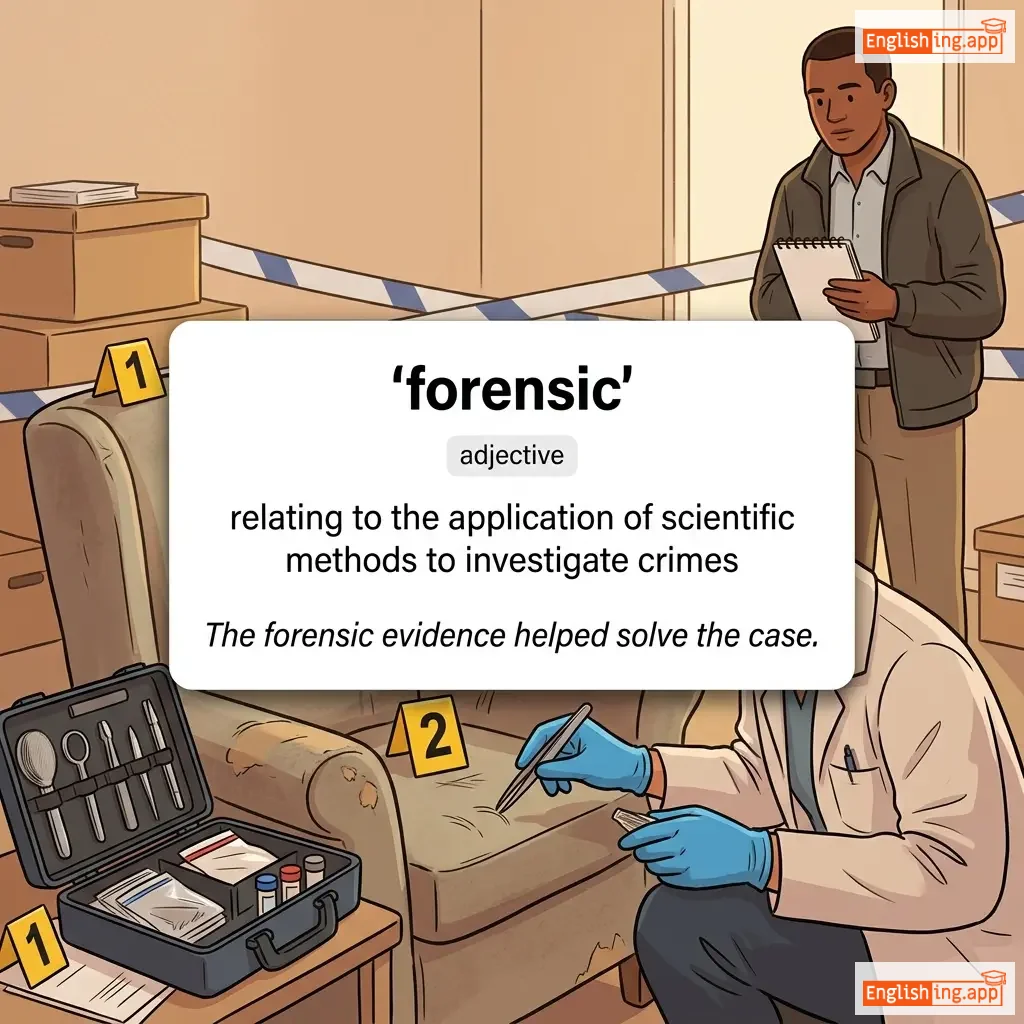
forensic definition card — visual illustration of the meaning
adjective
/fəˈrɛnsɪk/
criminel (criminel)

relating to the application of scientific methods to investigate crimes

"The forensic evidence helped solve the case."

"Les preuves criminelles ont aidé à résoudre l'affaire." (Les preuves criminelles ont aide a resoudre l'affaire.)
verb
/ˌfɔːrɔːrˈdeɪn/
prédestiner (predestiner)

to determine or decree something in advance; to predestine

"Some believe that our lives are foreordained by fate."

"Certains croient que nos vies sont prédestinées par le destin." (Certains croient que nos vies sont prédestinées par le destin.)
noun
/ˌfɔːrɔːrdɪˈneɪʃən/
prédestination (predestination)

the act of determining something in advance; predestination

"The doctrine of foreordination suggests that events are fixed by divine will."

"La doctrine de la prédestination suggère que les événements sont fixés par la volonté divine." (La doctrine de la predestination suggere que les evenements sont fixes par la volonte divine.)
noun
/ˈfɔːrˌpiːk/
avant du navire (avant du navire)

The compartment in the forward part of a ship, often used for storage.

"The sailors stored extra ropes in the forepeak."

"Les marins ont rangé des cordes supplémentaires dans l'avant du navire." (Les marins ont rangé des cordes supplémentaires dans l'avant du navire.)
🏃‍♂️

forerun (foreran)

verb
/ˌfɔːrˈrʌn/
précéder (preceder)

To go before; to precede in time, place, or action.

"Dark clouds often forerun a storm."

"Les nuages sombres annoncent souvent une tempête." (Les nuages sombres annoncent souvent une tempête.)
noun
/ˈfɔːrˌrʌnər/
précurseur (precurseur)

A person or thing that comes before another; a predecessor or harbinger.

"The Wright brothers were the forerunners of modern aviation."

"Les frères Wright étaient les précurseurs de l'aviation moderne." (Les frères Wright étaient les précurseurs de l'aviation moderne.)
noun
/ˈfɔːrˌseɪl/
voile de proue (voile de proue)

The principal sail set on the foremast of a sailing vessel.

"The crew adjusted the foresail to catch the wind."

"L'équipage a ajusté la voile de proue pour attraper le vent." (L'equipage a ajuste la voile de proue pour attraper le vent.)
verb
/fɔːrˈsiː/
prévoir (prevoir)

To be aware of beforehand; to predict or expect.

"She could foresee the challenges ahead."

"Elle pouvait prévoir les défis à venir." (Elle pouvait prévoir les défis à venir.)
adjective
/fɔːrˈsiːəbl/
prévisible (previsible)

Able to be predicted or expected in advance

"The company is unlikely to make changes in the foreseeable future."

"Il est peu probable que l'entreprise apporte des changements dans un avenir prévisible." (Il est peu probable que l'entreprise apporte des changements dans un avenir prévisible.)
verb
/fɔːrˈʃædoʊ/
présager (presager)

To indicate or suggest something that will happen in the future

"Dark clouds foreshadowed an approaching storm."

"Les nuages sombres ont présagé une tempête imminente." (Les nuages sombres ont présagé une tempête imminente.)
noun
/ˈfɔːrʃɔːr/
rivage (rivage)

The part of the shore between the high and low tide marks

"Children were playing on the foreshore, collecting shells."

"Les enfants jouaient sur le rivage, ramassant des coquillages." (Les enfants jouaient sur le rivage, ramassant des coquillages.)
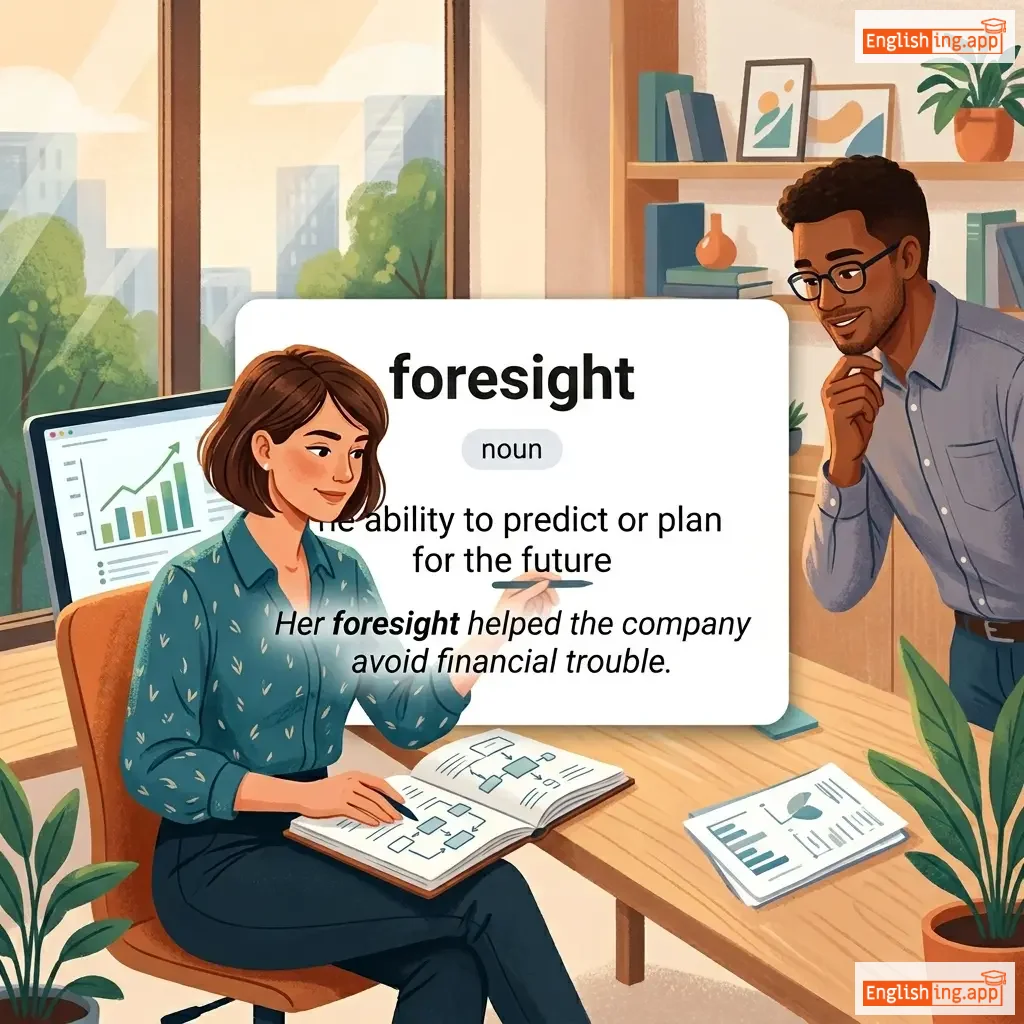
foresight definition card — visual illustration of the meaning
noun
/ˈfɔːrsaɪt/
prévoyance (prevoyance)

The ability to predict or plan for the future

"Her foresight helped the company avoid financial trouble."

"Sa prévoyance a aidé l'entreprise à éviter des problèmes financiers." (Sa prevoyance a aide l'entreprise a eviter des problemes financiers.)
noun
/ˈfɔːrɪst/
forêt (foret)

A large area covered chiefly with trees and undergrowth.

"They went hiking in the forest."

"Ils sont allés faire de la randonnée dans la forêt." (Ils sont alles faire de la randonnee dans la foret.)
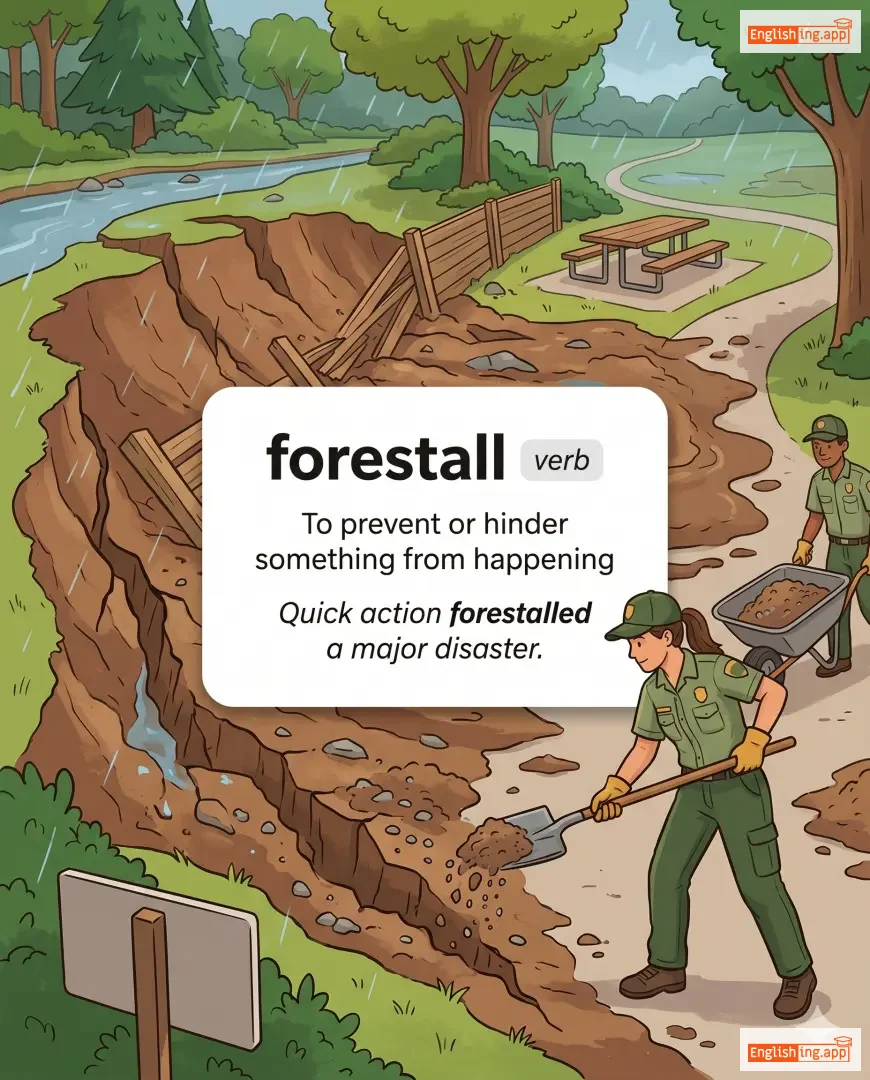
forestall definition card — visual illustration of the meaning
verb
/fɔːrˈstɔːl/
empêcher (empêcher)

To prevent or hinder something from happening

"Quick action forestalled a major disaster."

"Une action rapide a empêché un grand désastre." (Une action rapide a empêché un grand désastre.)
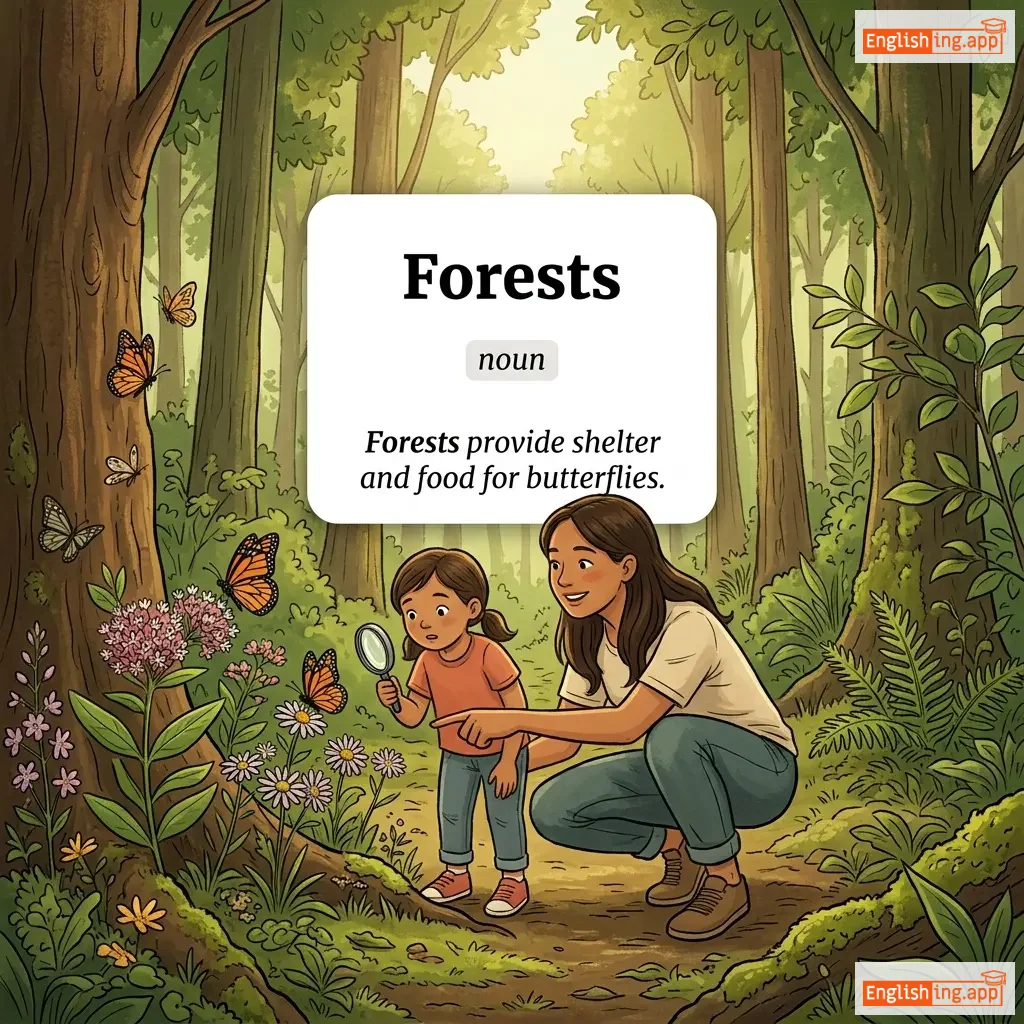
Forests definition card — visual illustration of the meaning
noun
ˈfɔːrɪsts
forêts (foret)

Large areas covered with trees and undergrowth, providing natural habitats for wildlife.

"Forests provide shelter and food for butterflies."

"Les forêts fournissent un abri et de la nourriture pour les papillons." (Les forets fournissent un abri et de la nourriture pour les papillons.)
verb
/fɔːrˈtɛl/
prédire (predire)

to predict or announce something before it happens

"The old man claimed he could foretell the future."

"L'homme âgé a affirmé qu'il pouvait prédire l'avenir." (L'homme âgé a affirmé qu'il pouvait prédire l'avenir.)
noun
/ˈfɔːrˌθɔːt/
prévoyance (prevoyance)

careful consideration of what will be necessary or may happen in the future

"With a little forethought, we could have avoided the problem."

"Avec un peu de prévoyance, nous aurions pu éviter le problème." (Avec un peu de prevoyance, nous aurions pu eviter le probleme.)
adverb
/fɔːrˈɛvər/
pour toujours (pour toujours)

For all future time; for always.

"She promised to love him forever."

"Elle a promis de l'aimer pour toujours." (Elle a promis de l'aimer pour toujours.)
noun
/ˈfɔːrwɜːrd/
préface (preface)

a short introduction at the beginning of a book, typically written by someone other than the author

"The foreword of the book was written by a famous historian."

"La préface du livre a été écrite par un historien célèbre." (La preface du livre a été écrite par un historien célèbre.)
verb
/ˈfɔːrfɪt/
perdre, renoncer comme pénalité (perdre, renoncer comme penalite)

to lose or give up something, usually as a penalty for wrongdoing

"He had to forfeit the match after breaking the rules."

"Il a dû abandonner le match après avoir enfreint les règles." (Il a dû abandonner le match après avoir enfreint les règles.)
verb
/fɔːrˈfɛnd/
protéger, défendre, prévenir (protéger, défendre, prévenir)

to protect or defend against something undesirable; to prevent

"May good fortune forfend any danger from our journey."

"Que la bonne fortune protège contre tout danger durant notre voyage." (Que la bonne fortune protège contre tout danger durant notre voyage.)
verb
/fɔːrdʒ/
forger, falsifier (forger, falsifier)

to create or shape something, often with effort or skill; also to counterfeit or fake something

"The blacksmith forged a strong sword from the iron."

"Le forgeron a forgé une épée solide à partir du fer." (Le forgeron a forgé une épée solide à partir du fer.)
noun
/ˈfɔːrdʒər/
falsificateur (falsificateur)

a person who makes fake documents, artworks, or signatures

"The police arrested a forger who had been selling counterfeit paintings."

"La police a arrêté un falsificateur qui vendait des peintures contrefaites." (La police a arrêté un falsificateur qui vendait des peintures contrefaites.)
noun
/ˈfɔːrdʒəri/
falsification (falsification)

the crime of making fake documents, money, or artworks

"The bank detected a forgery in the signature on the cheque."

"La banque a détecté une falsification dans la signature sur le chèque." (La banque a détecté une falsification dans la signature sur le chèque.)
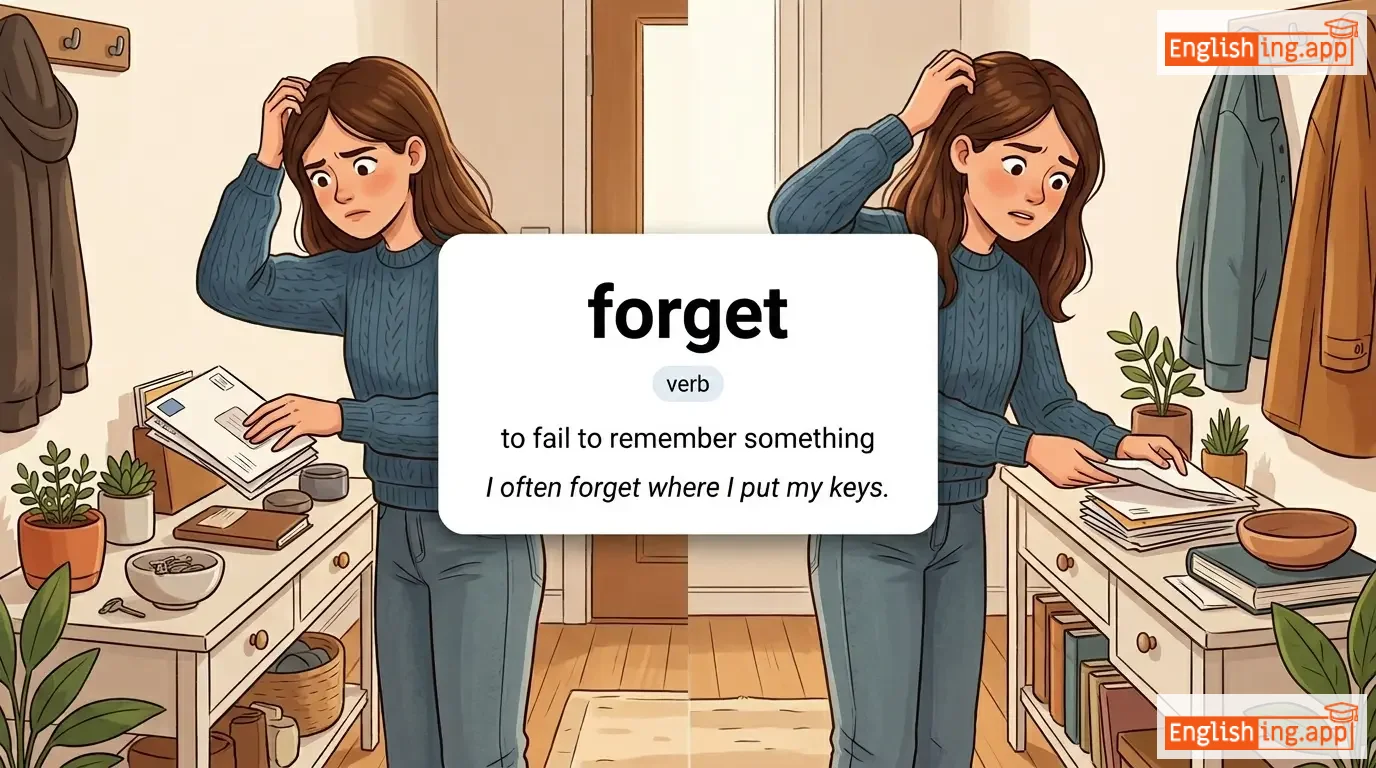
forget definition card — visual illustration of the meaning
verb
/fəˈɡɛt/
oublier (oublier)

to fail to remember something

"I often forget where I put my keys."

"J'oublie souvent où j'ai mis mes clés." (J'oublie souvent où j'ai mis mes clés.)
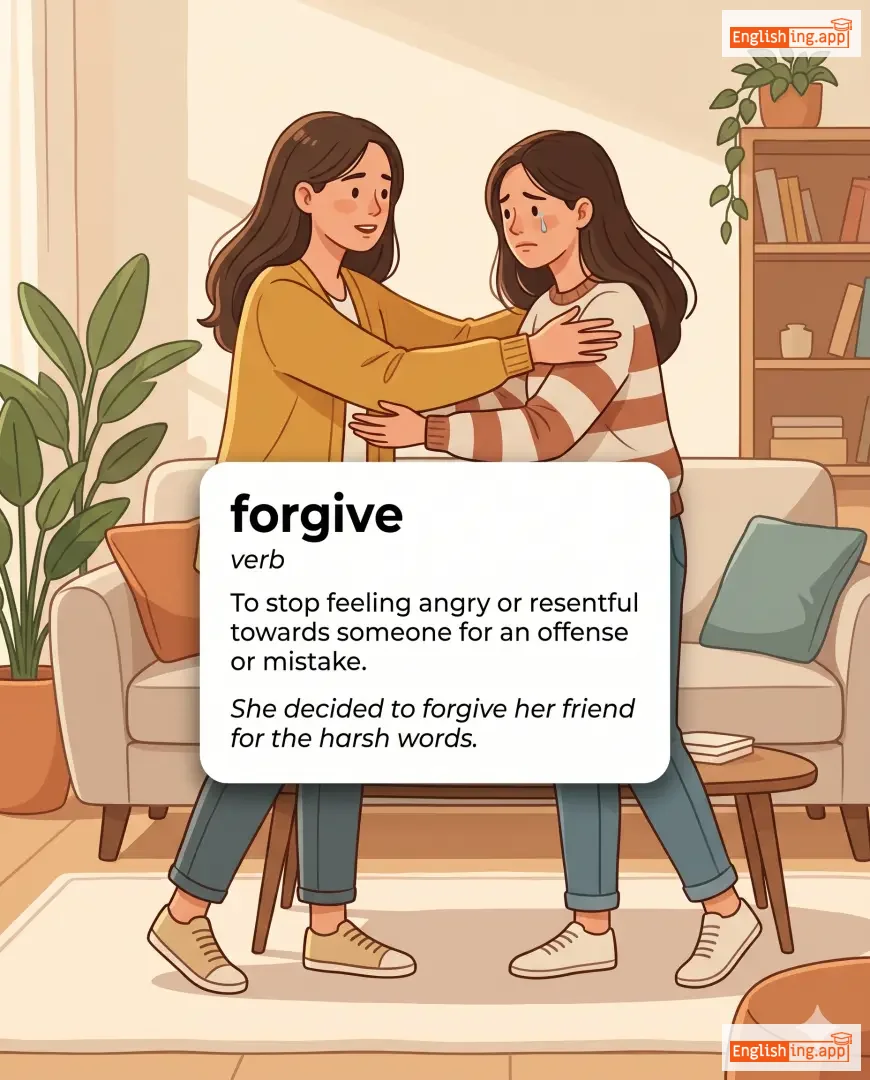
forgive definition card — visual illustration of the meaning
verb
/fərˈɡɪv/
pardonner (pardonner)

To stop feeling angry or resentful towards someone for an offense or mistake.

"She decided to forgive her friend for the harsh words."

"Elle a décidé de pardonner son ami pour ses paroles dures." (Elle a décidé de pardonner son ami pour ses paroles dures.)
adjective
/fəˈɡɪv.ɪŋ/
pardonneur (pardonneur)

ready and willing to forgive; merciful; lenient

"She has a forgiving nature and rarely holds grudges."

"Elle a une nature pardonneuse et garde rarement des rancunes." (Elle a une nature pardonneuse et garde rarement des rancunes.)
verb
/fɔːrˈɡoʊ/
renoncer (renoncer)

to decide not to do or have something

"She decided to forgo dessert to maintain her diet."

"Elle a décidé de renoncer au dessert pour maintenir son régime." (Elle a décidé de renoncer au dessert pour maintenir son régime.)
noun
/fɔːk/
fourchette (fourchette)

a tool with two or more prongs used for eating or serving food

"He ate his salad with a fork."

"Il a mangé sa salade avec une fourchette." (Il a mangé sa salade avec une fourchette.)
adjective
/fərˈlɔːrn/
désespéré, triste (desespéré, triste)

extremely sad, lonely, or abandoned

"The abandoned puppy looked so forlorn in the rain."

"Le chiot abandonné avait l'air si triste sous la pluie." (Le chiot abandonné avait l'air si triste sous la pluie.)