Vocabulaires

Découvrez, apprenez et maîtrisez le vocabulaire anglais

noun
/ˈkɒnfɪdænt/
confident (confident)

A person with whom one shares a secret or private matter, trusting them not to repeat it.

"She found a true confidant in her childhood friend."

"Elle a trouvé un vrai confident dans son ami d'enfance." (Elle a trouvé un vrai confident dans son ami d'enfance.)
noun
/ˌkɒnfɪˈdɑːnt/
amie de confiance (amie de confiance)

A woman with whom one shares a secret or private matter, trusting her not to repeat it.

"The queen’s maid became her most trusted confidante."

"La servante de la reine est devenue sa confidente la plus fidèle." (La servante de la reine est devenue sa confidente la plus fidèle.)
verb
/kənˈfaɪd/
confier (konfier)

To tell someone about a secret or private matter while trusting them not to repeat it.

"He confided his worries to his best friend."

"Il a confié ses préoccupations à son meilleur ami." (Il a confié ses préoccupations à son meilleur ami.)
noun
/ˈkɒnfɪdəns/
confiance (confiance)

The feeling or belief that one can rely on someone or something; firm trust or self-assurance.

"She spoke with great confidence during the meeting."

"Elle a parlé avec une grande confiance lors de la réunion." (Elle a parlé avec une grande confiance lors de la réunion.)
adjective
/ˈkɒnfɪdənt/
confiant (confiant)

feeling or showing certainty about something; having self-assurance

"She was confident about her ability to succeed."

"Elle était confiante quant à sa capacité à réussir." (Elle était confiante quant à sa capacité à réussir.)
adjective
/ˌkɒnfɪˈdɛnʃl/
confidentiel (confidentiel)

intended to be kept secret or private

"The lawyer shared confidential documents with her client."

"L'avocat a partagé des documents confidentiels avec son client." (L'avocat a partagé des documents confidentiels avec son client.)
confidentiality definition card — visual illustration of the meaning
noun
ˌkɒn.fɪ.den.ʃiˈæl.ɪ.ti
confidentialité (konfi-den-syal-ite)

The state of keeping or being kept secret or private

"Confidentiality is crucial in data security."

"La confidentialité est cruciale dans la sécurité des données." (La confidentialité est cruciale dans la sécurité des données.)
adverb
/ˌkɒnfɪˈdenʃəli/
confidentiellement (confidentiellement)

in a confidential manner; secretly; privately

"The information was shared confidentially between the two managers."

"L'information a été partagée confidentiellement entre les deux gestionnaires." (L'information a ete partagee confidentiellement entre les deux gestionnaires.)
noun
/kənˌfɪɡəˈreɪʃən/
configuration (configuration)

an arrangement of parts or elements in a particular form or structure

"The configuration of the system needs to be adjusted for better performance."

"La configuration du système doit être ajustée pour une meilleure performance." (La configuration du système doit être ajustée pour une meilleure performance.)
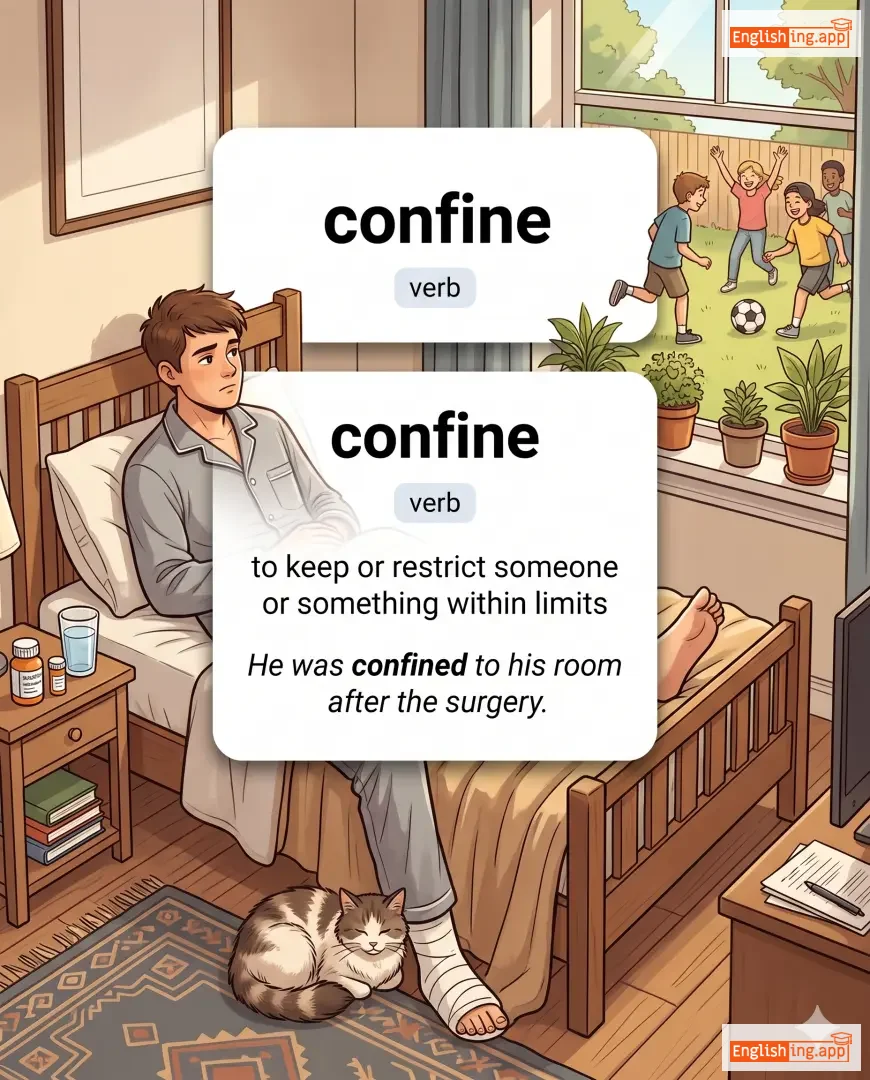
confine definition card — visual illustration of the meaning
verb
/kənˈfaɪn/
confiné (confiné)

to keep or restrict someone or something within limits

"He was confined to his room after the surgery."

"Il a été confiné dans sa chambre après la chirurgie." (Il a été confiné dans sa chambre après la chirurgie.)
noun
/kənˈfaɪnmənt/
confinement (confinement)

the state of being confined or restricted

"The prisoner endured years of confinement."

"Le prisonnier a enduré des années de confinement." (Le prisonnier a enduré des années de confinement.)
verb
/kənˈfɜːrm/
confirmer (confirmer)

to establish the truth, accuracy, or validity of something

"The hotel will confirm your reservation by email."

"L'hôtel confirmera votre réservation par e-mail." (L'hôtel confirmera votre réservation par e-mail.)
noun
/kənˌfɜːˈmeɪʃən/
confirmation (confirmation)

the action of confirming something or the state of being confirmed

"She received a confirmation email for her appointment."

"Elle a reçu un e-mail de confirmation pour son rendez-vous." (Elle a reçu un e-mail de confirmation pour son rendez-vous.)
verb
/ˈkɒnfɪskeɪt/
confisquer (kon-fis-ker)

to take something away officially, often as a punishment

"The teacher confiscated the student's phone during class."

"Le professeur a confisqué le téléphone de l'élève pendant le cours." (Le pro-fes-seur a kon-fis-ké le té-lé-pho-ne de l'é-lè-ve pen-dant le cours.)
noun
/ˌkɒnfləˈɡreɪʃən/
faute d'orthographe (de 'conflagration') (faute d'orthographe (de 'conflagration'))

This is a common misspelling of 'conflagration', which means a large, destructive fire.

"The term 'conflagaration' is often incorrectly used instead of 'conflagration'."

"Le terme 'conflagaration' est souvent utilisé à tort à la place de 'conflagration'." (Le terme 'conflagaration' est souvent utilisé à tort à la place de 'conflagration'.)
noun
/ˌkɒnfləˈɡreɪʃən/
grand incendie destructeur (grand incendie destructeur)

A large, destructive fire that destroys a great deal of land or property.

"The forest was devastated by a massive conflagration that lasted for days."

"La forêt a été dévastée par un énorme incendie qui a duré plusieurs jours." (La forêt a été dévastée par un énorme incendie qui a duré plusieurs jours.)
verb
/kənˈfleɪt/
fusionner / combiner (fusionner / combiner)

To combine two or more things, often confusingly, into one.

"The article tends to conflate facts with opinions."

"L'article a tendance à fusionner les faits avec les opinions." (L'article a tendance à fusionner les faits avec les opinions.)
noun
/ˈkɒnflɪkt/
conflit (conflit)

A serious disagreement or argument, often a prolonged one.

"The two countries are trying to resolve the conflict through negotiations."

"Les deux pays essaient de résoudre le conflit par des négociations." (Les deux pays essaient de résoudre le conflit par des négociations.)
conflict resolution definition card — visual illustration of the meaning
noun
/ˈkɒn.flɪkt ˌrez.əˈluː.ʃən/
résolution de conflits (resolution de conflits)

The process of finding peaceful solutions to disputes or disagreements between parties.

"Conflict resolution is vital for global peace."

"La résolution des conflits est essentielle pour la paix mondiale." (La resolution des conflits est essentielle pour la paix mondiale.)
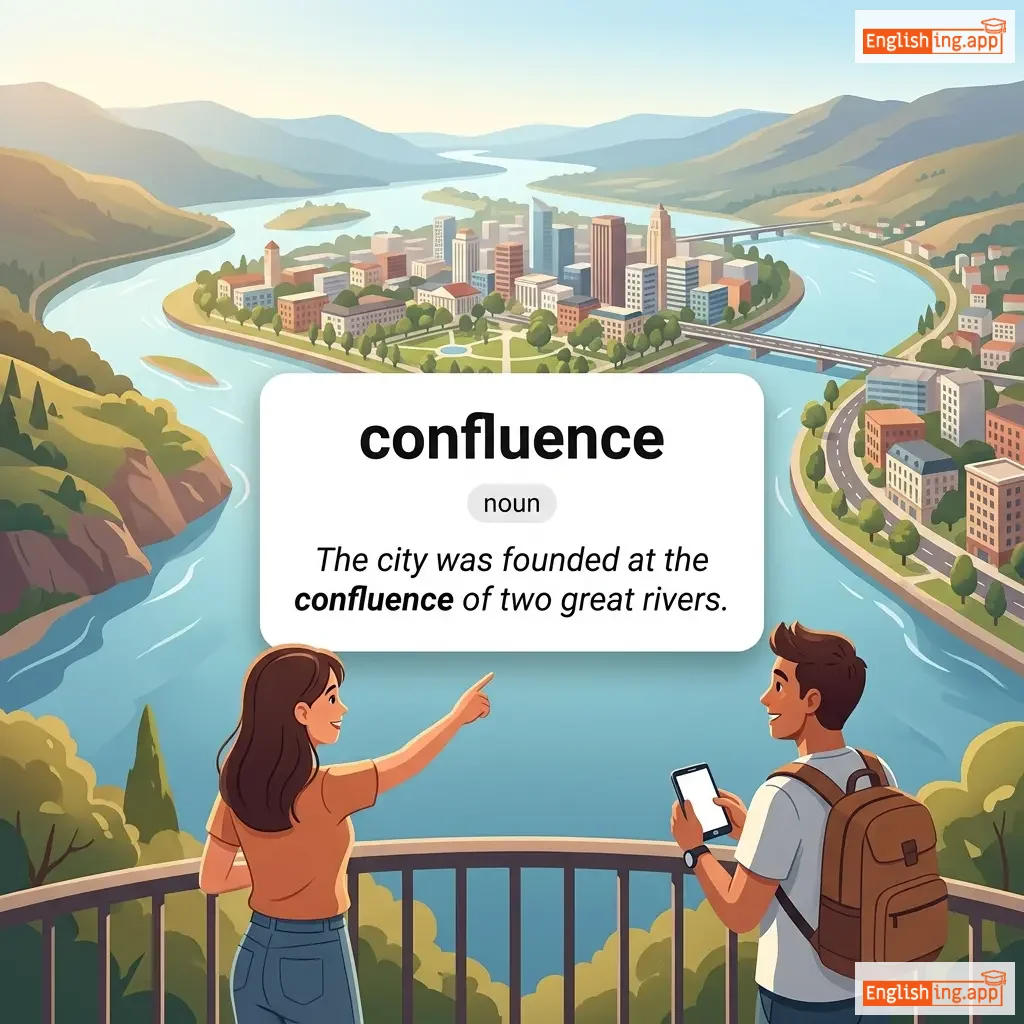
confluence definition card — visual illustration of the meaning
noun
/ˈkɒnfluəns/
confluence (konfluas)

The junction of two rivers; also a situation where people or things come together.

"The city was founded at the confluence of two great rivers."

"La ville a été fondée à la confluence de deux grands fleuves." (La ville a ete fondee a la confluence de deux grands fleuves.)
adjective
/ˈkɒnfluənt/
confluant (confluant)

Flowing together or merging; coming together at one point.

"The confluent streams formed a mighty river."

"Les ruisseaux confluent pour former une grande rivière." (Les ruisseaux confluent pour former une grande rivière.)
verb
/kənˈfɔːrm/
se conformer (se conformer)

To comply with rules, standards, or laws.

"Students must conform to the school regulations."

"Les étudiants doivent se conformer aux règlements scolaires." (Les étudiants doivent se conformer aux règlements scolaires.)
adjective
/kənˈfɔːrməbl/
conforme (conforme)

Capable of being adapted or consistent with something; compliant.

"His actions were conformable to the rules of the institution."

"Ses actions étaient conformes aux règles de l'institution." (ses actions étaient conformes aux règles de l'institution.)
noun
/kənˈfɔːrməns/
conformité (conformite)

The act of conforming to a rule, standard, or law.

"The product was tested for conformance with safety standards."

"Le produit a été testé pour sa conformité aux normes de sécurité." (Le produit a été testé pour sa conformité aux normes de sécurité.)
noun
/ˌkɑːnfɔːrˈmeɪʃən/
conformation (conformation)

The shape, structure, or arrangement of something.

"The scientist studied the molecular conformation of the protein."

"Le scientifique a étudié la conformation moléculaire de la protéine." (Le scientifique a etudie la conformation moleculaire de la proteine.)
noun
/kənˈfɔːrmɪst/
conformiste (conformiste)

A person who uncritically conforms to established practices or standards.

"She was labeled a conformist for always following the crowd."

"Elle a été étiquetée comme conformiste pour avoir toujours suivi la foule." (Elle a été étiquetée comme conformiste pour avoir toujours suivi la foule.)
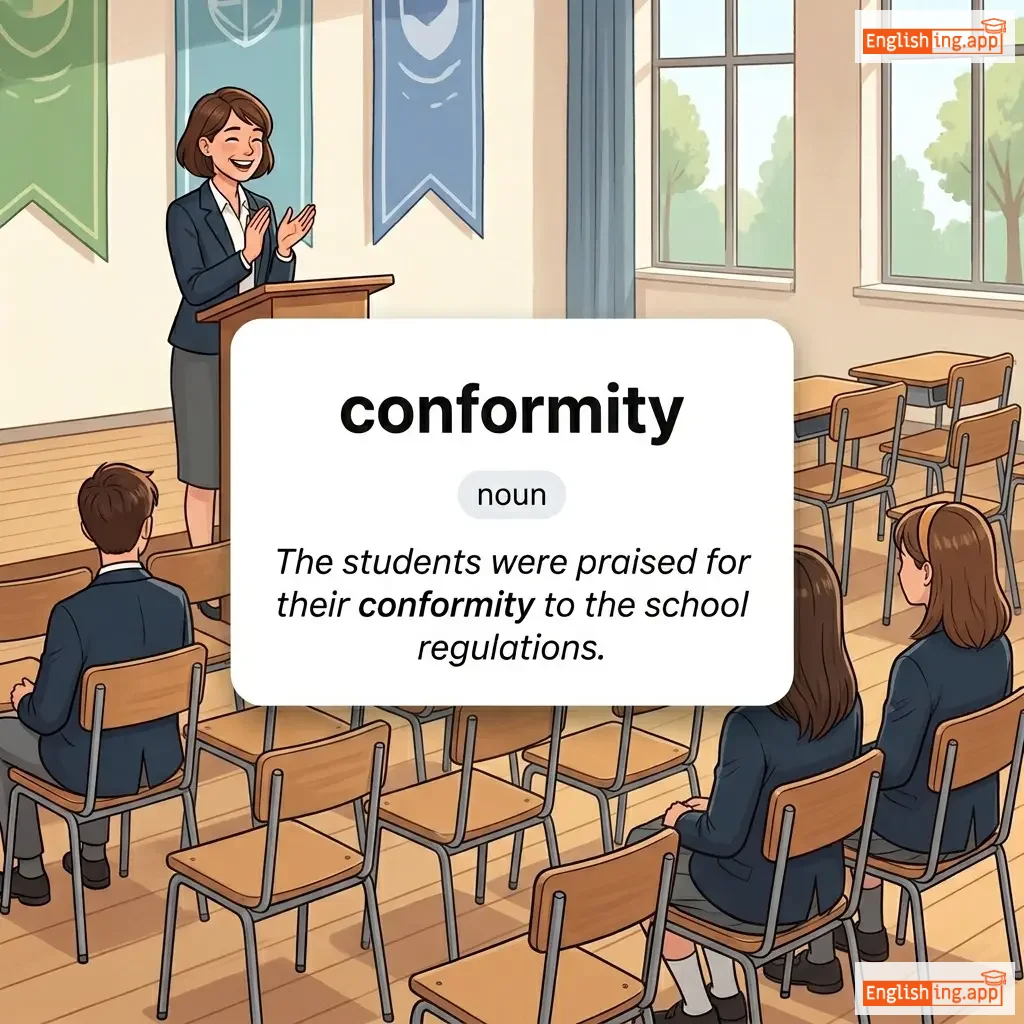
conformity definition card — visual illustration of the meaning
noun
/kənˈfɔːrməti/
conformité (conformite)

Compliance with standards, rules, or laws; behavior in accordance with social norms.

"The students were praised for their conformity to the school regulations."

"Les étudiants ont été félicités pour leur conformité aux règlements de l'école." (Les étudiants ont été félicités pour leur conformité aux règlements de l'école.)
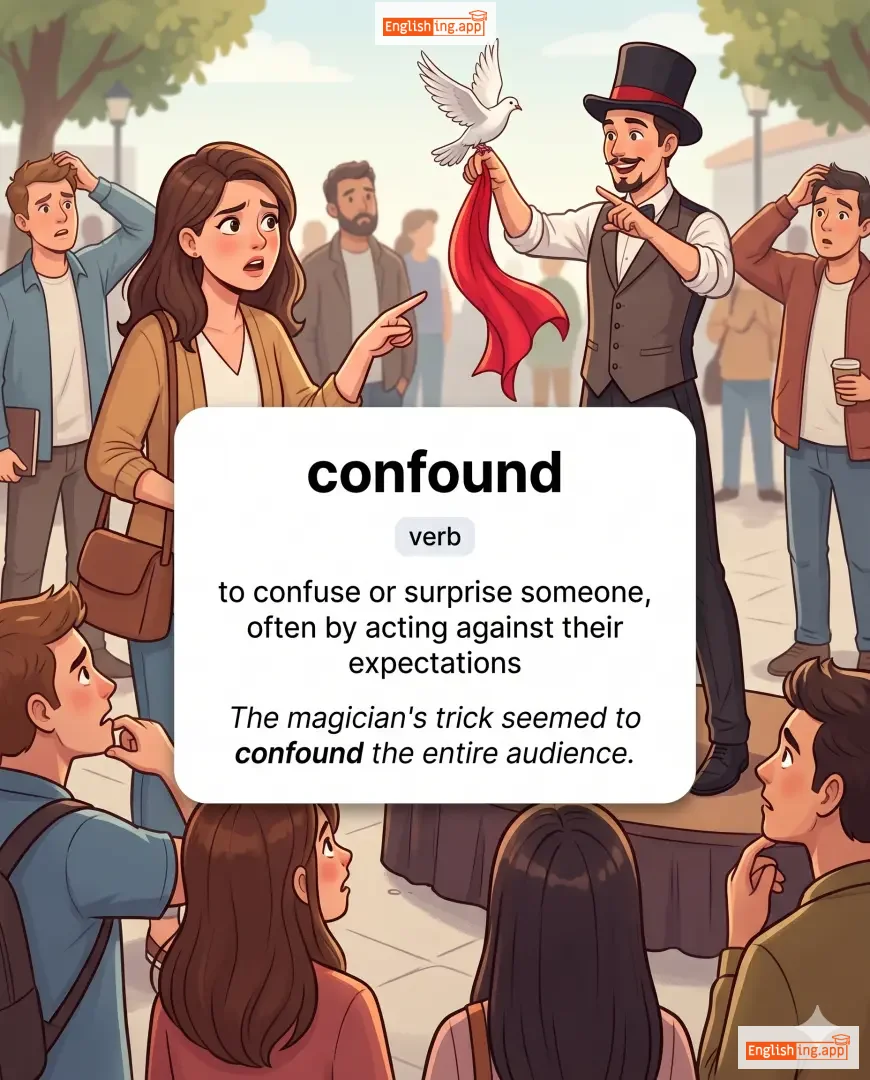
confound definition card — visual illustration of the meaning
verb
/kənˈfaʊnd/
déconcerter (deconcerter)

to confuse or surprise someone, often by acting against their expectations

"The magician's trick seemed to confound the entire audience."

"Le tour du magicien semblait déconcerter tout le public." (Le tour du magicien semblait déconcerter tout le public.)
verb
/kənˈfrʌnt/
confronter (confronter)

to face someone or something directly, especially in a challenge or conflict

"She had to confront her fears before making the speech."

"Elle a dû confronter ses peurs avant de faire son discours." (Elle a dû confronter ses peurs avant de faire son discours.)
noun
/ˌkɒnfrʌnˈteɪʃən/
confrontation (confrontation)

A hostile or argumentative meeting or situation between opposing parties.

"The protest led to a confrontation with the police."

"La manifestation a conduit à une confrontation avec la police." (La manifestation a conduit à une confrontation avec la police.)
verb
/kənˈfjuːz/
confondre (kɔ̃fɔ̃dr)

To make someone unable to think clearly; to bewilder.

"The complex instructions confused the students."

"Les instructions complexes ont dérouté les étudiants." (Les instructions complexes ont dérouté les étudiants.)
adjective
/kənˈfjuːzd/
confus (confus)

unable to think clearly; uncertain or puzzled

"She felt confused by the complicated instructions."

"Elle se sentait confuse à cause des instructions compliquées." (elle se sentait confuse a cause des instructions compliquees)
adjective
/kənˈfjuːzɪŋ/
déroutant (deroutant)

causing someone to be unable to think clearly or understand; difficult to comprehend

"The instructions were confusing and hard to follow."

"Les instructions étaient déroutantes et difficiles à suivre." (Les instructions etaient deroutantes et difficiles a suivre)
noun
/kənˈfjuːʒən/
confusion (confusion)

a state of being bewildered or unclear in one’s mind

"The sudden change in schedule caused a lot of confusion."

"Le changement soudain d'horaire a causé beaucoup de confusion." (Le changement soudain d'horaire a causé beaucoup de confusion.)
verb
/kənˈdʒiːl/
congeler (congeler)

to become thick or solid, especially from cooling

"The soup began to congeal after being left on the table."

"La soupe a commencé à se congeler après avoir été laissée sur la table." (La soupe a commence a se congeler apres avoir ete laissée sur la table.)
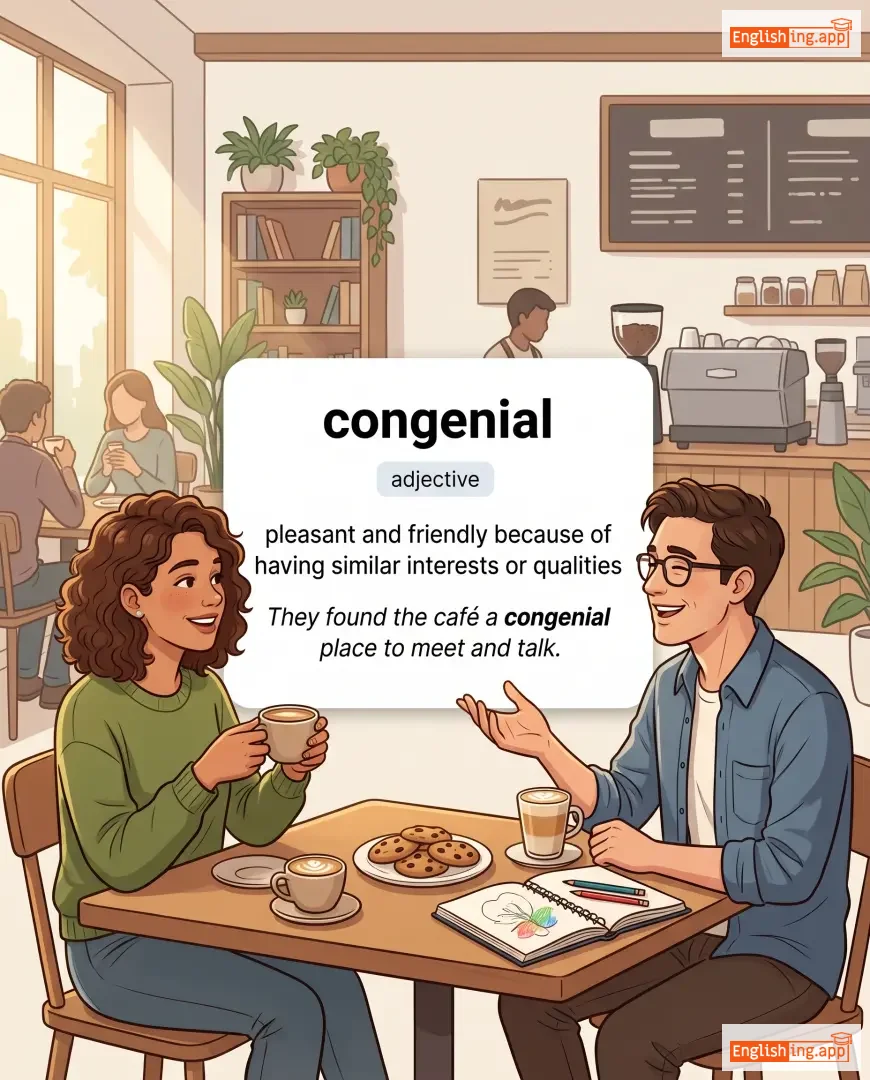
congenial definition card — visual illustration of the meaning
adjective
/kənˈdʒiːniəl/
chaleureux (chaleureux)

pleasant and friendly because of having similar interests or qualities

"They found the café a congenial place to meet and talk."

"Ils ont trouvé le café un endroit chaleureux pour se rencontrer et discuter." (Ils ont trouve le cafe un endroit chaleureux pour se rencontrer et discuter.)
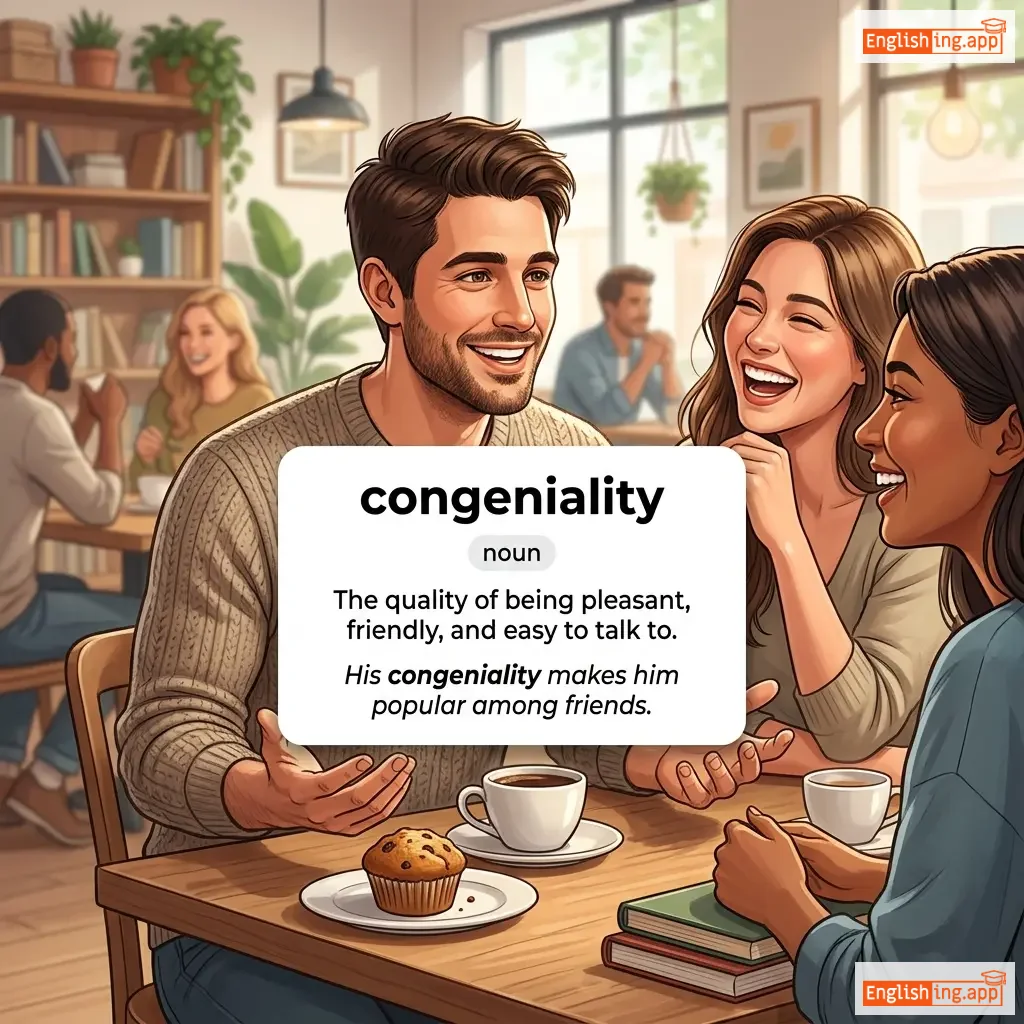
congeniality definition card — visual illustration of the meaning
noun
/kənˌdʒiː.niˈæl.ə.t̬i/
affabilité (affabilité)

The quality of being pleasant, friendly, and easy to talk to.

"His congeniality makes him popular among friends."

"Son affabilité le rend populaire parmi ses amis." (Son affabilité le rend populaire parmi ses amis.)
adjective
/kənˈdʒenɪtl/
congénital (congenital)

existing from birth, usually describing a disease or condition

"The child was born with a congenital heart defect."

"L'enfant est né avec une malformation cardiaque congénitale." (L'enfant est né avec une malformation cardiaque congénitale.)
verb
/kənˈdʒɛst/
congestionner (congestionner)

To block or overcrowd a space, making movement or flow difficult.

"Heavy traffic can congest the city streets during rush hour."

"Le trafic dense peut congestionner les rues de la ville pendant les heures de pointe." (Le trafic dense peut congestionner les rues de la ville pendant les heures de pointe.)
adjective
/kənˈdʒɛstɪd/
congestionné (congestionne)

Blocked up with too much traffic or crowding.

"The road was congested during rush hour."

"La route était congestionnée pendant l'heure de pointe." (La route était congestionnée pendant l'heure de pointe.)
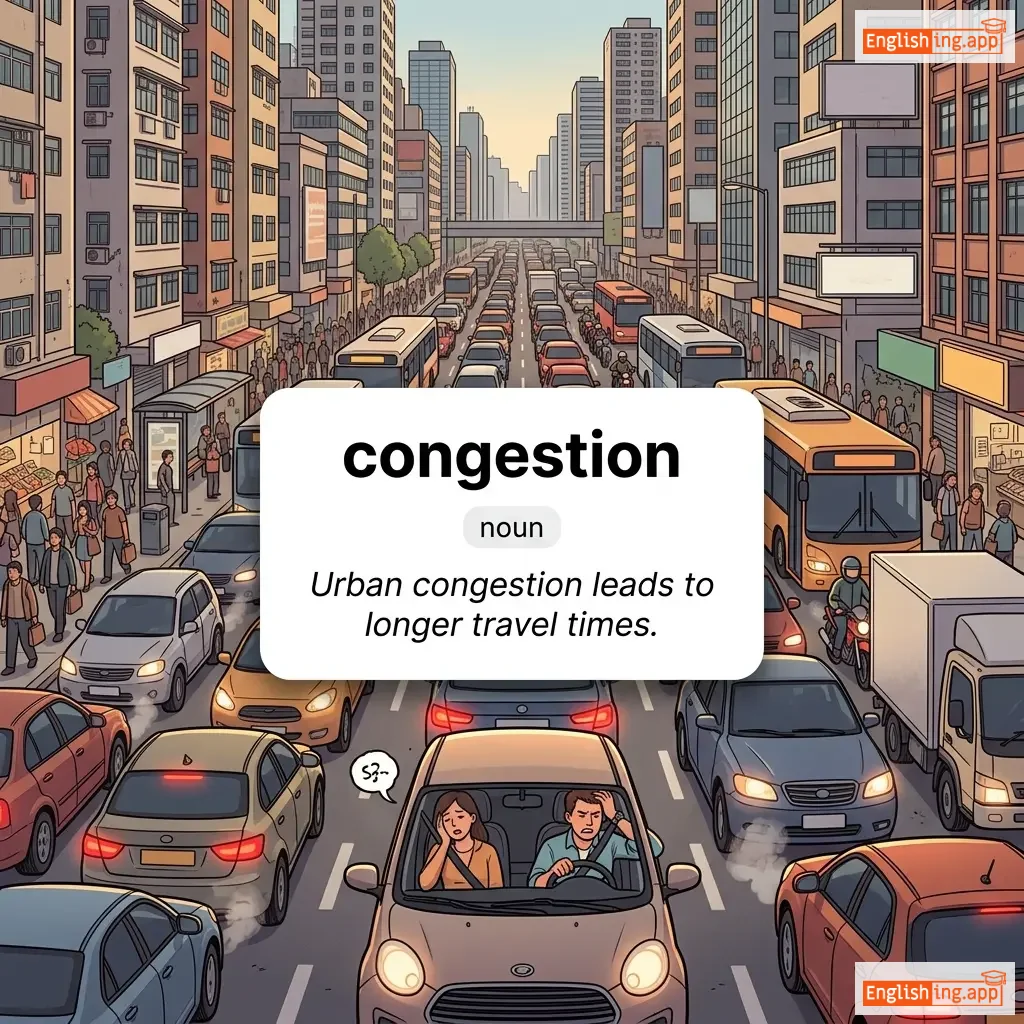
congestion definition card — visual illustration of the meaning
noun
/kənˈdʒes.tʃən/
embouteillage ou afflux excessif (embouteillage ou afflux excessif)

Traffic jam or overcrowded condition in roads or areas where there is excessive presence of vehicles or people.

"Urban congestion leads to longer travel times."

"La congestion urbaine entraîne des temps de voyage plus longs." (La congestion urbaine entraine des temps de voyage plus longs.)
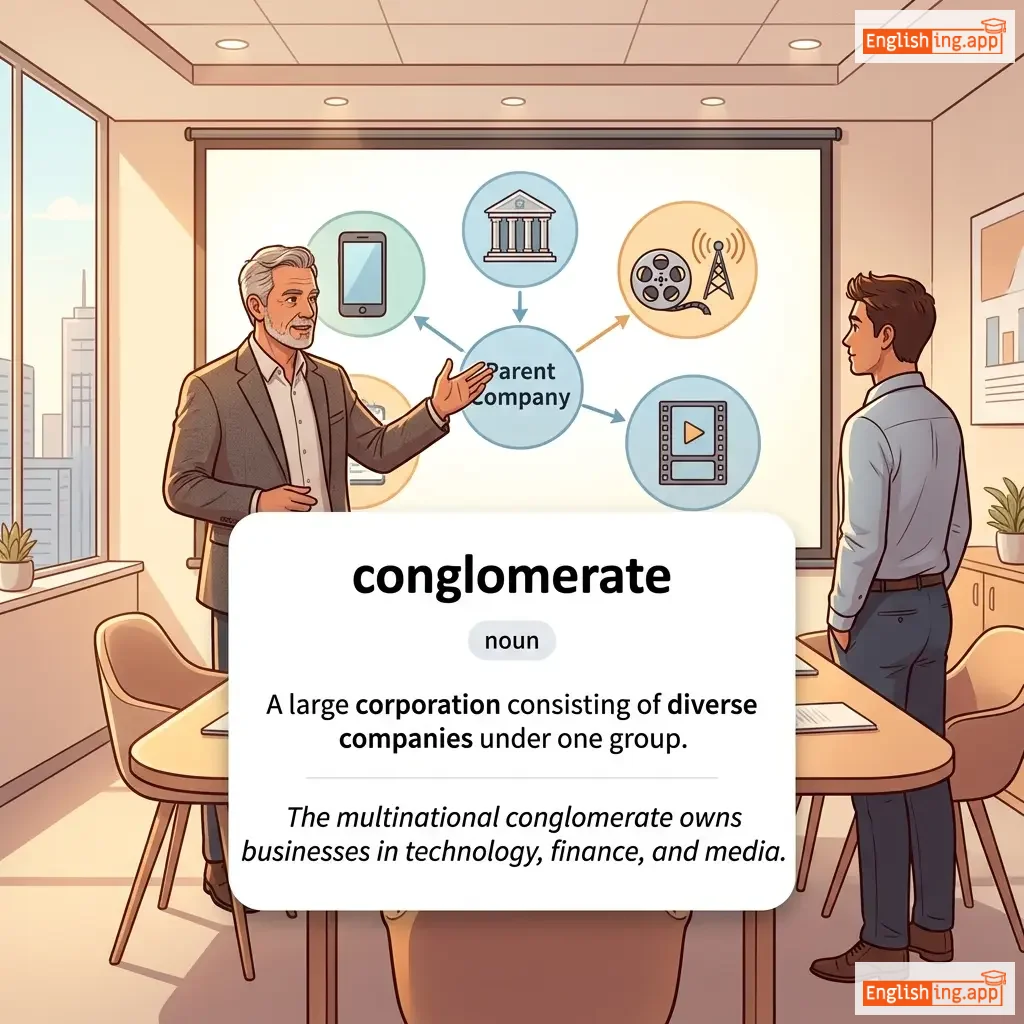
conglomerate definition card — visual illustration of the meaning
noun
/kənˈɡlɒmərət/
un grand groupe d'entreprises diverses (un grand groupe d'entreprises diverses)

A large corporation consisting of diverse companies under one group.

"The multinational conglomerate owns businesses in technology, finance, and media."

"Le conglomérat multinational possède des entreprises dans la technologie, la finance et les médias." (Le conglomérat multinational possède des entreprises dans la technologie, la finance et les médias.)
noun
/kənˌɡlɒməˈreɪʃən/
conglomérat (conglomerat)

A collection or mixture of different things grouped together.

"The market is a conglomeration of small shops and food stalls."

"Le marché est un conglomérat de petites boutiques et de stands de nourriture." (Le marché est un conglomérat de petites boutiques et de stands de nourriture.)
verb
/kənˈɡrætʃʊleɪt/
féliciter (feliciter)

to praise someone for an achievement or for a special occasion

"I want to congratulate you on your promotion."

"Je veux te féliciter pour ta promotion." (Je veux te féliciter pour ta promotion.)
noun
/kənˌɡrætʃəˈleɪʃən/
félicitation (felicitation)

an expression of praise or joy for someone’s achievement or good fortune

"She sent a congratulation to her friend on winning the award."

"Elle a envoyé une félicitation à son amie pour avoir gagné le prix." (elle a envoye une felicitation a son amie pour avoir gagne le prix)
noun
/kənˌɡrætʃ.əˈleɪ.ʃənz/
félicitations (felisitations)

words expressing praise for an achievement or good wishes on a special occasion

"Congratulations on your promotion! You really deserved this success."

"Félicitations pour ta promotion! Tu méritais vraiment ce succès." (Félicitations pour ta promotion! Tu méritais vraiment ce succès.)
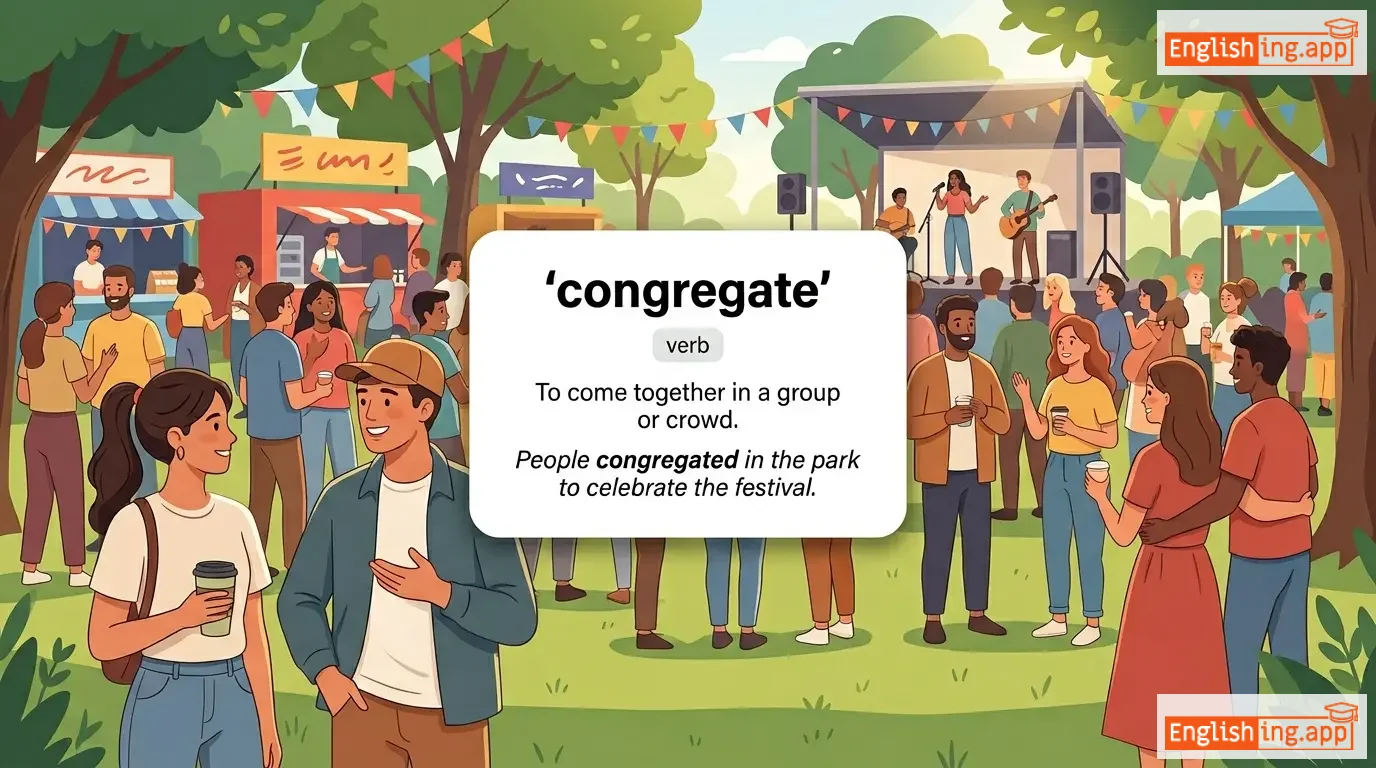
congregate definition card — visual illustration of the meaning
verb
/ˈkɒŋɡrɪˌɡeɪt/
se regrouper (se regrouper)

To come together in a group or crowd.

"People congregated in the park to celebrate the festival."

"Les gens se sont regroupés dans le parc pour célébrer le festival." (Les gens se sont regroupés dans le parc pour célébrer le festival.)
noun
/ˌkɒŋɡrɪˈɡeɪʃən/
congrégation (congregation)

a group of people assembled for religious worship or a common purpose

"The congregation gathered to hear the sermon."

"La congrégation s'est réunie pour écouter le sermon." (La congregation s'est reunie pour ecouter le sermon.)
noun
/ˈkɒŋɡrɛs/
congrès (congres)

a formal meeting or assembly, especially of representatives for discussion

"The international congress on climate change will be held next year."

"Le congrès international sur le changement climatique aura lieu l'année prochaine." (Le congres international sur le changement climatique aura lieu l'annee prochaine.)
adjective
/kənˈɡrɛʃənl/
congressional (congressional)

relating to a congress, especially the US Congress

"The bill received strong congressional support."

"Le projet de loi a reçu un fort soutien du Congrès." (Le projet de loi a reçu un fort soutien du Congrès.)