Vocabulaires

Découvrez, apprenez et maîtrisez le vocabulaire anglais

adjective
/ˈbaɪ.fərˌkeɪ.tɪd/
divisé en deux parties (divisé en deux parties)

Divided into two branches or parts.

"The river became bifurcated as it flowed around the island."

"Le fleuve est devenu bifurqué en deux parties lorsqu'il a traversé l'île." (Le fleuve est devenu bifurqué en deux parties lorsqu'il a traversé l'île.)
adjective
/bɪɡ/
grand (grand)

large in size, extent, or importance

"They moved into a big house with plenty of space."

"Ils ont déménagé dans une grande maison avec beaucoup d'espace." (Ils ont demenage dans une grande maison avec beaucoup d'espace.)
noun
/bɪɡ boʊl/
grand bol (grand bol)

a large, round, shallow container used for serving food, mixing ingredients, or washing

"She mixed the ingredients in a big bowl."

"Elle a mélangé les ingrédients dans un grand bol." (Elle a mélangé les ingrédients dans un grand bol.)
noun
/ˈbɪɡ.ə.mɪst/
bigame (bigame)

A person who commits the crime of marrying someone while already married to another.

"The man was arrested for being a bigamist."

"L'homme a été arrêté pour être un bigame." (L'homme a été arrêté pour être un bigame.)
noun
/ˈbɪɡ.ə.mi/
bigamie (bigamie)

The act of marrying one person while still legally married to another.

"He was charged with bigamy after his second marriage was discovered."

"Il a été accusé de bigamie après que son second mariage ait été découvert." (Il a ete accuse de bigamie apres que son second mariage ait ete decouvert.)
adjective
/ˈbɪɡɪst/
le plus grand (le plus grand)

largest in size, amount, degree, or importance; superlative form of big

"This is the biggest challenge we have ever faced."

"C’est le plus grand défi que nous ayons jamais rencontré." (cest le plus grand defi que nous ayons jamais rencontre)
noun
/baɪt/
courbure (courbure)

A bend or curve in a geographical feature, especially a coastline, or a loop in a rope.

"The sailors anchored in the calm waters of the bight."

"Les marins ont jeté l'ancre dans les eaux calmes de la courbure." (Les marins ont jete l'ancre dans les eaux calmes de la courbure.)
noun
/ˈbɪɡ.ət/
bigot (bigot)

A person who is intolerant toward those holding different opinions or beliefs.

"He was called a bigot for refusing to listen to others' views."

"Il a été traité de bigot pour avoir refusé d'écouter les opinions des autres." (Il a été traité de bigot pour avoir refusé d'écouter les opinions des autres.)
noun
/ˈbɪɡətri/
intolérance (intolerans)

Intolerance toward those who hold different opinions or lifestyles.

"Her bigotry prevented her from accepting people with different beliefs."

"Son intolérance l'empêchait d'accepter les personnes ayant des croyances différentes." (Son intolérance l'empêchait d'accepter les personnes ayant des croyances différentes.)
noun, verb
/baɪk/
vélo (velo)

a bicycle or motorcycle; to ride a bicycle

"He biked to school every day."

"Il allait à l'école à vélo tous les jours." (Il allait à l'école à vélo tous les jours.)
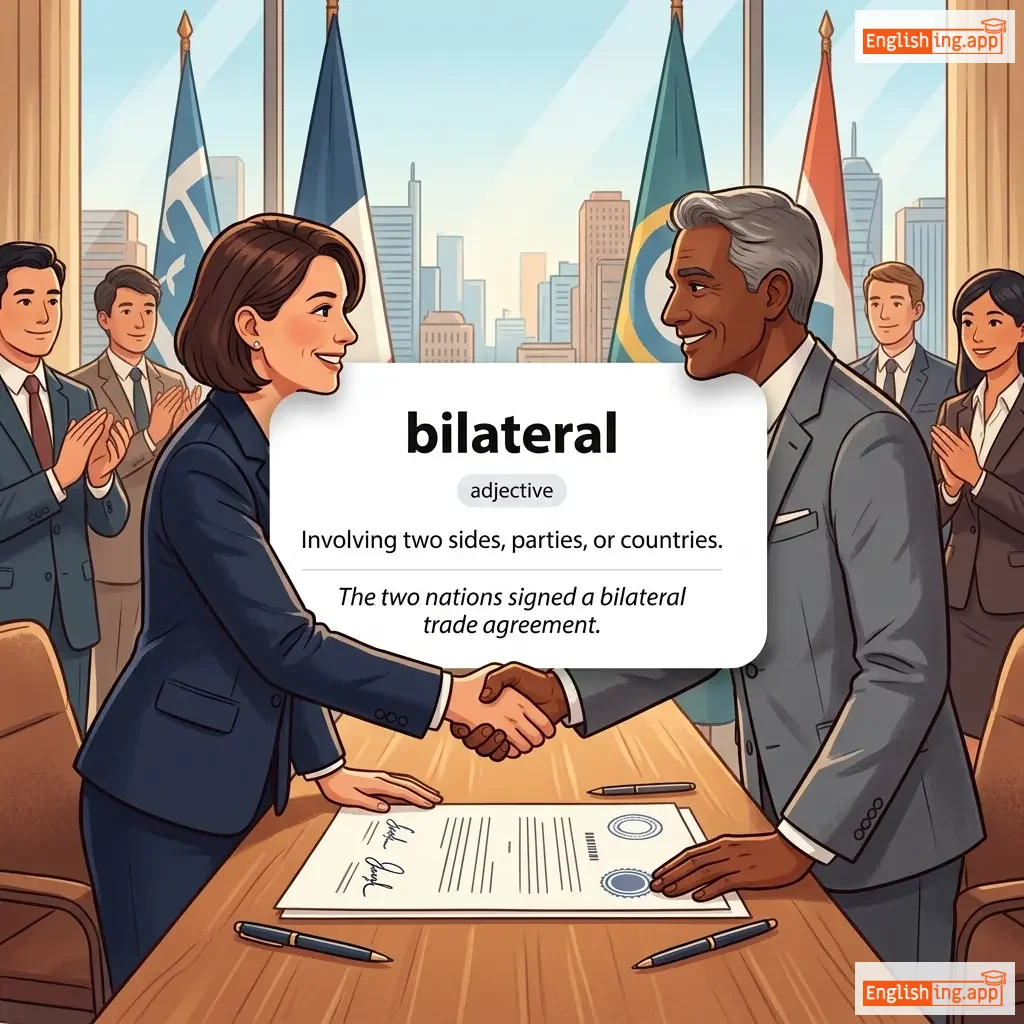
bilateral definition card — visual illustration of the meaning
adjective
/ˌbaɪˈlætərəl/
bilatéral (bilateral)

Involving two sides, parties, or countries.

"The two nations signed a bilateral trade agreement."

"Les deux pays ont signé un accord commercial bilatéral." (Les deux pays ont signé un accord commercial bilatéral.)
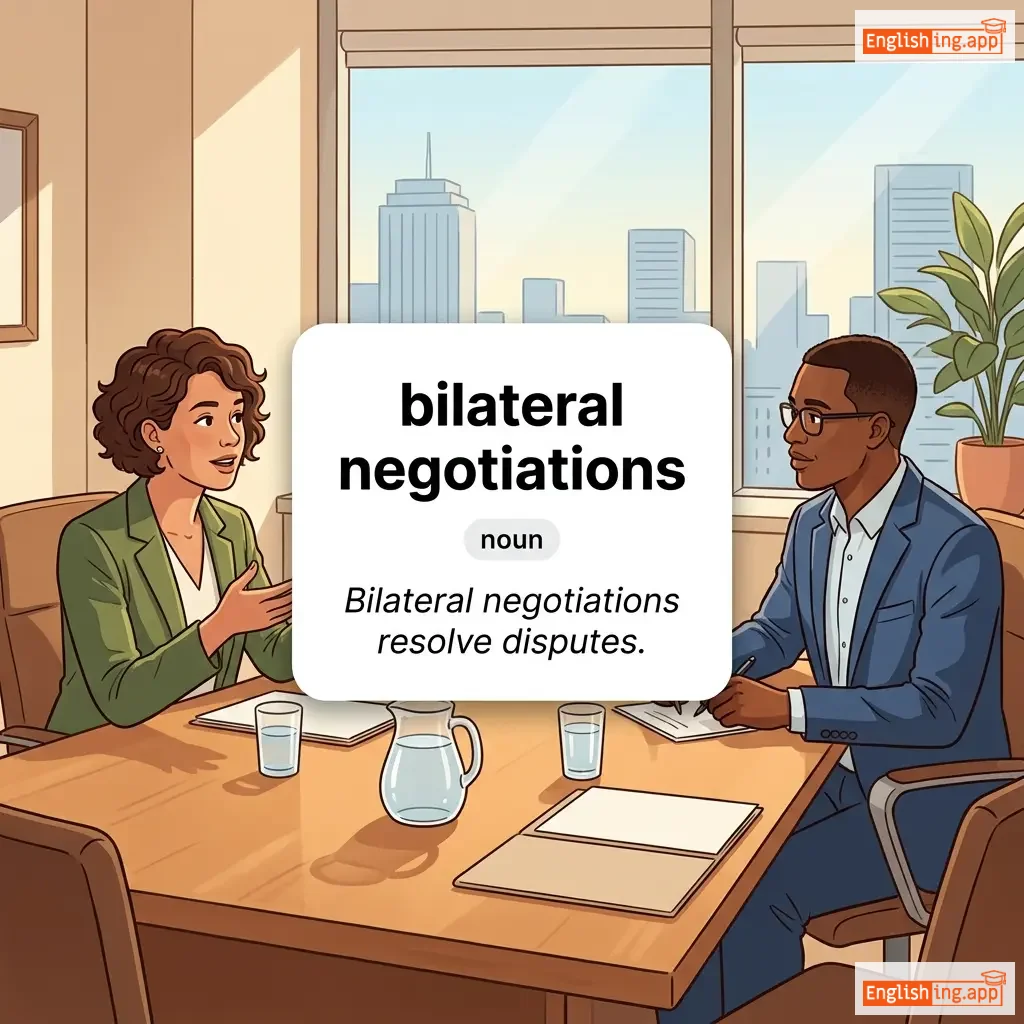
bilateral negotiations definition card — visual illustration of the meaning
noun
/ˌbaɪˈlæt.ər.əl nɪˌɡəʊ.ʃiˈeɪ.ʃənz/
négociations bilatérales (negociations bilaterales)

Negotiations or discussions between two parties, typically countries or organizations.

"Bilateral negotiations resolve disputes."

"Les négociations bilatérales résolvent les différends." (Les negociations bilaterales resolvent les differends.)
noun
/baɪl/
bile (bile)

a bitter greenish-brown alkaline fluid that aids digestion and is secreted by the liver and stored in the gallbladder

"The liver produces bile to help digest fats."

"Le foie produit de la bile pour aider à digérer les graisses." (Le foie produit de la bile pour aider a digerer les graisses)
adjective
/ˌbaɪˈlɪŋɡwəl/
bilingue (bilingue)

Able to speak two languages fluently.

"She grew up in a bilingual household speaking both English and Spanish."

"Elle a grandi dans une maison bilingue, parlant à la fois anglais et espagnol." (Elle a grandi dans une maison bilingue, parlant à la fois anglais et espagnol.)
adjective
/ˈbɪliəs/
bilieux (bilieux)

Relating to bile or an ill-tempered, irritable disposition.

"He became bilious after hearing the unfair criticism."

"Il est devenu bilieux après avoir entendu la critique injuste." (Il est devenu bilieux après avoir entendu la critique injuste.)
verb
/bɪlk/
escroquer (escroquer)

To cheat or defraud someone of money or rights.

"The scammer tried to bilk elderly people out of their savings."

"L'escroc a essayé de soutirer de l'argent aux personnes âgées en leur volant leurs économies." (L'escroc a essaye de soutirer de l'argent aux personnes agees en leur volant leurs economies.)
🧾

Bill

noun
/bɪl/

a written statement of money owed for goods or services; also a proposed law presented to a legislature

"He received the electricity bill yesterday."

noun
/ˈbɪlɪŋzˌɡeɪt/
langage grossier ou abusif (langage grossier ou abusif)

Coarse or abusive language; vulgar or offensive speech.

"The heated argument quickly descended into billingsgate."

"La discussion animée est rapidement descendue dans un langage grossier." (La discussion animée est rapidement descendue dans un langage grossier.)
noun
/ˈbɪljən/
milliard (miyar)

the number 1,000,000,000 (one thousand million)

"The company is worth more than a billion dollars."

"L'entreprise vaut plus d'un milliard de dollars." (Lentreprise vaut plus dun milliard de dollars)
verb
/ˈbɪloʊ/
se gonfler comme des vagues (se gonfler comme des vagues)

To swell or rise in large waves or surges; to flow outward in a rolling motion.

"Smoke billowed from the burning building."

"La fumée se gonflait comme des vagues depuis le bâtiment en feu." (La fumée se gonflait comme des vagues depuis le bâtiment en feu.)
adjective
/ˈbɪloʊɪŋ/
ondulant (ondulant)

Describing something that swells or surges outward in waves or large masses.

"She walked through the billowing curtains."

"Elle marcha à travers les rideaux ondulants." (Elle marcha a travers les rideaux ondulants.)
noun
/baɪˈmɛstər/
période de deux mois (periode de deux mois)

A period of two months.

"The academic program is divided into six bimesters."

"Le programme académique est divisé en six bimestres." (Le programme académique est divisé en six bimestres.)
bind definition card — visual illustration of the meaning
verb
/baɪnd/
lier (lier)

to tie or fasten tightly; to unite or restrict

"The contract will bind both parties to the agreement."

"Le contrat liera les deux parties à l'accord." (Le contrat liera les deux parties à l'accord.)
noun
/ˈbaɪoʊ ˌdeɪtə/
curriculum vitae (curriculum vitae)

biographical data; a resume or curriculum vitae containing personal and professional information

"Please submit your bio-data along with the job application."

"Veuillez soumettre votre curriculum vitae avec la demande d'emploi." (Veuillez soumettre votre curriculum vitae avec la demande d'emploi.)
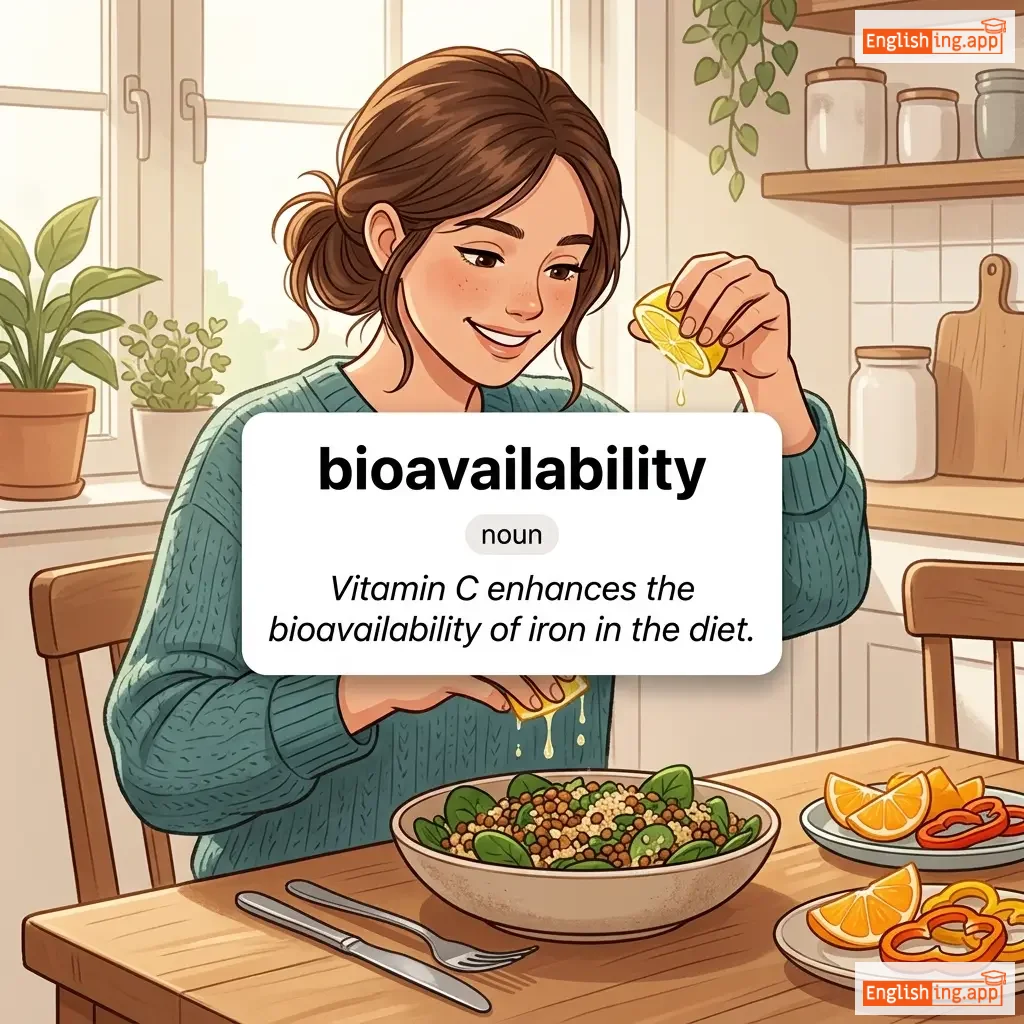
bioavailability definition card — visual illustration of the meaning
noun
/ˌbaɪ.oʊ.əˌveɪ.ləˈbɪl.ə.ti/
biodisponibilité (biodisponibilite)

The degree and rate at which a substance is absorbed or becomes available at the site of physiological activity.

"Vitamin C enhances the bioavailability of iron in the diet."

"La vitamine C améliore la biodisponibilité du fer dans l'alimentation." (La vitamine C améliore la biodisponibilité du fer dans l'alimentation.)
noun
ˈbaɪəʊˌsaɪd
biocide (biocide)

A chemical substance or microorganism intended to destroy, deter, render harmless, or exert a controlling effect on any harmful organism.

"Biocides help control pests and reduce the spread of diseases."

"Les biocides aident à contrôler les ravageurs et à réduire la propagation des maladies." (Les biocides aident a controler les ravageurs et a reduire la propagation des maladies.)
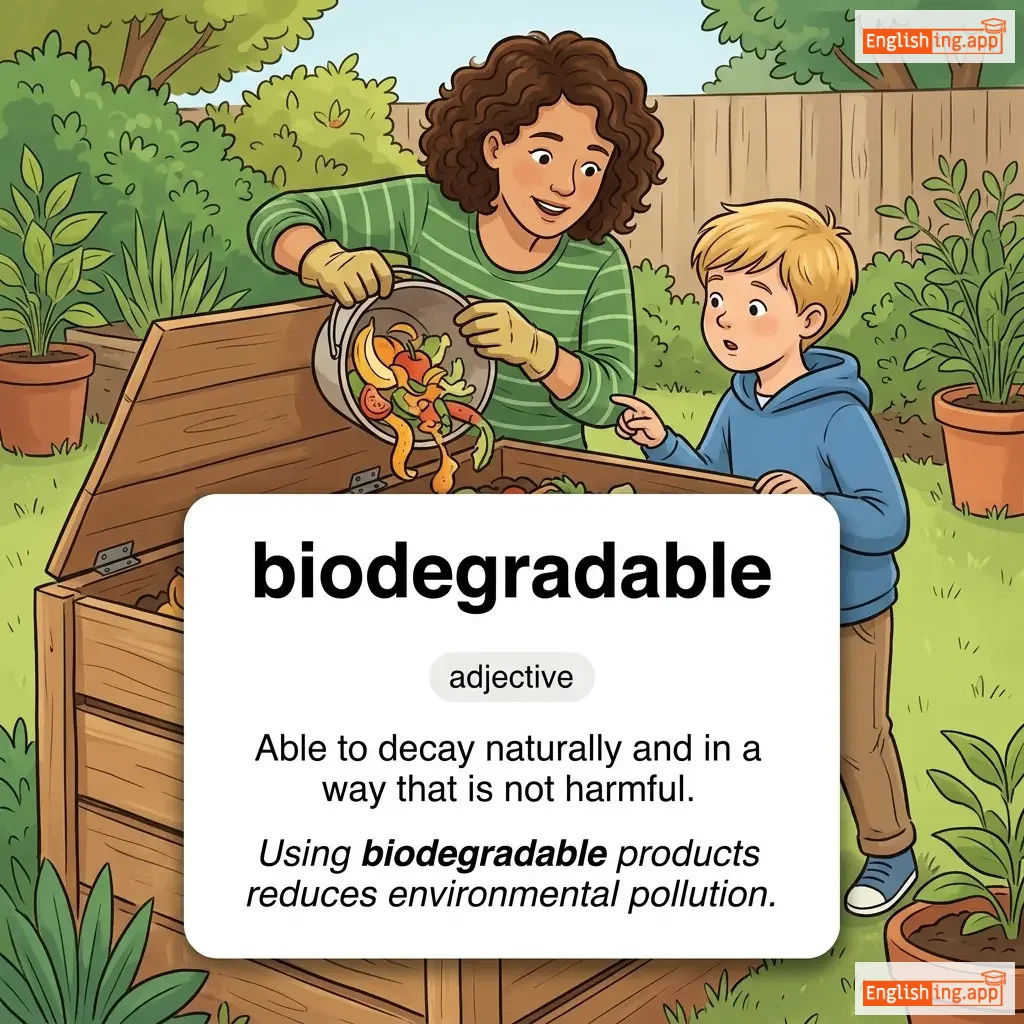
biodegradable definition card — visual illustration of the meaning
adjective
/ˌbaɪ.oʊ.dɪˈɡreɪ.də.bəl/
biodégradable (biodégradable)

Able to decay naturally and in a way that is not harmful.

"Using biodegradable products reduces environmental pollution."

"L'utilisation de produits biodégradables réduit la pollution environnementale." (L'utilisation de produits biodégradables réduit la pollution environnementale.)
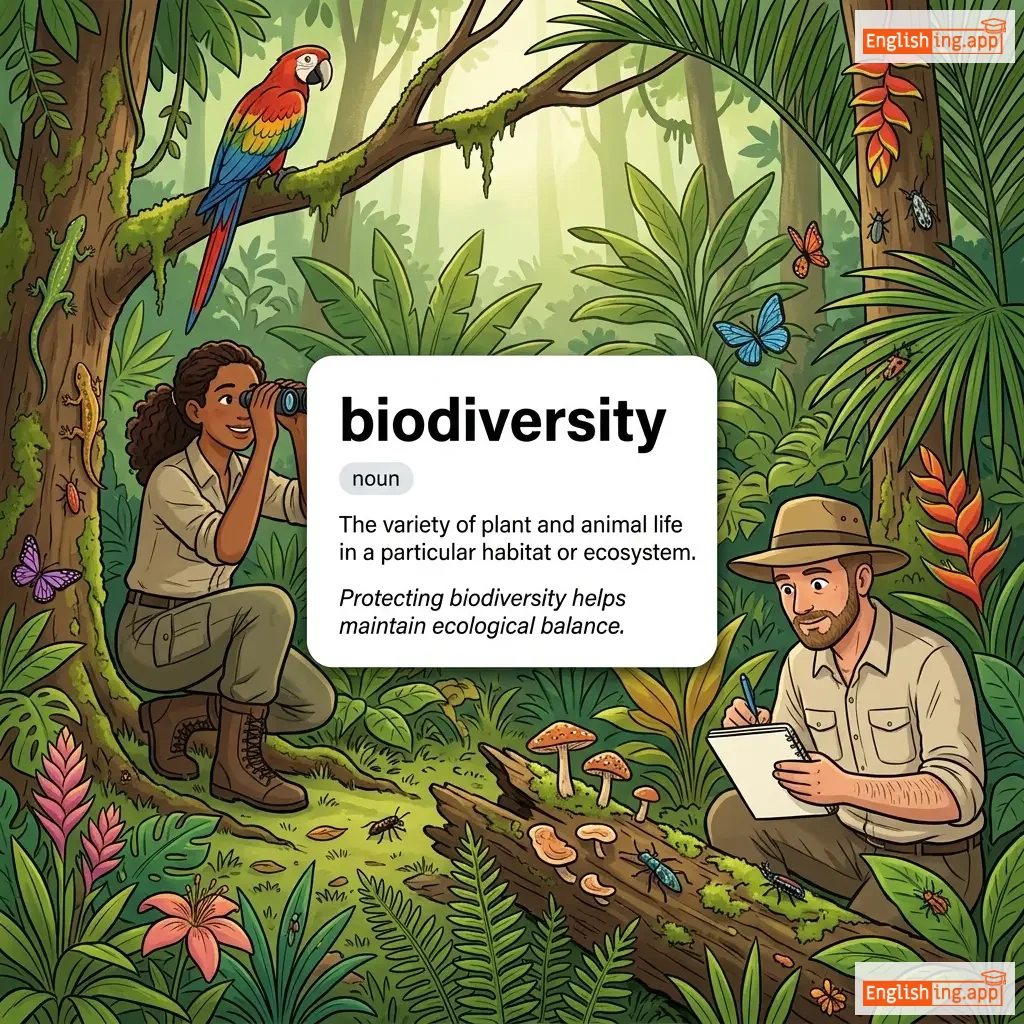
biodiversity definition card — visual illustration of the meaning
noun
/ˌbaɪ.oʊ.daɪˈvɜː.sɪ.ti/
biodiversité (biodiversite)

The variety of life in the world or in a particular habitat or ecosystem.

"Deforestation is a major threat to biodiversity."

"La déforestation est une menace majeure pour la biodiversité." (La deforestation est une menace majeure pour la biodiversite.)
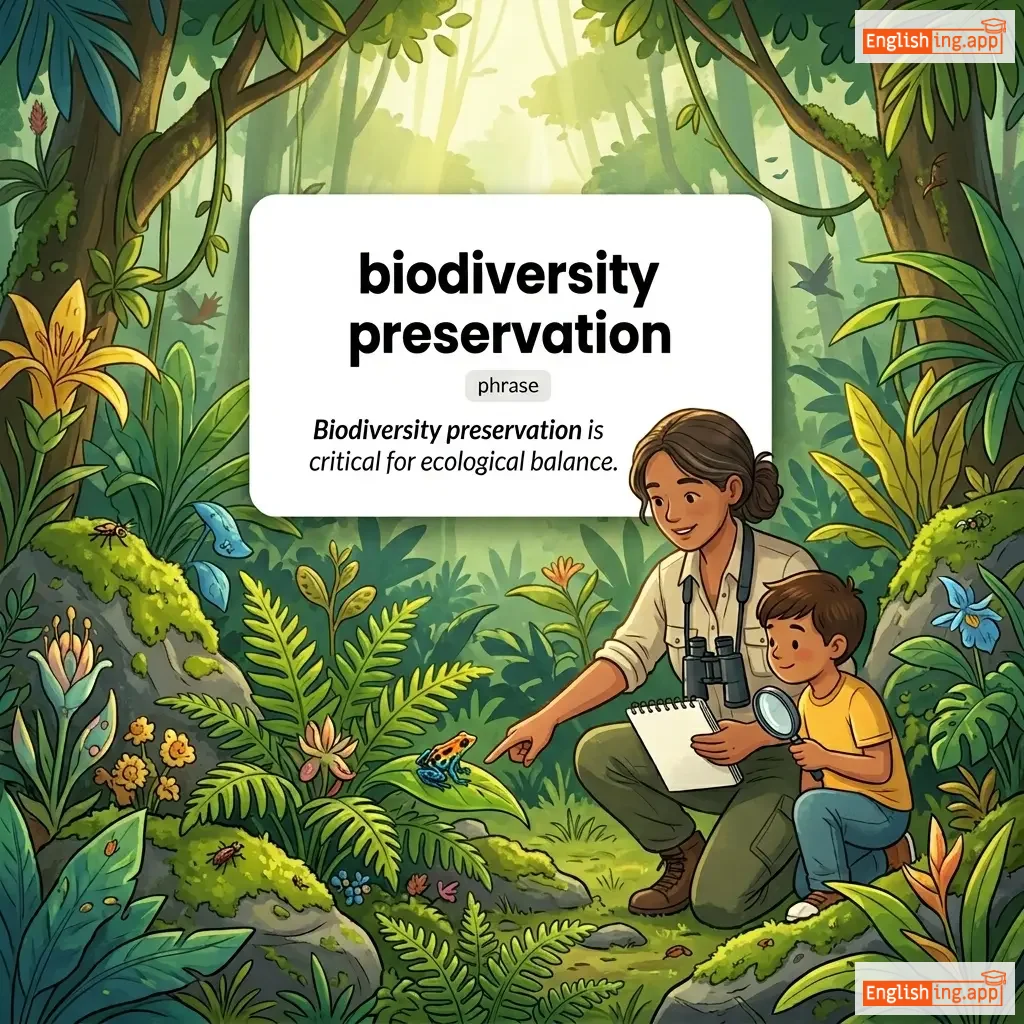
biodiversity preservation definition card — visual illustration of the meaning
phrase
ˌbaɪ.oʊ.daɪˈvɜː.sɪ.ti ˌprez.əˈveɪ.ʃən
préservation de la biodiversité (prezervasyon de la biodiversite)

The protection and conservation of the variety of life in all its forms, including different species, genetic diversity, and ecosystems.

"Biodiversity preservation is critical for ecological balance."

"La préservation de la biodiversité est essentielle pour l'équilibre écologique." (La preservation de la biodiversite est essentielle pour l'equilibre ecologique.)
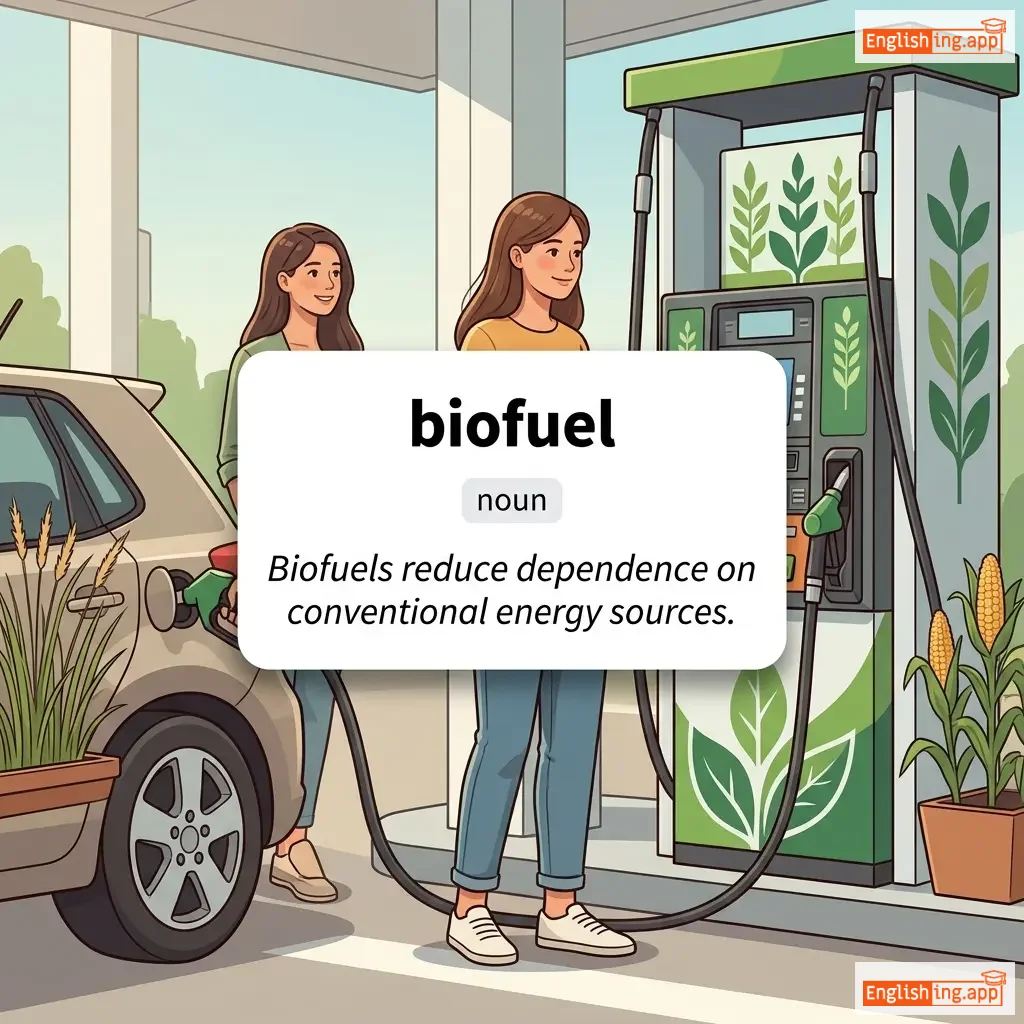
biofuel definition card — visual illustration of the meaning
noun
ˈbaɪ.əʊˌfjuː.əl
biocarburant (biocarburant)

A fuel derived immediately from living matter, as opposed to fossil fuels derived from long-dead biological matter.

"Biofuels reduce dependence on conventional energy sources."

"Les biocarburants réduisent la dépendance aux sources d'énergie conventionnelles." (Les biocarburants réduisent la dépendance aux sources d'énergie conventionnelles.)
noun
/ˈbaɪəˌɡræf/
biographie (biographie)

A written account of a person's life; an early motion-picture projector (historical use).

"The library holds an old biograph of the poet."

"La bibliothèque possède une ancienne biographie du poète." (La bibliothèque possède une ancienne biographie du poète.)
noun
/baɪˈɒɡrəfi/
biographie (biographie)

A written account of someone's life.

"She is writing a biography of the famous poet."

"Elle écrit une biographie du poète célèbre." (Elle ecrit une biographie du poete celebre.)
adjective
/ˌbaɪəˈlɒdʒɪkl̩/
biologique (biologique)

relating to the science of biology or to life and living organisms

"She is studying biological sciences at university."

"Elle étudie les sciences biologiques à l'université." (Elle etudie les sciences biologiques a l'universite.)
noun
/baɪˈɒlədʒi/
biologie (biologie)

The scientific study of living organisms.

"Biology explains how plants and animals function."

"La biologie explique comment les plantes et les animaux fonctionnent." (La biologie explique comment les plantes et les animaux fonctionnent.)
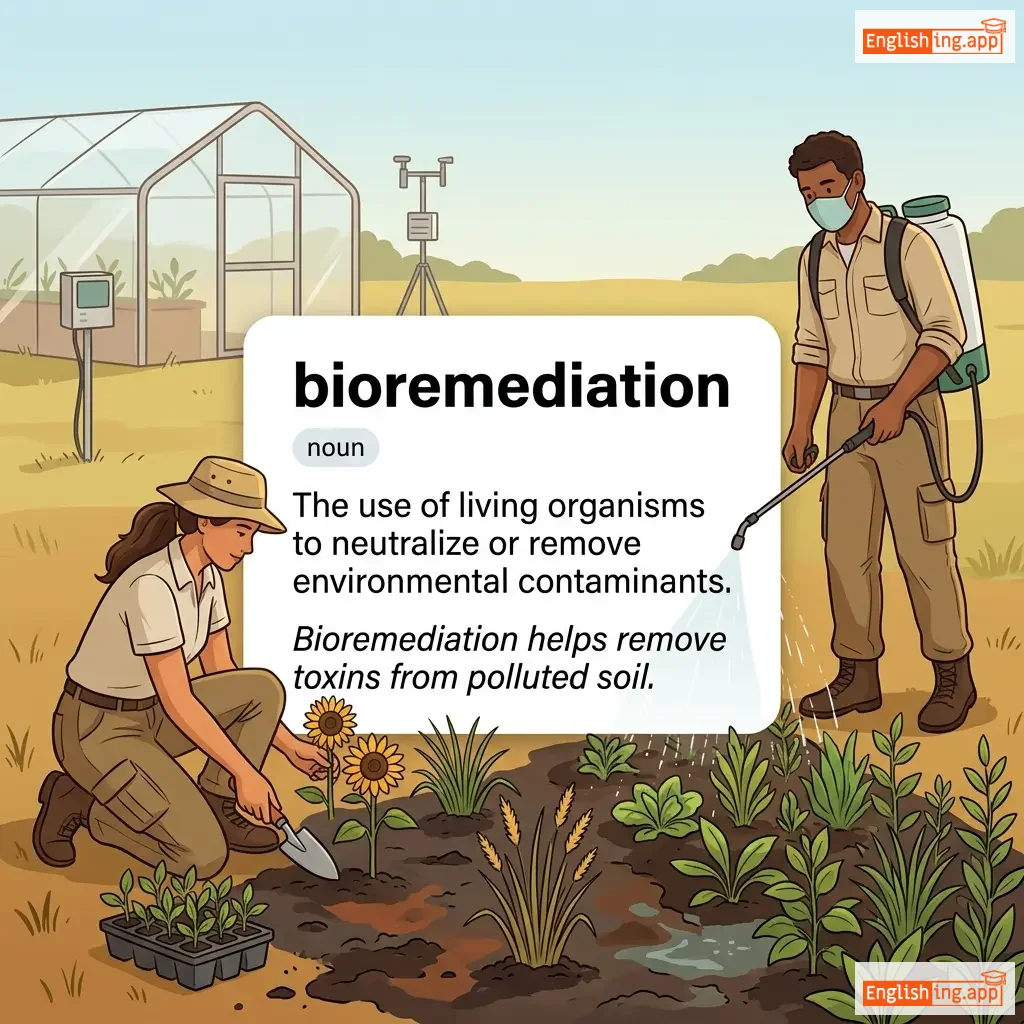
bioremediation definition card — visual illustration of the meaning
noun
/ˌbaɪ.oʊ.rɪˌmiː.diˈeɪ.ʃən/
biorémédiation (bioremediation)

The use of living organisms to neutralize or remove environmental contaminants.

"Bioremediation helps remove toxins from polluted soil."

"La biorémédiation aide à éliminer les toxines du sol pollué." (La biorémédiation aide à éliminer les toxines du sol pollué.)
noun
/ˈbaɪoʊˌsfɪr/
biosphère (biosphere)

the regions of the surface and atmosphere of the earth occupied by living organisms

"Climate change is affecting the entire biosphere."

"Le changement climatique affecte l'ensemble de la biosphère." (Le changement climatique affecte l'ensemble de la biosphere.)
noun
/ˈbaɪpɛd/
bipède (bipede)

An animal that walks on two feet.

"Humans are examples of biped creatures."

"Les humains sont des exemples d'êtres bipèdes." (Les humains sont des exemples d'êtres bipèdes.)
noun
/bɜːrd/
oiseau (oizeau)

a warm-blooded animal with feathers and wings that usually lays eggs and can often fly

"A bird was singing on the tree branch."

"Un oiseau chantait sur la branche de l'arbre." (Un oiseau chantait sur la branche de l'arbre)
noun
/bɜːrθ/
naissance (naissance)

the process of being born; the start of life

"The birth of a child brings joy to the whole family."

"La naissance d'un enfant apporte de la joie à toute la famille." (La naissance d'un enfant apporte de la joie à toute la famille.)
noun
/ˈbɜːrθ.deɪ/
anniversaire (an-nee-vehr-sair)

the anniversary of the day on which a person was born, typically celebrated annually

"We are planning a surprise birthday party for her."

"Nous préparons une fête d'anniversaire surprise pour elle." (Nous preparons une fete danniversaire surprise pour elle.)
noun
/ˈbɜːrθraɪt/
droit de naissance (droit de naissance)

A privilege or possession that a person has from birth.

"Freedom is considered a birthright of every individual."

"La liberté est considérée comme un droit de naissance de chaque individu." (La liberté est considérée comme un droit de naissance de chaque individu.)
noun
/ˈbɪs.kɪt/
biscuit (biscuit)

a small, hard, dry cake; a cookie

"Children love to eat chocolate biscuits with milk."

"Les enfants aiment manger des biscuits au chocolat avec du lait." (Les enfants aiment manger des biscuits au chocolat avec du lait.)
noun
/ˈbɪʃəp/
évêque (eveque)

a senior member of the Christian clergy, usually in charge of a diocese and empowered to confer holy orders.

"The bishop delivered a powerful sermon during Sunday service."

"L'évêque a prononcé un sermon puissant lors du service du dimanche." (L'évêque a prononcé un sermon puissant lors du service du dimanche.)
noun
/bɪsk/
soupe de fruits de mer (soupe de fruits de mer)

A rich, creamy soup made from shellfish.

"We ordered lobster bisque at the restaurant."

"Nous avons commandé une bisque de homard au restaurant." (Nous avons commandé une bisque de homard au restaurant.)
noun
/bɪt/
morceau (morceau)

a small piece, amount, or portion of something

"She ate a bit of the cake before leaving."

"Elle a mangé un morceau du gâteau avant de partir." (Elle a mangé un morceau du gâteau avant de partir.)
noun
/bɪtʃ/
chienne (chienne)

a female dog

"The bitch gave birth to five puppies."

"La chienne a donné naissance à cinq chiots." (La chienne a donné naissance à cinq chiots.)
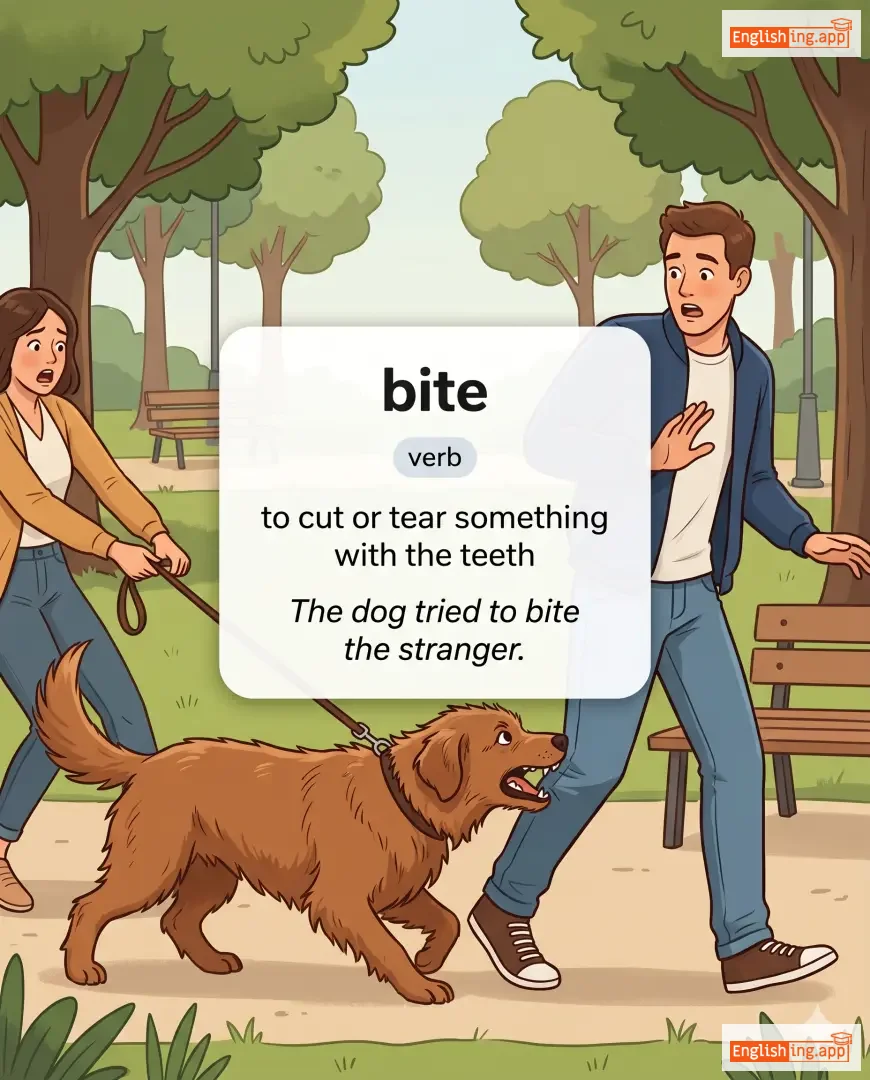
bite definition card — visual illustration of the meaning
verb
/baɪt/
mordre (mordre)

to cut or tear something with the teeth

"The dog tried to bite the stranger."

"Le chien a essayé de mordre l'inconnu." (Le chien a essaye de mordre l'inconnu.)
adjective
/ˈbaɪtɪŋ/
acerbe / piquant (acerbe / piquant)

harsh, sharp, or severely critical; capable of causing physical or emotional pain

"The critic’s biting remarks left the actor speechless."

"Les remarques acerbes du critique ont laissé l'acteur sans voix." (Les remarques acerbes du critique ont laissé l'acteur sans voix.)
adjective
/ˈbɪtər/
amer (amer)

having a sharp, unpleasant taste or showing strong hostility or resentment

"She felt bitter about losing the competition."

"Elle se sentit amère après avoir perdu la compétition." (Elle se sentit amère après avoir perdu la compétition.)
noun
/ˈbɪtər ɡɔːrd/
courge amère (courge amère)

a green, bumpy vegetable with a very bitter taste, known for its medicinal properties

"Bitter gourd is excellent for controlling blood sugar levels."

"La courge amère est excellente pour contrôler les niveaux de sucre dans le sang." (La courge amere est excellente pour controler les niveaux de sucre dans le sang.)