Vocabulaires

Découvrez, apprenez et maîtrisez le vocabulaire anglais

noun
/ˈbuːt.leɪs/
lacet de botte (lacet de botte)

a cord or string used to fasten a boot or shoe

"I need to tie my boot-lace before going for a walk."

"Je dois attacher mon lacet de botte avant de partir en promenade." (Je dois attacher mon lacet de botte avant de partir en promenade.)
noun
/buːθ/
cabine (cabine)

a small enclosed space or area used for a specific purpose, such as voting or selling.

"He went into the voting booth to cast his ballot."

"Il est allé dans la cabine de vote pour déposer son bulletin." (Il est alle dans la cabine de vote pour deposer son bulletin.)
adjective
/ˈbuːtləs/
inutile (inutile)

Useless or futile; of no benefit.

"His bootless attempt to fix the machine only wasted time."

"Sa tentative inutile de réparer la machine n'a fait que perdre du temps." (sa tentative inutile de reparer la machine n'a fait que perdre du temps.)
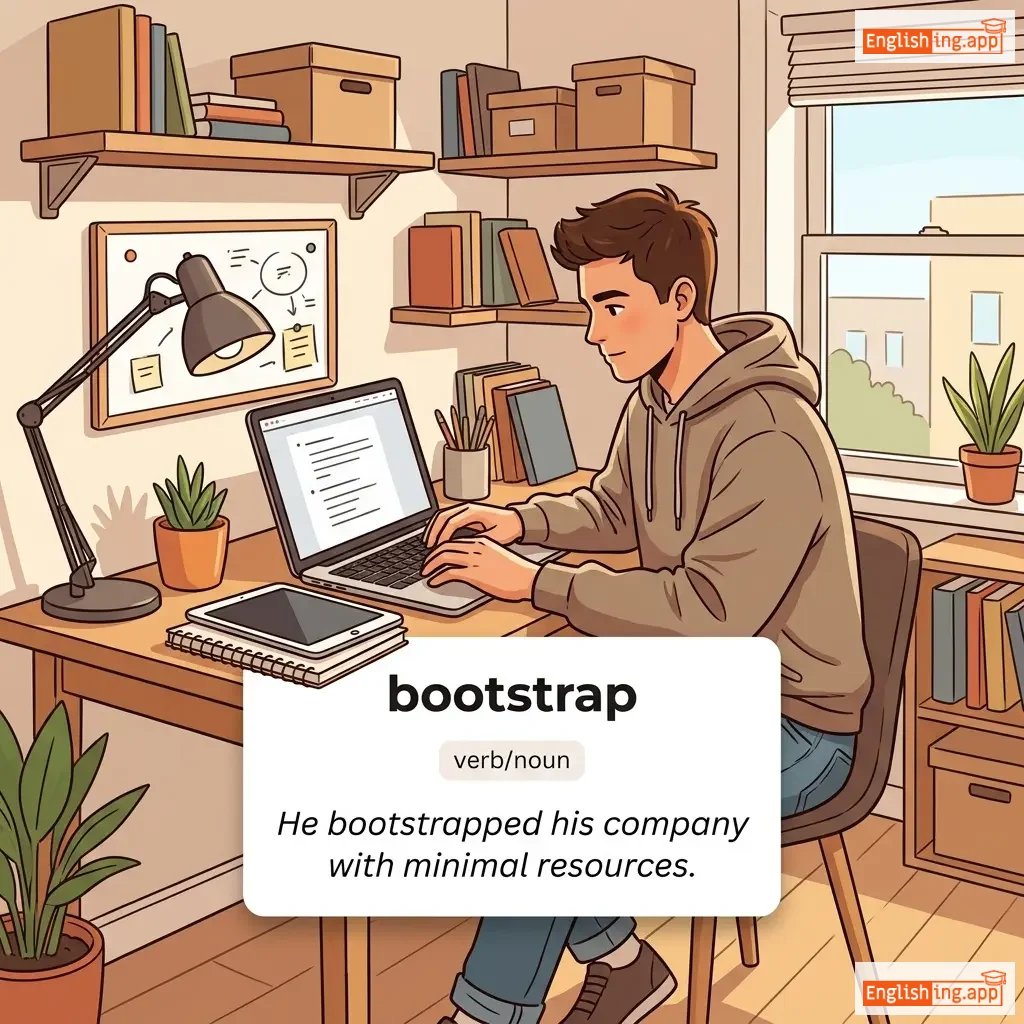
bootstrap definition card — visual illustration of the meaning
verb/noun
ˈbuːt.stræp
démarrer une entreprise avec des ressources personnelles sans financement extérieur (demarrer une entreprise avec des ressources personnelles sans financement exterieur)

To start and develop a business using personal resources without external funding.

"He bootstrapped his company with minimal resources."

"Il a démarré son entreprise avec des ressources minimales." (Il a demarre son entreprise avec des ressources minimales.)
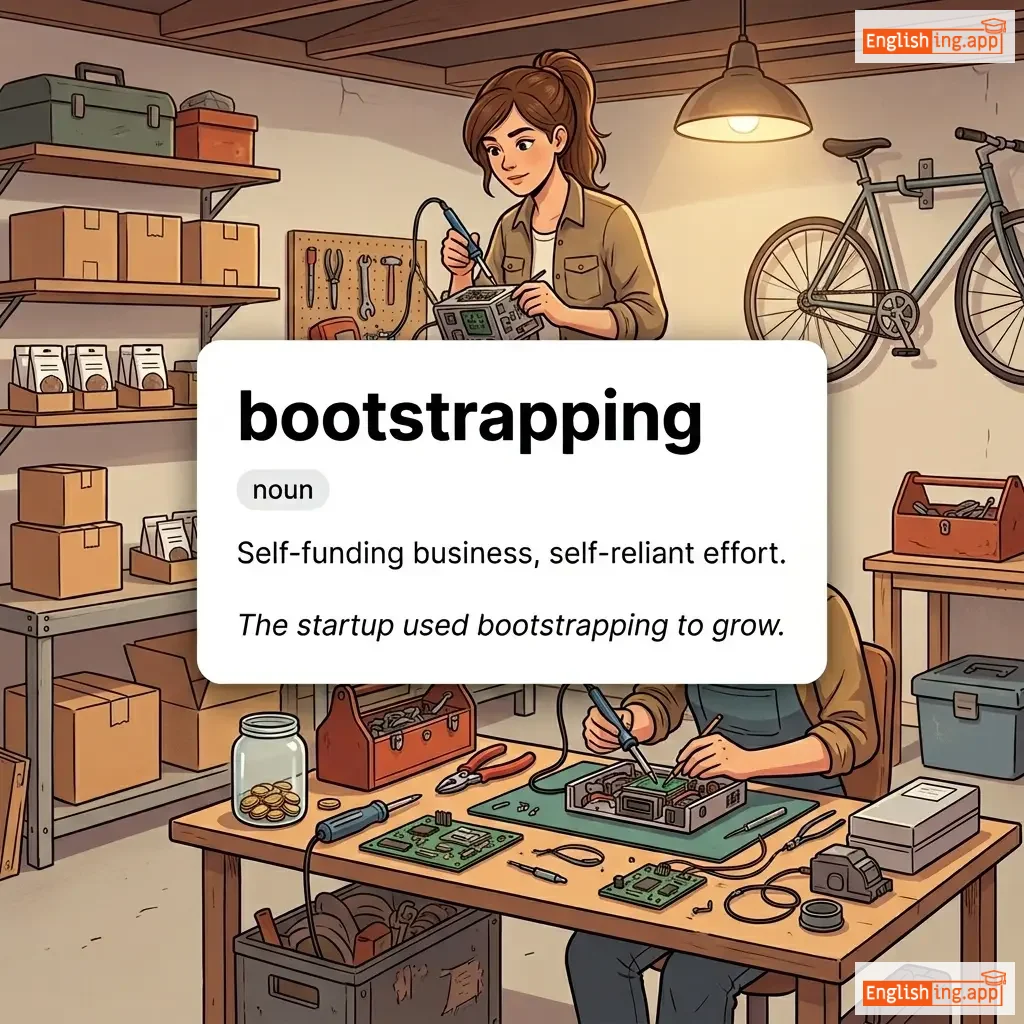
bootstrapping definition card — visual illustration of the meaning
noun
ˈbuːt.stræp.ɪŋ
autofinancement d'entreprise, effort autonome (autofinancement d'entreprise, effort autonome)

Self-funding business, self-reliant effort.

"The startup used bootstrapping to grow."

"La startup a utilisé le bootstrapping pour se développer." (La startup a utilisé le bootstrapping pour se développer.)
noun, verb
/buːz/
alcool (alcool)

alcoholic drink, especially strong liquor; to drink alcohol, often excessively

"They bought some booze for the party."

"Ils ont acheté de l’alcool pour la fête." (ils ont achete de l alcool pour la fete)
adjective
/ˈbuːzi/
alcoolisé (alcoolise)

containing or involving a lot of alcohol; slightly drunk from alcohol

"The party became boozy as the night went on."

"La fête est devenue très alcoolisée au fil de la nuit." (la fete est devenue tres alcoolisee au fil de la nuit)
noun, verb
/ˈbɔːrdər/
frontière (frontiere)

A line separating two political or geographical areas.

"Bangladesh shares a long border with India."

"Le Bangladesh partage une longue frontière avec l'Inde." (Le Bangladesh partage une longue frontière avec l'Inde.)
verb/noun
/bɔːr/
ennuyer (ennuyer)

Verb: To make someone feel uninterested or tired; Noun: A dull or tiresome person.

"The lecture began to bore the students."

"La conférence a commencé à ennuyer les étudiants." (La conférence a commencé à ennuyer les étudiants.)
adjective
/bɔːrd/
ennuyé (ennuye)

feeling weary or uninterested because of lack of activity or excitement

"She felt bored during the long meeting."

"Elle s’est sentie ennuyée pendant la longue réunion." (elle sest sentie ennuyee pendant la longue reunion)
adjective
/ˈbɔːrɪŋ/
ennuyeux (ennuyeux)

not interesting or exciting; dull.

"The lecture was so boring that several students fell asleep."

"La conférence était tellement ennuyeuse que plusieurs étudiants se sont endormis." (La conférence était tellement ennuyeuse que plusieurs étudiants se sont endormis.)
verb (past participle of 'bear'), adjective
/bɔːrn/
(ne)

To come into life; brought into existence.

"He was born in Dhaka in 1995."

"Il est né à Dhaka en 1995." (Il est ne a Dhaka en 1995.)
noun
/ˈbʌrə, ˈbʊrə/
arrondissement (arrondissement)

A town, district, or administrative division, especially one with its own local government.

"Brooklyn is a borough of New York City."

"Brooklyn est un arrondissement de New York." (Brooklyn est un arrondissement de New York.)
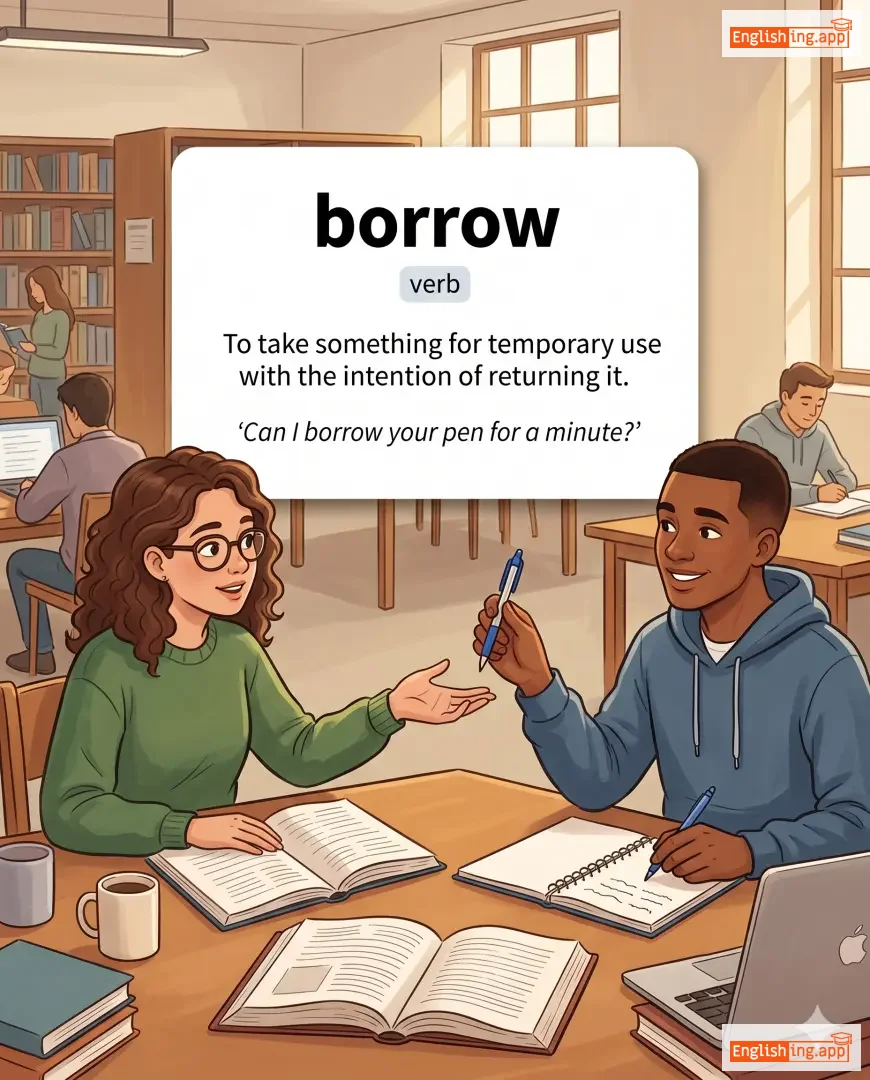
borrow definition card — visual illustration of the meaning
verb
/ˈbɑːroʊ/
emprunter (emprunter)

To take something for temporary use with the intention of returning it.

"Can I borrow your pen for a minute?"

"Puis-je emprunter ton stylo pendant une minute ?" (Puis-je emprunter ton stylo pendant une minute ?)
noun
/ˈbʊzəm/
poitrine (poitrine)

the human chest, especially a woman’s breast; also used metaphorically to refer to closeness or intimacy

"She kept the secret close to her bosom."

"Elle a gardé le secret près de sa poitrine." (Elle a gardé le secret près de sa poitrine.)
👨‍💼

boss (bos)

noun
/bɒs/
patron (patron)

a person who is in charge of a worker, group, or organization

"Her boss gave her a new project to complete."

"Son patron lui a donné un nouveau projet à réaliser." (Son patron lui a donné un nouveau projet à réaliser.)
adjective
/bəˈtænɪkəl/
botanique (botanique)

relating to plants or plant life

"She works at the botanical garden."

"Elle travaille au jardin botanique." (Elle travaille au jardin botanique.)
verb
/ˈbɒtənaɪz/
étudier les plantes (etudier les plantes)

to study plants in their natural environment

"They went to the forest to botanize during their vacation."

"Ils sont allés dans la forêt pour étudier les plantes pendant leurs vacances." (Ils sont allés dans la forêt pour étudier les plantes pendant leurs vacances.)
noun
/ˈbɒtəni/
botanique (botanique)

the scientific study of plants

"She is studying botany at the university."

"Elle étudie la botanique à l'université." (Elle etudie la botanique a l'universite.)
verb
/bɒtʃ/
gâcher (gacher)

to carry out a task badly or carelessly

"He completely botched the repair job."

"Il a complètement gâché le travail de réparation." (Il a completement gache le travail de reparation.)
determiner/pronoun
/boʊθ/
les deux (les deux)

referring to two people or things together

"Both of the children were excited about the trip."

"Les deux enfants étaient excités à propos du voyage." (Les deux enfants étaient excités à propos du voyage.)
verb
/ˈbɒðər/
déranger (deranger)

to annoy, worry, or cause trouble to someone

"I don't want to bother you while you're working."

"Je ne veux pas te déranger pendant que tu travailles." (Je ne veux pas te deranger pendant que tu travailles.)
noun
/ˈbɒt.əl/
bouteille (bouteille)

a container, typically made of glass or plastic, with a narrow neck used to hold liquids

"He poured water into the bottle."

"Il a versé de l'eau dans la bouteille." (Il a versé de l'eau dans la bouteille.)
adjective
/ˈbɒt.əl ɡriːn/
vert bouteille (vert bouteille)

a dark green color similar to that of a green glass bottle

"She wore a beautiful bottle-green dress to the evening party."

"Elle portait une belle robe vert bouteille à la soirée." (Elle portait une belle robe vert bouteille à la soirée.)
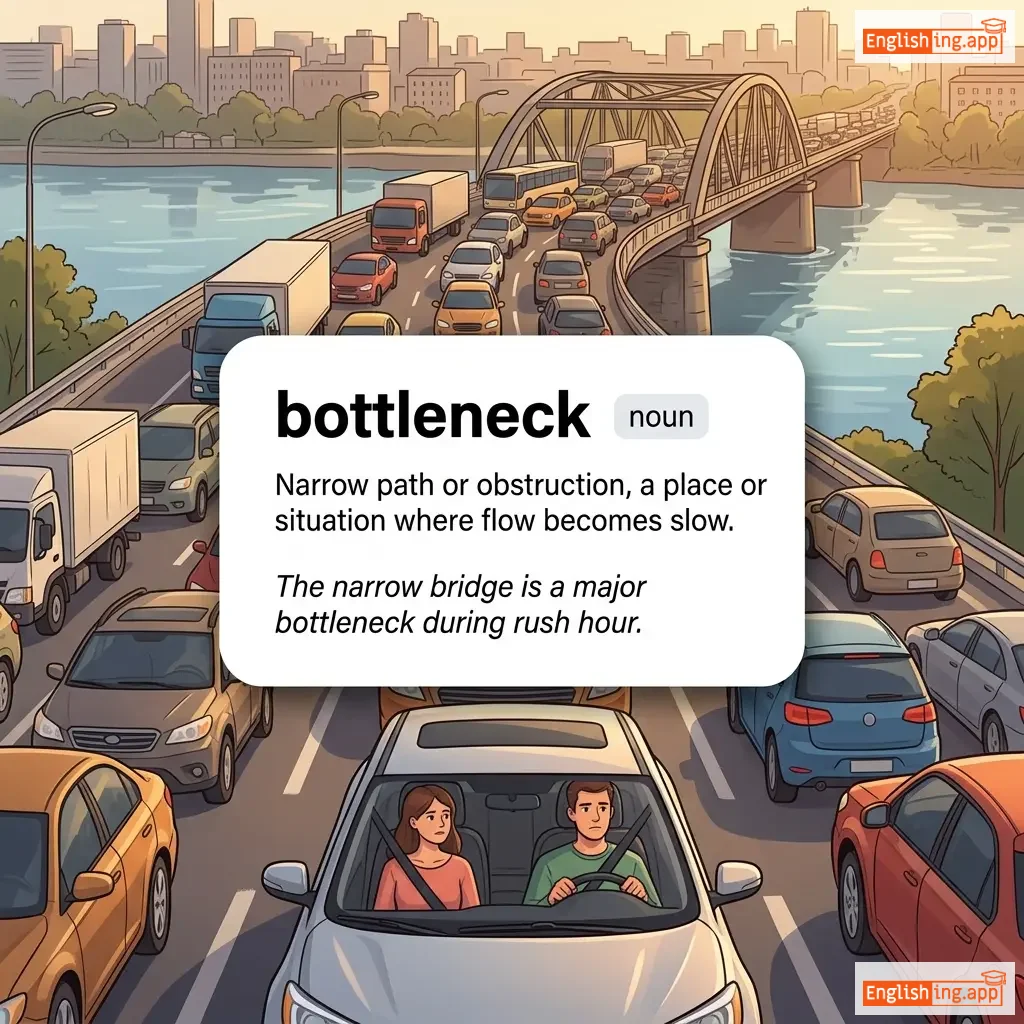
bottleneck definition card — visual illustration of the meaning
noun
/ˈbɒt.əl.nek/
goulot d'étranglement (goulot d'etranglement)

Narrow path or obstruction, a place or situation where flow becomes slow.

"The narrow bridge is a major bottleneck during rush hour."

"Le pont étroit est un goulot d'étranglement pendant les heures de pointe." (Le pont étroit est un goulot d'étranglement pendant les heures de pointe.)
noun, adjective
/ˈbɒtəm/
fond (fond)

The lowest part of something.

"The keys fell to the bottom of the bag."

"Les clés sont tombées au fond du sac." (Les clés sont tombées au fond du sac.)
noun
/ˌbuː.ɡənˈvɪl.i.ə/
bougainvillée (bougainvillee)

a tropical climbing plant with colorful bracts surrounding small flowers

"The bougainvillea climbing over the garden wall creates a beautiful purple display."

"La bougainvillée grimpant sur le mur du jardin crée une belle exposition violette." (La bougainvillee grimpant sur le mur du jardin cree une belle exposition violette.)
noun
/ˈbuː.jɒ̃/
bouillon (bouillon)

A clear, seasoned broth made by simmering meat, fish, or vegetables in water.

"She added vegetables to the bouillon for extra flavor."

"Elle a ajouté des légumes au bouillon pour plus de saveur." (Elle a ajouté des légumes au bouillon pour plus de saveur.)
verb
/baʊns/
rebondir (rebondir)

to spring back after hitting something; to rebound.

"The ball bounced off the wall and hit the window."

"Le ballon a rebondi contre le mur et a frappé la fenêtre." (Le ballon a rebondi contre le mur et a frappe la fenetre.)
verb, noun, adjective
/baʊnd/
limité / lié (limite / lie)

To move with large strides or jumps; also refers to being tied, limited, or certain.

"The dog bounded across the field with joy."

"Le chien a bondi à travers le champ avec joie." (Le chien a bondi à travers le champ avec joie.)
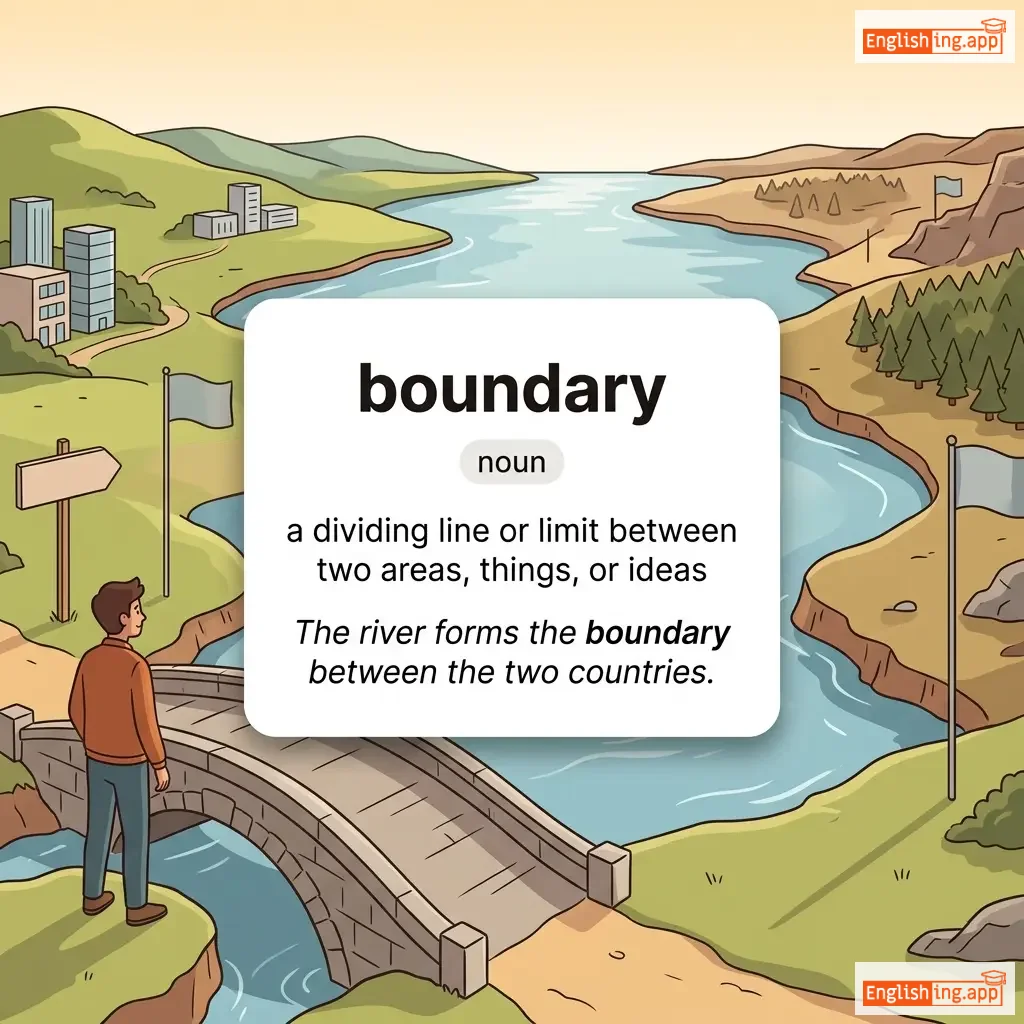
boundary definition card — visual illustration of the meaning
noun
/ˈbaʊn.dri/
frontière (frontiere)

a dividing line or limit between two areas, things, or ideas

"The river forms the boundary between the two countries."

"Le fleuve forme la frontière entre les deux pays." (Le fleuve forme la frontiere entre les deux pays.)
adjective
/ˈbaʊn.tɪ.fəl/
abondant / généreux (abondant / généreux)

Large in quantity; abundant; generous in giving.

"The farmer was grateful for the bountiful harvest."

"Le fermier était reconnaissant pour la récolte abondante." (Le fermier était reconnaissant pour la récolte abondante.)
noun
/buˈkeɪ/
bouquet de fleurs (bouquet de fleurs)

A bunch of flowers arranged together, often given as a gift or decoration.

"He gave her a bouquet of roses on her birthday."

"Il lui a offert un bouquet de roses pour son anniversaire." (Il lui a offert un bouquet de roses pour son anniversaire.)
adjective, noun
/ˈbʊrʒ.wɑː/
bourgeois (bourgeois)

Relating to the middle class, often with materialistic values or conventional attitudes.

"The novel criticizes the bourgeois lifestyle of the city dwellers."

"Le roman critique le mode de vie bourgeois des habitants de la ville." (Le roman critique le mode de vie bourgeois des habitants de la ville.)
noun
/baʊt/
une courte période d'activité intense ou un concours, en particulier dans les sports ou la maladie (une courte période d'activité intense ou un concours, en particulier dans les sports ou la maladie)

a short period of intense activity or a contest, especially in sports or illness

"He had a severe bout of flu last winter."

"Il a eu une grave crise de grippe l'hiver dernier." (Il a eu une grave crise de grippe l'hiver dernier.)
noun
/buːˈtiːk/
boutique (boutique)

a small shop that sells fashionable clothes or accessories

"She bought a beautiful dress from a boutique downtown."

"Elle a acheté une belle robe dans une boutique du centre-ville." (Elle a achete une belle robe dans une boutique du centre-ville.)
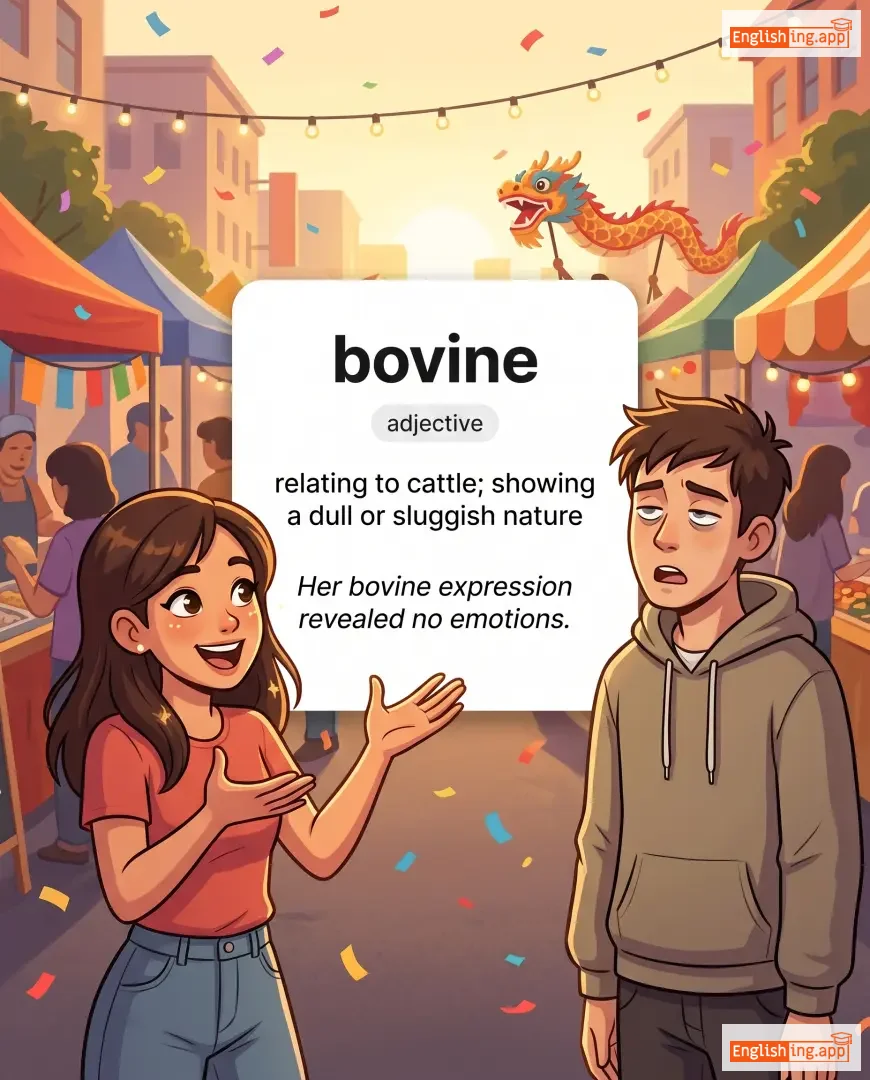
bovine definition card — visual illustration of the meaning
adjective
/ˈboʊvaɪn/
lié au bétail (lie au betail)

relating to cattle; showing a dull or sluggish nature

"Her bovine expression revealed no emotions."

"Son expression bovine n'a révélé aucune émotion." (Son expression bovine n'a révélé aucune émotion.)
verb
/baʊ/ (verb), /boʊ/ (noun)
s'incliner (s'incliner)

to bend the upper part of the body forward as a sign of respect or greeting.

"The performer bowed deeply after the show."

"L'interprète s'est incliné profondément après le spectacle." (L'interprète s'est incliné profondément après le spectacle.)
verb
/ˈbaʊdləˌraɪz/
supprimer les parties offensantes (supprimer les parties offensantes)

to remove or modify parts of a text considered offensive or inappropriate

"The editor bowdlerized the novel to make it suitable for children."

"L'éditeur a baudelérisé le roman pour le rendre adapté aux enfants." (L'éditeur a baudelérisé le roman pour le rendre adapté aux enfants.)
noun
/boʊl/
bol (bol)

a round, deep dish used for holding food or liquids

"She poured the soup into a large bowl."

"Elle a versé la soupe dans un grand bol." (Elle a verse la soupe dans un grand bol.)
noun
/ˈboʊlər/
lanceur (lanceur)

a person who delivers the ball in cricket; also a type of hard felt hat with a rounded crown

"The bowler took three wickets in the first over."

"Le lanceur a pris trois wickets lors du premier over." (Le lanceur a pris trois wickets lors du premier over.)
noun
/bɑːks/
boîte (boite)

a container with flat sides, typically square or rectangular, used for storing things

"He packed his clothes in a cardboard box."

"Il a emballé ses vêtements dans une boîte en carton." (Il a emballe ses vetements dans une boite en carton.)
noun
/ˈbɒksər/
boxeur; boxer (boxeur; boxer)

a person who fights in the sport of boxing; a type of short loose-fitting underwear; a breed of medium-to-large dog

"The boxer trained hard every morning before the championship match."

"Le boxeur s'entraînait dur chaque matin avant le championnat." (Le boxeur s entrainait dur chaque matin avant le championnat)
noun; gerund
/ˈbɒksɪŋ/
boxe (boxe)

the sport of fighting with fists using padded gloves; the act of putting something into a box

"He has been training hard for a professional boxing match."

"Il s'entraîne dur pour un match de boxe." (il s entraine dur pour un match de boxe)
noun
/bɔɪ/
garçon (garcon)

a male child or young male person

"The boy ran across the playground."

"Le garçon courait à travers la cour de récréation." (Le garcon courait à travers la cour de récréation.)
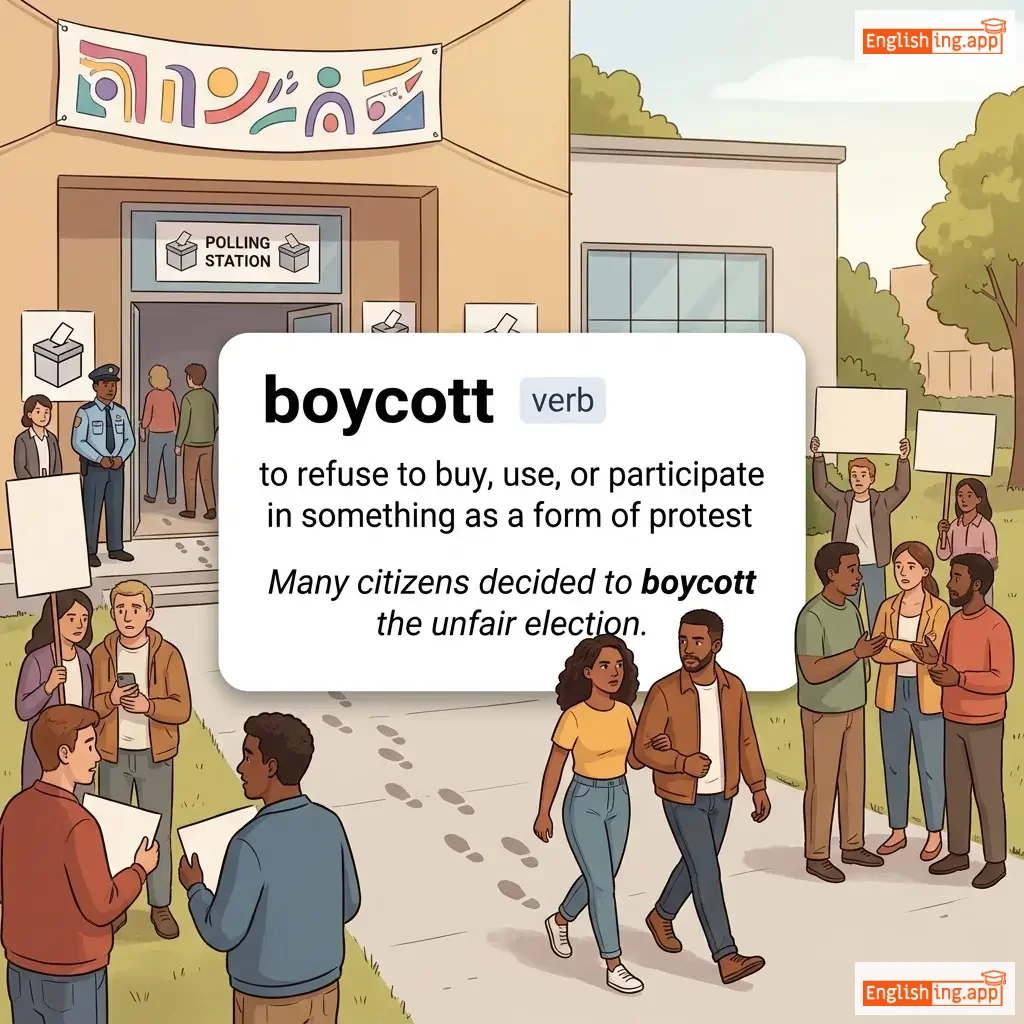
boycott definition card — visual illustration of the meaning
verb
/ˈbɔɪkɒt/
boycotter (boycotter)

to refuse to buy, use, or participate in something as a form of protest

"Many citizens decided to boycott the unfair election."

"Beaucoup de citoyens ont décidé de boycotter l'élection injuste." (Beaucoup de citoyens ont décidé de boycotter l'élection injuste.)
👨‍❤️‍👩

boyfriend (boifrend)

noun
/ˈbɔɪˌfrɛnd/
petit ami (pehtee ahmee)

a man or boy that someone is having a romantic or close relationship with

"She introduced her boyfriend to her parents."

"Elle a présenté son petit ami à ses parents." (Elle a presente son petit ami a ses parents)
noun
/brɑː/
soutien-gorge (soutien-gorge)

a woman's undergarment worn to support and cover the breasts

"She bought a comfortable bra for everyday wear."

"Elle a acheté un soutien-gorge confortable pour tous les jours." (elle a achete un soutien-gorge confortable pour tous les jours)
noun; verb
/breɪs/
attelle; se préparer (attelle; se preparer)

a device that supports or strengthens something; to prepare mentally or physically for something difficult

"She braced herself for the strong wind."

"Elle s’est préparée au vent fort." (elle sest preparee au vent fort)
noun
/ˈbreɪs.lət/
bracelet (bracelet)

an ornamental band worn around the wrist

"She received a gold bracelet as a birthday gift."

"Elle a reçu un bracelet en or comme cadeau d'anniversaire." (Elle a reçu un bracelet en or comme cadeau d'anniversaire.)