Vocabulaires

Découvrez, apprenez et maîtrisez le vocabulaire anglais

noun
/əˈmɛrɪkəˌnɪzəm/
américanisme (americanisme)

A word, phrase, or practice characteristic of American English or culture.

"The term 'sidewalk' is an Americanism, while 'pavement' is used in British English."

"Le terme « sidewalk » est un américanisme, tandis que « pavement » est utilisé dans l'anglais britannique." (Le terme sidewalk est un americanisme, tandis que pavement est utilise dans l'anglais britannique.)
adjective
/ˈeɪmiəbəl/
agréable (agreable)

Having a friendly and pleasant manner.

"She has an amiable personality that makes her well-liked by everyone."

"Elle a une personnalité agréable qui la rend bien-aimée de tous." (Elle a une personnalité agréable qui la rend bien-aimée de tous.)
adverb
/ˈeɪ.mi.ə.bli/
amicalement, de manière amicale (amicalement, de manière amicale)

in a friendly and pleasant manner

"They discussed the issue amiably without any arguments."

"Ils ont discuté du problème amicalement sans aucune dispute." (Ils ont discuté du problème amicalement sans aucune dispute.)
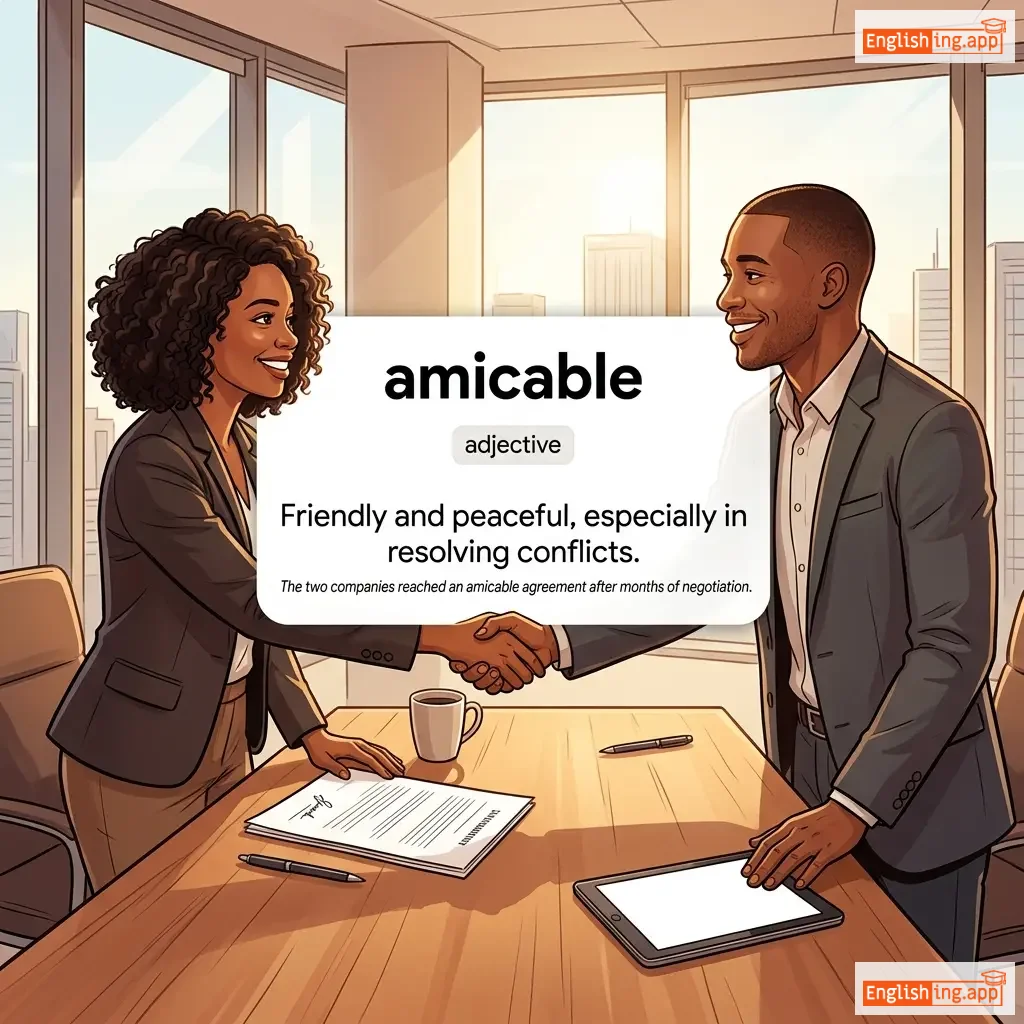
amicable definition card — visual illustration of the meaning
adjective
/ˈæmɪkəbəl/
amical (amical)

Friendly and peaceful, especially in resolving conflicts.

"The two companies reached an amicable agreement after months of negotiation."

"Les deux entreprises ont conclu un accord amical après des mois de négociations." (Les deux entreprises ont conclu un accord amical apres des mois de negociations.)
adverb
/ˈæm.ɪ.kə.bli/
amicalement (amicalement)

in a friendly way without anger or resentment

"The divorce was settled amicably between both parties."

"Le divorce a été réglé amicalement entre les deux parties." (Le divorce a ete regle amicalement entre les deux parties.)
preposition
/əˈmɪd/
au milieu de (au milieu de)

in the middle of or surrounded by something

"The team stayed calm amid the chaos."

"L'équipe est restée calme au milieu du chaos." (L'équipe est restée calme au milieu du chaos.)
adjective/adverb
/əˈmɪs/
incorrect (incorrect)

Not quite right; inappropriate or out of place.

"Something seems amiss with the car's engine."

"Il semble y avoir quelque chose d'incorrect avec le moteur de la voiture." (Il semble y avoir quelque chose d'incorrect avec le moteur de la voiture.)
noun
/ˈæmɪti/
amitié (amitie)

A friendly relationship between people or countries.

"The treaty helped maintain amity between the neighboring nations."

"Le traité a aidé à maintenir l'amitié entre les nations voisines." (Le traite a aide a maintenir l'amitie entre les nations voisines.)
noun
/æmˈniːʒə/
amnésie (amnésie)

A partial or total loss of memory, usually caused by injury, illness, or psychological trauma.

"After the accident, she suffered from amnesia and could not remember her own name."

"Après l'accident, elle a souffert d'amnésie et n'a pas pu se souvenir de son propre nom." (Apres l'accident, elle a souffert d'amnesie et n'a pas pu se souvenir de son propre nom.)
noun
/ˈæmnəsti/
amnistie (amnistie)

An official pardon granted to people who have been convicted of political offenses.

"The government announced an amnesty for all political prisoners."

"Le gouvernement a annoncé une amnistie pour tous les prisonniers politiques." (Le gouvernement a annonce une amnistie pour tous les prisonniers politiques.)
adverb
/əˈmʌk/
de manière incontrôlable (de maniere incontrôlable)

Behaving uncontrollably and disruptively.

"The angry mob ran amok after the verdict was announced."

"La foule en colère courut de manière incontrôlable après l'annonce du verdict." (La foule en colère courut de manière incontrôlable après l'annonce du verdict.)
preposition
/əˈmʌŋ/
parmi (parmi)

surrounded by; in the middle of a group

"He was sitting among his friends."

"Il était assis parmi ses amis." (Il était assis parmi ses amis.)
adjective
/ˌeɪˈmɔːrəl/
amoral (amoral)

Lacking a moral sense; unconcerned with rightness or wrongness of something.

"The character in the novel was portrayed as completely amoral."

"Le personnage dans le roman a été dépeint comme complètement amoral." (Le personnage dans le roman a été dépeint comme complètement amoral.)
adverb
/ˌeɪˈmɔːrəli/
amoralement (amoralement)

In a way that shows no concern about whether behavior is morally right or wrong.

"He acted amorally, ignoring the consequences of his actions."

"Il a agi amoralement, ignorant les conséquences de ses actions." (Il a agi amoralement, ignorant les conséquences de ses actions.)
adjective
/ˈæmərəs/
amoureux (amoureux)

Showing, feeling, or relating to romantic love or desire.

"He sent her an amorous letter filled with declarations of love."

"Il lui a envoyé une lettre amoureuse pleine de déclarations d'amour." (Il lui a envoyé une lettre amoureuse pleine de déclarations d'amour.)
adjective
/əˈmɔːrfəs/
amorphe (amorf)

Lacking a clear shape or form; without a defined structure.

"The plan remained amorphous and lacked concrete details."

"Le plan est resté amorphe et manquait de détails concrets." (Le plan est resté amorphe et manquait de détails concrets.)
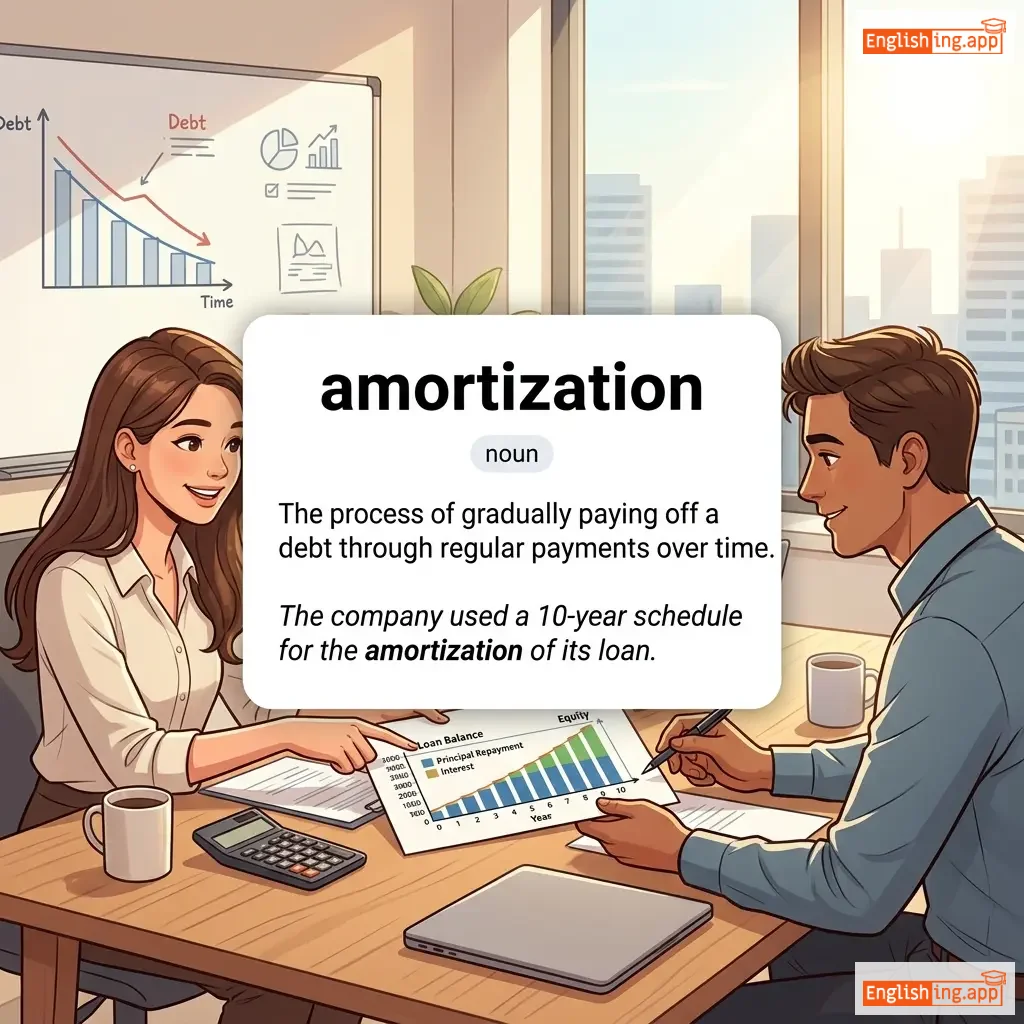
amortization definition card — visual illustration of the meaning
noun
/əˌmɔːrtəˈzeɪʃən/
amortissement de la dette (amortissement de la dette)

The process of gradually paying off a debt through regular payments over time.

"The company used a 10-year schedule for the amortization of its loan."

"L'entreprise a utilisé un programme de 10 ans pour l'amortissement de son prêt." (L'entreprise a utilisé un programme de 10 ans pour l'amortissement de son prêt.)
verb
/ˈæmərˌtaɪz/
amortir (amortir)

To gradually reduce or pay off a debt with regular payments.

"They plan to amortize the mortgage over 20 years."

"Ils prévoient d'amortir l'hypothèque sur 20 ans." (Ils prévoient d'amortir l'hypothèque sur 20 ans.)
noun/verb
/əˈmaʊnt/
montant (montant)

a quantity of something, typically the total of a thing or things in number, size, value, or extent

"The total amount of money is not enough."

"Le montant total d'argent n'est pas suffisant." (Le montant total d'argent n'est pas suffisant.)
noun
/əˈmʊr/
amour secret (amour secret)

A secret or illicit love affair.

"The novel tells the story of a forbidden amour between two characters."

"Le roman raconte l'histoire d'un amour interdit entre deux personnages." (Le roman raconte l'histoire d'un amour interdit entre deux personnages.)
noun
/ˈæmpɛər/
ampère (ampere)

A unit of electric current in the International System of Units (SI), symbolized as A.

"The current flowing through the wire is measured in amperes."

"Le courant qui traverse le fil est mesuré en ampères." (Le courant qui traverse le fil est mesuré en ampères.)
noun
/ˈæmpərˌsænd/
esperluette (esperluette)

The symbol '&' used to represent the word 'and'.

"Use an ampersand instead of writing the word 'and' in the company name."

"Utilisez une esperluette au lieu d'écrire le mot 'et' dans le nom de l'entreprise." (Utilisez une esperluette au lieu d'écrire le mot 'et' dans le nom de l'entreprise.)
noun
/æmˈfɪbiən/
amphibien (amphibien)

A cold-blooded vertebrate animal that can live both on land and in water.

"A frog is a common amphibian that lives both in water and on land."

"Une grenouille est un amphibien courant qui vit à la fois dans l'eau et sur terre." (Une grenouille est un amphibien courant qui vit a la fois dans l eau et sur terre.)
adjective
/æmˈfɪbiəs/
amphibie (amphibie)

Able to live or operate both on land and in water.

"The army used amphibious vehicles to cross the river."

"L'armée a utilisé des véhicules amphibies pour traverser la rivière." (L'armee a utilise des vehicules amphibies pour traverser la riviere.)
noun
/ˈæmfɪˌθiətər/
amphithéâtre (amphitheatre)

A large open circular or oval building with rising tiers of seats, used for public events.

"The concert was held in an ancient amphitheater."

"Le concert a eu lieu dans un amphithéâtre ancien." (Le concert a eu lieu dans un amphithéâtre ancien.)
adjective
/ˈæmpəl/
ample (ample)

more than enough; plentiful; abundant

"There was ample food for everyone at the party."

"Il y avait suffisamment de nourriture pour tout le monde à la fête." (Il y avait suffisamment de nourriture pour tout le monde à la fête.)
noun
/ˌæmplɪfɪˈkeɪʃən/
amplification (amplification)

the act or process of making something stronger, louder, or more intense; an expansion or elaboration of details

"The microphone provides amplification of the speaker’s voice."

"Le microphone permet l’amplification de la voix du locuteur." (le microphone permet lamplification de la voix du locuteur)
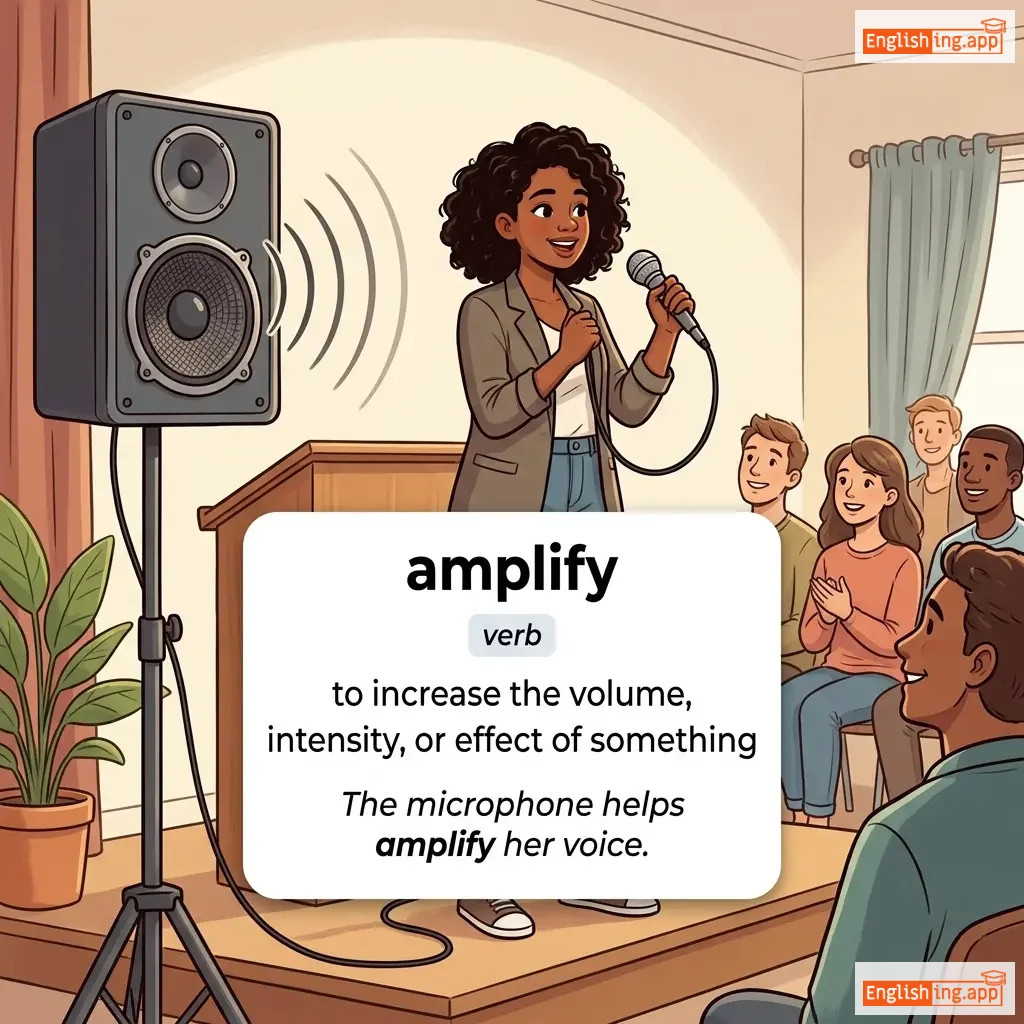
amplify definition card — visual illustration of the meaning
verb
/ˈæmplɪfaɪ/
amplifier (amplifier)

to increase the volume, intensity, or effect of something

"The microphone helps amplify her voice."

"Le microphone aide à amplifier sa voix." (Le microphone aide à amplifier sa voix.)
noun
/ˈæmplɪtjuːd/
amplitude (amplitude)

the maximum extent of a vibration or oscillation, or the size of something

"The amplitude of the earthquake was measured on the Richter scale."

"L'amplitude du tremblement de terre a été mesurée sur l'échelle de Richter." (L'amplitude du tremblement de terre a été mesurée sur l'échelle de Richter.)
adverb
/ˈæmpli/
amplement (amplement)

more than sufficiently; generously

"She was amply rewarded for her hard work."

"Elle a été généreusement récompensée pour son travail acharné." (Elle a été généreusement récompensée pour son travail acharné.)
verb
/ˈæmpjʊteɪt/
amputer (amputer)

to cut off a limb from the body by surgery

"The doctors had to amputate his leg after the accident."

"Les médecins ont dû amputer sa jambe après l'accident." (Les médecins ont dû amputer sa jambe après l'accident.)
adverb
/əˈmʌk/
de manière débridée (de maniere debridee)

in a frenzied, uncontrolled, or chaotic manner

"The bull ran amuck through the village."

"Le taureau a couru de manière débridée à travers le village." (Le taureau a couru de manière débridée à travers le village.)
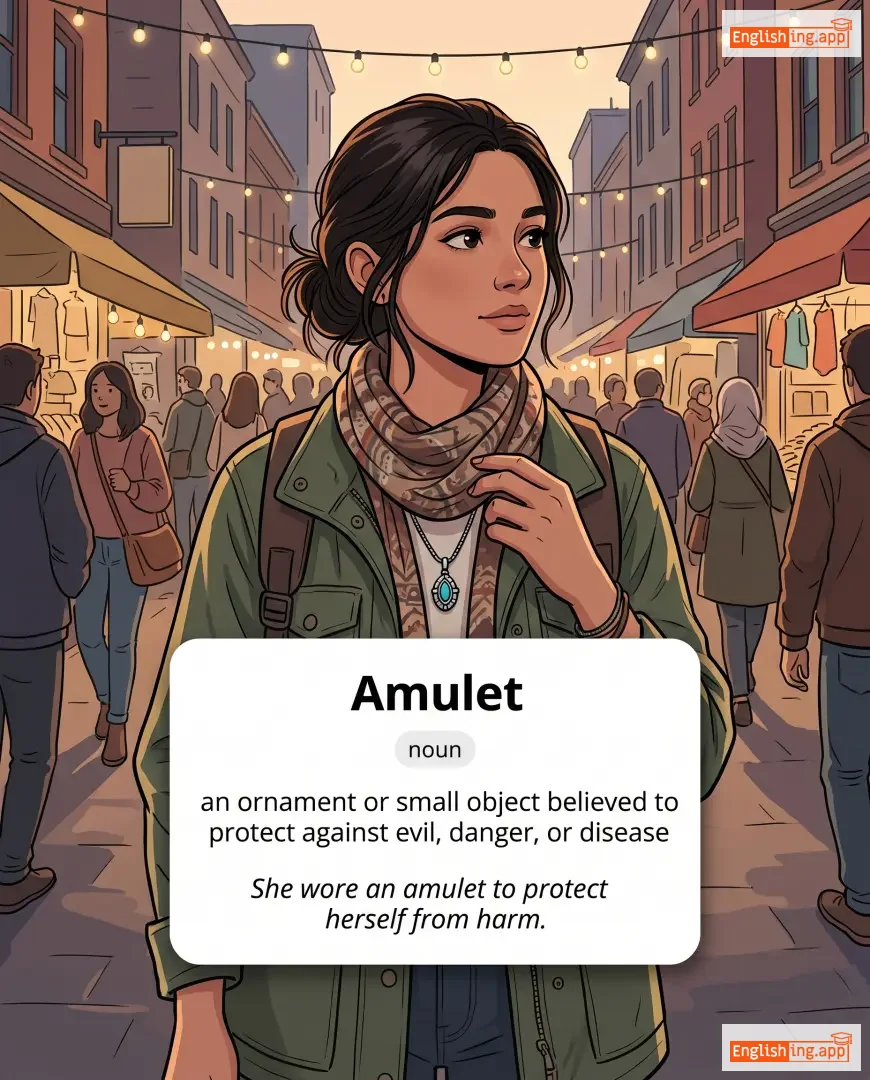
Amulet definition card — visual illustration of the meaning
noun
/ˈæmjʊlət/
amulette (amulette)

an ornament or small object believed to protect against evil, danger, or disease

"She wore an amulet to protect herself from harm."

"Elle portait un amulette pour se protéger du mal." (Elle portait un amulette pour se protéger du mal.)
verb
/əˈmjuːz/
amuser (amuser)

to entertain or make someone laugh or smile; to occupy pleasantly

"The clown amused the children at the party."

"Le clown a amusé les enfants à la fête." (le clown a amuse les enfants a la fete)
noun
/əˈmjuːzmənt/
amusement (amuzment)

the state of being entertained or finding something funny

"The children watched the clown with great amusement."

"Les enfants ont regardé le clown avec beaucoup d'amusement." (Les enfants ont regarde le clown avec beaucoup damusement)
adjective
/əˈmjuːzɪŋ/
amusant (amusant)

causing laughter or amusement

"The movie was very amusing, and I laughed a lot."

"Le film était très amusant, et j'ai beaucoup ri." (Le film etait tres amusant, et j'ai beaucoup ri.)
🅰️

an (an)

article
/æn/
un/une (un/une)

used before a noun to refer to a non-specific item that begins with a vowel sound

"She ate an apple for breakfast."

"Elle a mangé une pomme au petit déjeuner." (elle a mange une pomme au petit dejeuner)
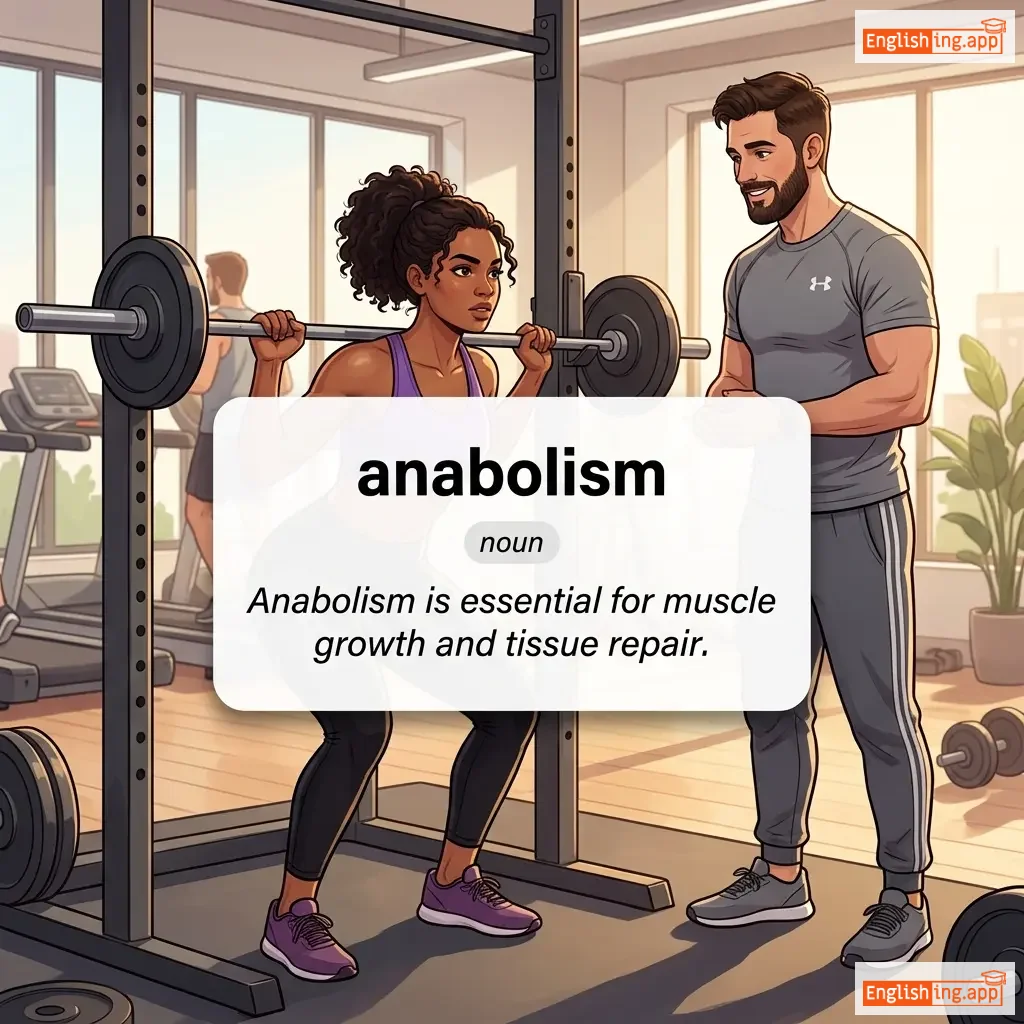
anabolism definition card — visual illustration of the meaning
noun
/əˈnæb.ə.lɪ.zəm/
anabolisme (anabolisme)

The set of metabolic pathways that construct molecules from smaller units, involving tissue repair and growth.

"Anabolism is essential for muscle growth and tissue repair."

"L'anabolisme est essentiel pour la croissance musculaire et la réparation des tissus." (L'anabolisme est essentiel pour la croissance musculaire et la reparation des tissus.)
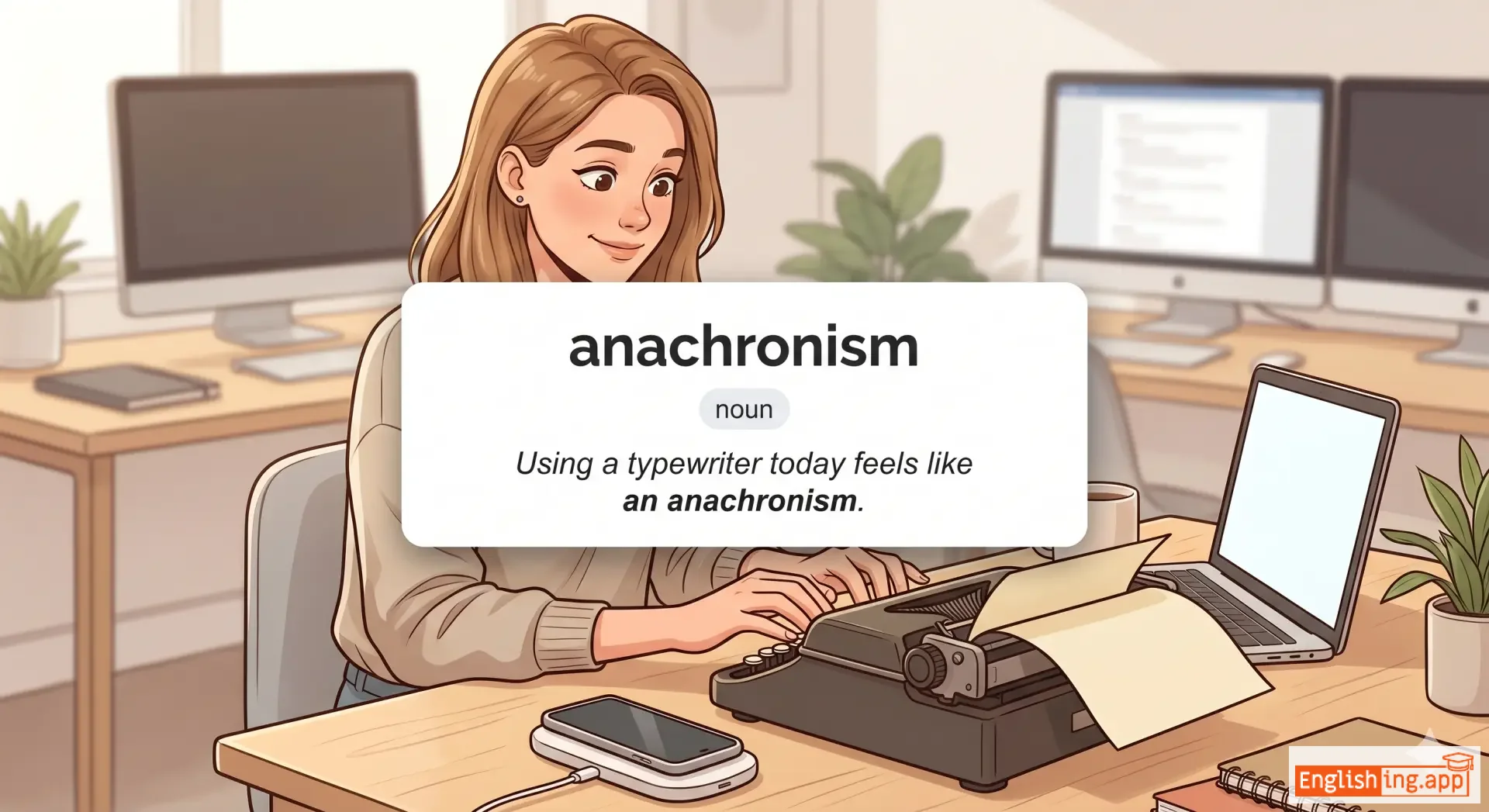
anachronism definition card — visual illustration of the meaning
noun
/əˈnækrəˌnɪzəm/
anachronisme (anakhronizm)

something that is out of its proper time period, especially something old-fashioned in a modern context

"Using a typewriter today feels like an anachronism."

"Utiliser une machine à écrire aujourd'hui ressemble à un anachronisme." (Utiliser une machine a ecrire aujourd hui ressemble a un anachronisme)
adjective
/əˌnækrəˈnɪstɪk/
anachronique (anachronique)

belonging to a period other than that being portrayed; old-fashioned or outdated

"His views on gender roles are considered anachronistic."

"Ses opinions sur les rôles de genre sont considérées comme anachroniques." (Ses opinions sur les rôles de genre sont considérées comme anachroniques.)
noun
/ˈænəɡræm/
un mot ou une phrase formée en réarrangeant les lettres d'un autre mot ou phrase. (un mot ou une phrase formée en réarrangeant les lettres d'un autre mot ou phrase)

A word or phrase formed by rearranging the letters of another word or phrase.

"The word 'listen' is an anagram of 'silent'."

"Le mot 'listen' est un anagramme de 'silent'." (Le mot 'listen' est un anagramme de 'silent'.)
noun
/ˌænəlˈdʒiːziə/
analgésie (analgesie)

The inability to feel pain while still conscious.

"The doctor induced analgesia before performing the procedure."

"Le médecin a induit l'analgésie avant de réaliser la procédure." (Le médecin a induit l'analgésie avant de réaliser la procédure.)
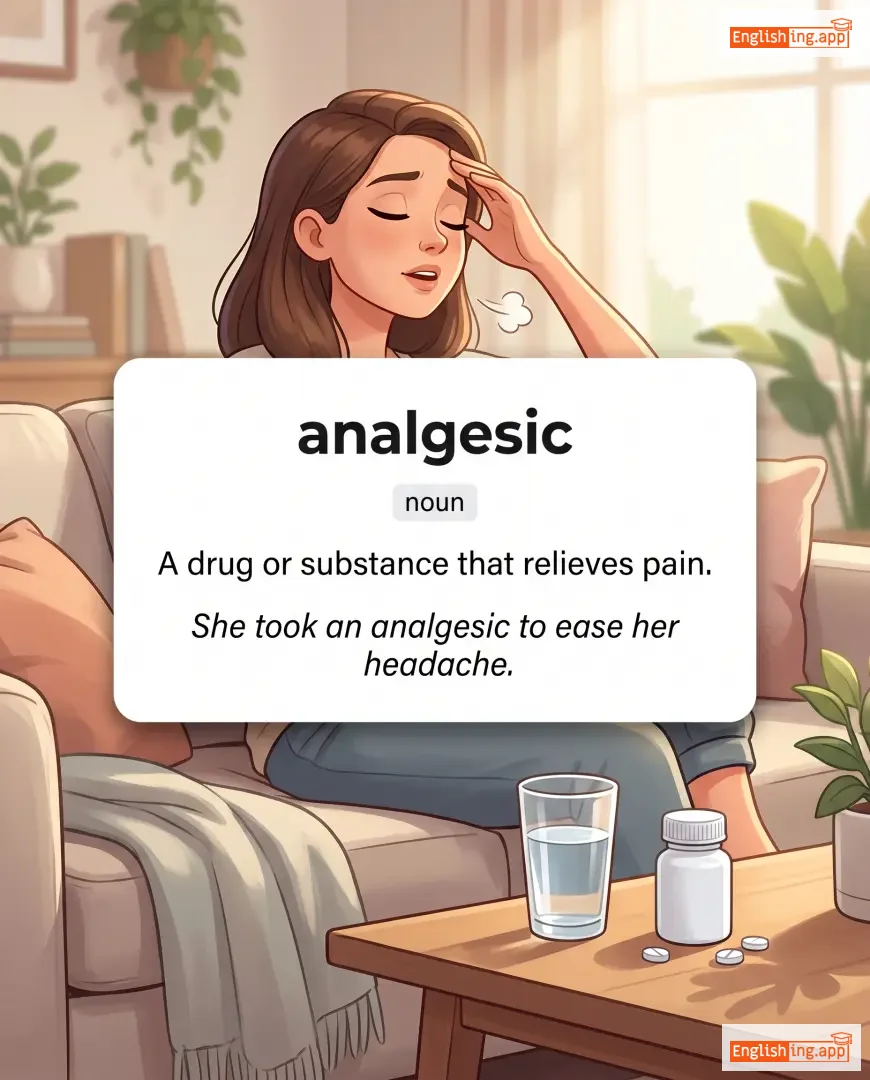
analgesic definition card — visual illustration of the meaning
noun
/ˌænəlˈdʒiːzɪk/
analgésique (analgesique)

A drug or substance that relieves pain.

"She took an analgesic to ease her headache."

"Elle a pris un analgésique pour soulager son mal de tête." (Elle a pris un analgesique pour soulager son mal de tete.)
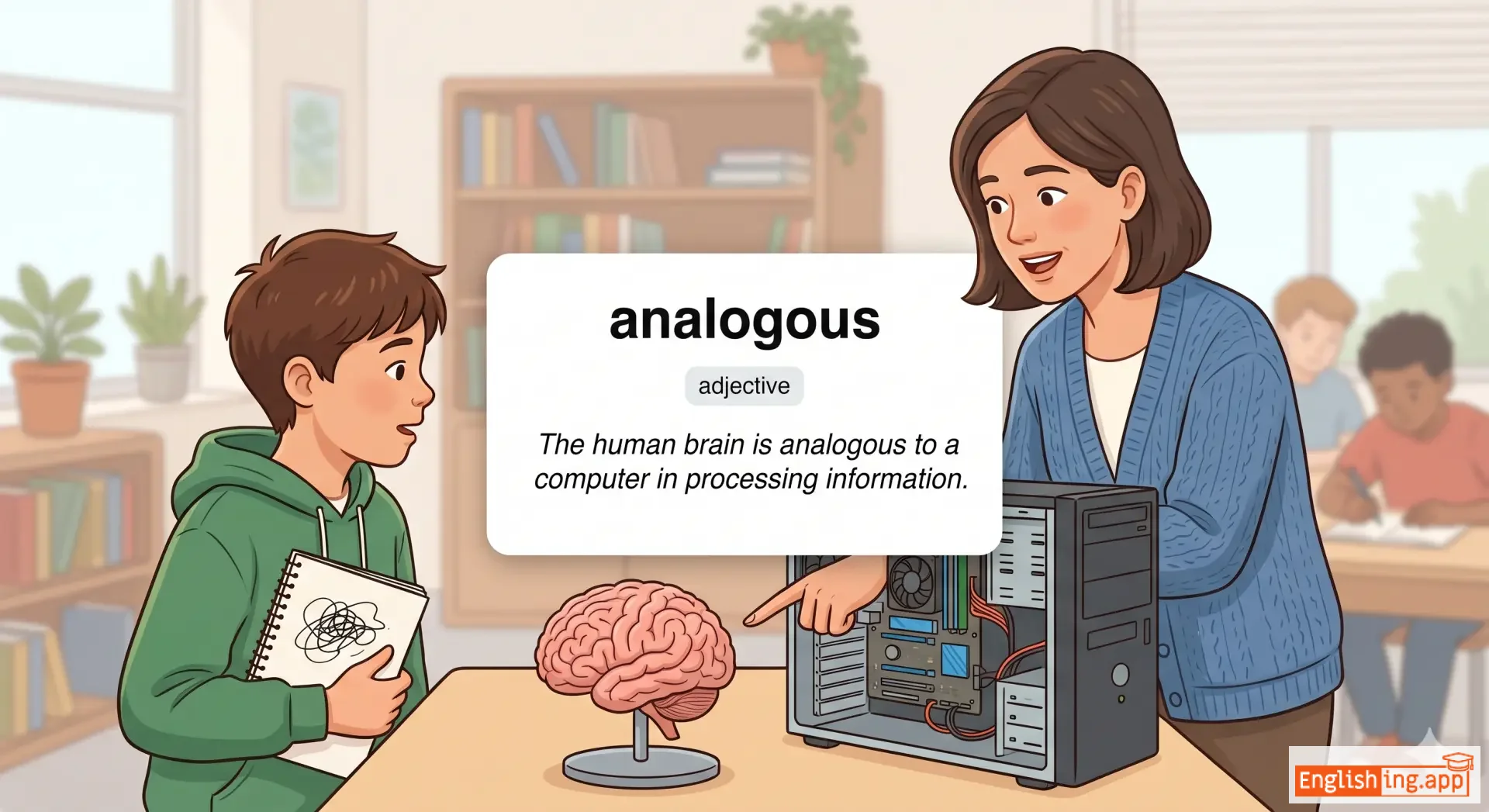
analogous definition card — visual illustration of the meaning
adjective
/əˈnæləɡəs/

Comparable in certain respects, typically in a way that makes clearer the nature of the things compared.

"The human brain is analogous to a computer in processing information."

noun
/əˈnælədʒi/
analogie (analogie)

A comparison between two things for the purpose of explanation or clarification.

"The teacher used the analogy of a tree to explain the structure of an essay."

"Le professeur a utilisé l'analogie d'un arbre pour expliquer la structure d'un essai." (Le professeur a utilise l'analogie d'un arbre pour expliquer la structure d'un essai.)
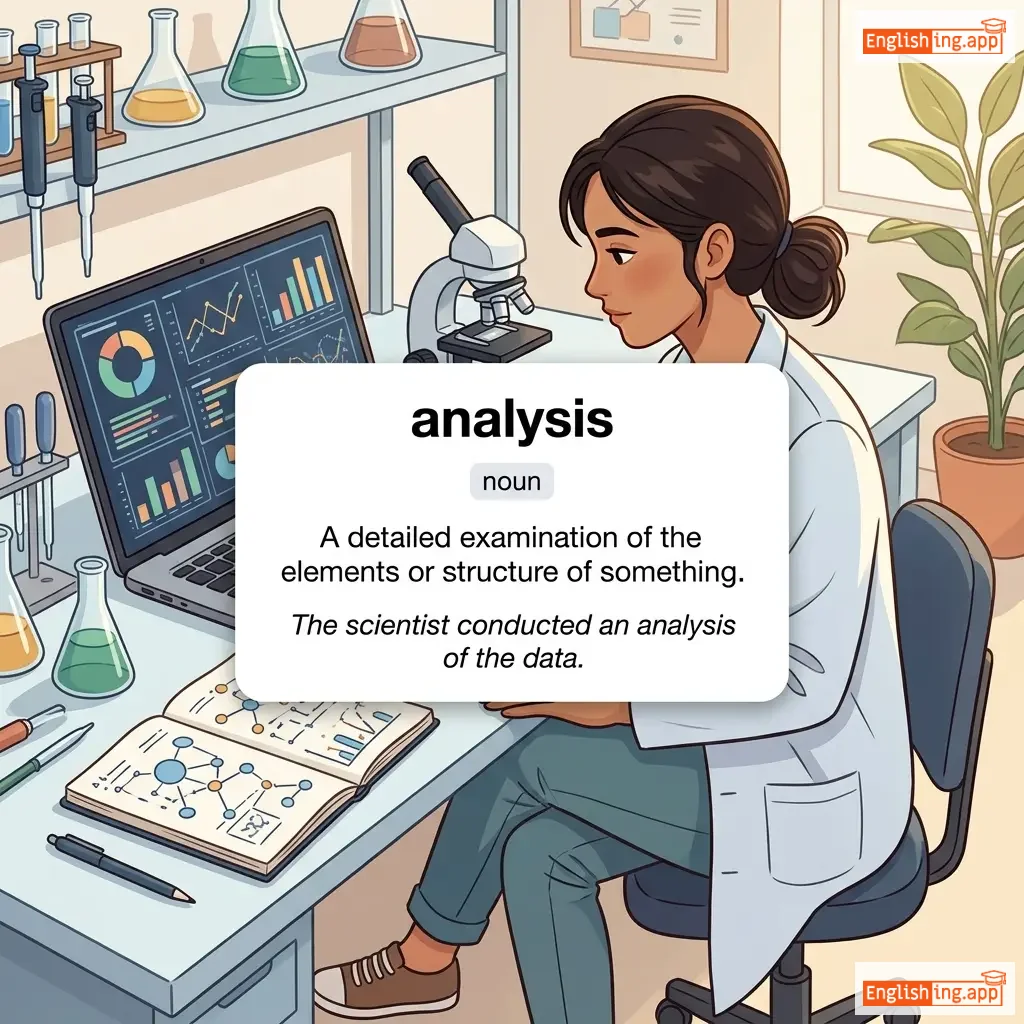
analysis definition card — visual illustration of the meaning
noun
/əˈnæləsɪs/
analyse (analyse)

A detailed examination of the elements or structure of something.

"The scientist conducted an analysis of the data."

"Le scientifique a effectué une analyse des données." (Le scientifique a effectué une analyse des données.)
noun
/ˈænəlɪst/
analyste (analiste)

a person who studies or examines something carefully to understand it or make decisions

"The financial analyst predicted a rise in the stock market."

"L'analyste financier a prédit une hausse du marché boursier." (L'analyste financier a prédit une hausse du marché boursier.)
analytical definition card — visual illustration of the meaning
adjective
ˌæn.əˈlɪt.ɪ.kəl
analytique (analytique)

Using analysis or logical reasoning; characterized by the use of analysis.

"His analytical approach helped solve the problem."

"Son approche analytique a aidé à résoudre le problème." (Son approche analytique a aidé à résoudre le problème.)
verb
/ˈænəlaɪz/
analyser (analyser)

to examine something in detail to understand it better or draw conclusions

"Scientists analyze data to discover new patterns."

"Les scientifiques analysent les données pour découvrir de nouveaux modèles." (Les scientifiques analysent les données pour découvrir de nouveaux modèles.)
noun
/ˈænərkɪst/
anarchiste (anarkiste)

a person who believes in or promotes the absence of government or authority

"The anarchist group protested against state control."

"Le groupe anarchiste a protesté contre le contrôle de l'État." (Le groupe anarchiste a protesté contre le contrôle de l'État.)