Vocabulaires

Découvrez, apprenez et maîtrisez le vocabulaire anglais

verb
/ʌnˈsɛtl/
perturber (perturber)

To disturb or make someone feel anxious or uneasy.

"The sudden news unsettled the entire community."

"La nouvelle soudaine a perturbé toute la communauté." (La nouvelle soudaine a perturbé toute la communauté.)
adjective
/ʌnˈʃeɪkən/
inquétable; ferme (inquetable; ferme)

not disturbed or affected; firm and steady; unwavering

"Her faith remained unshaken despite all the challenges."

"Sa foi est restée inébranlable malgré tous les défis." (Sa foi est restée inébranlable malgré tous les défis.)
adjective
/ʌnˈsaɪtli/
désagréable (desagreable)

Unpleasant to look at; ugly.

"The garbage pile created an unsightly view in the park."

"Le tas d'ordures a créé une vue désagréable dans le parc." (Le tas d'ordures a crée une vue désagréable dans le parc.)
adjective
/ʌnˈskɪld/
non qualifié; travailleur sans compétences (non qualifie; travailleur sans competences)

lacking technical training or ability; not requiring special skills

"Many unskilled workers are looking for training opportunities."

"De nombreux travailleurs non qualifiés recherchent des opportunités de formation." (De nombreux travailleurs non qualifiés recherchent des opportunités de formation.)
adjective
/ʌnˈsəʊʃəbl/
asocial (asocial)

not enjoying the company of others; avoiding social interaction

"He became unsociable after moving to a new city."

"Il est devenu asocial après avoir déménagé dans une nouvelle ville." (il est devenu asocial apres avoir demenage dans une nouvelle ville)
adjective
/ʌnˈsəʊʃəl/
asocial (asocial)

not enjoying the company of others; avoiding social interaction; contrary to social norms

"He prefers unsocial hours so he can work alone without interruptions."

"Il préfère des horaires asociaux pour travailler seul." (il prefere des horaires asociaux pour travailler seul)
adjective
/ʌnˈsoʊld/
invendu (invendu)

not sold; remaining without a buyer

"The unsold goods were returned to the warehouse."

"Les marchandises invendues ont été retournées à l’entrepôt." (les marchandises invendues ont ete retournees a l entrepot)
adjective
/ˌʌnsəˈfɪstɪˌkeɪtɪd/
non sophistiqué (non sophistique)

Lacking worldly experience, refinement, or complexity.

"The villagers led an unsophisticated but happy life."

"Les villageois menaient une vie non sophistiquée mais heureuse." (Les villageois menaient une vie non sophistiquée mais heureuse.)
adjective
/ʌnˈspɛərɪŋ/
implacable (implacable)

Showing no mercy or generosity; harsh or severe.

"The critic was unsparing in his review of the play."

"Le critique était implacable dans sa critique de la pièce." (Le critique était implacable dans sa critique de la pièce.)
adjective
/ʌnˈspiːkəbl/
indicible (indicible)

too bad or shocking to be expressed in words

"The survivors endured unspeakable horrors during the war."

"Les survivants ont enduré des horreurs indicibles pendant la guerre." (Les survivants ont enduré des horreurs indicibles pendant la guerre.)
adjective
/ʌnˈsteɪbəl/
instable (instable)

likely to change; not steady or secure; unsteady

"The unstable economy made people worried about their jobs."

"L'économie instable a rendu les gens inquiets au sujet de leurs emplois." (L'economie instable a rendu les gens inquiets au sujet de leurs emplois.)
adjective
/ʌnˈsteɪtɪd/
non exprimé (non exprime)

not expressed directly in words; implied or left unsaid

"The contract included several unstated expectations."

"Le contrat incluait plusieurs attentes non exprimées." (Le contrat incluait plusieurs attentes non exprimées.)
adjective
/ʌnˈstɛdi/
instable (instable)

not firm or stable; likely to change or fail

"She felt unsteady on her feet after the long journey."

"Elle se sentait instable après le long voyage." (Elle se sentait instable apres le long voyage)
adjective
/ʌnˈstɪntɪŋ/
généreux (genereu)

given generously without holding back

"She received unstinting support from her family."

"Elle a reçu un soutien généreux de sa famille." (Elle a recu un soutien genereux de sa famille.)
adjective
/ˌʌnsəkˈsesfl/
échoué; raté; (échoué; raté)

not achieving desired aims or results; failing to accomplish a purpose

"His unsuccessful attempt to climb the mountain left him disappointed."

"Sa tentative échouée de gravir la montagne l'a laissé déçu." (Sa tentative échouée de gravir la montagne l'a laissé déçu.)
adjective
/ʌnˈsuːtəbl/
inapproprié; inapte (inapropiye; inapto)

not fitting or appropriate for a particular purpose or situation

"This formal dress is unsuitable for a casual beach party."

"Cette robe formelle est inappropriée pour une fête de plage décontractée." (Cette robe formelle est inappropriée pour une fête de plage décontractée.)
adjective
/ʌnˈsʌlid/
immaculé (immacule)

not spoiled or made impure; perfectly clean or pure

"His reputation remained unsullied despite the accusations."

"Sa réputation est restée immaculée malgré les accusations." (Sa réputation est restée immaculée malgré les accusations.)
adjective
/ʌnˈʃʊr/
incertain (incertain)

not certain or confident; feeling doubt

"She felt unsure about the decision."

"Elle était incertaine à propos de la décision." (elle etait incertaine a propos de la decision)
adjective
/ʌnˈtiːtʃəbəl/
impossible à enseigner (impossible a enseigner)

not able or willing to learn; resistant to instruction or guidance

"He was so stubborn that he became almost unteachable."

"Il était si têtu qu’il est devenu presque impossible à enseigner." (il etait si tetu quil est devenu presque impossible a enseigner)
adjective
/ʌnˈtɛmpərd/
non tempéré (non tempeire)

not moderated or softened; lacking proper balance or control

"The untempered anger of the crowd caused chaos."

"La colère non tempérée de la foule a provoqué le chaos." (La colère non tempérée de la foule a provoqué le chaos.)
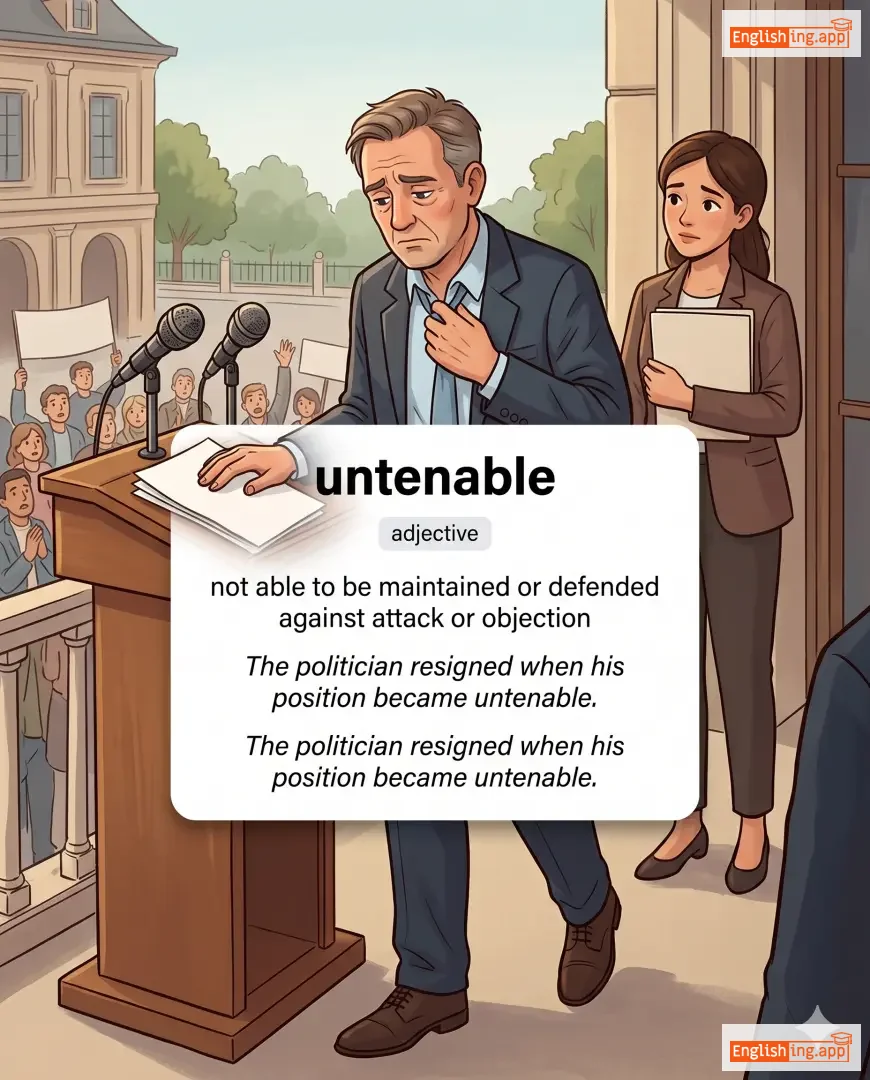
untenable definition card — visual illustration of the meaning
adjective
/ʌnˈtɛnəbl/
intenable (intenable)

not able to be maintained or defended against attack or objection

"The politician resigned when his position became untenable."

"Le politicien a démissionné lorsque sa position est devenue intenable." (Le politicien a démissionné lorsque sa position est devenue intenable.)
adjective
/ʌnˈθɪŋkəbl/
impensable (impensable)

impossible to conceive or imagine; beyond belief or consideration

"It was unthinkable that such a tragedy could happen in our peaceful town."

"Il était impensable qu'une telle tragédie puisse se produire dans notre ville paisible." (Il était impensable qu'une telle tragédie puisse se produire dans notre ville paisible.)
adjective
/ʌnˈθɪŋkɪŋ/
irréfléchi (irreflechi)

done without careful thought; automatic or thoughtless

"His unthinking remark hurt her feelings."

"Sa remarque irréfléchie a blessé ses sentiments." (sa remarque irreflechie a blesse ses sentiments)
adjective
/ʌnˈtaɪdi/
désordonné; en désordre; (desordonne)

not neat or orderly; messy and disorganized

"Her untidy room was filled with clothes scattered everywhere."

"Sa chambre en désordre était remplie de vêtements éparpillés partout." (sa chambre en desordre etait remplie de vetements eparpilles partout.)
verb
/ʌnˈtaɪ/
délier (delier)

to loosen or remove a knot or binding; to release something that is tied

"She untied the rope to free the boat."

"Elle a délié la corde pour libérer le bateau." (elle a delie la corde pour liberer le bateau)
preposition/conjunction
/ʌnˈtɪl/
jusqu'à (jusqu'a)

up to the time of

"I will wait until you come back."

"J'attendrai jusqu'à ce que tu reviennes." (J'attendrai jusqu'à ce que tu reviennes.)
adjective
/ʌnˈtaɪmli/
prématuré (premature)

Happening or done at an unsuitable or premature time.

"His untimely death shocked the entire community."

"Sa mort prématurée a choqué toute la communauté." (Sa mort prématurée a choqué toute la communauté.)
adjective
/ʌnˈtaɪərɪŋ/
inlassable; persévérant; infatigable (inlassable; perseverant; infatigable)

continuing without stopping; persistent; tireless

"Her untiring efforts finally led to success."

"Ses efforts inlassables ont finalement conduit au succès." (Ses efforts inlassables ont finalement conduit au succès.)
adjective
/ʌnˈtoʊld/
innombrable (innombrable)

Too great or numerous to be described or counted.

"The project caused untold stress for everyone involved."

"Le projet a causé un stress innombrable pour tous les impliqués." (Le projet a causé un stress innombrable pour tous les impliqués.)
adjective
/ʌnˈtʌtʃəbəl/
intouchable; au-delà de la critique ou de l'attaque (intouchable; au-dela de la critique ou de l'attaque)

not able to be touched or affected; beyond criticism or attack

"The CEO seemed untouchable despite the scandal."

"Le PDG semblait intouchable malgré le scandale." (Le PDG semblait intouchable malgre le scandale.)
adjective
/ˌʌn.təˈwɔːrd/
inattendu (inattendu)

Unexpected and inappropriate or inconvenient.

"The meeting ended without any untoward incidents."

"La réunion s'est terminée sans incidents inattendus." (La reunion s'est terminee sans incidents inattendus.)
adjective
/ʌnˈtræməld/
liberté illimitée (liberte illimitee)

Not restricted or hampered; free and unrestricted.

"She enjoyed untrammeled freedom in her new life abroad."

"Elle a apprécié la liberté illimitée dans sa nouvelle vie à l'étranger." (Elle a apprecie la liberte illimitee dans sa nouvelle vie a l'etranger.)
adjective
/ʌnˈtruː/
faux (faux)

not true; false or incorrect

"The rumor about the company closing was completely untrue."

"La rumeur sur la fermeture de l'entreprise était complètement fausse." (La rumeur sur la fermeture de l'entreprise était complètement fausse.)
adjective
/ʌnˈjuzd/
non utilisé; inutilisé (non utilise; inutilise)

not being used; not having been used before

"There are many unused rooms in this old mansion."

"Il y a beaucoup de pièces inutilisées dans ce vieux manoir." (Il y a beaucoup de pieces inutilisees dans ce vieux manoir.)
adjective
/ʌnˈjuːʒuəl/
inhabituel (inhabituel)

not common or ordinary; remarkable or exceptional

"She has an unusual talent for solving complex problems."

"Elle a un talent inhabituel pour résoudre des problèmes complexes." (Elle a un talent inhabituel pour résoudre des problèmes complexes.)
adverb
/ʌnˈjuːʒuəli/
de manière inhabituelle (de maniere inhabituelle)

in a way that is not typical or expected; to an uncommon degree

"It was unusually cold for this time of year."

"Il faisait inhabituellement froid pour cette période de l'année." (Il faisait inhabituellement froid pour cette periode de l annee)
adjective
/ʌnˈʌtərəbl/
inexprimable (inexprimable)

Too great, intense, or awful to be expressed or described in words.

"She was filled with unutterable joy at the news of her success."

"Elle était remplie de joie inexprimable en apprenant la nouvelle de son succès." (Elle était remplie de joie inexprimable en apprenant la nouvelle de son succès.)
verb
/ʌnˈveɪl/
dévoiler (devoiler)

to reveal or disclose something, especially in a formal manner

"The company will unveil a new product next week."

"L'entreprise dévoilera un nouveau produit la semaine prochaine." (L'entreprise devoilera un nouveau produit la semaine prochaine.)
adjective
/ʌnˈvaɪəbl/
invivable (invivable)

Not capable of working successfully; not feasible or practical.

"The project was deemed unviable due to high costs."

"Le projet a été jugé invivable en raison des coûts élevés." (Le projet a ete juge invivable en raison des couts eleves.)
adjective
/ʌnˈvɔɪst/
non exprimé (non exprime)

not expressed in speech; in phonetics, a sound produced without vocal cord vibration

"The student kept her opinion unvoiced during the meeting."

"L'étudiante a gardé son opinion non exprimée pendant la réunion." (L'étudiante a gardé son opinion non exprimée pendant la réunion.)
adjective
/ʌnˈwɒn.tɪd/
indésirable (indesirable)

not desired or welcome; not wanted

"He felt like an unwanted guest at the meeting."

"Il se sentait comme un invité indésirable à la réunion." (Il se sentait comme un invité indésirable à la réunion.)
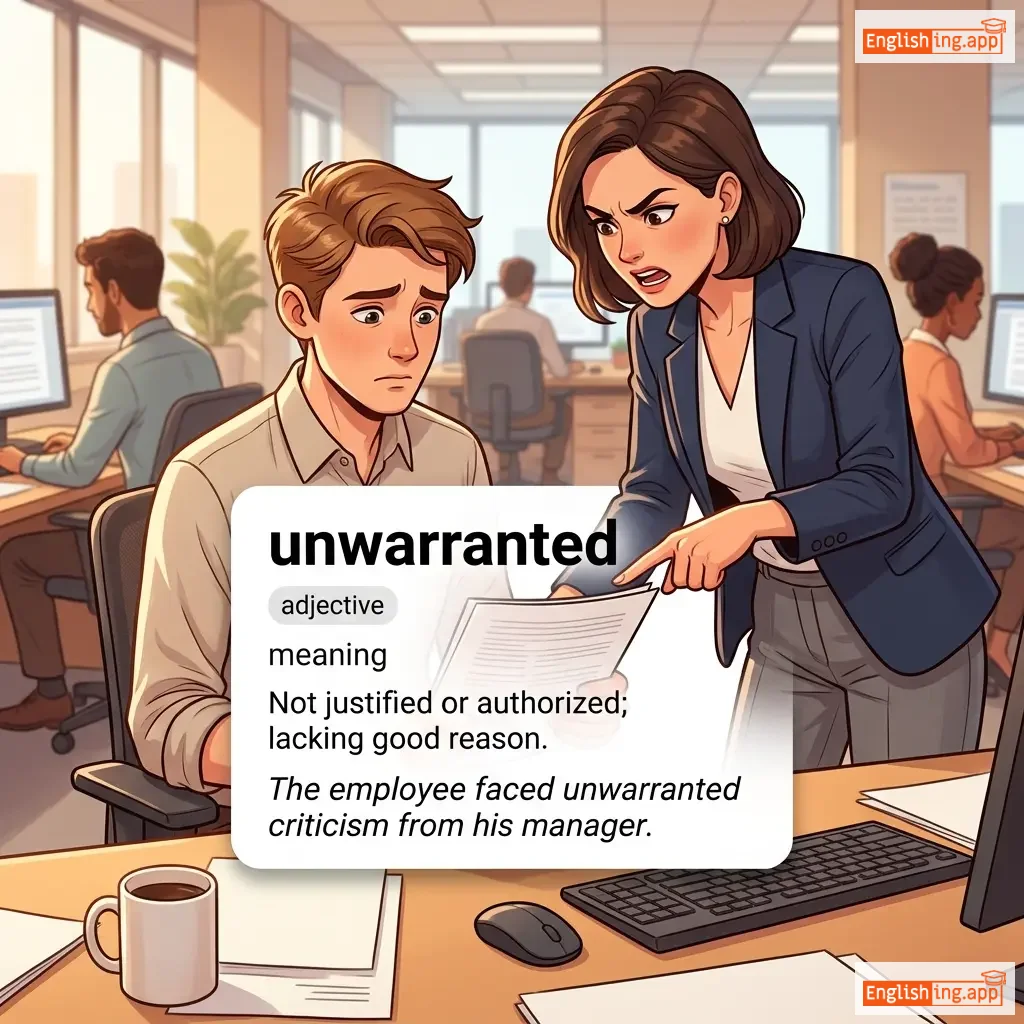
unwarranted definition card — visual illustration of the meaning
adjective
/ʌnˈwɒrəntɪd/
injustifié (injustifie)

Not justified or authorized; lacking good reason.

"The employee faced unwarranted criticism from his manager."

"L'employé a fait face à des critiques injustifiées de son responsable." (L'employé a fait face à des critiques injustifiées de son responsable.)
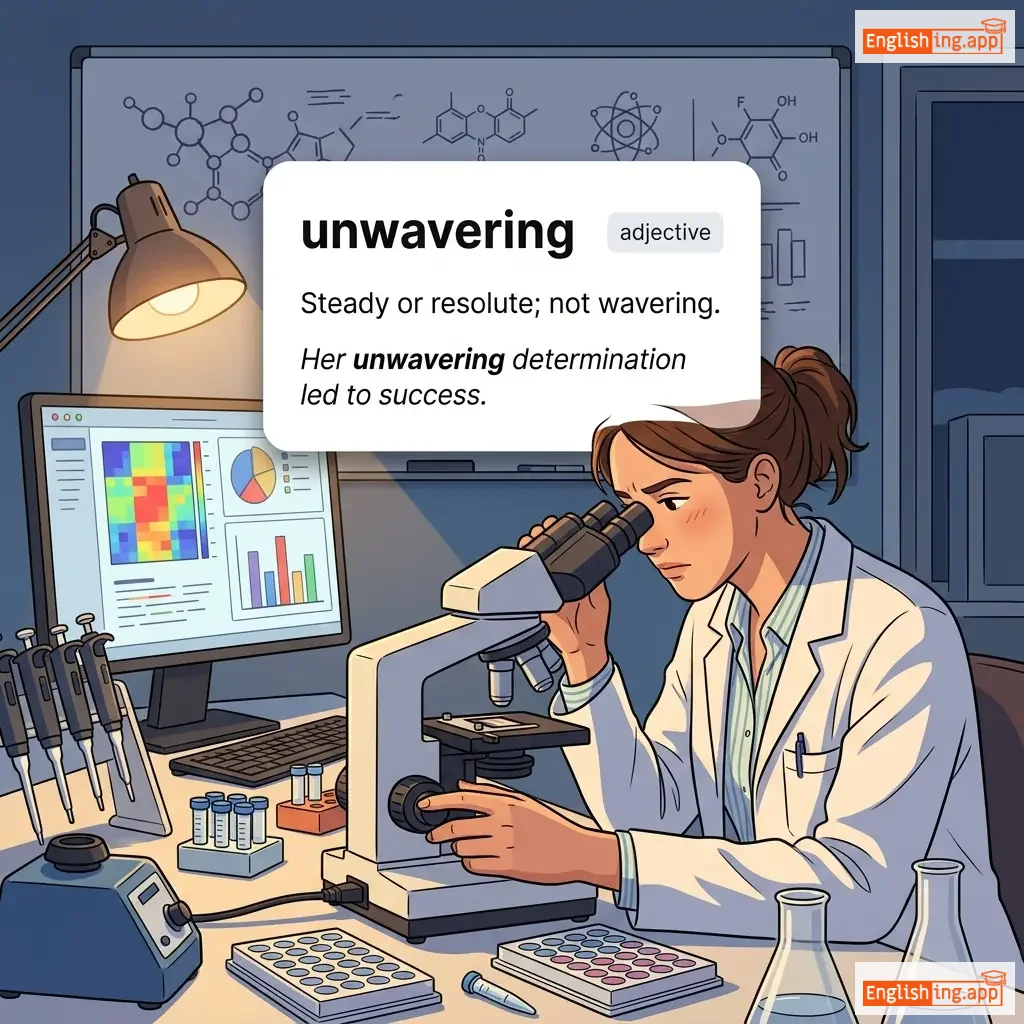
unwavering definition card — visual illustration of the meaning
adjective
/ʌnˈweɪ.vər.ɪŋ/
inébranlable, ferme, résolu (inebranlable, ferme, resolu)

Steady or resolute; not wavering.

"Her unwavering determination led to success."

"Sa détermination inébranlable l'a conduite au succès." (Sa détermination inébranlable l'a conduite au succès.)
adjective
/ʌnˈwel.kəm/
désagréable; non désiré; indésirable (desagreable; non desire; indesirable)

not wanted or accepted; not invited or pleasant

"The unwelcome news ruined their vacation plans."

"Les mauvaises nouvelles ont ruiné leurs plans de vacances." (Les mauvaises nouvelles ont ruiné leurs plans de vacances.)
adjective
/ʌnˈwel/
malade; indisposé (malade; indispose)

not in good health; feeling sick or ill

"She has been feeling unwell since yesterday."

"Elle se sent mal depuis hier." (Elle se sent mal depuis hier.)
adjective
/ʌnˈwiːldi/
difficile à manipuler (difficile a manipuler)

Difficult to carry or move because of its size, shape, or weight.

"The box was too unwieldy to carry up the stairs."

"La boîte était trop difficile à manipuler pour être montée dans les escaliers." (La boite etait trop difficile a manipuler pour etre montee dans les escaliers.)
adjective
/ʌnˈwɪl.ɪŋ/
réticent; récalcitrant; (réticent; récalcitrant)

not ready to do something; reluctant; not wanting to do

"He was unwilling to share his secret with anyone."

"Il ne voulait pas partager son secret avec qui que ce soit." (Il ne voulait pas partager son secret avec qui que ce soit.)
adverb
/ʌnˈwɪlɪŋli/
à contrecœur (a contrecœur)

in a way that shows reluctance or lack of desire; not willingly

"She unwillingly agreed to attend the meeting."

"Elle a accepté à contrecœur d'assister à la réunion." (elle a accepte a contrecœur dassister a la reunion)
adjective
/ʌnˈwaɪz/
imprudent (imprudent)

Showing poor judgment; not sensible or prudent.

"It would be unwise to invest all your money in one company."

"Il serait imprudent d'investir tout votre argent dans une seule entreprise." (Il serait imprudent d'investir tout votre argent dans une seule entreprise.)
adjective
/ʌnˈwɪtɪŋ/
involontaire (involontaire)

Not aware of what is happening; done without realizing.

"She became an unwitting participant in the scam."

"Elle est devenue une participante involontaire dans l'escroquerie." (Elle est devenue une participante involontaire dans l'escroquerie.)