Vocabulaires

Découvrez, apprenez et maîtrisez le vocabulaire anglais

verb
/ˈtɛrəˌfaɪ/
terrifier (terifier)

To cause someone to feel extreme fear.

"The loud thunder terrified the children."

"Le fort tonnerre a terrifié les enfants." (Le fort tonnerre a terrifie les enfants.)
adjective
/ˌtɛrɪˈtɔːriəl/
territorial (territorial)

Relating to the ownership or control of land or territory.

"The two countries had a territorial dispute over the island."

"Les deux pays avaient un différend territorial concernant l'île." (Les deux pays avaient un different territorial concernant l'ile.)
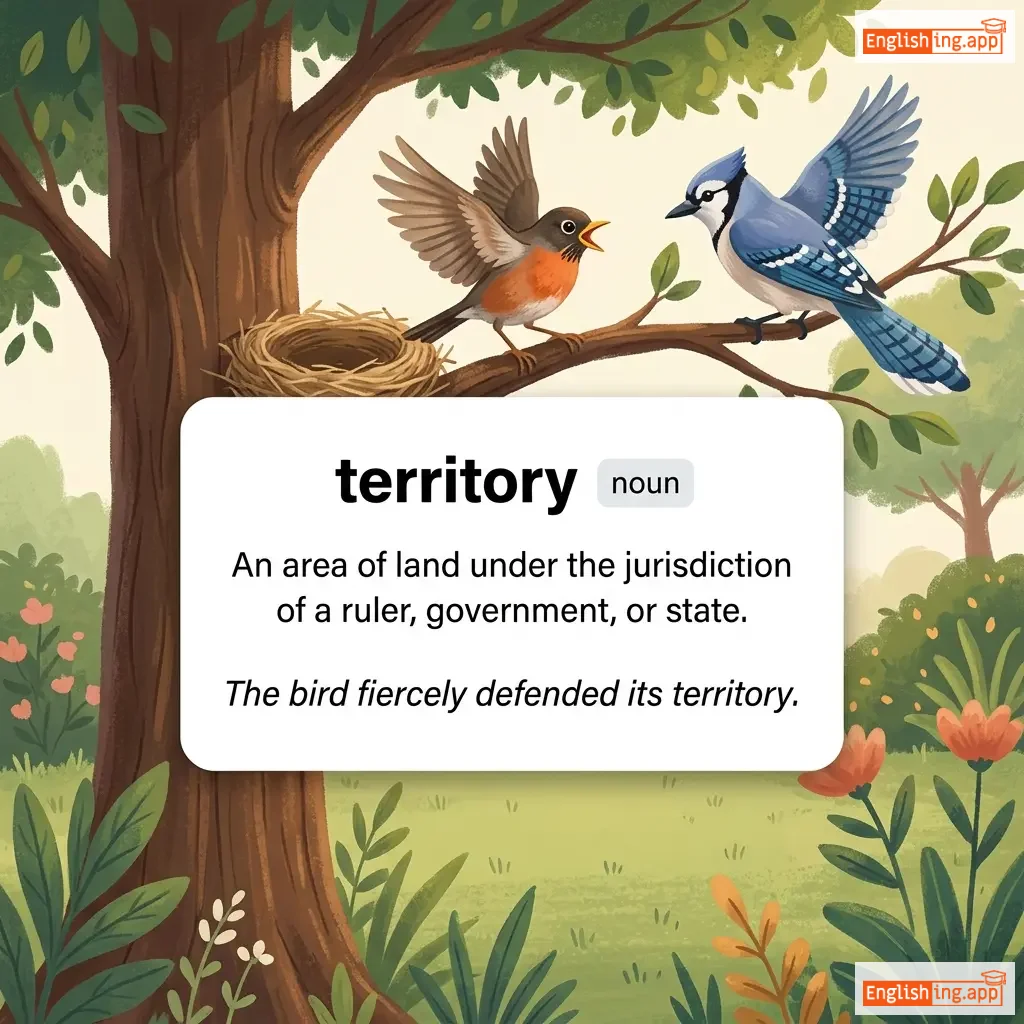
territory definition card — visual illustration of the meaning
noun
/ˈtɛrɪˌtɔːri/
territoire (territoire)

An area of land under the jurisdiction of a ruler, government, or state.

"The bird fiercely defended its territory."

"L'oiseau a défendu son territoire avec férocité." (L'oiseau a defendu son territoire avec ferocite.)
noun
/ˈtɛrər/
terreur (terreur)

Extreme fear or dread.

"The villagers fled in terror during the attack."

"Les villageois ont fui dans la terreur lors de l'attaque." (Les villageois ont fui dans la terreur lors de l'attaque.)
noun
/ˈtɛrərɪzəm/
terrorisme (terrorisme)

the use of violence or threats to intimidate or coerce, especially for political purposes

"Terrorism is a serious threat to global peace and security."

"Le terrorisme est une menace sérieuse pour la paix et la sécurité mondiales." (Le terrorisme est une menace sérieuse pour la paix et la sécurité mondiales.)
noun
/ˈtɛrərɪst/
terroriste (terroriste)

a person who uses violence or threats to intimidate or coerce, especially for political purposes

"The terrorist was arrested by the police after the attack."

"Le terroriste a été arrêté par la police après l'attaque." (Le terroriste a été arrêté par la police après l'attaque.)
adjective
/tɜːrs/
bref (bref)

brief and to the point; sparing in the use of words

"His reply was terse and ended the conversation quickly."

"Sa réponse était brève et a rapidement mis fin à la conversation." (sa reponse etait breve et a rapidement mis fin a la conversation.)
adjective
/ˈtɜːrʃieri/
tertiaire (tertiaire)

third in order, rank, or level

"He is pursuing his tertiary education at the university."

"Il poursuit ses études tertiaires à l'université." (Il poursuit ses etudes tertiaires a l universite)
adjective
/ˈtɛsəleɪtɪd/
carrelé (carrele)

arranged in a pattern of repeated shapes fitting together without gaps

"The tessellated floor was made of colorful tiles arranged in perfect symmetry."

"Le sol carrelé était composé de carreaux colorés disposés en parfaite symétrie." (Le sol carrele etait compose de carreaux colores disposes en parfaite symetrie.)
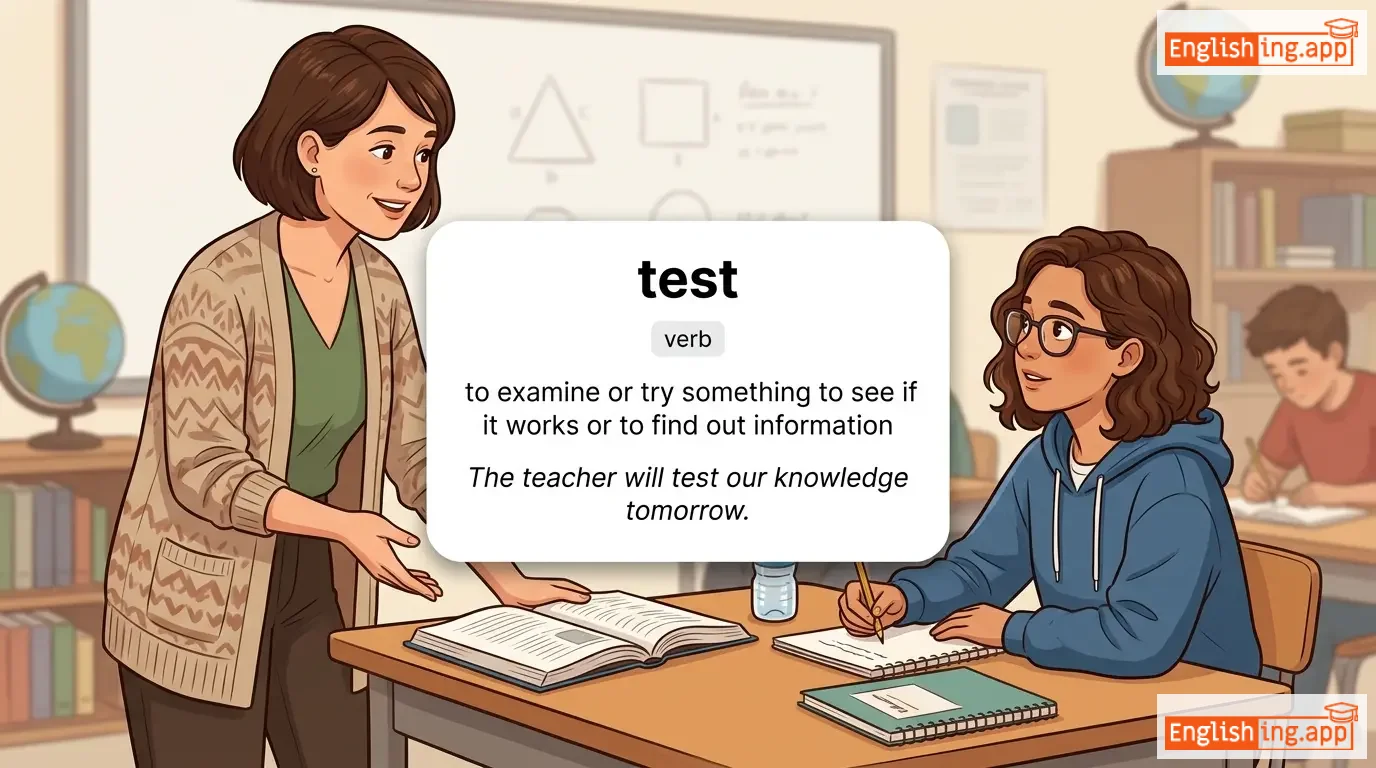
test definition card — visual illustration of the meaning
noun
/tɛst/
test (test)

a procedure intended to establish the quality, performance, or reliability of something

"The test results will determine whether the treatment is effective."

"Les résultats du test détermineront si le traitement est efficace." (Les résultats du test détermineront si le traitement est efficace.)
noun
/ˈtɛstəmənt/
testament / preuve (testament / preuve)

a person's will; or strong evidence of something

"His success is a testament to his hard work and dedication."

"Son succès est un testament de son travail acharné et de son dévouement." (Son succès est un testament de son travail acharné et de son dévouement.)
noun
/ˈtɛsteɪtər/
testateur (testateur)

a person who has made a will

"The lawyer read the will of the deceased testator."

"L'avocat a lu le testament du testateur décédé." (L'avocat a lu le testament du testateur décédé.)
verb
/ˈtɛstəfaɪ/
témoigner (temoigner)

to make a statement or declaration under oath or to give evidence

"She was called to testify in court about the accident."

"Elle a été appelée à témoigner au tribunal sur l'accident." (Elle a été appelée à témoigner au tribunal sur l'accident.)
noun
/ˌtɛstɪˈmoʊniəl/
témoignage (temoignage)

A formal statement testifying to someone's character, qualifications, or the quality of a product or service.

"The company shared a glowing testimonial from a satisfied customer."

"L'entreprise a partagé un témoignage élogieux d'un client satisfait." (L'entreprise a partage un temoignage elogieux d'un client satisfait.)
testimonials definition card — visual illustration of the meaning
noun
/ˌtɛstɪˈməʊnɪəlz/
témoignages, lettres de recommandation (temoignages, lettres de recommandation)

Written or spoken statements of praise or recommendation from clients or customers.

"Positive testimonials can enhance a company's reputation."

"Des témoignages positifs peuvent améliorer la réputation d'une entreprise." (Des temoignages positifs peuvent ameliorer la reputation d'une entreprise.)
noun
/ˈtɛstəˌmoʊni/
témoignage (temoignage)

A formal statement given in a court of law or evidence supporting a fact.

"Her testimony in court helped convict the criminal."

"Son témoignage devant le tribunal a aidé à condamner le criminel." (Son temoignage devant le tribunal a aide a condamner le criminel.)
noun
/ˈtɛstɪŋ/
test (test)

the process of assessing or evaluating something, often by trying it out

"The testing of the new software is still ongoing."

"Le test du nouveau logiciel est toujours en cours." (Le test du nouveau logiciel est toujours en cours.)
adjective
/ˈtɛsti/
irritable (irritable)

Easily irritated or annoyed.

"He became testy when asked the same question repeatedly."

"Il est devenu irritable lorsqu'on lui a posé la même question à plusieurs reprises." (Il est devenu irritable lorsqu'on lui a posé la même question à plusieurs reprises.)
verb
/ˈtɛðər/
attacher (attacher)

To tie an animal with a rope or chain so it cannot move far.

"The farmer tethered the goat to a post."

"Le fermier a attaché la chèvre à un poteau." (Le fermier a attaché la chèvre à un poteau.)
noun
/tɛkst/
texte (texte)

a written or printed work or passage, especially a book or document

"The teacher asked us to read the text on page 50."

"L'enseignant nous a demandé de lire le texte à la page 50." (L'enseignant nous a demandé de lire le texte à la page 50.)
noun
/ˈtɛkstbʊk/
livre scolaire (livre scolaire)

a book used for studying a subject in school or college

"She bought a new biology textbook for her class."

"Elle a acheté un nouveau livre de biologie pour sa classe." (Elle a acheté un nouveau livre de biologie pour sa classe.)
noun
/ˈtek.staɪl/
tissu (tissu)

a type of cloth or woven fabric made by knitting or weaving fibers

"Bangladesh is famous for its high-quality textile industry."

"Le Bangladesh est célèbre pour son industrie textile de haute qualité." (Le Bangladesh est célèbre pour son industrie textile de haute qualité.)
noun
/ˈtɛkstʃər/
texture (texture)

the way something feels when you touch it; the quality of a surface or substance

"The fabric has a soft and smooth texture."

"Le tissu a une texture douce et lisse." (Le tissu a une texture douce et lisse.)
conjunction
/ðæn/
que (que)

used to introduce the second element in a comparison

"She is taller than her brother."

"Elle est plus grande que son frère." (Elle est plus grande que son frère.)
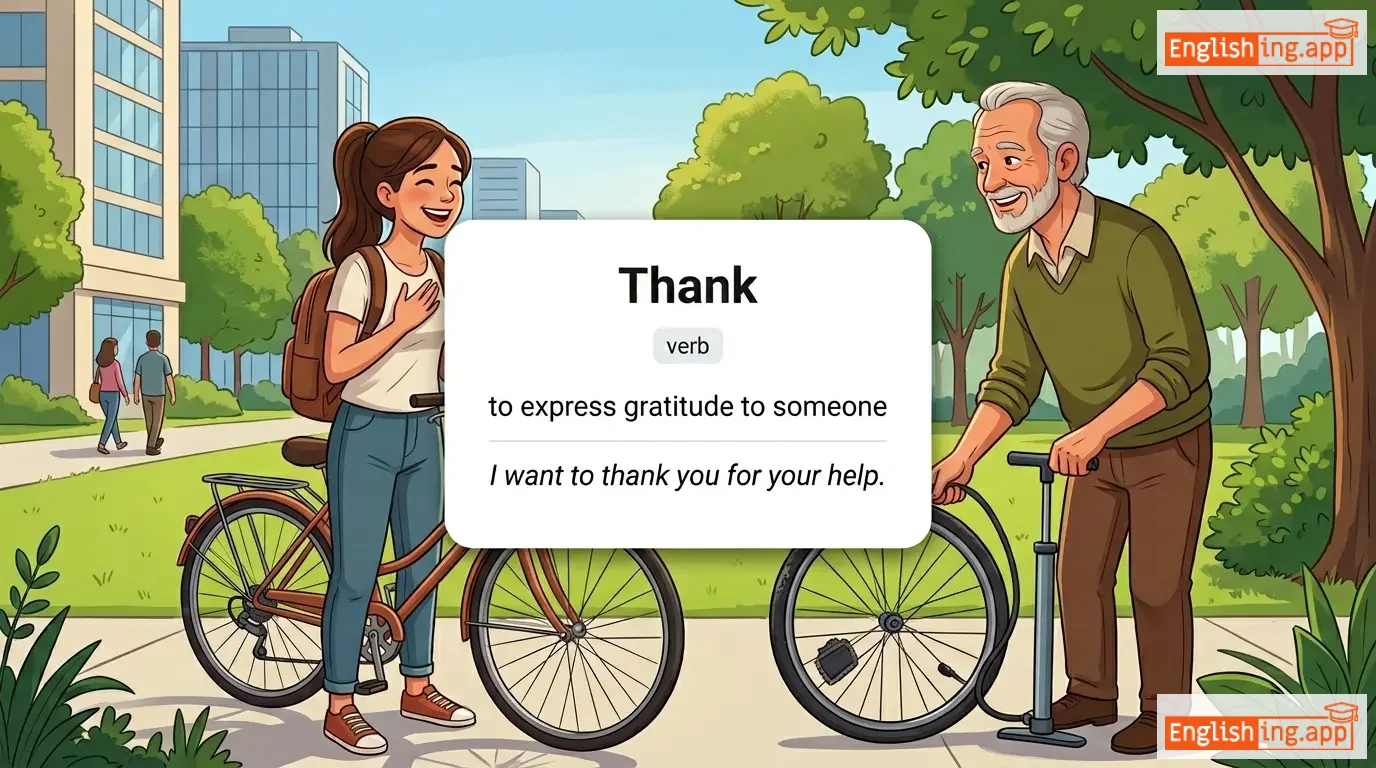
Thank definition card — visual illustration of the meaning
verb
/θæŋk/
remercier (remercier)

to express gratitude to someone

"I want to thank you for your help."

"Je veux vous remercier pour votre aide." (Je veux vous remercier pour votre aide.)
adjective
/ˈθæŋk.fəl/
reconnaissant; reconnaissante (reconnaissant; reconnaissante)

pleased and relieved; expressing gratitude; appreciative

"I am thankful for all your help and support."

"Je suis reconnaissant pour toute ton aide et ton soutien." (Je suis reconnaissant pour toute ton aide et ton soutien.)
adverb
/ˈθæŋkfəli/
heureusement (heureusement)

used to express relief or gratitude

"Thankfully, she arrived just in time for the meeting."

"Heureusement, elle est arrivée juste à temps pour la réunion." (Heureusement, elle est arrivée juste à temps pour la réunion.)
noun
/θæŋks/
merci (merci)

an expression of gratitude

"Thanks for helping me with the project."

"Merci de m'avoir aidé avec le projet." (Merci de m'avoir aidé avec le projet.)
noun
/ˈθæŋksˌɡɪvɪŋ/
Action de Grâce (Action de Grace)

an annual holiday in the US for giving thanks, celebrated with a meal

"We spent Thanksgiving dinner with our family."

"Nous avons passé le dîner de Thanksgiving avec notre famille." (Nous avons passe le diner de Thanksgiving avec notre famille.)
pronoun
/ðæt/
ce (se)

used to identify a specific person or thing observed or heard

"That is my book on the table."

"C'est mon livre sur la table." (C'est mon livre sur la table.)
noun
/ˈθɔːməˌtɜrdʒɪst/
thaumaturge (thaumaturge)

A worker of miracles or magician.

"The thaumaturgist amazed the audience with his tricks."

"Le thaumaturge a émerveillé le public avec ses tours." (Le thaumaturge a émerveillé le public avec ses tours.)
verb
/θɔː/
fondre (fondre)

to melt or cause to melt after being frozen

"The ice began to thaw in the sun."

"La glace a commencé à fondre au soleil." (La glace a commencé à fondre au soleil.)
article
/ðə/
le (luh)

used to specify a noun as something already mentioned or known

"The sun rises in the east."

"Le soleil se lève à l'est." (Le soleil se leve a l est)
noun
/ˈθiː.ɑːr.ki/
théarchie (thearchie)

Rule or government by the gods; divine sovereignty.

"In ancient cultures, some societies believed in thearchy where gods directly guided human affairs."

"Dans les cultures anciennes, certaines sociétés croyaient en la théarchie où les dieux guidaient directement les affaires humaines." (Dans les cultures anciennes, certaines sociétés croyaient en la théarchie où les dieux guidaient directement les affaires humaines.)
noun
/ˈθiːətər/
théâtre (theatre)

a building or area for dramatic performances

"We are going to the theater tonight."

"Nous allons au théâtre ce soir." (Nous allons au theatre ce soir.)
adjective
/θiˈætrɪkl/
théâtral (theatral)

Relating to the theater or exaggerated and dramatic in behavior or style.

"Her theatrical performance won the audience's applause."

"Sa performance théâtrale a récolté les applaudissements du public." (Sa performance theatrale a recolte les applaudissements du public.)
noun
/θɛft/
vol (vol)

the action or crime of stealing

"The theft of his wallet was reported to the police."

"Le vol de son portefeuille a été signalé à la police." (Le vol de son portefeuille a été signalé à la police.)
👨‍👩‍👧‍👦

their (ðɛər)

pronoun
/ðɛər/
leur (leur)

belonging to or associated with the people or things previously mentioned

"Their house is on the corner."

"Leur maison est au coin." (Leur maison est au coin.)
pronoun
/ðɛərz/
à eux (a eux)

belonging to them; that which is theirs

"This book is theirs, not ours."

"Ce livre est à eux, pas à nous." (Ce livre est a eux, pas a nous.)
noun
/ˈθiːɪzəm/
théisme (theisme)

Belief in the existence of a god or gods, especially a creator who intervenes in the universe.

"Theism is central to many world religions."

"Le théisme est central dans de nombreuses religions du monde." (Le théisme est central dans de nombreuses religions du monde.)
pronoun
/ðɛm/
eux (eux)

used to refer to people or things previously mentioned or easily identified

"I saw them at the park yesterday."

"Je les ai vus au parc hier." (Je les ai vus au parc hier.)
adjective
/θiːˈmætɪk/
thématique (thématique)

Relating to or based on a theme.

"The book is organized into thematic chapters."

"Le livre est organisé en chapitres thématiques." (Le livre est organise en chapitres thematiques.)
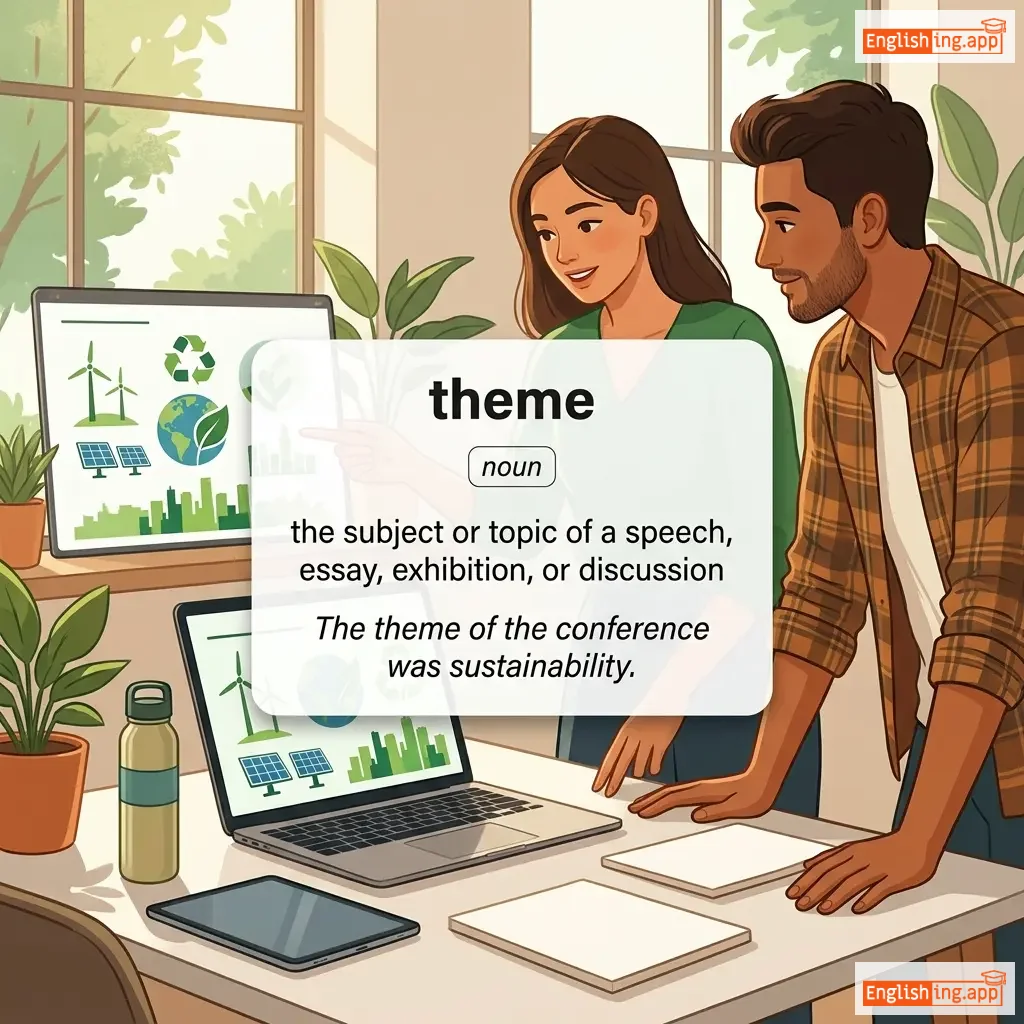
theme definition card — visual illustration of the meaning
noun
/θiːm/
thème (theme)

the subject or topic of a speech, essay, exhibition, or discussion

"The theme of the conference was sustainability."

"Le thème de la conférence était la durabilité." (Le thème de la conférence était la durabilité.)
pronoun
/ðəmˈsɛlvz/
eux-mêmes (eux-memes)

used to emphasize the subject of the sentence or to refer to the subject doing something to itself

"They fixed the problem themselves."

"Ils ont résolu le problème eux-mêmes." (Ils ont resolu le probleme eux-memes.)
adverb
/ðɛn/
alors (alors)

at that time; next in order of time or place

"We went to the park, and then we had lunch."

"Nous sommes allés au parc, puis nous avons déjeuné." (Nous sommes allés au parc, puis nous avons déjeuné.)
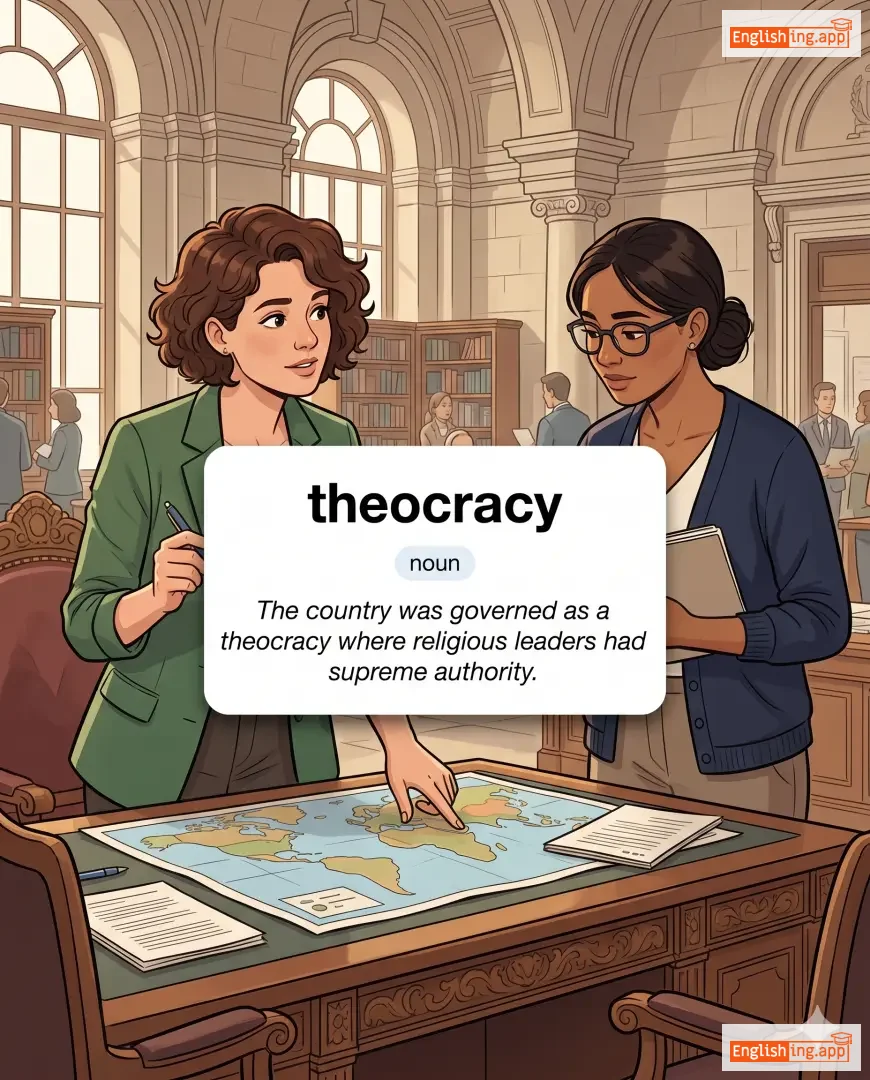
theocracy definition card — visual illustration of the meaning
noun
/θiˈɒkrəsi/
théocratie (theokrati)

A system of government in which priests or religious leaders rule in the name of God or a deity.

"The country was governed as a theocracy where religious leaders had supreme authority."

"Le pays était gouverné comme une théocratie où les dirigeants religieux avaient l'autorité suprême." (Le pays etait gouverne comme une theocratie ou les dirigeants religieux avaient l'autorite supreme.)
noun
/θiˈɒkrəsi/
théocratie (theocratie)

Government or rule by religious leaders or clergy.

"Theocrasy often merges religious authority with political power."

"La théocratie fusionne souvent l'autorité religieuse avec le pouvoir politique." (La theocratie fusionne souvent l'autorite religieuse avec le pouvoir politique.)
noun
/ˌθiːəˈloʊdʒən/
théologien (theologien)

A person who studies or is an expert in theology.

"Theologians often debate complex questions of faith and morality."

"Les théologiens débattent souvent de questions complexes de foi et de moralité." (Les théologiens débattent souvent de questions complexes de foi et de moralité.)
adjective
/ˌθiːəˈlɒdʒɪkl/
théologique (theologique)

Relating to the study of theology or religious belief.

"He wrote a theological paper on the concept of divine justice."

"Il a écrit un article théologique sur le concept de justice divine." (Il a ecrit un article theologique sur le concept de justice divine.)
noun
/θiˈɒlədʒi/
théologie (theologie)

The study of the nature of God and religious beliefs.

"She is pursuing a degree in theology at the university."

"Elle poursuit un diplôme en théologie à l'université." (Elle poursuit un diplome en theologie a l'universite.)