Vocabulaires

Découvrez, apprenez et maîtrisez le vocabulaire anglais

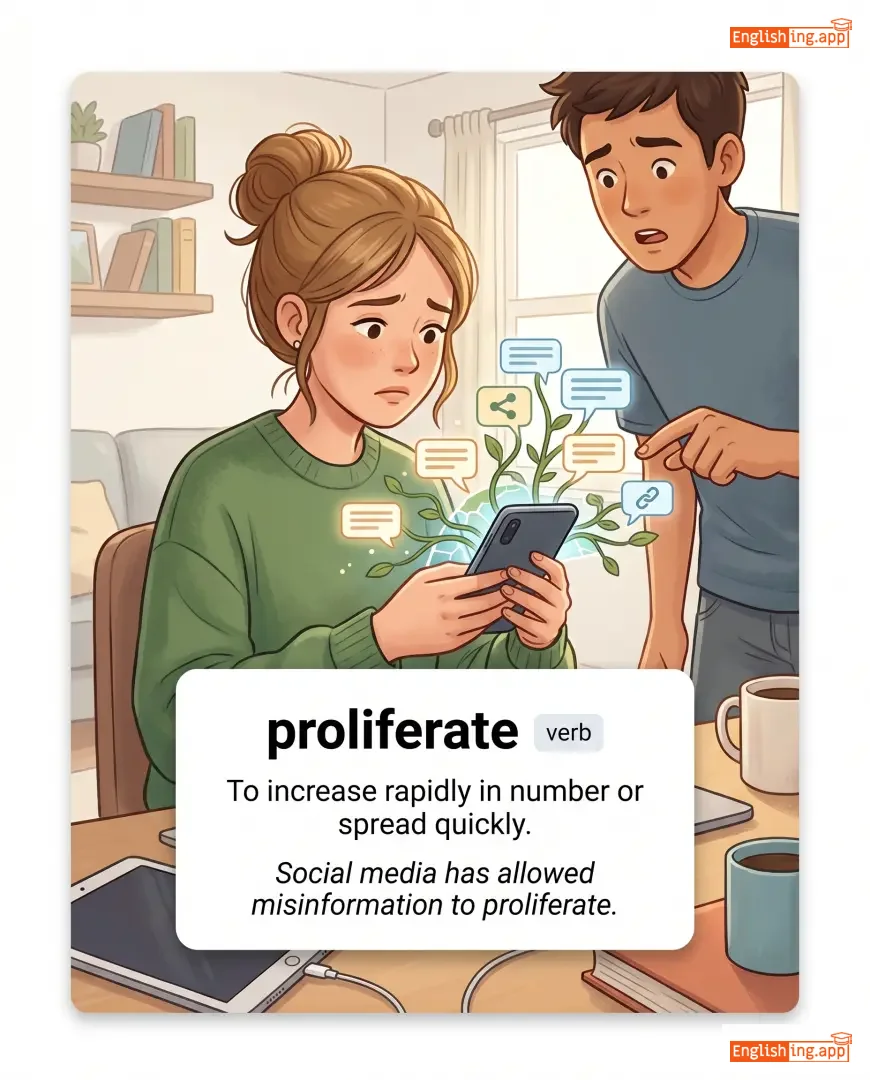
proliferate definition card — visual illustration of the meaning
verb
/prəˈlɪfəreɪt/
proliférer (proliférer)

To increase rapidly in number or spread quickly.

"Social media has allowed misinformation to proliferate."

"Les réseaux sociaux ont permis à la désinformation de proliférer." (Les réseaux sociaux ont permis à la désinformation de proliférer.)
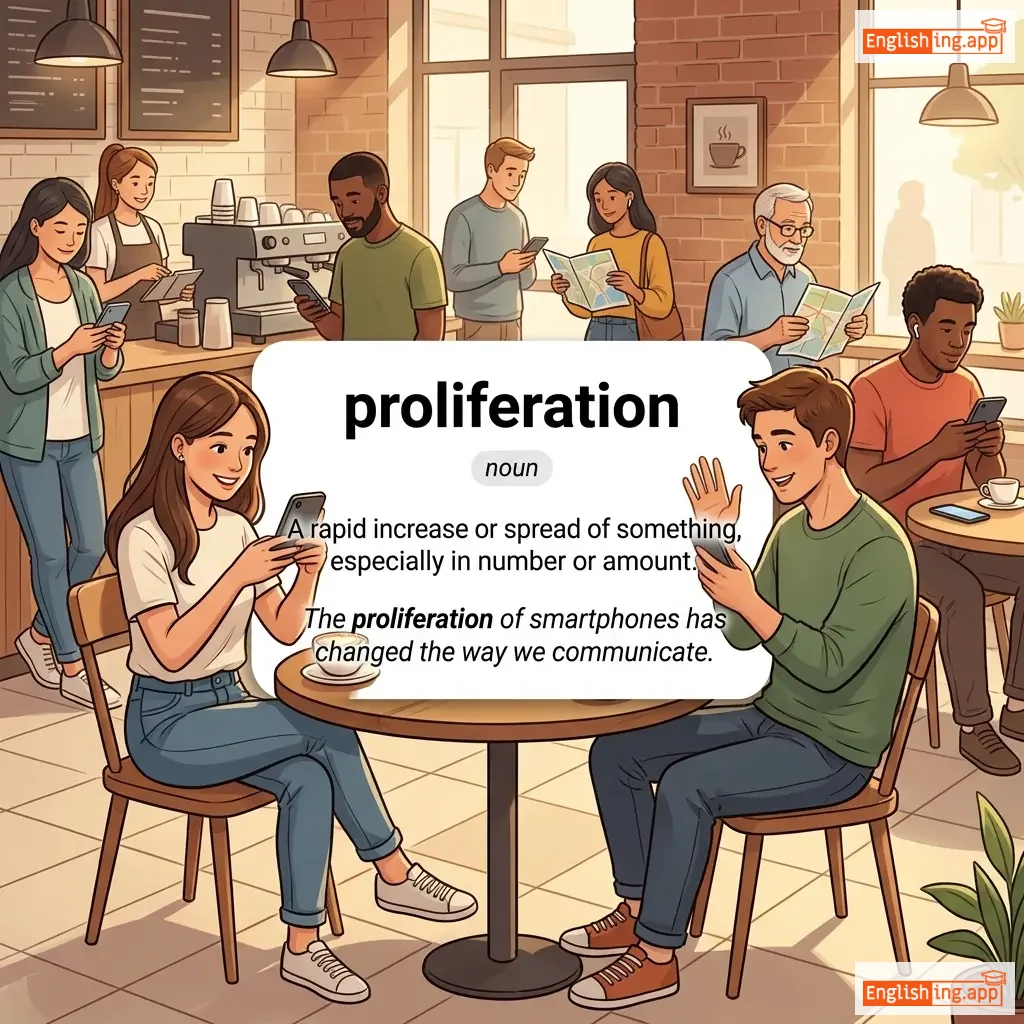
proliferation definition card — visual illustration of the meaning
noun
/prəˌlɪfəˈreɪʃən/
prolifération, expansion (proliferation, expansion)

A rapid increase or spread of something, especially in number or amount.

"The proliferation of smartphones has changed the way we communicate."

"La prolifération des smartphones a changé notre manière de communiquer." (La proliferation des smartphones a change notre maniere de communiquer.)
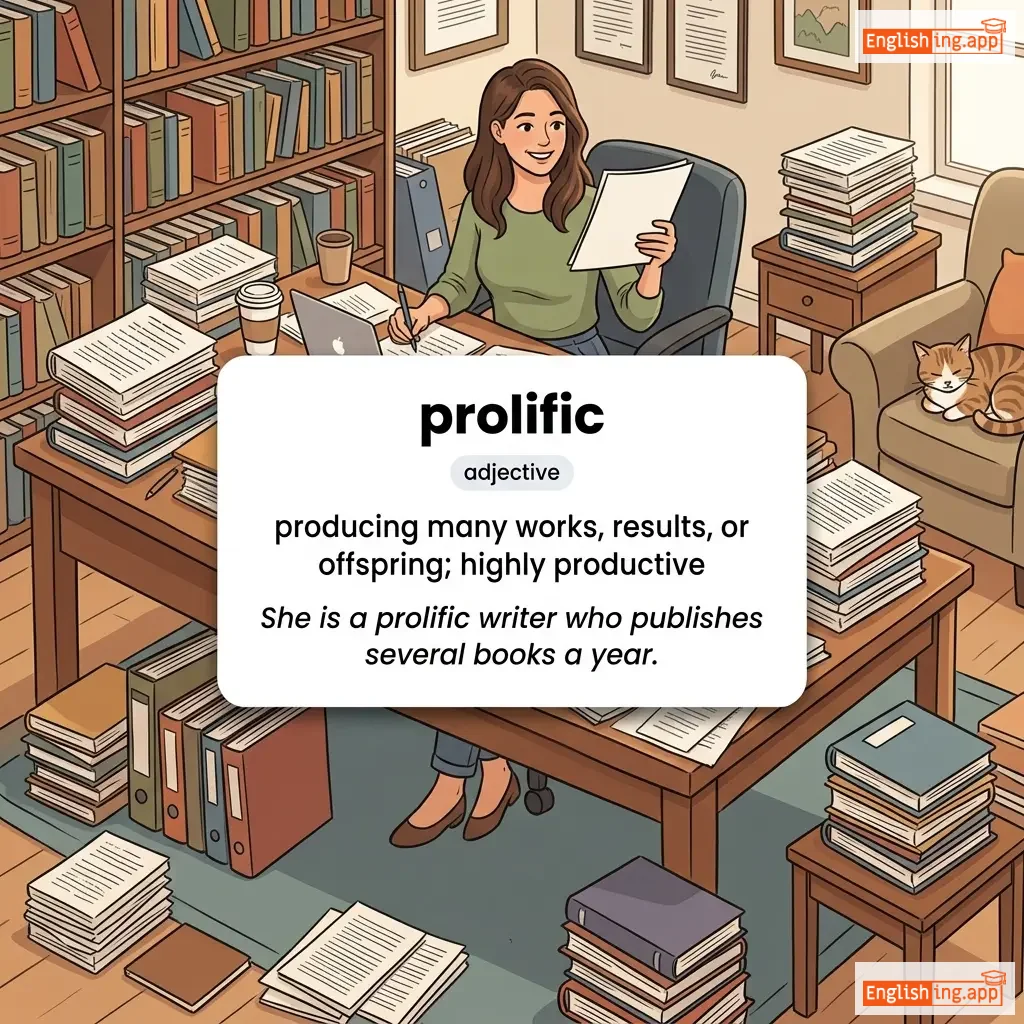
prolific definition card — visual illustration of the meaning
adjective
/prəˈlɪfɪk/
prolifique (prolifique)

producing many works, results, or offspring; highly productive

"She is a prolific writer who publishes several books a year."

"Elle est une écrivaine prolifique qui publie plusieurs livres chaque année." (Elle est une écrivaine prolifique qui publie plusieurs livres chaque année.)
adjective
/ˈprəʊ.lɪks/
trop long (trop long)

using too many words; tediously lengthy

"The professor’s prolix lecture put many students to sleep."

"Le cours prolixe du professeur a endormi de nombreux étudiants." (Le cours prolixe du professeur a endormi de nombreux étudiants.)
noun
/prəˈlɪksɪti/
prolixité (prolixité)

the quality of being tediously wordy and long

"The book’s prolixity made it difficult to read in one sitting."

"La prolixité du livre rendait difficile de le lire en une seule séance." (La prolixité du livre rendait difficile de le lire en une seule séance.)
noun
/ˈprəʊ.lɒɡ/
prologue (prologue)

an introduction to a book, play, or event

"The novel begins with a short prologue set in the past."

"Le roman commence par un court prologue situé dans le passé." (Le roman commence par un court prologue situé dans le passé.)
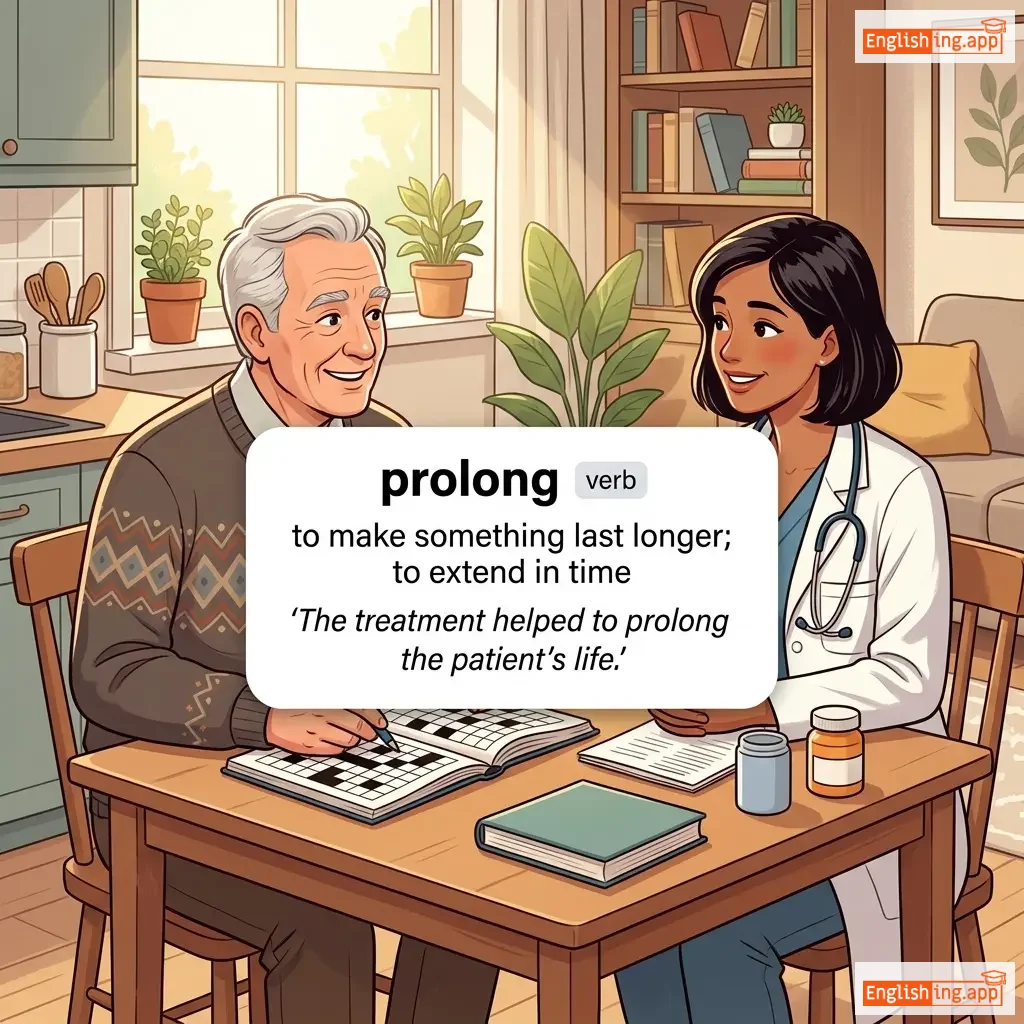
prolong definition card — visual illustration of the meaning
verb
/prəˈlɒŋ/
prolonger (prolonger)

to make something last longer; to extend in time

"The treatment helped to prolong the patient’s life."

"Le traitement a aidé à prolonger la vie du patient." (Le traitement a aide a prolonger la vie du patient.)
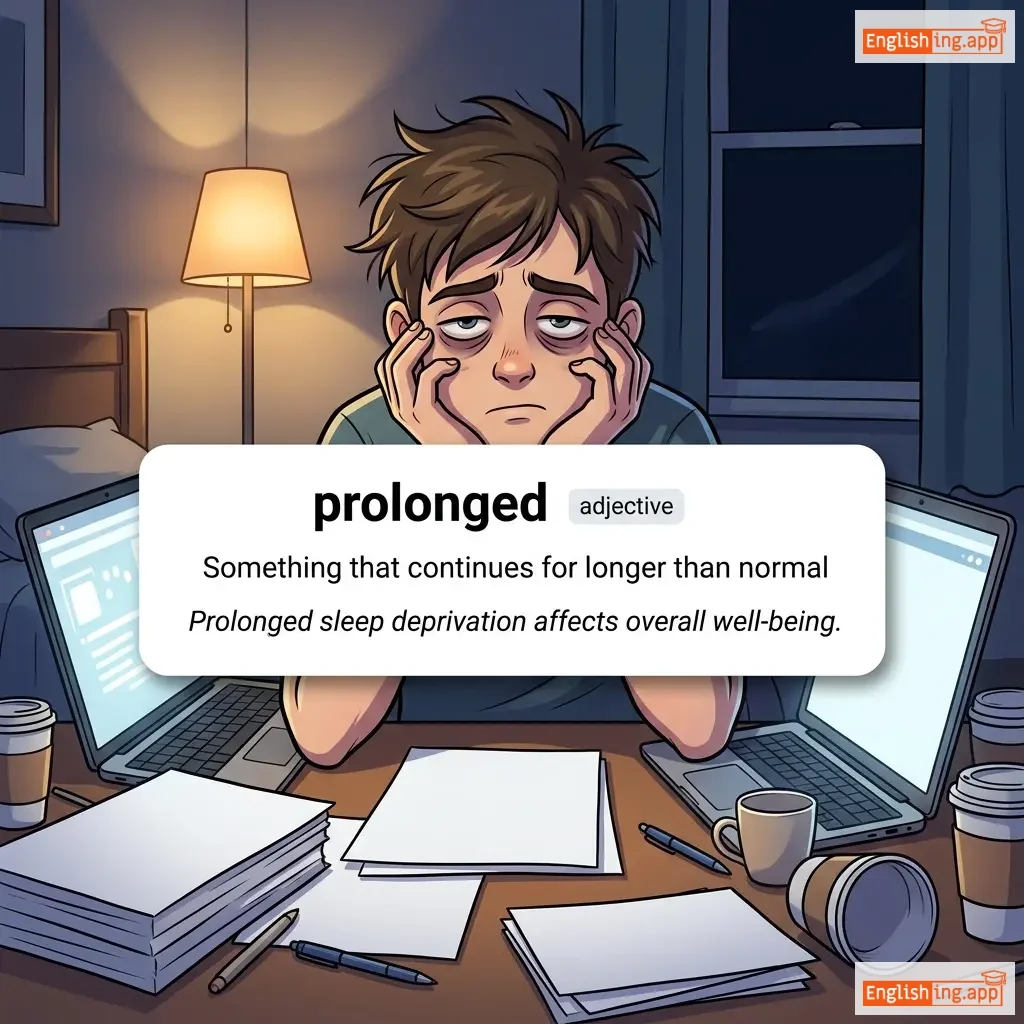
prolonged definition card — visual illustration of the meaning
adjective
prəˈlɒŋd
prolongé (prolonge)

Something that continues for longer than normal

"Prolonged sleep deprivation affects overall well-being."

"La privation prolongée de sommeil affecte le bien-être général." (La privation prolongée de sommeil affecte le bien-être général.)
noun, verb
/ˌprɒməˈneɪd/
promenade (promenade)

A leisurely walk or stroll, especially in a public place for pleasure or display.

"They went for a promenade along the seaside."

"Ils sont allés faire une promenade le long de la mer." (Ils sont allés faire une promenade le long de la mer.)
noun
/ˈprɒmɪnəns/
notoriété (notoriete)

The state of being important, famous, or easily noticed.

"Her work gained prominence after the award."

"Son travail a gagné en notoriété après le prix." (Son travail a gagne en notoriete apres le prix.)
adjective
/ˈprɒmɪnənt/
prominent (prominent)

Important, famous, or easily noticeable.

"He is a prominent leader in the community."

"Il est un leader prominent dans la communauté." (Il est un leader prominent dans la communauté.)
adjective
/prəˈmɪskjuəs/
promiscueux (promiskwe)

Having or showing a casual and unselective approach, often used to describe indiscriminate sexual relationships.

"The novel depicts a character with a promiscuous lifestyle."

"Le roman dépeint un personnage avec un mode de vie promiscu." (Le roman depeint un personnage avec un mode de vie promiscu.)
noun
/ˈprɒmɪs/
promesse (promesse)

a statement that one will definitely do something or that something will happen

"I made a promise to help her with the project."

"J'ai fait une promesse de l'aider avec le projet." (J'ai fait une promesse de l'aider avec le projet.)
adjective
/ˈprɒmɪsɪŋ/
prometteur (prometteur)

showing signs of future success or potential

"She is a promising young scientist with great ideas."

"Elle est une jeune scientifique prometteuse avec de grandes idées." (Elle est une jeune scientifique prometteuse avec de grandes idees.)
adjective
/ˈprɒmɪsəri/
promissoire (promissoire)

Containing or conveying a promise, especially in writing.

"He signed a promissory note to repay the loan."

"Il a signé un billet à ordre pour rembourser le prêt." (Il a signé un billet à ordre pour rembourser le prêt.)
noun
/ˈprɒm.ən.tɔːr.i/
promontoire (promontoire)

A high point of land or rock projecting into a body of water.

"The lighthouse stood on a promontory overlooking the sea."

"Le phare se trouvait sur un promontoire surplombant la mer." (Le phare se trouvait sur un promontoire surplombant la mer.)
promote definition card — visual illustration of the meaning
verb
/prəˈmoʊt/
promouvoir / encourager (promouvoir / encourager)

To support or encourage the growth, sale, or acceptance of something.

"The company worked hard to promote its new product."

"L'entreprise a travaillé dur pour promouvoir son nouveau produit." (L'entreprise a travaillé dur pour promouvoir son nouveau produit.)
noun
/prəˈmoʊ.tər/
organisateur (organisateur)

A person or organization that helps to organize or finance an event, business, or product launch.

"The promoter organized a concert for the new band."

"Le promoteur a organisé un concert pour le nouveau groupe." (Le promoteur a organise un concert pour le nouveau groupe.)
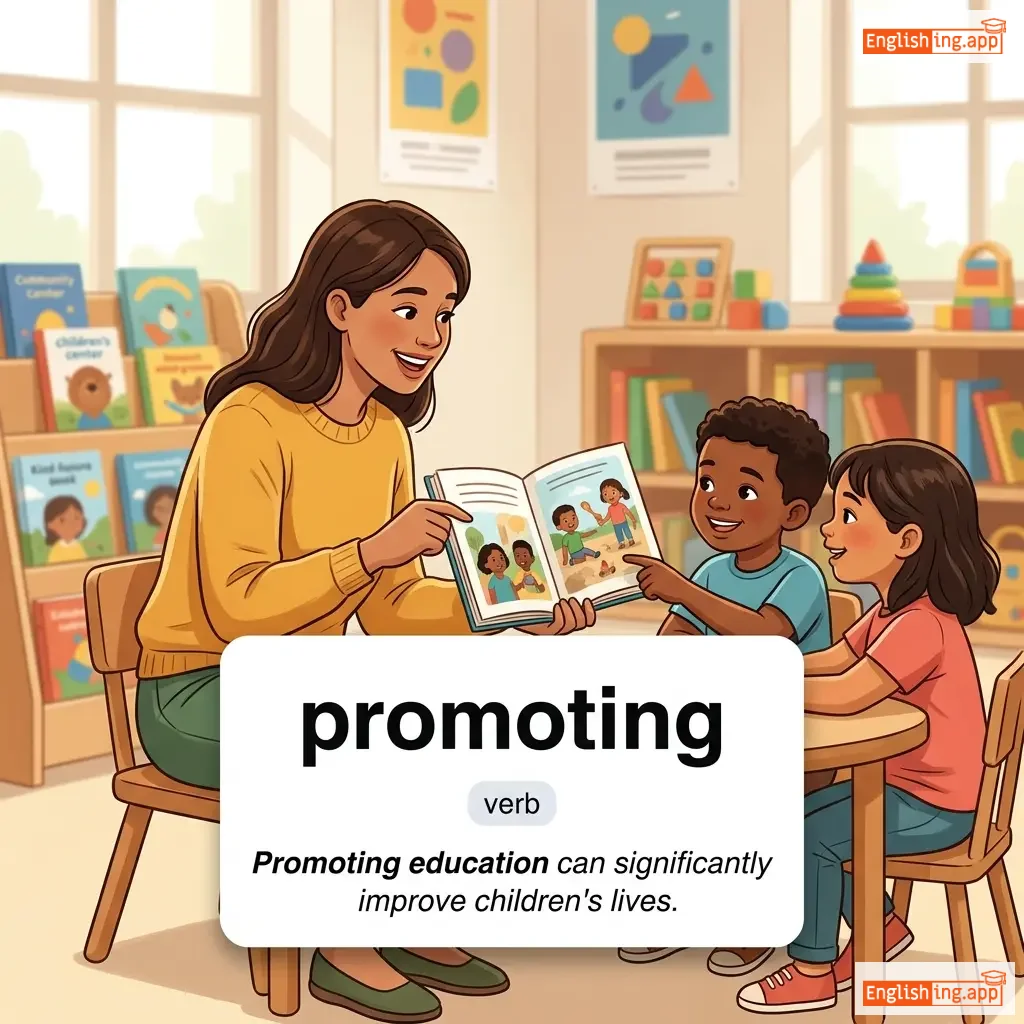
promoting definition card — visual illustration of the meaning
verb
prəˈmoʊtɪŋ
promouvoir (promouvoir)

To support or actively encourage a cause, venture, or aim; to help or encourage the progress or development of something.

"Promoting education can significantly improve children's lives."

"Promouvoir l'éducation peut améliorer considérablement la vie des enfants." (Promouvoir l'éducation peut améliorer considérablement la vie des enfants.)
noun
/prəˈmoʊʃən/
promotion, élévation (promotion, elevation)

the act of raising someone to a higher position or of marketing something to increase sales or awareness

"The company announced a big promotion campaign for their new product."

"L'entreprise a annoncé une grande campagne de promotion pour son nouveau produit." (L'entreprise a annonce une grande campagne de promotion pour son nouveau produit.)
verb, noun, adjective
/prɑːmpt/
inciter / rapide (inciter / rapide)

To cause someone to take action; done without delay.

"His speech prompted the audience to ask questions."

"Son discours a incité le public à poser des questions." (Son discours a incite le public a poser des questions.)
verb
/ˈprɑː.məl.ɡeɪt/
promulguer (promulguer)

To announce or make a law, decree, or idea officially known.

"The government promulgated new regulations on data privacy."

"Le gouvernement a promulgué de nouvelles régulations sur la confidentialité des données." (Le gouvernement a promulgué de nouvelles régulations sur la confidentialité des données.)
adjective
/proʊn/
prédisposé (predispose)

likely to suffer from or experience something, especially something unfortunate

"He is prone to headaches when he works too long."

"Il est prédisposé aux maux de tête lorsqu'il travaille trop longtemps." (Il est prédisposé aux maux de tête lorsqu'il travaille trop longtemps.)
noun
/prɔːŋ/
dent de fourchette (dent de fourchette)

a projecting pointed part, such as one of the pointed ends of a fork

"The fork has four prongs."

"La fourchette a quatre dents." (La fourchette a quatre dents.)
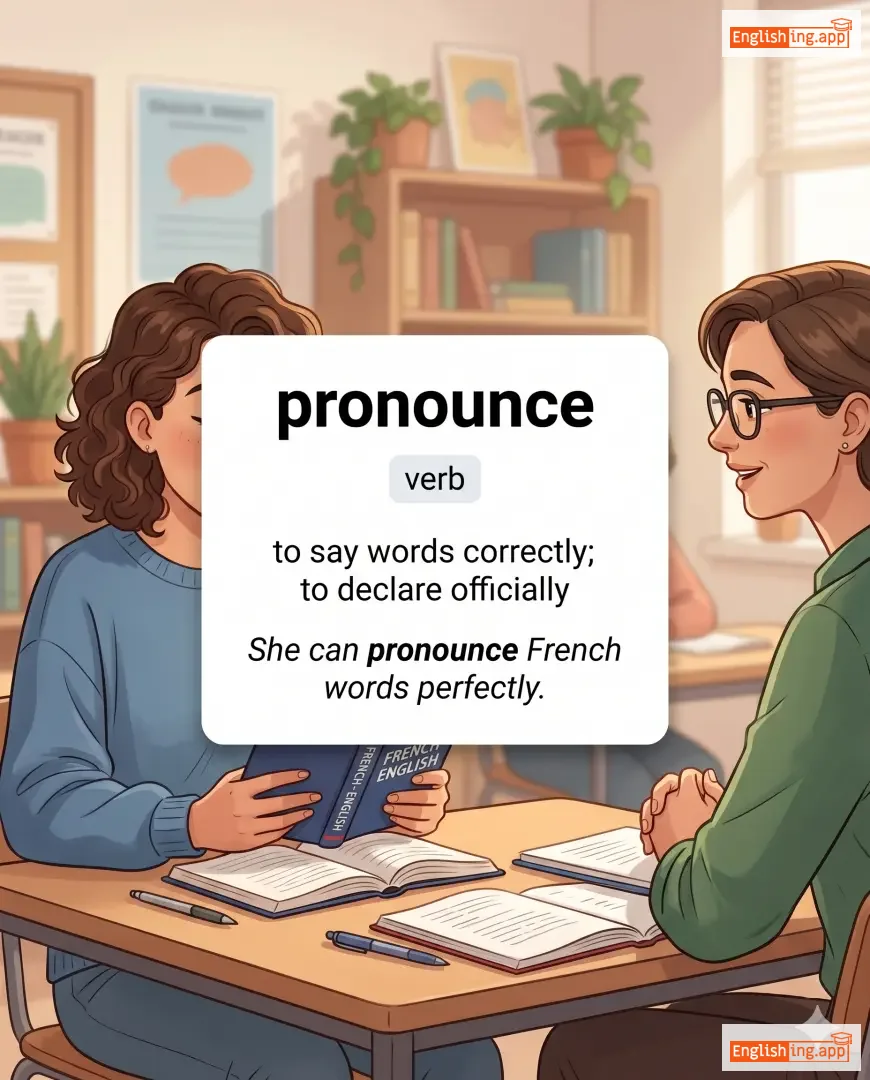
pronounce definition card — visual illustration of the meaning
verb
/prəˈnaʊns/
prononcer (prononcer)

to say words correctly; to declare officially

"She can pronounce French words perfectly."

"Elle peut prononcer les mots français parfaitement." (Elle peut prononcer les mots français parfaitement.)
adjective
/prəˈnaʊnst/
prononcé (prononce)

very noticeable or strongly marked

"There is a pronounced difference between the two styles."

"Il y a une différence prononcée entre les deux styles." (Il y a une différence prononcée entre les deux styles.)
noun
/prəˌnʌnsiˈeɪʃən/
prononciation (prononciation)

the way a word or language is spoken; the act or result of pronouncing words

"Her pronunciation of French words has improved significantly."

"Sa prononciation des mots français s’est beaucoup améliorée." (sa prononciation des mots francais s est beaucoup amelioree)
🧑‍⚖️

proof (pruf)

noun
/pruːf/
preuve (preuve)

evidence or argument establishing a fact or the truth of a statement

"The detective presented proof of the suspect's guilt."

"Le détective a présenté la preuve de la culpabilité du suspect." (Le detective a presente la preuve de la culpabilite du suspect.)
verb
/ˈpruːfˌriːd/
corriger (corriger)

to read written material and mark any errors

"She proofread the report before submission."

"Elle a corrigé le rapport avant la soumission." (Elle a corrigé le rapport avant la soumission.)
noun
/prɒp/
accessoire (accessoire)

an object used on stage by actors during a performance; something that supports or holds up

"The actor forgot his prop on stage."

"L'acteur a oublié son accessoire sur scène." (L'acteur a oublié son accessoire sur scène.)
noun
/ˌprɒpəˈɡændə/
propagande (propagande)

Information, especially biased or misleading, used to promote a political cause or point of view.

"The regime spread propaganda to control public opinion."

"Le régime a diffusé de la propagande pour contrôler l'opinion publique." (Le regime a diffuse de la propagande pour controler l'opinion publique.)
verb
/ˈprɒpəɡeɪt/
propager (propager)

To spread or transmit an idea, belief, or information widely; also to reproduce in plants or animals.

"Scientists work to propagate the species in captivity."

"Les scientifiques travaillent à propager les espèces en captivité." (Les scientifiques travaillent à propager les espèces en captivité.)
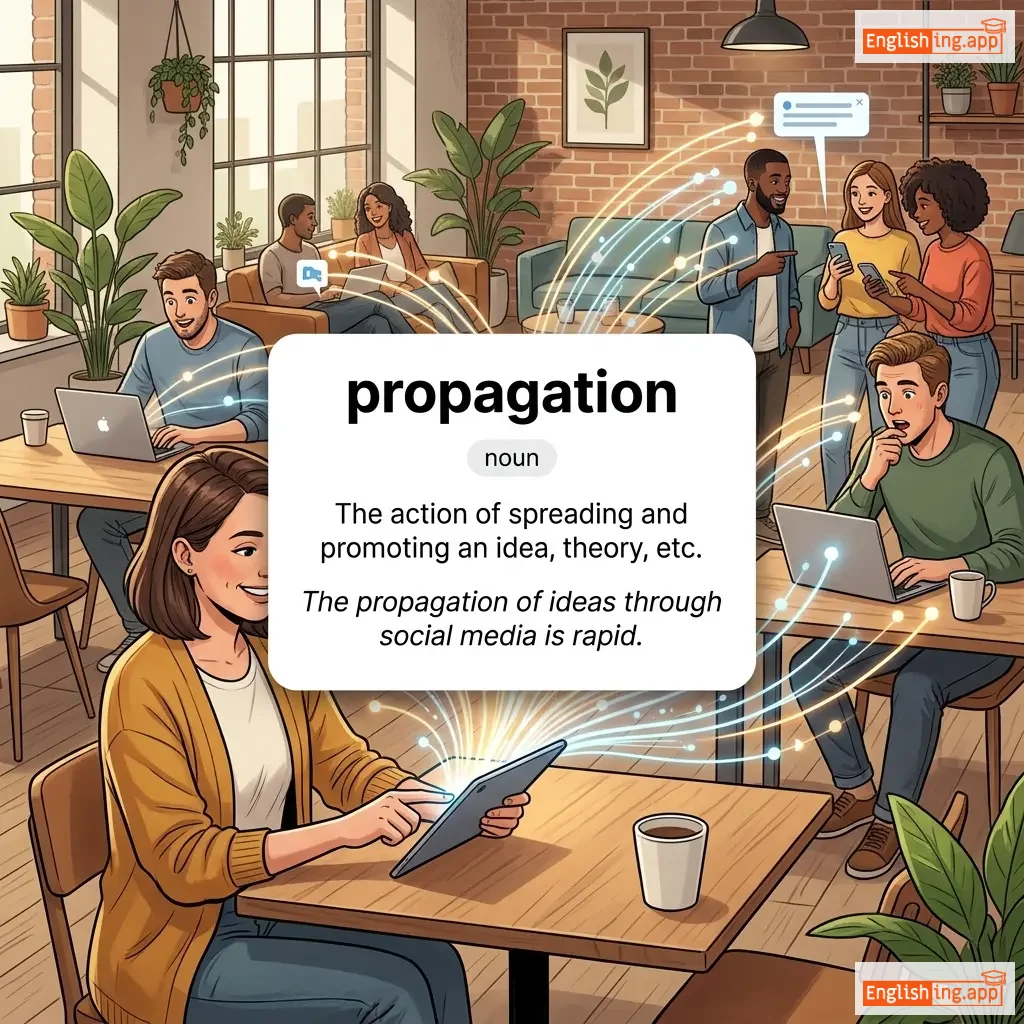
propagation definition card — visual illustration of the meaning
noun
/ˌprɒpəˈɡeɪʃən/
propagation, diffusion (propagation, diffusion)

The action of spreading and promoting an idea, theory, etc.

"The propagation of ideas through social media is rapid."

"La propagation des idées à travers les réseaux sociaux est rapide." (La propagation des idees a travers les reseaux sociaux est rapide.)
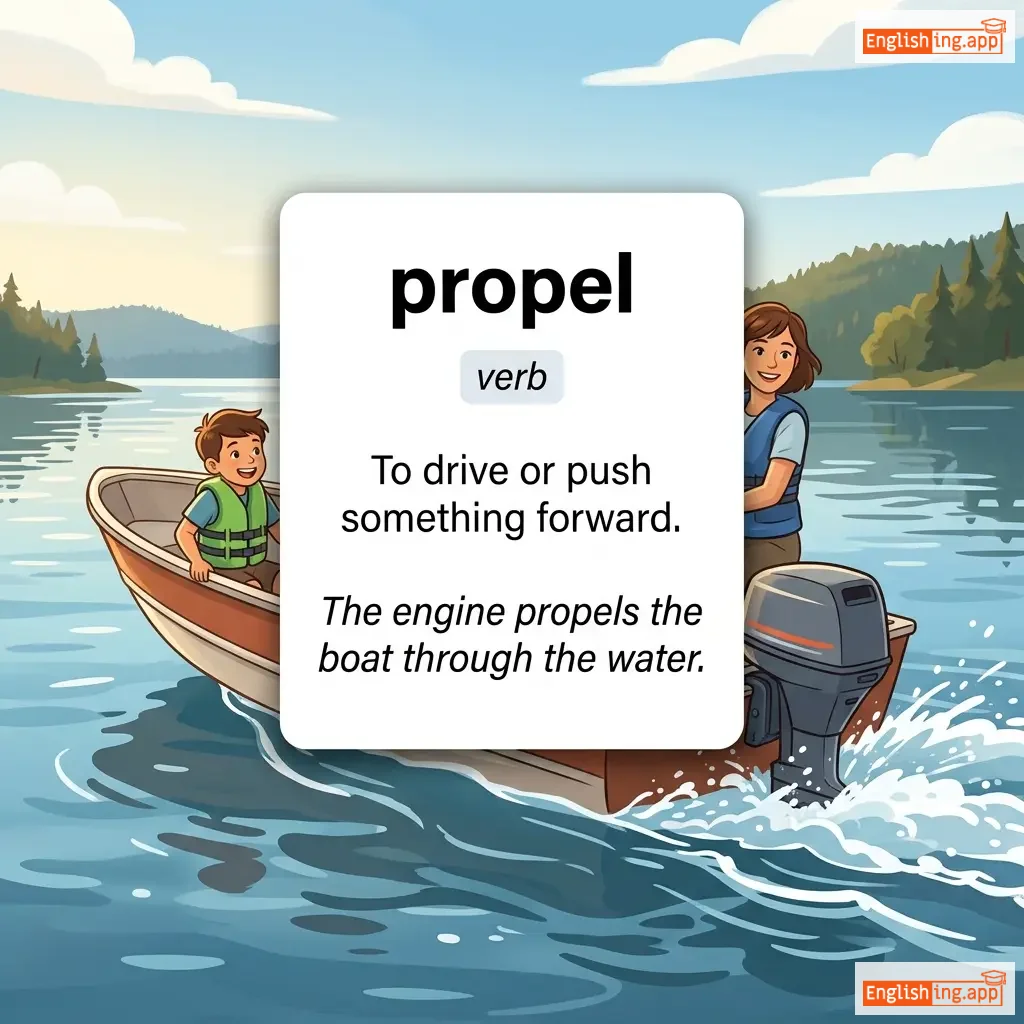
propel definition card — visual illustration of the meaning
verb
/prəˈpɛl/
propulser (propulser)

To drive or push something forward.

"The engine propels the boat through the water."

"Le moteur propulse le bateau à travers l'eau." (Le moteur propulse le bateau à travers l'eau.)
noun
/prəˈpɛlənt/
propulseur (propulseur)

A substance that drives or pushes something forward, especially fuel in rockets or engines.

"The rocket uses a liquid propellant to launch into space."

"La fusée utilise un propulseur liquide pour se lancer dans l'espace." (La fusée utilise un propulseur liquide pour se lancer dans l'espace.)
noun
/prəˈpɛlər/
hélice (helice)

A mechanical device with blades that rotates to drive a ship, aircraft, or other vehicle forward.

"The airplane’s propeller cut through the air with great speed."

"L'hélice de l'avion a coupé l'air à grande vitesse." (L'helice de l'avion a coupe l'air a grande vitesse.)
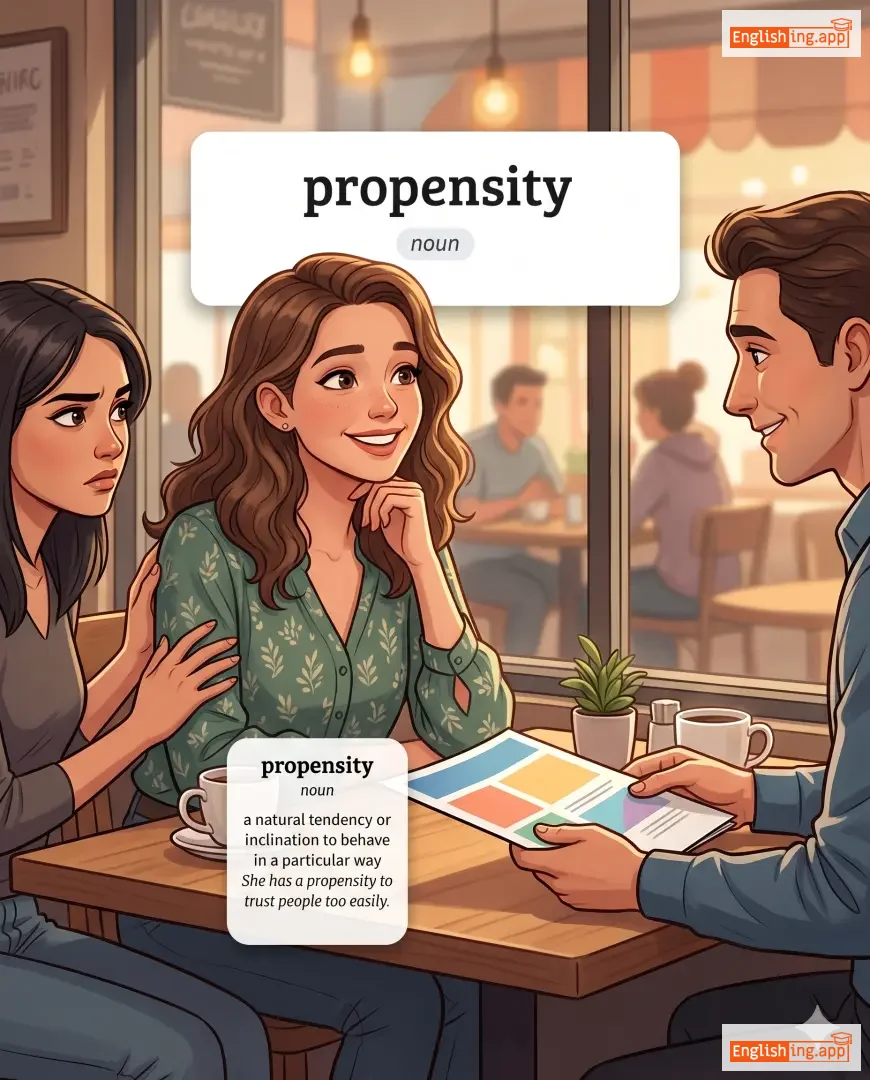
propensity definition card — visual illustration of the meaning
noun
/prəˈpɛnsəti/
propension (propension)

a natural tendency or inclination to behave in a particular way

"She has a propensity to trust people too easily."

"Elle a une propension à faire confiance aux gens trop facilement." (Elle a une propension a faire confiance aux gens trop facilement.)
adjective
/ˈprɒpər/
approprié (approprié)

conforming to accepted standards of behavior or morality

"He made sure to wear proper attire for the interview."

"Il s'est assuré de porter des vêtements appropriés pour l'entretien." (Il s'est assuré de porter des vêtements appropriés pour l'entretien.)
adverb
/ˈprɒpərli/
correctement (correctement)

in the correct or suitable manner

"He performed the task properly to avoid mistakes."

"Il a effectué la tâche correctement pour éviter les erreurs." (Il a effectué la tâche correctement pour éviter les erreurs.)
noun
/ˈprɒpərti/
propriété (propriete)

a thing or things that belong to someone; possessions or real estate

"The old mansion is his family’s property."

"Le vieux manoir est la propriété de sa famille." (Le vieux manoir est la propriété de sa famille.)
noun
/ˈprɒfəsi/
prophétie (prophetie)

a prediction or message about the future, often believed to be divinely inspired

"The prophecy foretold the rise of a great leader."

"La prophétie annonçait l'ascension d'un grand leader." (La prophetie annonçait l'ascension d'un grand leader)
verb
/ˈprɒfəsaɪ/
prophétiser (pro-feh-tee-zay)

to state or predict that something will happen in the future, especially as if divinely inspired

"The monk prophesied that peace would return to the land."

"Le moine prophétisa que la paix reviendrait dans le pays." (Le mwah-nuh pro-feh-tee-zah keh lah payh reh-vee-ehn-dray dahn le pay-ee.)
adjective
/prəˈfɛtɪk/
prophétique (prophetique)

accurately predicting or describing what will happen in the future

"His prophetic words came true after many years."

"Ses paroles prophétiques se sont réalisées après de nombreuses années." (Ses paroles prophétiques se sont réalisées après de nombreuses années.)
adjective
/ˌprɒfɪˈlæktɪk/
prophylactique (prophy-lactique)

intended to prevent disease or an unwanted outcome; protective

"The doctor prescribed a prophylactic treatment to prevent infection."

"Le médecin a prescrit un traitement prophylactique pour prévenir l'infection." (Le médecin a prescrit un traitement prophylactique pour prévenir l'infection.)
noun
/prəˈpɪŋkwɪti/
proximité (proximite)

the state of being close to someone or something; proximity

"The propinquity of their houses made them close friends."

"La proximité de leurs maisons les a rendus amis proches." (La proximite de leurs maisons les a rendus amis proches.)
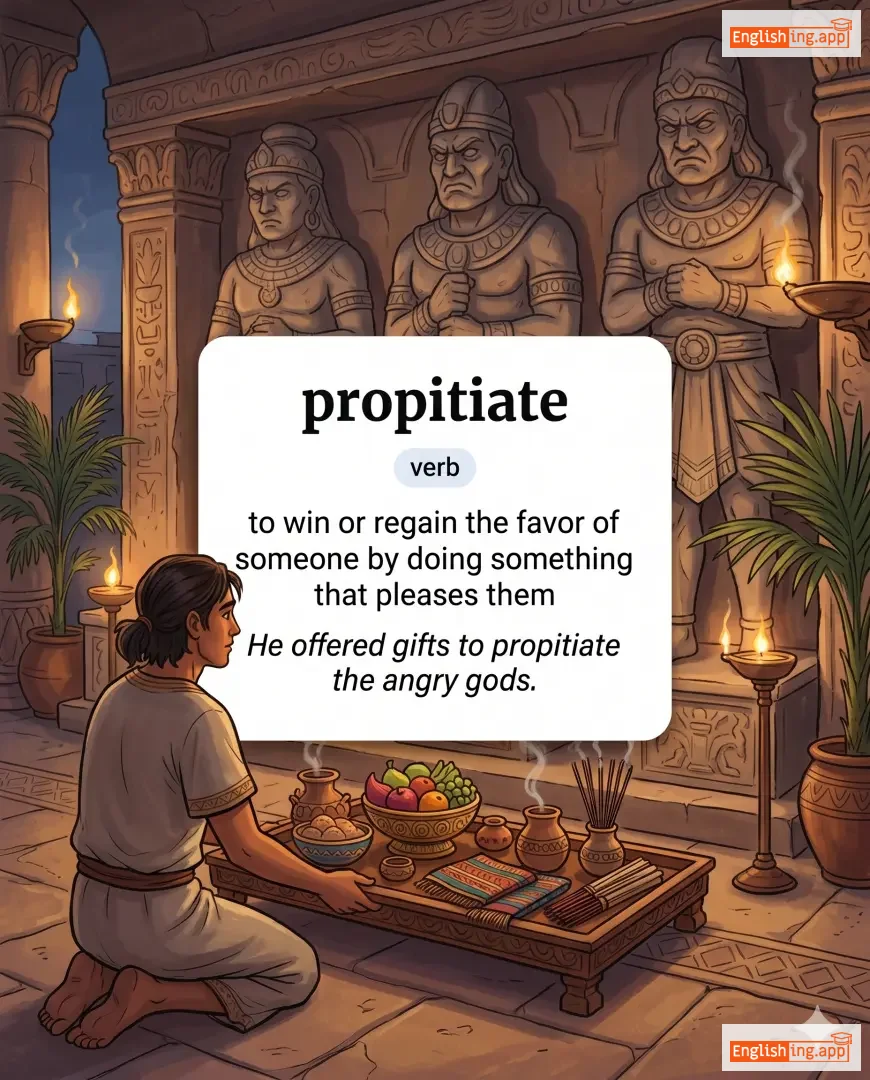
propitiate definition card — visual illustration of the meaning
verb
/prəˈpɪʃieɪt/
apaiser (apaiser)

to win or regain the favor of someone by doing something that pleases them

"He offered gifts to propitiate the angry gods."

"Il a offert des cadeaux pour apaiser les dieux en colère." (Il a offert des cadeaux pour apaiser les dieux en colère.)
adjective
/prəˈpɪʃəs/
propice (propice)

giving or indicating a good chance of success; favorable

"The sunny weather was a propitious start to the picnic."

"Le temps ensoleillé était un début propice pour le pique-nique." (Le temps ensoleillé était un début propice pour le pique-nique.)
noun
/prəˈpoʊnənt/
partisan, promoteur (partisan, promoteur)

a person who advocates for or supports a particular idea, cause, or plan

"She is a strong proponent of renewable energy."

"Elle est une forte partisane de l'énergie renouvelable." (Elle est une forte partisane de l'énergie renouvelable.)
noun
/prəˈpɔːʃən/
proportion (proportion)

a part, share, or number considered in comparative relation to a whole

"The proportion of students passing the exam was high."

"La proportion d'étudiants qui passent l'examen était élevée." (La proportion detudiants qui passent lexamen etait elevee)
adjective
/prəˈpɔːrʃənət/
proportionnel (proportionnel)

Corresponding in size, degree, or intensity; balanced in relation.

"The punishment should be proportionate to the crime."

"La peine doit être proportionnelle au crime." (La peine doit etre proportionnelle au crime.)