Vocabulaires

Découvrez, apprenez et maîtrisez le vocabulaire anglais

adjective
/ˌpoʊstˈwɔːr/
d'après-guerre (d'apres-guerre)

relating to the period after a war has ended

"The country experienced rapid economic growth in the post-war years."

"Le pays a connu une croissance rapide dans les années d'après-guerre." (le pays a connu une croissance rapide dans les annees d'apres-guerre)
verb
/ˌpoʊstˈdeɪt/
mettre une date ultérieure (mettre une date ulterieure)

To assign a date later than the actual date to a document or event.

"She postdated the check to next month."

"Elle a postdaté le chèque pour le mois prochain." (Elle a postdaté le chèque pour le mois prochain.)
noun
/ˈpoʊstər/
affiche (affiche)

a large printed picture or notice that is put on a wall for decoration or to advertise something

"They put up a movie poster outside the theater."

"Ils ont mis un poster de film dehors du cinéma." (Ils ont mis un poster de film dehors du cinéma.)
adjective
/pɒˈstɪəriər/
postérieur (posterieur)

Situated at or toward the back; later in time.

"The posterior part of the brain controls vision."

"La partie postérieure du cerveau contrôle la vision." (La partie posterieure du cerveau controle la vision.)
noun
/pɒˈstɛrɪti/
postérité (posterite)

All future generations of people.

"The monument was built for the benefit of posterity."

"Le monument a été construit pour le bénéfice de la postérité." (Le monument a été construit pour le bénéfice de la postérité.)
noun, adjective
/ˌpəʊstˈɡrædʒuət/
étudiant de troisième cycle (etudiant de troisieme cycle)

A student who has completed a first degree and is studying for a further degree.

"She is doing postgraduate research in physics."

"Elle fait des recherches de troisième cycle en physique." (Elle fait des recherches de troisieme cycle en physique.)
adjective
/ˈpɒstjʊməs/
posthume (posthume)

Occurring, awarded, or appearing after the death of the originator.

"He received a posthumous award for his bravery."

"Il a reçu un prix posthume pour son courage." (Il a reçu un prix posthume pour son courage.)
noun, adjective
/ˌpəʊstˈmɔːtəm/
autopsie (autopsie)

An examination of a dead body to determine the cause of death.

"The doctor carried out a postmortem on the body."

"Le médecin a pratiqué une autopsie sur le corps." (Le médecin a pratiqué une autopsie sur le corps.)
verb
/pəʊs(t)ˈpəʊn/
reporter (reporter)

to delay something to a later time

"The meeting was postponed until next week."

"La réunion a été reportée à la semaine prochaine." (La reunion a ete reportee a la semaine prochaine.)
adjective
/ˌpəʊstˈprændɪəl/
postprandial (postprandial)

Occurring after a meal.

"He went for a postprandial walk after dinner."

"Il est allé faire une promenade postprandiale après le dîner." (Il est alle faire une promenade postprandiale apres le diner.)
noun
/ˈpəʊstˌskrɪpt/
post-scriptum (post-scriptum)

an additional remark at the end of a letter or text, after the signature

"She added a brief postscript to thank him again."

"Elle a ajouté une brève post-scriptum pour le remercier à nouveau." (Elle a ajoute une breve post-scriptum pour le remercier a nouveau.)
postulate definition card — visual illustration of the meaning
verb
/ˈpɒstjʊˌleɪt/
postuler (postuler)

to suggest or assume the existence of something as a basis for reasoning

"The scientist postulated that life could exist on other planets."

"Le scientifique a postulé que la vie pourrait exister sur d'autres planètes." (Le scientifique a postulé que la vie pourrait exister sur d'autres planètes.)
noun
/ˈpɒstʃə/
bonheur (bonheur)

the position in which someone holds their body; an attitude or approach

"Good posture helps prevent back pain."

"Elle ne pouvait pas cacher son bonheur lorsqu'elle a reçu le prix." (Elle ne pouvait pas cacher son bonheur lorsqu'elle a reçu le prix.)
adjective
/ˈpəʊstwɔːr/
d'après-guerre (d'apres-guerre)

occurring or existing after a war

"The postwar period saw significant economic growth."

"La période d'après-guerre a vu une croissance économique significative." (La periode d'apres-guerre a vu une croissance economique significative.)
noun
/pɒt/
pot (pot)

a container, typically round and deep, used for cooking or holding plants

"She put the soup in a pot and set it on the stove."

"Elle a mis la soupe dans un pot et l'a placé sur le poêle." (Elle a mis la soupe dans un pot et l'a place sur le poêle.)
adjective
/ˈpəʊtəbl/
potable (potable)

safe to drink; drinkable

"The villagers did not have access to potable water."

"Les villageois n'avaient pas accès à l'eau potable." (Les villageois n'avaient pas accès à l'eau potable.)
noun
/pəˈteɪtoʊ/
pomme de terre (pomme de terre)

a starchy plant tuber that is a staple food around the world

"We had mashed potato with our dinner."

"Nous avons mangé de la purée de pommes de terre au dîner." (Nous avons mange de la puree de pommes de terre au diner.)
noun
/ˈpɒtˌbɔɪlə/
livre de série B (livre de serie B)

a book, play, or film produced quickly to make money rather than for artistic value

"The novel was dismissed by critics as a mere potboiler."

"Le roman a été rejeté par les critiques comme un simple livre de série B." (Le roman a été rejeté par les critiques comme un simple livre de série B.)
noun
/ˈpoʊtənsi/
puissance (puissance)

The power or ability of something to affect or influence; strength or effectiveness.

"The potency of the new medicine amazed the doctors."

"La puissance du nouveau médicament a étonné les médecins." (La puissance du nouveau médicament a étonné les médecins.)
adjective
/ˈpoʊtənt/
puissant (pwee-sãt)

Having great power, influence, or effect.

"This is a very potent drug that should be used carefully."

"C'est un médicament très puissant qui doit être utilisé avec précaution." (C'est un médicament très puissant qui doit être utilisé avec précaution.)
noun
/ˈpoʊtənˌteɪt/
potentat (potentat)

A monarch or ruler, especially one with absolute power.

"The ancient land was ruled by a powerful potentate."

"L'ancienne terre était gouvernée par un puissant potentat." (L'ancienne terre était gouvernée par un puissant potentat.)
potential definition card — visual illustration of the meaning
noun, adjective
/pəˈtɛnʃəl/
potentiel (potentiel)

Having the capacity to develop into something in the future; latent ability.

"She has great potential to become a successful leader."

"Elle a un grand potentiel pour devenir un leader réussi." (Elle a un grand potentiel pour devenir un leader réussi.)
adverb
/pəˈtɛnʃəli/
potentiellement (potentiellement)

with the possibility of becoming something in the future

"This project is potentially a huge success."

"Ce projet est potentiellement un grand succès." (Ce projet est potentiellement un grand succès.)
verb
/poʊˈtɛnʃiˌeɪt/
potentialiser (potentialiser)

To increase the power, effect, or likelihood of something.

"Caffeine can potentiate the effects of some medicines."

"La caféine peut potentialiser les effets de certains médicaments." (La caféine peut potentialiser les effets de certains médicaments.)
noun
/ˈpoʊʃən/
potion (potion)

a liquid with healing, magical, or poisonous properties

"The witch gave the hero a healing potion."

"La sorcière a donné au héros une potion de guérison." (La sorciere a donne au heros une potion de guerison.)
noun
/ˌpoʊpʊˈriː/
mélange de fleurs séchées (melange de fleurs sechees)

a mixture of dried flowers and spices kept in a bowl to perfume a room; a miscellaneous collection

"The living room was filled with the scent of potpourri."

"Le salon était rempli du parfum du potpourri." (Le salon etait rempli du parfum du potpourri.)
noun
/ˈpɑː.tər/
potier (potier)

a person who makes pottery

"The potter shaped clay on the spinning wheel."

"Le potier a façonné l'argile sur la roue tournante." (Le potier a façonné l'argile sur la roue tournante.)
noun
/paʊtʃ/
poche (poche)

a small bag or pocket, often used to carry small items

"She kept her coins in a small leather pouch."

"Elle a gardé ses pièces dans une petite poche en cuir." (Elle a garde ses pieces dans une petite poche en cuir.)
noun
/ˈpoʊltɪs/
cataplasme chaud aux herbes (cataplasme chaud aux herbes)

a soft, moist mass of material applied to the body to relieve soreness and inflammation

"The nurse applied a warm poultice to his injured leg."

"L'infirmière a appliqué un cataplasme chaud sur sa jambe blessée." (L'infirmière a appliqué un cataplasme chaud sur sa jambe blessée.)
noun, verb
/paʊnd/
livre (livre)

a unit of weight equal to 16 ounces or a unit of currency

"The price of the book is five pounds."

"Le prix du livre est de cinq livres." (Le prix du livre est de cinq livres.)
verb
/pɔːr/
verser (verser)

to cause a liquid to flow from a container

"She poured the tea into the cup."

"Elle versa le thé dans la tasse." (Elle versa le thé dans la tasse.)
verb
/paʊt/
faire la moue (faire la moue)

to push one's lips forward as an expression of annoyance or sulkiness

"The child began to pout when he didn’t get the toy."

"L'enfant a commencé à faire la moue lorsqu'il n'a pas eu le jouet." (L'enfant a commence a faire la moue lorsqu'il n'a pas eu le jouet.)
noun
/ˈpɒvəti/
pauvreté (pauvreté)

the state of being extremely poor

"Poverty is a major issue in many countries."

"La pauvreté est un problème majeur dans de nombreux pays." (La pauvreté est un problème majeur dans de nombreux pays.)
noun
/ˈpaʊdər/
poudre (poudre)

a fine, dry substance made of very tiny particles

"She sprinkled some powder on the cake."

"Elle a saupoudré un peu de poudre sur le gâteau." (Elle a saupoudré un peu de poudre sur le gâteau.)
power definition card — visual illustration of the meaning
noun
/ˈpaʊər/
pouvoir (pouvoir)

the ability or capacity to do something or influence others

"Knowledge is power."

"La connaissance est le pouvoir." (La connaissance est le pouvoir.)
powerful definition card — visual illustration of the meaning
adjective
/ˈpaʊərfəl/
puissant (pwisã)

having great strength or influence

"She is a powerful leader in her community."

"Elle est un leader puissant dans sa communauté." (Elle est un leader puissant dans sa communauté.)
adjective
/ˈpaʊərləs/
impuissant (impuissant)

without ability, influence, or strength

"She felt powerless against the unfair system."

"Elle se sentait impuissante contre le système injuste." (Elle se sentait impuissante contre le système injuste.)
noun
/ˈpaʊ.waʊ/
réunion informelle (reunion informelle)

an informal meeting or conference to discuss something

"The team held a quick powwow before the presentation."

"L'équipe a tenu une réunion rapide avant la présentation." (L'equipe a tenu une reunion rapide avant la presentation.)
adjective
/ˈpræk.tɪ.kə.bəl/
praticable (praticable)

able to be done or put into practice successfully

"The plan is not practicable without more resources."

"Le plan n'est pas praticable sans plus de ressources." (Le plan n'est pas praticable sans plus de ressources.)
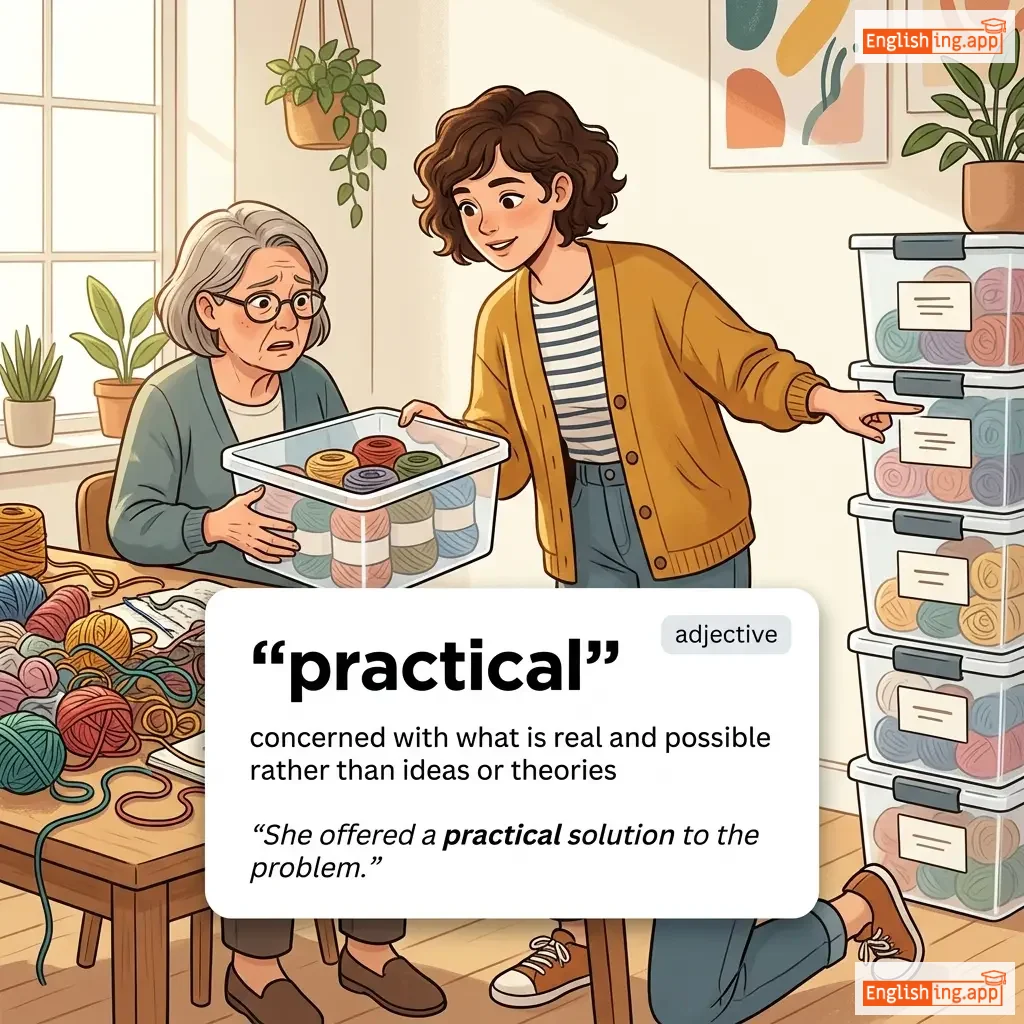
practical definition card — visual illustration of the meaning
adjective
/ˈpræk.tɪ.kəl/
pratique (pratique)

concerned with what is real and possible rather than ideas or theories

"She offered a practical solution to the problem."

"Elle a proposé une solution pratique au problème." (Elle a proposé une solution pratique au problème.)
adverb
/ˈpræktɪkli/
pratiquement (pratiquement)

in a way that is almost or nearly; in a realistic or functional manner

"The movie theater was practically empty."

"Le cinéma était pratiquement vide." (Le cinema etait pratiquement vide.)
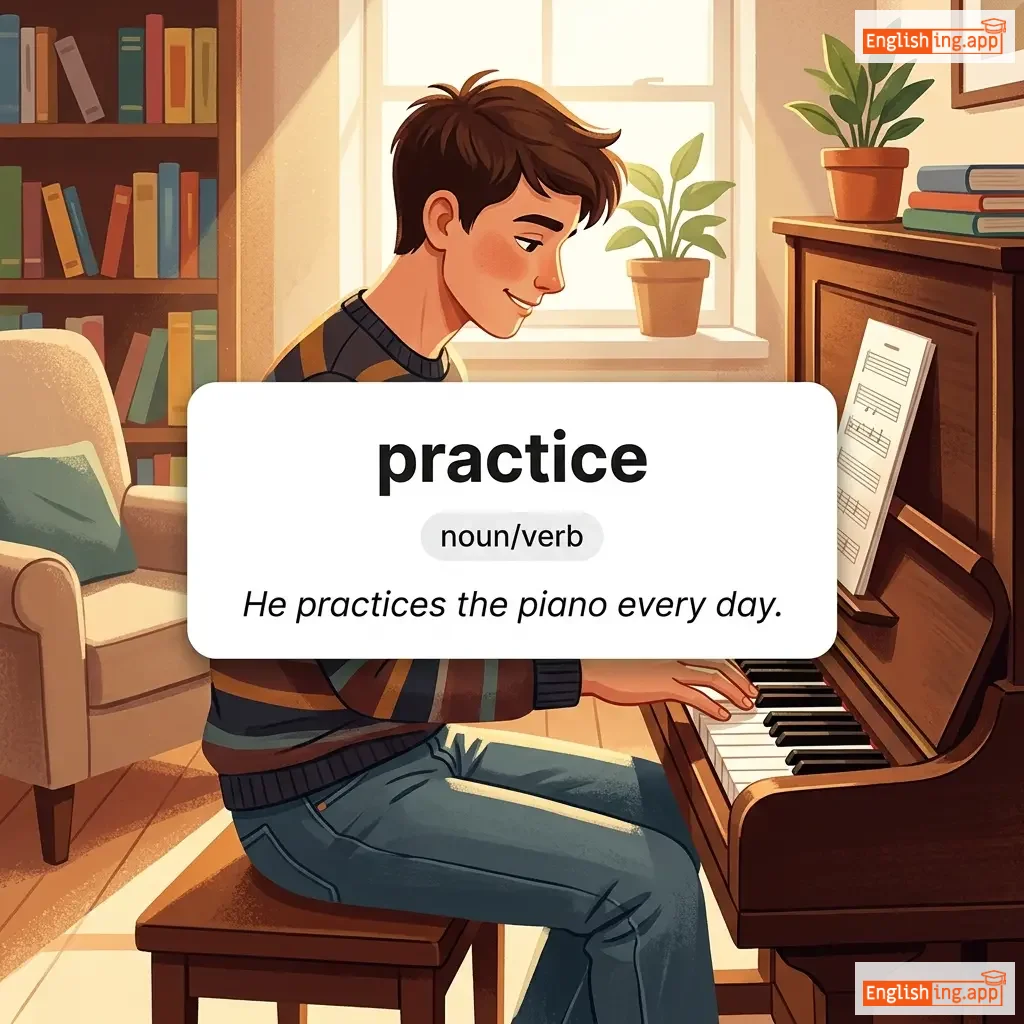
practice definition card — visual illustration of the meaning
noun/verb
/ˈpræk.tɪs/
pratique (pratique)

the act of doing something repeatedly to improve skill, or the actual application of an idea

"He practices the piano every day."

"Il pratique le piano tous les jours." (Il pratique le piano tous les jours.)
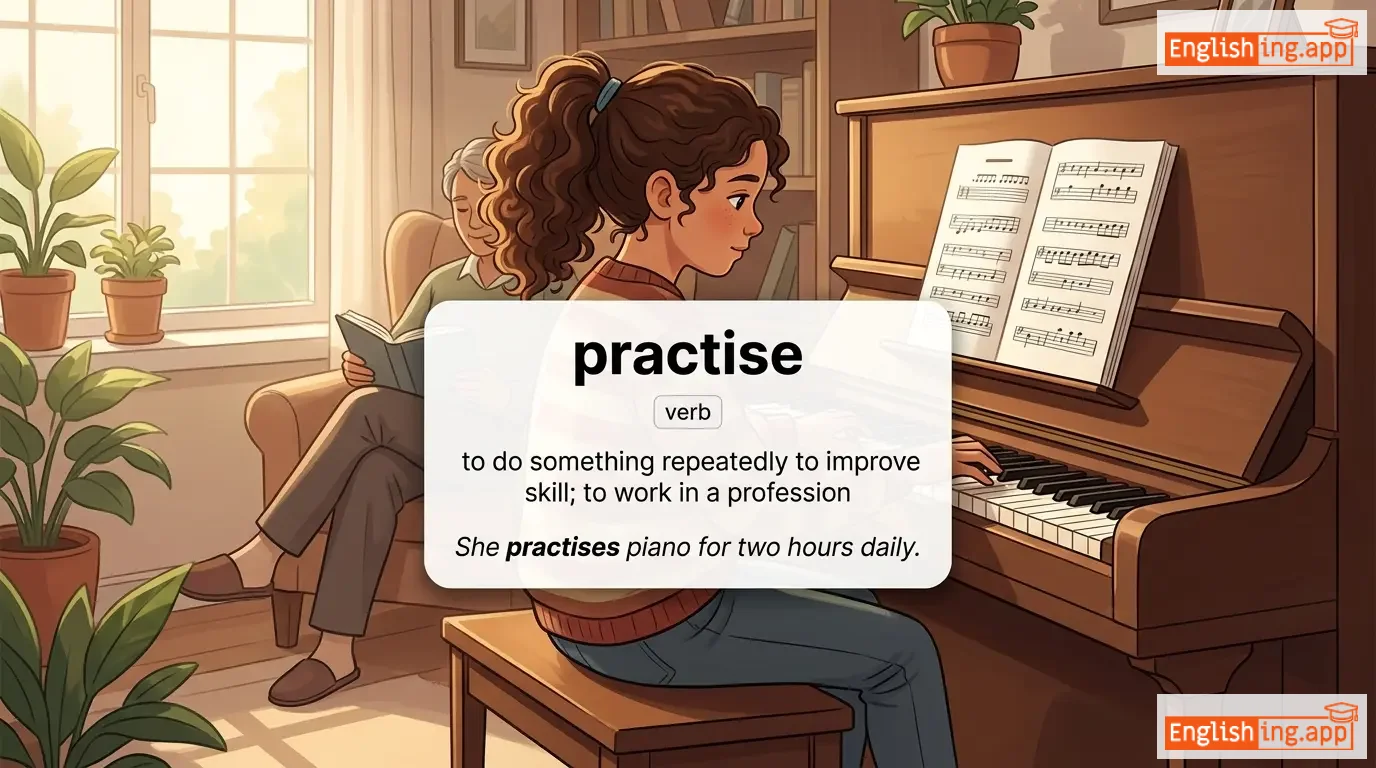
practise definition card — visual illustration of the meaning
verb
/ˈpræktɪs/
pratiquer (pratiquer)

to do something repeatedly to improve skill; to work in a profession

"She practises piano for two hours daily."

"Elle pratique le piano pendant deux heures chaque jour." (Elle pratique le piano pendant deux heures chaque jour.)
noun
/prækˈtɪʃ.ən.ər/
praticien (praticien)

a person actively engaged in a profession, especially medicine or law

"She is a skilled medical practitioner."

"Elle est une praticienne médicale qualifiée." (Elle est une praticienne medicale qualifiee.)
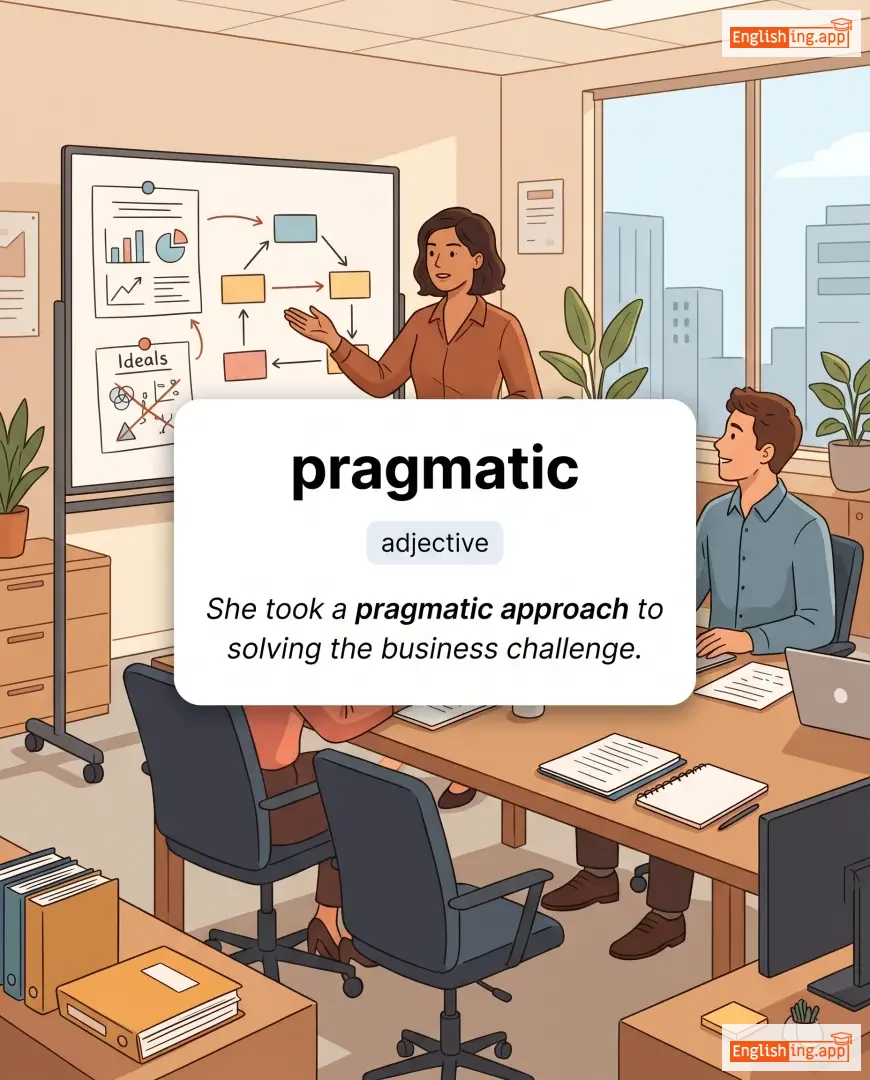
pragmatic definition card — visual illustration of the meaning
adjective
/præɡˈmætɪk/
pragmatique (pragmatique)

Dealing with problems in a practical and sensible way rather than depending on theories or ideals.

"She took a pragmatic approach to solving the business challenge."

"Elle a adopté une approche pragmatique pour résoudre le défi commercial." (Elle a adopté une approche pragmatique pour résoudre le défi commercial.)
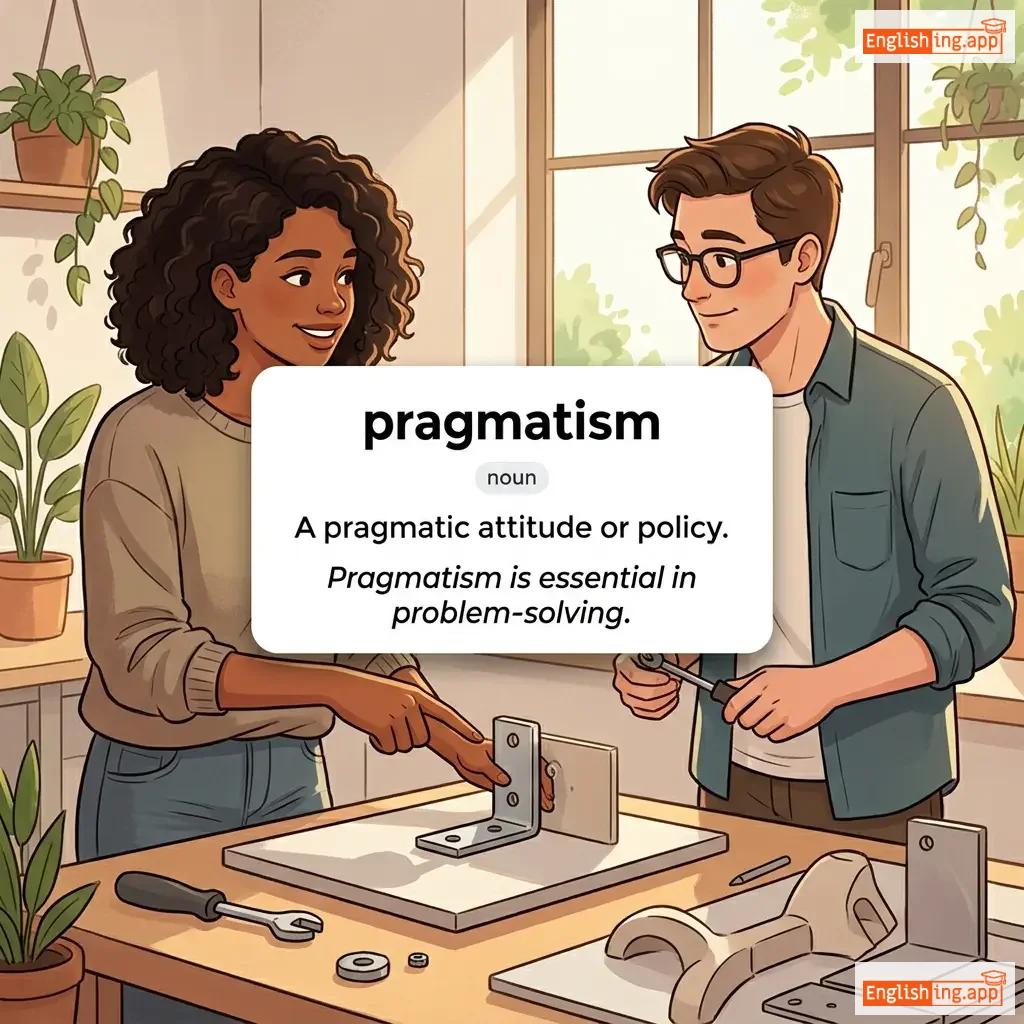
pragmatism definition card — visual illustration of the meaning
noun
/ˈpræɡ.mə.tɪ.zəm/
pragmatisme (pragmatisme)

A pragmatic attitude or policy.

"Pragmatism is essential in problem-solving."

"Le pragmatisme est essentiel pour résoudre les problèmes." (Le pragmatisme est essentiel pour resoudre les problemes.)
noun
/ˈpræɡmətɪst/
pragmatique (pragmatique)

A person who deals with things in a practical and realistic way.

"He is a true pragmatist who values results over ideals."

"Il est un véritable pragmatique qui valorise les résultats plus que les idéaux." (Il est un veritable pragmatique qui valorise les resultats plus que les ideaux.)
noun
/ˈprɛəri/
prairie (prairie)

A large open area of grassland, especially in North America.

"The bison roamed freely across the prairie."

"Les bisons erraient librement à travers la prairie." (Les bisons erraient librement à travers la prairie.)
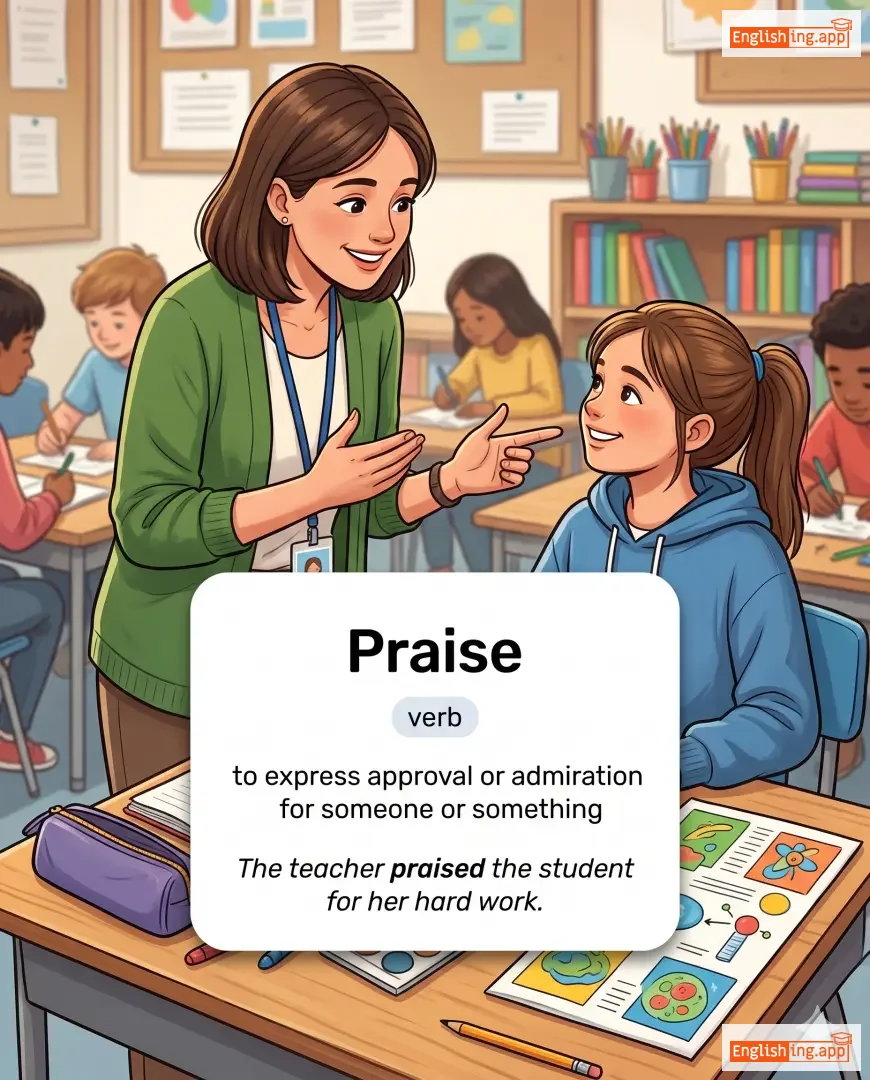
Praise definition card — visual illustration of the meaning
verb
/preɪz/
louer (louer)

to express approval or admiration for someone or something

"The teacher praised the student for her hard work."

"Le professeur a félicité l'élève pour son travail acharné." (Le professeur a félicité l'élève pour son travail acharné.)
adjective
/ˈpreɪz.wɜː.ði/
digne de louange (digne de louange)

deserving praise; commendable; admirable

"Her charitable work is truly praiseworthy."

"Son travail charitable est véritablement digne de louange." (Son travail charitable est véritablement digne de louange.)