Vocabulaires

Découvrez, apprenez et maîtrisez le vocabulaire anglais

verb
/mæʃ/
écraser (ecraser)

to crush or mix food into a soft mass, usually by pressing or beating

"She mashed the potatoes before serving dinner."

"elle a écrasé les pommes de terre avant de servir le dîner." (elle a ecrase les pommes de terre avant de servir le diner.)
noun
/mæsk/
masque (masque)

A covering for the face to protect, disguise, or entertain.

"He wore a mask at the costume party."

"Il portait un masque à la fête costumée." (Il portait un masque à la fête costumée.)
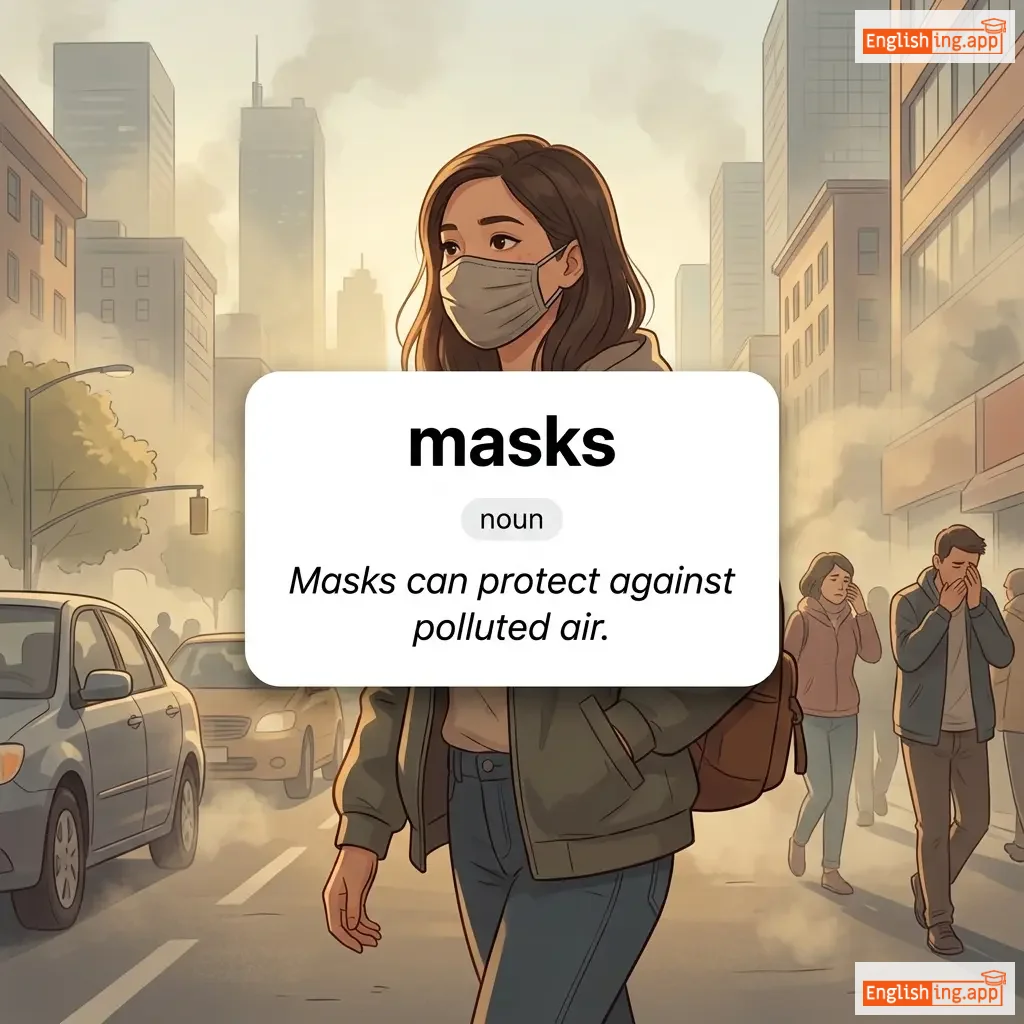
masks definition card — visual illustration of the meaning
noun
/mɑːsks/
masque (masque)

Coverings for all or part of the face, worn as a disguise, for protection, or for medical reasons.

"Masks can protect against polluted air."

"Les masques peuvent protéger contre l'air pollué." (Les masques peuvent protéger contre l'air pollué.)
noun
/ˈmæsəkɪst/
masochiste (masokiste)

a person who derives pleasure from their own pain or humiliation

"He was called a masochist for enjoying tough challenges."

"Il a été appelé masochiste pour apprécier les défis difficiles." (Il a été appelé masochiste pour apprécier les défis difficiles.)
noun
/ˈmeɪsən/
maçon (maçon)

a person skilled in building with stone, brick, or concrete

"The mason carefully laid the bricks for the new house."

"Le maçon a soigneusement posé les briques pour la nouvelle maison." (Le maçon a soigneusement posé les briques pour la nouvelle maison.)
noun
/ˌmæskəˈreɪd/
fête où les gens portent des masques et des costumes (fete ou les gens portent des masques et des costumes)

a party or gathering where people wear masks and costumes; a false outward show

"The charity event was held as a grand masquerade."

"L'événement de charité a eu lieu sous forme de grand masquerade." (L'evenement de charite a eu lieu sous forme de grand masquerade.)
noun
/mæs/
masse (masse)

a large body of matter with no specific shape; a large number of people or things

"A huge mass of people gathered in the square."

"Une grande masse de personnes s'est rassemblée sur la place." (Une grande masse de personnes s'est rassemblée sur la place.)
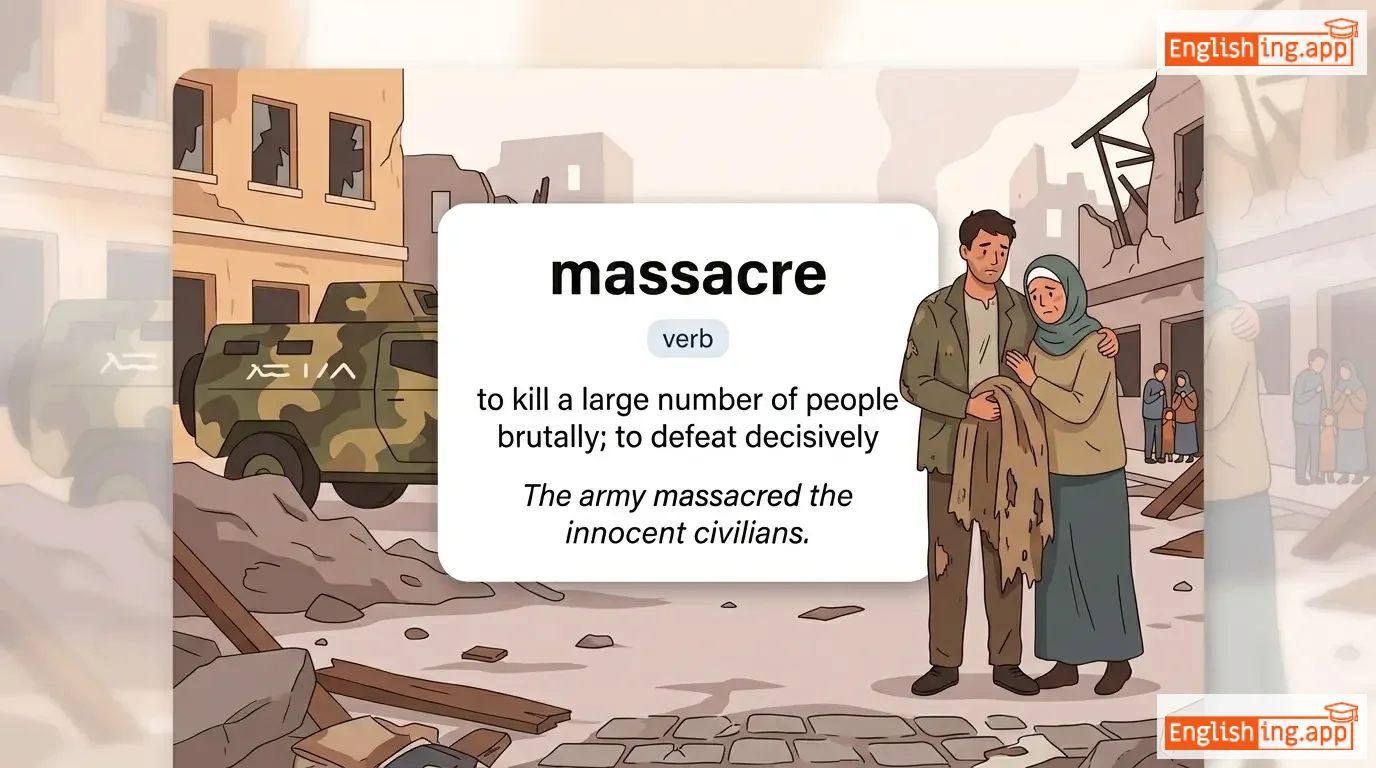
massacre definition card — visual illustration of the meaning
noun
/ˈmæsəkər/
massacre (massacre)

the killing of a large number of people, usually in a violent way

"The massacre resulted in the deaths of hundreds of civilians."

"Le massacre a entraîné la mort de centaines de civils." (Le massacre a entraine la mort de centaines de civils.)
verb
/məˈsɑːʒ/
massager (massager)

to rub and press muscles to relieve pain or tension; to manipulate information

"The therapist will massage your back to reduce muscle tension."

"Le thérapeute massera votre dos pour réduire la tension musculaire." (Le thérapeute massera votre dos pour réduire la tension musculaire.)
adjective
/ˈmæsɪv/
massif (massif)

extremely large, heavy, or solid in size or degree

"The company made a massive investment in renewable energy."

"L'entreprise a fait un investissement massif dans l'énergie renouvelable." (L'entreprise a fait un investissement massif dans l'énergie renouvelable.)
noun, verb
/ˈmɑːstər/
maître (maitre)

A person with great skill or control in a subject or activity; to gain full command over something.

"She mastered the art of cooking Italian dishes."

"Elle a maîtrisé l'art de cuisiner des plats italiens." (Elle a maîtrisé l'art de cuisiner des plats italiens.)
noun
/ˈmæstərˌpiːs/
chef-d'œuvre (chef-d'oeuvre)

a work of outstanding artistry, skill, or workmanship

"The Mona Lisa is considered Leonardo da Vinci’s masterpiece."

"La Mona Lisa est considérée comme le chef-d'œuvre de Léonard de Vinci." (La Mona Lisa est considérée comme le chef-d'œuvre de Léonard de Vinci.)
noun
/ˈmæstəri/
maîtrise (maitrise)

comprehensive knowledge or skill in a subject or accomplishment

"She has achieved mastery in classical dance."

"Elle a atteint la maîtrise dans la danse classique." (Elle a atteint la maitise dans la danse classique.)
verb
/ˈmæstɪkeɪt/
mastiquer (mastiquer)

to chew food thoroughly before swallowing

"He slowly masticated the bread before swallowing."

"Il mastiqua lentement le pain avant de l'avaler." (Il mastiqua lentement le pain avant de l'avaler.)
noun
/mæt/
tapis (tapis)

a piece of fabric material placed on a floor or surface for wiping feet or protection

"She placed a new mat at the entrance of the house."

"Elle a posé un nouveau tapis à l'entrée de la maison." (Elle a posé un nouveau tapis à l'entrée de la maison.)
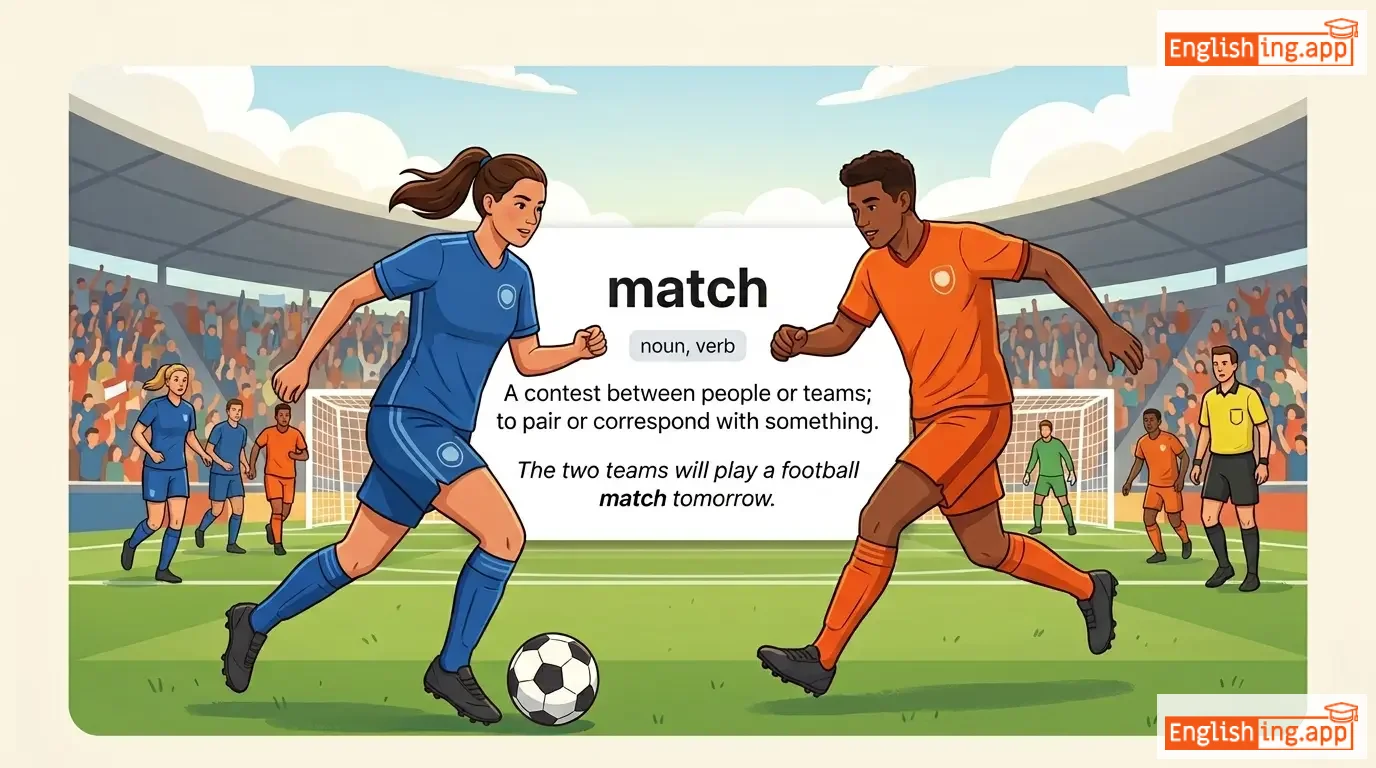
match definition card — visual illustration of the meaning
noun, verb
/mætʃ/
match / compétition (match / compétition)

A contest between people or teams; to pair or correspond with something.

"The two teams will play a football match tomorrow."

"Les deux équipes joueront un match de football demain." (Les deux équipes joueront un match de football demain.)
noun
/meɪt/
ami, compagnon (ami, compagnon)

a friend or companion; a partner in marriage or reproduction

"He went fishing with his old school mate."

"Il est allé pêcher avec son vieux camarade de l'école." (Il est alle pêcher avec son vieux camarade de l'ecole.)
noun, adjective
/məˈtɪəriəl/
matériel (materiel)

The substance or matter from which something is made; relating to physical things rather than ideas or emotions.

"The builder brought all the necessary material for the construction."

"Le constructeur a apporté tout le matériel nécessaire pour la construction." (Le constructeur a apporté tout le matériel nécessaire pour la construction.)
noun
/məˈtɪəriəlɪzəm/
matérialisme (materialisme)

A tendency to consider material possessions and physical comfort as more important than spiritual or moral values.

"The novel criticizes society's growing materialism."

"Le roman critique le matérialisme croissant de la société." (Le roman critique le matérialisme croissant de la société.)
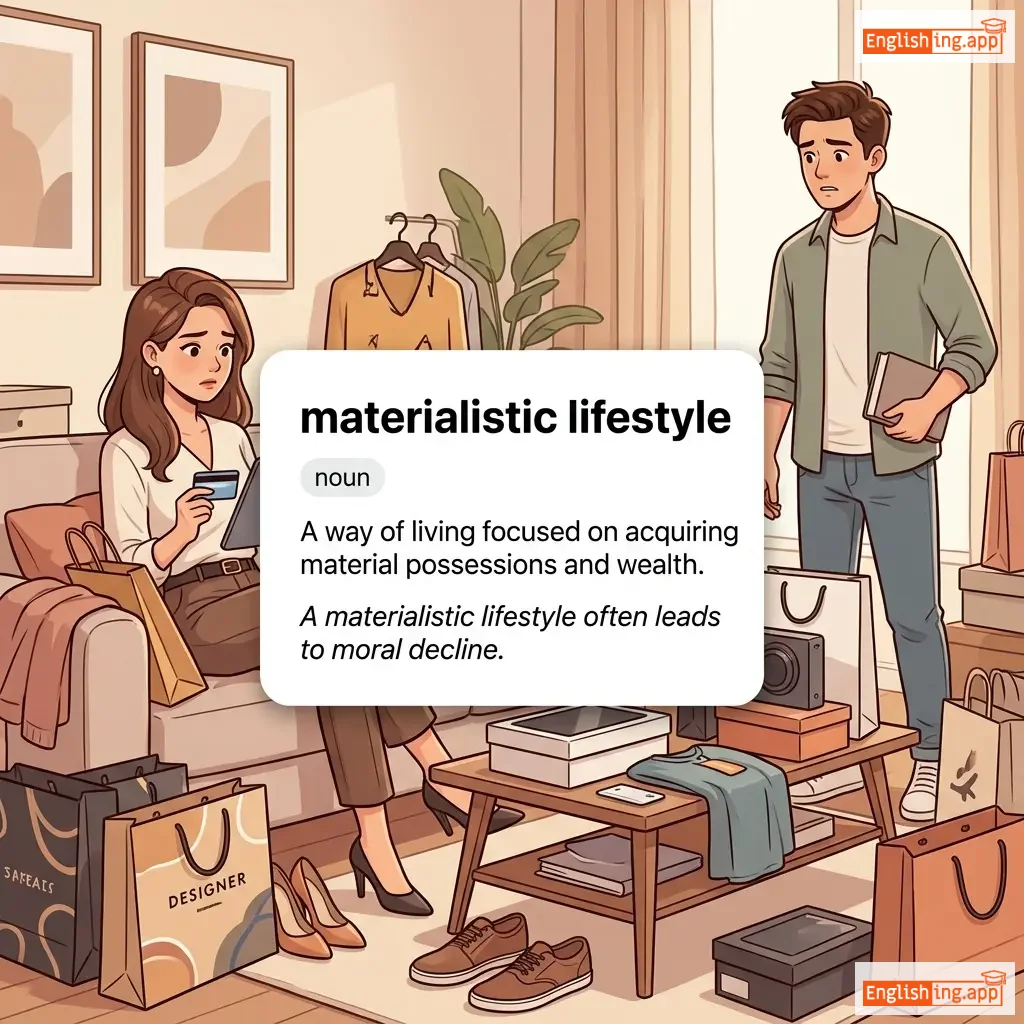
materialistic lifestyle definition card — visual illustration of the meaning
noun
məˌtɪərɪəˈlɪstɪk ˈlaɪfstaɪl
mode de vie matérialiste (mode de vie materialiste)

A way of living focused on acquiring material possessions and wealth.

"A materialistic lifestyle often leads to moral decline."

"Un mode de vie matérialiste conduit souvent à un déclin moral." (Un mode de vie matérialiste conduit souvent à un déclin moral.)
verb
/məˈtɪərɪəlaɪz/
se matérialiser (se materialiser)

To become real or actual; to appear suddenly or in a physical form.

"The opportunity he had been waiting for finally materialized."

"L'opportunité qu'il attendait est enfin matérialisée." (L'opportunité qu'il attendait est enfin matérialisée.)
adjective
/məˈtɜːnəl/
maternel (maternel)

Relating to a mother; showing motherly qualities such as care and protection.

"She showed great maternal affection toward the child."

"Elle a montré une grande affection maternelle envers l'enfant." (Elle a montré une grande affection maternelle envers l'enfant.)
noun
/məˈtɜːrnəti/
maternité (maternite)

The state of being a mother; motherhood

"The hospital has an excellent maternity ward for new mothers."

"L'hôpital dispose d'une excellente salle de maternité pour les nouvelles mères." (L'hopital dispose d'une excellente salle de maternite pour les nouvelles meres.)
noun
/mæθ/
mathématiques (mathematiques)

The study of numbers, quantities, and shapes, also called mathematics.

"She is very good at math."

"Elle est très bonne en mathématiques." (Elle est tres bonne en mathematiques.)
adjective
/ˌmæθəˈmætɪkəl/
mathématique (matematique)

relating to mathematics or the use of mathematics

"The mathematical equation was difficult to solve."

"L'équation mathématique était difficile à résoudre." (L'equation mathematique etait difficile a resoudre.)
adverb
/ˌmæθəˈmætɪkli/
mathématiquement (mathematiquement)

in a way that relates to mathematics; using numbers, formulas, or logical calculation

"The problem can be solved mathematically rather than by guesswork."

"Le problème peut être résolu mathématiquement plutôt que par des suppositions." (Le probleme peut etre resolu mathematiquement plutot que par des suppositions)
noun
/ˌmæθəˈmætɪks/
mathématiques (mathematiques)

the abstract science of number, quantity, and space; the study of numbers and their operations

"Mathematics helps us understand patterns in nature and the universe."

"Les mathématiques nous aident à comprendre les motifs dans la nature et l'univers." (Les mathematiques nous aident a comprendre les motifs dans la nature et l'univers.)
noun
/ˈmætɪneɪ/
spectacle de l'après-midi (spectacle de l'apres-midi)

A performance, especially a play or movie, that takes place in the afternoon.

"We bought tickets for the Sunday afternoon matinee."

"Nous avons acheté des billets pour le spectacle de l'après-midi du dimanche." (Nous avons achete des billets pour le spectacle de l'apres-midi du dimanche.)
👩‍👩‍👧‍👦

matriarch (maytreeark)

noun
/ˈmeɪ.triˌɑːrk/
matriarche (mateearsh)

A woman who is the head of a family or community.

"The matriarch of the family made all important decisions."

"La matriarche de la famille a pris toutes les decisions importantes." (La matriarche de la famille a pris toutes les decisions importantes.)
noun
/ˈmætrɪˌsaɪd/
matricide (matricide)

The act of killing one's own mother.

"The crime of matricide shocked the entire town."

"Le crime de matricide a choqué toute la ville." (Le krim de matricide a choké tout la vil.)
verb
/məˈtrɪkjʊˌleɪt/
matriculer (matriculer)

To enroll as a student in a college or university.

"She matriculated at Oxford University last year."

"Elle s'est inscrite à l'Université d'Oxford l'année dernière." (Elle s'est inscrite à l'Université d'Oxford l'année dernière.)
noun
/ˈmætrəˌmoʊni/
mariage (mariage)

The state of being married; marriage.

"They entered into matrimony after years of friendship."

"Ils sont entrés dans le mariage après des années d'amitié." (Ils sont entrés dans le mariage après des années d'amitié.)
noun
/ˈmeɪ.trɪks/
matrice, structure (matrice, structure)

An environment or structure in which something develops; also a mathematical array of numbers.

"The cultural matrix shaped his worldview."

"La matrice culturelle a façonné sa vision du monde." (La matrice culturelle a façonné sa vision du monde.)
noun, verb
/ˈmætər/
question / importance (kestion / ãpɔʁtãns)

A subject or situation under consideration; to be important.

"It doesn’t matter what others think."

"Peu importe ce que pensent les autres." (Peu importe ce que pensent les autres.)
noun/verb
/ˈmætərz/
questions / importer (questions / importer)

important topics, concerns, or issues; as a verb, to be of importance or significance

"What she thinks really matters to me."

"Ce que elle pense compte vraiment pour moi." (Ce que elle pense compte vraiment pour moi.)
noun
/ˈmætrəs/
matelas (matelas)

A large pad used as a bed or part of a bed, typically filled with soft material for sleeping on.

"She bought a new mattress for better sleep comfort."

"Elle a acheté un nouveau matelas pour plus de confort pendant son sommeil." (Elle a achete un nouveau matelas pour plus de confort pendant son sommeil.)
adjective
/məˈtjʊr/
mature (mature)

fully developed or grown, especially emotionally or intellectually

"She has become a mature and confident leader."

"Elle est devenue une leader mature et confiante." (Elle est devenue une leader mature et confiante.)
noun
/məˈtʃʊrəti/
maturité (maturity)

The state of being mature; full development physically or emotionally

"With age comes wisdom and emotional maturity."

"Avec l'âge vient la sagesse et la maturité émotionnelle." (Avec l'age vient la sagesse et la maturite emotionnelle.)
adjective
/ˈmɔːdlɪn/
trop sentimental (trop sentimental)

Overly sentimental, often tearfully or weakly emotional.

"He became maudlin after a few drinks."

"Il est devenu trop sentimental après quelques verres." (Il est devenu trop sentimental après quelques verres.)
verb
/mɔːl/
mutiler (mutiler)

To wound or injure someone by scratching or tearing; to handle roughly.

"The bear mauled the camper in the forest."

"L'ours a mutilé le campeur dans la forêt." (L'ours a mutilé le campeur dans la forêt.)
verb
/ˈmɔːndər/
parler de manière incohérente (parler de manière incohérente)

To speak or move aimlessly and incoherently.

"He maundered on about his old memories."

"Il parlait de manière incohérente de ses vieux souvenirs." (Il parlait de manière incohérente de ses vieux souvenirs.)
noun
/ˌmɔːzəˈliːəm/
mausolée (mausolee)

A large stately building that houses a tomb or several tombs.

"The king was buried in a grand mausoleum."

"Le roi a été enterré dans un grand mausolée." (Le roi a été enterré dans un grand mausolée.)
adjective
/moʊv/
mauve clair (mauve clair)

a pale purple color with a grayish or bluish tinge

"She wore a beautiful mauve dress to the party."

"Elle portait une magnifique robe mauve clair à la fête." (Elle portait une magnifique robe mauve clair à la fête.)
🧑‍🏫

maven (méven)

noun
/ˈmeɪvən/
expert (expert)

an expert or connoisseur in a particular field

"He is a tech maven who always knows the latest trends."

"Il est un expert en technologie qui connaît toujours les dernières tendances." (Il est un expert en technologie qui connaît toujours les dernières tendances.)
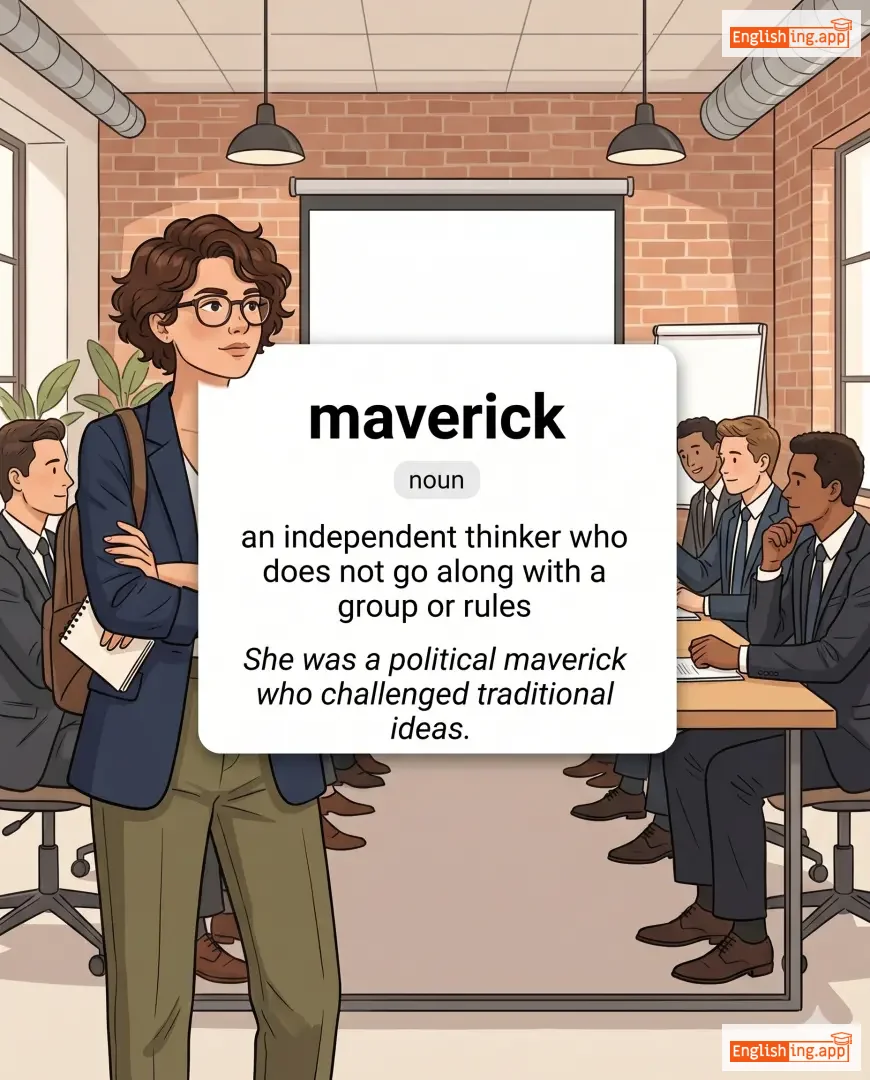
maverick definition card — visual illustration of the meaning
noun
/ˈmævərɪk/
indépendant (independent)

an independent thinker who does not go along with a group or rules

"She was a political maverick who challenged traditional ideas."

"Elle était une maverick politique qui défiait les idées traditionnelles." (Elle était une maverick politique qui défiait les idées traditionnelles.)
adjective
/ˈmɔːkɪʃ/
trop sentimental (trop sentimental)

excessively sentimental, often to the point of being sickly

"The movie was criticized for its mawkish sentimentality."

"Le film a été critiqué pour son sentimentalisme excessif." (Le film a été critiqué pour son sentimentalisme excessif.)
noun
/ˈmæksɪm/
maxime (maxime)

a short, well-known statement expressing a general truth or rule of conduct

"Honesty is a timeless maxim valued in every culture."

"L'honnêteté est une maxime intemporelle valorisée dans toutes les cultures." (L'honnete est une maxime intemporelle valorisee dans toutes les cultures.)
verb
/ˈmæk.sɪ.maɪz/
maximiser (maximiser)

to increase something as much as possible

"The company aims to maximize its profits this year."

"L'entreprise vise à maximiser ses profits cette année." (L'entreprise vise à maximiser ses profits cette année.)
noun/adjective
/ˈmæksɪməm/
maximum (maximum)

the greatest or highest amount, value, or degree possible

"She scored the maximum marks in the exam."

"Elle a obtenu la note maximale à l'examen." (Elle a obtenu la note maximale a l'examen.)
modal verb, noun
/meɪ/
peut-être / mois de mai (peut-etre / mois de mai)

Used to express possibility, permission, or uncertainty; also the name of the fifth month of the year.

"You may leave early if you finish your work."

"Tu peux partir tôt si tu finis ton travail." (Tu peux partir tôt si tu finis ton travail.)