Vocabulaires

Découvrez, apprenez et maîtrisez le vocabulaire anglais

noun
/ˈdʒʌɡləri/
jonglerie (jongleri)

The performance of tricks and illusions, especially by sleight of hand.

"The magician's jugglery amazed the audience."

"La jonglerie du magicien a émerveillé le public." (La jonglerie du magicien a émerveillé le public.)
noun
/ˈdʒʌɡjələr/
veine jugulaire (veine jugulaire)

A large vein in the neck that carries blood from the head back to the heart.

"The doctor checked the patient's jugular vein for signs of pressure."

"Le médecin a examiné la veine jugulaire du patient à la recherche de signes de pression." (Le médecin a examiné la veine jugulaire du patient à la recherche de signes de pression.)
noun
/dʒuːs/
jus (jus)

the liquid obtained from fruits, vegetables, or meat; also refers to energy or power in informal use

"She drank a glass of orange juice with breakfast."

"Elle a bu un verre de jus d'orange au petit déjeuner." (Elle a bu un verre de jus d'orange au petit dejeuner.)
adjective
/ˈdʒuːsi/
juteux (juteux)

Full of juice; succulent; also used to describe something exciting or scandalous.

"The steak was so juicy that it melted in my mouth."

"Le steak était tellement juteux qu'il fondait dans ma bouche." (Le steak était tellement juteux qu'il fondait dans ma bouche.)
noun
/dʒuˈlaɪ/
juillet (juillet)

the seventh month of the year in the Gregorian calendar

"July is often the hottest month of the year."

"Juillet est souvent le mois le plus chaud de l’année." (juillet est souvent le mois le plus chaud de lannee)
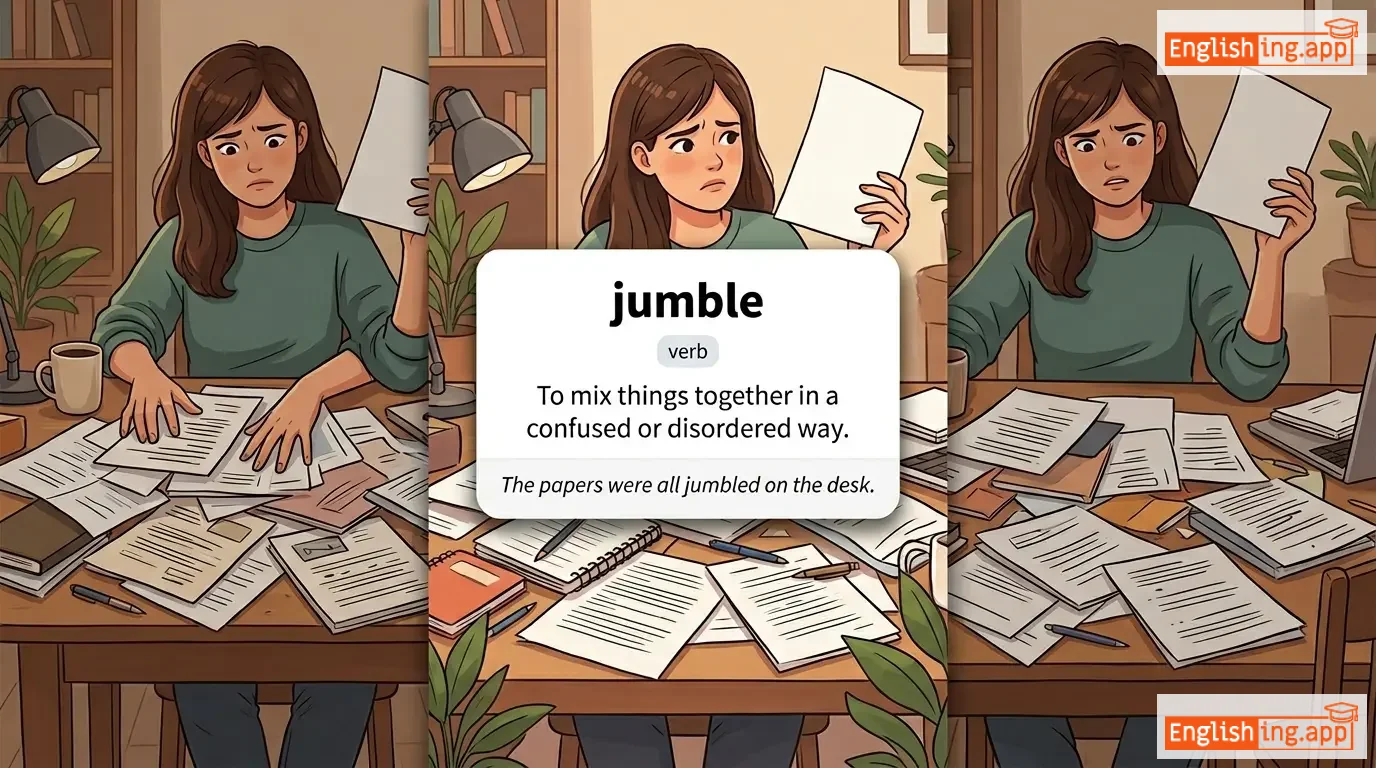
jumble definition card — visual illustration of the meaning
verb
/ˈdʒʌmbəl/
mélanger (melanger)

To mix things together in a confused or disordered way.

"The papers were all jumbled on the desk."

"Les papiers étaient tous en désordre sur le bureau." (Les papiers étaient tous en désordre sur le bureau.)
adjective
/ˈdʒʌm.boʊ/
exceptionnellement grand; gigantesque (jumbo)

exceptionally large; enormous; gigantic

"The jumbo jet was delayed at the airport."

"Le jet jumbo a été retardé à l'aéroport." (Le jet jumbo a été retardé à l'aéroport.)
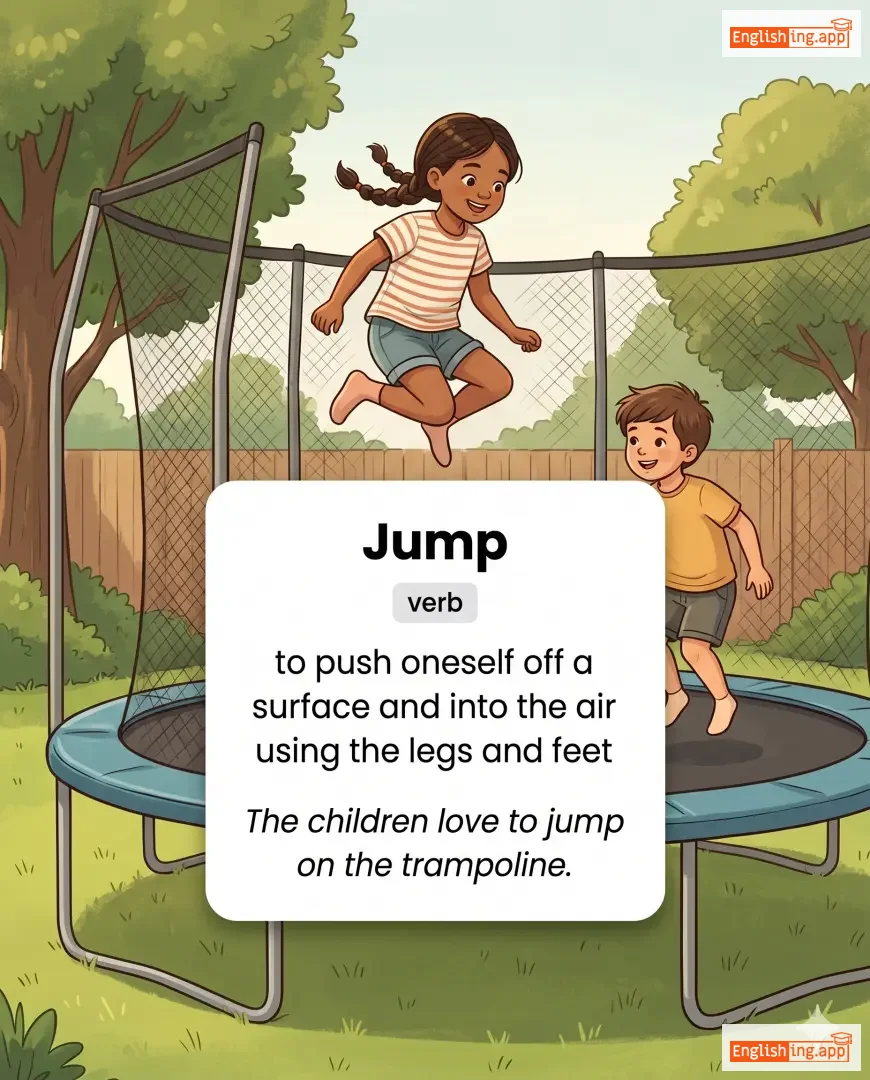
Jump definition card — visual illustration of the meaning
verb
/dʒʌmp/
sauter (sauter)

to push oneself off a surface and into the air using the legs and feet

"The children love to jump on the trampoline."

"Les enfants adorent sauter sur le trampoline." (Les enfants adorent sauter sur le trampoline.)
noun
/ˈdʒʌm.pər/
pull; (pull)

a knitted garment worn on the upper body; a person or animal that jumps

"She wore a warm woolen jumper during the cold winter evening."

"Elle portait un pull en laine chaud pendant la froide soirée d'hiver." (Elle portait un pull en laine chaud pendant la froide soirée d'hiver.)
noun
/ˈdʒʌŋkʃən/
jonction (jonk-syon)

A place where two or more roads or things meet or are joined.

"The car stopped at the busy junction."

"La voiture s'est arrêtée au carrefour très fréquenté." (La voiture s'est arrêtée au carrefour très fréquenté.)
noun
/ˈdʒʌŋktʃər/
moment critique (moment critique)

A particular point in time or a critical moment.

"At this critical juncture, we must make the right decision."

"À ce moment critique, nous devons prendre la bonne décision." (A ce moment critique, nous devons prendre la bonne decision.)
noun
/dʒuːn/
juin (juin)

the sixth month of the year in the Gregorian calendar

"Schools often close for summer vacation in June."

"Les écoles ferment souvent pour les vacances en juin." (les ecoles ferment souvent pour les vacances en juin)
noun
/ˈdʒʌŋɡəl/
jungle (jungle)

a dense forest, typically in a tropical region, filled with wild plants and animals

"They got lost in the thick jungle during their trip."

"Ils se sont perdus dans la jungle dense pendant leur voyage." (Ils se sont perdus dans la jungle dense pendant leur voyage.)
adjective, noun
/ˈdʒuːniər/
junior (junior)

younger or lower in rank; also a student in the next-to-last year of high school or college

"He works as a junior officer in the company."

"Il travaille comme officier junior dans l'entreprise." (Il travaille comme officier junior dans l'entreprise.)
noun
/dʒʌŋk/
poubelle; déchets (poubelle, dechets)

old or discarded articles that are considered useless or of little value; things of poor quality

"He cleaned out the garage and threw away all the old junk."

"Il a nettoyé le garage et a jeté toutes les vieilles poubelles." (il a nettoye le garage et a jete toutes les vieilles poubelles.)
noun
/ˈdʒʌŋkɪt/
voyage ou célébration (voyage ou celebration)

A trip or celebration, often funded by someone else, usually for pleasure or promotional purposes.

"The company organized a junket for journalists to promote their new resort."

"L'entreprise a organisé un voyage pour les journalistes afin de promouvoir leur nouveau complexe." (L'entreprise a organise un voyage pour les journalistes afin de promouvoir leur nouveau complexe.)
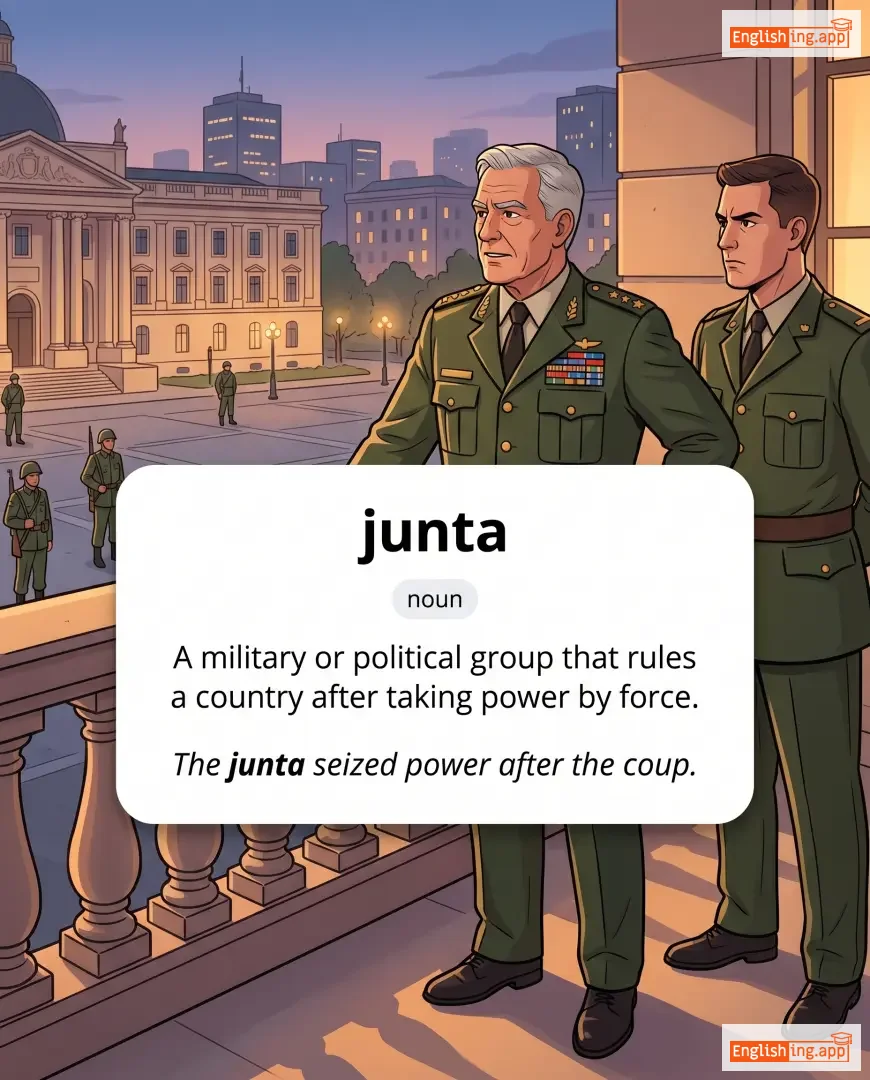
junta definition card — visual illustration of the meaning
noun
/ˈdʒʊntə/
junte militaire (junte militaire)

A military or political group that rules a country after taking power by force.

"The junta seized power after the coup."

"La junte a pris le pouvoir après le coup d'État." (La junte a pris le pouvoir après le coup d'État.)
noun
/ˈdʒuː.pɪ.tər/
Jupiter; dieu principal de la mythologie romaine (jupiter; dieu principal de la mythologie romaine)

the largest planet in our solar system; the chief god of Roman mythology

"Jupiter is known for its massive size and distinctive red spot."

"Jupiter est connu pour sa taille massive et sa tache rouge distincte." (Jupiter est connu pour sa taille massive et sa tache rouge distincte.)
adjective
/dʒʊˈrɪdɪkəl/
juridique (juridique)

Relating to judicial proceedings or the administration of law.

"The case raised important juridical questions."

"L'affaire a soulevé des questions juridiques importantes." (L'affaire a souleve des questions juridiques importantes.)
noun
/ˌdʒʊərɪsˈdɪkʃən/
juridiction (juridiction)

The official power to make legal decisions and judgments.

"The court has jurisdiction over criminal cases."

"Le tribunal a juridiction sur les affaires criminelles." (Le tribunal a juridiction sur les affaires criminelles.)
noun
/ˌdʒʊərɪsˈpruːdəns/
jurisprudence (jurisprudence)

The theory, philosophy, or science of law.

"She is a professor of jurisprudence at the university."

"Elle est professeure de jurisprudence à l'université." (Elle est professeure de jurisprudence à l'université.)
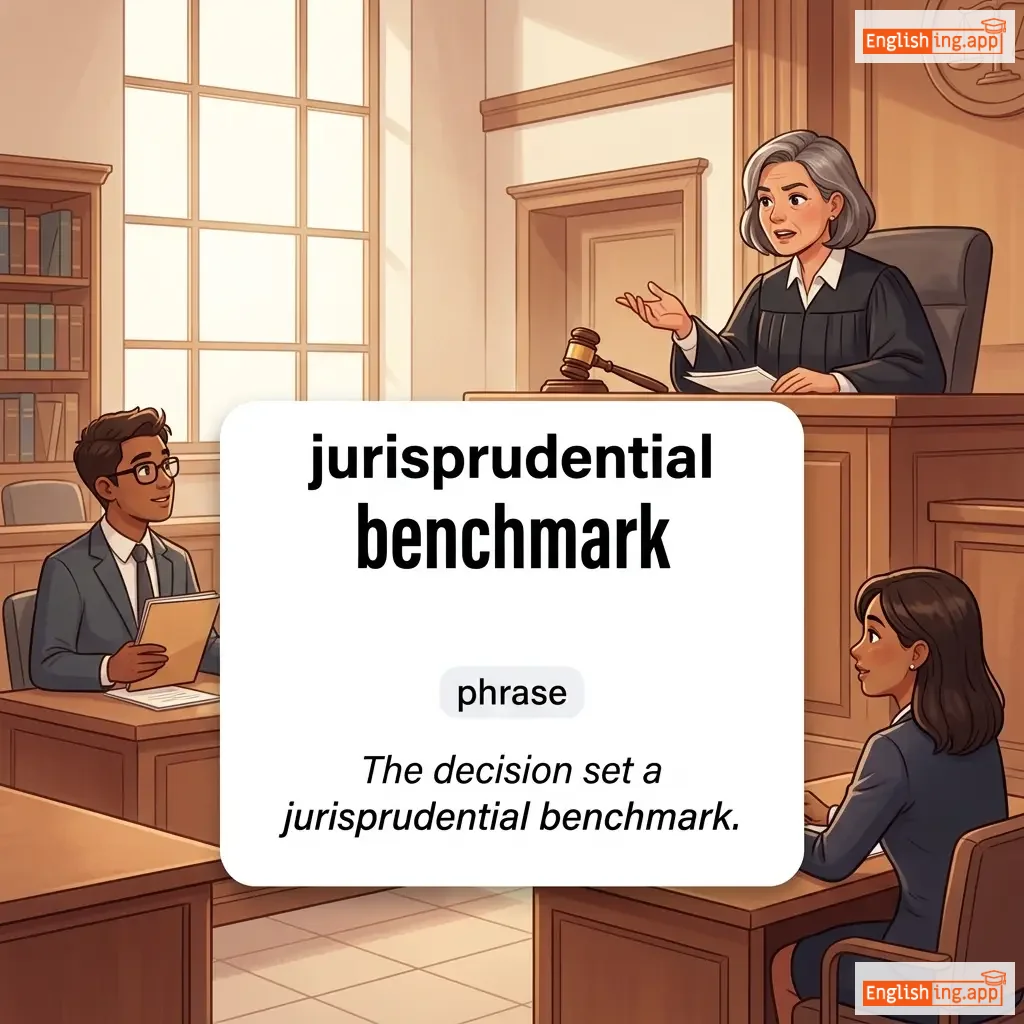
jurisprudential benchmark definition card — visual illustration of the meaning
phrase
ˌdʒʊə.rɪs.pruːˈden.ʃəl ˈbentʃ.mɑːk
repère juridique (reper juridique)

A legal standard or precedent that serves as a reference point for future legal decisions.

"The decision set a jurisprudential benchmark."

"La décision a établi un repère juridique." (La décision a établi un repère juridique.)
noun
/ˈdʒʊərər/
membre du jury (membre du jury)

a member of a jury who is chosen to hear evidence in a legal case and help make a decision

"The juror listened carefully to the witness’s testimony."

"Le membre du jury a écouté attentivement le témoignage du témoin." (Le membre du jury a écouté attentivement le témoignage du témoin.)
noun
/ˈdʒʊəri/
jury (jury)

a group of people sworn to give a verdict in a legal case based on the evidence

"The jury found him guilty of the crime."

"Le jury l'a trouvé coupable du crime." (Le jury l'a trouvé coupable du crime.)
adverb/adjective
/dʒʌst/
Exactement, seulement, ou juste et moralement correct (Exactement, seulement, ou juste et moralement correct)

Exactly, only, or fair and morally right.

"She arrived just in time for the meeting."

"Elle est arrivée juste à temps pour la réunion." (Elle est arrivée juste à temps pour la réunion.)
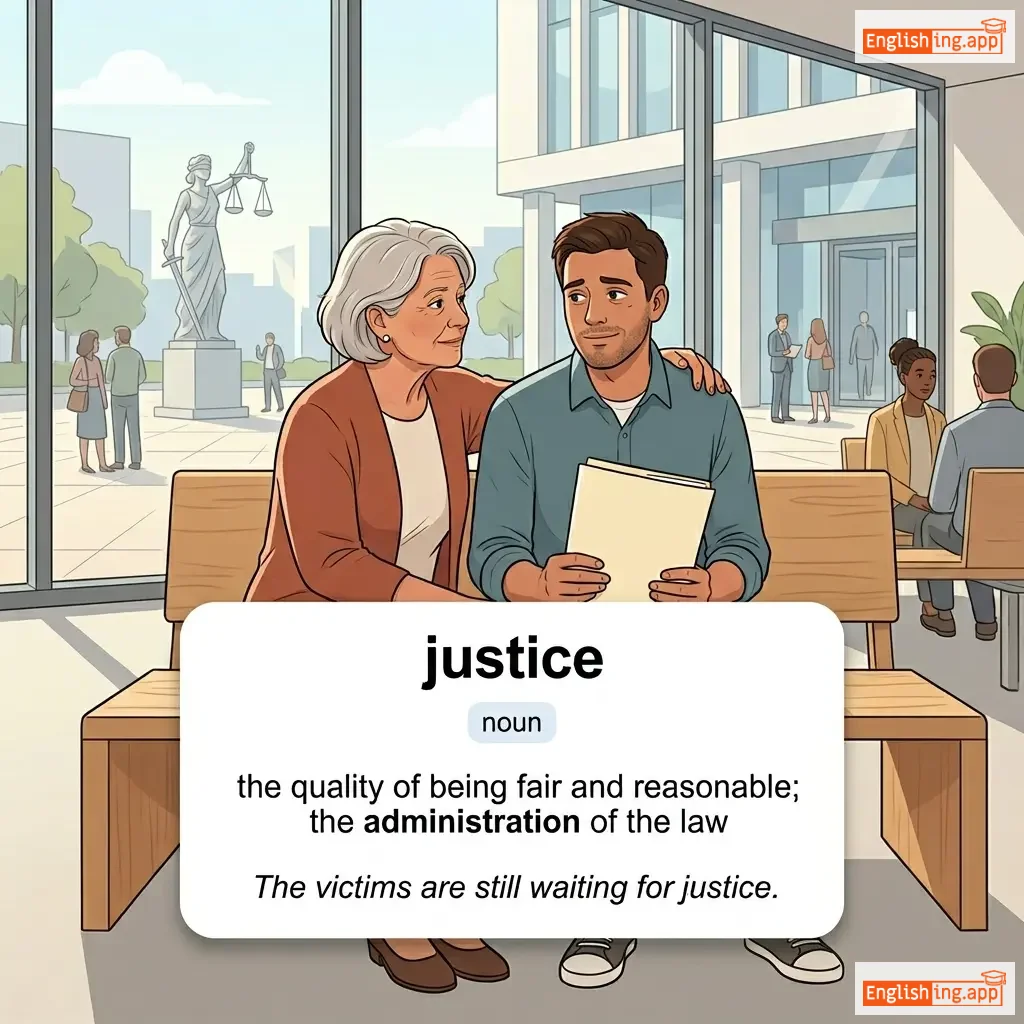
justice definition card — visual illustration of the meaning
noun
/ˈdʒʌstɪs/
justice (justice)

the quality of being fair and reasonable; the administration of the law

"The victims are still waiting for justice."

"Les victimes attendent toujours la justice." (Les victimes attendent toujours la justice.)
noun
/ˌdʒʌstɪfɪˈkeɪʃən/
justification (justification)

a reason, explanation, or excuse that shows something is right or reasonable

"There is no justification for such rude behavior."

"Il n'y a aucune justification pour un tel comportement grossier." (Il n'y a aucune justification pour un tel comportement grossier.)
verb
/ˈdʒʌstɪfaɪ/
justifier (justifier)

to show or prove that something is right or reasonable

"He tried to justify his decision with logical reasons."

"Il a essayé de justifier sa décision avec des raisons logiques." (Il a essayé de justifier sa décision avec des raisons logiques.)
noun
/dʒuːt/
jute (jute)

a long, soft, shiny plant fiber used to make rope, bags, sacks, and coarse cloth

"Jute is widely used to make eco-friendly bags and ropes."

"Le jute est utilisé pour fabriquer des sacs écologiques." (le jute est utilise pour fabriquer des sacs ecologiques)
noun
/dʒuːt liːf/
feuille de jute (feuille de jute)

the edible leaves of the jute plant, commonly eaten as a leafy green vegetable

"Jute leaf is rich in vitamins and minerals and is often cooked with lentils in Bengali cuisine."

"La feuille de jute est riche en vitamines et minéraux et est souvent cuite avec des lentilles dans la cuisine bengali." (La feuille de jute est riche en vitamines et minéraux et est souvent cuite avec des lentilles dans la cuisine bengali.)
adjective, noun
/ˈdʒuːvənaɪl/
juvénile (juvenil)

relating to young people; childish or immature

"The court sent the case to a juvenile detention center."

"Le tribunal a envoyé l'affaire dans un centre de détention juvénile." (Le tribunal a envoye l'affaire dans un centre de detention juvenile.)
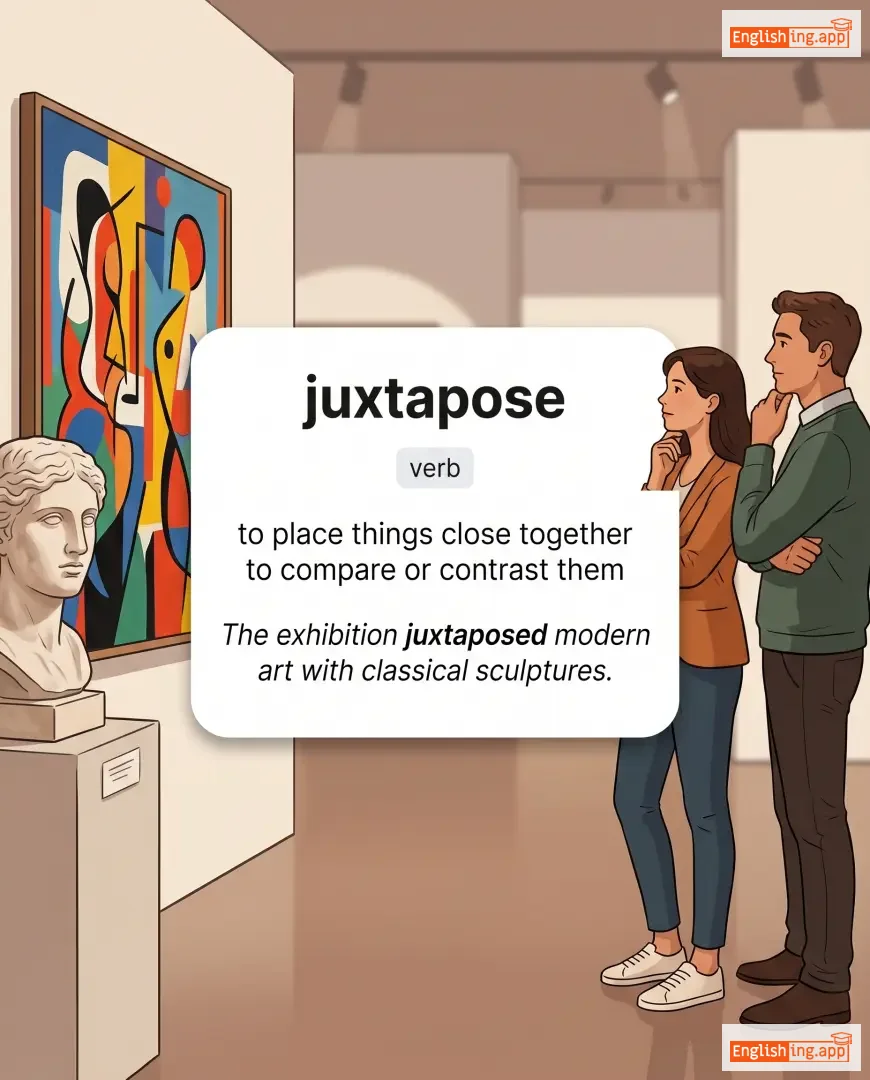
juxtapose definition card — visual illustration of the meaning
verb
/ˈdʒʌkstəˌpoʊz/
placer des choses ensemble pour comparer ou contraster (placer des choses ensemble pour comparer ou contraster)

to place things close together to compare or contrast them

"The exhibition juxtaposed modern art with classical sculptures."

"L'exposition a placé l'art moderne à côté des sculptures classiques." (L'exposition a placé l'art moderne à côté des sculptures classiques.)
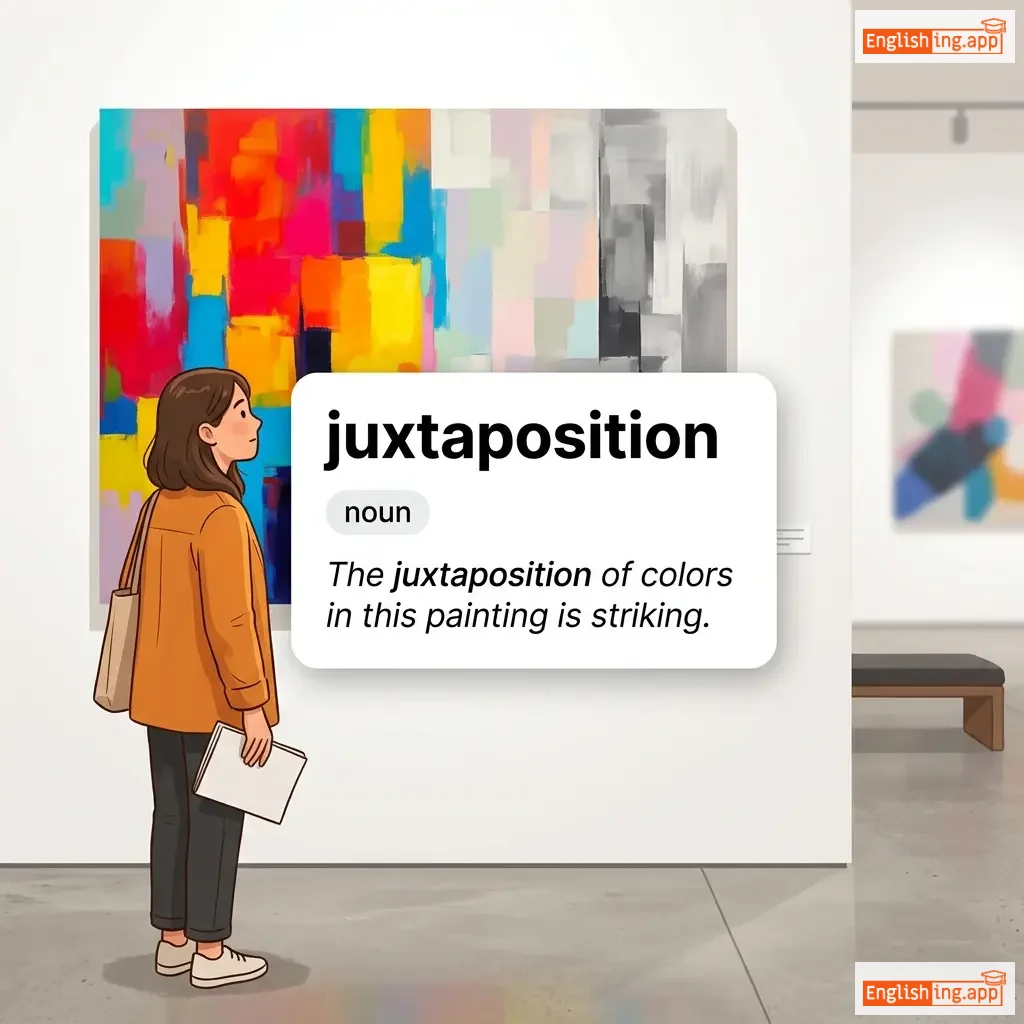
juxtaposition definition card — visual illustration of the meaning
noun
/ˌdʒʌk.stə.pəˈzɪʃ.ən/
juxtaposition (juxtaposition)

The fact of two things being seen or placed close together with contrasting effect.

"The juxtaposition of colors in this painting is striking."

"La juxtaposition des couleurs dans cette peinture est frappante." (La juxtaposition des couleurs dans cette peinture est frappante.)