Vocabulaires

Découvrez, apprenez et maîtrisez le vocabulaire anglais

noun
/ˌɪnkænˈdɛsəns/
incandescence (incandescence)

the emission of light from a hot object; brilliance

"The incandescence of the candle filled the dark room."

"L'incandescence de la bougie remplit la pièce sombre." (L'incandescence de la bougie remplit la piece sombre.)
adjective
/ˌɪnkænˈdɛsənt/
incandescent (incandescent)

emitting light as a result of being heated; extremely bright or passionate

"The incandescent lamp lit up the entire hall."

"La lampe incandescente a éclairé toute la salle." (La lampe incandescente a éclairé toute la salle.)
noun
/ˌɪnkænˈteɪʃən/
incantation (incantation)

a series of words used as a magic spell or charm

"The wizard chanted an incantation to summon the spirits."

"Le magicien a récité une incantation pour invoquer les esprits." (Le magicien a recite une incantation pour invoquer les esprits.)
noun
/ˌɪnˌkeɪpəˈbɪləti/
incapacité (incapacite)

lack of ability or power to do something; inability or incompetence

"His incapability to manage the team led to serious problems."

"Son incapacité à gérer l’équipe a causé de graves problèmes." (son incapacite a gerer lequipe a cause de graves problemes)
adjective
/ɪnˈkeɪpəbəl/
incapable (incapable)

lacking the ability, skill, or capacity to do something

"He is incapable of understanding complex instructions."

"Il est incapable de comprendre des instructions complexes." (Il est incapable de comprendre des instructions complexes)
verb
/ˌɪnkəˈpæsɪteɪt/
incapaciter (incapaciter)

to deprive someone or something of the ability or strength to function

"The severe injury incapacitated the player for the rest of the season."

"La blessure grave a rendu le joueur incapable pour le reste de la saison." (La blessure grave a rendu le joueur incapable pour le reste de la saison.)
noun
/ˌɪnkəˈpæsəti/
incapacité (incapacite)

the lack of ability, power, or fitness to do something

"His mental incapacity prevented him from making important decisions."

"Son incapacité mentale l'a empêché de prendre des décisions importantes." (Son incapacité mentale l'a empêche de prendre des décisions importantes.)
verb
/ɪnˈkɑːrsəreɪt/
incarcérer (incarcérer)

to imprison or confine someone

"The authorities incarcerated the criminal after the trial."

"Les autorités ont emprisonné le criminel après le procès." (Les autorités ont emprisonné le criminel après le procès.)
noun
/ɪnˌkɑːsəˈreɪʃən/
incarcération (incarceration)

the state of being imprisoned or confined

"The criminal faced years of incarceration for his crimes."

"Le criminel a purgé des années d'incarcération pour ses crimes." (Le criminel a purge des annees d'incarceration pour ses crimes.)
adjective/noun
/ɪnˈkɑːrnədiːn/
rouge incarnat (rouge incarnat)

a bright crimson or pinkish-red color

"The sky turned incarnadine at sunset."

"Le ciel est devenu rouge incarnat au coucher du soleil." (Le ciel est devenu rouge incarnat au coucher du soleil.)
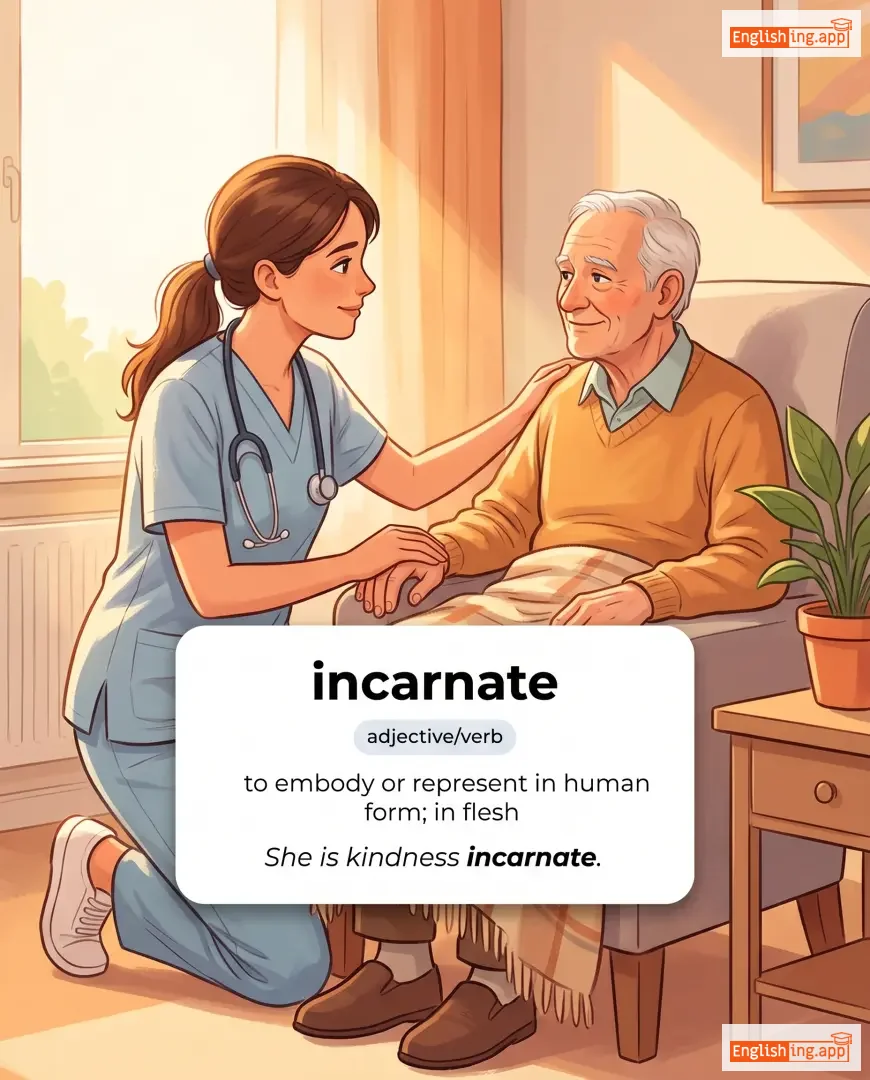
incarnate definition card — visual illustration of the meaning
adjective/verb
/ɪnˈkɑːrneɪt/
incarné (incarne)

to embody or represent in human form; in flesh

"She is kindness incarnate."

"Elle est la bonté incarnée." (Elle est la bonté incarnée.)
noun
/ˌɪnkɑːrˈneɪʃən/
incarnation (incarnation)

the embodiment of a deity, spirit, or quality in a physical form

"The monk was considered the incarnation of compassion."

"Le moine était considéré comme l'incarnation de la compassion." (Le moine etait considere comme l'incarnation de la compassion.)
adjective
/ɪnˈsɛndiˌɛri/
incendiaire / provocateur (incendiaire / provocateur)

designed to cause fires or stir up conflict

"The politician’s incendiary remarks angered the crowd."

"Les remarques incendiaires du politicien ont mis en colère la foule." (Les remarques incendiaires du politicien ont mis en colère la foule.)
noun/verb
/ˈɪnsɛns/
encens / irriter (encens / irriter)

a substance burned for its sweet smell (noun); to make very angry (verb)

"The smell of incense filled the temple, but his rude words incensed her."

"L'odeur de l'encens remplissait le temple, mais ses mots impolis l'ont mise en colère." (L'odeur de l'encens remplissait le temple, mais ses mots impolis l'ont mise en colère.)
noun
/ɪnˈsɛntɪv/
incitation (incitation)

a thing that motivates or encourages someone to do something

"The company offers bonuses as an incentive to increase productivity."

"L'entreprise offre des primes comme incitation pour augmenter la productivité." (L'entreprise offre des primes comme incitation pour augmenter la productivité.)
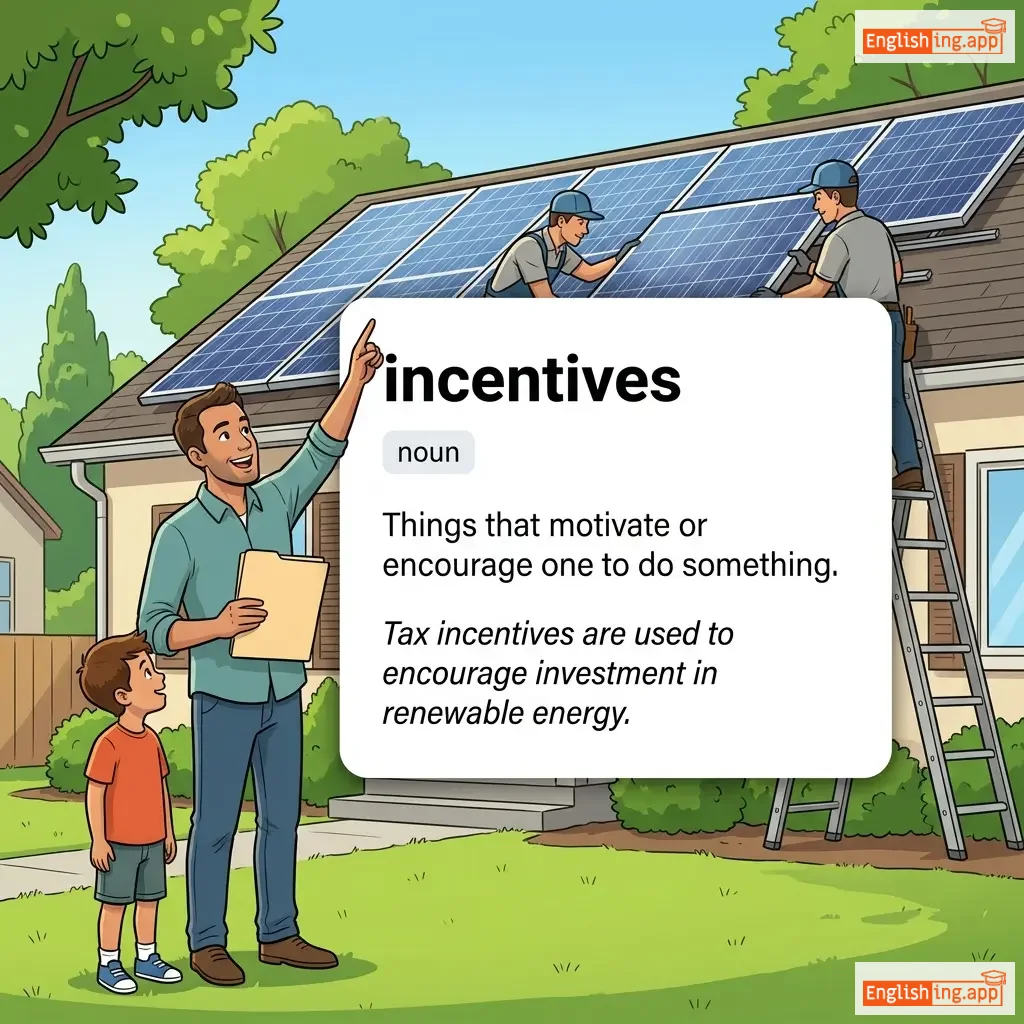
incentives definition card — visual illustration of the meaning
noun
ɪnˈsɛntɪvz
incitations, incitatifs (insitasyon, insitativ)

Things that motivate or encourage one to do something.

"Tax incentives are used to encourage investment in renewable energy."

"Les incitations fiscales sont utilisées pour encourager les investissements dans l'énergie renouvelable." (Lez ansitasyon fiskal son itilize pur ankouraje lez investisman dan lénerji renouvelable.)
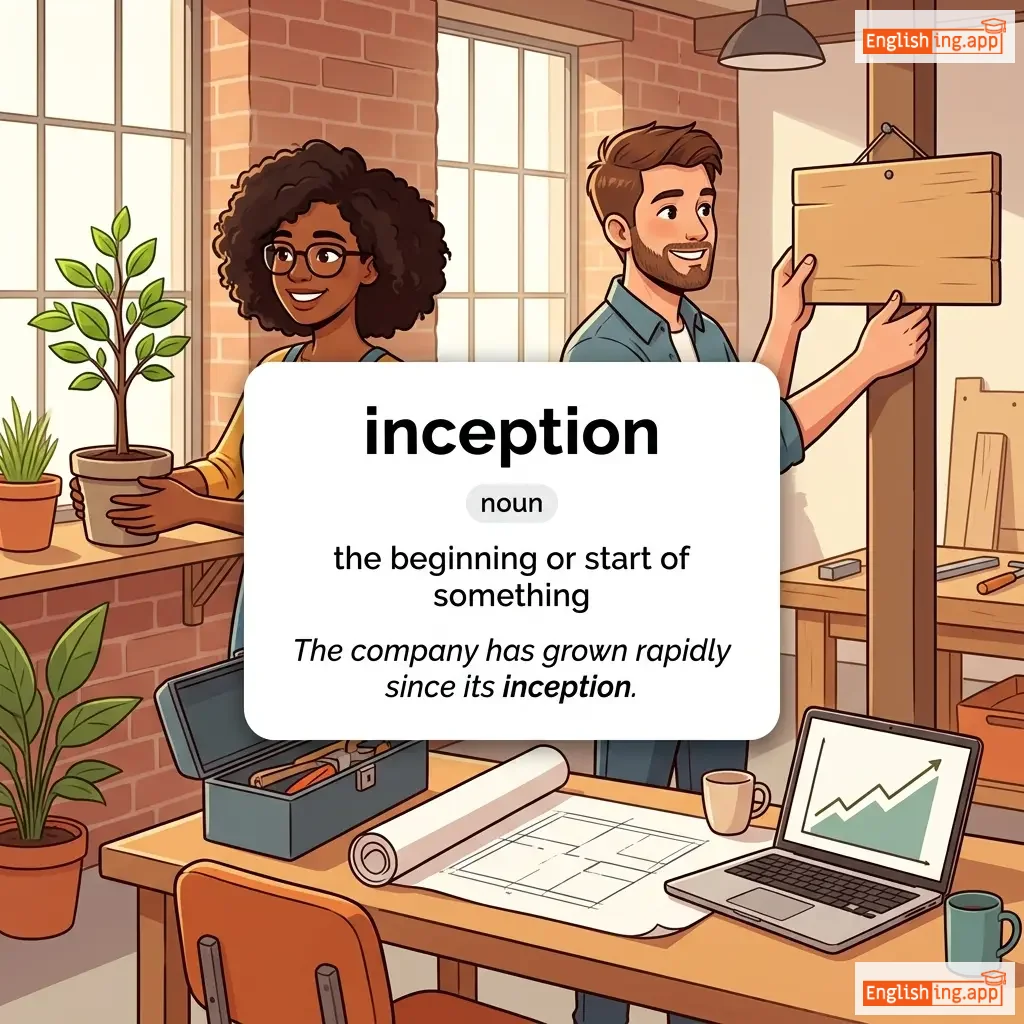
inception definition card — visual illustration of the meaning
noun
/ɪnˈsɛpʃən/
commencement (commencement)

the beginning or start of something

"The company has grown rapidly since its inception."

"L'entreprise a connu une croissance rapide depuis son commencement." (L'entreprise a connu une croissance rapide depuis son commencement.)
adjective
/ɪnˈsɛptɪv/
initial (initial)

Relating to or marking the beginning or initial stage of something.

"The inceptive phase of the project was marked by enthusiastic planning."

"La phase inceptive du projet a été marquée par une planification enthousiaste." (La phase inceptive du projet a été marquée par une planification enthousiaste.)
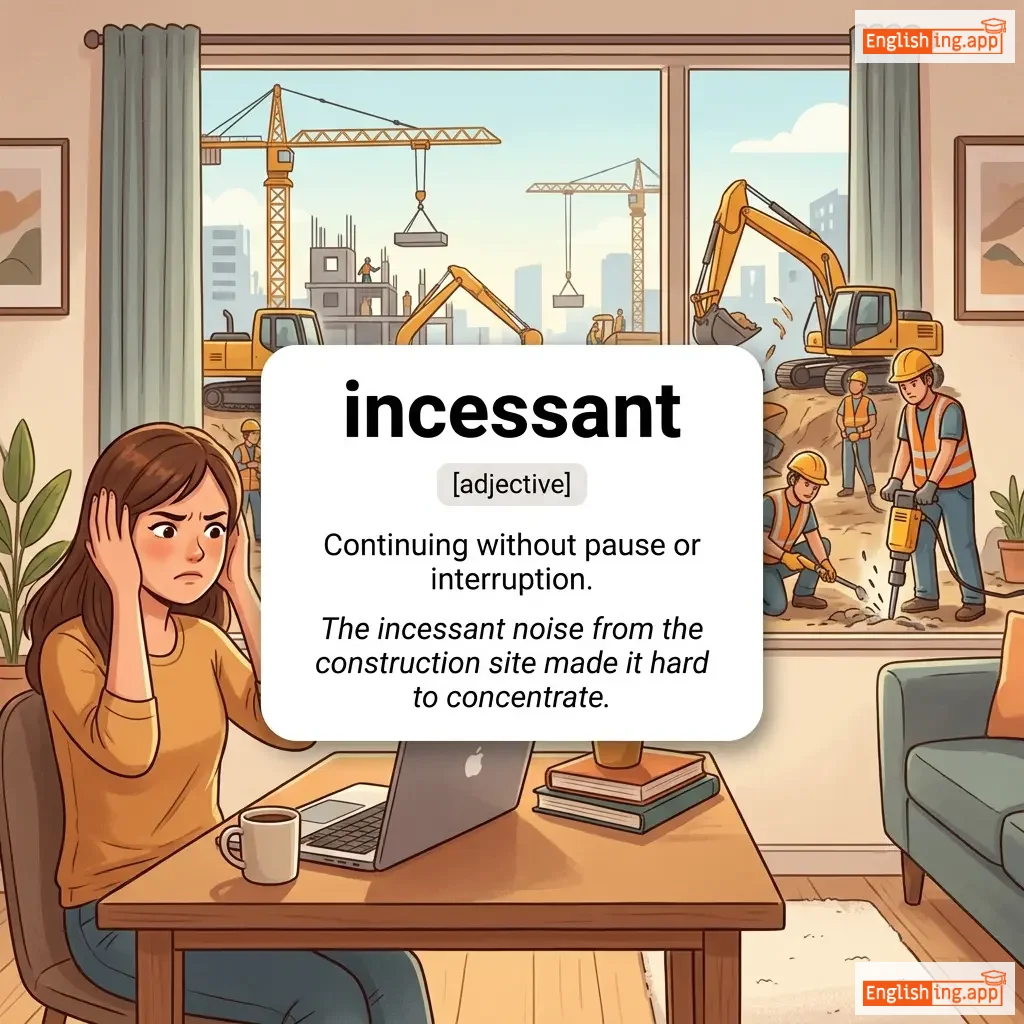
incessant definition card — visual illustration of the meaning
adjective
/ɪnˈsɛsənt/
incessant (incessant)

Continuing without pause or interruption.

"The incessant noise from the construction site made it hard to concentrate."

"Le bruit incessant du chantier rendait difficile de se concentrer." (Le bruit incessant du chantier rendait difficile de se concentrer.)
noun, verb
/ɪntʃ/
pouce / se déplacer lentement (pouce / se deplacer lentement)

A unit of length equal to 2.54 centimeters; or to move slowly and carefully in small amounts.

"She inched closer to the edge of the stage."

"Elle s'est lentement rapprochée du bord de la scène." (Elle s'est lentement rapprochee du bord de la scene.)
adverb
/ˈɪntʃmiːl/
petit à petit (petit a petit)

Gradually, little by little.

"The old castle fell inchmeal into ruin."

"Le vieux château est tombé petit à petit en ruine." (Le vieux château est tombé petit à petit en ruine.)
inchoate definition card — visual illustration of the meaning
adjective
/ɪnˈkoʊ.ɪt/ or /ɪnˈkoʊ.eɪt/
incomplet (incomplet)

Just begun and not fully formed; rudimentary.

"His inchoate ideas needed more research to be developed."

"Ses idées incomplètes avaient besoin de plus de recherches pour être développées." (Ses idées incomplètes avaient besoin de plus de recherches pour être développées.)
adjective
/ɪnˈkoʊətɪv/
inchoatif (inchoatif)

relating to the beginning of something; in an initial stage

"The poet used inchoative expressions to depict the dawn of creation."

"Le poète a utilisé des expressions inchoatives pour décrire l'aube de la création." (Le poète a utilisé des expressions inchoatives pour décrire l'aube de la création.)
noun
/ˈɪnsɪdəns/
incidence (incidence)

the occurrence, rate, or frequency of something

"The incidence of road accidents has decreased this year."

"L'incidence des accidents de la route a diminué cette année." (L'incidence des accidents de la route a diminué cette année.)
noun
/ˈɪnsɪdənt/
incident (incident)

an event or occurrence, often unpleasant or unusual

"The police quickly responded to the incident in the park."

"La police a rapidement répondu à l'incident dans le parc." (La police a rapidement répondu à l'incident dans le parc.)
adjective
/ˌɪnsɪˈdɛntəl/
incidentel (incidentel)

happening as a minor part or in connection with something else

"Incidental expenses like snacks and tips were included in the bill."

"Les dépenses incidentelles comme les collations et les pourboires ont été incluses dans la facture." (Les depenses incidentelles comme les collations et les pourboires ont ete incluses dans la facture.)
adverb
/ˌɪnsɪˈdɛntəli/
d'ailleurs (d'ailleurs)

by the way; used to introduce a remark not directly related to the main subject

"Incidentally, did you know that she studied in Paris?"

"D'ailleurs, savais-tu qu'elle avait étudié à Paris ?" (D'ailleurs, savais-tu qu'elle avait étudié à Paris ?)
verb
/ɪnˈsɪnəˌreɪt/
incinérer (incinerer)

to burn something completely until it is reduced to ashes

"The city decided to incinerate the medical waste for safety."

"La ville a décidé d'incinérer les déchets médicaux pour des raisons de sécurité." (La ville a decide d'incinérer les déchets médicaux pour des raisons de sécurité.)
noun
/ɪnˈsɪpiəns/
début (debut)

the beginning or initial stage of something

"The project was still in its incipience when funding was approved."

"Le projet en était encore à ses débuts lorsque le financement a été approuvé." (Le projet en était encore à ses débuts lorsque le financement a été approuvé.)
adjective
/ɪnˈsɪpiənt/
incipient (incipient)

in an initial stage; beginning to develop

"The incipient storm made the sky turn dark and heavy."

"La tempête incipiente a fait assombrir le ciel et le rendre lourd." (La tempête incipiente a fait assombrir le ciel et le rendre lourd.)
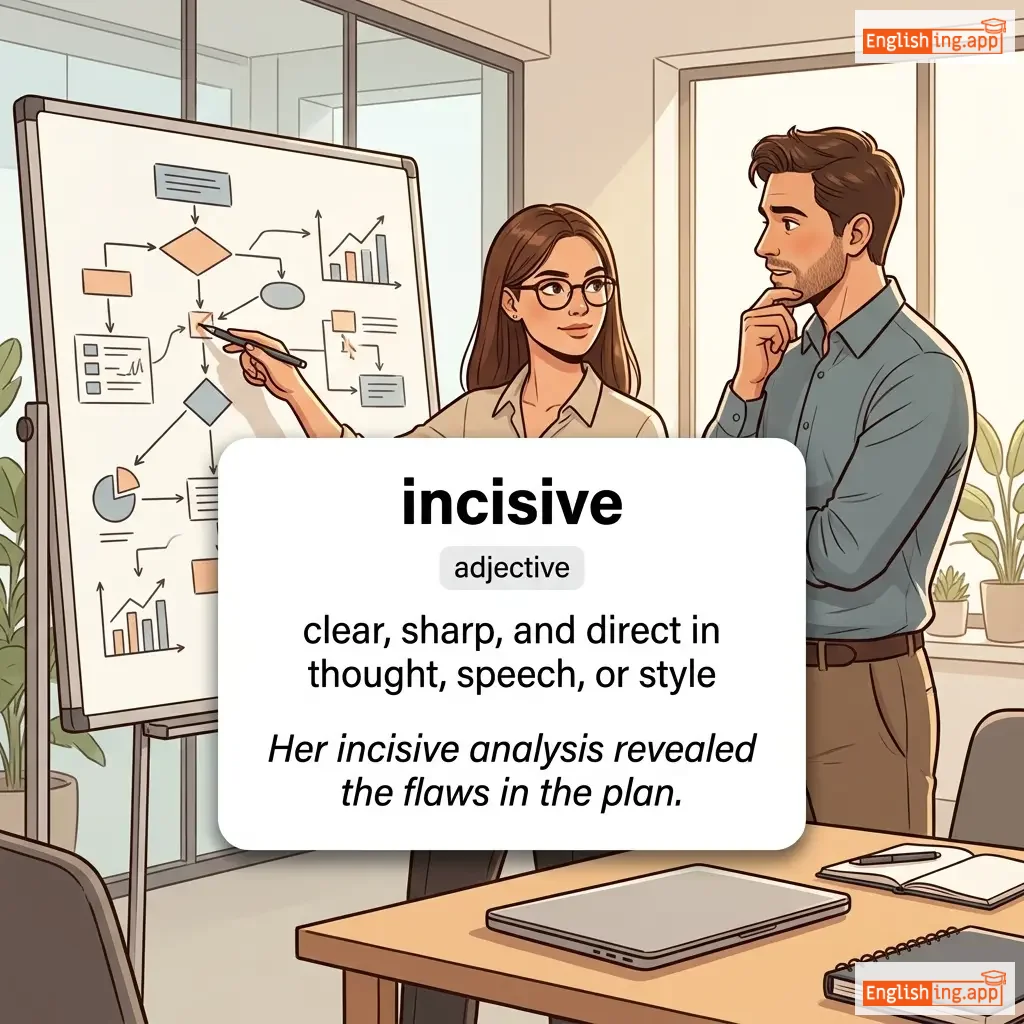
incisive definition card — visual illustration of the meaning
adjective
/ɪnˈsaɪsɪv/
perçant (perçant)

clear, sharp, and direct in thought, speech, or style

"Her incisive analysis revealed the flaws in the plan."

"Son analyse perçante a révélé les défauts du plan." (Son analyse perçante a révélé les défauts du plan.)
noun
/ɪnˈsaɪzər/
incisive (insisiv)

a narrow-edged tooth at the front of the mouth, adapted for cutting

"The dentist noted that his upper left incisor was chipped."

"Le dentiste a remarqué que son incisif supérieur gauche était fissuré." (Le dentiste a remarque que son incisif superieur gauche etait fissure.)
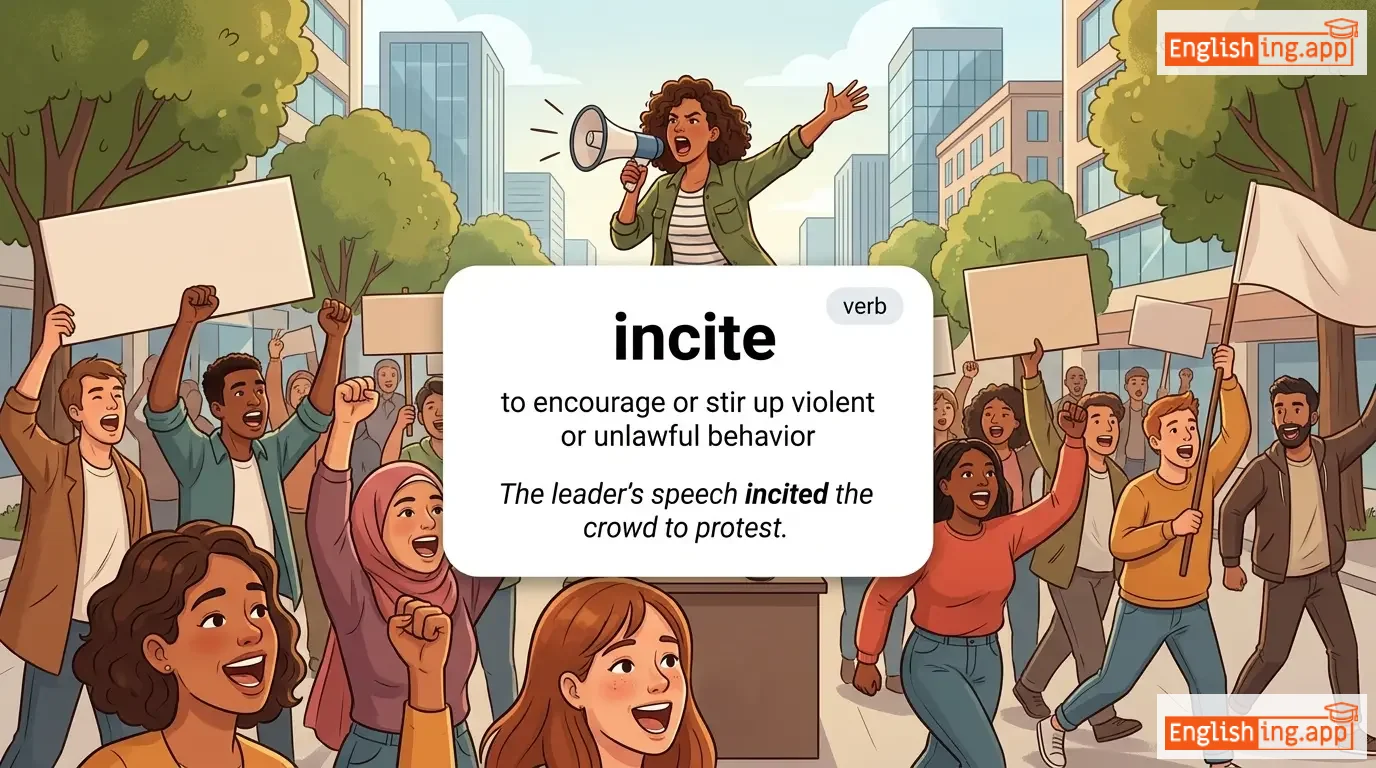
incite definition card — visual illustration of the meaning
verb
/ɪnˈsaɪt/
inciter (inciter)

to encourage or stir up violent or unlawful behavior

"The leader's speech incited the crowd to protest."

"Le discours du leader a incité la foule à protester." (Le discours du leader a incité la foule à protester.)
noun
/ɪnˈsaɪtmənt/
incitation (incitation)

the action of provoking unlawful or violent behavior

"He was arrested for incitement to riot."

"Il a été arrêté pour incitation à la violence." (Il a ete arrete pour incitation a la violence.)
adjective
/ɪnˈklɛmɛnt/
météo inclemente (meteo inclemente)

unpleasantly cold, wet, or stormy (usually weather)

"The match was canceled due to inclement weather."

"Le match a été annulé à cause du mauvais temps." (Le match a été annulé à cause du mauvais temps.)
noun
/ˌɪnklɪˈneɪʃən/
inclination (inclination)

A natural tendency or urge to act or feel in a particular way.

"She has an inclination towards helping others."

"Elle a une inclination à aider les autres." (Elle a une inclination à aider les autres.)
verb
/ɪnˈklaɪn/
s'incliner (s'incli-ner)

to feel willing or favorably disposed toward something; to bend or tilt

"She is inclined to agree with the proposal."

"Elle est inclinée à être d'accord avec la proposition." (Elle est incline a etre d'accord avec la proposition.)
adjective
/ɪnˈklaɪnd/
incliné (incline)

having a tendency or disposition toward something

"He is inclined to help those in need."

"Il est enclin à aider ceux qui sont dans le besoin." (Il est enclin à aider ceux qui sont dans le besoin.)
include definition card — visual illustration of the meaning
verb
/ɪnˈkluːd/
inclure (inclure)

to make something part of a whole or group

"The package includes free breakfast."

"Le paquet inclut le petit déjeuner gratuit." (Le paquet inclut le petit déjeuner gratuit.)
preposition
/ɪnˈkluːdɪŋ/
y compris (y compris)

used to show that someone or something is part of a larger group

"Many people attended the event, including students and teachers."

"Beaucoup de personnes ont assisté à l'événement, y compris des étudiants et des enseignants." (Beaucoup de personnes ont assisté à l'événement, y compris des étudiants et des enseignants.)
noun
/ɪnˈkluːʒən/
inclusion (inclusion)

the action or state of including or being included within a group or structure

"Diversity and inclusion are key values in modern workplaces."

"La diversité et l'inclusion sont des valeurs clés dans les lieux de travail modernes." (La diversité et l'inclusion sont des valeurs clés dans les lieux de travail modernes.)
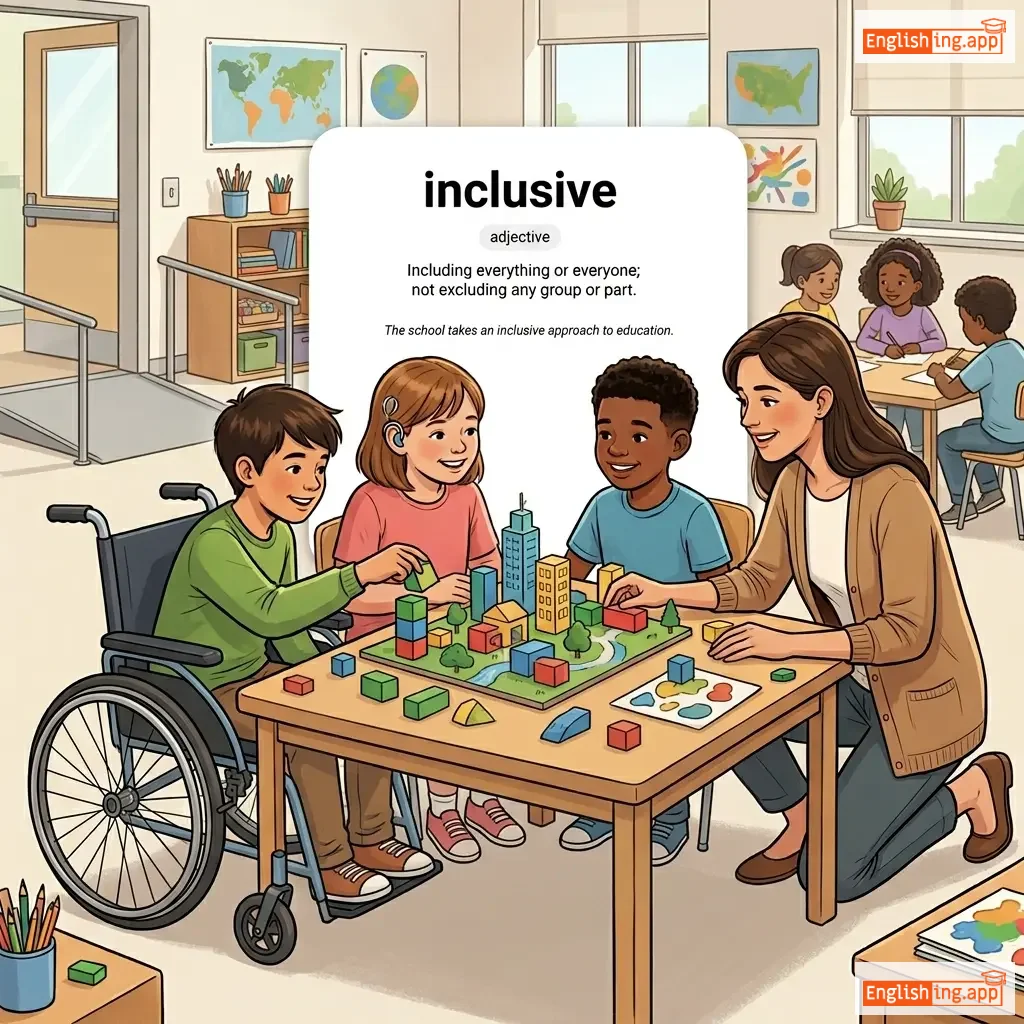
inclusive definition card — visual illustration of the meaning
adjective
/ɪnˈkluːsɪv/
inclusif (inclusif)

Including everything or everyone; not excluding any group or part.

"The school takes an inclusive approach to education."

"L'école adopte une approche inclusive de l'éducation." (L'école adopte une approche inclusive de l'éducation.)
adjective
/ˌɪnkoʊˈɜːrsəbl̩/
incoercible (incoercible)

Not capable of being forced, compelled, or restrained.

"Her incoercible spirit inspired others to fight for justice."

"Son esprit incoercible a inspiré les autres à lutter pour la justice." (Son esprit incoercible a inspiré les autres à lutter pour la justice.)
adjective
/ɪnˈkɑːdʒɪtənt/
irréfléchi (irreflechi)

Lacking thought; inconsiderate or thoughtless.

"It was incogitant of him to make such a rude comment."

"C'était incogitant de sa part de faire un commentaire aussi grossier." (C'était incogitant de sa part de faire un commentaire aussi grossier.)
adverb, adjective
/ˌɪnkɑːɡˈniːtoʊ/
incognito (incognito)

In disguise or with one's identity concealed.

"The celebrity traveled incognito to avoid the paparazzi."

"La célébrité a voyagé incognito pour éviter les paparazzis." (La célébrité a voyagé incognito pour éviter les paparazzis.)
noun
/ˌɪnkoʊˈhɪrəns/
incohérence (incoherence)

The quality of being unclear, confused, or lacking logical connection.

"His speech was full of incoherence and difficult to follow."

"Son discours était plein d'incohérences et difficile à suivre." (Son discours etait plein d'incoherences et difficile a suivre.)
adjective
/ˌɪnkəʊˈhɪərənt/
incohérent (incoherent)

Not clear or easy to understand; lacking logical connection.

"His explanation was so incoherent that nobody could follow it."

"Son explication était tellement incohérente que personne ne pouvait la suivre." (Son explication etait tellement incoherente que personne ne pouvait la suivre.)
adjective
/ˌɪnkəmˈbʌstəbl/
incombustible (incombustible)

Not capable of catching fire or burning.

"This material is incombustible and safe for construction."

"Ce matériau est incombustible et sûr pour la construction." (Ce matériau est incombustible et sûr pour la construction.)
noun
/ˈɪnkʌm/
revenu (revenu)

money received for work or through investments

"His monthly income is enough to support his family."

"Ses revenus mensuels suffisent à soutenir sa famille." (Ses revenus mensuels suffisent à soutenir sa famille.)
adjective
/ˌɪnkəˈməʊdiəs/
incommode (incommode)

Uncomfortably small, cramped, or inconvenient.

"We had to stay in an incommodious room during the trip."

"Nous avons dû rester dans une chambre inconfortable pendant le voyage." (Nous avons du rester dans une chambre inconfortable pendant le voyage.)