Vocabulaires

Découvrez, apprenez et maîtrisez le vocabulaire anglais

adjective
/ˌɪnˈvɜːrs/
inverse (inverse)

Opposite in position, direction, order, or effect.

"There is an inverse relationship between price and demand."

"Il existe une relation inverse entre le prix et la demande." (Il existe une relation inverse entre le prix et la demande.)
adverb
/ɪnˈvɜːrs.li/
inversement; de manière opposée (inversement; de maniere opposee)

in a way that is opposite or contrary; in reverse order or manner

"The price of goods is inversely related to their availability in the market."

"Le prix des biens est inversement lié à leur disponibilité sur le marché." (Le prix des biens est inversement lie a leur disponibilite sur le marche.)
noun
/ɪnˈvɜːrʒən/
inversion (inversion)

A reversal of the normal order, position, or relationship.

"In poetry, inversion is often used to create emphasis."

"Dans la poésie, l'inversion est souvent utilisée pour créer de l'emphase." (Dans la poesie, l'inversion est souvent utilisee pour creer de l'emphase.)
verb
/ɪnˈvɜːrt/
inverser (inverser)

To turn something upside down or in the opposite position, order, or direction.

"He inverted the glass to let the water drain out."

"Il a inversé le verre pour laisser l'eau s'écouler." (Il a inversé le verre pour laisser l'eau s'écouler.)
invest definition card — visual illustration of the meaning
verb
/ɪnˈvɛst/
investir (investir)

to put money, time, or effort into something with the expectation of achieving a benefit

"He decided to invest in real estate to secure his future."

"Il a décidé d'investir dans l'immobilier pour sécuriser son avenir." (Il a décidé d'investir dans l'immobilier pour sécuriser son avenir.)
verb
/ɪnˈvɛs.tɪ.ɡeɪt/
enquêter (enquêter)

to carry out a systematic inquiry to discover facts or information

"The police will investigate the incident thoroughly."

"La police enquêtera sur l'incident de manière approfondie." (La police enquêtera sur l'incident de manière approfondie.)
noun
/ɪnˌvɛs.tɪˈɡeɪ.ʃən/
enquête (enquete)

the process of inquiring into or examining something carefully to find the truth

"The investigation revealed new evidence about the fraud."

"L'enquête a révélé de nouvelles preuves sur la fraude." (L'enquete a revele de nouvelles preuves sur la fraude.)
noun
/ɪnˈvɛstɪˌɡeɪtər/
bonheur (bonheur)

a person who carries out a formal inquiry or investigation

"The investigator gathered evidence from the crime scene."

"Elle n'a pas pu cacher son bonheur lorsqu'elle a reçu le prix." (Elle n'a pas pu cacher son bonheur lorsqu'elle a reçu le prix.)
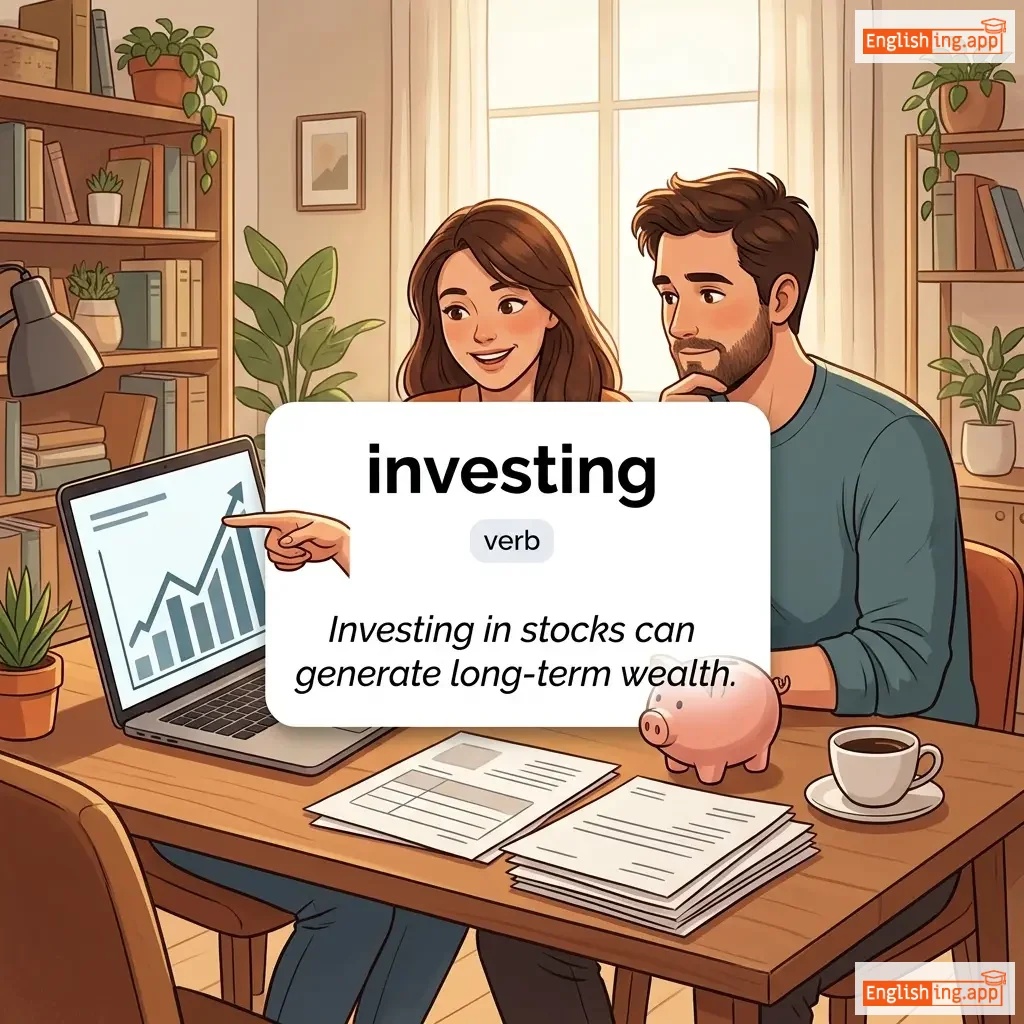
investing definition card — visual illustration of the meaning
verb
ɪnˈvɛst.ɪŋ
investir (investir)

The act of putting money into financial schemes, shares, property, or a commercial venture with the expectation of achieving a profit.

"Investing in stocks can generate long-term wealth."

"Investir dans des actions peut générer de la richesse à long terme." (Investir dans des actions peut générer de la richesse à long terme.)
noun
/ɪnˈvɛstɪtʃər/
cérémonie d'investiture (ceremonie d'investiture)

the formal ceremony of conferring authority, rank, or office

"The king held an investiture ceremony for the new knight."

"Le roi a organisé une cérémonie d'investiture pour le nouveau chevalier." (Le roi a organise une ceremonie d'investiture pour le nouveau chevalier.)
investment definition card — visual illustration of the meaning
noun
/ɪnˈvɛst.mənt/
investissement (investissement)

the action or process of putting money, time, or resources into something for future benefit

"Her investment in technology startups has paid off well."

"Son investissement dans les startups technologiques a bien payé." (Son investissement dans les startups technologiques a bien payé.)
noun
/ɪnˈvɛstər/
investisseur (investisseur)

a person or organization that puts money into financial schemes, property, or business ventures with the expectation of achieving a profit

"The investor funded the startup with a large sum of money."

"L'investisseur a financé la startup avec une grande somme d'argent." (L'investisseur a financé la startup avec une grande somme d'argent.)
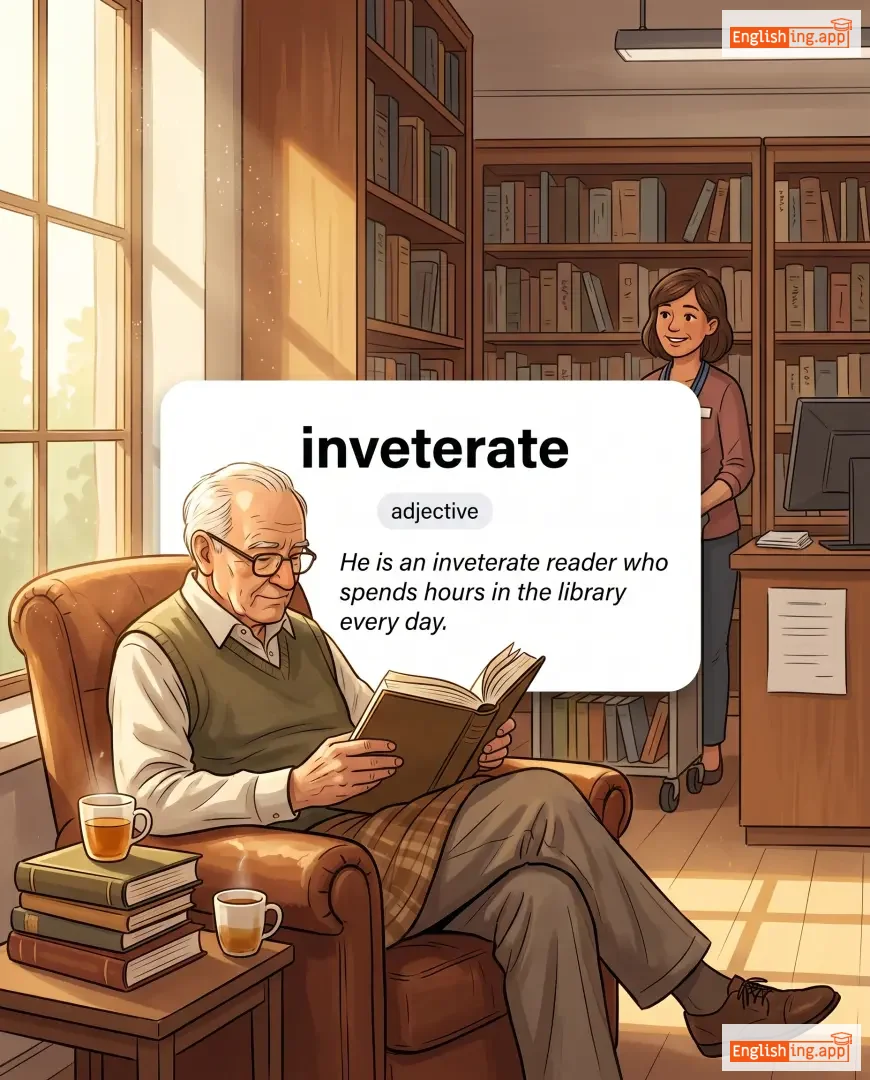
inveterate definition card — visual illustration of the meaning
adjective
/ɪnˈvɛtərət/
invétéré (invétére)

having a long-established habit, activity, or interest that is unlikely to change

"He is an inveterate reader who spends hours in the library every day."

"Il est un lecteur invétéré qui passe des heures à la bibliothèque chaque jour." (Il est un lecteur invetere qui passe des heures a la bibliotheque chaque jour.)
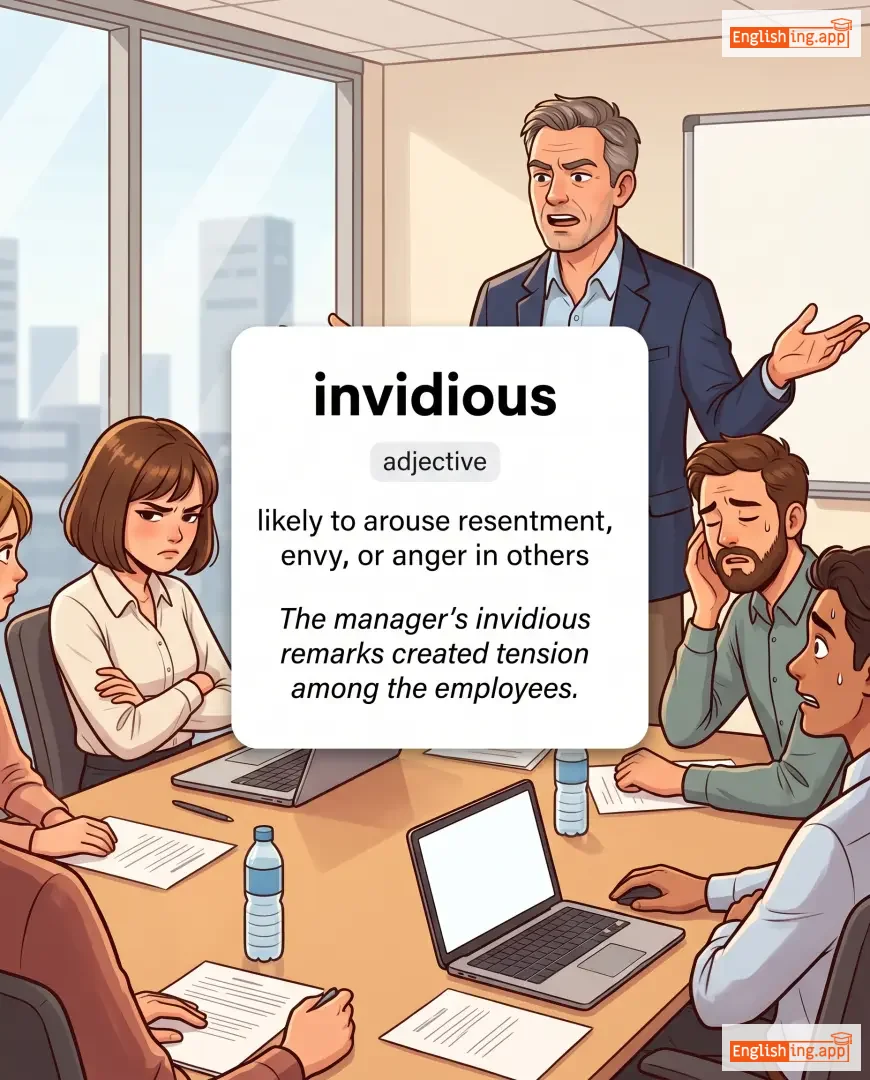
invidious definition card — visual illustration of the meaning
adjective
/ɪnˈvɪdiəs/
envieux (envieux)

likely to arouse resentment, envy, or anger in others

"The manager's invidious remarks created tension among the employees."

"Les remarques envieuses du manager ont créé des tensions parmi les employés." (Les remarques envieuses du manager ont créé des tensions parmi les employés.)
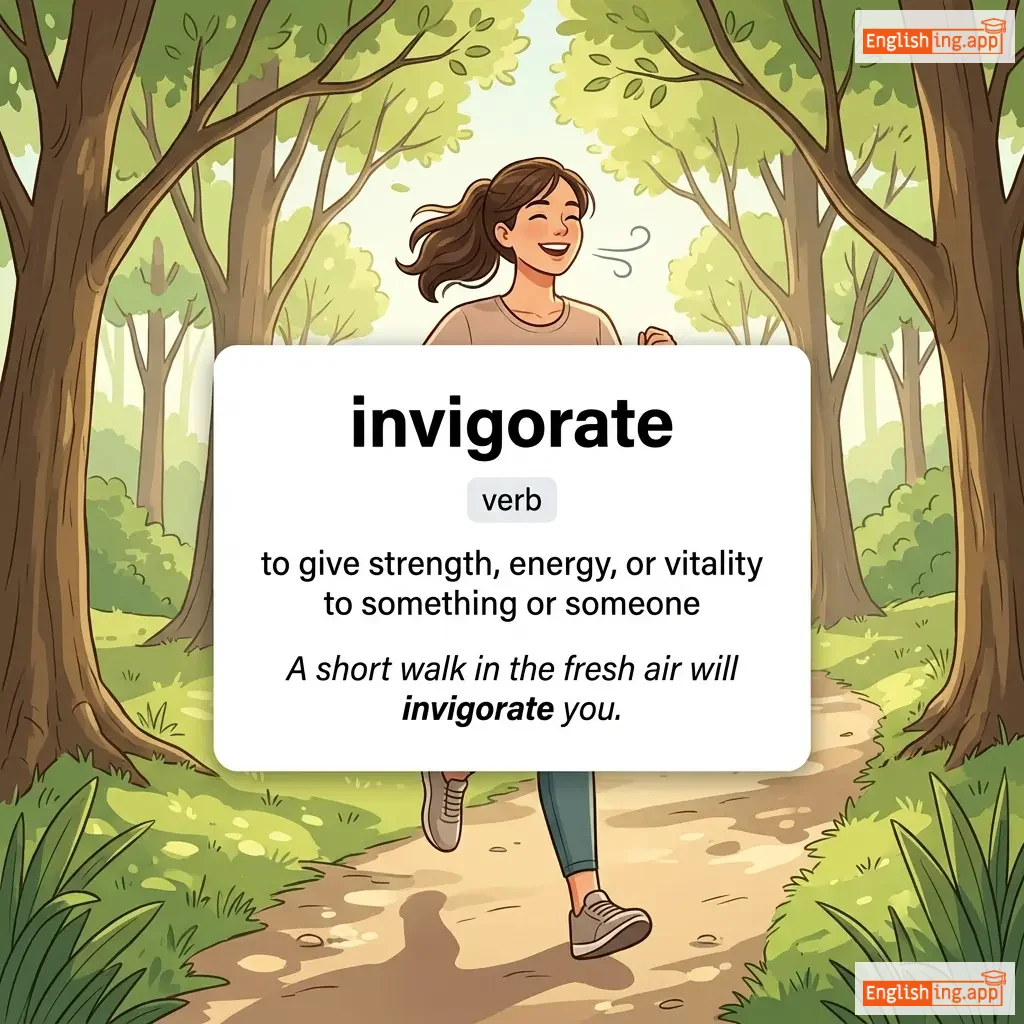
invigorate definition card — visual illustration of the meaning
verb
/ɪnˈvɪɡəreɪt/
revigorer (revigorer)

to give strength, energy, or vitality to something or someone

"A short walk in the fresh air will invigorate you."

"Une petite promenade dans l'air frais vous vivifie." (Une petite promenade dans l'air frais vous vivifie.)
adjective
/ɪnˈvɪnsəbl/
invincible (invincible)

too powerful to be defeated or overcome

"The team seemed invincible after winning ten matches in a row."

"L'équipe semblait invincible après avoir gagné dix matchs d'affilée." (L'equipe semblait invincible apres avoir gagne dix matchs d'affilee.)
adjective
/ɪnˈvaɪələbl/
inviolable (inviolable)

never to be broken, dishonored, or violated

"Human rights are considered inviolable in modern democracies."

"Les droits de l'homme sont considérés comme inviolables dans les démocraties modernes." (Les droits de l'homme sont considérés comme inviolables dans les démocraties modernes.)
adjective
/ɪnˈvaɪələt/
inviolé (inviole)

free from violation, injury, or desecration; kept safe and untouched

"The ancient temple remained inviolate for centuries."

"Le temple ancien est resté inviolé pendant des siècles." (Le temple ancien est reste inviole pendant des siecles.)
adjective
/ɪnˈvɪzɪbəl/
invisible (invisible)

unable to be seen; not visible to the eye

"The stars became invisible as the sun rose."

"Les étoiles sont devenues invisibles lorsque le soleil s'est levé." (Les étoiles sont devenues invisibles lorsque le soleil s'est levé.)
noun
/ˌɪnvɪˈteɪʃən/
bonheur (bonheur)

a written or spoken request to attend an event or to participate in something

"She sent me an invitation to her wedding."

"Elle n'a pas pu cacher son bonheur lorsqu'elle a reçu le prix." (Elle n'a pas pu cacher son bonheur lorsqu'elle a recu le prix.)
verb
/ɪnˈvaɪt/
inviter (inviter)

to ask someone to come to a place or event

"She invited her friends to the party."

"Elle a invité ses amis à la fête." (Elle a invité ses amis à la fête.)
verb
/ɪnˈvaɪtɪd/
invité (invite)

asked someone formally or politely to go somewhere or do something

"She was invited to the party."

"Elle a été invitée à la fête." (elle a ete invitee a la fete)
noun
/ɪnˈvaɪtər/
invitant (invitant)

a person who invites someone to an event, meeting, or place

"The invitor greeted all the guests warmly at the entrance."

"L’invitant a accueilli les invités à l’entrée." (Linvitant a accueilli les invites a lentree)
noun
/ˌɪnvəˈkeɪʃən/
invocation (invocation)

the act of calling upon a higher power for help, blessing, or inspiration

"The ceremony began with an invocation to the gods."

"La cérémonie a commencé par une invocation aux dieux." (La cérémonie a commencé par une invocation aux dieux.)
noun
/ˈɪnvɔɪs/
facture (facture)

a list of goods sent or services provided, with the amount due for payment

"The company sent an invoice for the delivered products."

"L'entreprise a envoyé une facture pour les produits livrés." (L'entreprise a envoyé une facture pour les produits livrés.)
verb
/ɪnˈvoʊk/
invoquer (invoquer)

to call upon a higher power, authority, or principle for help, support, or justification

"The lawyer invoked the constitution to defend his client."

"L'avocat a invoqué la constitution pour défendre son client." (L'avocat a invoqué la constitution pour défendre son client.)
adjective
/ɪnˈvɑːlənˌtɛri/
involontaire (involontaire)

done without will or conscious control

"He gave an involuntary shiver when he heard the loud noise."

"Il a eu un frisson involontaire lorsqu'il a entendu le bruit fort." (Il a eu un frisson involontaire lorsqu'il a entendu le bruit fort.)
noun
/ˌɪnvəˈluːʃən/
involution (involution)

a complicated or intricate form or state; in biology, the shrinking of an organ after its function has finished

"The story was full of involution, making it hard to follow."

"L'histoire était pleine d'involution, ce qui la rendait difficile à suivre." (L'histoire était pleine d'involution, ce qui la rendait difficile à suivre.)
verb
/ɪnˈvɑːlv/
impliquer (impliquer)

to include as a necessary part, or to engage someone in an activity

"The project will involve several departments working together."

"Le projet impliquera plusieurs départements travaillant ensemble." (Le projet impliquera plusieurs départements travaillant ensemble.)
adjective
/ɪnˈvɑːlvd/
impliqué (implike)

complicated or engaged in something

"She was deeply involved in community service."

"Elle était profondément impliquée dans le service communautaire." (Elle était profondément impliquée dans le service communautaire.)
noun
/ɪnˈvɒlvmənt/
implication (implication)

the act of taking part in something

"His involvement in the project was crucial."

"Son implication dans le projet était cruciale." (Son implication dans le projet etait cruciale.)
adjective
/ɪnˈvʌlnərəbl/
invulnérable (invulnerable)

Impossible to harm, damage, or defeat.

"The fortress was thought to be invulnerable to attack."

"La forteresse était considérée comme invulnérable aux attaques." (La forteresse etait consideree comme invulnerable aux attaques.)
adverb
/ˈɪnwərdli/
intérieurement (interieurement)

In the mind or spirit; not outwardly visible.

"She smiled outwardly but inwardly she was worried."

"Elle a souri extérieurement, mais intérieurement elle était inquiète." (Elle a souri extérieurement, mais intérieurement elle était inquiète.)
noun
/aɪˈoʊtə/
une quantité infime (une quantite infime)

An extremely small amount.

"He did not show an iota of fear."

"Il n'a montré même pas une infime quantité de peur." (Il n'a montré même pas une infime quantité de peur.)
adjective/noun
/ɪˈrɑːki/
irakien (irakien)

relating to Iraq or its people

"The Iraqi culture is rich and diverse."

"La culture irakienne est riche et diversifiée." (La culture irakienne est riche et diversifiée.)
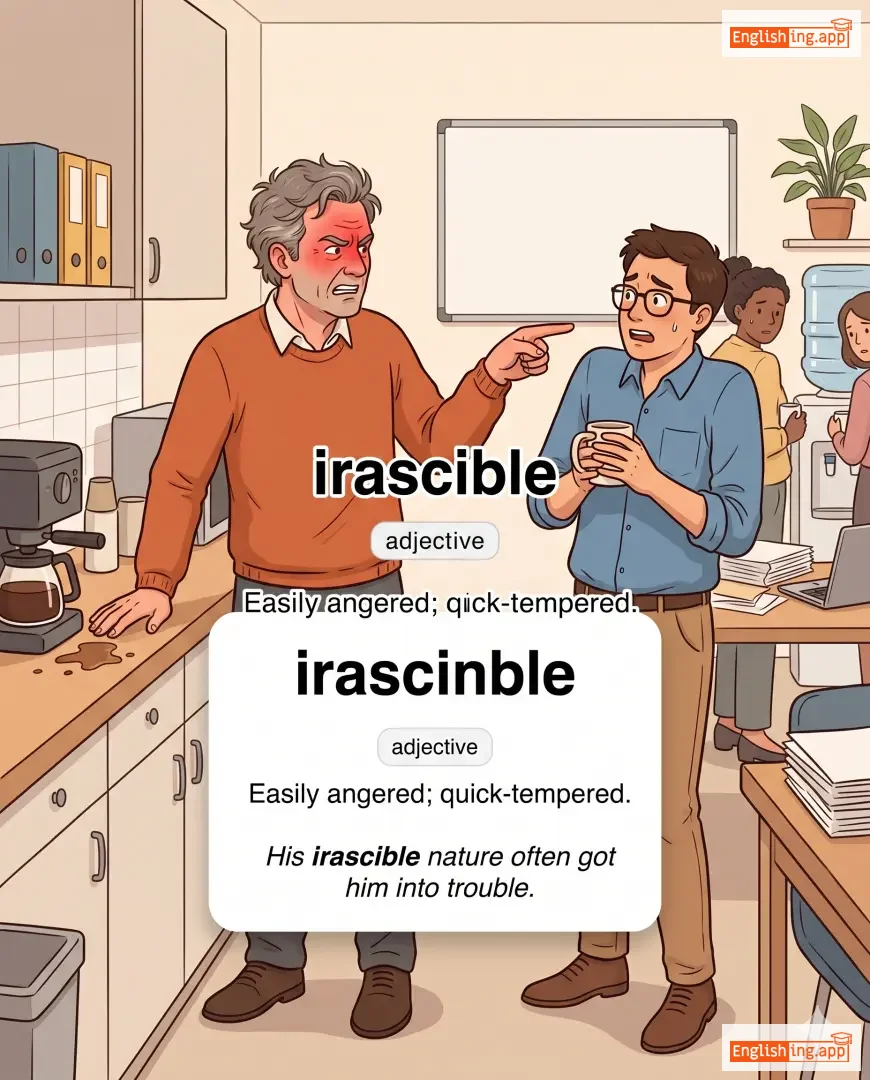
irascible definition card — visual illustration of the meaning
adjective
/ɪˈræsɪbl/
irritable (irritable)

Easily angered; quick-tempered.

"His irascible nature often got him into trouble."

"Sa nature irritable le mettait souvent dans des situations difficiles." (Sa nature irritable le mettait souvent dans des situations difficiles.)
adjective
/aɪˈreɪt/
furieux (furieux)

Extremely angry.

"The customer became irate after waiting for hours."

"Le client est devenu furieux après avoir attendu pendant des heures." (Le client est devenu furieux après avoir attendu pendant des heures.)
noun
/aɪər/
colère, rage (colère, rage)

intense anger or rage

"The new policy provoked the ire of the employees."

"La nouvelle politique a provoqué la colère des employés." (La nouvelle politique a provoqué la colère des employés.)
noun
/ˌɪrɪˈdɛsəns/
brillance iridescente (brillance iridescente)

a play of lustrous, changing colors like those of a rainbow

"The butterfly's wings shimmered with iridescence."

"Les ailes du papillon brillaient d'une brillance iridescente." (Les ailes du papillon brillaient d'une brillance iridescente.)
adjective
/ˌɪrɪˈdɛsənt/
iridescent (iridescent)

showing luminous colors that seem to change when seen from different angles

"She wore an iridescent dress that sparkled in the light."

"Elle portait une robe iridescente qui scintillait à la lumière." (Elle portait une robe iridescente qui scintillait à la lumière.)
adjective/noun
/ˈaɪrɪʃ/
bonheur (bonheur)

relating to Ireland, its people, or its language

"The Irish countryside is very beautiful."

"Elle ne pouvait pas cacher son bonheur lorsqu'elle a reçu le prix." (Elle ne pouvait pas cacher son bonheur lorsqu'elle a reçu le prix.)
verb
/ɜːrk/
agacer (agacer)

to annoy or irritate someone

"It irks me when people are late without calling."

"Ça m'agace quand les gens arrivent en retard sans appeler." (Ça m'agace quand les gens arrivent en retard sans appeler.)
adjective
/ˈɜːrksəm/
énervant (enervant)

annoying or irritating

"Waiting in a long line is one of the most irksome tasks."

"Attendre dans une longue file est l'une des tâches les plus énervantes." (Attendre dans une longue file est l'une des tâches les plus énervantes.)
noun/verb
/ˈaɪən/ or /ˈaɪərn/
fer / repassage (fer / repassage)

a strong, hard metal used in construction; also to press clothes with heat

"He used an iron to smooth his shirt."

"Il a utilisé un fer à repasser pour lisser sa chemise." (Il a utilisé un fer à repasser pour lisser sa chemise.)
adjective
/ˈaɪərnˌklæd/
inflexible (ironclad)

impossible to change, break, or dispute; very strong and firm

"The company had an ironclad contract with its suppliers."

"L'entreprise avait un contrat inflexible avec ses fournisseurs." (L'entreprise avait un contrat inflexible avec ses fournisseurs.)
adjective
/aɪˈrɒnɪk/
ironique, sarcastique (aironik)

happening in the opposite way to what is expected, often amusing or sarcastic

"It is ironic that the fire station burned down."

"Il est ironique que la caserne de pompiers ait brûlé." (Il est ironique que la caserne de pompiers ait brûlé.)
adjective
/aɪˈrɒnɪkəl/
ironique (ironik)

expressing irony; having the nature of irony

"Her ironical tone made everyone uncomfortable."

"Son ton ironique a mis tout le monde mal à l'aise." (Son ton ironique a mis tout le monde mal à l'aise.)
adverb
/aɪˈrɒnɪkli/
ironiquement (ironiquement)

in a way that is contrary to what is expected or intended

"Ironically, the fire station burned down."

"Ironicament, la caserne de pompiers a brûlé." (Ironicament, la caserne de pompiers a brule.)
noun
/ˈaɪ.ərn.wʊd/
bois de fer (bois de fer)

a hard, dense wood from various trees; also the tree itself that produces small flowers

"The ironwood tree blooms with tiny white flowers."

"L'arbre de bois de fer fleurit avec de petites fleurs blanches." (L'arbre de bois de fer fleurit avec de petites fleurs blanches.)
noun
/ˈaɪrəni/
ironie (ironi)

a situation that is strange or amusing because it is the opposite of what is expected; the use of words to convey the opposite meaning

"The irony of the situation was that the winner forgot his own prize."

"L'ironie de la situation était que le gagnant avait oublié son propre prix." (L'ironie de la situation etait que le gagnant avait oublie son propre prix.)