Vocabulaires

Découvrez, apprenez et maîtrisez le vocabulaire anglais

noun/adjective
/ˈɪnstənt/
instantané (instantane)

A very short period of time; happening immediately.

"He replied in an instant without hesitation."

"Il a répondu en un instant sans hésitation." (Il a repondu en un instant sans hesiter.)
adjective
/ˌɪnstənˈteɪniəs/
instantané (instantane)

Happening immediately, without any delay.

"The change in temperature was almost instantaneous."

"Le changement de température a été presque instantané." (Le changement de temperature a ete presque instantane.)
adverb
/ˈɪnstəntli/
instantanément (instantanement)

immediately, without any delay

"He replied instantly to the message."

"Il a répondu instantanément au message." (Il a repondu instantanement au message.)
verb
/ɪnˈsteɪt/
installer (installer)

To set up in position, office, or authority.

"The board decided to instate her as the new director."

"Le conseil a décidé de l'instaurer en tant que nouveau directeur." (Le conseil a décidé de l'instaurer en tant que nouveau directeur.)
adverb
/ɪnˈstɛd/
à la place de (a la place de)

As an alternative or substitute.

"She didn’t buy the dress; instead, she chose a pair of shoes."

"Elle n'a pas acheté la robe; à la place, elle a choisi une paire de chaussures." (Elle n'a pas acheté la robe; à la place, elle a choisi une paire de chaussures.)
verb
/ˈɪnstɪˌɡeɪt/
inciter (inciter)

To bring about or initiate an action, often something negative.

"He was accused of instigating the riot."

"Il a été accusé d'inciter aux émeutes." (Il a été accusé d'inciter aux émeutes.)
noun
/ˈɪnstɪˌɡeɪtər/
instigateur (instigateur)

A person who brings about or initiates something, usually something bad.

"The police identified him as the instigator of the violence."

"La police l'a identifié comme l'instigateur de la violence." (La police l'a identifié comme l'instigateur de la violence.)
verb
/ɪnˈstɪl/
instiller (instiller)

to gradually but firmly establish an idea, attitude, or habit in someone's mind

"Parents try to instill good values in their children."

"Les parents essaient d'inculquer de bonnes valeurs à leurs enfants." (Les parents essaient d'inculquer de bonnes valeurs à leurs enfants.)
noun
/ˈɪnstɪŋkt/
instinct (instinct)

A natural way of behaving or reacting that does not require learning.

"Birds build nests by instinct."

"Les oiseaux construisent leurs nids par instinct." (Les oiseaux construisent leurs nids par instinct.)
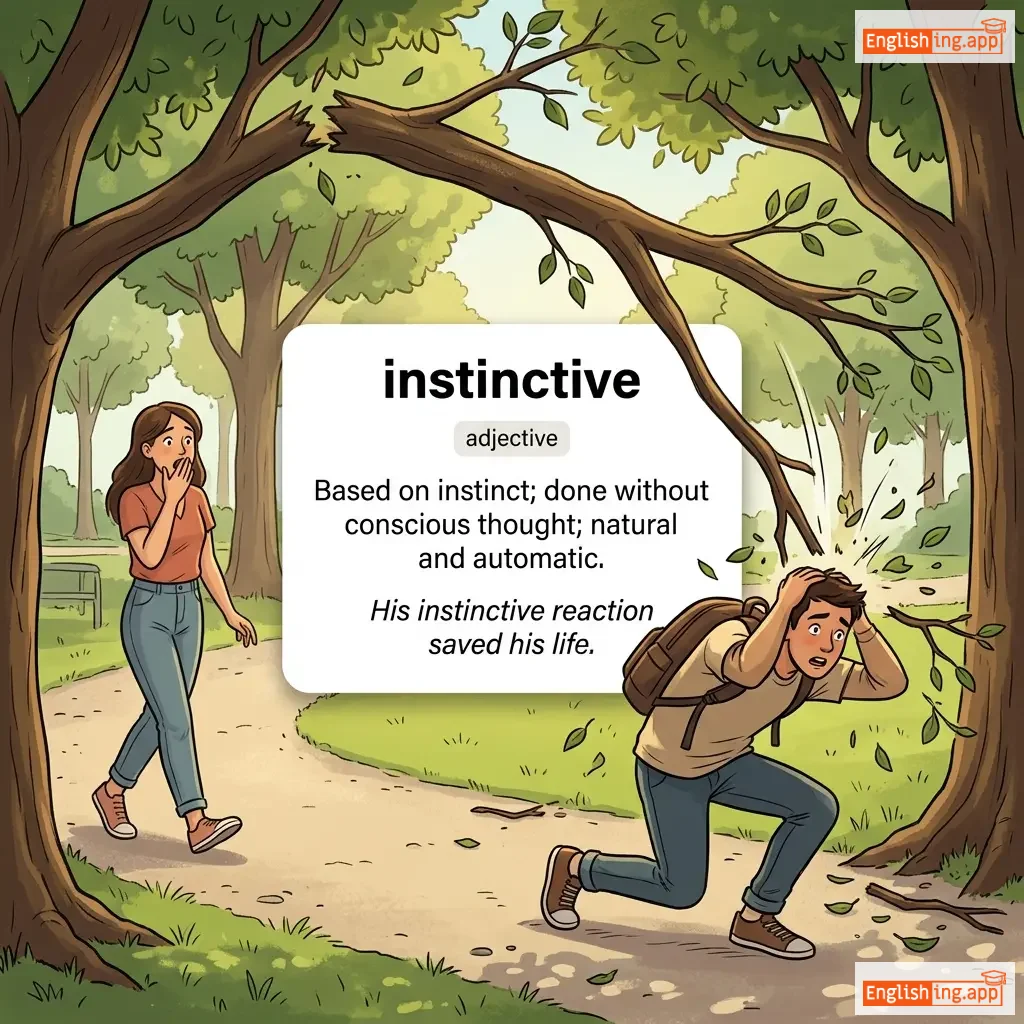
instinctive definition card — visual illustration of the meaning
adjective
/ɪnˈstɪŋk.tɪv/
instinctif, naturel, automatique (instinctif, naturel, automatique)

Based on instinct; done without conscious thought; natural and automatic.

"His instinctive reaction saved his life."

"Sa réaction instinctive lui a sauvé la vie." (Sa reaction instinctive lui a sauve la vie.)
noun, verb
/ˈɪnstɪˌtjuːt/
institut (institut)

as a noun, an organization founded for a specific purpose; as a verb, to establish or initiate

"The university decided to institute new rules for the library."

"L'université a décidé d'instituer de nouvelles règles pour la bibliothèque." (L'universite a decide d'instituer de nouvelles regles pour la bibliotheque.)
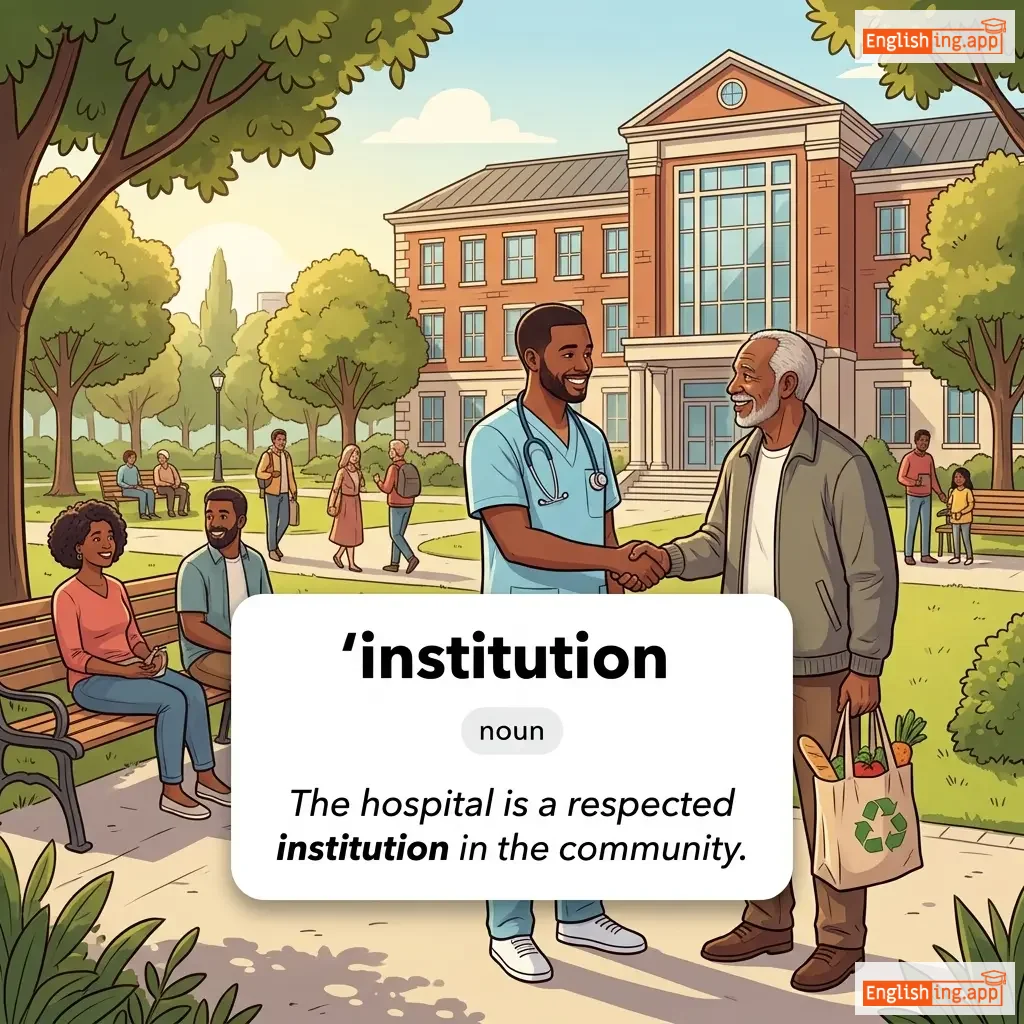
institution definition card — visual illustration of the meaning
noun
/ˌɪnstɪˈtjuːʃən/
institution (institution)

an established organization, especially one dedicated to education, public service, or a particular purpose

"The hospital is a respected institution in the community."

"L'hôpital est une institution respectée dans la communauté." (L'hopital est une institution respecte dans la communaute.)
adjective
/ˌɪnstɪˈtjuːʃənl/
institutionnel (institutionnel)

Relating to an organization or established practice.

"The government made several institutional reforms in education."

"Le gouvernement a mis en œuvre plusieurs réformes institutionnelles dans l'éducation." (Le gouvernement a mis en oeuvre plusieurs reformes institutionnelles dans l'education.)
verb
/ˌɪnstɪˈtjuːʃənəlaɪz/
institutionnaliser (institutionnaliser)

to establish something as a formal institution, custom, or practice

"The government seeks to institutionalize environmental protection."

"Le gouvernement cherche à institutionnaliser la protection de l'environnement." (Le gouvernement cherche a institutionnaliser la protection de l'environnement.)
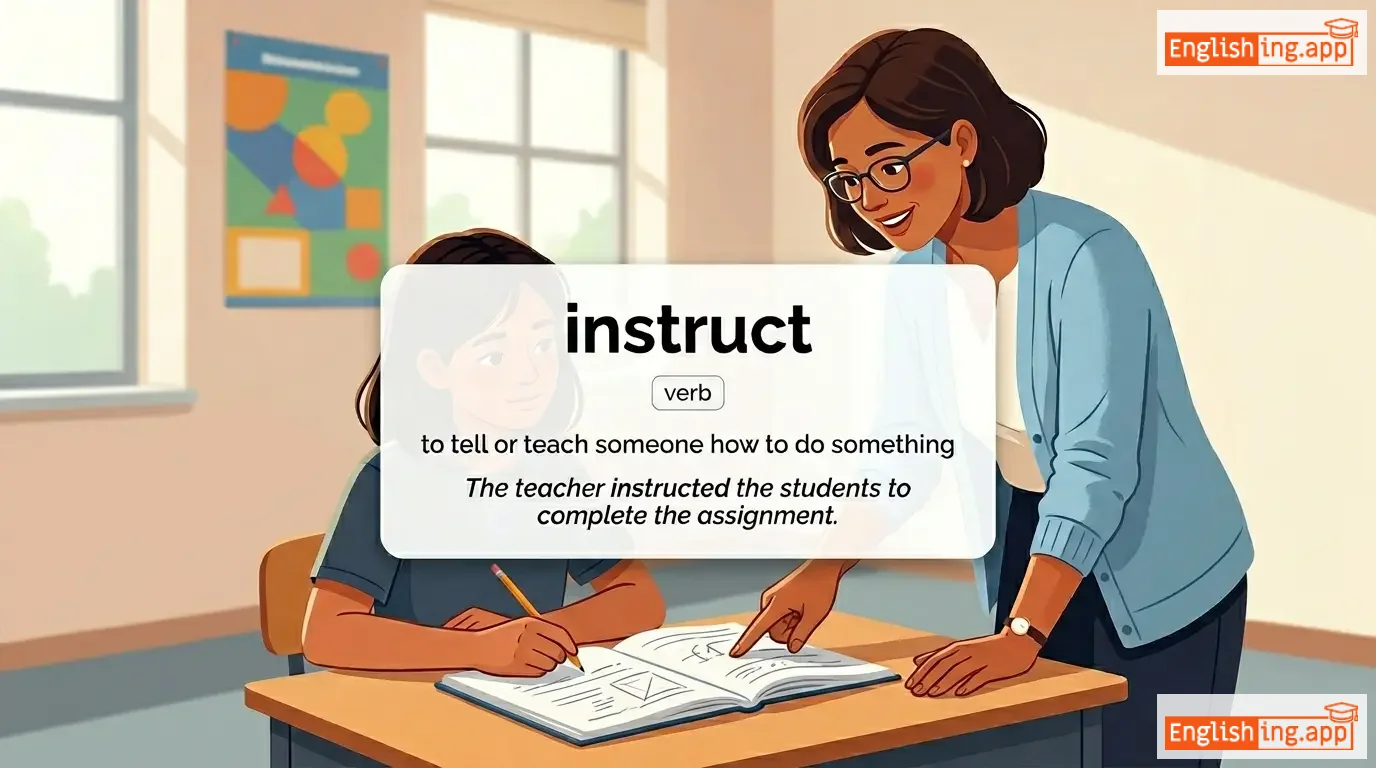
instruct definition card — visual illustration of the meaning
verb
/ɪnˈstrʌkt/
instruire, enseigner (instruire, enseigner)

to tell or teach someone how to do something

"The teacher instructed the students to complete the assignment."

"Le professeur a instruit les étudiants de compléter l'exercice." (Le professeur a instruit les étudiants de compléter l'exercice.)
noun
/ɪnˈstrʌkʃən/
instruction (instruction)

Detailed information telling how something should be done or operated.

"Please read the instruction carefully before using the machine."

"Veuillez lire l'instruction attentivement avant d'utiliser la machine." (Veuillez lire l'instruction attentivement avant d'utiliser la machine.)
adjective
/ɪnˈstrʌkʃənəl/
pédagogique (pedagogique)

providing knowledge or information; intended to teach

"The website offers many instructional videos for beginners."

"Le site Web propose de nombreuses vidéos pédagogiques pour les débutants." (Le site Web propose de nombreuses videos pedagogiques pour les debutants.)
noun
/ɪnˈstrʌkʃənz/
instructions (instructions)

Detailed information on how something should be done or operated.

"Please follow the instructions on the box."

"Veuillez suivre les instructions sur la boîte." (Veuillez suivre les instructions sur la boîte.)
adjective
/ɪnˈstrʌktɪv/
instructif (instructif)

useful and informative; providing knowledge or instruction

"The lecture was highly instructive and engaging."

"La conférence était très instructive et captivante." (La conférence était très instructive et captivante.)
noun
/ɪnˈstrʌktər/
instructeur (instructeur)

A person who teaches a subject or skill.

"The driving instructor was very patient with new learners."

"L'instructeur de conduite était très patient avec les nouveaux élèves." (L'instructeur de conduite était très patient avec les nouveaux élèves.)
noun
/ˈɪnstrəmənt/
instrument (instrument)

A tool or device used for a particular purpose, especially for scientific or musical work.

"The doctor used a special instrument during the surgery."

"Le médecin a utilisé un instrument spécial pendant la chirurgie." (Le médecin a utilisé un instrument spécial pendant la chirurgie.)
instrumental definition card — visual illustration of the meaning
adjective
/ˌɪnstrʊˈmɛntəl/
instrumental (instrumental)

serving as an instrument or means to an end; helpful or useful

"His instrumental role in the project was vital to its success."

"Son rôle instrumental dans le projet a été vital pour son succès." (Son rôle instrumental dans le projet a été vital pour son succès.)
noun
/ˌɪn.strəˈmɛn.təl.ɪst/
instrumentiste (instrumentiste)

A person who plays a musical instrument.

"The instrumentalist played a beautiful solo on the violin."

"L'instrumentiste a joué un beau solo au violon." (L'instrumentiste a joué un beau solo au violon.)
adjective
/ˌɪn.səˈbɔːr.dɪ.nət/
insubordonné (insubordonne)

Defiant of authority; disobedient to orders.

"The insubordinate employee refused to follow the manager's instructions."

"L'employé insubordonné a refusé de suivre les instructions du gestionnaire." (L'employe insubordonne a refuse de suivre les instructions du gestionnaire.)
noun
/ˌɪn.səˌbɔːr.dɪˈneɪ.ʃən/
insubordination (insubordination)

Defiance of authority; refusal to obey orders.

"The soldier was punished for insubordination during the mission."

"Le soldat a été puni pour insubordination pendant la mission." (Le soldat a été puni pour insubordination pendant la mission.)
adjective
/ˌɪn.səbˈstæn.ʃəl/
insubstantiel (insubstantiel)

Lacking strength, substance, or solidity.

"The evidence provided was insubstantial and unconvincing."

"Les preuves fournies étaient insubstantielles et non convaincantes." (Les preuves fournies étaient insubstantielles et non convaincantes.)
adjective
/ɪnˈsʌf.ər.ə.bəl/
insupportable (insupportable)

Too extreme to bear; intolerable.

"The heat during the summer was insufferable."

"La chaleur pendant l'été était insupportable." (La chaleur pendant l'été était insupportable.)
noun
/ˌɪnsəˈfɪʃənsi/
insuffisance (insuffisance)

The state of not being enough or not being adequate.

"The project failed due to the insufficiency of funds."

"Le projet a échoué en raison de l'insuffisance des fonds." (Le projet a échoué en raison de l'insuffisance des fonds.)
adjective
/ˌɪnsəˈfɪʃənt/
insuffisant (insuffisant)

Not enough; inadequate.

"His explanation was insufficient to clear the confusion."

"Son explication était insuffisante pour clarifier la confusion." (Son explication etait insuffisante pour clarifier la confusion.)
adjective
/ˈɪnsjələr/
étroit d'esprit, relatif à une île (etroit d'esprit, relatif à une île)

Narrow-minded, isolated, or relating to an island.

"The community was criticized for its insular attitudes toward outsiders."

"La communauté a été critiquée pour ses attitudes insulaires envers les étrangers." (La communauté a été critiquée pour ses attitudes insulaires envers les étrangers.)
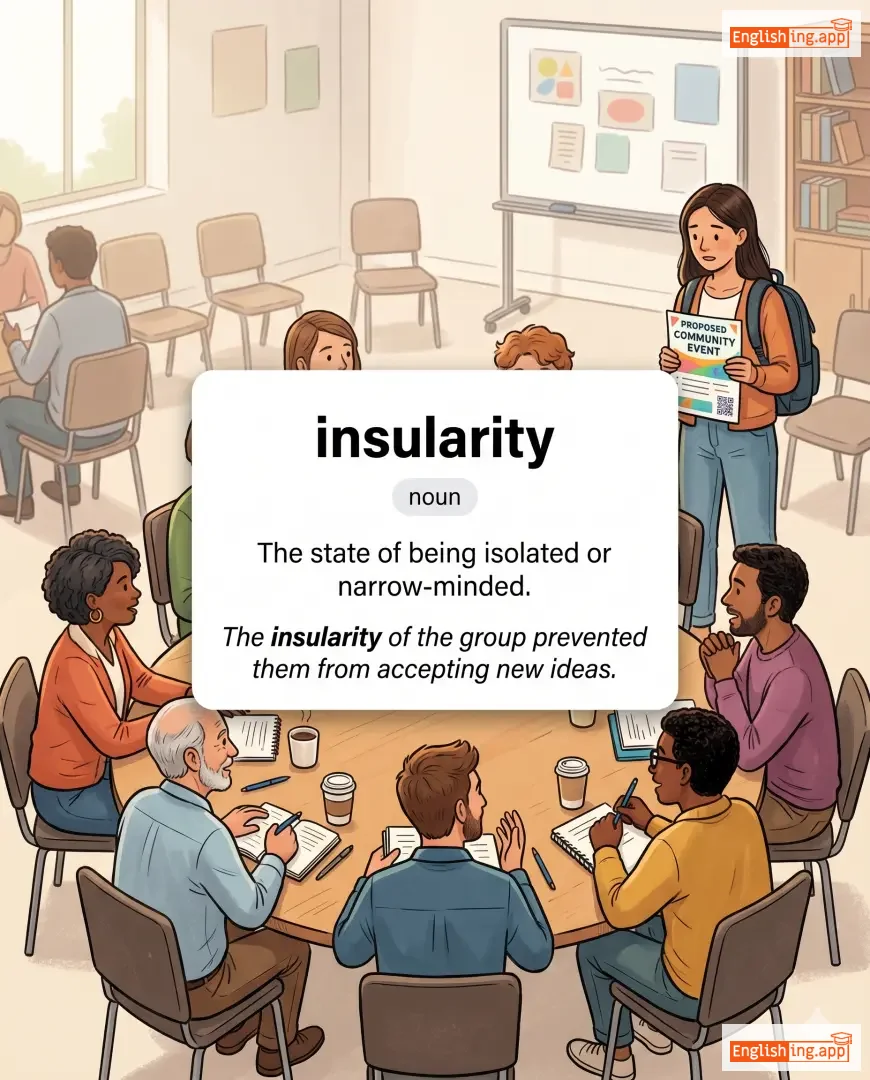
insularity definition card — visual illustration of the meaning
noun
/ˌɪnsjəˈlærəti/
insularité (insularite)

The state of being isolated or narrow-minded.

"The insularity of the group prevented them from accepting new ideas."

"L'insularité du groupe l'a empêché d'accepter de nouvelles idées." (L'insularité du groupe l'a empêché d'accepter de nouvelles idées.)
verb
/ˈɪnsjuleɪt/
isoler (isoler)

To protect something by covering it, especially to prevent heat, sound, or electricity from escaping or entering.

"The house was insulated to reduce heating costs."

"La maison a été isolée pour réduire les coûts de chauffage." (La maison a été isolée pour réduire les coûts de chauffage.)
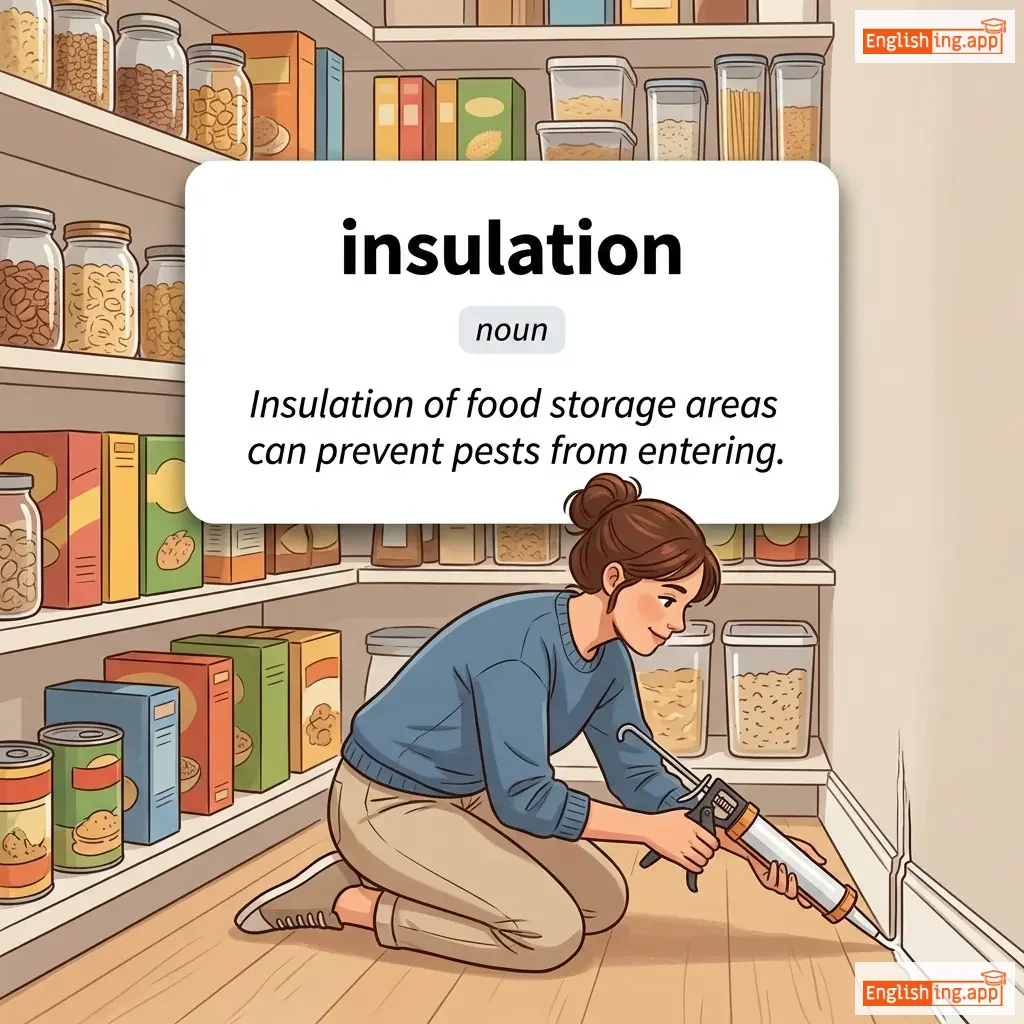
insulation definition card — visual illustration of the meaning
noun
ˌɪnsjʊˈleɪʃən
isolation (isolation)

Material used to prevent heat, sound, or electricity from being transmitted from one area to another.

"Insulation of food storage areas can prevent pests from entering."

"L'isolation des zones de stockage des aliments peut empêcher les nuisibles d'entrer." (L'isolation des zones de stockage des aliments peut empecher les nuisibles d'entrer.)
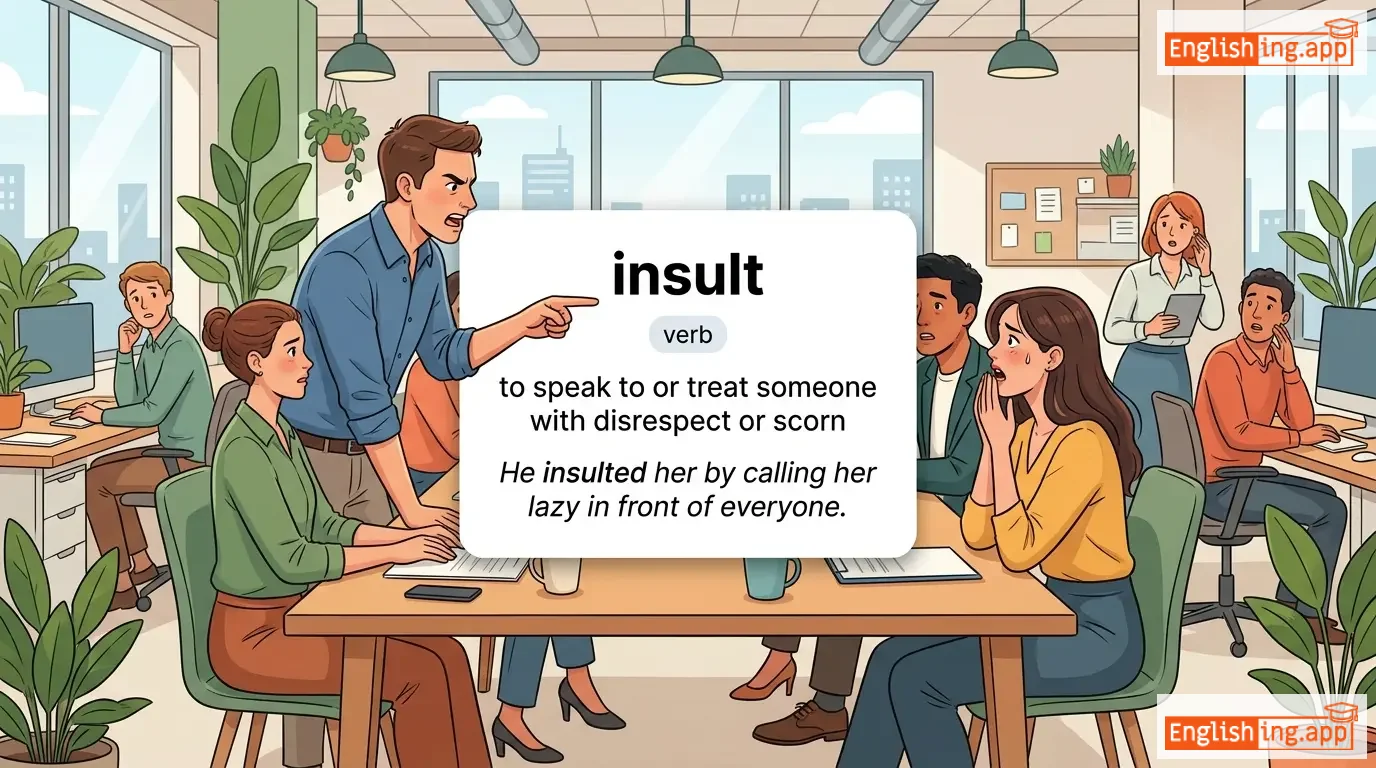
insult definition card — visual illustration of the meaning
verb
/ˈɪnsʌlt/
insulter (insulter)

to speak to or treat someone with disrespect or scorn

"He insulted her by calling her lazy in front of everyone."

"Il l'a insultée en l'appelant paresseuse devant tout le monde." (Il l'a insultée en l'appelant paresseuse devant tout le monde.)
insuperable definition card — visual illustration of the meaning
adjective
/ɪnˈsuːpərəbl/
insurmontable (insurmontable)

Impossible to overcome or surpass.

"The team faced insuperable challenges during the expedition."

"L'équipe a fait face à des défis insurmontables lors de l'expédition." (L'equipe a fait face a des defis insurmontables lors de l'expedition.)
adjective
/ˌɪnsəˈpɔːrtəbl̩/
insupportable (insupportable)

Too extreme or difficult to be endured.

"The heat was insupportable during the long journey."

"La chaleur était insupportable pendant le long voyage." (La chaleur était insupportable pendant le long voyage.)
adjective
/ˌɪnsəˈprɛsəbl/
irrépressible (irrépressible)

That cannot be suppressed or restrained.

"She had an insuppressible urge to laugh during the ceremony."

"Elle avait une envie irrépressible de rire pendant la cérémonie." (Elle avait une envie irrépressible de rire pendant la cérémonie.)
noun
/ɪnˈʃʊərəns/
assurance (assurance)

An arrangement by which a company provides compensation for loss, damage, or illness in return for a premium.

"He bought health insurance to cover medical expenses."

"Il a acheté une assurance santé pour couvrir les frais médicaux." (Il a acheté une assurance santé pour couvrir les frais médicaux.)
insure definition card — visual illustration of the meaning
verb
/ɪnˈʃʊr/
assurer, protéger (assurer, protéger)

to arrange for compensation in case of loss or damage, typically by taking out insurance

"You should insure your car against theft or accidents."

"Vous devriez assurer votre voiture contre le vol ou les accidents." (Vous devriez assurer votre voiture contre le vol ou les accidents.)
noun
/ɪnˈsɜːrdʒəns/
insurrection (insurrection)

An act of rebellion or uprising against authority.

"The government struggled to contain the growing insurgence."

"Le gouvernement a eu du mal à contenir l'insurrection croissante." (Le gouvernement a eu du mal à contenir l'insurrection croissante.)
noun
/ɪnˈsɜːrdʒənt/
insurgé (insurge)

A person who rises in revolt against authority or government.

"The army arrested several insurgents after the attack."

"L'armée a arrêté plusieurs insurgés après l'attaque." (L'armee a arrete plusieurs insurges apres l'attaque.)
adjective
/ˌɪnsərˈmaʊntəbl/
insurmontable (insurmontable)

Too great to be overcome.

"The explorers faced insurmountable odds in the desert."

"Les explorateurs ont fait face à des obstacles insurmontables dans le désert." (Les explorateurs ont fait face à des obstacles insurmontables dans le désert.)
noun
/ˌɪnsəˈrɛkʃən/
insurrection (insurrection)

A violent uprising against an authority or government.

"The army was called in to suppress the insurrection."

"L'armée a été appelée pour réprimer l'insurrection." (L'armee a ete appelee pour reprimmer l'insurrection.)
adjective
/ɪnˈtækt/
intacte (intakte)

Remaining whole, complete, and undamaged.

"Despite the storm, the old house remained intact."

"Malgré la tempête, la vieille maison est restée intacte." (Malgré la tempête, la vieille maison est restée intacte.)
noun
/ˈɪnˌteɪk/
ingestion (ingestion)

the process of taking something in, especially food or drink

"He monitored his daily intake of calories to maintain a healthy diet."

"Il a surveillé son apport quotidien en calories pour maintenir un régime alimentaire sain." (Il a surveillé son apport quotidien en calories pour maintenir un régime alimentaire sain.)
intangible definition card — visual illustration of the meaning
adjective
/ɪnˈtændʒəbl/
intangible (intangible)

Unable to be touched or grasped; not having a physical presence.

"Trust is an intangible quality in relationships."

"La confiance est une qualité intangible dans les relations." (La confiance est une qualité intangible dans les relations.)
integral definition card — visual illustration of the meaning
adjective
/ˈɪntɪɡrəl/ or /ɪnˈtɛɡrəl/
intégral (integral)

Necessary and important as a part of a whole.

"Honesty is an integral part of good leadership."

"L'honnêteté est une partie intégrale d'un bon leadership." (L'honnêteté est une partie intégrale d'un bon leadership.)
verb
/ˈɪntɪɡreɪt/
intégrer (integrer)

To combine or bring together into a unified whole.

"The new system integrates data from multiple sources."

"Le nouveau système intègre des données provenant de plusieurs sources." (Le nouveau système intègre des données provenant de plusieurs sources.)
integrated definition card — visual illustration of the meaning
adjective
/ˈɪntɪɡreɪtɪd/
intégré (intégré)

combined or united to form a whole; including all parts or people equally

"The company offers an integrated system for managing all business operations."

"L'entreprise propose un système intégré pour gérer toutes les opérations commerciales." (L'entreprise propose un système intégré pour gérer toutes les opérations commerciales.)
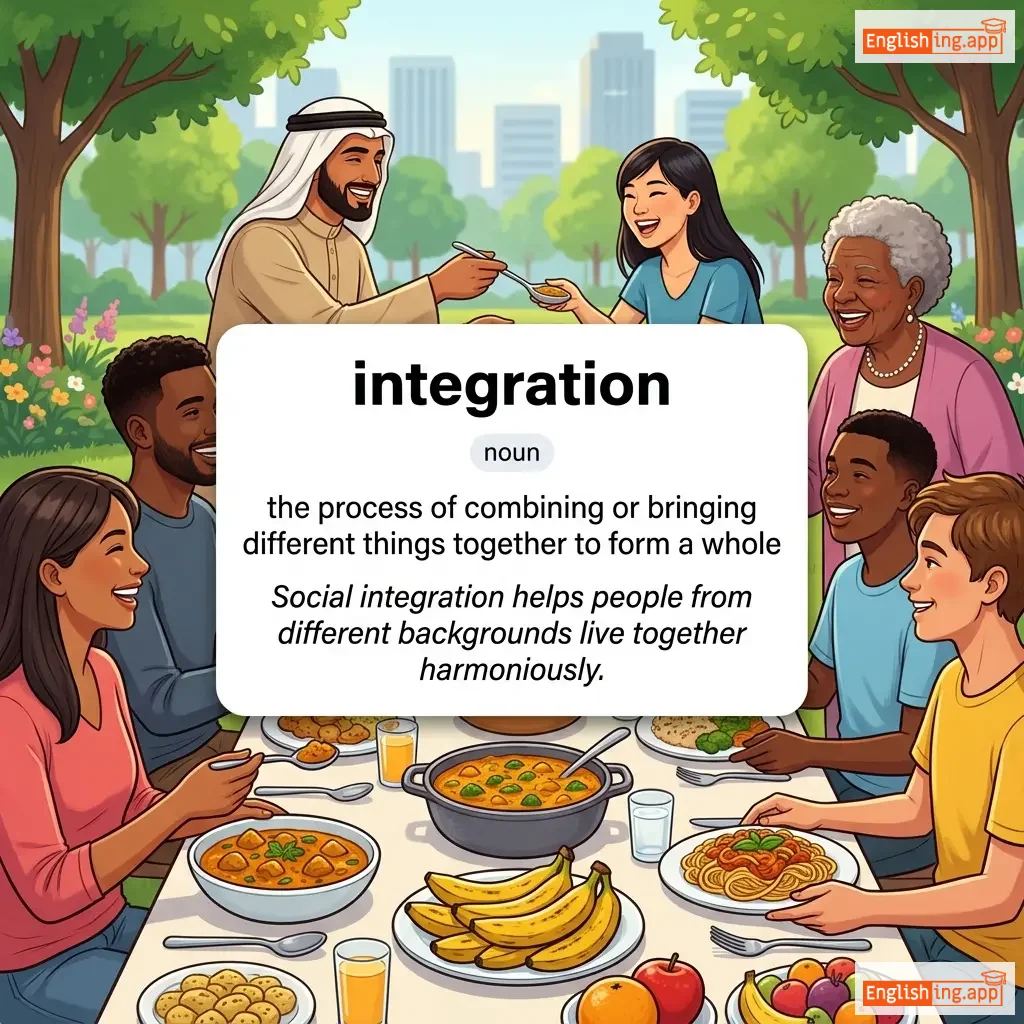
integration definition card — visual illustration of the meaning
noun
/ˌɪntɪˈɡreɪʃən/
intégration (integration)

the process of combining or bringing different things together to form a whole

"Social integration helps people from different backgrounds live together harmoniously."

"L'intégration sociale aide les personnes de différentes origines à vivre ensemble harmonieusement." (L'integration sociale aide les personnes de différentes origines a vivre ensemble harmonieusement.)