Vocabulaires

Découvrez, apprenez et maîtrisez le vocabulaire anglais

adjective
/ˌɪnɪˈsɛnʃəl/
non essentiel (non essentiel)

not necessary or important; not essential

"The report removes all inessential details to stay focused."

"Le rapport supprime les détails non essentiels pour rester concentré." (le rapport supprime les details non essentiels pour rester concentre)
adjective
/ɪnˈɛstɪməbl/
inestimable (inestimable)

Too great or valuable to be measured or estimated.

"Her contribution to the project was of inestimable value."

"Sa contribution au projet avait une valeur inestimable." (Sa contribution au projet avait une valeur inestimable.)
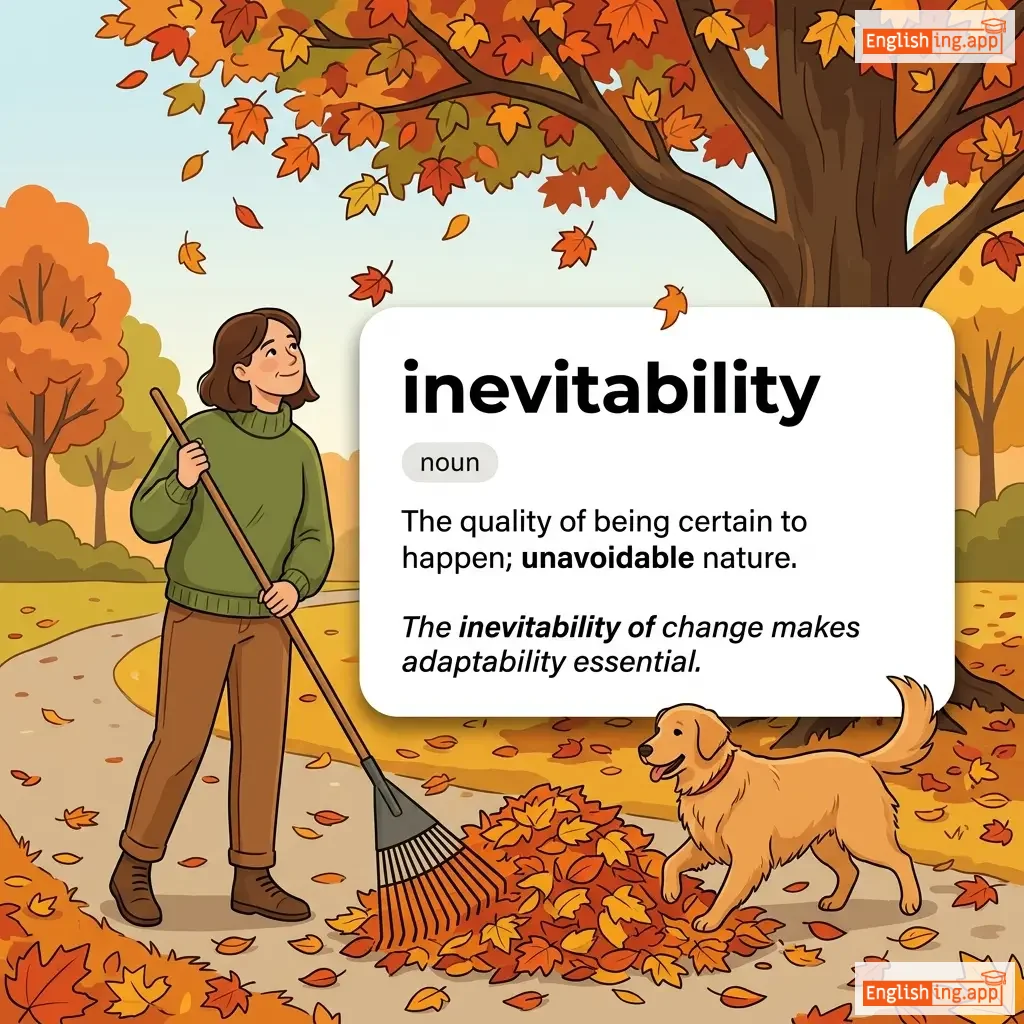
inevitability definition card — visual illustration of the meaning
noun
/ɪnˌɛvɪtəˈbɪləti/
inévitabilité (inevitablete)

The quality of being certain to happen; unavoidable nature.

"The inevitability of change makes adaptability essential."

"L'inévitabilité du changement rend l'adaptabilité essentielle." (L'inévitabilité du changement rend l'adaptabilité essentielle.)
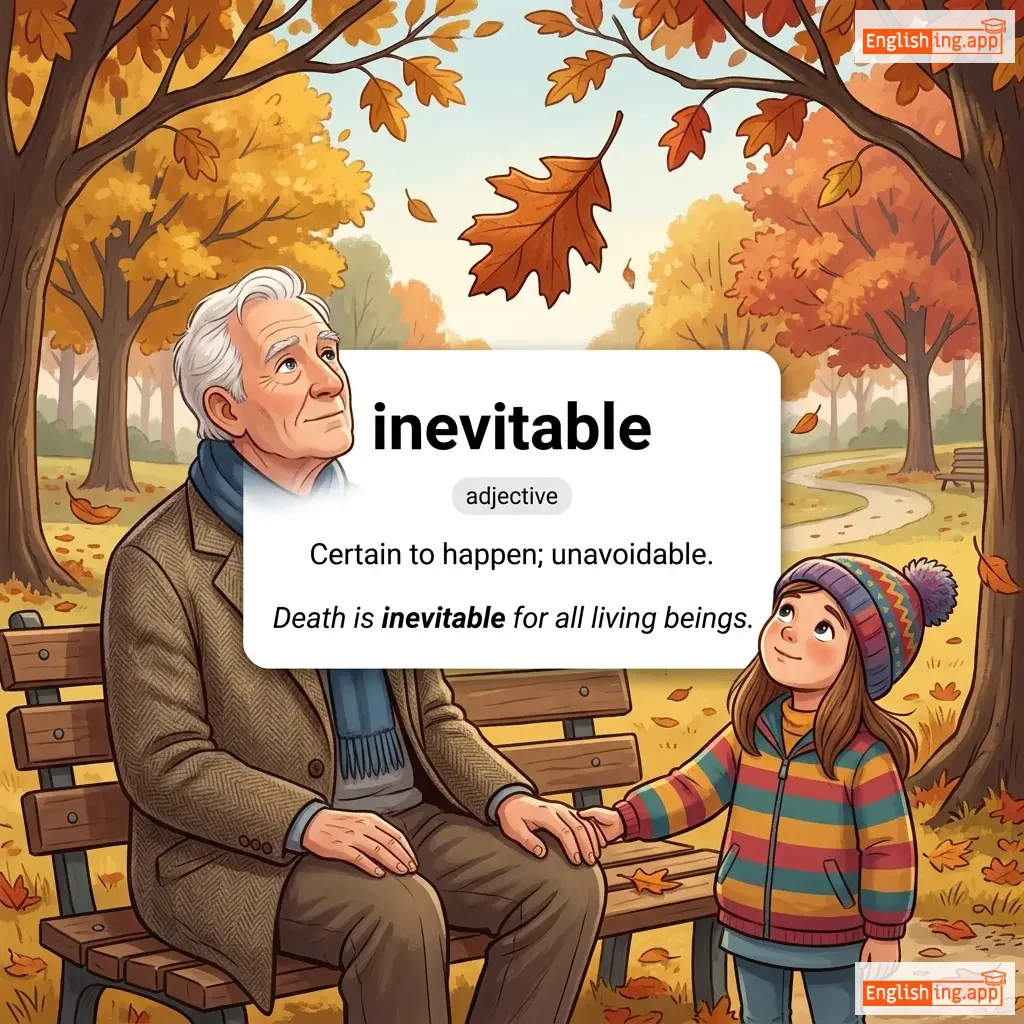
inevitable definition card — visual illustration of the meaning
adjective
/ɪnˈɛvɪtəbl/
inévitable (inevitable)

Certain to happen; unavoidable.

"Death is inevitable for all living beings."

"La mort est inévitable pour tous les êtres vivants." (La mort est inévitable pour tous les êtres vivants.)
adverb
/ɪnˈɛvɪtəbli/
inévitable (inevitable)

in a way that cannot be avoided or prevented

"Inevitably, the team faced challenges during the project."

"Inévitablement, l'équipe a rencontré des défis pendant le projet." (Inévitablement, l'équipe a rencontré des défis pendant le projet.)
adjective
/ˌɪnɪkˈskjuːzəbl/
inexcusable (inexcusable)

Too bad to be justified or overlooked; unforgivable.

"His rude behavior was inexcusable."

"Son comportement impoli était inexcusable." (Son comportement impoli était inexcusable.)
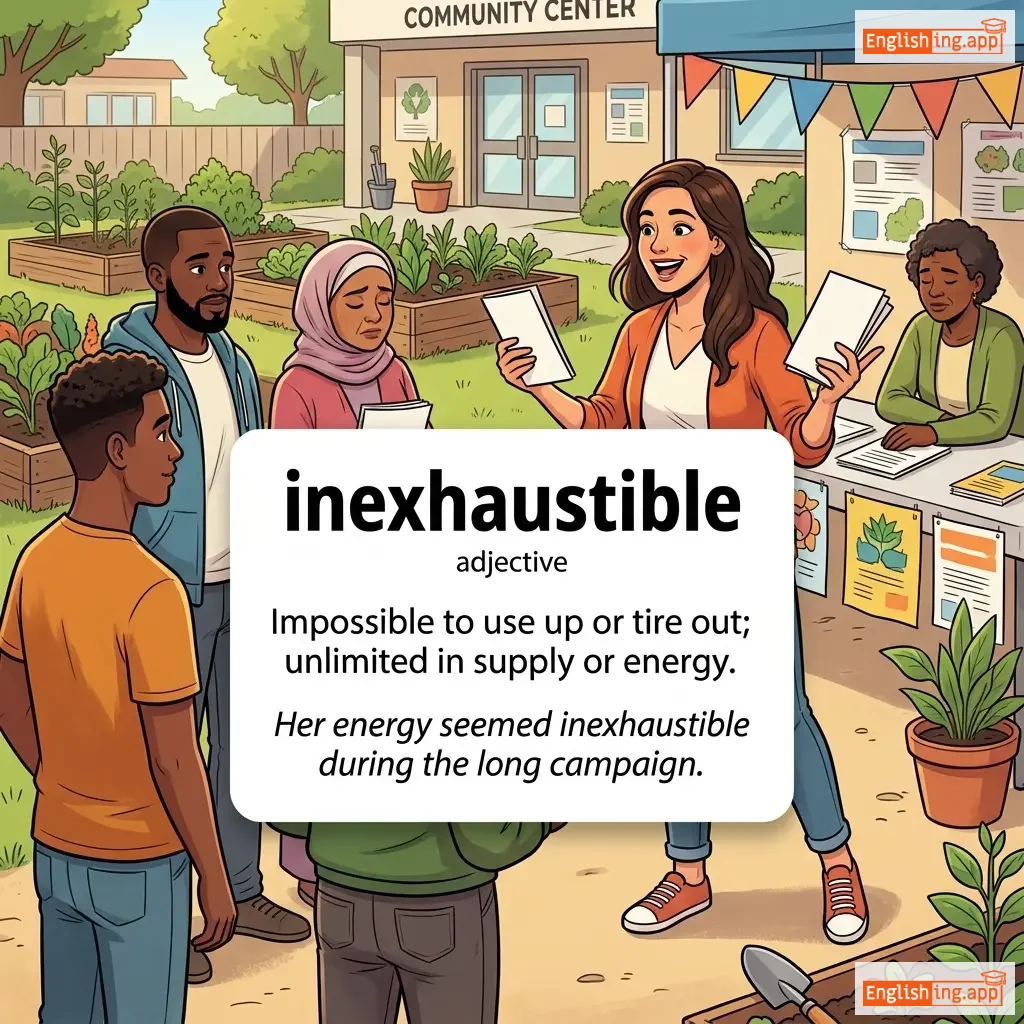
inexhaustible definition card — visual illustration of the meaning
adjective
/ˌɪnɪɡˈzɔːstəbl/
inépuisable (inepuisable)

Impossible to use up or tire out; unlimited in supply or energy.

"Her energy seemed inexhaustible during the long campaign."

"Son énergie semblait inépuisable pendant la longue campagne." (Son energie semblait inepuisable pendant la longue campagne.)
adjective
/ɪnˈɛksərəbl/
inexorable (inexorable)

Impossible to stop or prevent; relentless.

"The inexorable rise of technology is changing every aspect of life."

"La montée inexorable de la technologie change chaque aspect de la vie." (La montée inexorable de la technologie change chaque aspect de la vie.)
noun (compound/erroneous entry)
/ɪnˈɛksərəbl ɑːrmi/
armée imparable (armee imparable)

This appears to be a corrupted or concatenated form; interpreted as 'inexorable army' — an unstoppable or relentless force.

"The rebels feared the inexorable army approaching their stronghold."

"Les rebelles craignaient l'armée imparable qui approchait de leur bastion." (Les rebelles craignaient l'armee imparable qui approchait de leur bastion.)
adjective
/ˌɪnɪkˈspiːdiənt/
déconseillé (deconseillé)

Not advisable, suitable, or practical in the circumstances.

"It would be inexpedient to invest without proper research."

"Il serait déconseillé d'investir sans une recherche appropriée." (Il serait déconseillé d'investir sans une recherche appropriée.)
adjective
/ˌɪnɪkˈspɛnsɪv/
bon marché (bon marche)

Cheap; costing little money.

"They found an inexpensive restaurant near the station."

"Ils ont trouvé un restaurant bon marché près de la gare." (Ils ont trouve un restaurant bon marche pres de la gare.)
noun
/ˌɪnɪkˈspɪəriəns/
inexpérience (inexperience)

Lack of knowledge or skill in a particular activity or field.

"His inexperience in handling negotiations was evident."

"Son inexpérience dans la gestion des négociations était évidente." (Son inexpérience dans la gestion des négociations était évidente.)
adjective
/ˌɪnˈekspɜːrt/
inexpérimenté (inexperimente)

not skilled or experienced; lacking expertise

"The inexpert handling of the machine caused several mistakes."

"La manipulation inexpérimentée de la machine a causé plusieurs erreurs." (La manipulation inexperimentee de la machine a cause plusieurs erreurs)
adjective
/ˌɪnɪkˈsplɪkəbl/
inexpliquable (inexpliquable)

Impossible to explain or understand.

"The sudden disappearance of the file was inexplicable."

"La disparition soudaine du fichier était inexpliquable." (La disparition soudaine du fichier était inexpliquable.)
adjective
/ˌɪnɪkˈsprɛsəbl/
inexprimable (inexprimable)

Too strong or extreme to be expressed in words.

"She felt inexpressible joy at the news of her success."

"Elle ressentit une joie inexprimable en apprenant son succès." (Elle ressentit une joie inexprimable en apprenant son succès.)
adjective
/ˌɪnɪkˈstɛnsəbl/
inextensible (inextensible)

Not capable of being stretched or extended.

"This rope is made of an inextensible material."

"Cette corde est faite d’un matériau inextensible." (Cette corde est faite d’un matériau inextensible.)
adjective
/ˌɪnɪkˈstrɪkəbl/
inextricable (inextricable)

Impossible to separate or escape from.

"The two friends shared an inextricable bond."

"Les deux amis partageaient un lien inextricable." (Les deux amis partageaient un lien inextricable.)
adjective
/ɪnˈfæləbl̩/
infaillible (infaillible)

incapable of making mistakes or being wrong

"Her judgment seemed infallible in matters of finance."

"Son jugement semblait infaillible en matière de finances." (Son jugement semblait infaillible en matière de finances.)
adjective
/ˈɪnfəməs/
infâme (infam)

well known for some bad quality or deed

"The dictator was infamous for his cruelty."

"Le dictateur était infâme pour sa cruauté." (Le dictateur était infâme pour sa cruauté.)
noun
/ˈɪnfəmi/
bonheur (bonheur)

the state of being well known for some bad quality or deed

"His name will live in infamy for the crimes he committed."

"Elle n'a pas pu cacher son bonheur lorsqu'elle a reçu le prix." (Elle n'a pas pu cacher son bonheur lorsqu'elle a recu le prix.)
noun
/ˈɪnfənt/
bambin (bambin)

A very young child or baby.

"The infant was sleeping peacefully in the cradle."

"Le bébé dormait paisiblement dans le berceau." (Le bebe dormait paisiblement dans le berceau.)
adjective
/ˈɪnfəntaɪl/
infantile (infantile)

characteristic of an infant; childish

"His infantile behavior embarrassed everyone at the meeting."

"Son comportement infantile a embarrassé tout le monde à la réunion." (Son comportement infantile a embarrasse tout le monde a la reunion.)
noun
/ˈɪn.fən.tri/
infanterie (infanterie)

soldiers marching or fighting on foot; foot soldiers collectively

"The infantry advanced across the battlefield on foot."

"L'infanterie a avancé à travers le champ de bataille à pied." (L'infanterie a avancé à travers le champ de bataille à pied.)
verb
/ɪnˈfætʃueɪt/
fasciner (fasciner)

to inspire with an intense but short-lived passion or admiration

"He was infatuated with her beauty."

"Il était fasciné par sa beauté." (Il etait fascine par sa beaute.)
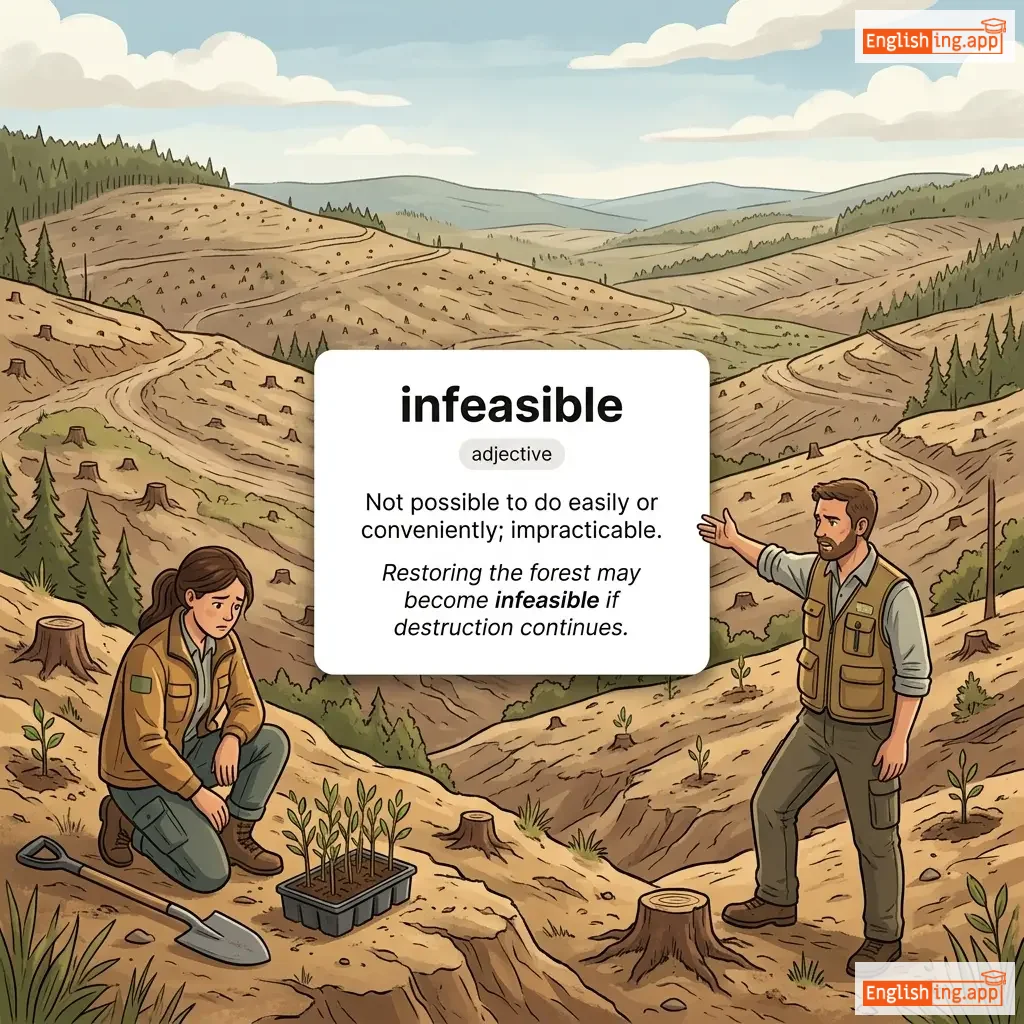
infeasible definition card — visual illustration of the meaning
adjective
ɪnˈfiː.zə.bəl
infaisable (infaisable)

Not possible to do easily or conveniently; impracticable.

"Restoring the forest may become infeasible if destruction continues."

"Restaurer la forêt peut devenir infaisable si la destruction continue." (Restaurer la forêt peut devenir infaisable si la destruction continue.)
verb
/ɪnˈfɛkt/
infecter (infecter)

To contaminate with a disease-causing organism.

"The virus can infect healthy people quickly."

"Le virus peut infecter rapidement les personnes en bonne santé." (Le virus peut infecter rapidement les personnes en bonne santé.)
noun
/ɪnˈfɛkʃən/
infection (infection)

The process of becoming infected with harmful microorganisms such as bacteria or viruses.

"The doctor prescribed antibiotics to treat the infection."

"Le médecin a prescrit des antibiotiques pour traiter l'infection." (Le medecin a prescrit des antibiotiques pour traiter l'infection.)
adjective
/ɪnˈfekʃəs/
infectieux (infectieux)

capable of causing infection or disease; spreading easily from one person to another; able to spread feelings or attitudes such as enthusiasm

"Her infectious laughter made everyone in the room smile."

"Son rire infectieux a fait sourire tout le monde." (son rire infectieux a fait sourire tout le monde)
adjective
/ˌɪnfəˈlɪsɪtəs/
inopportun (inopportun)

not suitable or well chosen; awkward or unfortunate

"His infelicitous remark ruined the atmosphere of the meeting."

"Sa remarque inopportune a gâché l'ambiance de la réunion." (Sa remarque inopportune a gâché l'ambiance de la réunion.)
verb
/ɪnˈfɜːr/
inférer (inferer)

to conclude or deduce something from evidence and reasoning rather than from explicit statements

"From his silence, I inferred that he was not happy with the decision."

"De son silence, j'ai inféré qu'il n'était pas content de la décision." (De son silence, j'ai inféré qu'il n'était pas content de la décision.)
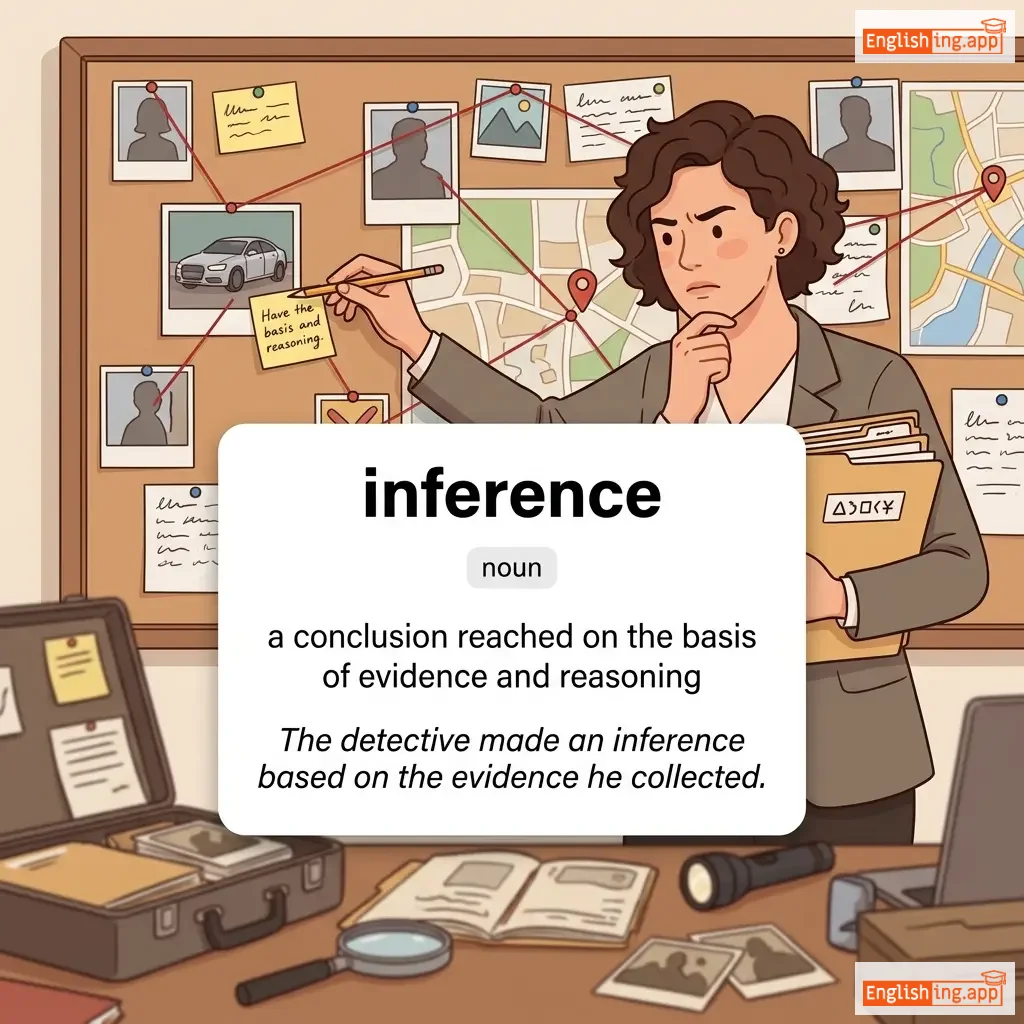
inference definition card — visual illustration of the meaning
noun
/ˈɪnfərəns/
inférence (inference)

a conclusion reached on the basis of evidence and reasoning

"The detective made an inference based on the evidence he collected."

"Le détective a fait une inférence basée sur les preuves qu'il avait collectées." (Le detective a fait une inference basee sur les preuves quil avait collecte.)
adjective
/ɪnˈfɪə.ri.ər/
inférieur (inferieur)

Of lower quality, rank, or status.

"This material is inferior to the one we used before."

"Ce matériau est inférieur à celui que nous avons utilisé auparavant." (Ce materiau est inferieur a celui que nous avons utilise auparavant.)
adjective
/ɪnˈfɜːrnəl/
infernal (infernal)

relating to hell; extremely troublesome or annoying

"The workers complained about the infernal noise from the construction site."

"Les travailleurs se sont plaints du bruit infernal provenant du site de construction." (Les travailleurs se sont plaints du bruit infernal provenant du site de construction.)
noun
/ɪnˈfɜːrnoʊ/
incendie (incendie)

a large, intense fire that is dangerously out of control

"The building turned into an inferno within minutes."

"Le bâtiment s'est transformé en un incendie en quelques minutes." (Le batiment s'est transforme en un incendie en quelques minutes.)
verb
/ɪnˈfɛst/
infester (infester)

to overrun in large numbers, especially so as to cause damage or discomfort

"The old house was infested with rats."

"La vieille maison était infestée de rats." (La vieille maison était infestée de rats.)
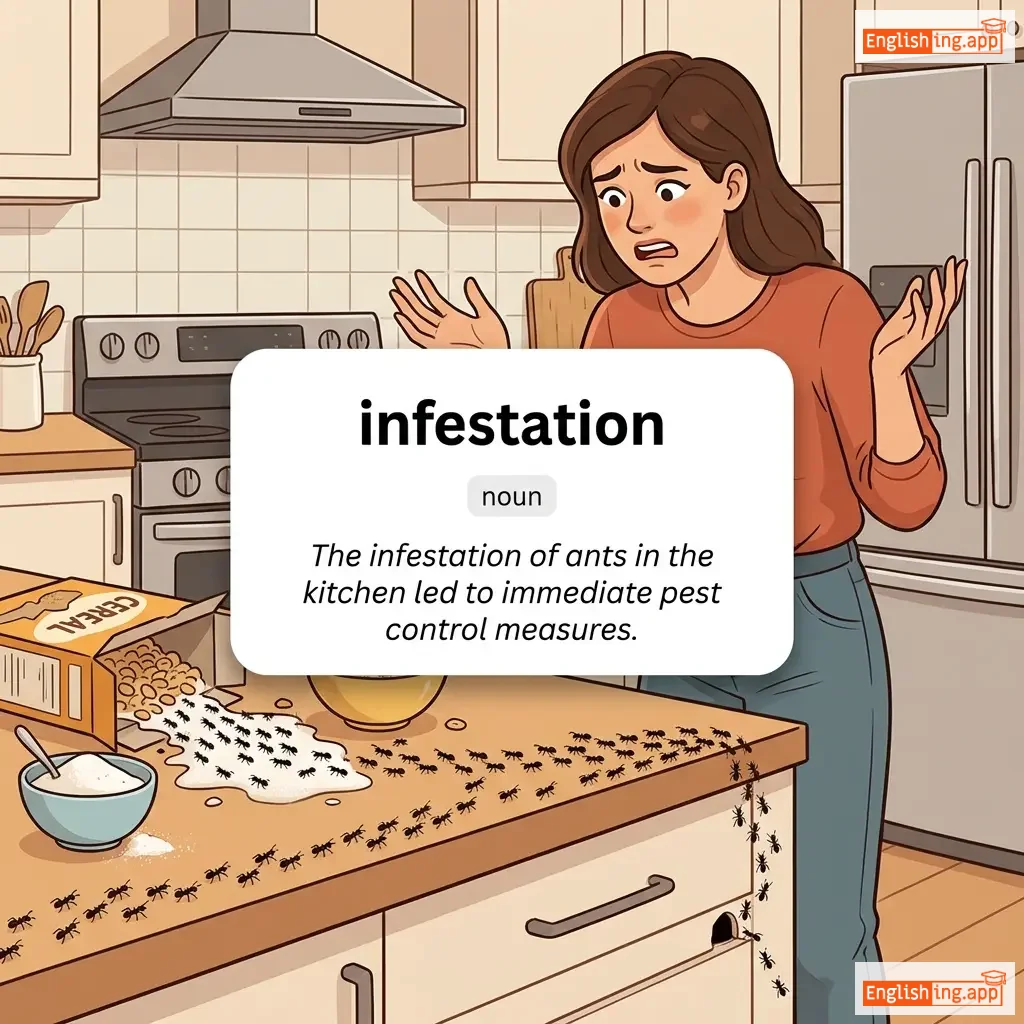
infestation definition card — visual illustration of the meaning
noun
ˌɪnfɛsˈteɪʃən
infestation, présence anormalement élevée d'insectes ou d'animaux dans un endroit (infestation, presence anormalement elevee d'insectes ou d'animaux dans un endroit)

The presence of an unusually large number of insects or animals in a place, causing damage or disease.

"The infestation of ants in the kitchen led to immediate pest control measures."

"L'infestation de fourmis dans la cuisine a conduit à des mesures immédiates de contrôle des nuisibles." (L'infestation de fourmis dans la cuisine a conduit a des mesures immediates de controle des nuisibles.)
noun
/ˈɪnfɪdɛl/
infidèle (infidele)

a person who does not believe in a particular religion or faith

"In medieval times, people often called non-Christians infidels."

"Au Moyen Âge, les gens appelaient souvent les non-chrétiens des infidèles." (Au Moyen Âge, les gens appelaient souvent les non-chrétiens des infidèles.)
noun
/ˌɪnfɪˈdɛləti/
infidélité (infidelite)

the act of being unfaithful to a spouse or partner

"Their marriage ended due to his infidelity."

"Leur mariage a pris fin à cause de son infidélité." (Leur mariage a pris fin à cause de son infidélité.)
verb
/ˈɪnfɪltreɪt/
infiltrer (infiltrer)

to secretly enter or gain access to a place or group

"The spies managed to infiltrate the enemy base."

"Les espions ont réussi à infiltrer la base ennemie." (Les espions ont réussi à infiltrer la base ennemie.)
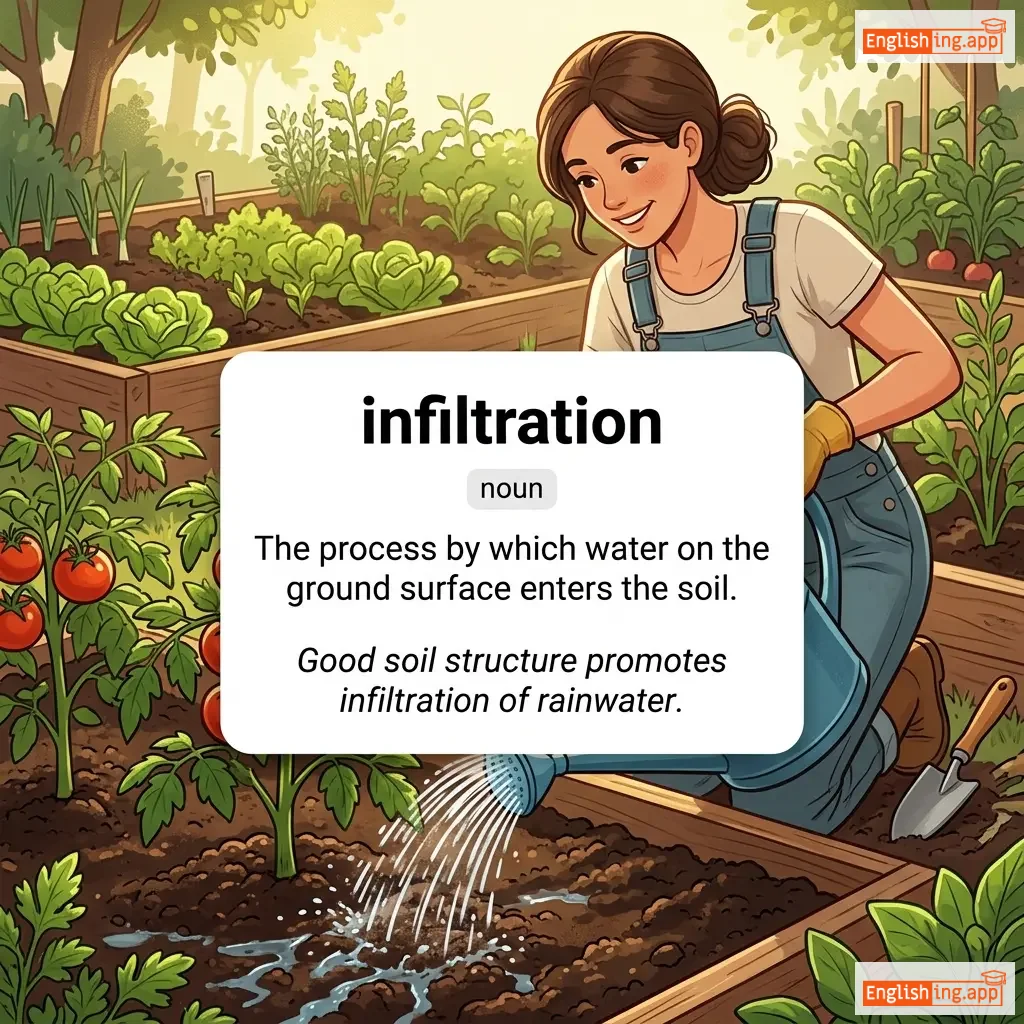
infiltration definition card — visual illustration of the meaning
noun
/ˌɪn.fɪlˈtreɪ.ʃən/
infiltration (infiltration)

The process by which water on the ground surface enters the soil.

"Good soil structure promotes infiltration of rainwater."

"Une bonne structure du sol favorise l'infiltration de l'eau de pluie." (Une bonne structure du sol favorise leau de pluie linfiltration.)
adjective
/ˈɪnfɪnɪt/
infini (infini)

limitless or endless in space, extent, or number

"The universe is often described as infinite."

"L'univers est souvent décrit comme infini." (L'univers est souvent décrit comme infini.)
adjective
/ˌɪnfɪnɪˈtɛsɪməl/
infinitésimal (infinitesimal)

Extremely small in size or amount; so tiny as to be almost negligible.

"The error was so infinitesimal that it didn’t affect the results."

"L'erreur était si infinitésimale qu'elle n'a pas affecté les résultats." (L'erreur etait si infinitesimale quelle n'a pas affecte les resultats.)
noun
/ɪnˈfɪnɪti/
infini (infini)

A concept describing something without any limit or end.

"The universe seems to stretch into infinity."

"L'univers semble s'étendre à l'infini." (L'univers semble s'etendre a l'infini.)
adjective
/ɪnˈfɜːm/
fragile (fragil)

Weak, especially due to old age or illness.

"The infirm old man needed assistance to walk."

"L'homme âgé et fragile avait besoin d'aide pour marcher." (L'homme âgé et fragile avait besoin d'aide pour marcher.)
noun
/ɪnˈfɜːməri/
infirmerie (infirmerie)

A hospital or place where the sick or injured are cared for.

"The school had an infirmary for minor injuries."

"L'école avait une infirmerie pour les blessures mineures." (L'école avait une infirmerie pour les blessures mineures.)
noun
/ɪnˈfɜːməti/
affaiblissement (affaiblissement)

Physical or mental weakness, especially from old age.

"Despite his infirmity, he remained cheerful."

"Malgré son affaiblissement, il est resté joyeux." (Malgré son affaiblissement, il est resté joyeux.)
verb
/ɪnˈfleɪm/
enflammer (enflammer)

to arouse strong feelings or provoke anger; to cause inflammation in the body

"The politician's remarks served to inflame public opinion."

"Les remarques du politicien ont servi à enflammer l'opinion publique." (Les remarques du politicien ont servi à enflammer l'opinion publique.)
adjective
/ɪnˈflæməbl/
inflammable (inflammable)

easily set on fire; easily excited or angered

"This material is highly inflammable and should be kept away from heat."

"Ce matériau est hautement inflammable et doit être tenu à l'écart de la chaleur." (Ce materiau est hautement inflammable et doit etre tenu a l'ecart de la chaleur.)
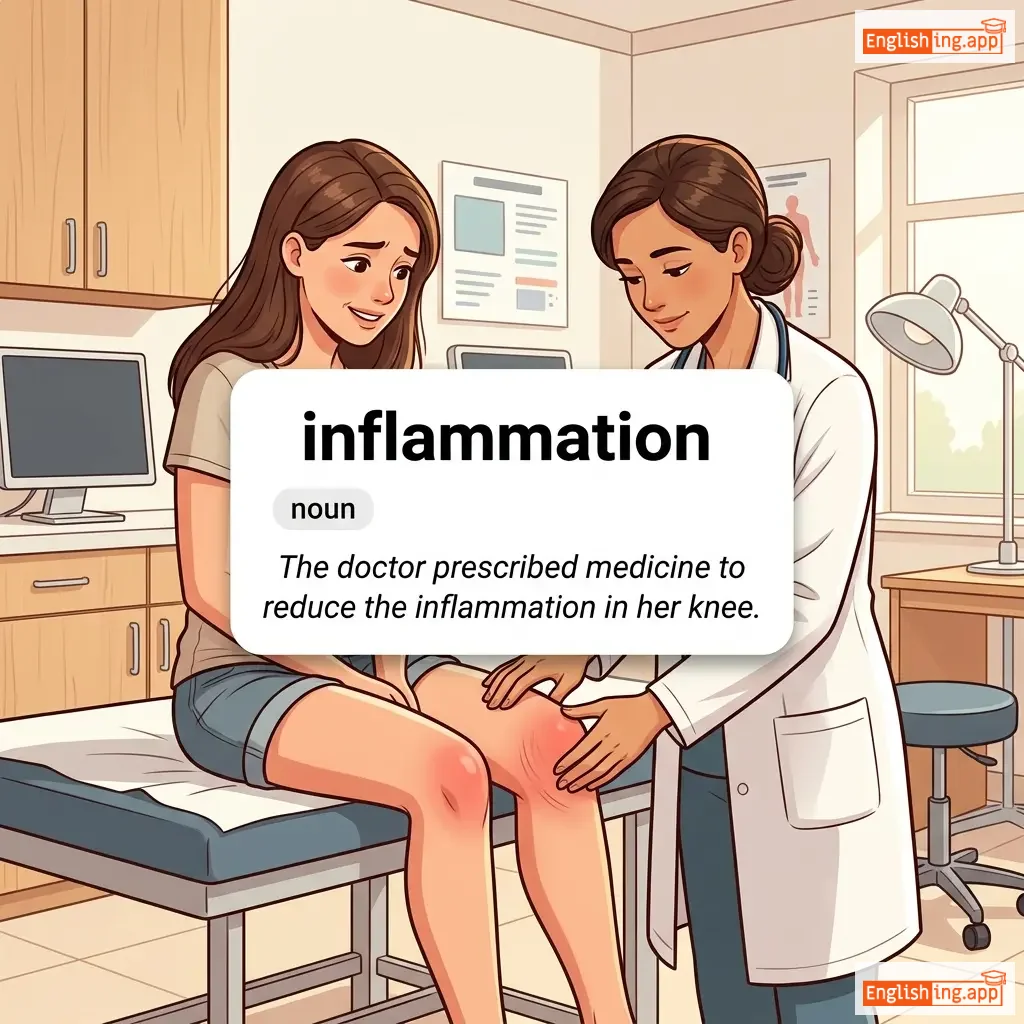
inflammation definition card — visual illustration of the meaning
noun
/ˌɪnfləˈmeɪʃən/
inflammation (inflammation)

a localized physical condition in which part of the body becomes red, swollen, hot, and often painful

"The doctor prescribed medicine to reduce the inflammation in her knee."

"Le médecin a prescrit des médicaments pour réduire l'inflammation dans son genou." (Le medecin a prescrit des medicaments pour reduire l'inflammation dans son genou.)
adjective
/ɪnˈflæməˌtɔːri/
bonheur (bonheur)

causing inflammation in the body; arousing anger, hostility, or strong emotion

"His inflammatory speech triggered protests across the city."

"Elle ne pouvait pas cacher son bonheur lorsqu'elle a reçu le prix." (Elle ne pouvait pas cacher son bonheur lorsqu'elle a reçu le prix.)