Vocabulaires

Découvrez, apprenez et maîtrisez le vocabulaire anglais

adjective
/ˈfræʤaɪl/
fragile (fragile)

Easily broken or damaged; delicate.

"Be careful with that vase, it's very fragile."

"Faites attention avec ce vase, il est très fragile." (Faites attention avec ce vase, il est très fragile.)
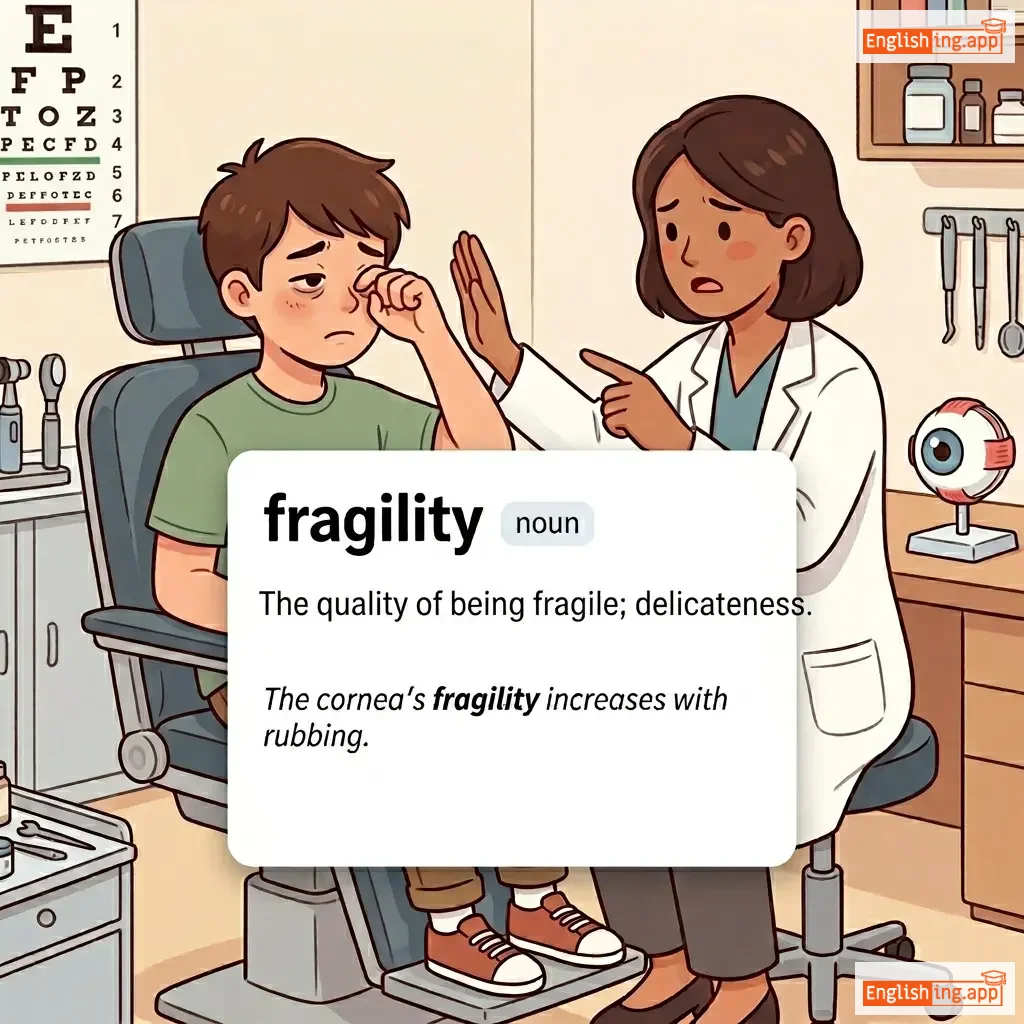
fragility definition card — visual illustration of the meaning
noun
/frəˈdʒɪl.ɪ.ti/
fragilité (fragilite)

The quality of being fragile; delicateness.

"The cornea's fragility increases with rubbing."

"La fragilité de la cornée augmente avec le frottement." (la fragilite de la cornee augmente avec le frottement)
noun
/ˈfræɡmənt/
fragment (fragment)

a small piece broken off something larger

"He found a fragment of ancient pottery near the river."

"Il a trouvé un fragment d'un ancien pot près de la rivière." (Il a trouve un fragment d'un ancien pot pres de la riviere.)
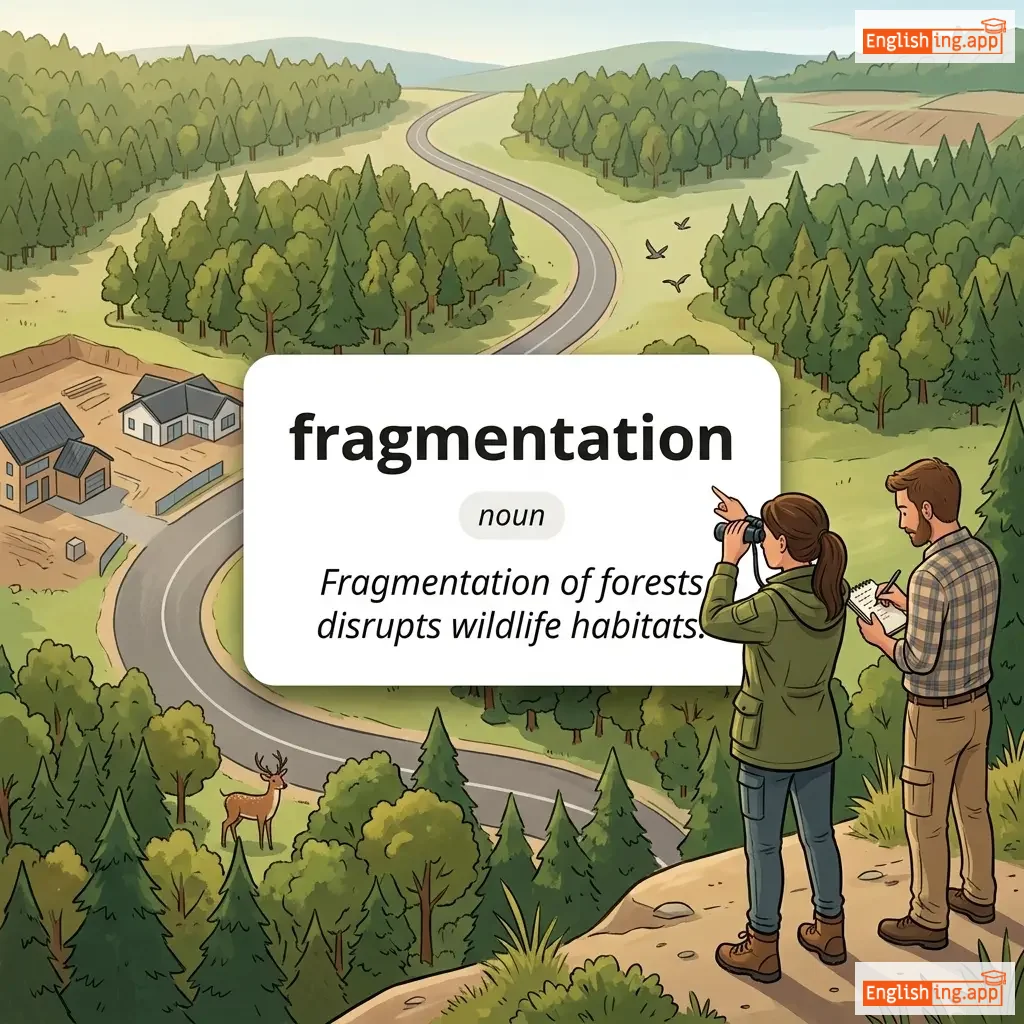
fragmentation definition card — visual illustration of the meaning
noun
/ˌfræɡ.mənˈteɪ.ʃən/
fragmentation (fragmentation)

The process of breaking into fragments; division of habitat into isolated patches.

"Fragmentation of forests disrupts wildlife habitats."

"La fragmentation des forêts perturbe les habitats de la faune." (La fragmentation des forêts perturbe les habitats de la faune.)
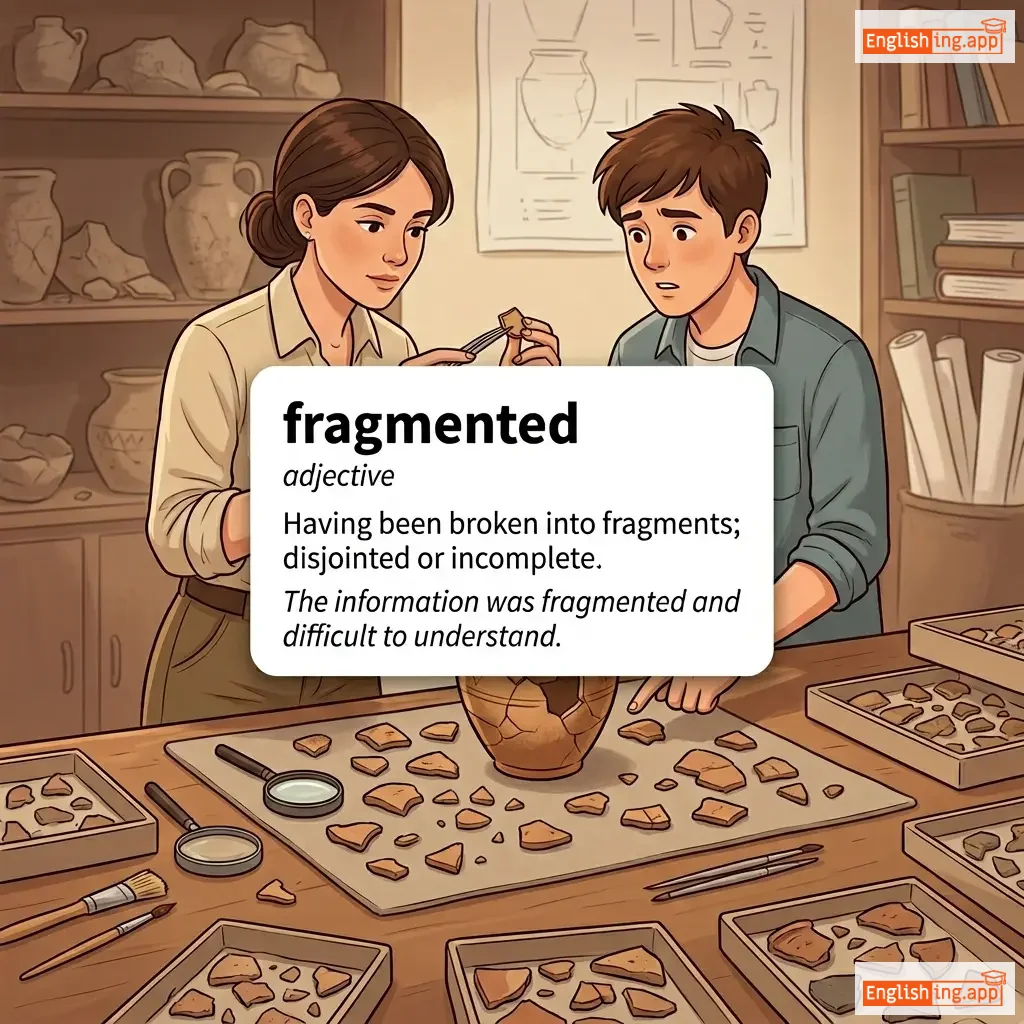
fragmented definition card — visual illustration of the meaning
adjective
/ˈfræɡməntɪd/
fragmenté, divisé, incomplet (fragmente, divise, incomplet)

Having been broken into fragments; disjointed or incomplete.

"The information was fragmented and difficult to understand."

"L'information était fragmentée et difficile à comprendre." (L'information etait fragmente et difficile a comprendre.)
noun
/ˈfreɪɡrəns/
parfum (parfum)

A pleasant, sweet smell.

"The fragrance of fresh flowers filled the room."

"Le parfum des fleurs fraîches remplissait la pièce." (Le parfum des fleurs fraîches remplissait la pièce.)
adjective
/freɪl/
fragile (fragile)

Physically weak and delicate.

"The old man was too frail to walk without help."

"L'homme âgé était trop fragile pour marcher sans aide." (L'homme age etait trop fragile pour marcher sans aide.)
noun
/ˈfreɪlti/
fragilité (fragilite)

The condition of being weak, delicate, or easily broken.

"Old age often comes with physical frailty."

"La vieillesse vient souvent avec une fragilité physique." (La vieillesse vient souvent avec une fragilite physique.)
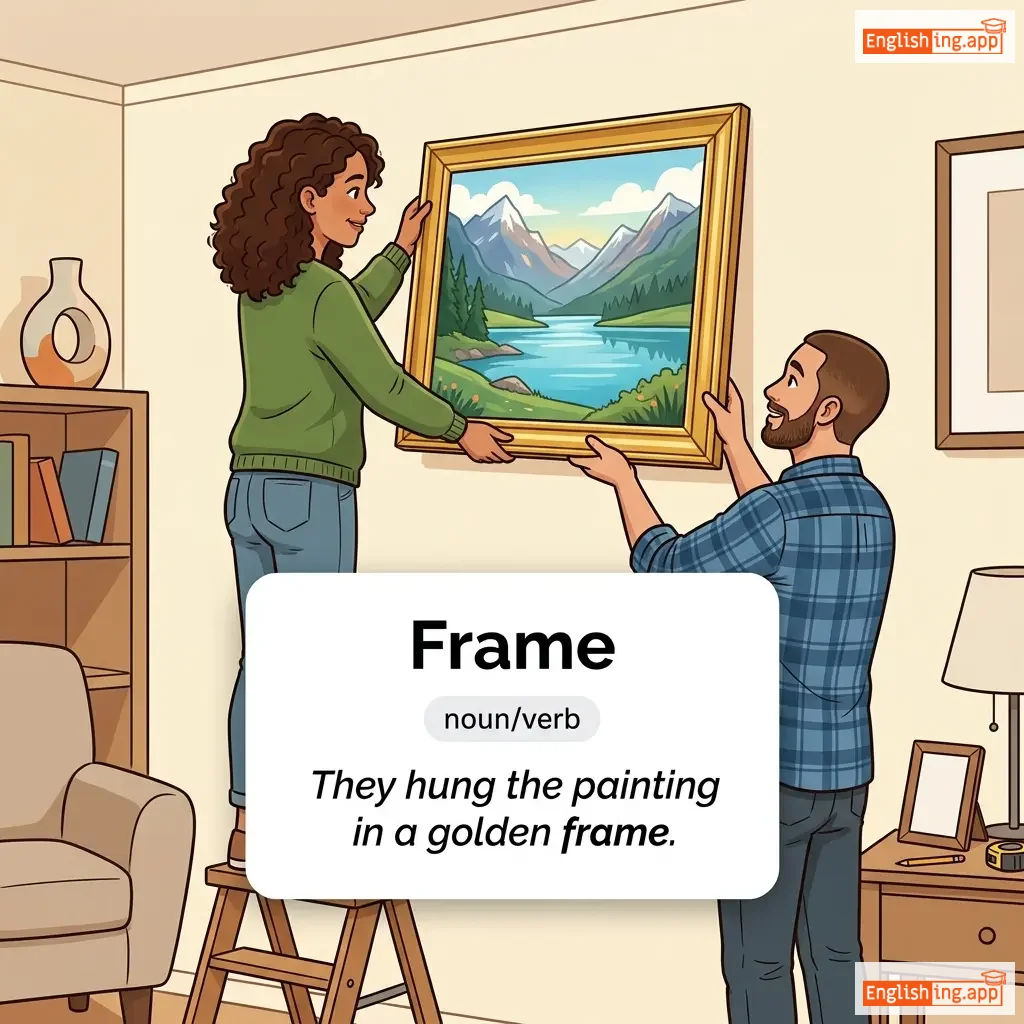
Frame definition card — visual illustration of the meaning
noun/verb
/freɪm/
cadre / structure (cadre / structure)

A rigid structure that surrounds or encloses something; to construct or formulate.

"They hung the painting in a golden frame."

"Ils ont accroché le tableau dans un cadre doré." (Ils ont accroché le tableau dans un cadre doré.)
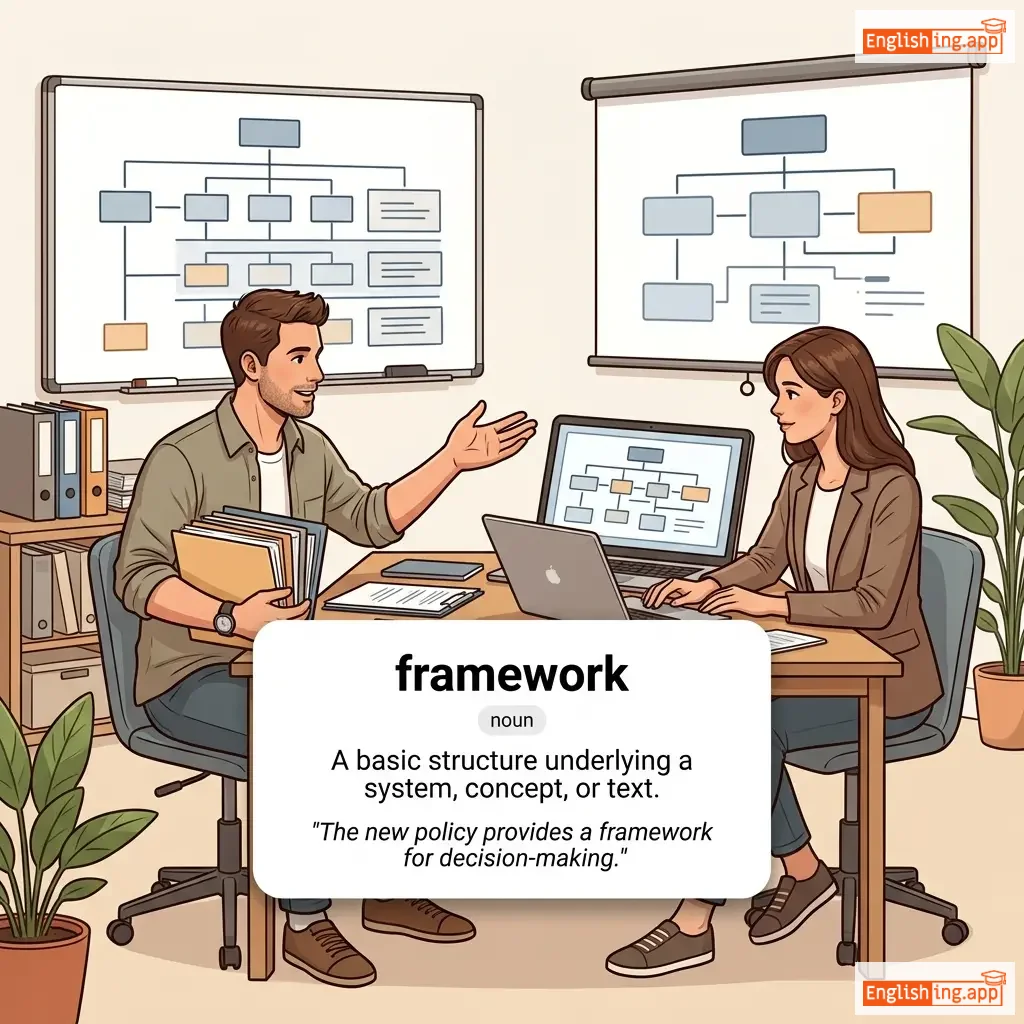
framework definition card — visual illustration of the meaning
noun
/ˈfreɪmˌwɜːrk/
cadre (cadre)

A basic structure underlying a system, concept, or text.

"The new policy provides a framework for decision-making."

"La nouvelle politique fournit un cadre pour la prise de décisions." (La nouvelle politique fournit un cadre pour la prise de décisions.)
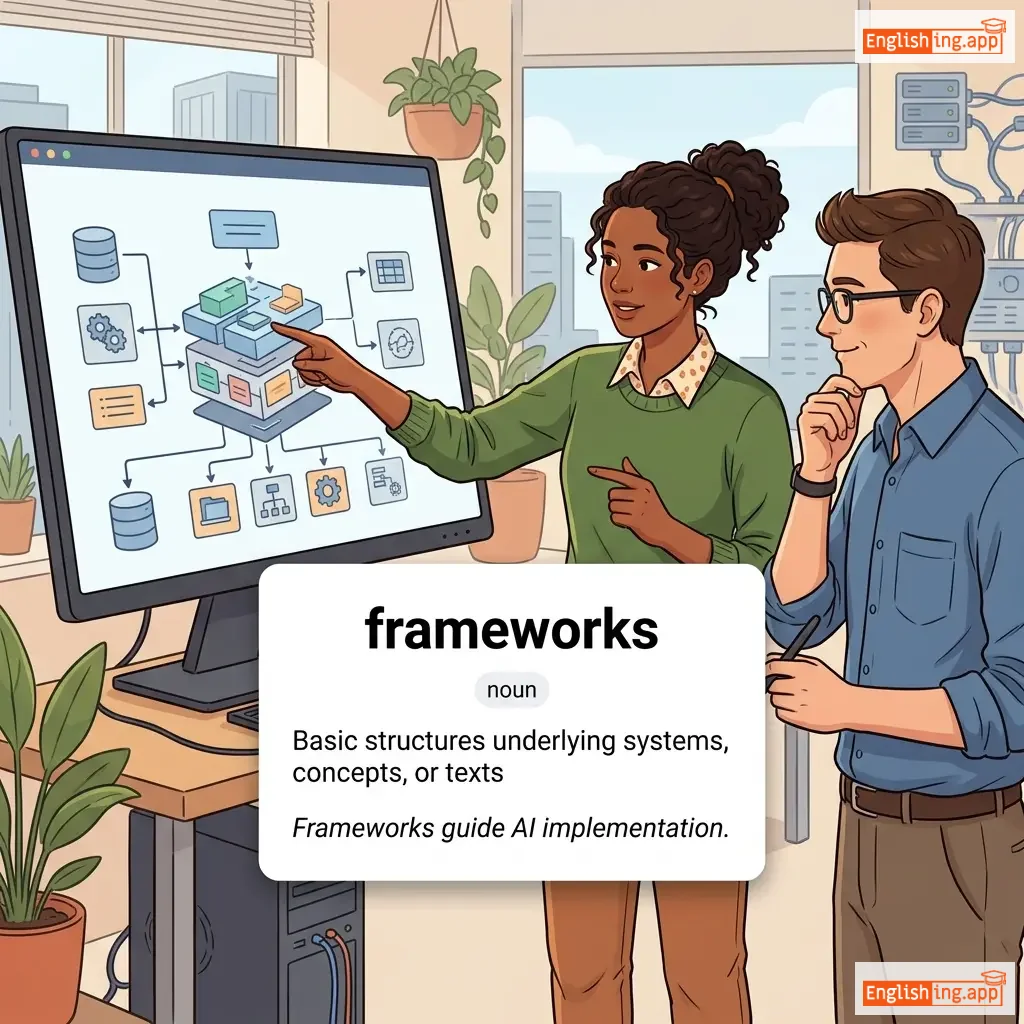
frameworks definition card — visual illustration of the meaning
noun
ˈfreɪm.wɜːks
cadres (cadres)

Basic structures underlying systems, concepts, or texts

"Frameworks guide AI implementation."

"Les cadres guident la mise en œuvre de l'IA." (Les cadres guident la mise en œuvre de l'IA.)
noun, verb
/ˈfrænʧaɪz/
franchise (franchise)

A legal right to sell or distribute goods or services in a specific area; to grant such a right.

"He opened a new fast-food franchise in the city."

"Il a ouvert une nouvelle franchise de restauration rapide dans la ville." (Il a ouvert une nouvelle franchise de restauration rapide dans la ville.)
adjective
/fræŋk/
franc (frank)

open, honest, and direct in speech or expression

"She was frank about her feelings on the matter."

"Elle était franche à propos de ses sentiments sur la question." (Elle etait franche a propos de ses sentiments sur la question.)
noun
/ˈfræŋkɪnsɛns/
encens (encens)

An aromatic gum resin used in incense and perfumes, often in religious ceremonies.

"The temple was filled with the sweet smell of burning frankincense."

"Le temple était rempli de l'odeur douce de l'encens brûlant." (Le temple était rempli de l'odeur douce de l'encens brûlant.)
adverb
/ˈfræŋkli/
franchement (franchement)

in an honest and direct way

"Frankly, I don’t think this plan will work."

"Franchement, je ne pense pas que ce plan va marcher." (Franchement, je ne pense pas que ce plan va marcher.)
adjective
/ˈfræntɪk/
frénétique (frenetique)

Extremely anxious, hurried, or out of control due to fear or excitement.

"She made a frantic call to her family after the accident."

"Elle a passé un appel frénétique à sa famille après l'accident." (Elle a passe un appel frenetique a sa famille apres l'accident.)
adjective
/frəˈtɜːrnəl/
fraternel (fraternel)

Relating to brothers or brotherhood; friendly and supportive.

"The two nations maintain a fraternal relationship."

"Les deux nations maintiennent une relation fraternelle." (Les deux nations maintiennent une relation fraternelle.)
noun
/frɔːd/
fraude (fraud)

A wrongful or criminal deception intended to result in financial or personal gain.

"The company collapsed due to massive accounting fraud."

"L'entreprise s'est effondrée à cause d'une fraude comptable massive." (L'entreprise s'est effondree a cause d'une fraude comptable massive.)
noun
/ˈfrɔːdjʊləns/
fraude (fraude)

The quality or state of being fraudulent; deceitfulness.

"The audit revealed fraudulence in the financial statements."

"L'audit a révélé une fraude dans les états financiers." (L'audit a revele une fraude dans les etats financiers.)
adjective
/ˈfrɔːdjʊlənt/
frauduleux (frauduleux)

Involving or using deceit, especially criminal deception.

"He was arrested for making fraudulent insurance claims."

"Il a été arrêté pour avoir fait des demandes frauduleuses d'assurance." (Il a ete arrete pour avoir fait des demandes frauduleuses d'assurance.)
adjective
/frɔːt/
chargé (charge)

Filled with or likely to result in something undesirable.

"The negotiations were fraught with tension and uncertainty."

"Les négociations étaient chargées de tension et d'incertitude." (Les négociations étaient chargées de tension et d'incertitude.)
noun/verb
/freɪ/
dispute, s'effilocher (dispute, s'effilocher)

As a noun, a fight or heated dispute; as a verb, to unravel or wear out through friction.

"He tried to stay calm, but his nerves began to fray during the argument."

"Il a essayé de rester calme, mais ses nerfs ont commencé à s'effilocher pendant la dispute." (Il a essayé de rester calme, mais ses nerfs ont commencé à s'effilocher pendant la dispute.)
noun
/ˈfrek.əl/
tache de rousseur (tash de rousseur)

a small brownish spot on the skin, often becoming more pronounced through exposure to the sun

"Her face was covered with cute freckles that appeared every summer."

"Son visage était couvert de jolies taches de rousseur qui apparaissaient chaque été." (Son visage etait couvert de jolies taches de rousseur qui apparaissaient chaque ete.)
🕊️

free (fri)

adjective/verb/adverb
/friː/
libre (libre)

Not under the control or in the power of another; able to act or be done as one wishes.

"The children are free to play outside."

"Les enfants sont libres de jouer dehors." (Les enfants sont libres de jouer dehors.)
noun
/ˈfriː taɪm/
temps libre (temps libre)

time when a person is not working or occupied and can do activities they enjoy

"She likes to read books in her free time."

"Elle aime lire des livres pendant son temps libre." (Elle aime lire des livres pendant son temps libre)
noun
/ˈfriːˌbuːtər/
flibustier (flibustier)

A pirate or plunderer who roams freely in search of wealth.

"The freebooter raided the merchant ships along the coast."

"Le flibustier a attaqué les navires marchands le long de la côte." (Le flibustier a attaqué les navires marchands le long de la côte.)
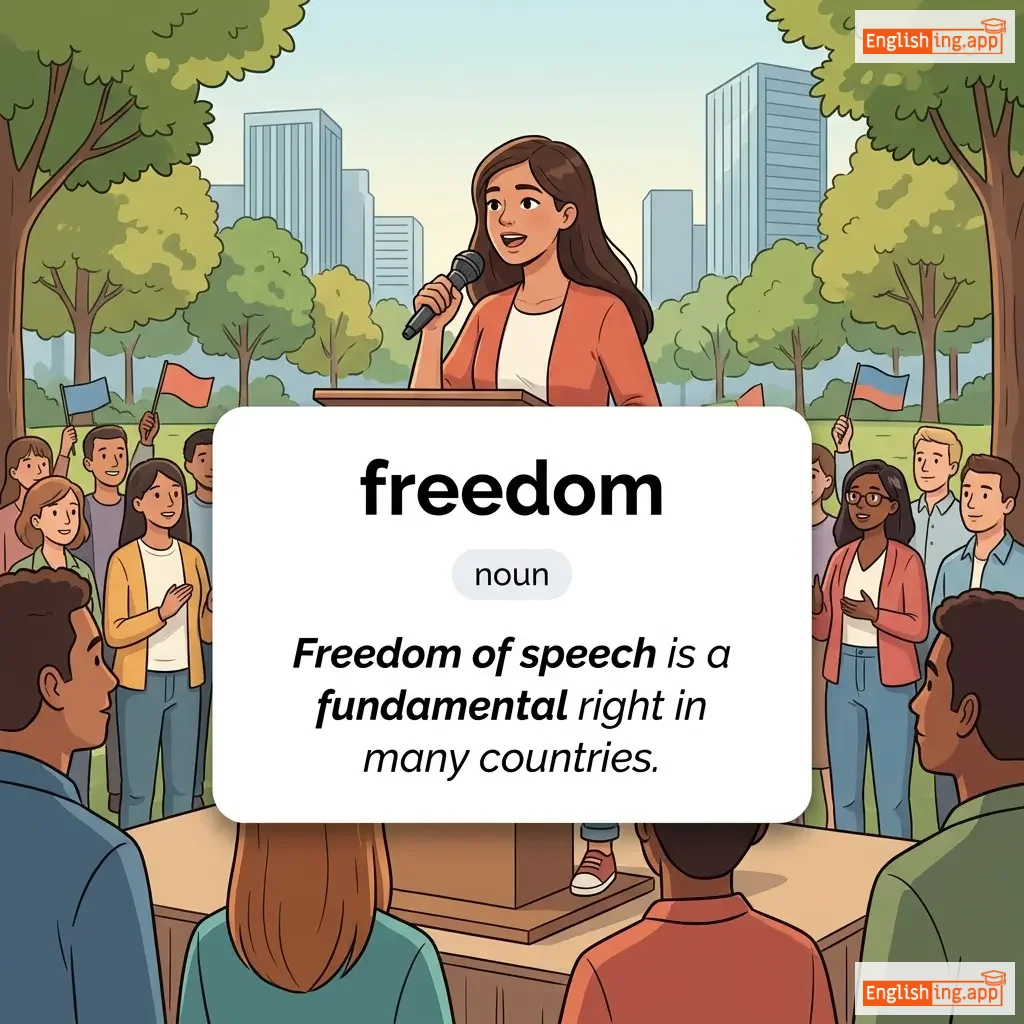
freedom definition card — visual illustration of the meaning
noun
/ˈfriːdəm/
liberté (liberte)

The state of being free; the power or right to act, speak, or think without hindrance or restraint.

"Freedom of speech is a fundamental right in many countries."

"La liberté d'expression est un droit fondamental dans de nombreux pays." (La liberte d'expression est un droit fondamental dans de nombreux pays.)
noun
/ˈfriːdəm ˌfaɪtər/
combattant de la liberté (combattant de la liberte)

a person who takes part in an armed or political struggle to achieve freedom or independence for their people or country

"The freedom fighter dedicated his life to the liberation of his homeland."

"Le combattant de la liberté a consacré sa vie à la libération de son pays." (Le combattant de la liberte a consacre sa vie a la liberation de son pays)
noun
/ˈfriːˌlænsər/
travailleur indépendant (travailleur independant)

A person who works independently without being permanently employed by one organization.

"She works as a freelancer designing websites for different clients."

"Elle travaille en tant que freelance en concevant des sites web pour différents clients." (Elle travaille en tant que freelance en concevant des sites web pour differents clients.)
adverb
/ˈfriːli/
librement (librement)

without restriction or control; willingly

"Information should flow freely in a democratic society."

"L'information devrait circuler librement dans une société démocratique." (L'information devrait circuler librement dans une societe democratique.)
noun
/ˈfriːˌmeɪsən/
franc-maçon membre (franc-maçon membre)

A member of an international fraternity known as Freemasonry, focused on moral and spiritual values.

"His grandfather was a respected freemason in the community."

"Son grand-père était un franc-maçon respecté dans la communauté." (Son grand-père était un franc-maçon respecté dans la communauté.)
noun
/ˈfriːˌθɪŋkər/
librepenseur (librepenseur)

A person who forms opinions based on reason and independent thought rather than tradition or authority.

"Voltaire was considered a great freethinker of his time."

"Voltaire a été considéré comme un grand librepenseur de son époque." (Voltaire a ete considere comme un grand librepenseur de son epoque.)
verb
/friːz/
geler (geler)

To turn into ice or cause to become hard due to extreme cold.

"The water in the lake will freeze during winter."

"L'eau du lac gèlera pendant l'hiver." (L'eau du lac gèlera pendant l'hiver.)
adjective
/frɛntʃ/
français (fran-say)

Relating to France, its people, or their language.

"We enjoyed delicious French cuisine on our trip to Paris."

"Nous avons apprécié une délicieuse cuisine française lors de notre voyage à Paris." (Nous avons apprécié une délicieuse cuisine française lors de notre voyage à Paris.)
adjective
/frəˈnɛtɪk/
frenétique (frenetique)

Fast and energetic in a wild or uncontrolled way.

"The stock market experienced frenetic trading after the announcement."

"Le marché boursier a connu des transactions frénétiques après l'annonce." (Le marché boursier a connu des transactions frenétiques après l'annonce.)
adjective
/ˈfrɛn.zid/
frenétique (frenetique)

Wildly excited or uncontrolled

"The frenzied crowd cheered as the band took the stage."

"La foule frénétique a acclamé lorsque le groupe monta sur scène." (La foule frenetique a acclamé lorsque le groupe monta sur scène.)
noun
/ˈfrɛn.zi/
frénésie (frenesie)

A state of uncontrolled excitement or wild behavior

"The news of the sale caused a shopping frenzy."

"La nouvelle de la vente a provoqué une frénésie de shopping." (La nouvelle de la vente a provoqué une frénésie de shopping.)
noun
/ˈfriː.kwən.si/
fréquence (frequance)

The rate at which something occurs or is repeated over a period of time

"The frequency of bus services has been increased during rush hours."

"La fréquence des services de bus a été augmentée pendant les heures de pointe." (La fréquence des services de bus a été augmentée pendant les heures de pointe.)
adjective, verb
/ˈfriː.kwənt/ (adj.), /friːˈkwent/ (verb)
fréquent (frekwant)

Adjective: happening often; Verb: to visit a place regularly

"He is a frequent visitor to the library."

"Il est un visiteur fréquent de la bibliothèque." (Il est un visiteur fréquent de la bibliothèque.)
adverb
/ˈfriːkwəntli/
fréquemment (frequement)

Happening often or at short intervals.

"He frequently visits his grandparents on weekends."

"Il visite fréquemment ses grands-parents le week-end." (Il visite frequement ses grands-parents le week-end.)
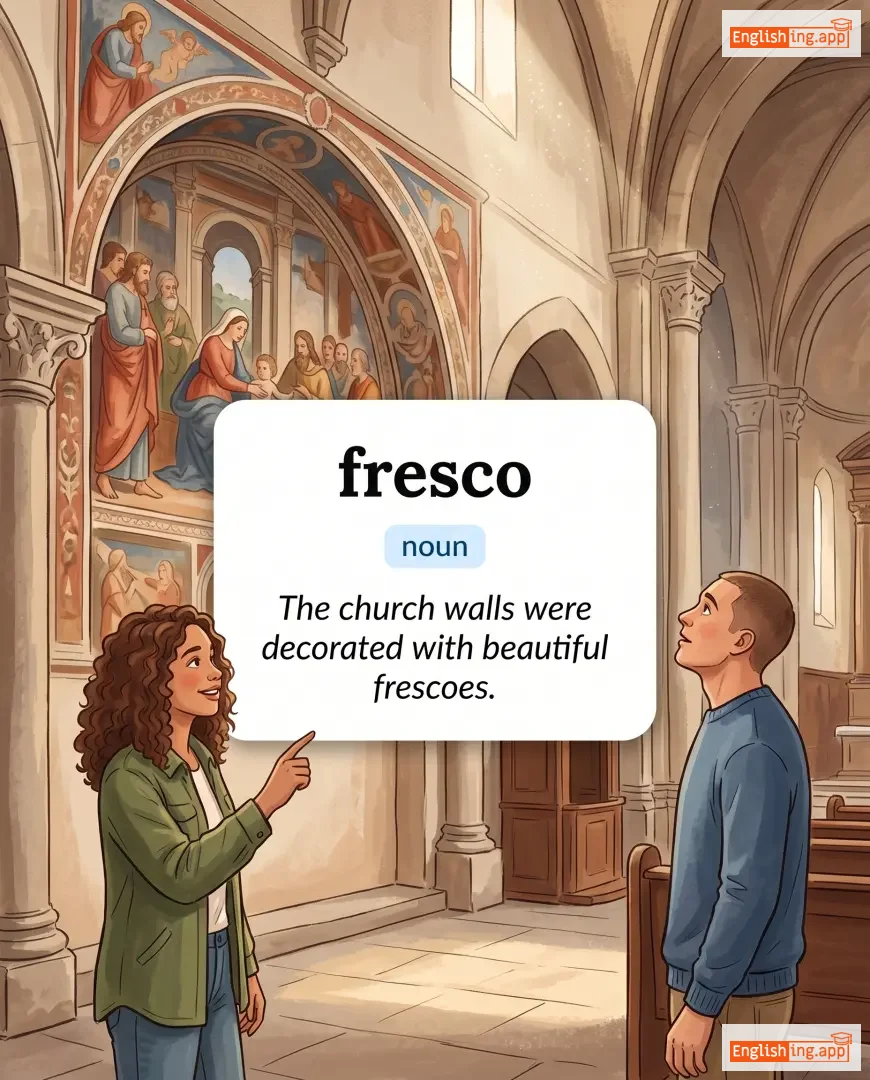
fresco definition card — visual illustration of the meaning
noun
/ˈfrɛs.koʊ/
fresque (freske)

A painting done rapidly in watercolor on wet plaster so that the colors penetrate the surface

"The church walls were decorated with beautiful frescoes."

"Les murs de l'église étaient décorés de magnifiques fresques." (Les murs de l'église étaient décorés de magnifiques fresques.)
adjective
/frɛʃ/
frais (fre)

new, recently made, or clean and pure

"The bread is still fresh from the oven."

"Le pain est encore frais du four." (Le pain est encore frais du four.)
noun
/ˈfrɛʃɪt/
crue soudaine du fleuve (crue soudaine du fleuve)

A sudden overflow of a stream or river caused by heavy rain or melting snow.

"After the storm, the river turned into a raging freshet."

"Après la tempête, la rivière est devenue un freshet furieux." (Après la tempête, la rivière est devenue un freshet furieux.)
noun
/ˈfreʃmən/
étudiant de première année (etudiant de premiere annee)

a first-year student at a high school, college, or university

"The freshman felt nervous on his first day at university."

"L'étudiant de première année se sentait nerveux lors de son premier jour à l'université." (L'etudiant de premiere annee se sentait nerveux lors de son premier jour a l'universite.)
noun
/ˈfrɛʃnəs/
fraîcheur (fraicheur)

The quality of being new, clean, and full of energy.

"The freshness of the morning air made everyone feel alive."

"La fraîcheur de l'air du matin a fait en sorte que tout le monde se sente vivant." (La fraicheur de l'air du matin a fait en sorte que tout le monde se sente vivant.)
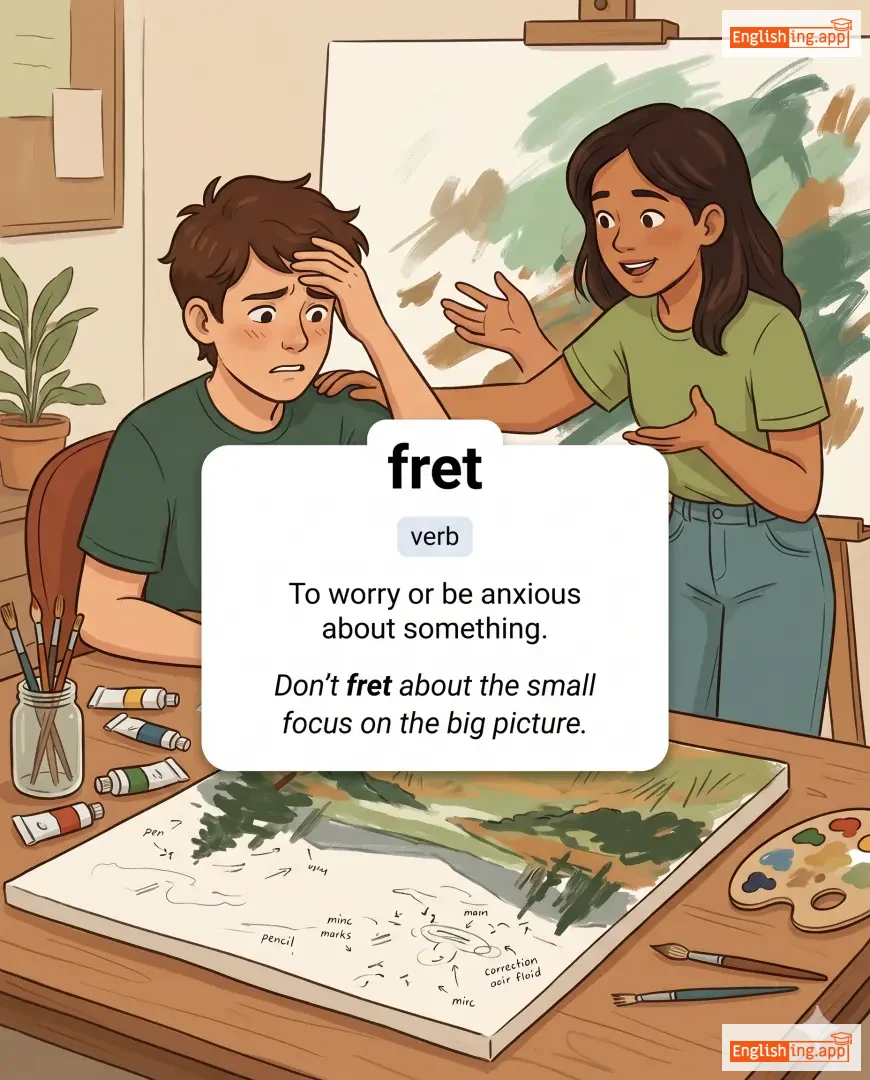
fret definition card — visual illustration of the meaning
verb
/frɛt/
s'inquiéter (s'inquieter)

To worry or be anxious about something.

"Don't fret about the small mistakes; focus on the big picture."

"Ne t'inquiète pas des petites erreurs; concentre-toi sur l'essentiel." (Ne t'inquiète pas des petites erreurs; concentre-toi sur l'essentiel.)
adjective
/ˈfrɛtfəl/
agité (agite)

Feeling or showing distress or irritation.

"The baby was fretful all night and could not sleep."

"Le bébé était agité toute la nuit et n'a pas pu dormir." (Le bebe etait agite toute la nuit et n'a pas pu dormir.)
adjective
/ˈfraɪəbl/
friable (friabl)

Easily crumbled or reduced to powder.

"The old brick wall was friable and broke apart at a touch."

"Le vieux mur en briques était friable et se brisa au toucher." (Le vieux mur en briques était friable et se brisa au toucher.)
noun
/ˈfrɪkʃən/
friction (friction)

the resistance that one surface or object encounters when moving over another; conflict or tension between people or groups

"There was friction between the two departments over resource allocation."

"Il y avait de la friction entre les deux départements concernant l'allocation des ressources." (Il y avait de la friction entre les deux departements concernant l'allocation des ressources.)
noun
/ˈfraɪ.deɪ/
vendredi (vendredi)

the day of the week following Thursday and preceding Saturday

"We have a team meeting every Friday afternoon."

"Nous avons une réunion d’équipe chaque vendredi après-midi." (nous avons une reunion dequipe chaque vendredi apres midi)