Vocabulaires

Découvrez, apprenez et maîtrisez le vocabulaire anglais

verb
/ɪnˈsnɛər/
piéger (piéger)

to catch or trap, often by trickery or deceit

"The hunter ensnared the rabbit with a net."

"Le chasseur a piégé le lapin avec un filet." (Le chasseur a piégé le lapin avec un filet.)
verb
/ɪnˈsjuː/
suivre (suivre)

to happen as a result or consequence

"After the argument, silence ensued."

"Après la dispute, le silence s'ensuivit." (Après la dispute, le silence s'ensuivit.)
verb
/ɪnˈʃʊər/
assurer (assurer)

To make certain that something will happen or be the case.

"Please ensure that the door is locked before you leave."

"Veuillez vous assurer que la porte est verrouillée avant de partir." (Veuillez vous assurer que la porte est verrouillée avant de partir.)
verb
/ɪnˈteɪl/
impliquer (impliquer)

to involve something as a necessary or inevitable part or consequence

"The job will entail a lot of travel across the country."

"Le travail impliquera beaucoup de voyages à travers le pays." (Le travail impliquera beaucoup de voyages à travers le pays.)
verb
/ɪnˈtæŋɡəl/
emmêler (emmeler)

to become twisted together or caught in something; to involve in difficulties

"The fish got entangled in the net."

"Le poisson s'est emmêlé dans le filet." (Le poisson s'est emmêlé dans le filet.)
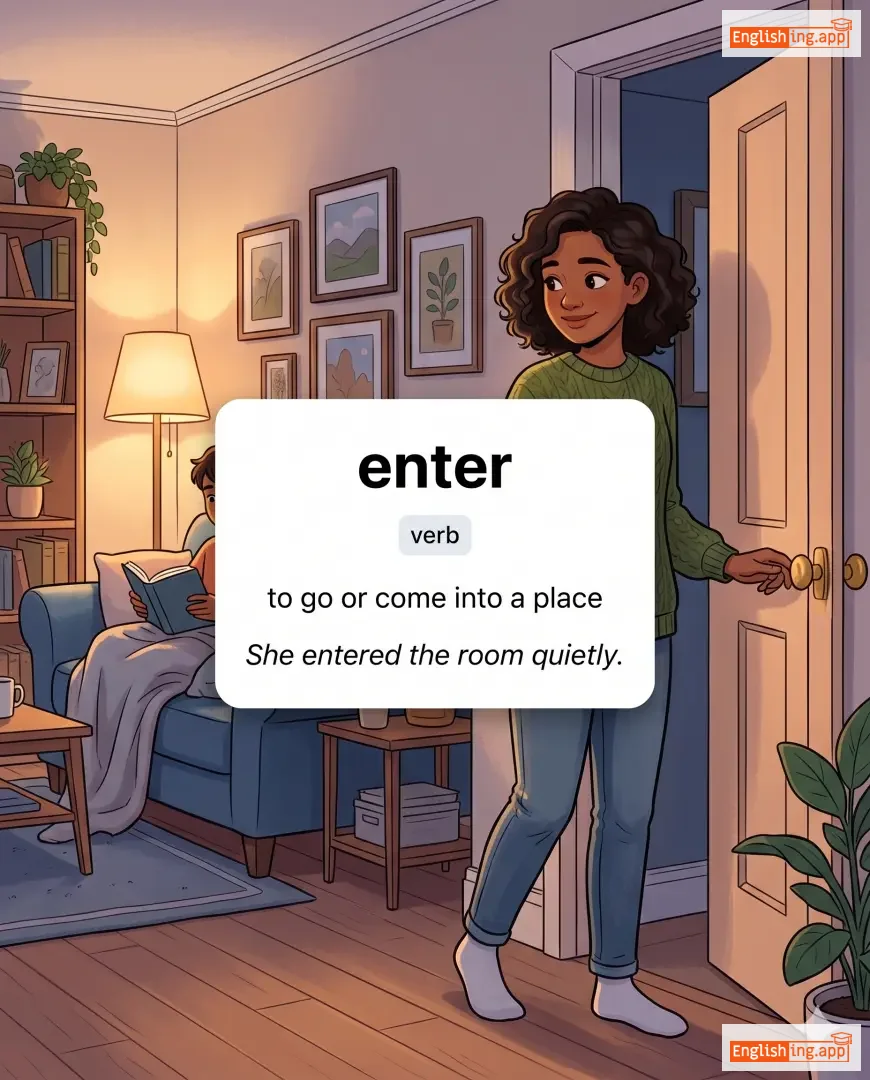
enter definition card — visual illustration of the meaning
verb
/ˈɛntər/
entrer (entrer)

to go or come into a place

"She entered the room quietly."

"Elle entra dans la pièce silencieusement." (Elle entra dans la pièce silencieusement.)
noun
/ˈɛntərˌpraɪz/
entreprise (entreprise)

a business or company; a project or undertaking that requires effort and initiative

"The new enterprise aims to create sustainable energy solutions."

"La nouvelle entreprise vise à créer des solutions énergétiques durables." (La nouvelle entreprise vise a creer des solutions energetiques durables.)
adjective
/ˈɛntərˌpraɪzɪŋ/
entreprenant (entreprenant)

showing initiative and resourcefulness; willing to take risks to achieve success

"She is an enterprising young entrepreneur."

"Elle est une jeune entrepreneuse entreprenante." (Elle est une jeune entrepreneuse entreprenante.)
verb
/ˌɛntərˈteɪn/
divertir (divertir)

to provide amusement, enjoyment, or hospitality to others

"The comedian entertained the audience with his jokes."

"Le comédien a diverti le public avec ses blagues." (Le comédien a diverti le public avec ses blagues.)
adjective
/ˌɛntərˈteɪnɪŋ/
divertissant (divertissant)

providing amusement or enjoyment

"The comedian gave an entertaining performance."

"Le comédien a donné une performance divertissante." (Le comedien a donne une performance divertissante.)
noun
/ˌɛntərˈteɪnmənt/
divertissement (divertissement)

something that amuses, pleases, or diverts

"The concert was a great source of entertainment."

"Le concert était une grande source de divertissement." (Le concert était une grande source de divertissement.)
verb
/ɪnˈθrɔːl/
captiver (captiver)

To captivate or hold someone’s full attention.

"The magician’s performance enthralled the audience."

"La performance du magicien a captivé l'audience." (La performance du magicien a captive l'audience.)
verb
/ɪnˈθrɔːl/
captiver (captiver)

to captivate or hold someone’s attention completely

"The magician’s tricks enthralled the children."

"Les tours du magicien ont captivé les enfants." (Les tours du magicien ont captivé les enfants.)
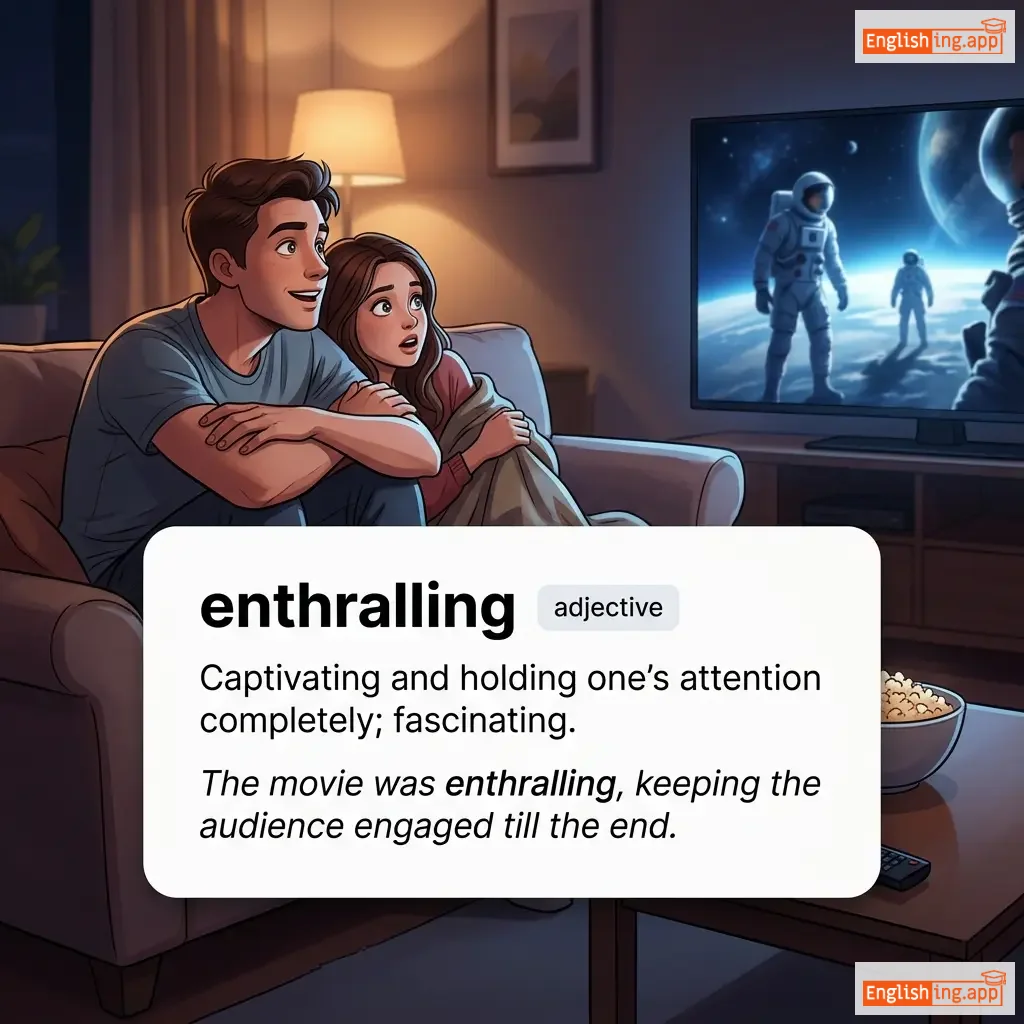
enthralling definition card — visual illustration of the meaning
adjective
/ɪnˈθrɔː.lɪŋ/
captivant (captivant)

Captivating and holding one's attention completely; fascinating.

"The movie was enthralling, keeping the audience engaged till the end."

"Le film était captivant, maintenant le public engagé jusqu'à la fin." (Le film etait captivant, maintenant le public engage jusqu'à la fin.)
verb
/ɪnˈθroʊn/
introniser (introniser)

to install someone on a throne or to give someone high status

"The king was enthroned in a grand ceremony."

"Le roi fut intronisé lors d'une grande cérémonie." (Le roi fut intronisé lors d'une grande cérémonie.)
verb
/ɪnˈθjuːz/
enthousiasmer (enthousiasmer)

to express excitement or admiration

"She enthused about her trip to Italy."

"Elle a exprimé son enthousiasme à propos de son voyage en Italie." (Elle a exprimé son enthousiasme à propos de son voyage en Italie.)
noun
/ɪnˈθjuːziæzəm/
enthousiasme (enthousiasme)

intense and eager enjoyment, interest, or approval

"His enthusiasm for teaching inspired his students."

"Son enthousiasme pour l'enseignement a inspiré ses élèves." (Son enthousiasme pour l'enseignement a inspire ses eleves.)
noun
/ɪnˈθuziæst/
passionné (passione)

a person who is very interested in a particular activity or subject

"He is a football enthusiast and watches every match."

"Il est un passionné de football et regarde chaque match." (Il est un passionné de football et regarde chaque match.)
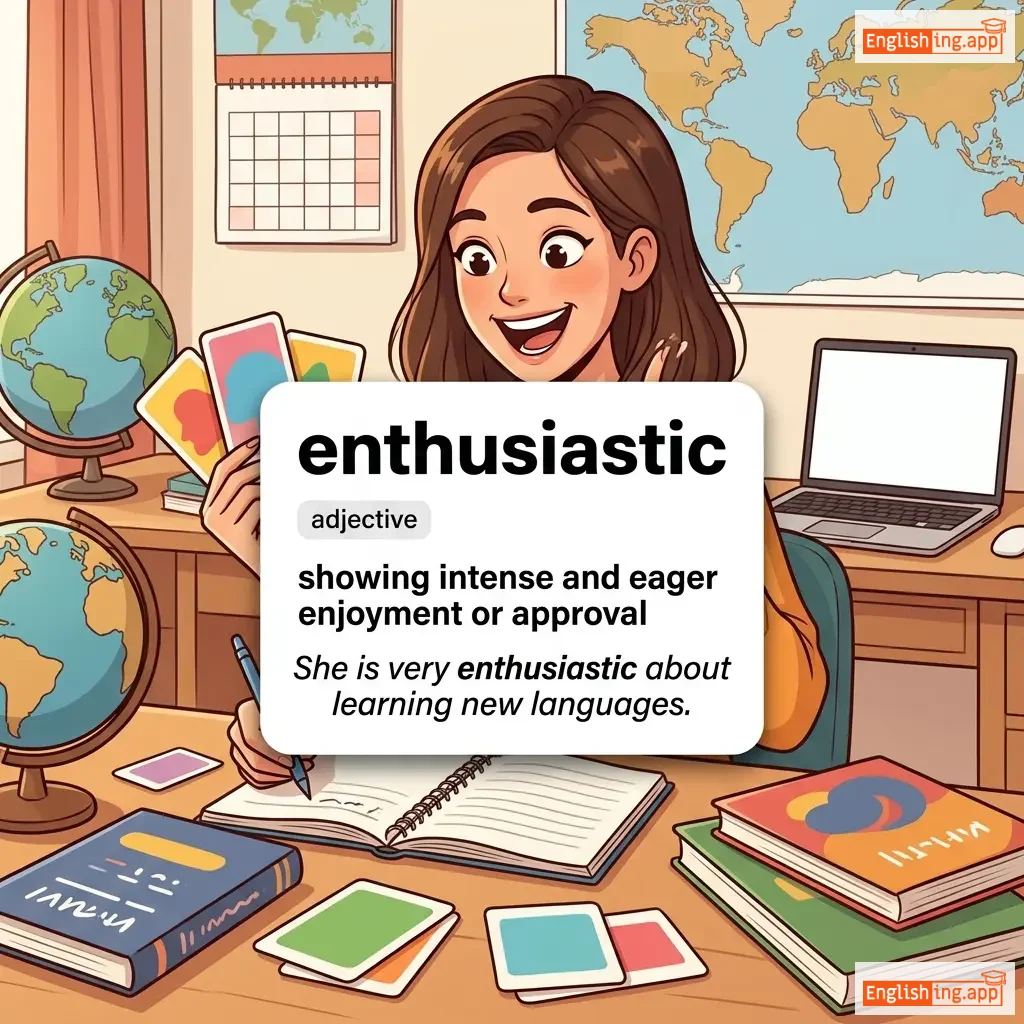
enthusiastic definition card — visual illustration of the meaning
adjective
/ɪnˌθjuːziˈæstɪk/
enthousiaste (enthousiaste)

showing intense and eager enjoyment or approval

"She is very enthusiastic about learning new languages."

"Elle est très enthousiaste à l'idée d'apprendre de nouvelles langues." (Elle est tres enthousiaste a l'idee d'apprendre de nouvelles langues.)
verb
/ɪnˈtaɪs/
attirer (attirer)

to attract or tempt someone by offering something appealing

"The advertisement was designed to entice customers into the store."

"La publicité a été conçue pour attirer les clients dans le magasin." (La publicité a été conçue pour attirer les clients dans le magasin.)
adjective
/ɪnˈtaɪər/
entier (entier)

whole; with no part left out

"He spent the entire day reading books."

"Il a passé toute la journée à lire des livres." (Il a passé toute la journée à lire des livres.)
adverb
/ɪnˈtaɪərli/
entièrement (entierement)

Completely or wholly.

"She is entirely responsible for the project."

"Elle est entièrement responsable du projet." (Elle est entierement responsable du projet.)
noun
/ɪnˈtaɪərəti/
intégralité (integralite)

the whole of something; the complete form

"He watched the movie in its entirety."

"Il a regardé le film dans son intégralité." (Il a regarde le film dans son integralite.)
verb
/ɪnˈtaɪtəl/
donner le droit (donner le droit)

to give someone the right to have or do something

"Employees are entitled to receive paid holidays."

"Les employés ont droit à des congés payés." (Les employés ont droit à des congés payés.)
adjective
/ɪnˈtaɪtəld/
ayant droit (ayant droit)

having the right to do or have something; feeling deserving of special treatment

"Employees are entitled to paid leave."

"Les employés ont droit à un congé payé." (Les employés ont droit à un congé payé.)
noun
/ɪnˈtaɪtəlmənt/
droit (dwa)

the belief that one is inherently deserving of privileges or special treatment; a right to benefits

"The program provides entitlement to health care."

"Le programme accorde un droit aux soins de santé." (Le programme accorde un droit aux soins de sante.)
noun
/ˈɛntəti/
entité (entite)

something that exists as a single and complete unit; an organization or being

"The new company will operate as a separate legal entity."

"La nouvelle entreprise fonctionnera en tant qu'entité juridique distincte." (La nouvelle entreprise fonctionnera en tant qu'entite juridique distincte.)
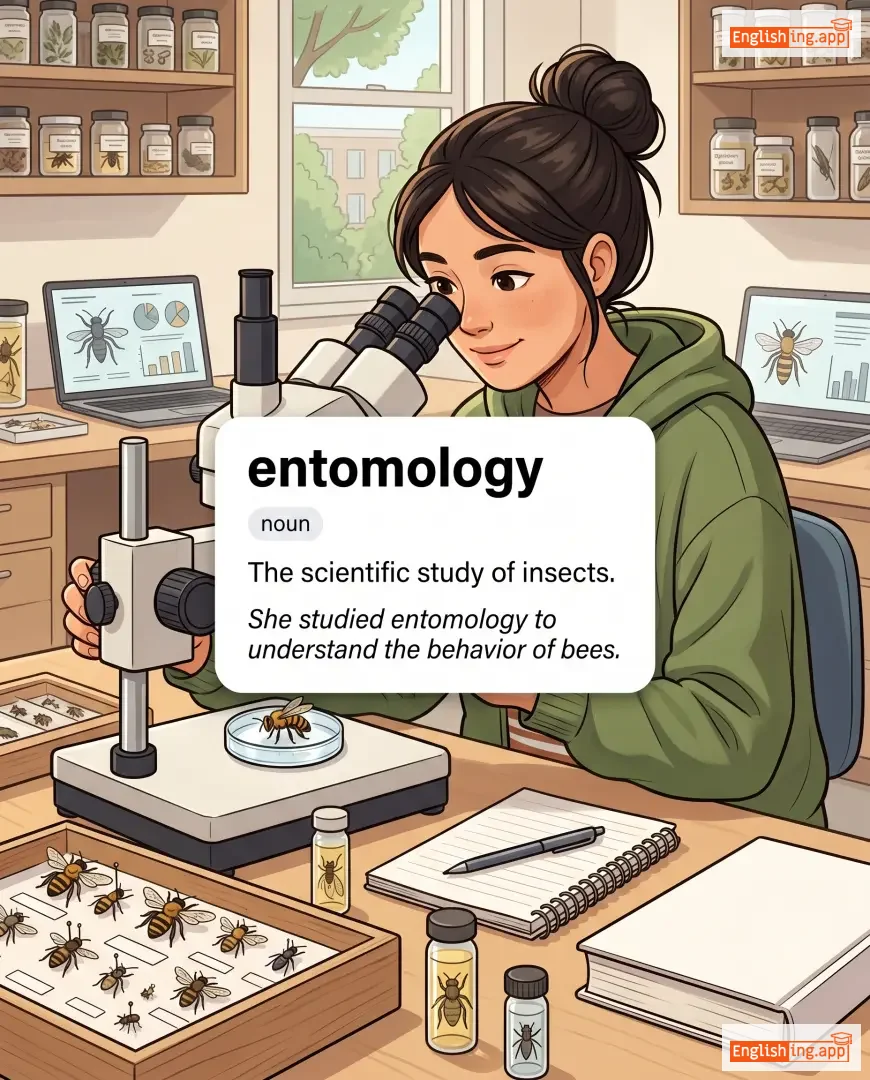
entomology definition card — visual illustration of the meaning
noun
/ˌɛntəˈmɒlədʒi/
entomologie (entomologie)

The scientific study of insects.

"She studied entomology to understand the behavior of bees."

"Elle a étudié l'entomologie pour comprendre le comportement des abeilles." (Elle a etudie l'entomologie pour comprendre le comportement des abeilles.)
noun
/ˈɒntʊrɑːʒ/
entourage (onturazh)

A group of people attending or surrounding an important person.

"The celebrity arrived with her entourage of assistants and bodyguards."

"La célébrité est arrivée avec son entourage d'assistants et de gardes du corps." (La célébrité est arrivée avec son entourage d'assistants et de gardes du corps.)
noun
/ˈɛntrəns/
entrée (entree)

A place of entering; an entry point.

"They waited at the main entrance of the building."

"Ils ont attendu à l'entrée principale du bâtiment." (Ils ont attendu à l'entrée principale du bâtiment.)
verb
/ɪnˈtræp/
piéger (piyer)

To catch or trick someone into a difficult situation.

"The police tried to entrap the criminal with false evidence."

"La police a tenté de piéger le criminel avec de fausses preuves." (La police a tenté de piéger le criminel avec de fausses preuves.)
verb
/ɪnˈtriːt/
supplier (supplier)

To ask earnestly or beg someone to do something.

"She entreated him to stay a little longer."

"Elle le supplia de rester un peu plus longtemps." (Elle le supplia de rester un peu plus longtemps.)
noun
/ɪnˈtriːti/
supplication (supplication)

An earnest or humble request or plea.

"She made an entreaty for peace during the heated argument."

"Elle fit une supplication pour la paix pendant la discussion animée." (Elle fit une supplication pour la paix pendant la discussion animee.)
noun
/ˈɒntreɪ/ (UK), /ˈɑːntreɪ/ (US)
plat principal (plat principal)

The main course of a meal (US); the right to enter or access (formal).

"The restaurant’s signature steak was served as the main entree."

"Le steak signature du restaurant a été servi en tant que plat principal." (Le steak signature du restaurant a été servi en tant que plat principal.)
verb
/ɪnˈtrɛntʃ/
enraciner (enraciner)

To establish something so firmly that it is difficult to change.

"The company entrenched its position in the market through innovation."

"L'entreprise a consolidé sa position sur le marché grâce à l'innovation." (L'entreprise a consolidé sa position sur le marché grâce à l'innovation.)
adjective
/ɪnˈtrɛntʃt/
enraciné (enracine)

Firmly established and unlikely to change.

"Corruption is deeply entrenched in the system."

"La corruption est profondément enracinée dans le système." (La corruption est profondément enracinee dans le systeme.)
noun
/ˌɒntrəprəˈnɜːr/ (UK), /ˌɑːntrəprəˈnɝː/ (US)
entrepreneur (entrepreneur)

A person who starts and runs a business, taking on financial risks in the hope of profit.

"The young entrepreneur launched a successful tech startup."

"Le jeune entrepreneur a lancé une startup technologique réussie." (Le jeune entrepreneur a lancé une startup technologique réussie.)
entrepreneurial definition card — visual illustration of the meaning
adjective
/ˌɒn.trə.prəˈnɜː.ri.əl/
entrepreneurial (entrepreneurial)

Having the characteristics of an entrepreneur; showing initiative and willingness to undertake new ventures.

"Her entrepreneurial mindset led to the launch of a successful startup."

"Sa mentalité entrepreneuriale a conduit au lancement d'une startup réussie." (Sa mentalité entrepreneuriale a conduit au lancement d'une startup réussie.)
noun
/ˈɛntri/
entrée (entree)

the act of going into a place, or permission to go in

"Entry to the museum is free on Fridays."

"L'entrée au musée est gratuite le vendredi." (L'entrée au musée est gratuite le vendredi.)
verb
/ɪnˈtwaɪn/
entrelaçer (entrelacer)

to twist or wind together; to become closely connected or involved

"The vines entwine around the old fence."

"Les vignes s'enroulent autour de la vieille clôture." (Les vignes s'enroulent autour de la vieille clôture.)
verb
/ɪˈnjuːməˌreɪt/
énumérer (énumérer)

to mention things one by one; to list or count

"She enumerated the reasons for her decision."

"Elle a énuméré les raisons de sa décision." (Elle a énuméré les raisons de sa décision.)
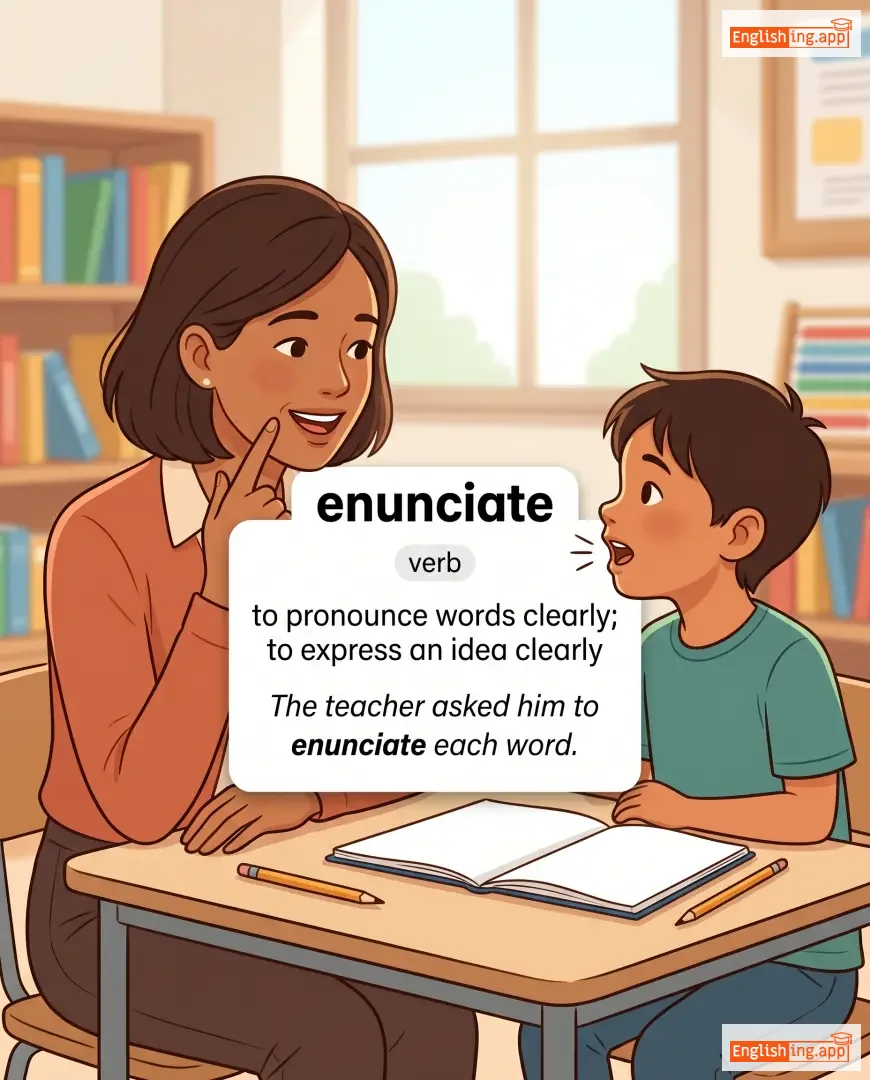
enunciate definition card — visual illustration of the meaning
verb
/ɪˈnʌnsieɪt/
énoncer (énoncer)

to pronounce words clearly; to express an idea clearly

"The teacher asked him to enunciate each word."

"L'enseignant lui a demandé d'énoncer chaque mot." (L'enseignant lui a demandé d'énoncer chaque mot.)
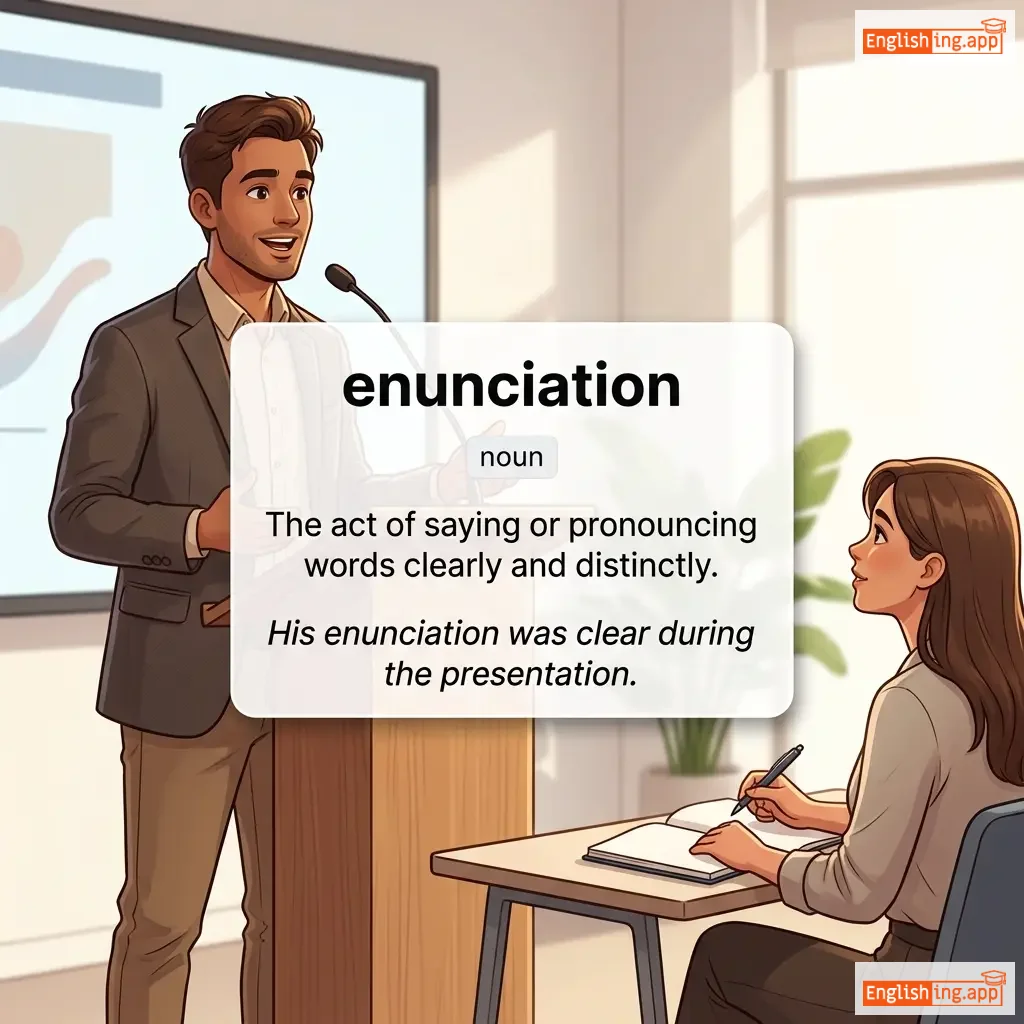
enunciation definition card — visual illustration of the meaning
noun
/ɪˌnʌn.siˈeɪ.ʃən/
énonciation, prononciation claire (enonsiasyon, prononsiasyon claire)

The act of saying or pronouncing words clearly and distinctly.

"His enunciation was clear during the presentation."

"Son énonciation était claire pendant la présentation." (Son enonciation etait claire pendant la presentation.)
noun
/ˈɛnvəloʊp/
enveloppe (enveloppe)

a flat paper container used to enclose a letter or document

"She sealed the letter in an envelope and posted it."

"Elle a scellé la lettre dans une enveloppe et l'a envoyée." (Elle a scellé la lettre dans une enveloppe et l'a envoyée.)
adjective
/ˈen.vi.ə.bəl/
envieux (envieux)

causing envy; desirable

"Her success was enviable among her peers."

"Son succès était enviable parmi ses collègues." (Son succes etait enviable parmi ses collegues.)
adjective
/ˈen.vi.əs/
envieux/envieuse; jaloux/jalouse (envieux/envieuse; jaloux/jalouse)

feeling or showing envy; jealous

"She felt envious of her friend's new car."

"Elle se sentait envieuse de la nouvelle voiture de son amie." (Elle se sentait envieuse de la nouvelle voiture de son amie.)
verb
/ɪnˈvaɪərən/
entourer (entourer)

to surround or enclose; to encircle

"Mountains environ the small valley."

"Les montagnes entourent la petite vallée." (Les montagnes entourent la petite vallée.)
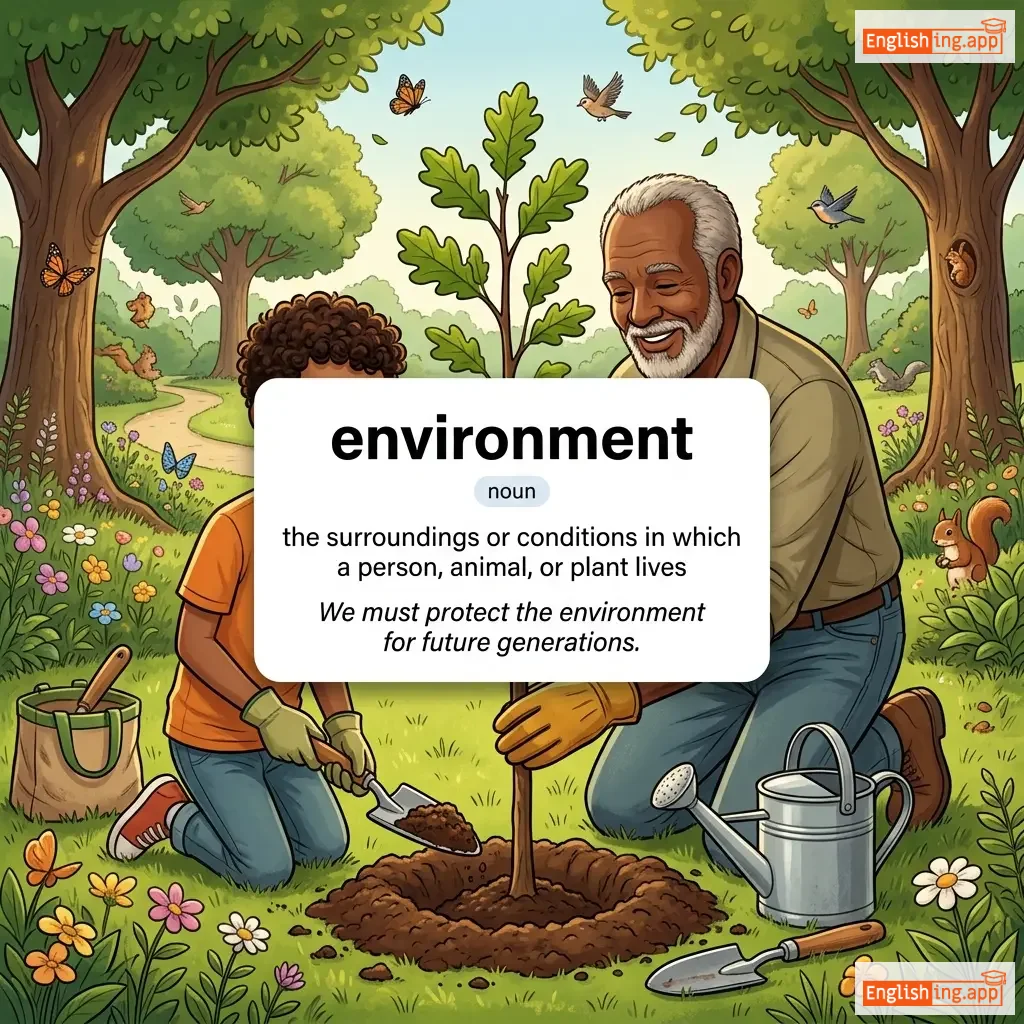
environment definition card — visual illustration of the meaning
noun
/ɪnˈvaɪrənmənt/
environnement (environnement)

the surroundings or conditions in which a person, animal, or plant lives

"We must protect the environment for future generations."

"Nous devons protéger l'environnement pour les générations futures." (Nous devons protéger l'environnement pour les générations futures.)
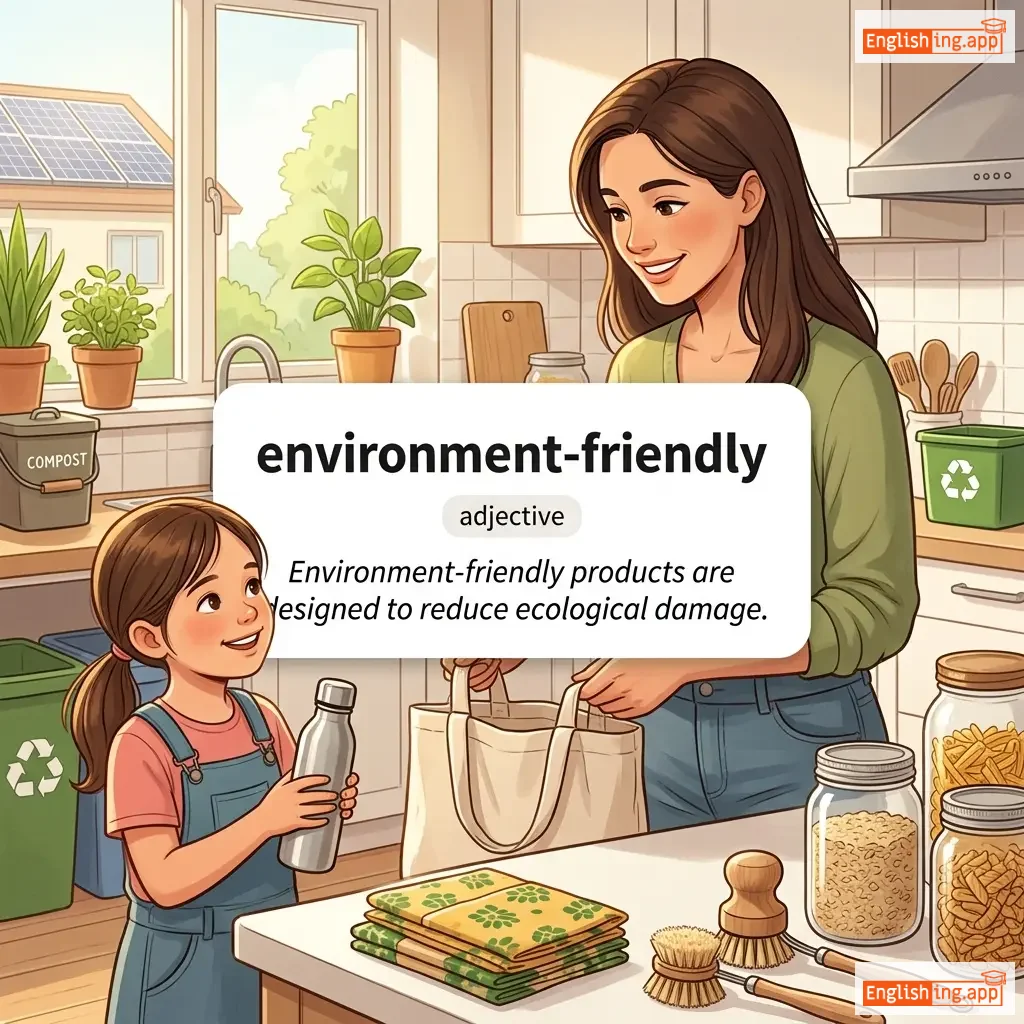
environment-friendly definition card — visual illustration of the meaning
adjective
/ɪnˈvaɪrənmənt ˈfrɛndli/
écologique (ecologique)

Designed or produced in a way that causes minimal harm to the environment, often using sustainable materials and processes that reduce ecological impact.

"Environment-friendly products are designed to reduce ecological damage."

"Les produits écologiques sont conçus pour réduire les dommages écologiques." (Les produits écologiques sont conçus pour réduire les dommages écologiques.)
adjective
/ɪnˌvaɪrənˈmɛntl/
environnemental (environnemental)

relating to the natural world and the impact of human activity on its condition

"The company adopted new policies to reduce environmental damage."

"L'entreprise a adopté de nouvelles politiques pour réduire les dommages environnementaux." (L'entreprise a adopté de nouvelles politiques pour réduire les dommages environnementaux.)